Bangkok moves fast. The traffic, the towers, the tuk-tuk energy that never really switches off.
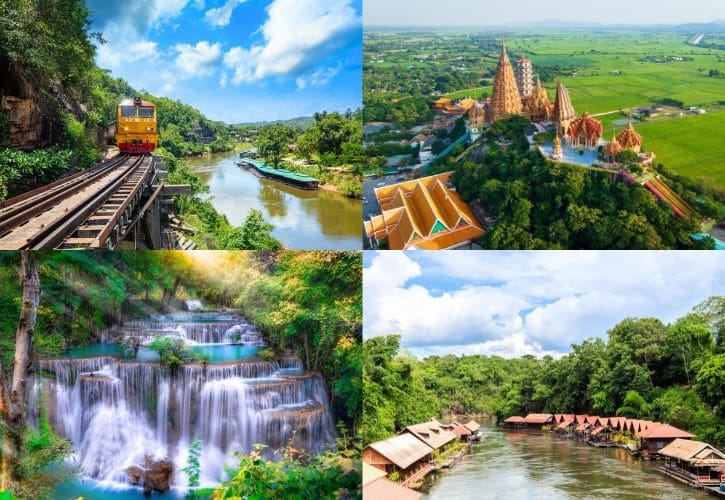
But head west, and the rhythm changes completely. Historic railway bridges span quiet waterways. Jungle waterfalls spill into emerald pools. Temples sit high above rice fields like watchtowers over the countryside.
Along the River Kwai, Kanchanaburi feels like a different Thailand, one that’s calmer, greener, and unexpectedly moving.
It’s one of the most surprising and rewarding day trips you can take from the capital. Come discover the places that make it unforgettable. 😊
1. Where Kanchanaburi Is Located
Kanchanaburi Province sits about 120 to 130 kilometers west of Bangkok. By road, the drive takes roughly 1.5 to 2.5 hours, depending on traffic leaving the capital.
It’s Thailand’s third-largest province, covering nearly 19,500 square kilometers of mountains, rivers, and dense forest.
The Kwai Yai and Kwai Noi rivers flow through the region and merge near the provincial capital to form the Mae Klong River.
To the west, rugged mountain ranges create a natural border with Myanmar. That remote, jungle-heavy geography is exactly what gives Kanchanaburi its wild, untouched feel.
2. Why Kanchanaburi Is One of the Best Day Trips From Bangkok
Kanchanaburi works so well as a day trip because it feels like a completely different world from Bangkok, and it’s only a short drive away.
Instead of skyscrapers and neon lights, you get:
- River views and green rice fields stretching to the horizon
- Temples perched on hilltops with panoramic views
- Emerald-green waterfall pools perfect for swimming
- Sobering WWII history that gives the trip real depth
- Ethical wildlife sanctuaries where elephants are treated with care
The mix is what makes it special. You can reflect at a war cemetery in the morning, swim in a jungle waterfall in the afternoon, and end the day at a riverside cafe overlooking ancient Khmer ruins.
Few places in Thailand pack that much variety into a single trip.
3. The History Behind the Bridge on the River Kwai
You can’t visit Kanchanaburi without understanding the history that put it on the map.
During World War II, the Japanese military needed a land route to supply their forces in Burma.
Sea routes were too dangerous because of Allied submarines. The solution was a 415-kilometer railway linking Ban Pong in Thailand to Thanbyuzayat in Burma.
Engineers estimated the project would take five to six years under normal conditions. The Japanese military demanded it be finished in 12 to 16 months.
To meet that deadline, more than 60,000 Allied prisoners of war and an estimated 200,000 to 250,000 Asian forced laborers were put to work in brutal conditions.
The jungle heat was extreme. Food and medical supplies were almost nonexistent. Diseases like cholera, malaria, and beriberi spread fast.
The human cost was staggering:
- Allied POW deaths: an estimated 12,000 to 13,000
- Asian forced laborer deaths: an estimated 80,000 to 100,000
The railway required more than 600 bridges, many cut through solid limestone.
Bridge number 277, which crossed what was then called the Mae Klong River, became the most famous.
It’s the one known worldwide thanks to the 1957 film The Bridge on the River Kwai.
Allied bombing raids damaged the bridge in 1944 and 1945. It was later repaired and still operates today as both a functioning railway crossing and a historical landmark.
4. Top Things to See and Do in Kanchanaburi
a. Wat Tham Suea (Tiger Cave Temple)
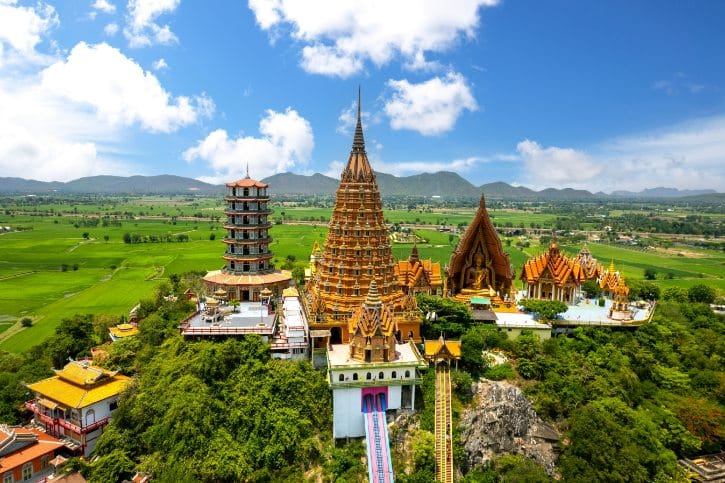
About 20 kilometers from the city center, Wat Tham Suea is a hilltop temple with some of the best views in the province.
The star attraction is the Chin Prathanporn Buddha, a massive golden statue standing 18 meters tall and 10 meters wide, housed inside a gold-tiled pavilion.
The complex also includes the Ketkaew Prasat Chedi, a nine-story octagonal pagoda reaching 75 meters in height.
You can climb the spiral staircase to the top floor, which holds sacred Buddha relics brought from India.
From the summit, you get a full 360-degree view of the Mae Klong River and the surrounding rice paddies. It’s one of those views that makes you stop and stare.
You can reach the hilltop by climbing 157 steps or by taking a small cable car for a small fee.
b. MEENA Café
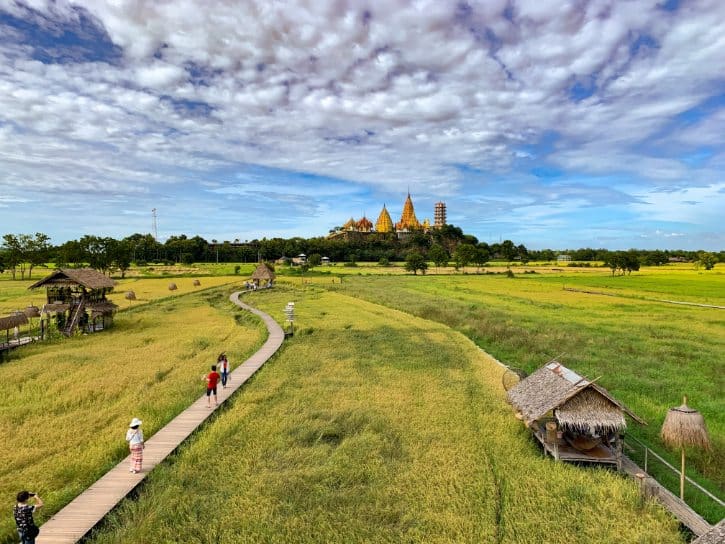
Right behind Wat Tham Suea, MEENA Cafe has become one of the most popular photo spots in Kanchanaburi.
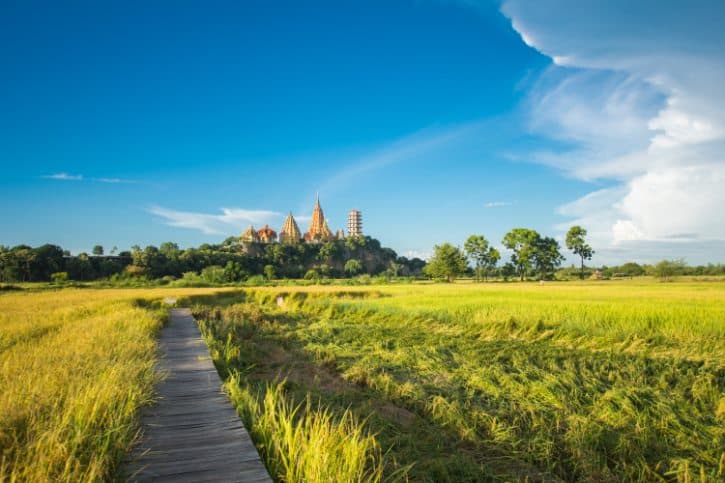
The cafe features elevated wooden walkways that stretch out into the surrounding rice fields.
From the walkway, you get a stunning view of the Tiger Cave Temple’s golden spires rising above bright green crops.
The best time to visit is during the peak growing season between June and October, when the rice fields are at their greenest. If you enjoy photography with your coffee, this one’s for you.
c. River Kwai Bridge
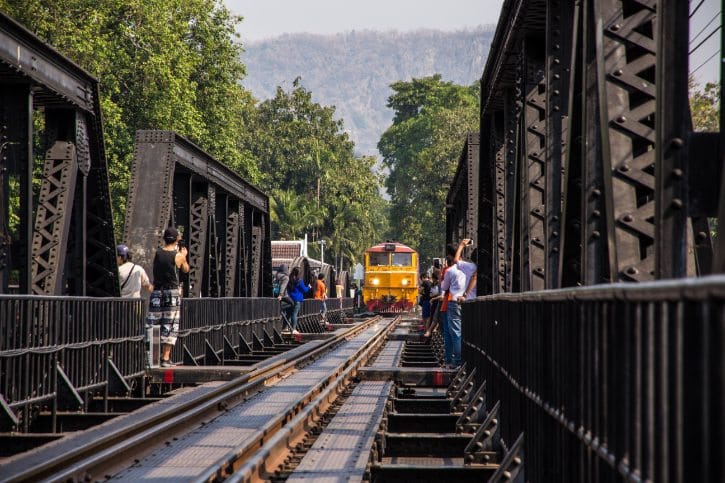
This is the emotional center of Kanchanaburi.
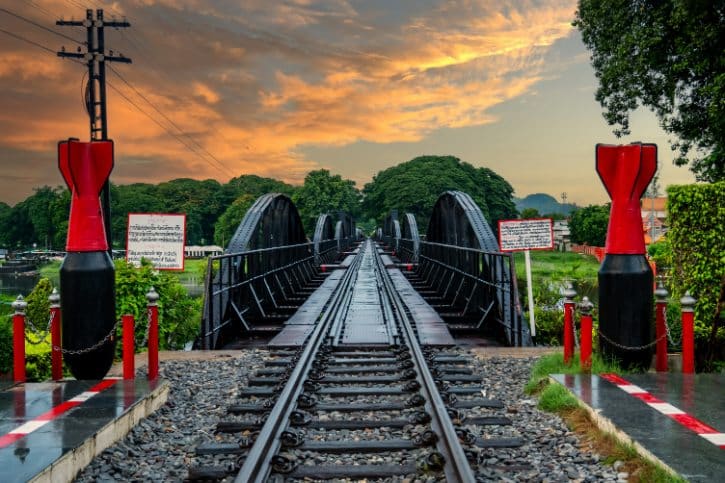
The Bridge on the River Kwai is still a working railway bridge, with the State Railway of Thailand running three daily passenger trains across it.
Between train crossings, you can walk across the bridge on iron planks and take in the river views.
Nearby, you’ll find the JEATH War Museum and the Kanchanaburi War Cemetery, where 6,982 Allied POWs are buried. It’s a quiet, well-maintained space that brings the history into sharp, personal focus.
d. Wat Tham Phu Wa
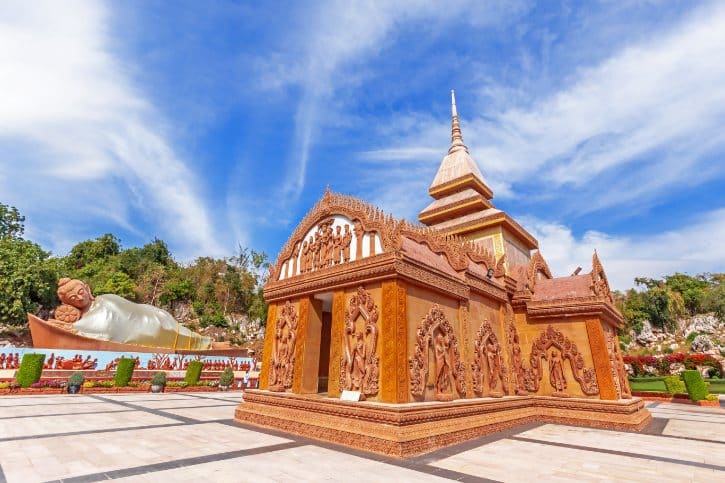
Located about 10 to 20 kilometers from the city center, Wat Tham Phu Wa feels completely different from the hilltop temples.
The entrance features a massive sandstone facade inspired by ancient Khmer and Lopburi architecture.
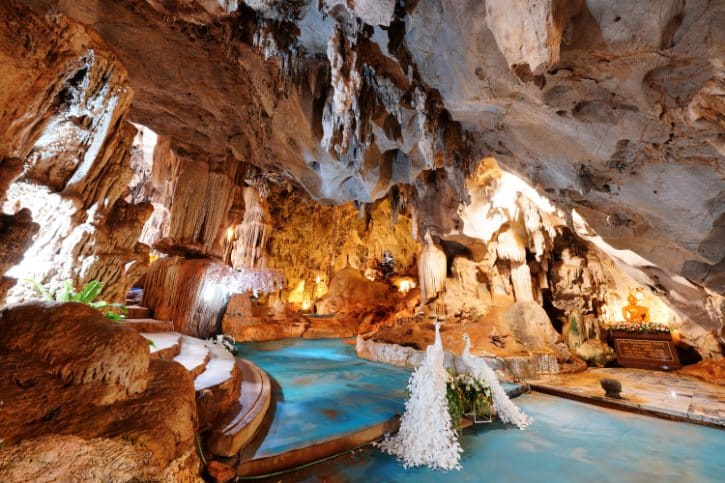
Behind it, a sprawling limestone cave has been transformed into a spiritual sanctuary and meditation space.
Inside, the chambers are naturally cool and filled with Buddha shrines, stalactites, and stalagmites.
The lower level contains statues representing the Chinese astrological signs. It’s peaceful, a bit mystical, and far quieter than the bigger tourist sites.
e. Mueang Sing Historical Park
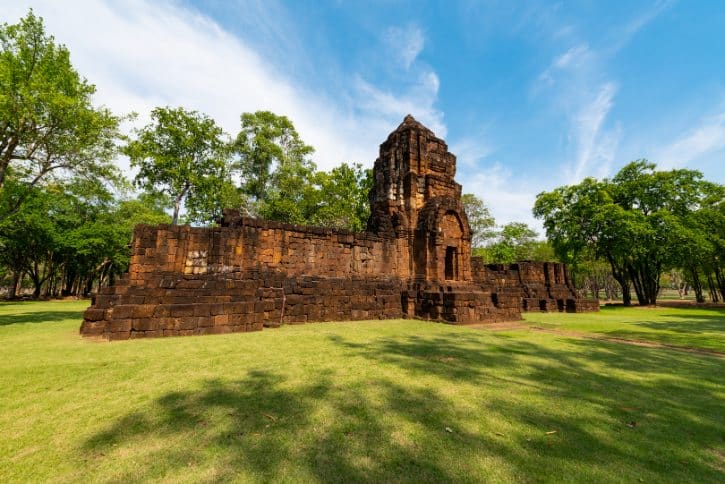
If you’re interested in ancient history, this one is worth the detour.
Prasat Mueang Sing (meaning “The Lion’s City”) was the westernmost outpost of the Khmer Empire.
Built in the 13th century during the reign of King Jayavarman VII, it served as both a military garrison and a Mahayana Buddhist religious center.
The park is enclosed by a laterite wall and moat, covering 640 to 700 rai of land.
The main monument features a central tower built from volcanic rock and laterite in the Bayon style.
Excavations have uncovered statues of Avalokitesvara Bodhisattva and the goddess Prajnaparamita, now displayed in the on-site museum.
Its location on a bend of the Kwai Noi River makes the setting even more impressive.
f. Mallika City R.E. 124
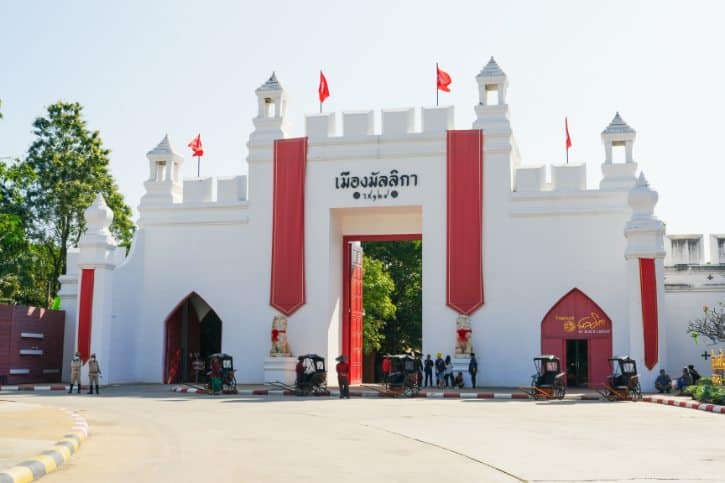
Mallika City is a living museum that recreates a Siamese village from the year 1905 A.D.
That year is historically significant because it marked the formal abolition of slavery in Thailand under King Rama V.
Here’s what makes it fun:
- Currency: You exchange modern Baht for ancient copper coins (Pod Duang) to use inside
- Dress code: You can rent traditional Thai clothing like sarongs and sabai
- Food: Vendors sell rare Thai desserts and traditional street food
- Language: Staff use old-fashioned Thai phrases to stay in character
It’s part history lesson, part immersive experience. A great spot if you want something completely different.
g. Elephants World
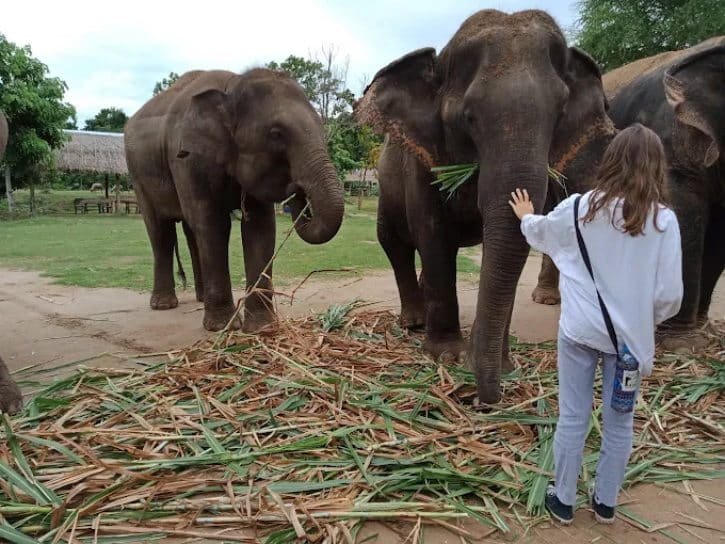
Founded in 2008 by a local veterinarian, Elephants World is a non-profit sanctuary that cares for elderly, abused, and disabled elephants rescued from the logging and trekking industries.
The philosophy here is simple: visitors work for the elephants, not the other way around.
During a day visit, you help gather and prepare food like Napier grass, sugarcane, and sticky rice balls for older elephants who have trouble chewing.
The highlight is the afternoon river bath, where you help scrub the elephants in the River Kwai.
There’s no riding and no circus-style tricks. Just a genuine, hands-on experience with rescued animals in a peaceful jungle setting.
h. Safari Park Kanchanaburi
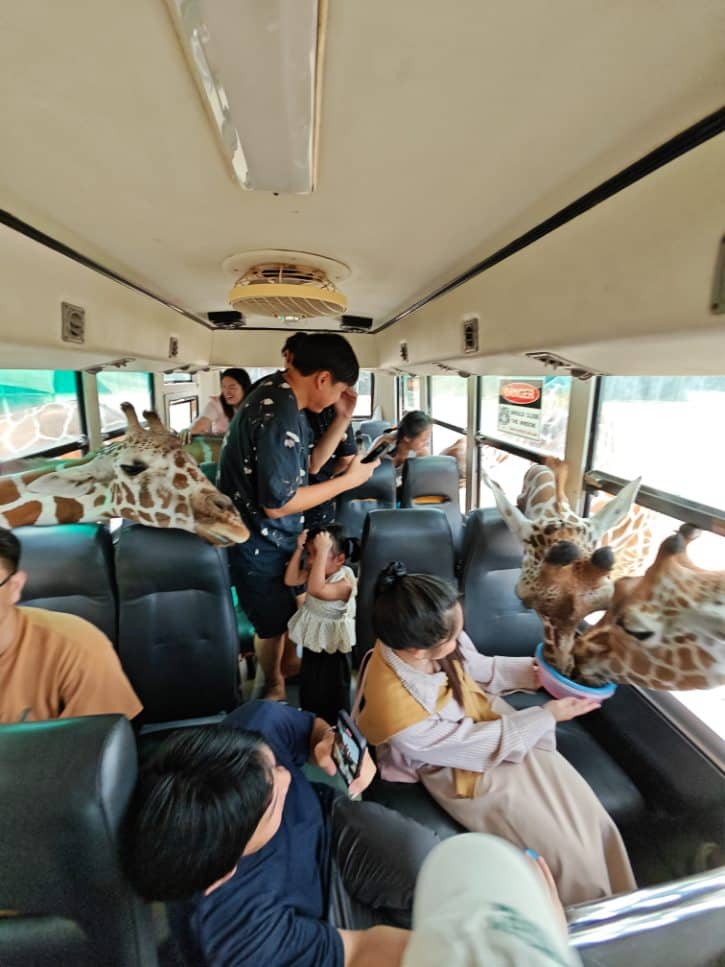
The Safari Park Open Zoo in Bo Phloi District offers a different kind of wildlife experience.
You ride through the park in a mini-bus, passing through open zones with giraffes, zebras, camels, lions, and tigers.
The standout is the Giraffe Encounter, a jeep tour where the giraffes lean right into the vehicle to be fed.
It makes for incredible photos and a memorable experience, especially if you’re traveling with kids.
i. Tham Krasae Death Railway Bridge
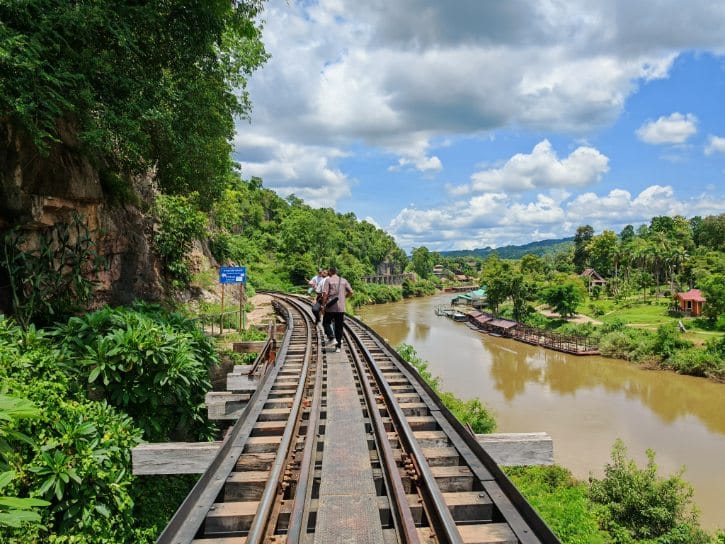
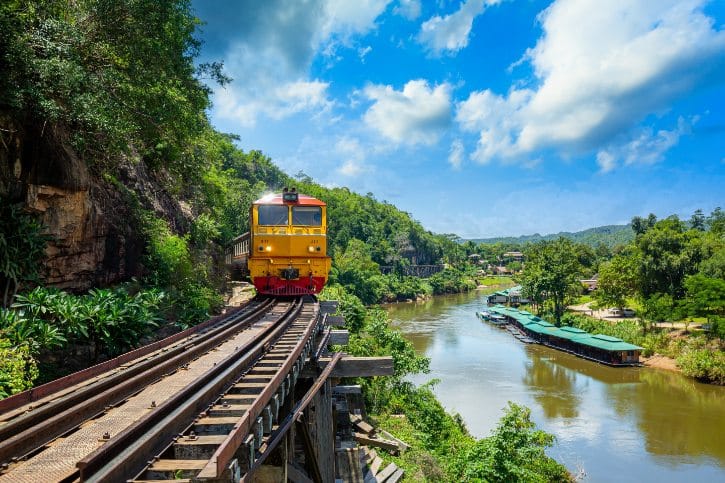
This is widely considered the most scenic stretch of the Death Railway.
A wooden trestle bridge clings to a steep limestone cliff face high above the River Kwai.
It’s a dramatic piece of engineering, and walking along the tracks between train times gives you a real sense of how dangerous the original construction was.
Nearby, the Krasae Cave served as a wartime shelter and hospital for POWs. Today, it houses a revered Buddha statue and is open for visitors to explore.
j. Erawan National Park (Erawan Falls)
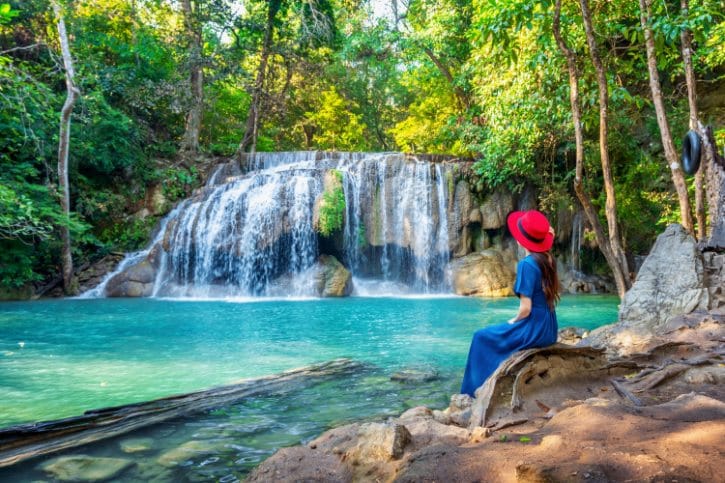
This is the waterfall you’ve probably seen in photos of Thailand. And it’s even better in person.
Erawan Falls is a seven-tiered cascade of bright emerald-green pools, named after the three-headed white elephant of Hindu mythology. The seventh tier’s limestone formation is said to resemble the mythical creature.
Here’s what to expect on the trail:
- Tiers 1 to 3 are easy to reach and great for families, with picnic areas and swimming spots
- Tier 4 (Oke Nange Peesau) has smooth rock slopes that work as natural water slides
- Tier 7 (Phu Pha Erawan) is the summit, with white rocks shaped like elephant heads. The climb gets steep and rugged
The trail is about 1.5 kilometers from the visitor center. To protect the environment, the park charges a 20 Baht refundable deposit on any plastic bottle you take past the second tier.
k. Sai Yok National Park
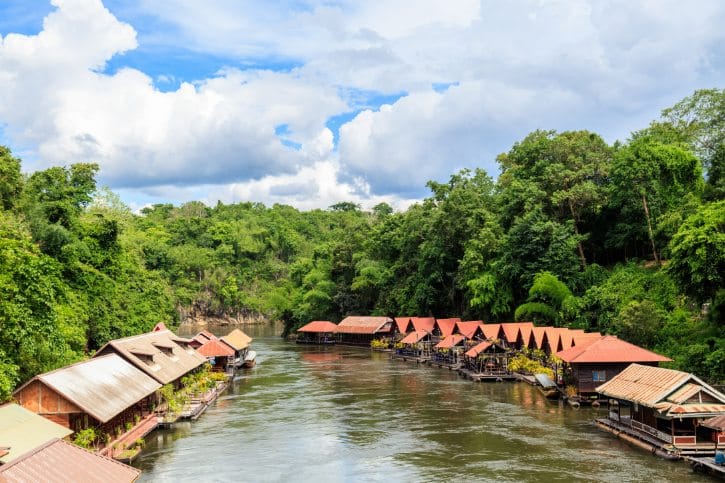
Covering 958 square kilometers, Sai Yok National Park is known for its teak forests, riverside cliffs, and the Sai Yok Yai Waterfall, which drops directly into the Kwai Noi River.
The park is also home to Kitti’s hog-nosed bat, the world’s smallest mammal, weighing just 2 grams.
Many visitors explore the park by long-tail boat, passing towering cliffs along the shoreline.
You can also walk trails that reveal remnants of the Death Railway, including abandoned bridge foundations and wartime artifacts.
l. Huay Mae Khamin Waterfall
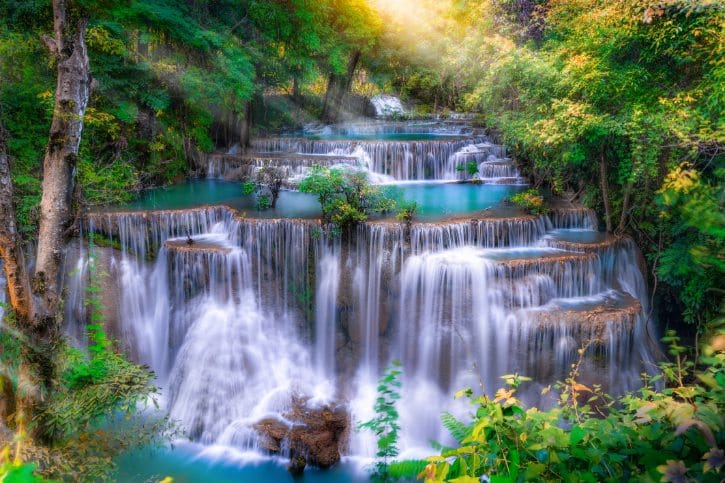
If Erawan is the most famous waterfall in Kanchanaburi, Huay Mae Khamin is the local favorite.
Located in Srinakarin Dam National Park, this seven-tier waterfall stayed under the radar for years because it was only reachable by 4×4 or car ferry.
That limited access means it’s significantly quieter and more pristine than Erawan.
The highlight is the fourth tier, Chatkaew, with its wide, staircase-like limestone curtains.
The water flows from the Kala mountain range through lush forest, and the limestone composition keeps the pools naturally non-slippery.
If you want a waterfall experience without the crowds, this is it.
5. How to Get From Bangkok to Kanchanaburi
The most practical way to visit Kanchanaburi as a day trip is by private car with a driver or on an organized group tour.
Both options save you from navigating local bus schedules and give you air-conditioned comfort for the roughly 2.5-hour drive.
A few popular options to look into:
- Kanchanaburi Multiple Routes Private Tour
- Kanchanaburi Highlights Day Tour by AK Travel
- Kanchanaburi Safari Park and River Kwai Bridge Day Tour
- Bangkok Car Rental with Driver by TTD Global
6. Final Thoughts: Why Kanchanaburi Surprises So Many Travelers
Kanchanaburi has a way of catching people off guard. Most visitors come expecting one thing, maybe the bridge or a waterfall, and leave feeling like they’ve discovered an entirely different side of Thailand.
It’s the combination that does it. WWII history that’s deeply moving. Temples with views that stop you in your tracks. Waterfalls so green they almost look unreal. Ethical wildlife encounters that leave a lasting impression.
And all of it sits just a couple of hours from Bangkok.
Whether you have one day or several, Kanchanaburi is one of those places that rewards you for stepping outside the usual tourist trail. Trust me, it’s worth the trip.