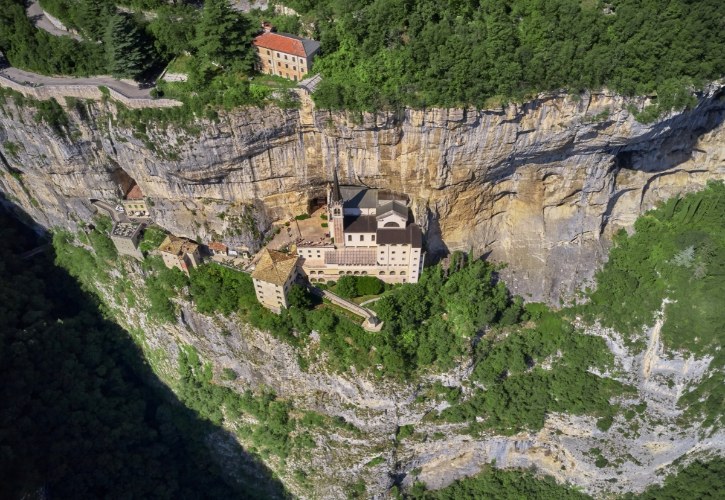
Picture yourself on a mountain path in northern Italy when a church suddenly appears, wedged into a sheer limestone cliff as if it grew straight out of the rock.
This is Madonna della Corona, resting 774 metres above sea level with the valley falling away far below your feet.
Its roots run back nearly 1,000 years, through hermits, warrior monks, and a legend about a statue carried by angels. You will not forget your first glimpse of it, and you will want to know its secrets. 😊
1. A Church That Looks Like It Grew Out of the Mountain
a. The First Sight That Stops You in Your Tracks
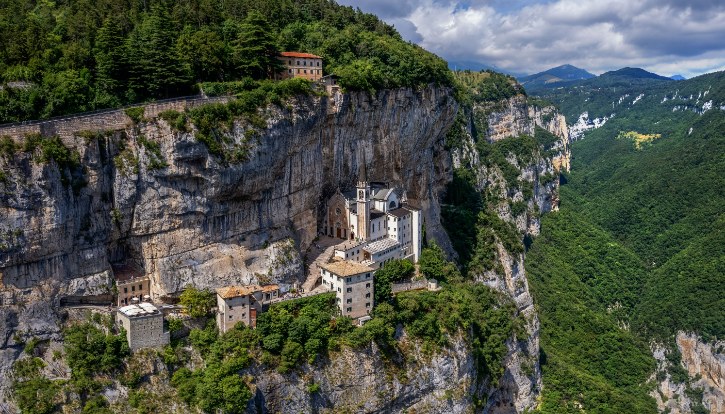
When you round the path and finally see it, Madonna della Corona looks almost impossible. The church sits half-built against the cliff and half-carved into the living rock, seeming to hang in the open air.
- It clings to a narrow limestone ledge on the eastern wall of Monte Baldo
- Part of the building rests in open air, and part is buried in the mountain’s stone
- Sheer rock rises behind it while a deep valley opens in front
- Few churches anywhere in Italy sit in a setting this dramatic
b. Where in Italy You Will Find It
You will find the sanctuary in the northeastern Veneto region, in the Province of Verona, within the village district of Ferrara di Monte Baldo. The small plateau village of Spiazzi is your gateway.
- Verona lies roughly 45 kilometres to the southeast
- Lake Garda, with Garda, Torri del Benaco, and Bardolino, sits about 20 kilometres southwest across Monte Baldo
- Directly below runs the Val d’Adige, the valley the Adige River carved, which forms the age-old corridor linking northern Italy to the Brenner Pass
- Spiazzi, the village above the cliff, is where your visit begins
c. What the Famous “774 Metres” Really Means
That number can mislead you, so it helps to get it straight before you go.
- 774 metres is the sanctuary’s height above sea level, not the height of the cliff
- Below the building, the rock face drops in a sheer plunge of nearly 400 metres
- The church was set into a recessed alcove carved in the vertical stone
- The result leaves it half-suspended in air and half-locked into the mountain
d. The Natural Stone Amphitheatre That Wraps Around You
Part of the magic is the great bowl of rock that surrounds you on three sides.
- The cliffs belong to Monte Cimo, an eastern arm of the Monte Baldo chain
- Monte Baldo earned the nickname “Garden of Europe” for its rich and varied plant life
- Bare limestone walls enclose the sanctuary and hush the noise of the valley
- That semicircle of rock, curving like a crown, is where the place got its name
2. Nearly a Thousand Years of Faith on a Narrow Ledge
a. The Hermits Who Quietly Started It All
The story begins not with builders but with people seeking silence and solitude on the mountain.
- Around the year 1000, hermits linked to the Abbey of San Zeno in Verona settled in these rock caves
- A charter from 1278 gives the first written proof of a chapel called Santa Maria della Corona
- Through the 1200s and 1300s, a small monastic community lived on the cliff
- Early worship happened in natural grottos reached only by a dangerous cut path
b. The Warrior Monks Who Built the First Bridges
In the 15th century, the lonely hermitage gained some powerful new guardians.
- Between 1434 and 1437, the Knights Hospitaller, the Knights of Saint John, took ownership
- In 1458 they replaced risky rope descents with the first timber bridge across the chasm
- Between 1490 and 1521 they raised the first real stone church on the ledge
- They cared for the sanctuary for nearly four centuries, until Napoleon’s decrees ended their rule in 1806
c. From Tiny Chapel to Grand Basilica
As more and more pilgrims arrived, the sanctuary kept growing to welcome them.
- A larger church was begun in 1625 and finished in 1685, built over the older chapel rather than replacing it
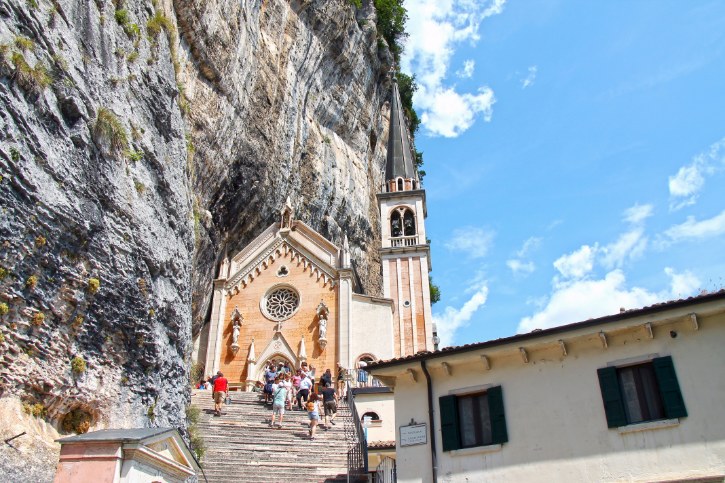
- Between 1898 and 1899, architects added the ornate neo-Gothic marble facade you admire today
- Between 1921 and 1922, the 33-metre bell tower was rebuilt and a rock tunnel was cut for safer access
- In 1982, Pope John Paul II raised the church to Minor Basilica rank
d. The Modern Rebuild You Actually Walk Through
Here is the honest truth many visitors miss. The devotion is ancient, but the building you enter is largely modern.
- By the 1970s the old masonry was cracking and seeping water was damaging the interior
- Architect Guido Tisato led a full reconstruction from 1975 to 1978
- His team preserved the marble facade, the bell tower, and the original rock cavities
- They rebuilt the church on a steel and concrete frame anchored into the bedrock, nearly tripling the floor space
3. The Legend of the Flying Statue and the Name “Corona”
a. The Night the Cliffs Began to Glow
The sanctuary’s best-loved story is pure drama, and locals have passed it down for centuries.
- Tradition says that one night in 1522, villagers saw a light on the cliffs and heard singing echo off the rock
- Peering over the precipice, they spotted a carved Pietà resting on a narrow ledge above the drop
- Young men were lowered on thick hemp ropes to recover it
- A grander version claims angels carried the statue across the sea from Rhodes to save it from an Ottoman siege
b. What the History Books Actually Say
It is a wonderful tale, and it is worth holding gently against the documented facts.
- People worshipped here for over five centuries before the legendary date
- The statue carries a carved inscription dating it to 1432, long before the story claims
- It is made of local Veronese stone, not marble from the distant Aegean
- The siege of Rhodes actually ended months after the supposed miracle on the mountain
c. Why the Place Is Called a “Crown”
You might assume “Corona” points to a crown on the Virgin’s head, but the real reason lies in the land itself.
- The Italian word Corona simply means “crown”
- Old charters used the name because the cliff curves around the site in a wide semicircle, a crown of mountains
- Over time it also came to suggest Mary’s coronation as Queen of Heaven
- It echoes the Crown of Thorns of Christ’s Passion too, a theme repeated in the altar’s bronze sculptures
d. The Sacred Spring and the Tales Pilgrims Still Share
Smaller legends cling to the approach paths as well, and they add to the atmosphere.
- The Fonte dell’Indipendenza, the Spring of Independence, was believed to hold healing and protective powers
- Pilgrims paused there to wash and pray before the steep descent
- Folklore tells of travellers falling from the cliffs, only to be caught by branches after praying to the Madonna
- These rescues live on in the sanctuary’s large collection of heartfelt thank-you offerings
4. How They Built a Church Into a Vertical Cliff
a. A Building Held Up by the Mountain Itself
The true wonder here is that the mountain is not just the backdrop. It is part of the structure.
- The entire northern wall and the apse are made of raw, unplastered limestone bedrock
- Early builders chiselled sockets into the cliff to anchor their arches and vaults
- Modern engineers drilled deep holes and grouted in high-tensile steel rods and cables
- Concrete columns pinned into the rock support the wall that overhangs the 400-metre drop
b. Two Hidden Worlds Inside One Sanctuary
As you explore, you move between two very different levels of the building.
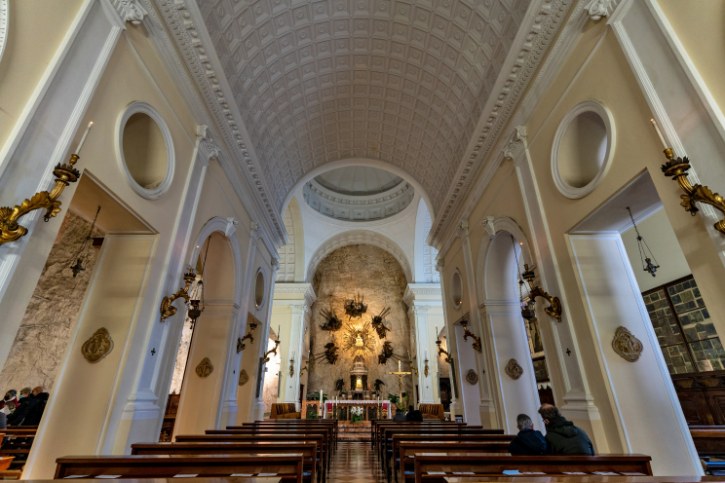
- The upper basilica holds the main hall and the high altar set against bare rock, lit by tall stained-glass windows
- The lower crypt preserves the stone footprints of the oldest chapels
- Down there you can find the Chapel of Confessions and a rock-cut Holy Staircase
- One stone chamber even holds glass-fronted niches with the remains of medieval hermits
c. The Marble Face That Glows Against Grey Stone
From a distance, two features make the sanctuary shine against the dark cliff.
- The neo-Gothic facade uses white and rose marble, with pointed arches and delicate tracery
- Deep niches along it hold carved marble statues of saints
- The freestanding bell tower rises 33 metres, crowned by a slender copper spire
- Both features date from the late 1800s and early 1900s, not the medieval period
d. The Quiet Engineering That Keeps It Standing
Holding a church on a cliff face has taken real ingenuity across the centuries.
- Tall masonry retaining walls, some over 20 metres high, brace the foundations
- A rock tunnel cut in the early 1920s lets you pass through the mountain to the entrance
- A hidden drainage system catches water seeping through the porous limestone
- Together these works protect the building from the very mountain that holds it up
5. The Treasures Waiting for You Inside
a. The Oldest Painting on the Rock Face
In the quiet lower passages hides one of the most important things to see here.
- A 14th-century fresco of the Madonna and Child survives on the interior rock
- It once served as the altarpiece of the original medieval chapel
- Rediscovered during 20th-century restoration, it proves worship here long predates the famous legend
- You can still see it today, carefully protected under glass
b. The Sorrowful Statue at the Very Heart of It All
The spiritual centre of the basilica sits above the main altar, framed by bare rock.
- The venerated Pietà shows Mary cradling the body of Jesus across her lap
- It stands about 70 centimetres high, carved from local limestone and gently gilded
- Its pedestal bears a Latin inscription naming the nobleman Lodovico Castelbarco, who donated it in 1432
- This documented history is older and firmer than the miracle story that grew around it
c. Marble Saints and Gleaming Bronze
Two gifted artists shaped much of what you admire inside the sanctuary.
- Veronese sculptor Ugo Zannoni carved marble saints for the facade and chapels, and cast the 14 bronze Stations of the Cross
- Master caster Raffaele Bonente set the Pietà within a bronze crown of thorns ringed by rising angels
- Bonente also made the bronze altar front showing the Nativity, Crucifixion, and Pentecost
- Watch for the recurring symbols of thorns, angels, and the seven swords of Mary’s sorrows
d. The Humble Gifts of Grateful Pilgrims
One interior wall quietly tells the story of ordinary people across five centuries.
- The sanctuary holds 167 ex-voto offerings, painted tablets left in thanks for answered prayers
- They picture illnesses, farm accidents, and narrow escapes from danger
- The oldest dates to 1547 and shows a young woman saved from drowning in the Adige River
- A 1724 painting by the Baroque master Antonio Balestra sits among these treasures
6. The Secret Wooden Hoist That Kept the Church Alive
a. Why Life on This Ledge Was Such Hard Work
Before tunnels and paved roads, simply keeping this church supplied was a daily battle.
- Every stone block, timber beam, and barrel of food had to reach an isolated ledge
- Workers either hauled it up by hand or lowered it down the cliff face
- The sheer difficulty pushed early engineers toward a clever solution
- The answer was a rudimentary wooden winch that lowered loads down the cliff from above
b. How the Clever Wooden Cage Worked
The machine worked like a vertical cableway built entirely from timber and rope.
- Known as the argano di legno, it stood in a small stone building called La Gabbiola, “The Little Cage”
- It used hand-carved wooden cogwheels, a windlass drum, and heavy counterweighted ropes
- Mules carried supplies to the edge of the plateau, where workers loaded a slatted wooden freight cage
- Operators lowered the cage hundreds of feet down the rock, then reversed it to haul waste back up
c. The Astonishing Machine That Still Survives
Remarkably, this is no tall tale. The original mechanism is still right where it was built.
- The timber hoist and its stone housing remain physically intact today
- Long closed for safety, the site drew fresh attention when the rector ordered a preservation survey
- Students and surveyors used 3D laser scanners and drones to map the old machinery
- Their detailed digital models will guide a careful future restoration
d. The Cardinal Who Once Rode the Cage
One story gives the old hoist a genuinely famous passenger.
- In the late 1800s, Cardinal Giuseppe Sarto is said to have been hoisted up inside the wooden cage
- He would later become Pope Pius X
- Today the sanctuary occasionally opens La Gabbiola for guided tours
- These usually fall on major feast days, such as the Feast of the Assumption on 15 August
7. The Views and Photos You Will Want to Take Home
a. The Balcony Over a 400-Metre Drop
Step onto the terrace in front of the church and the view does all the work for you.
- You can look straight up at the 33-metre bell tower against the overhanging cliff
- From the stone parapet, the valley falls nearly 400 metres beneath your feet
- Vineyards, orchards, and the winding river spread out far below
- It is the kind of view that makes you grip the railing a little tighter
b. The Postcard Shot Everyone Comes For
To capture the whole church against the rock wall, you need to stand in the right spot.
- The classic view sits on the paved path from Spiazzi, just after you leave the rock tunnel
- From there the full basilica, its stone piers, and the bell tower appear suspended in the cliff
- It is the easiest great photo to get, with no hard hiking required
- For a dramatic low angle, shoot upward from the Lime Tree Bridge below
c. The Best Light and the Finest Seasons
Timing your visit well will completely transform your photos.
- The sanctuary faces east, so morning light is best, roughly between 8:30 and 11:30
- By early afternoon the high ridge throws the whole church into deep shade
- Autumn sets the surrounding beech and chestnut forests glowing amber and crimson
- Winter often fills the gorge with mist, leaving the church in sunlight above a sea of cloud
Pick a clear autumn or winter morning, take your time on the walk down, and Madonna della Corona will give you a day, and a set of photographs, that you will keep returning to long after you leave.