Picture Italy’s easternmost town, a salt breeze off the Adriatic, and a weathered stone church that has stood for more than 900 years. That church is Otranto Cathedral, and it guards a story you will not forget.
More than 500 years ago, a brutal siege ended with hundreds of local people choosing death over surrender, and inside, rows of their preserved skulls still honor that choice. It belongs near the top of any Puglia trip.
1. A Cathedral Unlike Any Other in Puglia
a. Where You’ll Find It
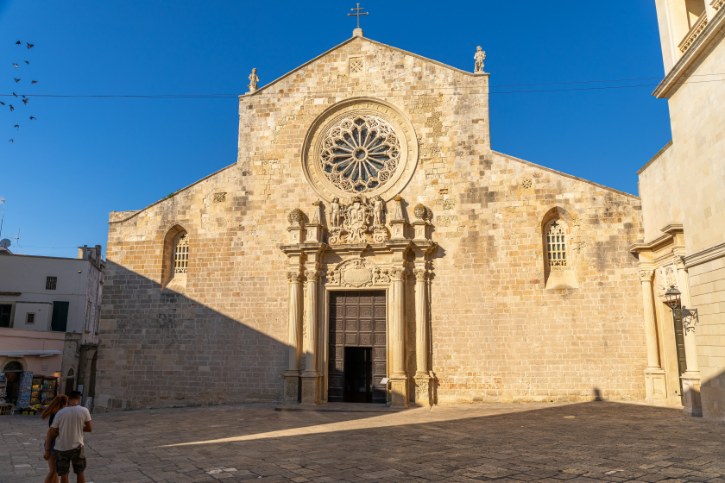
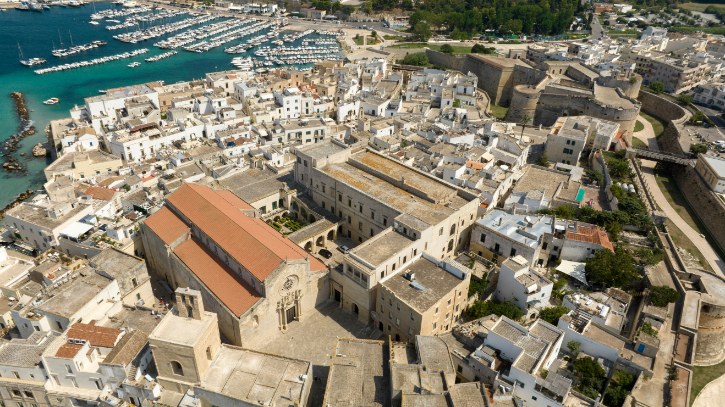
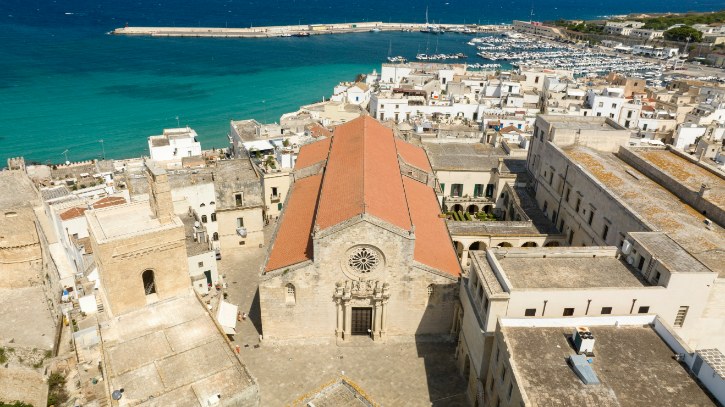
You’ll meet Otranto Cathedral at the highest point of the old town, on the Salento peninsula in the province of Lecce. Its full, formal name is the Basilica Cattedrale di Santa Maria Annunziata, and it sits just a short stroll from the Aragonese Castle and the harbor, at the easternmost edge of mainland Italy.
b. Nearly a Thousand Years of History
- Construction began around 1068, after Norman leaders Robert Guiscard and Count Roger I pushed out the Byzantine rulers.
- The church was consecrated on 1 August 1088, during the papacy of Urban II.
- It has stood for more than 930 years, making it one of Apulia’s grandest Norman buildings.
- The Normans raised it over older layers still: a Messapic settlement, a Roman complex, and an early Christian basilica from the fourth to sixth centuries.
c. Why It Stops You in Your Tracks
What sets this cathedral apart is how it blends great art with deep tragedy. Three features in particular stay with visitors:
- One of Europe’s largest and best-preserved 12th-century floor mosaics.
- An ancient underground crypt supported by dozens of columns.
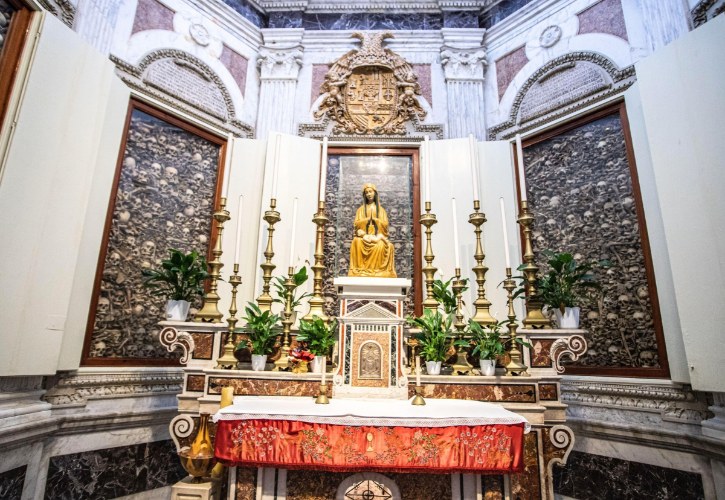
- Glass cases holding the remains of townspeople killed in the 1480 siege.
d. A Church Built for a Dangerous Coast
Because Otranto sat on a busy sea route, the cathedral worked as both a mother church and a fortified refuge. Crusader armies, Venetian sailors, and Norman knights were blessed here before sailing east, and its tower doubled as a lookout over the strait.
e. The Layers Added Over Time
- A 16-ray rose window in the late 15th century.
- A sculpted Baroque portal in 1674.
- An elaborate Moorish-style gilded ceiling in 1698.
Read More: The Best Puglia Road Trip: 15 Amazing Stops
2. The Siege That Scarred the Town
a. Why the Ottomans Came
You have to picture the wider ambitions at play. Sultan Mehmed II, the conqueror of Constantinople, wanted a foothold in Italy to challenge Naples and eventually push toward Rome. Otranto sat right across the Adriatic from his naval base at Avlona, modern Vlorë in Albania, which made it the perfect landing point.
b. The Fleet on the Horizon
- On 28 July 1480, an Ottoman armada led by commander Gedik Ahmed Pasha appeared off the coast.
- The ships anchored at an inlet still called Baia dei Turchi, the Bay of the Turks.
- Estimates put the force at 90 to 150 ships and roughly 18,000 troops, including elite Janissaries and cavalry.
c. The Days That Sealed the City’s Fate
- 28 to 29 July: Troops land and encircle the town, and residents fall back behind the walls.
- 11 to 12 August: After about fifteen days of bombardment, the walls collapse and soldiers storm the city.
- 12 August: The cathedral is breached and Archbishop Stefano Pendinelli is killed.
- 14 August: The mass execution takes place on a hill outside the walls.
d. What Happened at the Altar
As the city fell, hundreds of frightened citizens sheltered inside the cathedral with the elderly Archbishop Pendinelli. He was cut down in front of the high altar while still in his vestments. Later accounts added gruesome details, but those belong to tradition rather than firm record.
e. Thirteen Months of Occupation
- The cathedral itself was turned into a mosque.
- Horses were stabled in the side aisles.
- Altars were dismantled, religious images were defaced or plastered over, and sacred vessels were looted.
f. How the Town Was Freed
The occupation unraveled when Sultan Mehmed II died on 3 May 1481, triggering a succession struggle that cut off supplies. A Christian army led by Alfonso, Duke of Calabria, retook Otranto between 10 and 13 September 1481, and religious life slowly returned.
3. The 813 Who Would Not Give Up Their Faith
a. Ordinary Men, Extraordinary Courage
The people remembered as the Martyrs of Otranto were not soldiers. They were the town’s everyday men, aged fifteen and older, who survived the breach of the walls:
- Tailors and blacksmiths.
- Carpenters and fishermen.
- Farmers and other local tradesmen.
b. The Number Behind the Name
Early chroniclers often wrote “about 800”. Later Church investigations settled on 813 as the definitive figure, drawn from survivor testimony, town archives, and inventories taken after the city was freed. That is the number the Catholic Church recognizes today.
c. An Impossible Choice
- After taking control, Gedik Ahmed Pasha summoned the surviving men to his camp.
- Through interpreters, they were told to convert to Islam and keep their lives, property, and freedom.
- Refusal meant immediate execution.
d. The Man Who Spoke First
One voice rose above the rest. An elderly artisan named Antonio Primaldo, recorded in archives as Antonio Pezzulla, urged his neighbors to stand firm for their faith. The men agreed as one. On the morning of 14 August, the eve of the Feast of the Assumption, they were led in chains to Colle della Minerva and beheaded, with Primaldo the first to die.
e. The Stories Faith Still Holds
These accounts are cherished locally, though they come down through religious tradition rather than proven history:
- After Primaldo was beheaded, his body is said to have stayed standing until the last man was killed.
- An Ottoman executioner, traditionally named Berlabei, was so moved that he declared himself a Christian and was put to death.
f. From Victims to Saints
- Pope Francis canonized them on 12 May 2013, in the first canonization of his papacy.
- At more than 800 people, it was the largest group ever canonized on a single day.
- They are now the patron saints of Otranto, honored every year on 14 August with processions and solemn celebrations.
4. Coming Face to Face With the Remains
a. Finding the Chapel
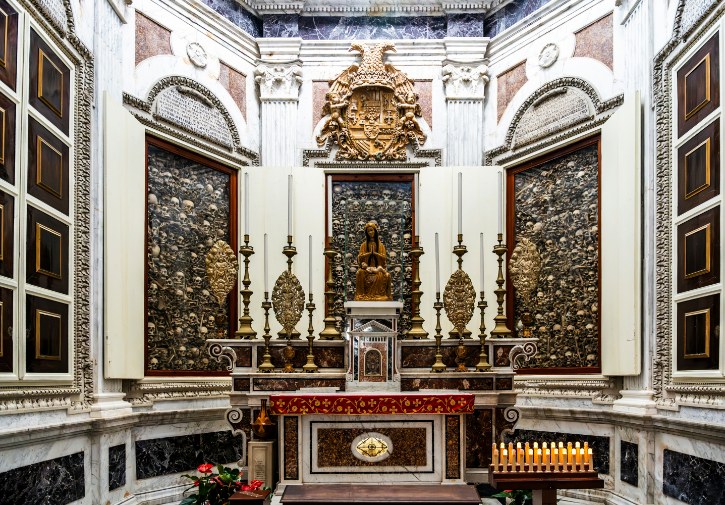
The remains rest in the Chapel of the Martyrs, or Cappella dei Martiri, tucked into the right side of the cathedral near the raised presbytery. Enter through the main doors and follow the right aisle to its far end, where the chapel sits beside the presbytery.
b. What Lies Behind the Glass
- Seven tall arched niches sealed behind floor-to-ceiling glass panels.
- Rows of skulls facing outward toward the sanctuary.
- Stacks of arm, leg, and rib bones layered below them.
- A Baroque marble altar dedicated to the Otranto saints.
c. Are They Really the Martyrs?
- Bone analysis has found weapon strikes and decapitation fractures throughout the collection, matching a late 15th-century attack.
- A University of Pisa team once studied a drilled skull and found that bone powder had been harvested from it long ago to make medicine.
- Because the bones have been mixed over the centuries, no individual skeleton can be matched to a named person, and not every bone of the 813 is here.
d. The Bones That Traveled
Not all the remains stayed in Otranto. In 1485, Duke Alfonso of Aragon moved about 240 complete sets to Naples, where they rest in the church of Santa Caterina a Formiello. Smaller relics later went to Bovino, Venice, Milan, and Rome, but Otranto keeps the main collection.
e. The Martyrdom Rock
Housed within the chapel’s altar is the Sasso del Martirio, a stone carried down from the execution hill. Tradition holds that the executioners used it as a block, though that link rests on long-standing belief rather than hard proof.
f. How to Visit With Respect
The chapel is an active place of prayer, so the mood is hushed and solemn. A few expectations keep it that way:
- No flash photography.
- Silence inside the chapel itself.
- Guides give their commentary out in the nave before you step in.
5. A Floor That Holds the Whole World
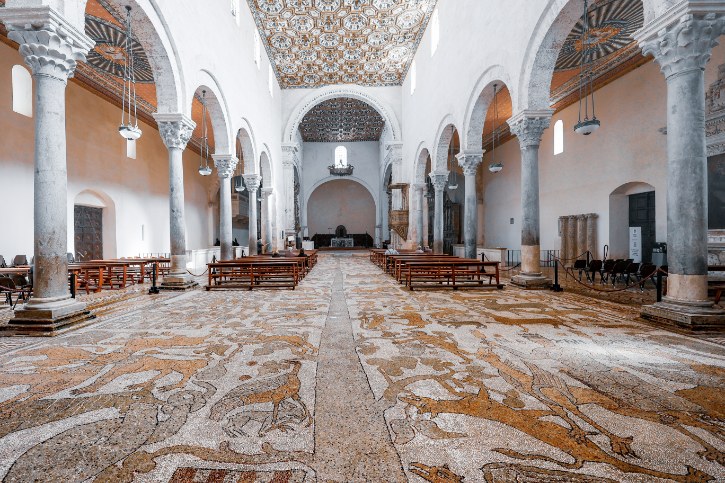
a. Eight Centuries Underfoot
Spread across the entire length of the church is one of the largest medieval mosaics anywhere. It was laid between 1163 and 1165 under Archbishop Jonathas, which makes it roughly 860 years old. Few medieval floors anywhere have survived so complete.
b. The Monk Who Dreamed It Up
A monk named Pantaleone, from the nearby monastery of San Nicola di Casole, led the team of artists who created it. Drawing on his monastery’s famous multilingual library, he wove together scripture, Greek and Roman myth, medieval legend, and folklore into one vast picture that covers the nave, aisles, transept, and presbytery.
c. Follow the Tree of Life
The design is built around a giant Tree of Life. It rises from the backs of two elephants at the entrance, and its trunk runs down the central nave toward the altar, branching out to tie together sacred history and the cycles of the year. Start at the door and trace it forward.
d. Scenes You’ll Want to Spot
- Adam and Eve, and their fall in the garden.
- Noah’s Ark and the Great Flood.
- The Tower of Babel, with workers scaling its ladders.
- Jonah and the whale, near the altar end.
- The Labors of the Months, paired with their zodiac signs.
e. The Surprising Guests
Here is where the floor gets wonderfully strange for a church:
- Alexander the Great, lifted into the sky by griffins, as a warning against pride.
- King Arthur, labeled Rex Arturus, riding what is usually described as a goat.
- Sphinxes, harpies, and the titan Atlas straining to hold up the heavens, among other mythical beasts.
f. How to See It Today
- The mosaic came through the 1480 occupation largely intact.
- A careful restoration in the late 20th century cleaned and stabilized it.
- You take it in from the edges of the nave and aisles, where the figures and their Latin labels are easy to pick out.
6. Stone, Light, and the Crypt Below
a. A Mix of Many Worlds
The cathedral is a patchwork of styles, which is why its parts can look so different from one another. You’ll see sturdy Norman Romanesque bones, Byzantine proportions, and later Baroque flourishes, all wrapped in warm local stone.
b. The Rose Window and the Doorway
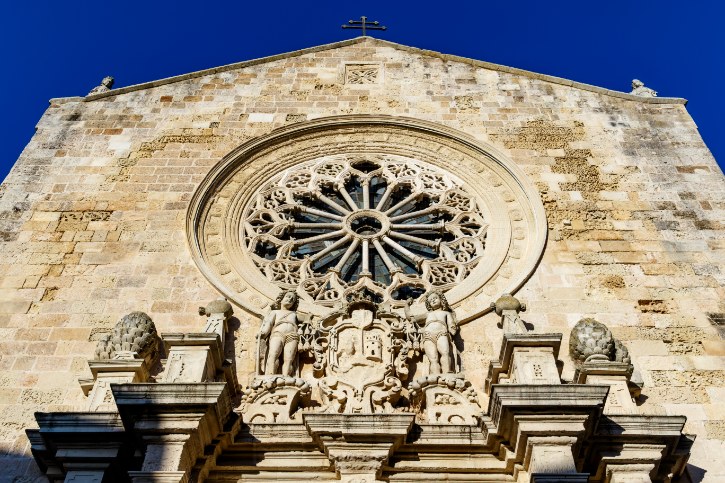
- A 16-ray rose window crowns the façade and sends afternoon light down the nave.
- A Baroque portal from 1674 frames the main door, topped by an archbishop’s carved coat of arms.
- A Renaissance side portal opens on one flank, carved with the face of Christ and figures of local abbots and prelates.
c. Look Up, Look Around
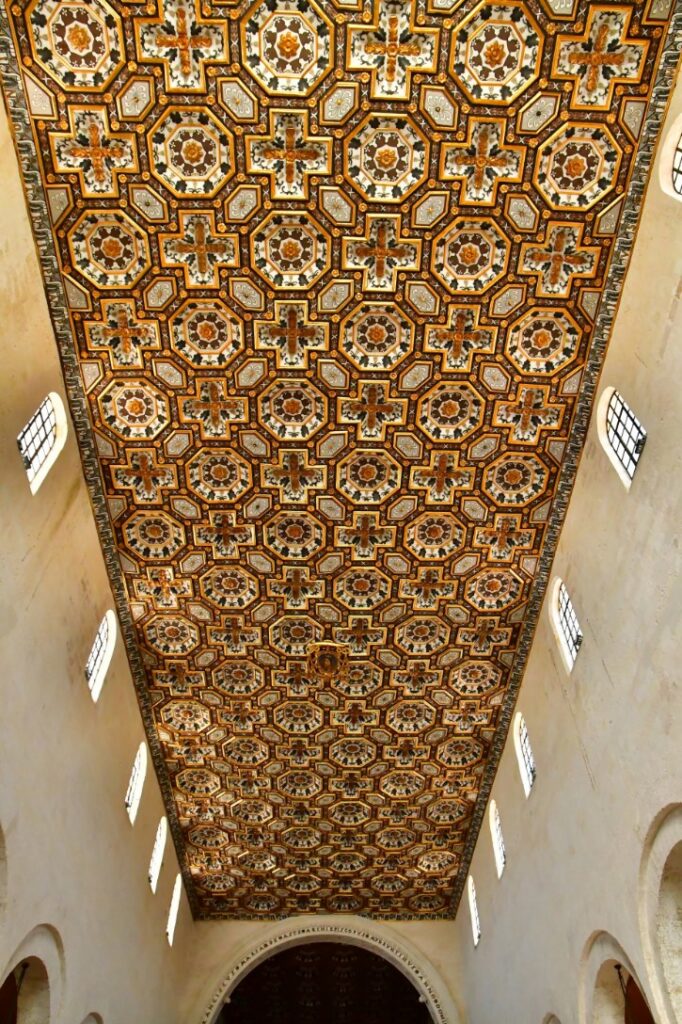
- The interior is a three-aisle basilica, its nave lined with 14 granite columns.
- They rise to Romanesque capitals, most left plain, with one richly carved.
- Overhead hangs a gilded wooden ceiling from 1698, rich with Moorish patterns.
- Look too for walnut choir stalls carved in the late 16th century and a square bell tower that once watched the sea.
d. Into the Underground Crypt
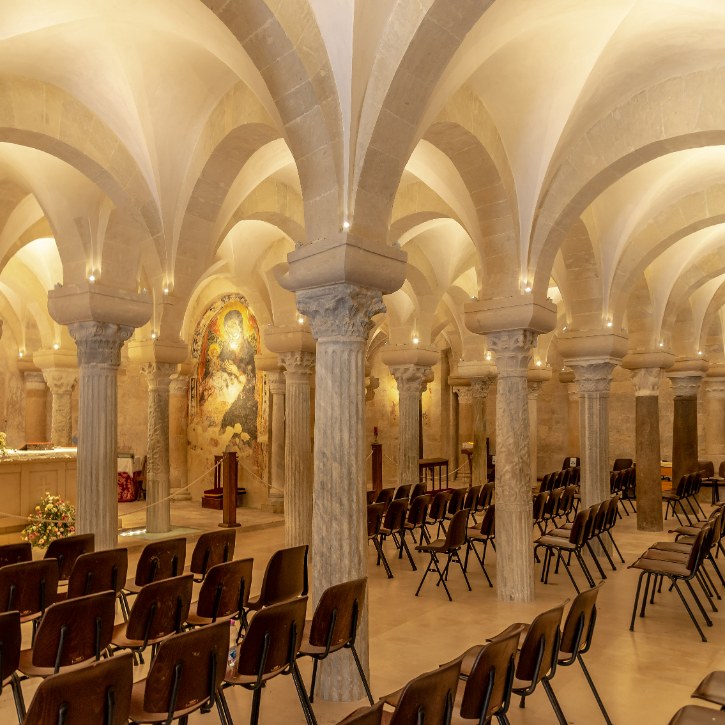
Below the main floor waits one of the oldest and most atmospheric spaces in the building. The crypt dates to the original Norman phase, consecrated around 1088, and you reach it by two stone staircases descending from the aisles.
e. A Forest of Ancient Columns
- 42 freestanding columns plus 23 half-columns line the space.
- They hold up 48 small vaulted bays, like a miniature stone forest.
- Many were reused from older Roman and Byzantine buildings, in green marble, red granite, and white stone.
- Their capitals vary wildly, some carved with eagles, rams, and lions.
f. Painted Walls and a Sacred Past
- Faded frescoes from the 13th to 15th centuries still cling to the walls, including the Virgin and Child and Saint George slaying the dragon.
- This is where the martyrs’ remains were first laid to rest before moving upstairs.
- Keep in mind the stairs down are steep and worn.
7. Knowing Before You Go
a. When the Doors Are Open
- The cathedral opens in the morning and again in the late afternoon, closing for a couple of hours in the early afternoon.
- Summer evenings run late, often until around 20:00, while winter hours are shorter.
- Tourist visits pause during Mass and other services.
b. What It Costs to Enter
If you visit on your own, entry is free under current archdiocesan rules. Organized groups joining a guided tour pay a small contribution toward upkeep, so going independently is the simplest option.
c. The Rules Inside
- Personal photos are fine, but flash is never allowed.
- Silence is expected, especially in the Chapel of the Martyrs.
- Dress modestly, with shoulders and knees covered and hats removed.
- Food, drinks, and pets stay outside.
d. Timing It Right
- Aim for early morning or late afternoon, when groups thin out.
- Late afternoon also lights up the western rose window beautifully.
- Give yourself 45 to 60 minutes to take in the mosaic, the crypt, and the chapel.
e. Getting Around Inside
The nave, aisles, and chapel sit on one level and are reachable by a low ramp. The crypt, though, is only accessible down narrow stairs, so plan around that if mobility is a concern. Restrooms and a bookshop are in the Diocesan Museum across the square.
8. How to Reach Otranto
a. Where the Cathedral Stands
You’ll find the cathedral at Piazza Basilica, deep in Otranto’s pedestrian old town. It sits close to the Aragonese Castle and the harbor, so those two landmarks make it easy to get your bearings once you’re inside the walls.
b. From Lecce by Train
- Trains are run by Ferrovie del Sud Est (FSE), departing Lecce Railway Station for Maglie in about 55 to 58 minutes.
- At Maglie, you transfer to the Maglie to Otranto train or an FSE connecting bus, roughly 25 to 30 minutes more.
- Total travel time runs about 1 hour 15 minutes to 2 hours, depending on the connection at Maglie, with fewer trains on Sundays and holidays.
c. From Lecce by Bus
- Year-round FSE buses run directly from Lecce to Otranto in about 1 hour to 1 hour 20 minutes.
- In summer, the Salento in Bus network adds more options:
- Linea 106 runs inland through Maglie.
- Linea 101 hugs the coast, stopping at San Foca and Torre dell’Orso.
d. From Brindisi
- Take the Pugliairbus shuttle (run by Cotrap) from Brindisi Airport to Lecce in about 40 minutes, or a Trenitalia train from Brindisi Centrale to Lecce in roughly 25 to 30 minutes.
- From Lecce, continue on FSE to Otranto.
- Plan on roughly 2 hours to 2 hours 30 minutes in all.
e. From Bari
- Trenitalia services (Frecciarossa, Frecciargento, Intercity, and regional trains) link Bari Centrale to Lecce in about 1 hour 20 minutes to 2 hours.
- Transfer in Lecce to an FSE train or bus for the final leg.
- Allow about 3 hours to 3 hours 30 minutes in total.
f. If You’re Driving
- Driving gives you the most freedom, especially if you want to explore the Salento coast along the way. Rough times to Otranto:
- From Lecce: about 40 minutes.
- From Brindisi: about 1 hour 10 minutes.
- From Bari: about 2 hours 15 minutes.
g. The Last Stretch on Foot
- From the Otranto FSE station, it’s a 12 to 15 minute walk to the cathedral.
- If your bus drops you near the port, it’s a shorter 5 to 6 minute climb uphill.
- The old town is car-free, so you’ll finish the journey on foot either way, winding through the historic streets to Piazza Basilica.