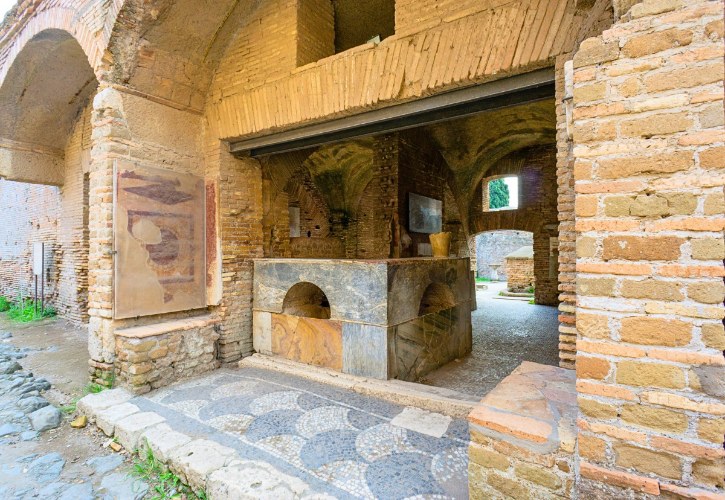
You already know the Colosseum and the Forum. But just downriver from Rome sits Ostia Antica, a whole Roman city almost nobody talks about, with real streets, apartment blocks, and corner taverns still standing.
You can walk its paved roads, step through worn doorways, and feel daily life at the height of the empire. Here is how to make the most of your visit. 😊
1. What Exactly Is Ostia Antica, and Why Is It So Extraordinary?
a. A Whole Roman City Hiding Downriver From Rome
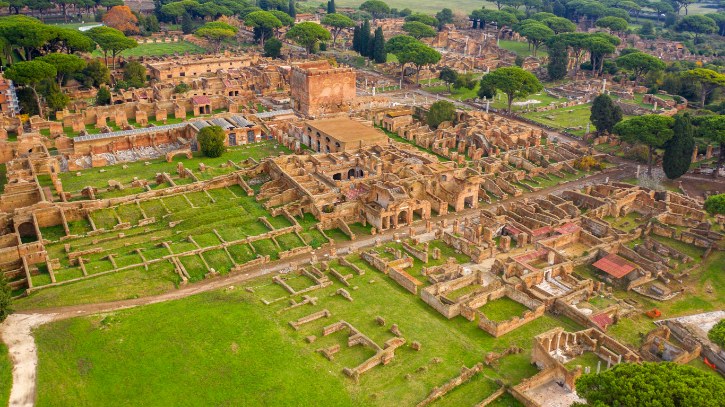
Ostia Antica is the vast remains of ancient Rome’s main port city, sitting about 25 kilometers southwest of central Rome in the lower Tiber valley. In Roman times it stood at the mouth of the Tiber, where the river met the sea, acting as the gateway through which food, goods, and people flowed into the capital.
b. Three Places, One Name, So Don’t Get Them Confused
- The Archaeological Park of Ostia Antica, the ancient ruins you came to see.
- The modern town of Ostia Antica, a small village built around a 15th-century castle, just east of the ruins.
- Lido di Ostia, Rome’s beach resort, about four kilometers further southwest on the coast.
If a friend says they “went to Ostia” and describes sand and seafood, they went to the beach, not the ancient city.
c. Why It Beats Pompeii for a Real City Feel
- The Roman Forum was quarried and rebuilt for centuries, leaving only scattered fragments.
- Pompeii is a single frozen day in 79 AD, mostly grand private homes.
- Ostia is a working commercial metropolis that grew naturally through the 2nd to 4th centuries AD.
You walk a living city here, not a stripped monument or a single preserved moment. Of its roughly 150 hectares, about 50 have been excavated, so there is plenty to explore on foot.
d. What You See, and the Flood That Moved the Sea
Most of what you look at is original Roman work: brick walls, volcanic road stones, and intact mosaic floors. The city survived because it was slowly abandoned rather than destroyed, then buried by river silt and sand. Later repairs were mostly careful conservation.
One surprise: this famous port now sits about three kilometers inland, because the river’s silt and drifting sand slowly pushed the coastline away over the centuries. Its importance is formally recognized by the European Heritage Label.
2. The Fascinating History of Ostia Antica and How It Became Rome’s Great Port City
a. The Legend of a King and a Salt Outpost
Ancient writers like Livy and Cicero credited the founding to King Ancus Marcius around 620 BC, saying he set up the outpost to guard the coast, work the salt beds, and control the river. That is the tradition, and it makes a good story.
b. What the Digging Actually Proves
- No homes or fortifications from the 7th century BC have ever been found here, so the legendary founding stays unconfirmed.
- The earliest proven feature is a military fort (castrum) from the 4th century BC.
- Its heavy tufa walls date to between 380 and 330 BC.
- The fort guarded the river mouth against naval raids and pirates.
c. How a Fort Grew Into Rome’s Food Lifeline
As Rome’s population swelled toward a million, Ostia became the critical channel for the grain supply that fed the capital. Fleets from Sicily, Sardinia, and North Africa unloaded here, along with Spanish oil, Gallic wine, marble, and timber.
Because the silty river mouth blocked big ships, emperors Claudius and Trajan built the deep-water harbor of Portus nearby. Ships docked at Portus, while Ostia stayed the business and residential heart, where the shipping firms, guilds, and dockworkers lived and worked.
d. The Slow Fade, Not a Sudden Fall
- At its peak in the 2nd and 3rd centuries AD, Ostia housed an estimated 50,000 residents or more, with some scholars suggesting far higher figures.
- Decline was gradual, driven by shifting trade and the environment, not one disaster.
- Raids, the Gothic Wars, silting canals, and malaria slowly emptied the city.
- Systematic excavations began in the early 1900s and brought the city back to light.
3. Walking Through the Ancient Roman Streets of Ostia Antica
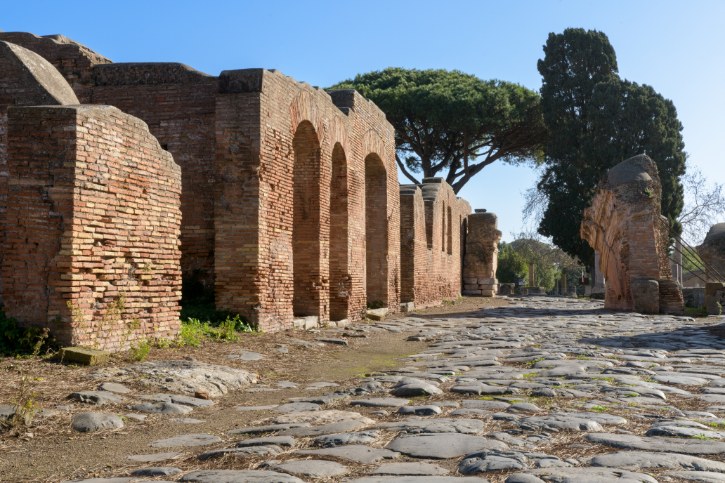
Stepping Straight Onto 2,000-Year-Old Pavement
For most of the site, nothing stands between you and the ruins. You step directly onto the original volcanic basalt paving stones of the Roman road and walk the exact routes laid down thousands of years ago.
a. The Grid That Ran the Whole City
- The Decumanus Maximus is the main spine, running over a kilometer from the Porta Romana through the Forum to the old shoreline.
- The Via dei Molini was lined with bakeries and warehouses.
- The Via di Diana is packed with preserved apartment blocks and shops.
- The Via della Foce headed toward the river docks.
b. Everyday Traces Still Under Your Feet
- Deep wheel ruts carved into the stone by heavy cart traffic.
- Raised curbs that kept pedestrians safe from wagons.
- Drain covers feeding underground sewers.
- Lead pipes, some stamped with emperors’ names, that once carried water to fountains and baths.
c. Wander Freely, but Watch Your Step
You can roam quiet side alleys, cross into courtyards, and step inside ancient shops, which is rare for a site like this. Just come prepared, because the stones are uneven and worn slick, you will step up and down over curbs constantly, and the deeper residential zones turn to dirt and gravel.
4. The Ancient Roman Theatre That Once Held Thousands of Spectators
a. Finding the City’s Grand Theatre
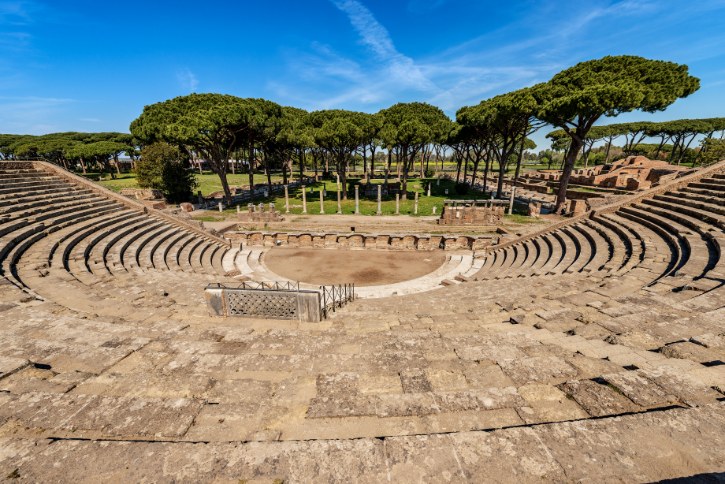
You will spot the theatre easily on the northern side of the Decumanus Maximus, one of the most recognizable monuments in the park.
b. Built by Agrippa, Grown Over Centuries
- First built in the late 1st century BC under Augustus, funded by his general Agrippa.
- A surviving marble inscription fragment still preserves Agrippa’s name.
- Enlarged in the late 2nd century AD, which is why it looks different from the original.
- The theatre you see today was heavily restored and stabilized in the early 20th century.
c. Who Sat Where, and What They Watched
- The best lower seats went to local magistrates and honored guests.
- The middle tiers held merchants and ordinary citizens.
- The top tiers were for women, foreigners, and enslaved people.
- By the 2nd century, the bills were popular comedies, music, acrobatics, and pantomimes rather than classic tragedy.
d. The Climb to the Best View in the Park
You can walk in, cross the orchestra floor, and climb the brick steps. Here is the fun part: the highest rows give you the finest panoramic view in the whole park, looking out over the stage and the pine-shaded square behind it. The theatre still earns its keep too, hosting evening concerts and plays during the summer festival.
5. The Incredible Ancient Mosaics at the Baths of Neptune and Piazzale delle Corporazioni
a. Why Ostia’s Floors Are World Famous
You will find one of the finest collections of black-and-white Roman mosaics anywhere. Rather than the colorful style of private villas, craftsmen here used bold white limestone and black basalt, a high-contrast look that held up under heavy foot traffic and suited big public spaces.
b. Neptune Rides Across the Baths
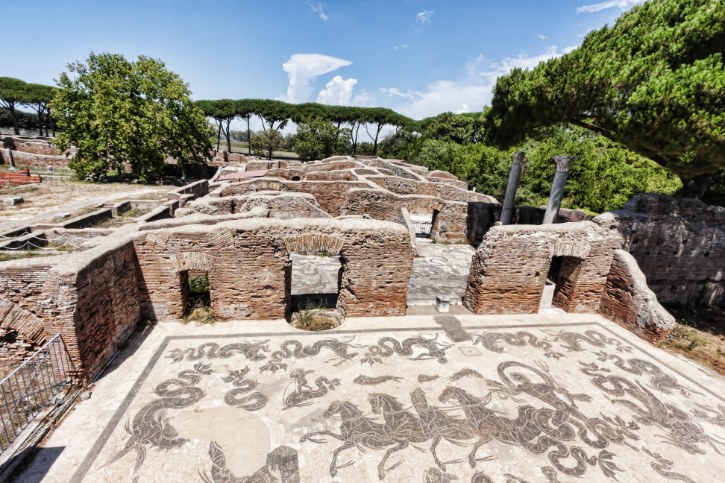
- The Baths of Neptune were completed in 139 AD under Hadrian and Antoninus Pius.
- The star is a huge floor mosaic of Neptune driving a chariot pulled by sea-horses.
- Around him swim tritons, sea nymphs, dolphins, and human swimmers.
- A raised wooden terrace lets you study the whole scene from above.
c. The Square Where Ships Did Business
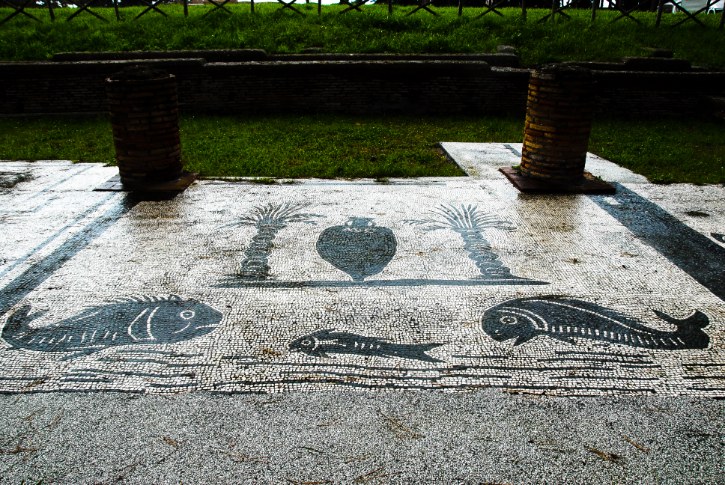
Directly behind the theatre sits the Piazzale delle Corporazioni, a vast colonnaded square ringed by about sixty-one small offices. These were the business desks of shipowners, traders, and guilds from ports across the Roman world. Think of it less as a market and more as an ancient maritime chamber of commerce.
d. Reading the Ancient Ads Set in Stone
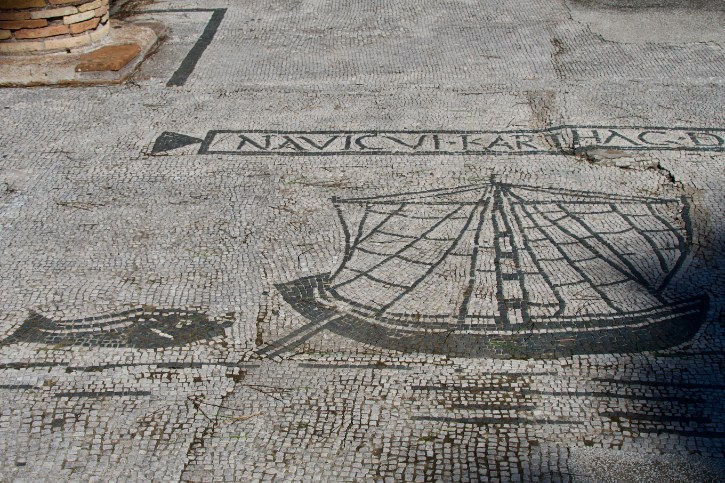
- Ocean freighters shown under full sail.
- The multi-tiered lighthouse of Portus.
- Grain measures with leveling sticks to show honest trade.
- An African elephant marking the merchants who shipped exotic animals to Rome.
The mosaics are still in place, and you can walk the corridor to read the ancient Latin labels up close.
6. The Roman Forum and the Monumental Capitolium
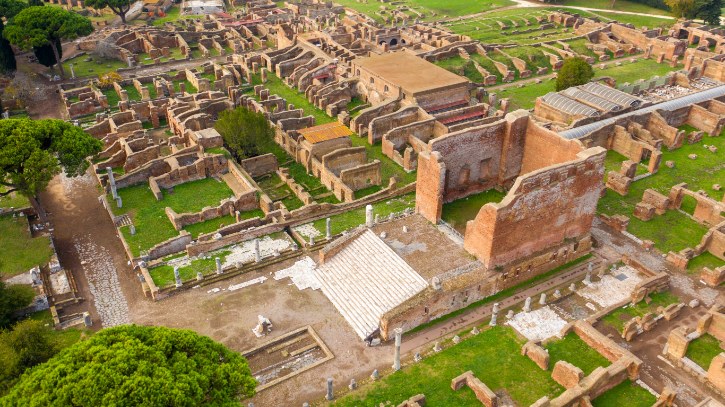
a. The Crossroads Where the City Made Decisions
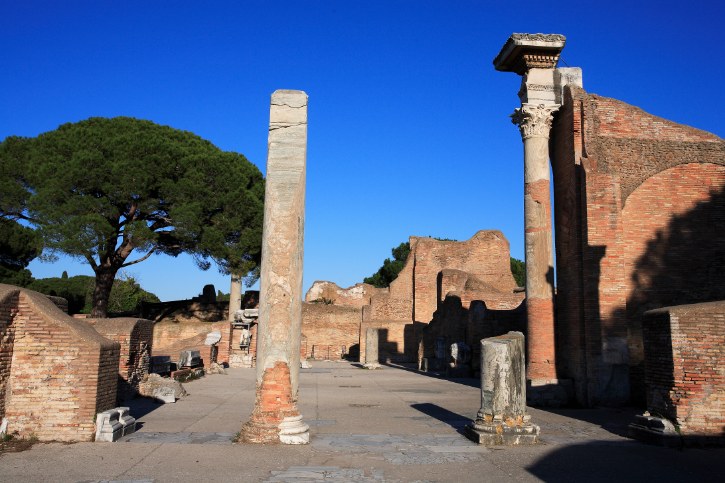
At the meeting point of the city’s two main streets sits the Forum, the political and religious center. Reshaped under Hadrian, it became a grand paved plaza for assemblies, speeches, court hearings, and ceremonies.
b. The Temple That Towers Over Everything
- The Capitolium was built around 120 to 130 AD.
- It honored Jupiter, Juno, and Minerva, the three chief gods of the Roman state.
- It was raised on a podium more than 5.5 meters high, reached by 21 broad steps.
- Its front porch once carried six marble columns nearly fourteen meters tall.
c. What Still Stands, and What Was Stripped Away
The Capitolium is now the tallest landmark in Ostia, its brick walls still rising more than fifteen meters. Be clear that this is not a complete temple. The marble that once covered it was stripped off centuries ago for lime kilns and later palaces. What remains is the raw orange-red brick, with joints still tight after nearly nineteen centuries.
d. The Civic Buildings Around the Square
- The Basilica, the city’s courthouse and exchange hall.
- The Curia, where local councilors debated laws.
- The Temple of Rome and Augustus, signaling loyalty to the emperor.
- The Forum Baths, one of the largest bathing complexes in the city.
You can walk freely across the plaza and look into the vaulted chambers beneath the temple, though the very top of the staircase is fenced off for safety.
7. Ancient Roman Apartment Buildings and Homes You Can Still Discover
a. The Best Place to See How Romans Really Lived
Most Romans lived in multi-storey apartment blocks, but almost none survive in Rome itself. Ostia, rebuilt on a grand scale in the 2nd century, preserves the most intact record of ordinary Roman apartment living anywhere in the world.
b. Apartment Blocks Versus Private Houses
- An insula was a tall apartment block for the working majority, often three to five storeys.
- Ground floors were shops and taverns.
- Upper floors were separate apartments reached by narrow street staircases.
- A domus was a larger private house for wealthier families.
c. Four Homes Worth Hunting Down
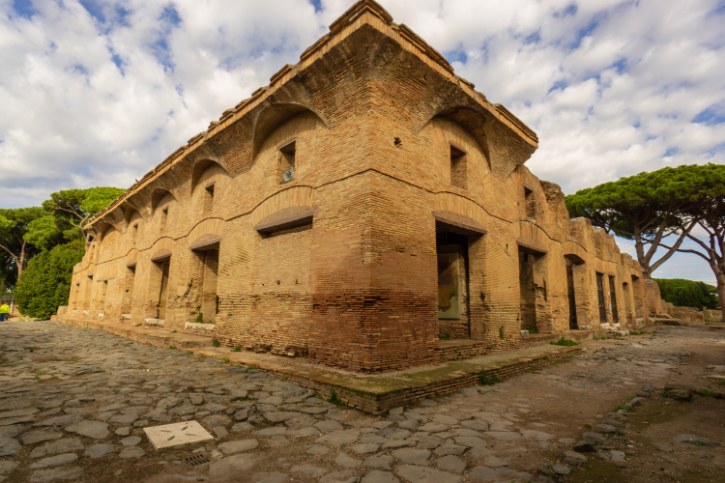
- Caseggiato di Diana, a towering apartment block with a balcony, courtyard cistern, and a hidden underground shrine to Mithras.
- Case a Giardino, airy middle-class apartments arranged around landscaped gardens.
- Domus di Amore e Psiche, a late-era luxury home with a marble fountain and opulent inlaid floors.
- Domus dei Dioscuri, a sprawling residence with private heated baths and vivid mosaics.
d. Rich and Poor, Side by Side
The contrast is striking. Elite families enjoyed running water, heated rooms, and private marble latrines, while tenants upstairs made do with tight, drafty quarters and no running water. Upper floors are roped off, but you can explore ground-floor corridors and view painted plaster from the thresholds.
8. Ancient Roman Restaurants, Bakeries, Shops, and Everyday Life
a. The Ancient Fast-Food Counter That Still Stands
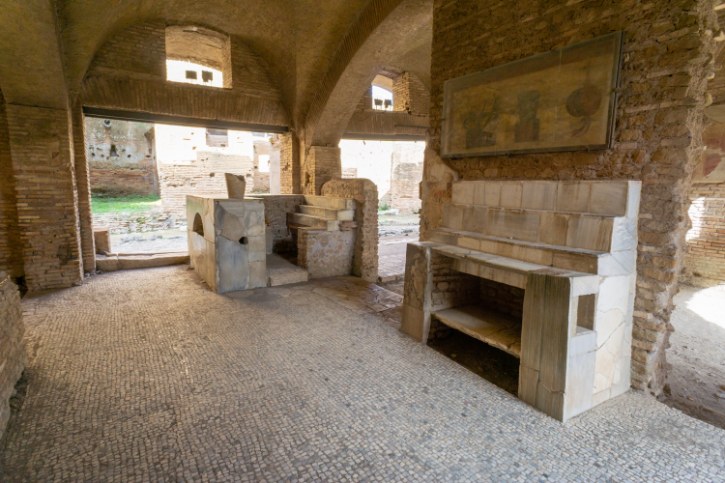
Most tenants had no kitchen, so they ate at neighborhood bars called thermopolia. The finest surviving example sits on the Via di Diana, and stepping inside feels oddly familiar:
- An L-shaped marble counter opening onto the street.
- Large jars for dried food and wine.
- Stepped shelves that once held cups and jugs.
- A painted “menu” fresco showing wine, olives, fruit, and game.
They served spiced wine alongside cheap, filling street food like lentils, sausages, cheese, and bread.
b. Bread, Mills, and Walking Donkeys
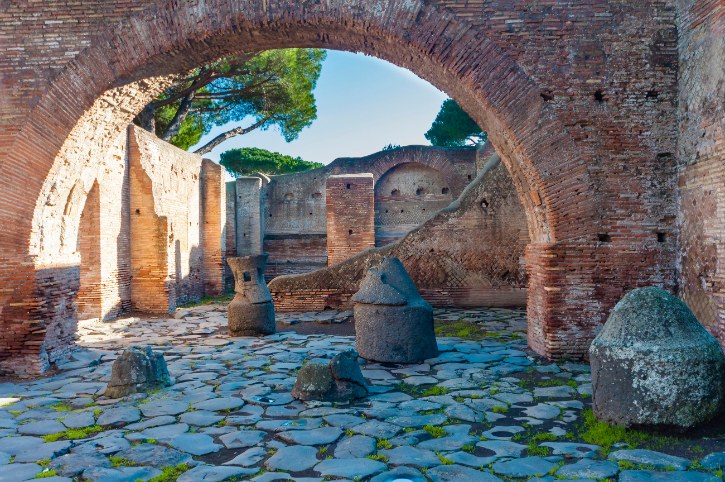
Bread was the foundation of Roman life, and the Caseggiato dei Molini was the city’s biggest mill. You can inspect more than a dozen massive basalt millstones, turned in endless circles by blindfolded donkeys or enslaved workers to grind grain into flour. The circular grooves worn into the floor by animal hooves are still visible, alongside the vaults of huge brick ovens.
c. The Warehouse Built Like a Bank Vault
The Horrea Epagathiana is the best-preserved private warehouse in the Roman world, built around 145 to 150 AD by two wealthy freedmen. Its grand brick doorway leads to a courtyard ringed by storage bays. Heavy stone doorframes still show the slots where iron locking bars were secured every night against theft.
d. Public Toilets and Street Fountains
- A communal latrine with twenty marble seats side by side, no privacy at all.
- A constant stream of water below for flushing, and a channel in front for rinsing sponges.
- Public fountains fed by aqueduct at nearly every intersection.
- Constant overflow that washed dust and waste into the sewers.
These ordinary places connect you with the real workers who kept the city alive.
9. How to Get to Ostia Antica From Rome in Around 30 Minutes
You take the Metromare line (the former Roma-Lido railway) from Rome’s Porta San Paolo station to Ostia Antica station. The ride takes about 25 to 30 minutes.
10. The Museo Ostiense and How to Plan Your Visit
a. The Reopened Museo Ostiense
The on-site Museo Ostiense reopened after a major multi-year overhaul, and it is well worth your time. Housed in a historic 16th-century salt warehouse (the Casone del Sale) in the middle of the ruins, it now displays restored sculpture and art from the city, including:
- The famous marble statue of Cupid and Psyche.
- A dynamic sculpture of Mithras slaying the sacred bull.
- Imperial portraits of Trajan, Hadrian, and Marcus Aurelius.
- The soaring winged statue of Victoria from the Porta Romana.
b. How Much Time to Set Aside
- A half-day of 3 to 4 hours covers the core highlights along the main street, including the theatre, the Neptune mosaics, the Forum, and the museum.
- A full day of 5 to 6 hours is best for enthusiasts who want to reach the quieter western quarters, the garden houses, and the ancient synagogue, one of the oldest in Europe.
- Wear supportive shoes with thick soles, since you will cross kilometers of uneven stone.
- Bring a hat, sunscreen, and water in summer, because shade is scarce.