From the street, some Italian towns look pretty but ordinary. Climb above the rooftops, though, and a few of them turn into something astonishing: a reclining giant, a perfect star, a crown of towers, a spiraling shell, and a crisp white circle.
Here are five towns whose shapes from above are unlike anywhere else, and why each one is worth your time once your feet are back on the ground. 😊
1. Centuripe, Sicily

a. The Giant You Only See From the Sky
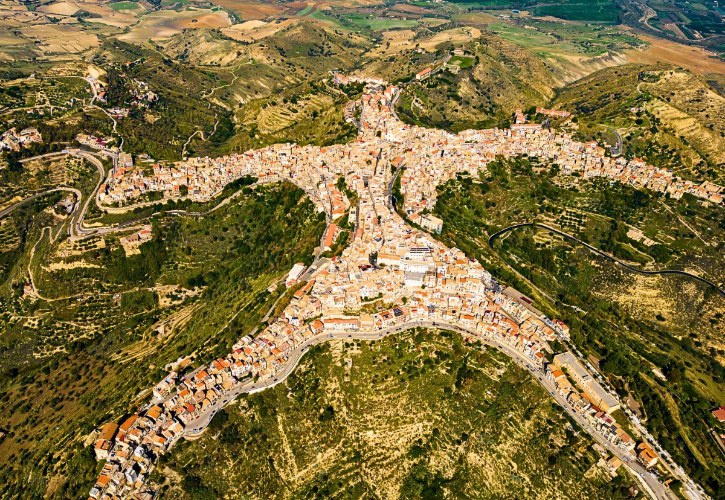
From street level, Centuripe feels like any other Sicilian hill town. Rise above it, and you see a colossal human figure stretched across the ridges of eastern Sicily, complete with a head, a torso, two arms, and two long legs. Some people see a five-pointed star instead, or a swallow with open wings. All three are fair.
b. Why That Shape Happened on Its Own
- Perched around 730 meters up in the province of Enna, the town packs tightly around a central core, then stretches along five narrow ridges split by steep, eroding valleys.
- Those five “limbs” are simply neighborhoods that filled the rocky fingers as houses squeezed along them over the centuries.
- Nobody designed it. The giant, star, or swallow you see is a trick of the terrain, not a plan.
- The shape went viral after pilot Pio Andrea Peri stitched drone photos into a single overhead image. You may see it credited to “Giuseppe Peri”, but that was a misprint repeated by some outlets.
c. A History Written Into the Stone
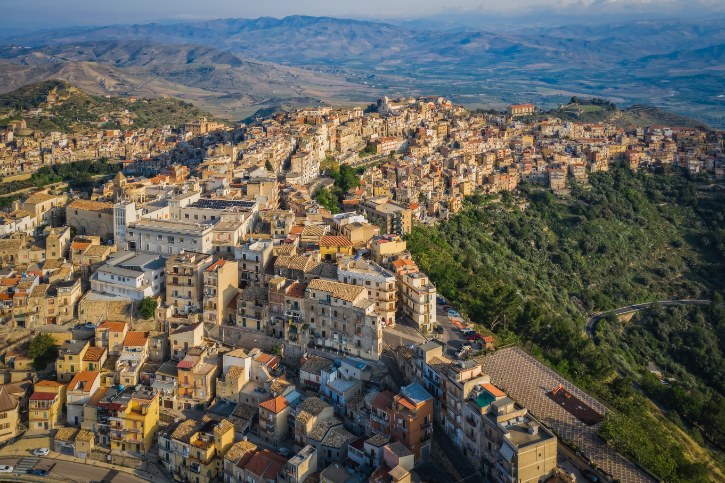
You are standing on an ancient prize. Centuripe rose as a stronghold of the Sicels, flourished under the Greeks as Kentoripa, and grew rich under Rome, earning praise from the orator Cicero himself.
A few traces of that golden age survive in plain sight. Under the Greeks the town minted coins stamped with Zeus and a thunderbolt, and those ancient letters still sit on the municipal coat of arms today.
After medieval wars left it in ruins, Count Francesco Moncada refounded the town in 1548. That rebuild locked the street grid onto the five ridges you still see today. Local legend says Garibaldi later admired the view and called it the “Balcony of Sicily”.
d. Treasures Worth Your Time
- The Regional Archaeological Museum, which holds the largest collection of Roman finds in central Sicily, including rare marble portraits of the emperors Hadrian and Augustus. It fully reopened in summer 2024 after a long restoration.
- Centuripe’s famous ancient painted ceramics, delicate enough to earn the town the nickname “the Tanagra of Sicily”.
- Castello di Corradino, which looks like a castle but is really a Roman mausoleum later fortified as a lookout.
- Roman bath arches at Contrada Bagni and the warm, pink-fronted Chiesa Madre.
e. Views, Food, and Village Life
- From the town’s “arms”, streets drop away toward the Simeto Valley and the smoking cone of Mount Etna. Trust me, that view alone is worth the climb.
- Nearby badlands, the Calanchi del Cannizzola, were striking enough to serve as film sets for John Huston and Pier Paolo Pasolini.
- Time your visit for Ruralia and the Living Nativity in early January, or the September agricultural fair.
- Skip the hunt for a cheese made only here, since town records do not support one. Enjoy honest Sicilian classics like arancini and pasta alla Norma instead.
Read More: This Sicily Road Trip Connects 17 of the Island’s Most Beautiful Places
2. Palmanova, Friuli-Venezia Giulia
a. The Star Stamped Into the Plain
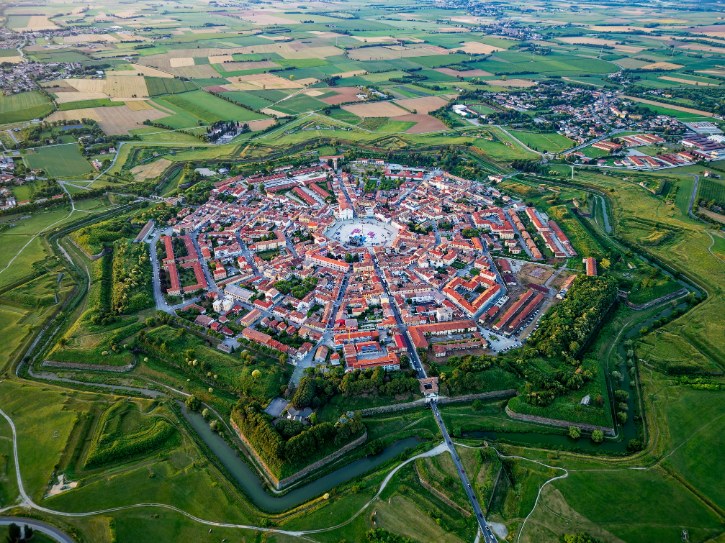
If Centuripe was shaped by nature, Palmanova was shaped by math. From the air, this town near Udine forms a flawless nine-pointed star pressed into flat green countryside, with symmetrical streets radiating from a crisp hexagonal square at its heart.
b. Built for the Age of Cannons
- Once cannons arrived, tall stone walls became easy targets, so engineers used low, angled ramparts to sweep every meter of the wall with crossfire and leave no blind spots.
- Three defensive rings grew over two centuries: a nine-bastion core (1593 to 1620), triangular ravelins beyond the moat (1665 to 1683), and Napoleonic earthen lunettes (1806 to 1809).
- Buildings were kept deliberately low, so an approaching army saw only grassy earthworks and three gates, with no rooftops in sight.
c. Venice’s Dream of the Perfect City
Venice founded Palmanova on a single recorded day, October 7, 1593, to guard its frontier against Ottoman raids and Habsburg pressure. A team led by Giulio Savorgnan, with the theorist Vincenzo Scamozzi, merged hard military science with the Renaissance dream of an ordered “ideal city”.
It worked. Across the whole life of the Venetian Republic, no enemy ever placed Palmanova under formal siege, and it now holds UNESCO World Heritage status.
d. Landmarks Worth Your Steps
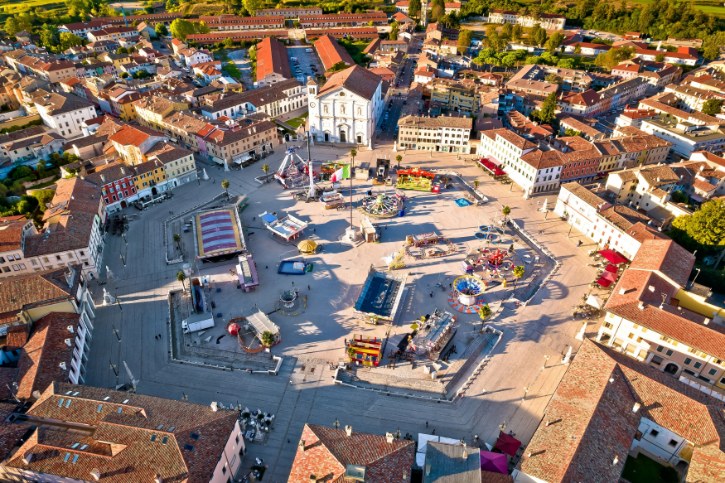
- Piazza Grande, the hexagonal center, where you can feel the town’s geometry at eye level.
- The Cathedral of Santa Maria Assunta, whose bell tower was built low on purpose so enemy gunners could not use it to aim.
- Eleven stone statues of the Venetian Provveditori Generali, the military governors who once ruled the fortress, ringing the square.
- A tall central standard nicknamed “Mario” by locals, which over the centuries has flown the banners of Venice, France, Austria, and Italy.
- Three grand gates, one now holding a Great War and fortress museum, another a small museum devoted to bees.
e. Go Underground, Then Slow Right Down
- Walk or cycle the Parco dei Bastioni, tracing the dry moats and grassy triangular lunettes.
- Descend into the countermine galleries, tunnels once meant to be packed with explosives and blown up beneath attackers.
- Catch Palma alle Armi, a huge reenactment with around 1,000 participants in 17th-century costume.
- Then take it easy at a café under the arcades of Piazza Grande.
3. Monteriggioni, Tuscany
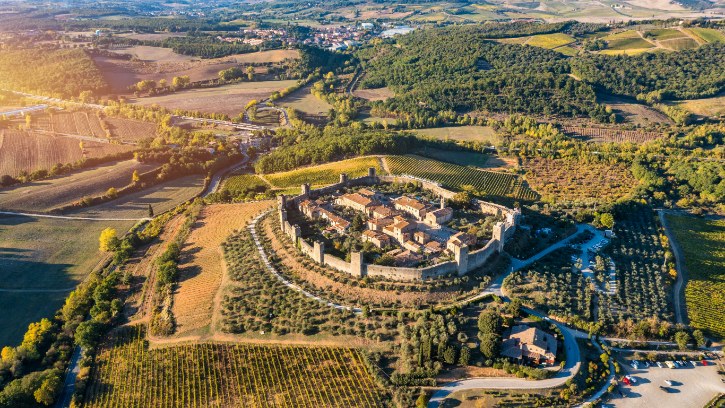
a. A Stone Crown on a Tuscan Hill
Between Siena and Florence, Monteriggioni rises like a mirage. One unbroken ring of medieval wall, about 570 meters around, hugs the exact top of its hill and clasps the tiny village inside like a stone crown.
b. The Towers That Make the Shape
- Fourteen square watchtowers punctuate the wall, and eleven still rise boldly above it.
- The rest were lowered in the 16th century to shrink their profile against artillery fire.
- No suburbs ever spilled out, so golden fields, olive groves, and woodland press right up to the ancient masonry.
c. Siena’s Watchtower Against Florence
Siena began building this fortress in 1213 to command the valley and keep an eye on its great rival, Florence. The town held for three centuries, and its skyline so struck Dante that he worked it into the Inferno, picturing giants around a pit like a place that “crowns itself with towers”. It finally fell in 1554, surrendered without a fight.
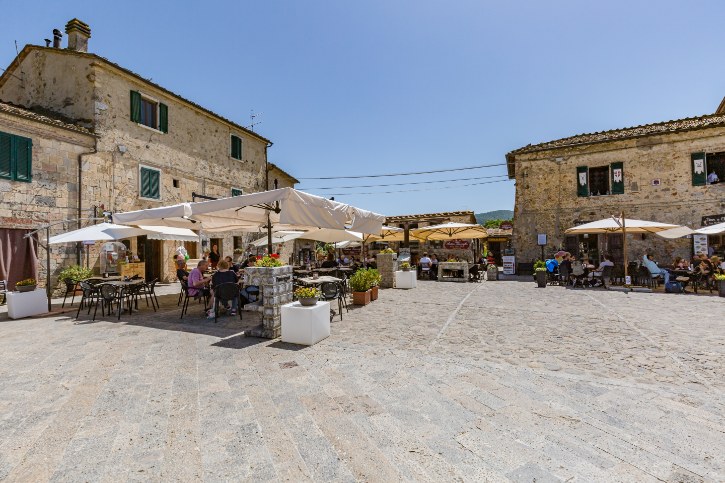
d. What Waits Inside the Walls
- Just two gates, with the southern one showing both a 1213 foundation stone and an 1860 plaque marking the vote to join a united Italy.
- Two rampart walkways you can climb to patrol the walls and look out over the hills.
- A surprisingly broad central square, officially named for Dante, with an old stone well wrapped in tales of secret underground passages.
- The Romanesque Church of Santa Maria Assunta, begun around the same years as the walls, and the small “Monteriggioni in Arme” museum of reproduction armor and weapons.
e. Festivals, Trails, and Tuscan Flavors
- Each July, the medieval festival Monteriggioni di Torri si Corona fills the piazza with costumed knights, artisans, and torches.
- Hikers on Stage 32 of the Via Francigena pass straight through the gates toward the old abbey at Abbadia a Isola.
- Inside the walls, taste locally pressed olive oil, Tuscan cured meats, cheeses, and regional wines.
- Come at golden hour, when the light over the Chianti hills is at its best.
Read More: 12 Stunning Villages in Tuscany: The Perfect Road Trip Route
4. Lucignano, Tuscany
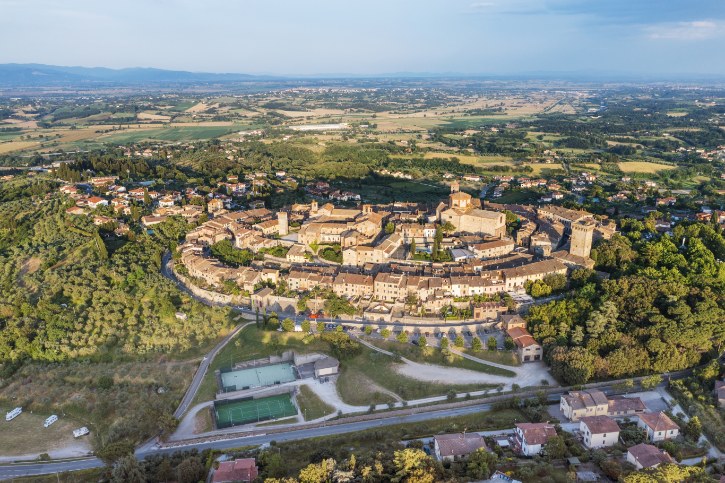
a. The Snail-Shell Village
Near the Valdichiana, between Arezzo and Siena, Lucignano coils its whole historic center into looping oval rings that climb toward the summit. From above it curls so gracefully that Italians call it il borgo a chiocciola, the snail-shell village.
b. Rings You Can Walk Through
- The core is really three concentric oval streets linked by short, steep alleys, not one true spiral.
- Sienese rulers fixed this layout in 1371, building the perimeter wall straight into the outer walls of the houses.
- Follow a single loop and you walk between old social classes. Grander homes line the sunny southern curve, while humbler ones sit along the shaded northern arc.
c. A Hilltop Prize Fought Over for Centuries
Perugia, Arezzo, Siena, and Florence all wanted this ridge. Sienese rule shaped the oval town and its Gothic art, and the Medici later added the never-finished Fortezza Medicea at the top.
The Medici fortress was never finished and today often stays closed, but its outer bastions still shape the northern edge of town. Just outside the walls below it stands the late-16th-century Sanctuary of the Madonna delle Querce.
Today Lucignano wears its history lightly, holding both a Touring Club Orange Flag and a place among Italy’s most beautiful villages.
d. Don’t Leave Without Seeing the Tree of Gold
- A roughly 2.6-meter Gothic reliquary in silver and gilded copper, kept in the Civic Museum. It is traditionally attributed to Sienese goldsmiths Ugolino di Vieri, who began it around 1350, and Gabriello d’Antonio, who completed it in 1471.
- Twelve ornate branches studded with gilded leaves, rock crystal, and sprigs of red coral for the blood of Christ.
- Stolen in a dramatic 1914 heist, then largely recovered and reassembled.
- Legend says couples who exchange vows beneath the “Tree of Love” win lifelong luck. A lovely story, though folklore rather than history.
e. Churches, Lanes, and Spring Color
- The Church of San Francesco, with its striped marble facade and Bartolo di Fredi’s haunting fresco The Triumph of Death.
- Piazza del Tribunale at the summit and the nearby Collegiata di San Michele Arcangelo, raised on the ruins of the old citadel.
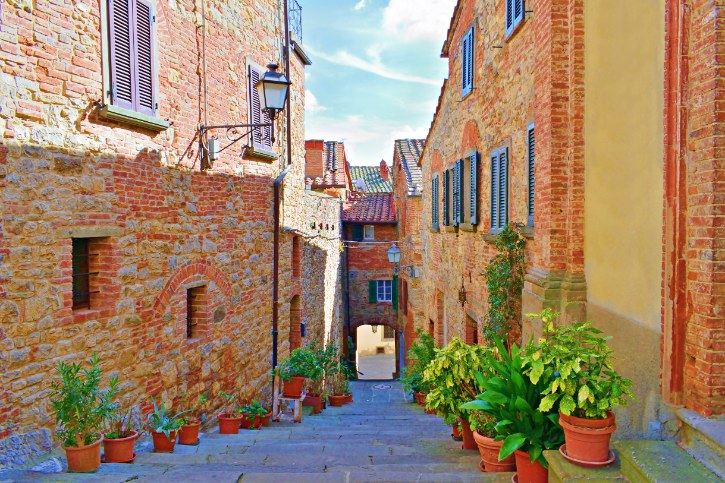
- Curving lanes full of arches, stairways, and sudden views over the patchwork fields.
- The Maggiolata festival on the last two Sundays of May, when flower-covered floats parade the circular streets.
- Local tables anchored by fine olive oil and local honey.
5. Locorotondo, Puglia
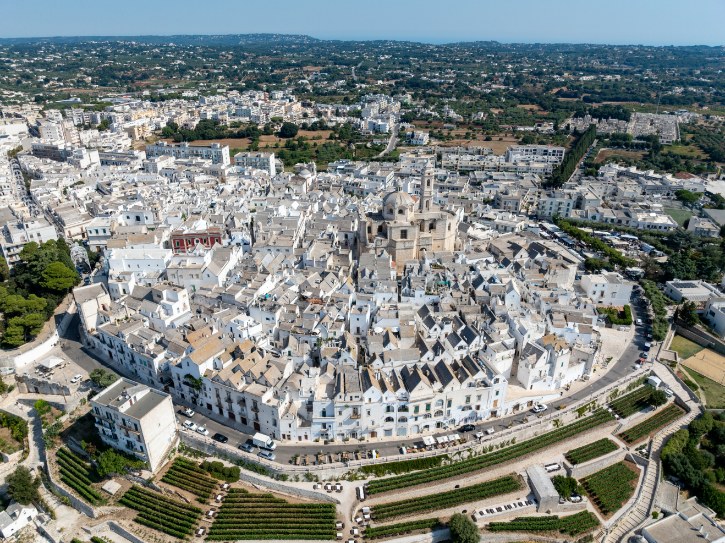
a. The White Circle of the Valle d’Itria
In Puglia, Locorotondo gleams from above like a crisp white disk crowning a limestone hill. Its very name tells you what to expect, coming from the medieval Latin Locus Rotundus, or “round place”.
b. A Circle That Grew On Its Own
- There was no master plan. The round shape formed gradually around a hilltop castle and parish core.
- A curving outer promenade rings the crest, wrapping a dense maze of narrow white lanes inside.
- Compared with Lucignano’s long ovals, Locorotondo is tight and genuinely circular.
c. The Rooftops That Set It Apart
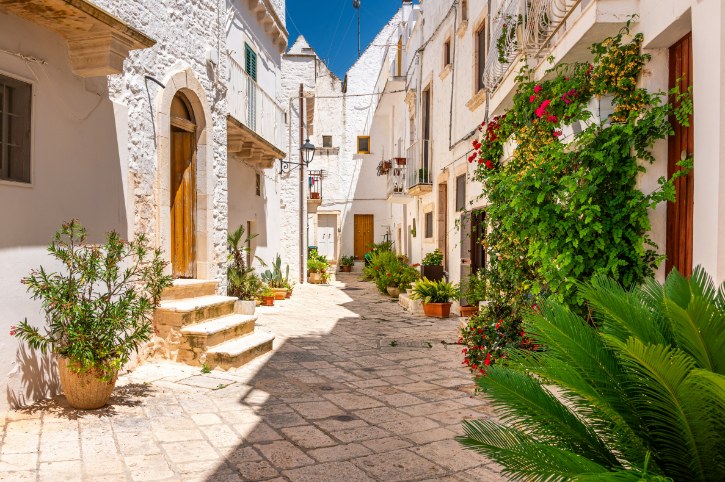
Look up as much as you look ahead. While the countryside is dotted with cone-roofed trulli, Locorotondo’s center is defined by le cummerse: narrow white houses capped by steep, pointed gabled roofs of grey limestone slabs.
Packed tightly side by side to make the most of limited space inside the circle, they give the town a surprisingly tall, sharp skyline against the bright Puglian sky. Between the white walls, stone steps and iron balconies spill over with red and pink geraniums. The charm here comes from modest, everyday craftsmanship rather than grand palaces.
d. Landmarks and a “Seafront” With No Sea
- The Chiesa Madre di San Giorgio Martire, crowned by a 35-meter dome and a 47-meter bell tower.
- Smaller gems like the Church of Madonna della Greca, which recalls early Greek worship, and the Baroque Church of San Rocco.
- The 22-meter white Torre Civica of the old town hall, crowned with a round colonnaded loggia.
- Via Nardelli, the curving outer walk locals nickname “il Lungomare”, the seafront, even though the sea is miles away.
- At sunset it looks out over trulli, olive groves, and tidy vineyards. You will love this one.
e. Wine, Food, and Festival Lights
- Locorotondo DOC whites, built on native Verdeca and Bianco d’Alessano grapes and bright with citrus and pineapple.
- Puglian plates like orecchiette con le cime di rapa, grilled bombette pork rolls, and local gnumerèdde lamb.
- The patron festival of San Rocco in mid-August, with glowing luminarie arches, processions, and fireworks.
- A winter Living Nativity and Christmas lights draped over the white cummerse, when the whole circle glows after dark.
Seen from above or wandered street by street, each of these five towns proves the same thing: in Italy, the shape of a place is often the story of the people who built it.
Read More: The Best Puglia Road Trip: 15 Amazing Stops