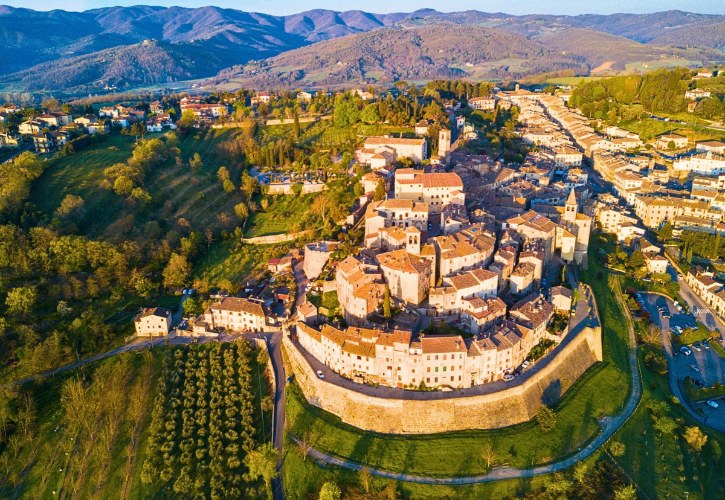
Beyond Tuscany’s famous art cities lies a quieter world of hilltop villages, each a small discovery at the end of a winding country road.
Picture yourself rolling past vineyards, wandering medieval streets, and pausing in sleepy squares where life slows right down.
One connected route links twelve of these historic gems, from fortified strongholds to dramatic cliffside towns and elegant Renaissance centers.
Here is how to experience every side of Tuscany on a single unforgettable journey. 😊
1. Montefioralle
a. Why You’ll Fall for This Chianti Hideaway
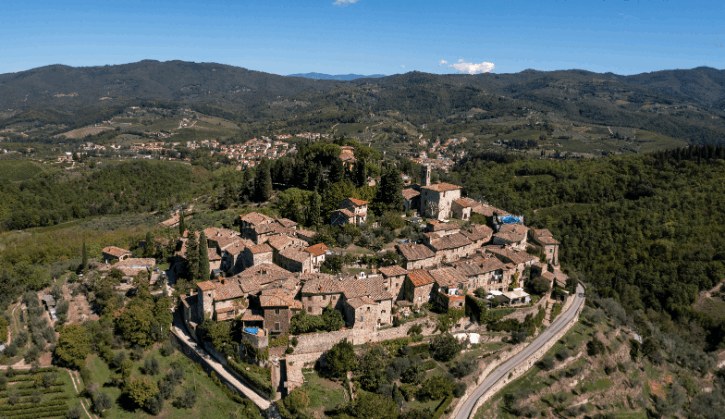
Montefioralle sits on a limestone ridge above the Greve valley, one of the most intact feudal villages in all of Chianti. Once a fortified stronghold, it now offers a calm, lived-in contrast to the busier towns nearby.
b. A Village Built as a Stone Spiral
Laid out as a concentric oval around its hilltop citadel, it greets you with:
- A single circular lane crossed by narrow passages
- Covered stone archways built to trap intruders
- An intact ring of medieval defensive walls
- Old watchtowers, later absorbed into private homes
- The ancient cassero, a fortress now turned into houses
c. What to See Within the Walls
- Church of Santo Stefano, holding a panel of the Madonna and Child by the Master of Montefioralle
- Three historic arched gateways into the cobbled core
- Pieve di San Cresci, one of the oldest churches in Chianti, a short way outside the village
- Perimeter viewpoints over terraced vineyards and stone farmhouses
d. Flavors and Festivals Worth Chasing
- Taste the local Chianti Classico with traditional Tuscan dishes
- Time your visit for the Sagra delle Frittelle in March, where sweet rice fritters are fried in a giant iron pan
- Catch I Vini del Castello in May, when Chianti Classico producers pour their wines around the village walls
- Round out a tasting with the area’s olive oil and farmhouse produce
e. The Explorer’s Mark on the Wall
One old stone home carries a carved wasp and the letter “V”, the emblem of the Vespucci family. Amerigo was born in Florence, not here, so treat any “Vespucci house” as local lore. From these alleys, the road drops toward a true frontier fortress.
2. Monteriggioni
a. A Fortress That Stops You in Your Tracks
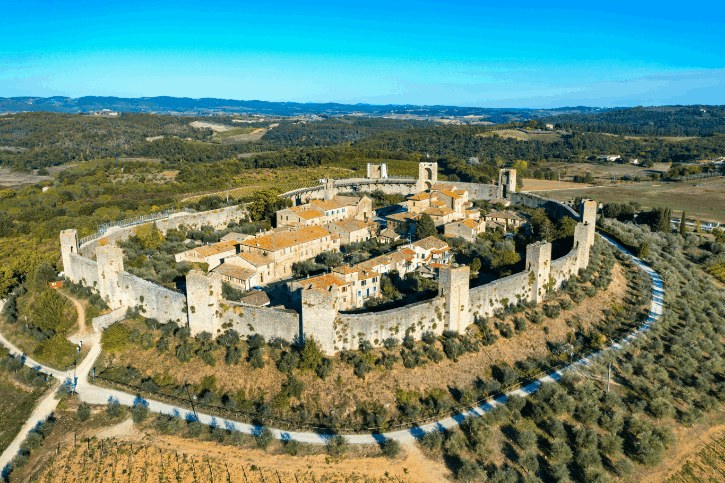
Monteriggioni crowns a low hill as one of the most intact examples of thirteenth-century military architecture in Italy. Built by Siena to hold back Florence, it was never a market town but a pure fortress, and that is exactly what makes it unforgettable.
b. Life Inside the Ring of Towers
Step through the gateway into a compact world completely enclosed by walls, where you’ll find:
- Fourteen stone towers rising around the rim
- Simple houses gathered around one square
- The quiet, deliberate feel of an old garrison
- Countryside views waiting just beyond the ramparts
c. The Landmarks to Find First
- Porta Franca, the main southern gate toward Siena
- Porta di Sotto, the northern gateway facing Florence
- Piazza Roma, the open heart of the village
- The Romanesque Church of Santa Maria Assunta
- The Monteriggioni in Arme museum of arms and armor
d. History You Can Walk Into
- Discover its place in Dante’s Inferno, where the towers were likened to a ring of giants
- Follow the old Via Francigena, the pilgrim route that once offered refuge here
- Visit in July for Monteriggioni di Torri si Corona, a festival of medieval crafts and banqueting
- Settle in for hearty Tuscan cooking in the village
e. Why Its Crown of Towers Stays With You
The walls and towers survive in remarkable shape, tied to Siena’s long rivalry with Florence. Add the Dante connection and the pilgrim history, and you get both a military and a literary window into the Middle Ages. From here the road climbs toward a town of soaring private towers.
3. San Gimignano
a. The Skyline Everyone Remembers
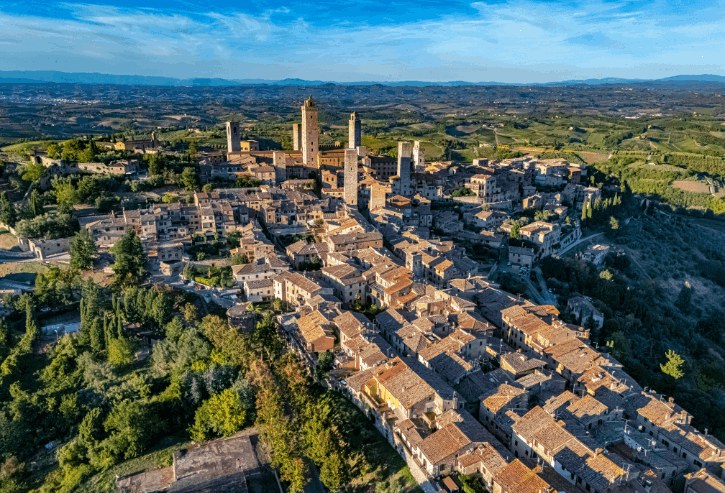
San Gimignano rises on a ridge, famous worldwide for its skyline of medieval towers and recognized as a UNESCO World Heritage site. It flourished on the old pilgrim road, and even with its popularity today, it absolutely earns its place on this route.
b. A Medieval Race to the Sky
Wealthy families once competed by building ever-taller tower-houses to flaunt their status:
- As many as seventy-two towers once rose above the town
- Around fourteen still rise above the town today
- The tallest still reaches an impressive height
- Lively squares give it a buzz unlike quiet Monteriggioni
c. Squares and Treasures to Explore
- Piazza della Cisterna, a triangular square paved in herringbone brick
- Piazza del Duomo, the civic and religious heart of town
- The Collegiata, with rich medieval fresco cycles, Ghirlandaio’s Chapel of Santa Fina, and a Saint Sebastian by Benozzo Gozzoli
- Torre Grossa, with a staircase to sweeping rooftop views
- Rocca di Montestaffoli, a hilltop fortress park overlooking the towers
d. What to Sip and Savor
- Sample Vernaccia di San Gimignano, the first Italian wine ever awarded DOC status
- Visit the Wine Experience at La Rocca to learn its story
- Seek out local saffron, still hand-harvested from crocus flowers each autumn
- Wander the medieval squares and artisan shops between tastings
e. More Than Just a Pretty Skyline
Here the towers became symbols of pride and wealth, raised higher and higher to outdo the neighbors. Combined with its role on the pilgrim road and the art in its churches, San Gimignano stands apart. From these bustling squares, the road heads west toward a town with far older roots.
4. Volterra
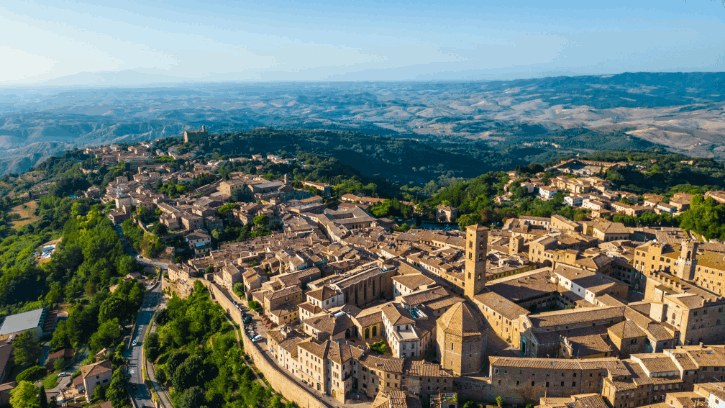
a. Three Thousand Years on One Hill
Volterra commands an imposing ridge and carries three millennia of continuous history. First Etruscan, then Roman, then medieval, it feels completely different from the villages so far, with a world-famous alabaster craft to match.
b. Reading the Town’s Many Pasts
As you walk, different eras sit side by side, each leaving its mark:
- Etruscan, Roman, and medieval features in one center
- Stone buildings resting on marine clay, not volcanic rock
- The striking eroded badlands of Le Balze nearby
- Narrow streets opening onto wide valley views
c. The Must-See Highlights
- Porta all’Arco, an Etruscan gateway with three weathered stone heads
- The Roman Theatre, with seating for more than two thousand spectators
- Museo Etrusco Guarnacci, home to the famous bronze L’Ombra della Sera
- Palazzo dei Priori, the oldest communal town hall in Tuscany
- The Romanesque Duomo and its banded marble Baptistery
d. Crafts and Flavors of the Hills
- Watch artisans shape translucent alabaster in generations-old workshops
- Taste Pecorino delle Balze Volterrane, made with wild cardoon flowers
- Hunt for seasonal truffles, celebrated at the Volterragusto food fair
- Catch the Palio dei Caci, a race rolling cheese wheels down a steep street
e. A Town of Layered History
Few places let you touch so many eras at once, from ancient tombs to medieval halls to living craft. That depth is Volterra’s most memorable quality. From these ancient stones, the journey turns toward the coast and an elegant wine country framed by cypress trees.
5. Bolgheri
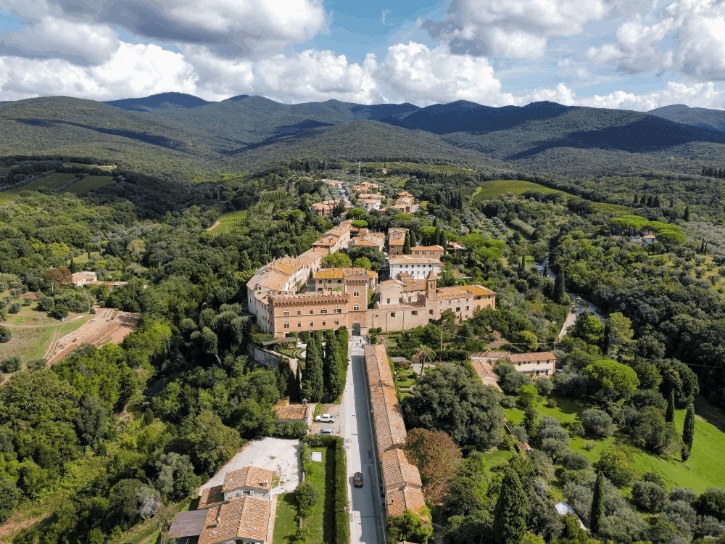
a. The Village at the End of the Cypresses
Bolgheri is a small village near the Etruscan Coast, best known for its celebrated vineyards and an unforgettable cypress-lined approach. Even if wine isn’t your thing, the charming streets and literary history make it well worth a stop.
b. A Small Center with Big Character
Enter through the arched gateway beneath the red-brick castle, and you’ll find:
- Fieldstone houses and shaded wine terraces
- Inviting wine shops and small restaurants
- Vineyards, cypress trees, and soft coastal light all around
c. Landmarks Along the Way
- Viale dei Cipressi, the famous avenue of around 2,500 cypresses running to the village gate
- Castello di Bolgheri, its brick gateway admired from the public squares
- Oratorio di San Guido, a small chapel marking the avenue’s far end
- The Romanesque Church of Santi Giacomo e Cristoforo
d. The Wines That Made It Famous
- This is the birthplace of the Super Tuscan movement and the legendary Sassicaia
- Neighboring estates like Ornellaia and Guado al Tasso followed its lead
- Estate cellar tours run across the plain, though it’s wise to book ahead
- Pair the wines with hearty dishes like slow-cooked wild boar
e. Where Poetry Meets the Vineyards
The cypress avenue was immortalized by Giosuè Carducci, Italy’s first Nobel Laureate in Literature, who grew up nearby. Between world-class wine and that cinematic approach, Bolgheri lingers in the memory. Leaving the coast, the route heads inland into the rustic hills of the Maremma.
6. Montemerano
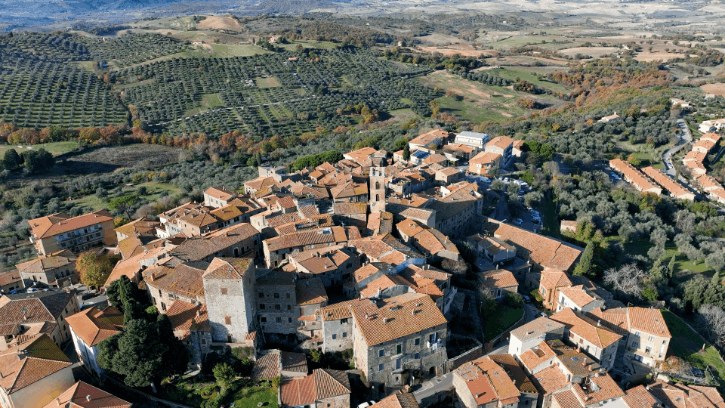
a. A Peaceful Corner of the Maremma
Montemerano is a charming medieval village tucked into the interior hills, founded by the Aldobrandeschi and later turned into a fortress by Siena. If you want somewhere small, quiet, and full of local character, this is the kind of place you’ll be glad you detoured for.
b. Wandering the Heart-Shaped Walls
Three rings of medieval walls wrap the village, tracing a heart shape from above, and you’ll notice:
- Streets kept free of cars and crowds
- Weathered stone and outdoor stairways
- Alleys dressed with jasmine and potted plants
- Quiet corners with barrel-vaulted passages
c. Squares and Streets to Discover
- Piazza del Castello, reached through a stone archway at the top of a steep lane
- Porta del Ponte, still showing grooves for its original drawbridge
- Piazzetta dell’Antico Frantoio, home to the community’s old olive press
- The Church of San Giorgio, rich in Sienese Renaissance art
d. Art, Food, and a Curious Cat
- Find the Madonna della Gattaiola, a painting with a round hole once cut so the church cat could chase mice
- Try rustic Maremma cooking like acquacotta soup and pici with wild boar
- Visit around late April for the Festa di San Giorgio and its Giostra del Drago
- Pair your meal with a glass of local Morellino di Scansano
e. Small Village, Big Personality
Where Monteriggioni impresses with its ring of walls and towers, Montemerano charms with quiet and detail. Its heart-shaped walls, intimate streets, and surprising art give it an identity all its own. From here the road travels east into volcanic country of deep ravines and golden rock.
7. Pitigliano
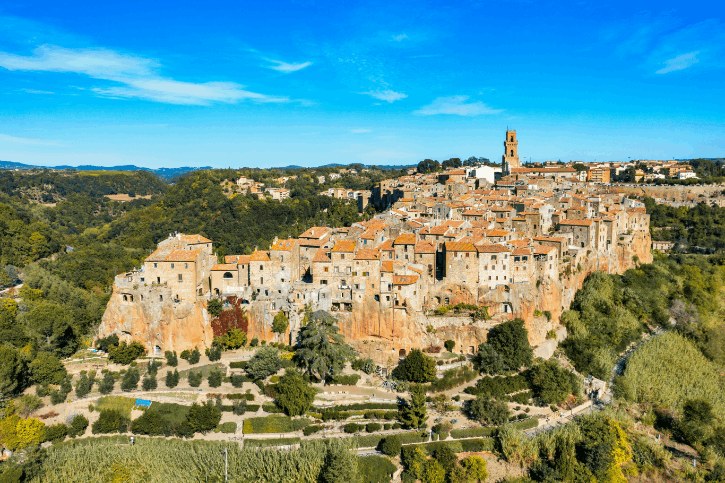
a. The Village That Rises from the Cliffs
Pitigliano is one of southern Tuscany’s most dramatic sights, built on a tufa promontory ringed by sheer cliffs. From a distance the whole village looks carved straight from the rock, and its history is just as remarkable.
b. The View You Have to See
From the road on the southern approach, at a curve opposite the town:
- The entire village reveals itself as a wall of stone houses
- Warm ochre tones blend into the exposed rock face
- Steep stairways and arched alleys thread the spur
- Lit up at night, it seems to float above the ravine
c. Exploring Little Jerusalem
Known as La Piccola Gerusalemme for the Jewish community that thrived here for centuries, it invites you to explore:
- The historic Jewish Quarter, run as an open-air museum
- The Synagogue, with its carved wooden ark and ornate stuccoes
- Rock-cut spaces below, including the ritual bath and kosher wine cellar
- Palazzo Orsini, a fortified citadel housing two museums
d. Ancient Roads and Local Flavors
- Walk the Vie Cave, sunken roads carved by the Etruscans with towering walls
- Try Lo Sfratto dei Goym, a baton-shaped pastry filled with honey, walnuts, and spices
- Sip Bianco di Pitigliano, a crisp white grown in the tufa soils
- Pick up Maremma products that reflect the town’s Jewish-Tuscan heritage
e. A Place Unlike Anywhere Else
Nowhere else quite matches the way Pitigliano’s buildings seem to grow out of the cliffs, shaped by its geology and its layered Etruscan and Jewish history. A short crossing of the valleys leads to its sister citadel, wilder and quieter still.
8. Sorano
a. The Matera of Tuscany
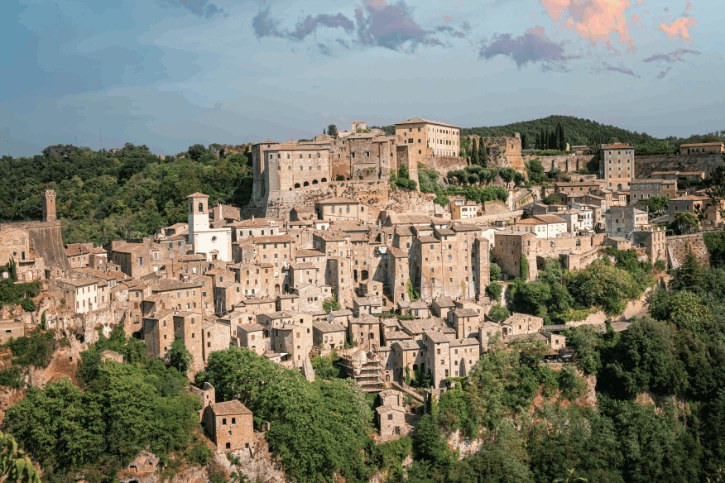
Sorano clings to the edge of a tufa gorge above the Lente River, often called the Matera of Tuscany. Its rugged, stacked townscape is well worth exploring after Pitigliano, with a quieter, wilder character all its own.
b. A Town Carved into the Rock
Grown hand in hand with the rock itself, its center offers:
- Narrow alleys and old stone walls at every turn
- Cellars cut straight into the tufa
- Dense woodland pressing in around the gorge
- Hidden squares tucked between the cliffs
c. Fortresses and Viewpoints to Find
- Fortezza Orsini, one of the finest Renaissance fortresses in central Italy
- Masso Leopoldino, a rock terrace with 360-degree views over the rooftops
- The ancient portals of Porta di Sopra and Porta dei Merli
- The Collegiate Church of San Nicola, with its carved stone font
d. Beyond the Walls
- Explore the Parco Archeologico Città del Tufo, reached by a dramatic sunken Etruscan road
- Find the rock belvedere near the Church of San Rocco for the finest view of town
- Soak at the Terme di Sorano, warm springs around a historic stone pool once used by monks
- Sample the local foods and wines of the surrounding tufa country
e. Wild, Quiet, and Unforgettable
Sorano sets itself apart with its fortress, its tufa landscape, and its deep archaeological roots, and it even holds the Orange Flag for quality tourism. Leaving the canyons behind, the journey climbs north onto the sweeping clay ridges of the Val d’Orcia.
9. Montalcino
a. The Home of a Legendary Wine
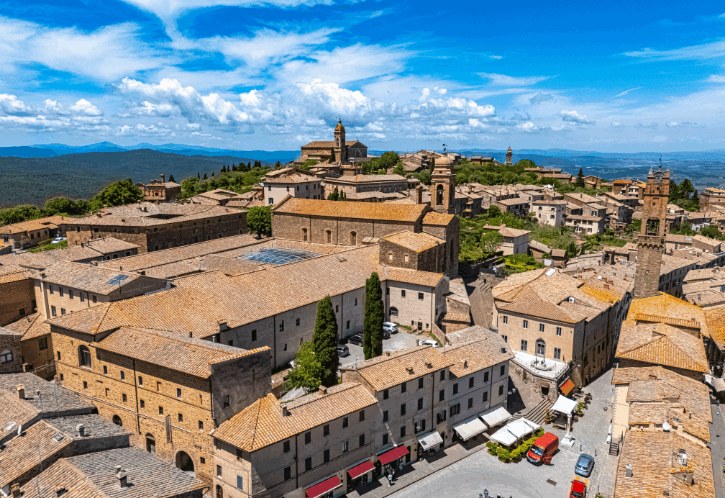
Montalcino commands a dominant hilltop and anchors the gateway to the Val d’Orcia, a UNESCO-listed landscape. Famous above all for Brunello di Montalcino, it is an essential stop for anyone who loves historic towns and great wine.
b. A Hilltop with Endless Views
Grand and rural at once, the historic center offers:
- Old walls, medieval streets, and an imposing fortress
- Views of vineyards and wooded hills in every direction
- Wine culture running through the whole town
- A gentle contrast of monumental stone and quiet countryside
c. The Sights Worth Your Time
- The Fortezza di Montalcino, with rampart walkways and panoramic views
- Piazza del Popolo, framed by a slender medieval clock tower
- The Museo Civico e Diocesano, rich in Sienese paintings
- The Abbey of Sant’Antimo nearby, a Romanesque gem famed for its acoustics
d. Wine, Food, and Festival
- Taste Brunello, aged for years before it can even be released
- Enjoy it with roasted game, Chianina beef, and aged pecorino
- Visit in late October for the Sagra del Tordo, with costumed parades and an archery tournament
- Browse the town’s enotecas and cellars for a Brunello tasting
e. A Proud History in Every Glass
After the fall of Siena, hundreds of noble families retreated to this fortress and held out defiantly for years. Add world-class wine and a UNESCO landscape, and Montalcino is hard to match. From here the road climbs toward an idealized vision of Renaissance beauty.
10. Pienza
a. The Renaissance Town Built on a Dream
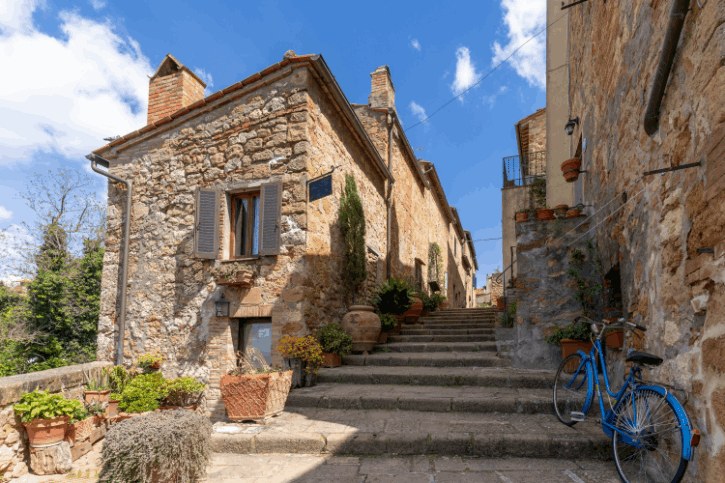
Pienza crowns a crest above the Orcia Valley and holds a special place in architectural history. A pope transformed his humble birthplace into an ideal Renaissance town, now a UNESCO site famous for both its design and its Pecorino cheese.
b. A Center Designed to Perfection
Carefully planned rather than grown by chance, the town stands out with:
- Harmonious proportions and elegant facades
- Public spaces designed to work together
- A compact center perched above rolling countryside
- Clever perspective that frames the cathedral
c. The Landmarks to Seek Out
- Piazza Pio II, the trapezoidal square at the heart of the plan
- The Cathedral, with one of the earliest Renaissance church facades
- Palazzo Piccolomini, home to an early Renaissance hanging roof garden
- Via del Casello, a walled promenade acting as a balcony over the valley
d. A Cheese Lover’s Paradise
- Taste Pecorino di Pienza in its many styles, from soft and fresh to crumbly and aged
- Look for wheels matured with olive oil, wood ash, or walnut leaves
- Visit in early September for the Fiera del Cacio, where cheese wheels are rolled across the square
- Browse the food shops along the main street for more Val d’Orcia specialties
e. A One-of-a-Kind Vision
Pienza is seen as the world’s first practical attempt to apply Renaissance ideals to a whole town center, which is why it earned UNESCO recognition. That elegance sets it clearly apart. From these serene pastures, the route ascends toward a grander, ridge-top town.
11. Montepulciano
a. The Pearl on the Ridge
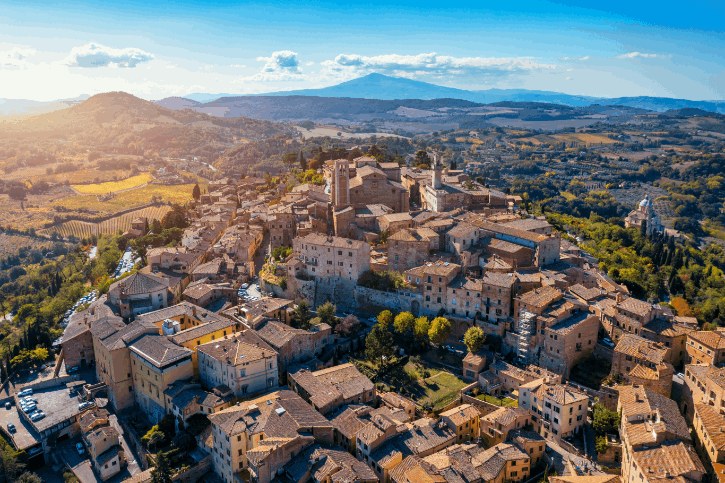
Montepulciano perches along a narrow limestone ridge and earned the nickname “Pearl of the Sixteenth Century”. Known for its Renaissance palaces and prized Vino Nobile wine, it makes a rewarding stop after Pienza.
b. The Climb to Piazza Grande
Built around a single avenue winding uphill to its summit square, the town leads you past:
- Grand palaces and historic stone facades
- Palazzo Bucelli, with ancient Etruscan urns set into its base
- A church front designed by a famous Florentine architect
- Wide views stretching to distant mountains and a lake in Umbria
c. The Highlights You’ll Remember
- Piazza Grande, crowned by a palace recalling Florence’s Palazzo Vecchio
- The Cathedral, famously left with a raw, unfinished stone facade
- The Tempio di San Biagio, a perfect Renaissance church standing alone below the walls
- A climbable bell tower with panoramic views
d. Into the Underground Cellars
- Descend into the historic cantine storiche carved beneath the town
- Visit Cantina De’ Ricci, a soaring “wine cathedral” of stone pillars
- Taste Vino Nobile where it quietly ages in huge oak casks
- Pair it with pici pasta and local cured meats
e. Grand Architecture and Noble Wine
Montepulciano’s monumental palaces and ridge-top setting give it a grandeur all its own, with an underground city of wine cellars beneath. Its Vino Nobile even differs from Montalcino’s Brunello nearby. From these palaces, the road heads toward the eastern edge of Tuscany.
12. Anghiari
a. A Fitting Finale in Eastern Tuscany
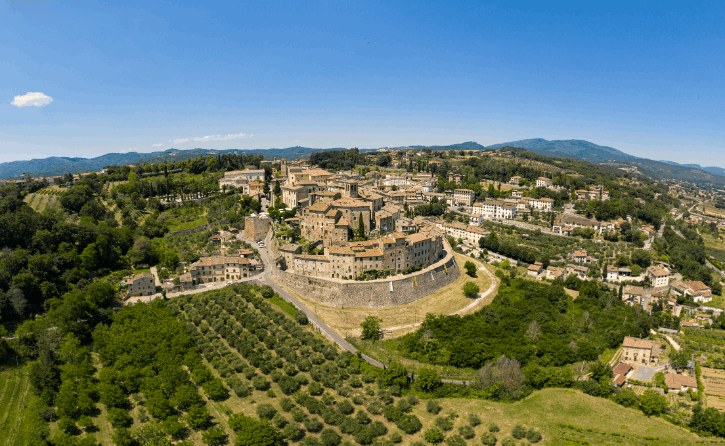
Anghiari is a beautiful historic village known for its medieval character and its important place in Italian history. Tied forever to a famous battle and a lost Leonardo masterpiece, it makes a perfect final destination for this journey.
b. A Village Steeped in Medieval Calm
Largely untouched by heavy tourism, the village keeps an authentic feel, with:
- Steep stone stairways and covered overpasses
- Small, quiet residential squares
- Panoramic terraces over the green Valtiberina plain
- A slower pace made for unhurried wandering
c. What to Explore in Town
- Piazza Baldaccio Bruni, the lively lower market square
- The Museo della Battaglia, telling the story of the 1440 battle
- Palazzo Pretorio, its facade covered in colorful coats of arms
- The Chiesa di Santo Stefano, a rare early-medieval church below the town
d. A Battle, a Genius, and Local Craft
- Learn how Leonardo da Vinci was commissioned to paint the battle, only for his experimental technique to fail
- Discover that his lost work survives today through sketches and a copy by Rubens
- Browse workshops for the village’s famed woodcraft and textiles
- Try Bringoli, a thick handmade pasta served with porcini or duck ragù
e. Where the Journey Comes Full Circle
The battle shaped Anghiari’s whole identity, and its medieval streets, craftsmanship, and connection to Leonardo give it real depth. So different from the wine regions before it, this quiet village brings the journey to a rich and memorable close. Twelve villages, one road, and an entire history of Tuscany discovered along the way.