Worried that Naples is too chaotic to explore on foot? You can relax. The old city packs centuries of history into a handful of straight, walkable streets, so ancient Greek roads, soaring churches, hidden tiled cloisters, busy craft lanes, and grand royal squares all run into one another.
You rarely need a map for long. You just follow the route and let the city reveal itself. Here is how one connected walk links fifteen of its finest spots, each only a short stroll apart. 😊
1. Naples Cathedral (Duomo di Napoli)
a. Where the City Keeps Its Soul
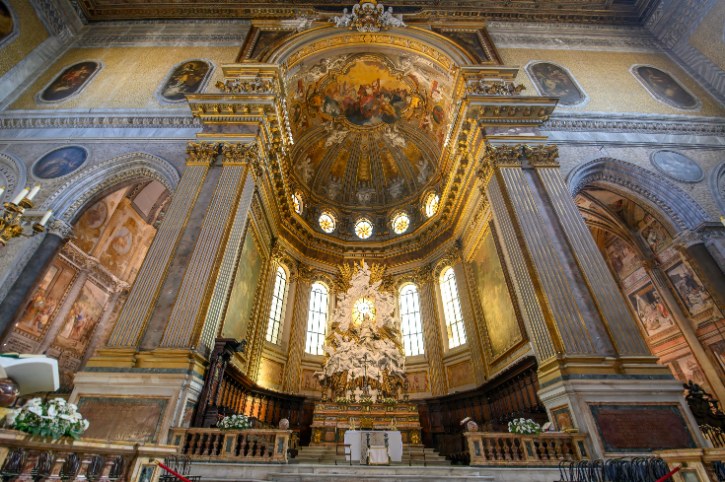
You start at the spiritual heart of Naples, the great Duomo. It was begun by the Angevin king Charles II and finished under Robert of Anjou in 1314, and it reads almost like a timeline of the city. You can see Roman foundations, early Christian churches, Gothic vaults, rich Baroque marble, and a 19th-century Neo-Gothic front all woven into one building.
b. The Blood That Stops the Whole City
The Duomo’s deepest bond is with San Gennaro, the city’s patron saint. Three times a year, crowds gather to watch a sealed phial of his dried blood turn to liquid.
- Believers see the liquefaction as a sign of protection over Naples.
- Scientists point out the substance behaves like a gel that can soften with gentle movement.
- Either way, the ceremony is one of the most emotional civic moments you can witness here.
c. The Riches Waiting Inside
- Look up at the gilded coffered ceiling, then notice the nave’s great piers, which encase 110 ancient columns reused from older Roman buildings.
- Step into the Chapel of the Treasure of San Gennaro for its bronze screen by Cosimo Fanzago, frescoes by Domenichino, and Lanfranco’s swirling dome of Paradise.
- Behind the silver altar sits the safe holding the saint’s reliquary bust and the phials of blood.
d. A Hidden Baptistery From the Dawn of Christianity
- Off the left side lies the Basilica of Santa Restituta, an early Christian church with 27 antique Roman columns.
- It leads to the Baptistery of San Giovanni in Fonte, considered the oldest surviving baptistery in the Western Christian world.
- Tilt your head toward its dome to find 5th-century mosaics glowing in blue and gold.
e. How to Feel the Place
Pause at the threshold of the Chapel of San Gennaro and let your eye travel from the calm nave into that dense, glowing Baroque space. The shift in mood tells you everything about how Naples layers its history. From here, the streets narrow, and a turn west pulls you into the lively run of Via dei Tribunali.
2. Via dei Tribunali
a. The Oldest Street Still Beating
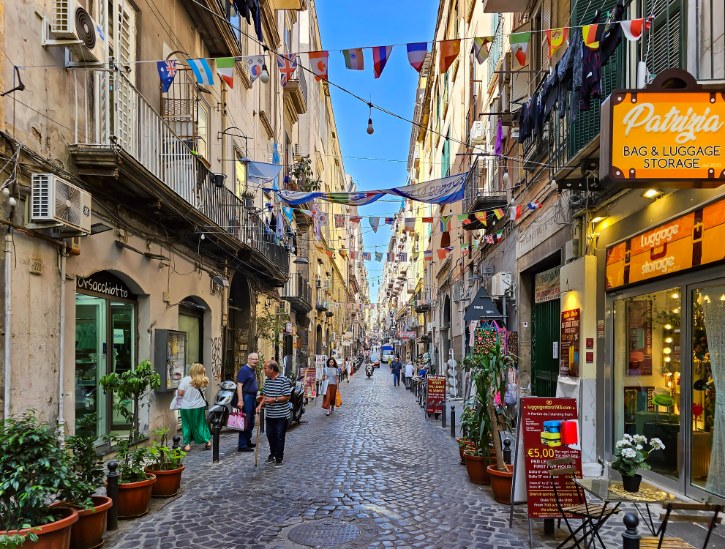
You are now walking the main artery of ancient Naples, laid out by Greek colonists more than 2,500 years ago as the Decumano Maggiore. It has been the city’s living spine ever since, and its energy has never faded.
b. Real Neapolitan Life, Up Close
- Ground-floor homes called bassi open straight onto the street.
- Family pizzerias, old bakeries, and craft workshops sit beneath Renaissance and Baroque facades.
- This unbroken daily life is a big reason the Historic Center is a UNESCO World Heritage site.
c. Skulls, Shrines, and Small Wonders
- Find the Church of Santa Maria delle Anime del Purgatorio ad Arco, whose dark front carries carved bronze skulls tied to an old devotion to forgotten souls.
- Spot the small lit street shrines, the edicole votive, decorated with fresh flowers and saints’ portraits.
- Look above the shop signs for reused Roman marble and worn family crests.
d. What to Eat as You Walk
- Grab a pizza a portafoglio, a Margherita folded in paper so you can eat it on the move.
- Try a hot frittatina di pasta, a fried disc of pasta, béchamel, peas, and meat.
- These counters are where the street’s flavor truly lives, so follow the smell.
The paving soon widens into Piazza San Gaetano, the very center of ancient Greek and Roman Naples.
3. Piazza San Gaetano
a. Standing on the Ancient Forum
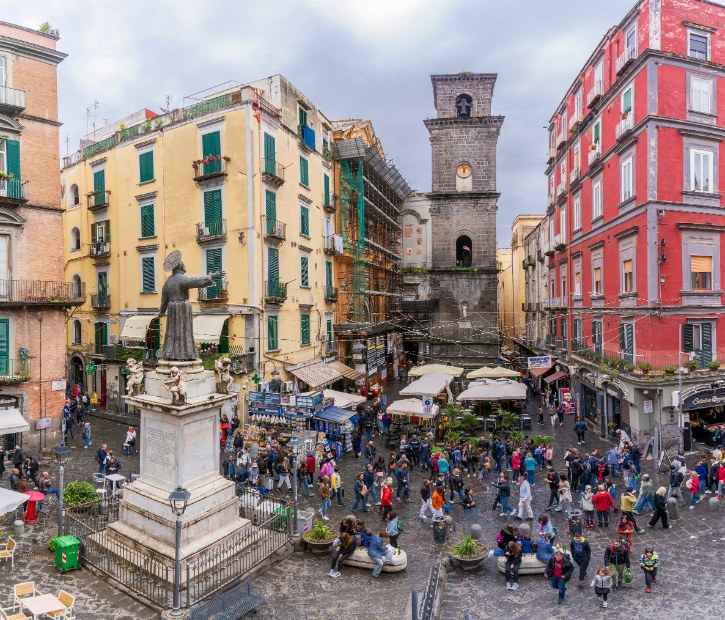
This square sits on the old heart of the city. In classical times it was the Greek agora and then the Roman forum, lined with temples, courts, and markets. Later, Christian churches rose directly on top, without erasing the ancient shape beneath your feet.
b. Columns That Outlived an Earthquake
- The Basilica of San Paolo Maggiore rose inside an ancient Roman temple, the Temple of the Dioscuri.
- The temple front once had six grand columns. Two of them survived the earthquake of 1688.
- You can still see those two ancient columns set right into the church front beside the staircase.
c. A Buried City Below the Church
- The Basilica of San Lorenzo Maggiore keeps a soaring Gothic interior behind its 18th-century Baroque facade by Ferdinando Sanfelice.
- Beneath its cloister lies Neapolis Sotterrata, a preserved Roman market with shopfronts and paved alleys.
- Walking it is like stepping into the city’s daily life from 2,000 years ago.
d. The Statue at the Center
At the heart of the square stands a bronze statue of San Gaetano, made by Cosimo Fanzago as a thank-you after the plague of 1656. It is a quiet reminder of how often this city has turned fear into faith and art.
Turning south, the grand walls give way to something smaller, busier, and full of handmade magic.
4. Via San Gregorio Armeno
a. The Street Where Christmas Is Made
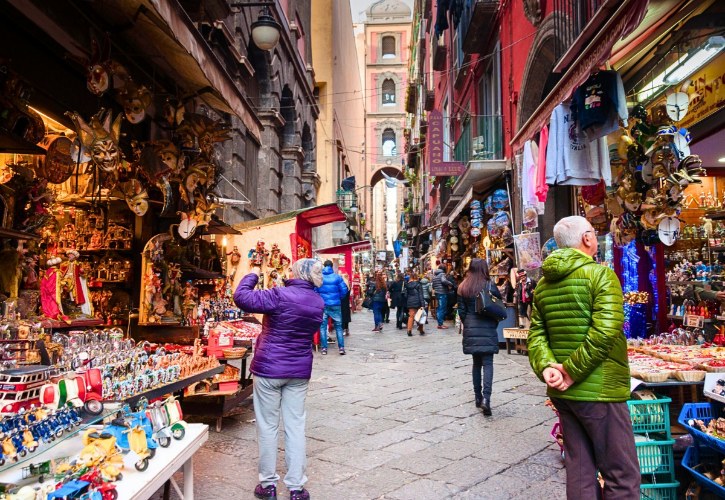
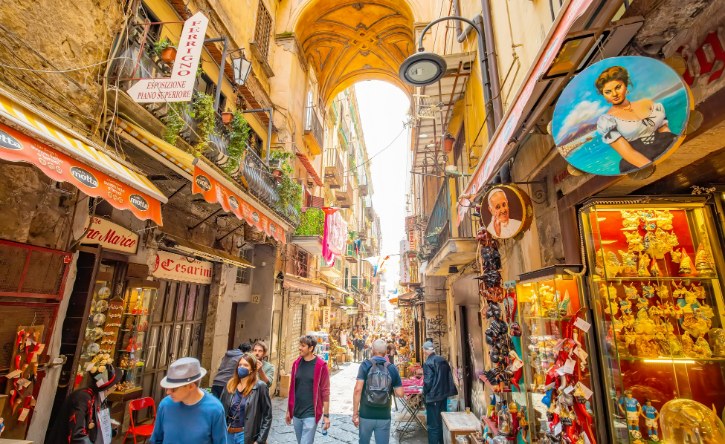
You have reached the world-famous lane of Neapolitan Nativity craft. The best news is that it works all year round, not just in December, so you can enjoy it in peace outside the holiday rush. The workshops are run by artisan families who have passed their skills down for generations.
b. Tiny Masterpieces to Look For
- Handmade figures called pastori, built with terracotta heads, glass eyes, and real fabric clothing.
- Whole miniature worlds of old Naples, from butcher shops to taverns full of diners.
- Cheeky caricatures of celebrities and sports heroes, above all Diego Maradona, treated here like a local saint.
c. A Calm Church Hiding in the Crowd
- Halfway down, step into the Church of San Gregorio Armeno.
- Inside you find gilded Baroque woodwork and wide frescoes by Luca Giordano.
- Look up outside too, where a raised arch once let cloistered nuns cross above the street.
d. How to Spot the Real Thing
- Genuine handmade pieces have a slightly rough terracotta texture and stiffened fabric.
- Many carry the artist’s own workshop signature.
- Smooth, shiny resin copies are the mass-produced giveaways.
At the end of the lane, you meet the dead-straight line of Spaccanapoli.
5. Spaccanapoli (Via San Biagio dei Librai)
a. The Line That Splits the City
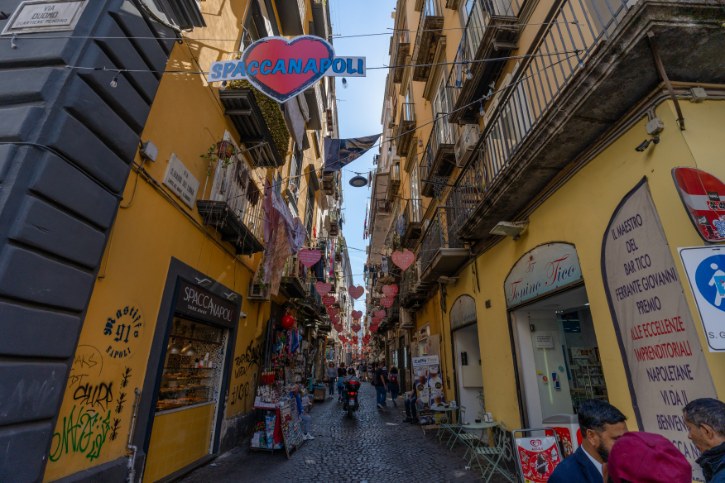
Spaccanapoli means “Naples Splitter”, and the name fits. Seen from the hills, this arrow-straight street slices clean through the red-tiled rooftops. You are walking an ancient Greek road more than 2,500 years old, right through the city’s oldest core.
b. The Old Quarter of Books and Palaces
- This stretch was once the quarter of booksellers and copyists.
- The philosopher Giambattista Vico was born and educated nearby.
- Grand palaces in dark piperno stone line the way, including Palazzo Marigliano with its elegant courtyard.
c. Details That Reward a Slow Walk
- Small wall shrines sit at eye level between old shops.
- Carved Baroque doorways open into working courtyards.
- Looking straight down the street gives you that classic long, framed view of balconies and laundry.
d. The Best Light of the Day
For photos, stand in the middle of the flagstones early in the morning or late in the afternoon. That is when the low sun cuts through the narrow canyon of buildings and throws dramatic light and shadow across the stone. Trust the timing, and the street looks completely different.
A short turn north leads you toward one of Italy’s most astonishing sculptures.
6. Museo Cappella Sansevero
a. A Chapel Like No Other
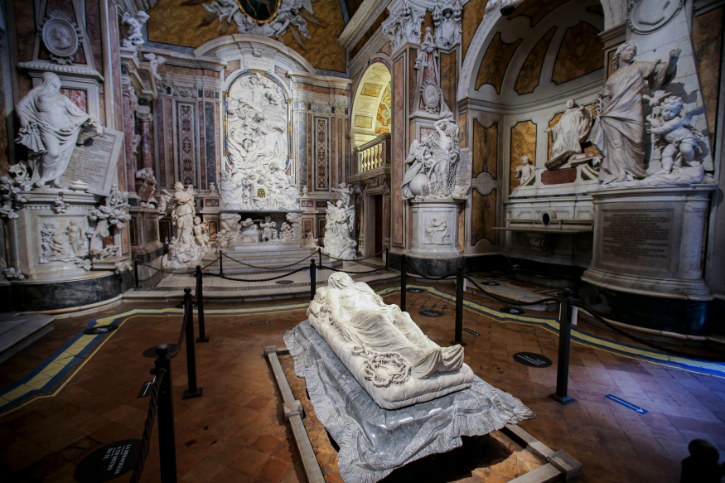
This small chapel holds some of the greatest marble sculpture on Earth. It was transformed by Raimondo di Sangro, Prince of Sansevero, an extraordinary figure who was part soldier, part inventor, part alchemist. He built it as a symbolic journey blending faith, philosophy, and science.
b. The Marble Veil That Fooled Everyone
- The Veiled Christ is carved from a single block of marble.
- The veil is so fine you can see the face and wounds through the “cloth”.
- For centuries people swore it was real fabric turned to stone, but records prove it was all carved by hand.
c. Two More Miracles in Stone
- Disinganno shows a man freeing himself from a net, with the whole net carved from one marble block.
- Pudicizia shows a woman draped in a sheer marble veil, honoring the prince’s mother.
- Even the ceiling fresco still glows, thanks to a paint the prince invented himself.
d. The Strange Secret in the Crypt
- Downstairs wait the Anatomical Machines, two skeletons fitted with detailed models of their blood vessels.
- Old legends claimed the prince used mercury on living people.
- The truth is just as fascinating. The “veins” are a careful handmade framework of wax, wire, and plant dye.
e. How to Take It In
Walk slowly all the way around the Veiled Christ and watch the light make the marble look soft. Then look closely at the net of the Disinganno, where carved marble lifts into real open space. This is a place to linger, not rush.
A gentle stroll south brings you into a lively, café-lined square.
7. Piazza San Domenico Maggiore
a. A Square Built on Big Ideas
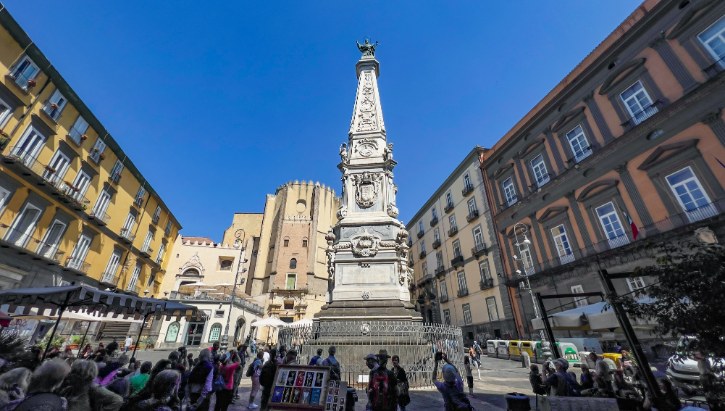
This was once a center of learning and power. Saint Thomas Aquinas taught here, and great thinkers studied nearby. Today it is a relaxed, lively square ringed by palaces, pastry shops, and café terraces, perfect for a slow pause.
b. The Spire at the Center
- The Guglia di San Domenico is an ornate Baroque spire built in thanks for the end of a plague.
- It is crowned with a bronze statue of Saint Dominic.
- From a café table, you can admire it against the church’s Gothic walls in one view.
c. A Church That Looks Like a Fortress
- The Basilica of San Domenico Maggiore turns its stern, fortress-like Gothic apse toward the square.
- You enter from the piazza up a grand flight of stairs.
- Inside you find Gothic frescoes and the cell linked to Saint Thomas Aquinas.
d. Kings in the Rafters
- High in the sacristy sits a balcony lined with 45 wooden coffins.
- They are draped in antique velvet and silk and hold Aragonese kings and nobles.
- It is one of the most unexpected royal sights in the whole city.
Leaving along the next stretch of Spaccanapoli, you reach the Gothic gates of Santa Chiara.
8. Complesso Monumentale di Santa Chiara
a. A Beloved Royal Retreat
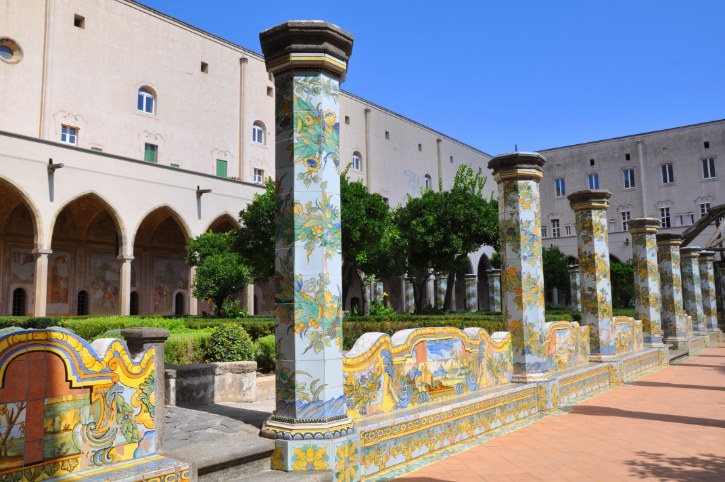
Founded in 1310 by King Robert the Wise and Queen Sancia, Santa Chiara was a vast monastery and the resting place of the Angevin kings. It carries a moving story of survival, since it was destroyed by bombing in 1943 and lovingly rebuilt to its original Gothic lines.
b. The Cloister Everyone Falls For
- The Majolica Cloister is the star, a garden framed by 66 pillars covered in hand-painted tiles.
- The tiles swirl with vines and flowers in blue, green, and yellow.
- Orange and lemon trees scent the air, making it a true escape from the busy streets.
c. Stories Painted on the Benches
- Long tiled benches run between the pillars, painted by the master Massa ceramists.
- Scenes show country festivals, carnivals, and ships at sea.
- Look for the lovely panel of a nun feeding bread to the monastery cats.
d. More Than the Garden
- Behind the altar towers the huge Tomb of King Robert of Anjou.
- An Opera Museum holds sculpture that survived the wartime fires.
- Beneath the grounds lie the excavated remains of ancient Roman baths.
Stepping back onto the street, you meet the strange, spiky front of the Gesù Nuovo.
9. Chiesa del Gesù Nuovo
a. A Palace That Became a Church
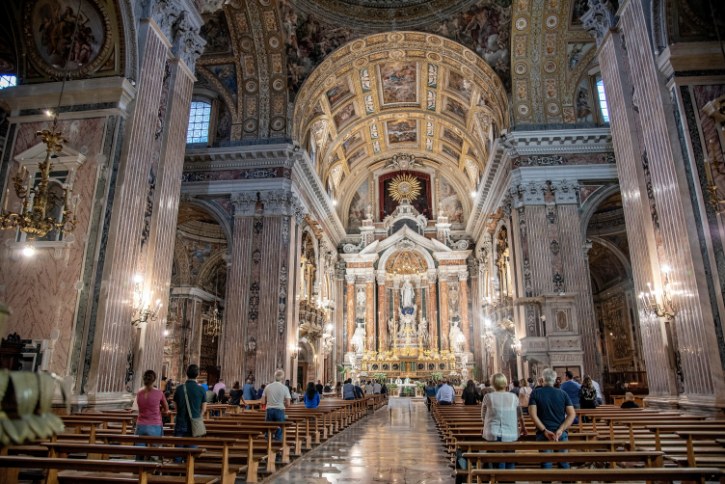
This church began life as a grand fortified palace, built in 1470. The Jesuits later bought it and turned it into a church, keeping its remarkable stone front. The result is one of the most surprising buildings in Naples.
b. The Mystery Carved in Stone
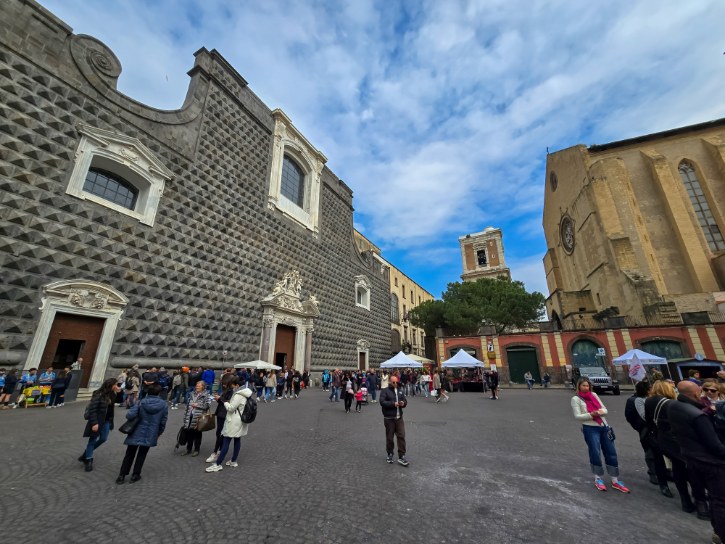
- The facade is covered in sharp diamond-point blocks of dark volcanic stone.
- Many carry small carved marks that fueled centuries of legend about curses and dark symbols.
- The real answer is simpler. They are ordinary quarry workers’ marks for tracking stone and payment.
c. The Dazzling World Inside
- Step through the plain door into a rich, colorful Baroque interior.
- Above the entrance hangs Solimena’s huge fresco of the Expulsion of Heliodorus.
- The walls glow with rich polychrome marble, worked by the city’s finest craftsmen.
d. The Holy Doctor and the Silent Bomb
- The church holds the tomb of Saint Giuseppe Moscati, a doctor who treated the poor for free.
- Locals still touch his bronze hand in prayer.
- In one aisle you can even see an unexploded wartime bomb that fell through the roof without going off.
A few steps outside, a wide square opens up with a soaring spire ahead.
10. Piazza del Gesù Nuovo
a. The Grand Western Gateway
This square marks the western edge of the old Greek-Roman center. It mixes Renaissance palaces, Gothic walls, and tall Baroque spires in one open space, and it has always been a stage for the city’s public life.
b. The Spire Paid For by the People
- The Guglia dell’Immacolata rises more than 30 meters at the center of the square.
- It was funded entirely by public donations.
- Marble carvings climb its sides, topped by a gilded statue of the Virgin.
c. A Touch of Movie History
- On the north side stands Palazzo Pandola, a filming location for Italian cinema classics.
- One of them starred the legendary Sophia Loren.
- From the southern side, you can frame the spire and the diamond facade together in a single shot.
d. The Legend and the Firefighters
- Local lore says the Virgin’s veil, seen from behind in certain light, resembles a hooded figure. It is only a trick of the eye.
- Each December, firefighters climb a ladder truck to place fresh flowers in her hands.
- The steps around the base make a perfect spot to sit and watch the square’s flow.
Crossing westward, you leave the ancient quarters and enter modern Naples.
11. Piazza Carità
a. Where Old Naples Meets New
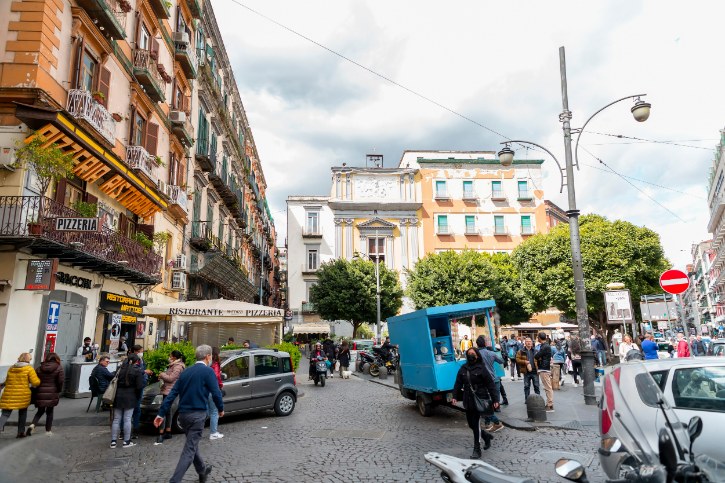
This square is the turning point of your walk, linking the medieval center with the modern boulevard ahead. It is less grand than the historic squares, but it tells the story of the modern city and its everyday life.
b. A Monument to Real Courage
- The central monument honors Salvo D’Acquisto, a young carabiniere during the Second World War.
- After an explosion, he falsely confessed to a crime to stop 22 innocent civilians from being shot.
- He saved them all and was executed in their place, and the city has never forgotten him.
c. A Change of Architecture
- Around the square rise bold 1930s buildings with clean, modern stone lines.
- They contrast sharply with the older quarters you just left.
- A 16th-century church also survives here, a quiet link to the square’s past.
d. A Handy Food Stop
- This is a great base for local bakeries, espresso bars, and pizzerias.
- Nearby sprawls the lively Pignasecca market, full of fishmongers and fruit sellers.
- You get an honest taste of daily Neapolitan life, away from the heaviest crowds.
From the southern corner, you step onto the city’s great shopping avenue.
12. Via Toledo
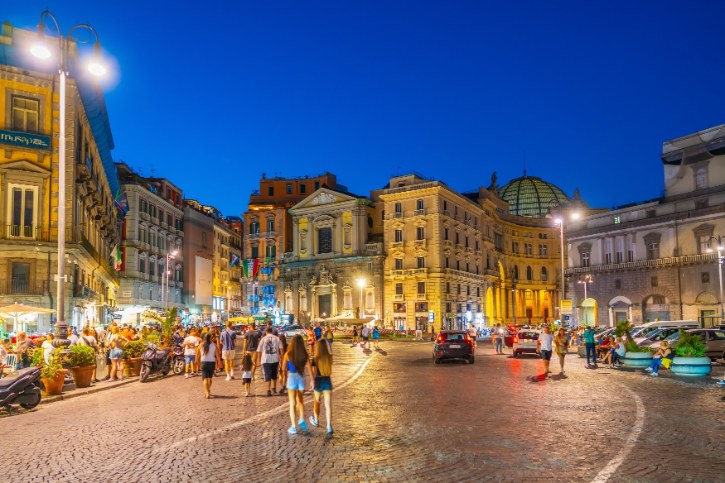
a. One of Europe’s Liveliest Streets
Laid out in 1536 by the Spanish viceroy it is named after, Via Toledo has drawn crowds for centuries. The writer Stendhal once called it one of the busiest, most joyful streets anywhere, and that spirit still holds today.
b. A Street of Two Worlds
- To the west climb the steep, packed alleys of the Quartieri Spagnoli, the Spanish Quarters.
- To the east stand grand palaces and old banking halls.
- Glance up any side alley for a classic view of laundry, shrines, and murals of local heroes.
c. Art and Architecture Above the Shops
- Look above the storefronts for ornate old balconies, stone crests, and pediments.
- The Gallerie d’Italia museum now fills a huge palace on the street.
- Inside hangs Caravaggio’s final masterpiece, the Martyrdom of Saint Ursula.
d. What to Taste and When to Stroll
- Join the late-afternoon passeggiata, when the whole street fills with people.
- Stop for a warm sfogliatella, either the flaky riccia or the softer frolla, filled with sweet ricotta.
- These simple pleasures are the real joy of the avenue.
Midway along, the street dips below ground into a modern marvel.
13. Stazione Toledo (Toledo Metro Station)
a. The Metro That Became a Museum
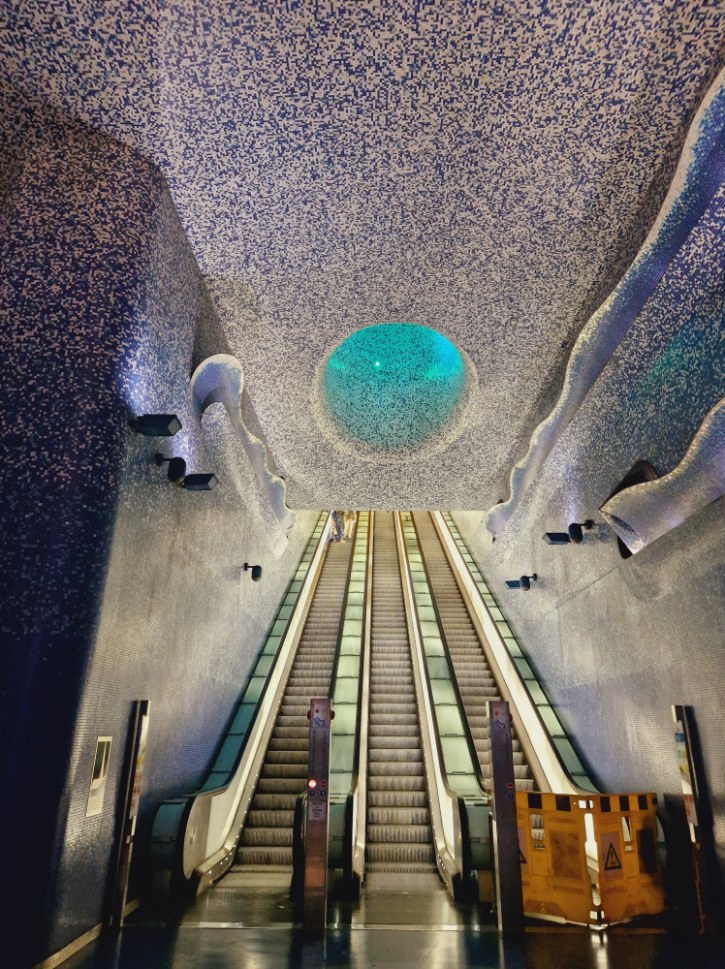
Opened on Line 1, Toledo Station is often named one of the most beautiful metro stations in the world. Designed by a celebrated Catalan architect, it turns an ordinary commute into a journey down through the layers of Naples.
b. A Descent Through the City’s Depths
- The upper levels use black and grey mosaics for the city’s streets and volcanic rock.
- Deeper down, warm ochre tiles stand for the soft tufo stone the city is carved from.
- At the bottom, glass mosaics shift from turquoise to deep cobalt, like sinking into the sea.
c. Art Hidden Below the Surface
- Two large mosaics by artist William Kentridge crowd the upper levels with figures from Neapolitan history, from Saint Januarius to everyday laborers.
- During construction, crews uncovered old defensive walls, now kept on display.
- The deeper art sits past the gates, so you ride down to reach the best of it.
d. The Cone of Light
- The showpiece is the Crater de Luz, a vast funnel that pulls daylight down from the street.
- It is lit with a shifting LED system by artist Robert Wilson.
- Riding the long escalator up into that circle of blue light is the moment to savor.
Back in the sunlight, a short walk south reveals a glittering glass hall.
14. Galleria Umberto I
a. A Triumph of Iron and Glass
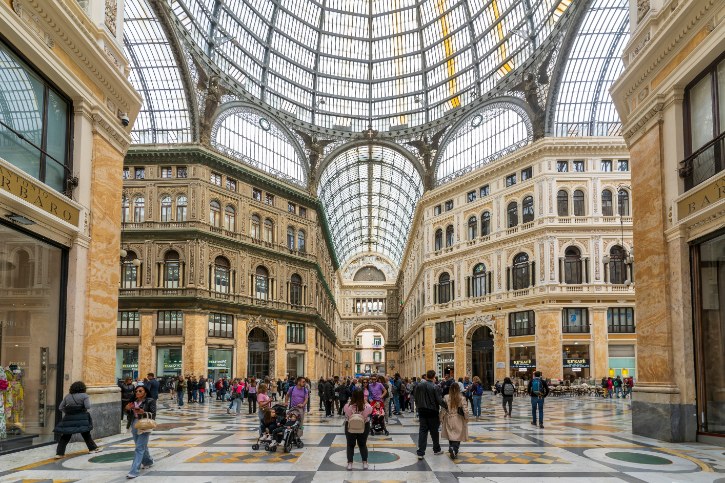
Built in the late 1800s, Galleria Umberto I was the centerpiece of a grand rebuilding of the city after a cholera outbreak. Named for the king who stood by Naples in that crisis, it was designed as a glorious public space for shopping and strolling.
b. Look Up Into the Dome
- Four glass-roofed wings meet under a soaring iron-and-glass dome.
- It rises an astonishing 57 meters above the marble floor.
- Standing at the exact center and looking straight up is the best way to feel its scale.
c. The Floor Worth Studying
- The marble floor holds a wide mosaic with the twelve signs of the zodiac.
- A local tradition says you should find your star sign and step on it for luck.
- The interior is also dotted with elegant sculptures and classical details.
d. A Grand Neighbor and a Quiet Coffee
- The southern exit faces the Teatro di San Carlo, Europe’s oldest active opera house.
- Inside the gallery, you can sip an espresso or enjoy a pastry under the vaulted ceiling.
- Violin music often drifts through, making it a lovely place to rest your feet.
A short walk through the next square brings you to the grand finale.
15. Piazza del Plebiscito
a. The Royal Heart of Naples
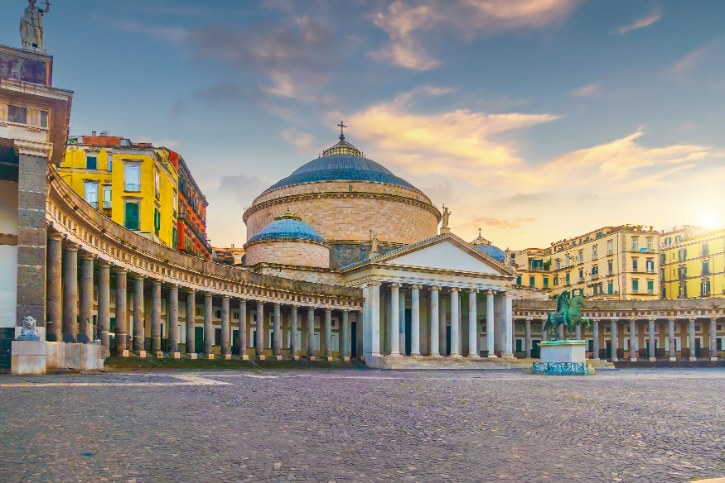
You finish in one of Italy’s largest and grandest squares, the ceremonial center of the city. Its name comes from the historic vote of 1860, when Naples and the south chose to join a unified Italy. Today it hosts ceremonies, concerts, and events under an open sky.
b. A Church Modeled on the Pantheon
- The Basilica of San Francesco di Paola curves across the western side.
- It was modeled directly on the Pantheon in Rome, with a great dome and sweeping colonnades.
- Its two curved arms of columns reach out to embrace the whole square.
c. The Palace and Its Kings
- Facing it stretches the long facade of the Royal Palace of Naples.
- Eight large statues fill its niches, each honoring a dynasty that once ruled the kingdom.
- Two grand bronze horsemen stand in the open center, one of them carved by the master Antonio Canova.
d. A Local Challenge to Try
- Try the famous blindfold challenge, walking straight from the palace through the gap between the two statues.
- Most people drift off course, because the paving has a gentle, hidden slope.
- Visit near sunset, when golden light sets the colonnades and palace aglow.
e. The End of the Walk
Here the city opens out toward the sparkling Gulf, and your journey comes to a natural close. In a single connected walk, you have crossed more than 20 centuries, from ancient roads and glowing churches to artisan lanes, breathtaking sculpture, a modern mosaic metro, and this royal square by the sea. That is the real magic of Naples. Explore it on foot, and its history, art, and daily life all reveal themselves, one easy step at a time.