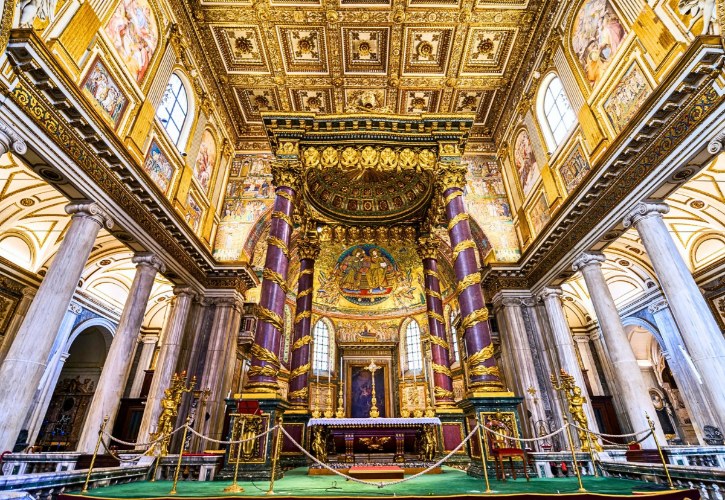
Rome holds more than nine hundred churches, and the best of them hide their beauty from the street. Behind plain stone fronts wait glowing mosaics, painted skies, and marble that seems to breathe.
Step inside and two thousand years of art and faith surround you at once. Wear comfortable shoes, keep your voice low, and look up often, because in Rome the finest details are almost always above your head.
Here are ten you will not want to miss. 😊
1. Chiesa di Sant’Ignazio di Loyola
a. A Church Built for a New Saint
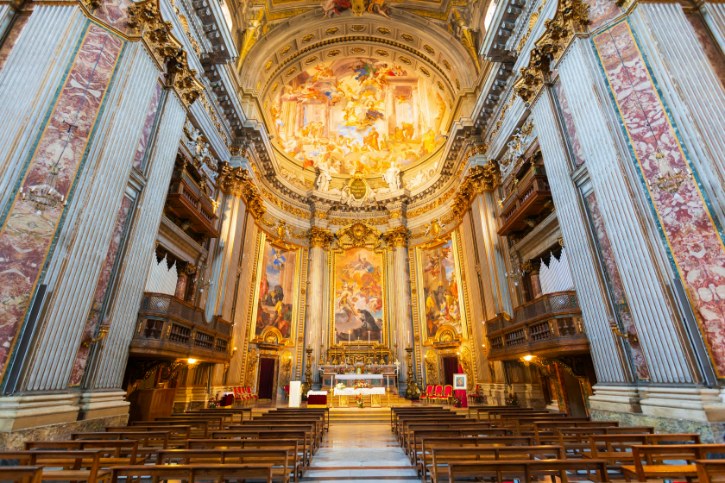
This church honors Saint Ignatius of Loyola, founder of the Jesuits, canonized in 1622.
- Construction began in 1626, funded by Cardinal Ludovico Ludovisi.
- Father Orazio Grassi, a Jesuit mathematician, led the design.
- It rose beside the Collegio Romano, serving its young Jesuit students.
- The large Latin cross interior runs about 81.5 meters long.
- The warm interior glows with red jasper, alabaster, and gilded stucco.
- Six connected side chapels line the nave.
- Its grand front echoes the nearby Chiesa del Gesù.
b. The Ceiling and Dome That Fool Your Eyes
Look up for one of the world’s greatest optical illusions, painted by Andrea Pozzo between 1685 and 1694.
- Stand on the yellow marble disc and the flat ceiling opens into an endless sky.
- Step away, and the painted columns bend and the trick falls apart.
- A second marker reveals the famous false dome, really a flat painted canvas.
- Pozzo painted it when money ran out and neighbors feared a real dome would block their light.
- The main fresco sends Christ’s light to the four known continents, honoring Jesuit missions.
- Old Testament heroes guard the corners near the crossing.
c. Chapels and Tombs to Notice
The side chapels hold some of the finest Baroque sculpture in the city.
- The Chapel of Saint Aloysius Gonzaga has a marble relief by Pierre Le Gros the Younger.
- A matching chapel honors Saint John Berchmans across the way.
- The Ludovisi Chapel holds the grand tomb of Pope Gregory XV.
- Look closely at how the marble is carved to look like soft, flowing cloth.
d. Why It Stays With You
This church does not just show you art. It asks you to take part in it. You stand on the markers, watch heaven appear, then step away and watch it vanish. That playful mix of science and faith gives Sant’Ignazio a character all its own.
2. Basilica di Santa Maria Maggiore
a. A Basilica Born From a Snowfall
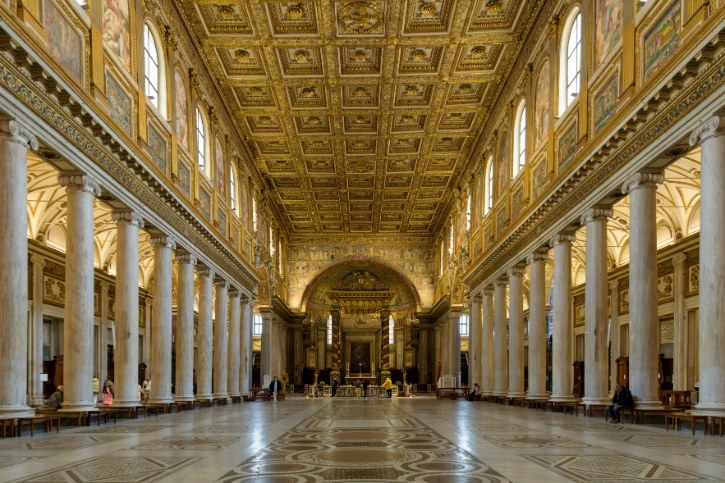
High on the Esquiline Hill stands the only major papal basilica that keeps its fifth-century core.
- It was built under Pope Sixtus III between the years 432 and 440.
- It is one of Rome’s four great papal basilicas, and the one most tied to Mary.
- Legend tells of the Miracle of the Snows, when snow fell in August to mark the spot.
- Records show the church rose under Sixtus III, so treat the snowfall as cherished tradition.
- Around forty ancient columns, most of them marble, line the long central nave.
b. Treasures of Faith Inside
Two revered objects draw pilgrims from around the world.
- The Salus Populi Romani, a Byzantine-style icon of the Virgin and Child, sits in the Borghese Chapel.
- The Relic of the Holy Crib holds five slats of wood tied to the manger in Bethlehem.
- Tradition once credited the icon to Saint Luke, though its true date is much debated.
- Both treasures make the basilica a meaningful stop for lovers of Christian heritage.
c. Golden Mosaics Across the Ages
The mosaics here span centuries and form the artistic heart of the basilica.
- The nave and arch mosaics from the 430s show Old Testament scenes and the life of Christ.
- The apse mosaic from 1295, by Jacopo Torriti, shows the Coronation of the Virgin.
- Golden vines around it hide birds, deer, and tiny river gods.
- A gilded coffered ceiling glows overhead, its gold linked to early American shipments.
- Two grand chapels, the Sistine and the Borghese, face each other across the nave.
- A plain floor slab near the altar marks the grave of the great sculptor Bernini.
d. Why It Feels Like Time Travel
Stand in the center of the nave and turn slowly. Ancient columns, golden mosaics, a Renaissance ceiling, and grand Baroque chapels surround you at once. No single style rules the room. Instead, you see sixteen centuries of art held together in one remarkable space.
3. Church of the Most Holy Name of Jesus (Chiesa del Gesù)
a. The Church That Became a Model
This is the mother church of the Jesuits, and its design was copied around the world.
- Construction began in 1568, funded by Cardinal Alessandro Farnese.
- Vignola shaped the interior, and Giacomo della Porta designed the grand front.
- Saint Ignatius himself first imagined the church.
- Its two-tiered façade became a pattern for countless churches.
- Look for the sweeping side scrolls that so many later churches copied.
b. One Open Space That Pulls You In
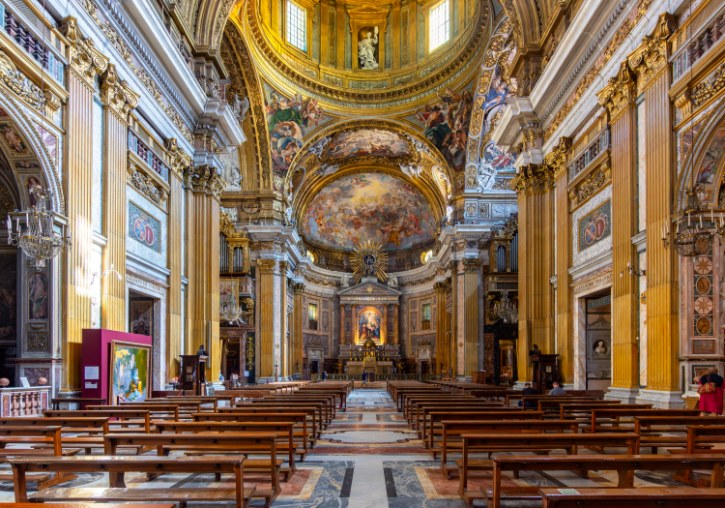
Step inside and your eyes are drawn straight to the altar.
- Vignola removed the side aisles, creating a single broad nave.
- Shallow chapels line the sides, keeping the focus forward.
- Colored marble, gilded stucco, and frescoes fill every surface.
- The layout follows the Council of Trent’s call for clear preaching and focus.
- A dome rises above the crossing, drawing your eye upward.
c. The Ceiling That Spills Into the Room
Look up for Gaulli’s fresco, the Triumph of the Holy Name of Jesus, from 1676 to 1679.
- The glowing IHS monogram blazes at the center.
- Saints rise upward while sinners tumble down toward the nave.
- Painted shadows on the gilded stucco make the figures seem to float into your space.
- Gaulli painted it under the guidance of the great Bernini.
- Stand in the center of the nave for the fullest sense of depth and motion.
d. Why It Is Worth Your Time
Beyond the ceiling, seek out the lavish Chapel of Saint Ignatius, with its lapis lazuli columns and the saint’s tomb. A hidden mechanism still lowers a painting each day to reveal his statue. Every corner was designed to move you, which is why the Gesù became the heart of the Jesuit world.
4. Papal Basilica of Saint Paul Outside the Walls
a. A Giant Over an Apostle’s Grave
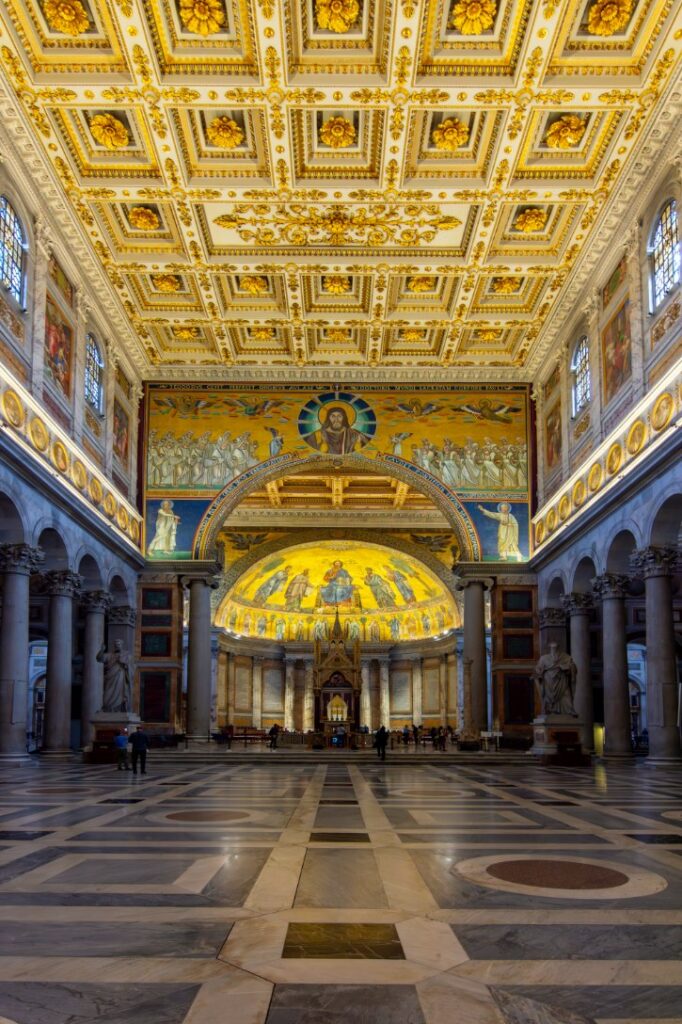
This vast basilica marks the burial place of the Apostle Paul, beyond the ancient city walls.
- Emperor Constantine founded the first shrine here in the year 324.
- A fire in 1823 destroyed most of it, and three popes rebuilt it on the old footprint.
- Later emperors expanded it into a huge five-aisle basilica, dedicated in the year 390.
- An outer courtyard is ringed by around 150 granite columns.
- Eighty tall granite columns and a gilded ceiling create an endless sense of space.
b. Mosaics and a Line of Every Pope
The art rewards a slow walk through the huge interior.
- The apse mosaic from around 1220 shows Christ enthroned with the apostles.
- A line of papal portraits circles the nave, recording every pope from Saint Peter onward.
- The figure of Pope Honorius III kneels at Christ’s feet in the apse.
- Look for the fifth-century mosaics on the great triumphal arch.
c. The Tomb and the Quiet Cloister
The heart of the basilica lies beneath the main altar.
- The tomb of Saint Paul sits below a Gothic marble canopy from 1285.
- Recent digging uncovered an ancient sarcophagus marked with Paul’s name.
- A thirteenth-century cloister nearby dazzles with twisted, colorful Cosmatesque columns.
- Nearby rooms hold a chain traditionally linked to Paul’s imprisonment.
- The cloister offers calm and intimate detail after the grand nave.
d. Why Its Scale Amazes You
Nowhere else in Rome gives you such an overwhelming sense of space. Rows of polished granite stretch out beneath a golden ceiling, and the hush makes you feel small in the best possible way. Pair the grand nave with the peaceful cloister for an unforgettable visit.
5. Basilica of San Giovanni in Laterano
a. The True Cathedral of Rome
Here is a surprise: the real cathedral of Rome is not Saint Peter’s.
- This is the seat of the pope as Bishop of Rome.
- Its title names it the Mother and Head of all Churches in the city and the world.
- Constantine founded it, and it was consecrated in the year 324.
- It was the first public Christian basilica in the Western world.
- Its grand east front was completed in the seventeen hundreds.
b. A Grand Interior by Borromini
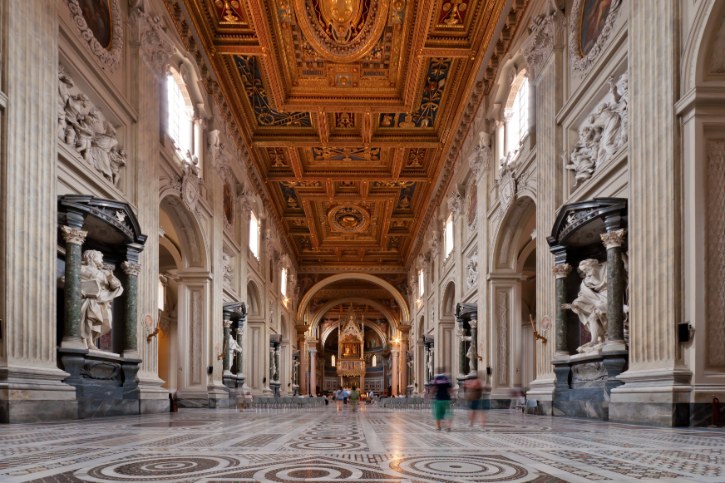
For the Jubilee of 1650, Francesco Borromini reshaped the nave.
- He wrapped the ancient columns inside bold new piers.
- Giant marble statues of the Twelve Apostles fill the niches.
- Their swirling robes bring real energy to the long nave.
- A gilded ceiling and a Gothic altar canopy crown the space.
- The canopy is said to hold the skulls of Saints Peter and Paul.
- Fifteen giant statues crown the façade, often mistaken for the apostles.
c. Ancient Doors and Treasures
Several treasures connect the church to ancient Rome.
- The bronze entrance doors once belonged to the Roman Senate House.
- The Corsini Chapel holds a sarcophagus salvaged from the Pantheon.
- Nearby stand the Holy Stairs, a baptistery, and a towering Egyptian obelisk.
- A preserved Giotto fresco fragment survives on a pillar in the right aisle.
- Remember that the Holy Stairs and baptistery are separate buildings nearby.
d. Why It Outranks the Rest
Walking through the doors of the old Roman Senate, past Borromini’s piers and the towering apostles, you feel the roots of Christian Rome. As the city’s true cathedral, it carries a weight that goes far beyond its art.
6. Basilica of San Clemente
a. Three Churches in One Spot
This church lets you walk down through two thousand years of history.
- Level one is the twelfth-century church at street level.
- Level two is a fourth-century early Christian church below.
- Level three holds ancient Roman ruins, including a temple of Mithras.
- The lower levels were rediscovered in the eighteen hundreds by a curious priest.
- Each staircase takes you deeper and further back in time.
b. The Bright Church Up Top
The upper church is a gem on its own.
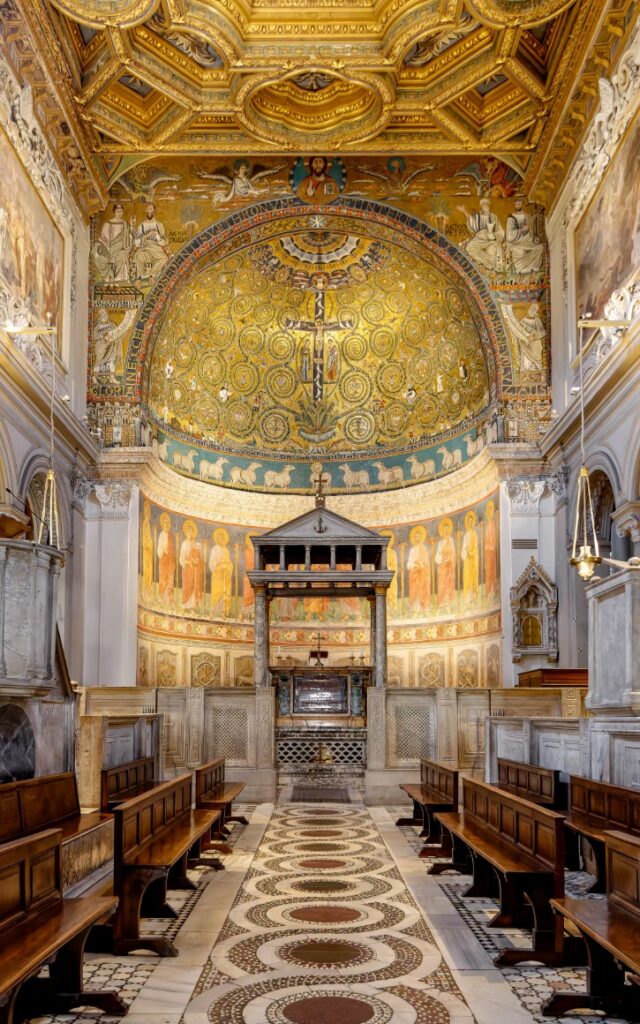
- The apse mosaic shows the Crucifixion as a glowing Tree of Life.
- Twelve white doves represent the Apostles.
- A Cosmatesque marble floor and choir add to its beauty.
- A side chapel holds early Renaissance frescoes by Masolino.
c. The Buried Worlds Below
Descend the stairs and the mood changes with every step.
- The lower church holds the Legend of Sisinnius, with text in early Italian.
- Deeper still, a temple of Mithras has an altar carved with a bull-slaying scene.
- Mithras was worshipped in a secret religion open only to its members.
- You can hear ancient water still running through the stone.
- The temple has two stone benches where followers once shared ritual meals.
- The lower church also holds the tomb of the missionary Saint Cyril.
d. Why the Descent Is Unforgettable
You begin in a bright medieval church, step into a shadowy early Christian hall, and end in a dark Roman temple. Few churches in the city let you travel through so many centuries in one quiet descent.
7. Basilica of Santa Maria in Trastevere
a. Rome’s Old Heart of Devotion
In the lively Trastevere district stands one of Rome’s oldest churches.
- Tradition links its founding to Pope Callixtus I, around the year 221.
- The present church was built between the years 1140 and 1143.
- A gentle legend tells of a spring of oil that rose here in ancient times.
- A floor inscription in the presbytery marks where the spring was believed to appear.
- Its square is one of the warmest, most welcoming spots in the city.
b. Golden Mosaics Over a Lively Square
The mosaics here glow in two layers of history.
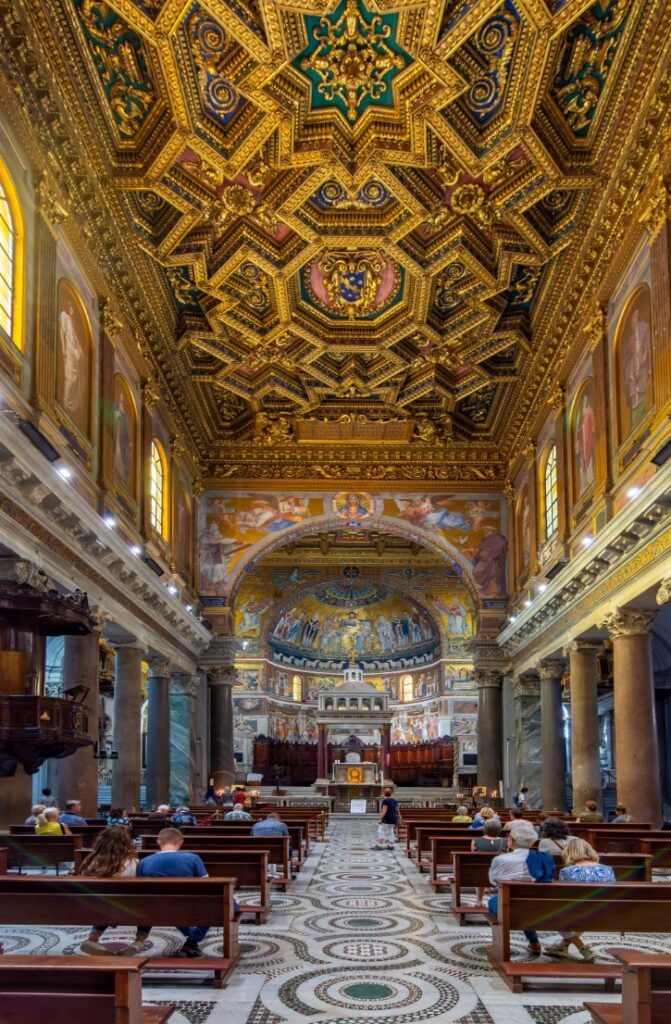
- The upper apse shows Christ and Mary enthroned side by side.
- Mary wears the golden robes of a Byzantine queen.
- The lower scenes, by Pietro Cavallini, tell the Life of the Virgin with new warmth.
- Cavallini’s softer, lifelike style pointed the way toward the great painter Giotto.
- A façade mosaic glows over the square at sunset.
c. Ancient Columns and Quiet Chapels
Look beyond the mosaics for older treasures.
- Twenty-two granite columns came from the ancient Baths of Caracalla.
- A gilded ceiling by Domenichino centers on the Assumption of the Virgin.
- The Altemps Chapel holds a rare early medieval icon of the Virgin, among the oldest in Rome.
- The Avila Chapel features a clever false dome held up by stucco angels.
- Carved faces on the capitals, long thought to show Egyptian gods, were hammered off in a nineteenth-century restoration.
d. Why It Feels Like Home
This church balances world-class art with real neighborhood life. The golden mosaics shimmer over ancient columns, while a lively square waits just outside the doors. Visit in the late afternoon, when the façade glows and the square fills with people.
8. Church of Santa Maria della Vittoria
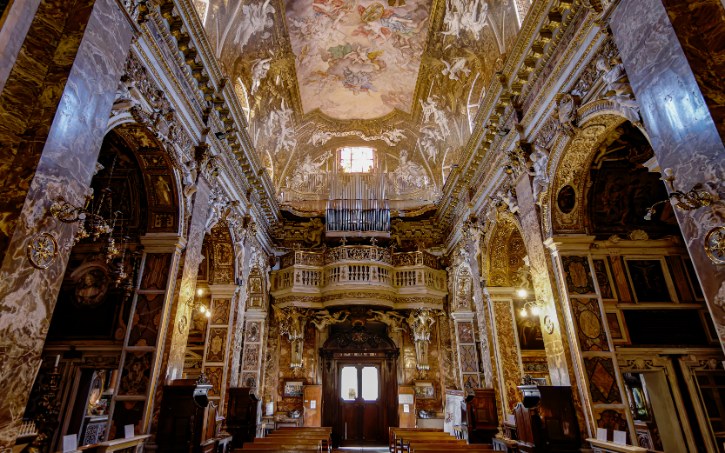
a. A Victory Turned Into a Church
A modest front hides one of Rome’s richest Baroque interiors.
- It was built from 1608 by the Carmelites, designed by Carlo Maderno.
- It was renamed after a famous battle near Prague in the year 1620.
- A grateful emperor and Roman nobles funded its lavish makeover.
- Its front was paid for in exchange for a famous ancient statue found nearby.
b. An Interior of Marble and Gold
Every surface glows with color and gilding.
- Deep yellow, green, and red marbles cover the walls.
- Painted ceilings by Cerrini and Serra fill the nave and apse.
- A single nave is lined with three richly decorated chapels on each side.
- Look beyond the famous chapel to enjoy this rich detail.
c. Bernini’s Famous Chapel
The Cornaro Chapel holds one of the greatest Baroque sculptures.
- Bernini’s Ecstasy of Saint Teresa shows the saint lifted in a mystical vision.
- A hidden window lights gilded rays behind the marble figures.
- Sculpted family members watch from marble boxes like a theater audience.
- The scene captures a mystical vision from Saint Teresa’s own writings.
- Other chapels hold fine works by Domenichino and Guercino.
d. Why This Small Church Hits Hard
In Bernini’s hands, hard marble seems to turn soft, capturing deep emotion in stone. The hidden light brings the whole scene alive. Few churches deliver such intense beauty in such a small, intimate space.
9. Basilica di Santa Maria sopra Minerva
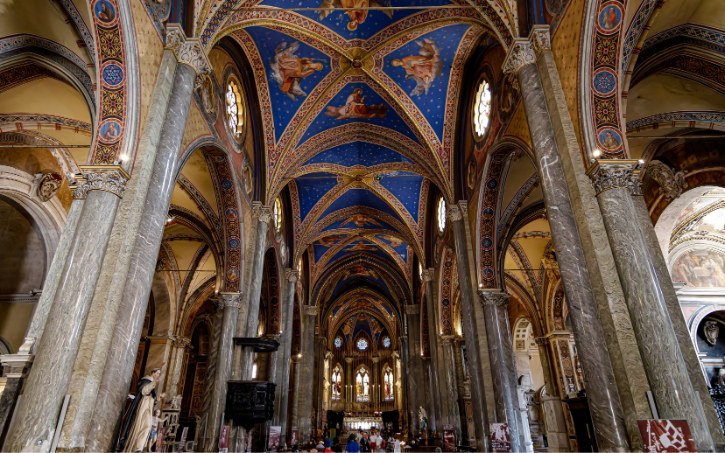
a. A Gothic Surprise by the Pantheon
Next to the Pantheon stands Rome’s only major Gothic church.
- The Dominicans began building it around the year 1280.
- A plain front hides pointed arches and ribbed vaults inside.
- It was built over the ruins of an ancient temple to Egyptian gods.
- The ceiling is a deep blue scattered with gold stars.
b. Michelangelo and the Masters
The art here spans the great names of the Renaissance.
- Michelangelo’s Christ the Redeemer stands beside the high altar.
- A gilded bronze cloth was added to the statue later, for modesty.
- The Carafa Chapel holds glowing frescoes by Filippino Lippi.
- These true frescoes feel warm and alive against the cool Gothic stone.
- Michelangelo’s statue shows the risen Christ leaning on the Cross.
- The Carafa frescoes include a glowing Annunciation and Assumption.
c. Tombs, Memorials, and an Elephant
This church is a resting place for great figures.
- Saint Catherine of Siena lies beneath the high altar.
- Fra Angelico, patron saint of artists, is buried here too.
- A small Bernini memorial turns dark marble into billowing drapery.
- Outside stands Bernini’s beloved Elephant and Obelisk monument.
- The grand tombs of two popes sit in the choir behind the altar.
- Romans fondly nickname the little elephant “Minerva’s Chick”.
d. Why It Breaks the Rules
After a day of Baroque domes, this starry Gothic hall feels like a gentle surprise. Michelangelo’s marble Christ, Lippi’s frescoes, and famous tombs give it quiet depth. It is a calm, thoughtful counterpoint to the rest of the city.
10. Chiesa di San Luigi dei Francesi
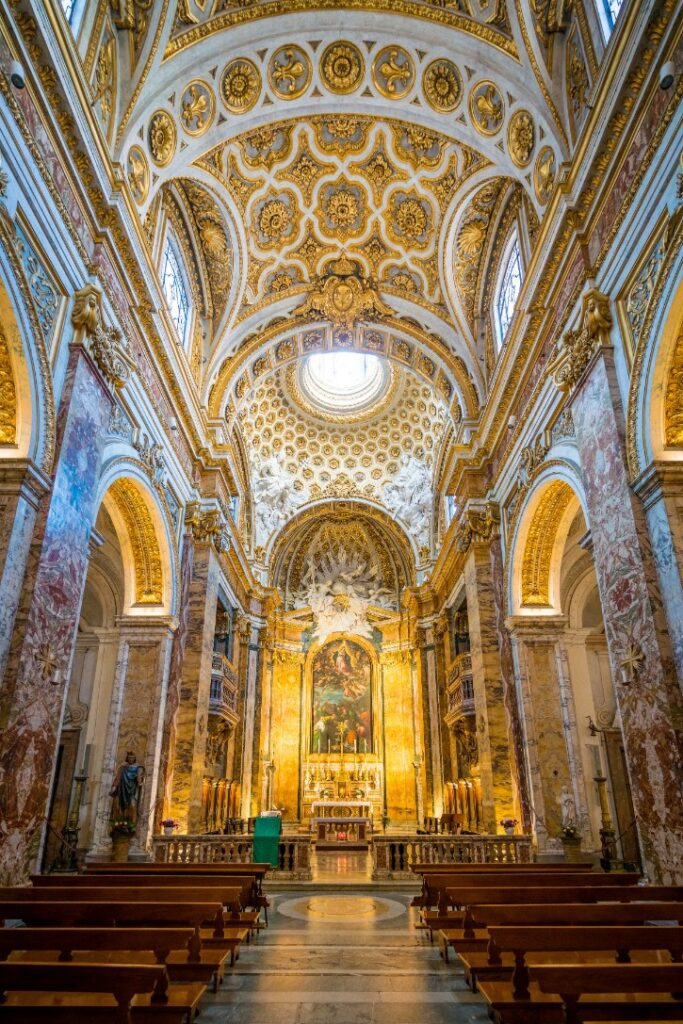
a. A Piece of France in Rome
Between Piazza Navona and the Pantheon stands the French community’s church.
- It is dedicated to Saint Louis, King Louis IX of France.
- It was founded in 1518 by Cardinal Giulio de’ Medici, a future pope.
- Queen Catherine de’ Medici was among its royal patrons.
- French symbols and saints decorate its elegant front.
b. Three Caravaggios in One Chapel
The Contarelli Chapel holds one of the most famous painting cycles in art.
- The Calling of Saint Matthew shows a beam of light reaching Levi in a dim tavern.
- The Inspiration of Saint Matthew shows the saint writing beside an angel.
- The Martyrdom of Saint Matthew shows the apostle’s dramatic final moment.
- Caravaggio even painted himself into the martyrdom scene.
- Follow the light in each painting to see where he wants you to look.
- Bring a few coins, as the lights are often coin-operated.
c. Quieter Art Across the Aisle
Do not miss the beautiful work on the other side of the church.
- The Polet Chapel holds frescoes by Domenichino on the life of Saint Cecilia.
- His calm, classical style contrasts with Caravaggio’s raw drama.
- The scenes follow the life of Saint Cecilia, patron saint of music.
- A rich ceiling fresco honors Saint Louis above the nave.
d. The Perfect Final Stop
Few places let you meet Caravaggio’s genius face to face, in the very chapel his paintings were made for. The dramatic light and lifelike figures feel almost alive. Take your time with each one, and notice how the three scenes follow key moments in Saint Matthew’s life, from his calling to his death. It is a fitting way to end any journey through the churches of Rome.
Simple Tips for Your Visits
A little planning makes church-hopping in Rome far more enjoyable. Keep these quick pointers in mind.
- Dress respectfully, with shoulders and knees covered, or you may be turned away.
- Keep your voice low, since many people come to pray, not just to look.
- Bring small coins, as some chapels and famous artworks are lit by coin-operated lights.
- Visit early or late for softer light and smaller crowds.
- Check opening hours, because many churches close for a few hours midday.
- Look up often, since the best details are usually on the ceilings.
It also helps to group your visits by area.
- Sant’Ignazio, the Gesù, San Luigi dei Francesi, and Santa Maria sopra Minerva sit close together near the Pantheon.
- Santa Maria Maggiore and San Giovanni in Laterano pair well on the eastern side of the center.
- Santa Maria in Trastevere fits a relaxed afternoon across the river.
- Saint Paul Outside the Walls sits farther out and deserves its own trip.
- San Clemente slots neatly into any day near the Colosseum.
Above all, let yourself be surprised. The plainest door in Rome can open onto the most dazzling room you have ever seen, so take your time and follow your curiosity.