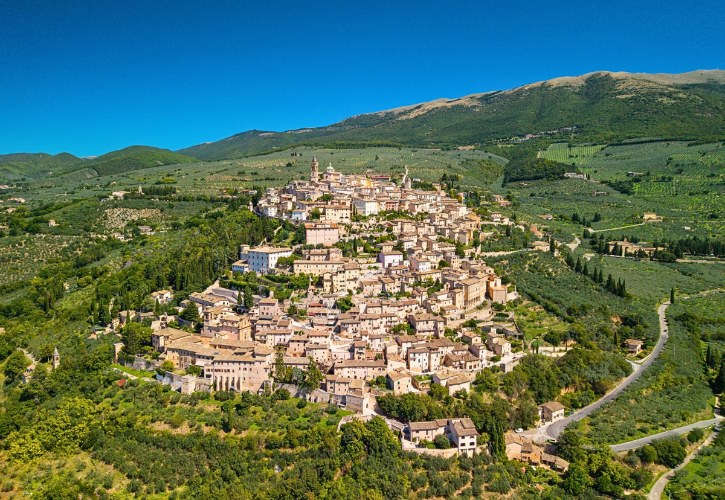
Picture winding country roads, olive groves that roll on forever, and medieval towns glowing on the hilltops. That is Umbria, the green heart of Italy, and it is made for driving.
There are no rushing highways to hurry you along, just quiet lanes that reward you with one beautiful view after another.
You get to slow down, follow your curiosity, and let the region reveal its vineyards, sacred springs, and timeless art at your own pace. Here is where to go. 😊
1. Perugia
a. Why You Should Start Here
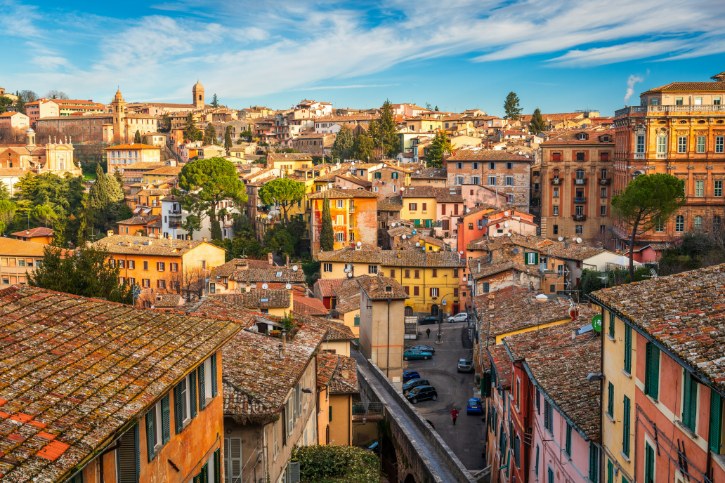
Perugia is the ideal place to begin your journey. The regional capital sits high on an irregular ridge, nearly five hundred meters above the Tiber River valley, and you feel that height the moment you arrive.
- People have lived here for over two thousand years, first the ancient Umbri, then the Etruscans.
- Their massive stonework still stands in the travertine city walls and the Arco Etrusco, an Etruscan arch from the 3rd century BC.
- The approach gives you sweeping views of tiered stone facades rising steeply out of the green hills.
b. The Heart of the Old Town
Climb to the top of the historic center and you reach Piazza IV Novembre, one of the most harmonious medieval squares in Italy.
- Fontana Maggiore: A circular fountain carved between 1275 and 1278 by Nicola and Giovanni Pisano, decorated with marble panels showing the farming months, the liberal arts, and historic figures.
- Palazzo dei Priori: A graceful Gothic civic palace built between 1293 and 1443, crowned with battlements and guarded by bronze statues of the Perugian Griffin and the Guelph Lion.
These two landmarks face each other across the square, and together they set the tone for the whole city.
c. Art and Hidden History
Perugia rewards anyone curious about art and history. Inside the Palazzo dei Priori you will find the Collegio del Cambio, the old seat of the money-changers’ guild.
- Its audience hall holds a High Renaissance treasure, a fresco cycle painted between 1496 and 1500 by Pietro Vannucci, known as Il Perugino, with help from his young pupil Raphael.
- The scenes blend classical figures like Cato and Socrates with Christian themes, and the master even slipped in a trompe-l’oeil self-portrait.
Below the old center lies the Rocca Paolina, a huge papal fortress built in the 1540s. Whole medieval neighborhoods were buried beneath its brick vaults, and walking through these underground passages today feels like exploring a hidden city, with intact streets and doorways frozen in time.
d. A Lively, Youthful City
Modern Perugia has real energy, thanks to a historic university founded in 1308 and a famous university for foreigners. Two events fill the ancient alleys with an international buzz:
- Umbria Jazz in July, one of Europe’s great jazz festivals
- Eurochocolate in autumn, a dream if you love the city’s chocolate tradition
e. The Best Views in Town
Perugia’s hilltop setting gives you some wonderful places to pause and look out.
- Giardini Carducci: A terrace garden laid over the old fortress ramparts, with a wide southern view across the valley toward Monte Subasio.
- Porta Sole: A higher terrace, mentioned by Dante himself, that looks over the northeastern Apennines.
Trust me, these terraces are the perfect spot to catch your first real sense of the Umbrian countryside.
Leaving Perugia, the road winds down through gentle slopes into the wide, flat floor of the valley. The dense stone of the capital gives way to an open farming plain, with fields and vineyards stretching toward the great mass of Monte Subasio.
2. Santa Maria degli Angeli
a. A Town Built Around One Church
Down on the valley floor, directly beneath Assisi, you reach a town shaped entirely by a single remarkable sanctuary.
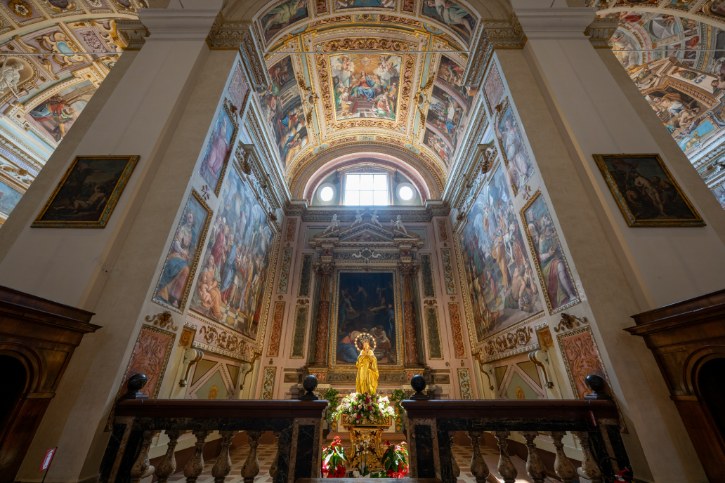
- The Papal Basilica of Santa Maria degli Angeli was commissioned by Pope Pius V and built between 1569 and 1679.
- It was rebuilt after the earthquake of 1832, and its facade was reworked again in the early twentieth century.
- The whole settlement grew up around this one pilgrimage site.
b. The Little Chapel Inside the Giant
Here is the fascinating part. This enormous, gilded basilica was raised to shelter a tiny, primitive stone chapel that now stands under its central dome.
- That little chapel is the Porziuncola, a humble stone oratory from the 10th century.
- Saint Francis repaired its walls with his own hands around 1205, and the Benedictine monks of Monte Subasio later gave it to him.
- Here he received his calling to a life of poverty and founded the Order of Friars Minor.
Stepping inside this small, smoke-stained chapel, you sense the simple beginnings of a movement that spread across the world.
c. Sacred Corners Worth Seeking Out
The complex holds several meaningful spots beyond the main chapel:
- Cappella del Transito: The small infirmary cell where Saint Francis died on the evening of October 3, 1226, decorated with frescoes by the painter known as Lo Spagna and a glazed terracotta statue by Andrea della Robbia.
- Il Roseto: The legendary rose garden, tied to the thornless roses associated with the saint.
- Cappella delle Rose: A 16th-century chapel with lively frescoes by Tiberio d’Assisi.
d. A Calm, Open Setting
Santa Maria degli Angeli feels completely different from Perugia’s steep lanes. The basilica rises over a broad, open square on the flat valley plain.
Look up from the quiet piazza and you will see the great stone arcades of Assisi outlined against the pink face of Monte Subasio. This stop deserves its own place on the route. It lets you connect with the humble side of the Franciscan story before you meet its grand artistic side.
From the plain, the road begins to climb toward the hillside town waiting above.
3. Assisi
a. A Town Carved from the Mountain
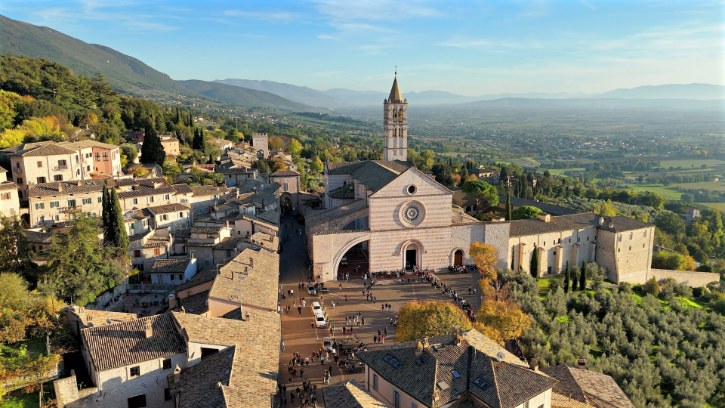
Assisi is one of Umbria’s most important and beautiful towns, named a UNESCO World Heritage site in 2000.
- It is built almost entirely from the pink and white limestone of Monte Subasio.
- Its walls seem to shift color as the light changes through the day.
- Narrow terraced streets climb the mountainside, opening onto sweeping views of the plain below.
This is the home of Saint Francis and Saint Clare, and that history is woven into every stone.
b. The Great Basilica of St. Francis
The Basilica di San Francesco is the town’s crown jewel. Begun in 1228, just two years after Francis’s death, it is a masterwork of Italian Gothic architecture made of two churches, one above the other.
- Lower Church: Low Romanesque arches create a dim, prayerful mood, with frescoes by early masters including Cimabue’s famous portrait of Saint Francis, works by Giotto and his workshop, scenes by Simone Martini, and a powerful Crucifixion by Pietro Lorenzetti.
- The crypt: Beneath the nave rests the plain stone tomb of the saint, sealed in secret in 1230 and rediscovered in 1818.
- Upper Church: A brighter, soaring space where the celebrated cycle of twenty-eight scenes from the life of Saint Francis runs along the walls, traditionally attributed to Giotto di Bondone.
These frescoes changed art forever, as Italian painting moved toward real human emotion, depth, and natural landscapes.
c. Santa Chiara and the Roman Temple
A short walk brings you to two more striking sights.
- Basilica di Santa Chiara: Bold pink and white stone bands and dramatic flying buttresses. Inside, the chapel of San Giorgio keeps the wooden Crucifix of San Damiano, the cross said to have spoken to Saint Francis in 1205.
- Temple of Minerva: On Piazza del Comune, the old Roman forum, stands this beautifully preserved classical facade from the 1st century BC, its six Corinthian columns now fronting a church.
You get Roman and Catholic architecture side by side, a vivid reminder of how deep this town’s history runs.
d. The Quiet, Spiritual Side
Beyond the great churches, Assisi has a reflective spirit that stays with you.
- Eremo delle Carceri: A hermitage tucked into the forests of Monte Subasio, where Francis and his companions prayed in caves carved from the cliffs.
- Calendimaggio: A spirited medieval spring pageant each May, when the upper and lower districts compete in archery, song, and costume.
Wander the smaller lanes and quieter churches, and you will understand why so many travelers find this town unforgettable.
Leaving Assisi along the mountain’s southern flank, olive groves blanket the terraced slopes as the road curves toward another lovely hill town.
4. Spello
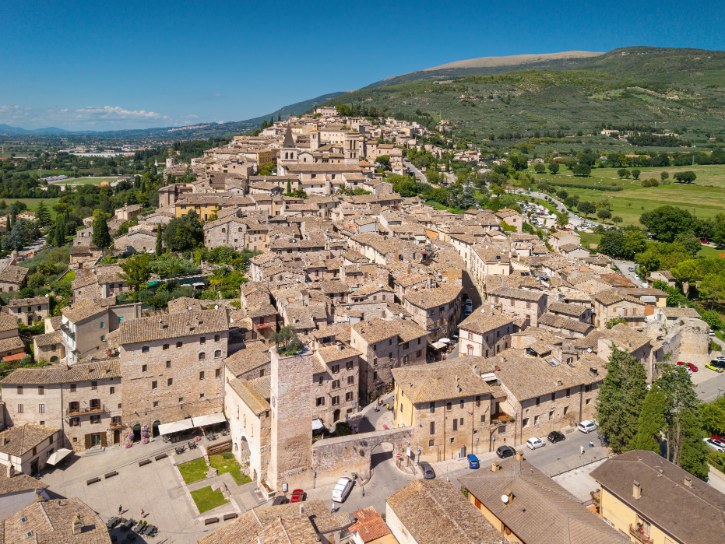
a. The Town That Loves Flowers
Spello greets you as a cascade of warm pink stone wrapped in blossoms. Known in Roman times as Hispellum, it is one of the most charming and best preserved historic centers in central Italy.
- Along streets like Via Cavour and Via dell’Arco, residents fill every balcony, archway, and staircase with geraniums, petunias, and climbing vines.
- The flowers are not just decoration, they are a point of local pride, tended with real care.
b. A Spectacular Spring Festival
Each spring, for the feast of Corpus Christi, the town hosts the famous Infiorate di Spello.
- Local artists spend months gathering millions of flower petals.
- They work through a single night to turn the streets into a floral carpet of sacred and geometric designs.
- The finished carpet stretches more than a kilometer and a half before fading by evening.
Even if you miss the festival, Spello’s floral character lasts all year round.
c. Roman Gates and Renaissance Art
Spello carries a deep Roman and medieval past that you can still see on foot.
- Porta Consolare: An ancient limestone gateway from the 1st century BC, topped with three old funerary statues.
- Porta Venere: A grand gateway with three travertine arches, flanked by twin twelve-sided towers.
- Santa Maria Maggiore: A Romanesque church holding the town’s greatest treasure, the Baglioni Chapel, frescoed by Pinturicchio in 1500 and 1501, right down to a floor of glazed Deruta tiles.
Take your time and notice the small details, from carved doorways to the painter’s hidden self-portrait inside the chapel.
d. Where to Catch the View
Climb toward the upper town for the best scenery.
- The Belvedere dei Cappuccini, up near the top of the town where the old acropolis once stood, looks across the plains toward Foligno and the Martani mountains.
- Quiet corners and olive-draped slopes make lovely, unhurried spots for photos.
Spello’s mix of flowers and hilltop views gives it a softer, more colorful mood than Assisi.
From here the road turns east, climbing into the limestone ridges and oak forests of the Apennines. The next stop trades flowers for something unexpected, flowing water.
5. Rasiglia
a. The Village Built on Water
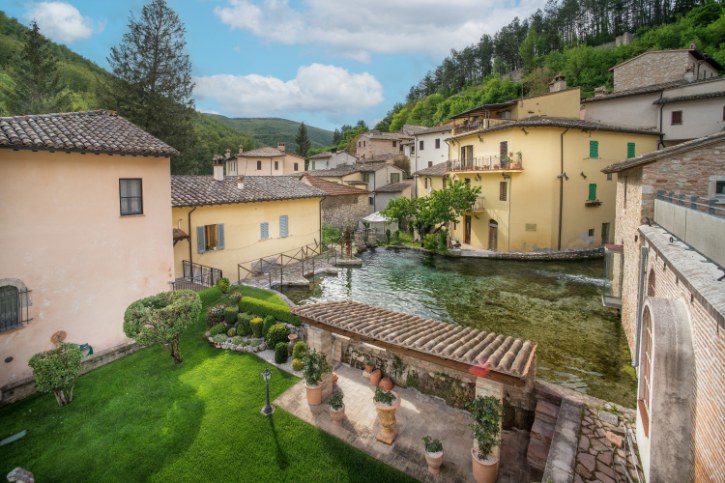
Tucked into the forested folds of the Menotre Valley, tiny Rasiglia is one of the most enchanting places in Umbria.
- It is often called the “Village of Water” or the “Venice of Umbria”.
- The whole village is built around a maze of fresh springs, streams, and stone canals.
- The water runs beneath, around, and between the houses, so its gentle sound follows you everywhere.
b. How the Water Shaped the Village
Everything here flows from the Capovena spring, which bursts from the limestone cliff above the upper houses. Over generations, local craftsmen built channels, small gates, and wooden footbridges to guide the water through every corner of the settlement. The result is a village that feels completely woven into its stream.
c. The Spots You Shouldn’t Miss
A few corners stand out as you explore:
- La Peschiera: A large stone basin in the heart of the village where the springs and canals gather, once used as a reservoir and for washing sheep before shearing.
- Molino Silvestri: An 18th-century grain mill with its grinding stones still in place.
- Rocca dei Trinci: The ruins of a 14th-century fortress on the rocky spur above, built to guard an old trade route.
d. A Living Record of Old Crafts
For centuries, the swift current powered grain mills and textile workshops where mountain wool was spun and woven. That industry faded by the mid-twentieth century, but the old mills and looms remain as a quiet record of the past. Two gentle traditions still bring the village to life:
- Penelope a Rasiglia in June, which revives old handloom weaving
- A beloved living nativity in winter, staged across the waterways
e. Simply a Place to Breathe
Cars cannot enter the narrow inner lanes, so you just walk, crossing little wooden bridges and following streams past flower-hung stone alleys. If you love peaceful villages and photography, this stop is a real gift.
Leaving Rasiglia, the road descends out of the gorge and follows the river back toward the plains, where wide farmland and calm riverbanks lead you onward.
6. Bevagna
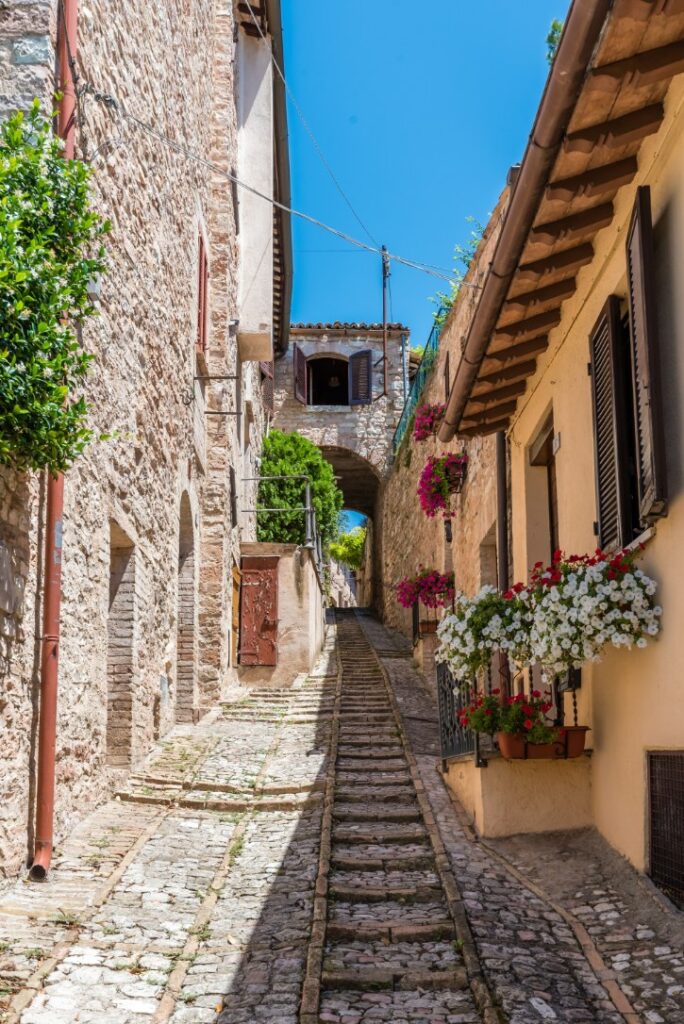
a. A Rare Town on Flat Ground
Unlike most of Umbria’s hilltop towns, Bevagna sits on flat land, ringed by medieval walls with square defensive towers.
- It has grown steadily from an ancient Umbrian settlement into a Roman town and later a medieval commune.
- The surrounding farmland, fed by two rivers, gives it a relaxed, rural feel.
b. Rome Hidden in the Streets
In Roman times, Bevagna was Mevania, a busy river port along the Via Flaminia, famous for its pastures and white oxen. Traces of that era survive right inside the medieval town:
- Roman Baths: A wonderful black-and-white floor mosaic from the 2nd century AD, alive with dolphins, seahorses, and playful sea monsters.
- Roman theater: Its curving foundations were absorbed into later houses and cellars, and you reach them along a street still called Via dell’Anfiteatro, a name left over from when people believed the remains were an amphitheater.
c. One of Italy’s Loveliest Squares
At the center lies Piazza Silvestri, one of Italy’s most admired irregular squares, with no straight angles at all.
- It is framed by Romanesque churches, San Silvestro from 1195 and San Michele Arcangelo.
- The Palazzo dei Consoli of 1270 hides a tiny 140-seat opera theater from 1886 inside.
It is the kind of square where you will want to sit with a coffee and simply take it in.
d. Step Back into the Middle Ages
Bevagna’s cultural heart beats loudest during the Mercato delle Gaite, a ten-day festival held in late June. The town splits into its four historic quarters and recreates daily life between 1250 and 1350. You can step into workshops that produce:
- Rag paper on water-driven hammer mills
- Silk spun on wooden twisters
- Pure beeswax candles
- Illuminated manuscripts on hand-scraped parchment
Here is the good news if you miss the festival. Several of these historic workshops stay open for guided demonstrations throughout the year.
e. The Countryside Around You
Around the town stretch vineyards, farmland, and olive groves, and the local food culture is tied closely to the land. It is an easy, pleasant place to enjoy the peaceful rural side of Umbria.
As you leave, the road climbs south through sun-drenched hills, where fields give way to rows of vines and the landscape rises toward a true balcony over the valley.
7. Montefalco
a. The Balcony of Umbria
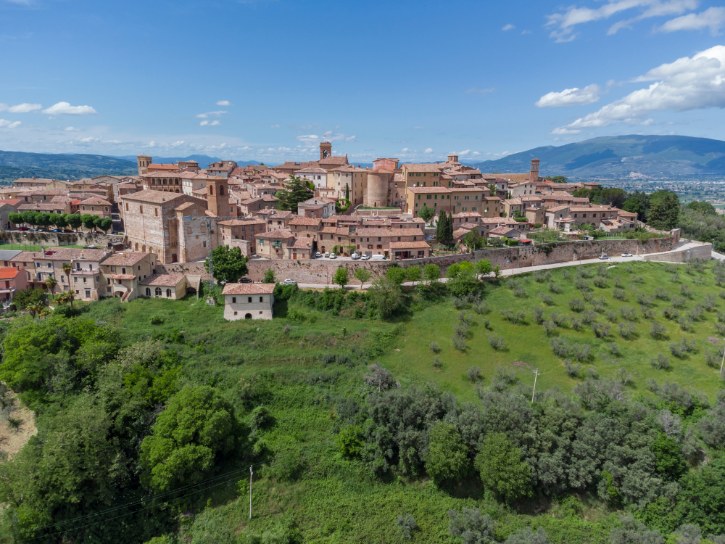
Rising 473 meters above sea level, Montefalco earns its nickname, the “Balcony of Umbria”.
- From its hilltop you get a sweeping, almost full-circle view.
- It reaches from Perugia in the north, across Assisi and Spello, all the way south to Spoleto.
- Medieval walls and five old stone gates ring the town, which winds up to a circular piazza.
For anyone who loves wide countryside panoramas, this is a highlight of the whole route.
b. A Renaissance Masterpiece
Montefalco’s great artistic treasure sits inside the former Church of San Francesco, now a civic museum.
- Between 1450 and 1452, the Florentine painter Benozzo Gozzoli decorated the apse with a fresco cycle on the life of Saint Francis.
- These twelve scenes are the most important Renaissance cycle of Franciscan painting after Giotto’s work in Assisi.
- Gozzoli filled them with bright colors, natural detail, an accurate view of the town itself, and small portraits of Dante and Petrarch.
c. The Home of a Bold Red Wine
Montefalco is famous worldwide as the home of Sagrantino, a local grape once made by Franciscan friars into a sweet wine for the altar.
- Montefalco Sagrantino DOCG: A deep, powerful dry red with some of the highest tannin levels of any grape in the world, aging for years into notes of blackberry, plum, leather, and forest floor.
- Montefalco Rosso DOC: A friendlier blend that pairs beautifully with wild boar stew, roasted lamb, and aged pecorino cheese.
Even if Italian wines are new to you, tasting one here among the vineyards is a lovely experience.
d. Where to Wander
Step away from the busy wine bars of the central piazza and you will find quieter rewards.
- Residential lanes like Via Ringhiera Umbra lead to panoramic terraces.
- Below, vineyards and olive groves fall away in neat terraces across the hills.
Heading southeast, the vineyards slowly give way to a silver-green sea of olive trees, guiding you toward the next town.
8. Trevi
a. The Olive Oil Capital
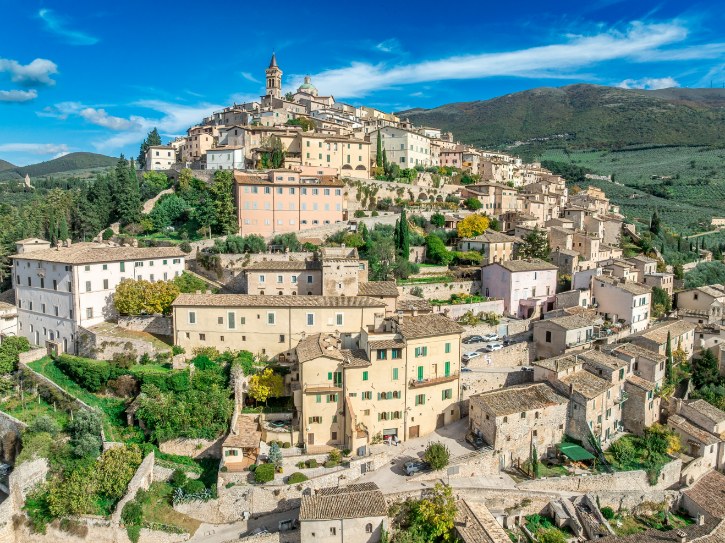
Trevi rises on a steep conical hill, its stone houses stacked in rings like an ancient amphitheater, surrounded by a vast forest of olive trees.
- The slopes belong to the Fascia Olivata Assisi-Spoleto, recognized by the United Nations FAO as a Globally Important Agricultural Heritage System.
- For more than two thousand years, farmers have shaped these hills with dry-stone walls that hold the soil.
- The star is the Moraiolo olive, a hardy variety that gives a bright green, peppery oil with hints of artichoke and wild herbs.
b. Climbing the Old Town
The town itself is a maze of medieval stone lanes and Renaissance palaces, best explored on foot.
- Streets like Via Roma and the steep, stair-lined piagge reveal quiet corners and fine old buildings.
- At the highest point stands the Duomo di Sant’Emiliano, a 12th-century Romanesque cathedral dedicated to the town’s patron saint.
Climb slowly and enjoy the views that open up between the buildings as you go.
c. Walking Among the Olive Trees
Running through these groves is the Sentiero degli Ulivi, a long trail across the olive-covered hills between Assisi and Spoleto.
- It is a footpath rather than a road, so lace up your shoes if you want to walk a stretch of it.
- Even from the town’s edge, the olive-draped slopes give you a real sense of why this landscape is so treasured.
d. Flavors to Try Before You Leave
Local food in Trevi revolves around its oil and its land.
- Extra-virgin Moraiolo oil: Best fresh, drizzled over bruschetta and grilled meats, especially during the autumn Festivol harvest celebration.
- Sedano Nero di Trevi: A prized heirloom black celery with crisp texture and rich aroma, recognized by Slow Food.
Tasting these simple, honest flavors is one of the best ways to connect with the area.
Leaving the olive heights, the road winds down into a cooler valley of natural springs and willow groves, where water takes center stage once again.
9. Fonti del Clitunno & Campello sul Clitunno
a. Springs That Inspired Poets
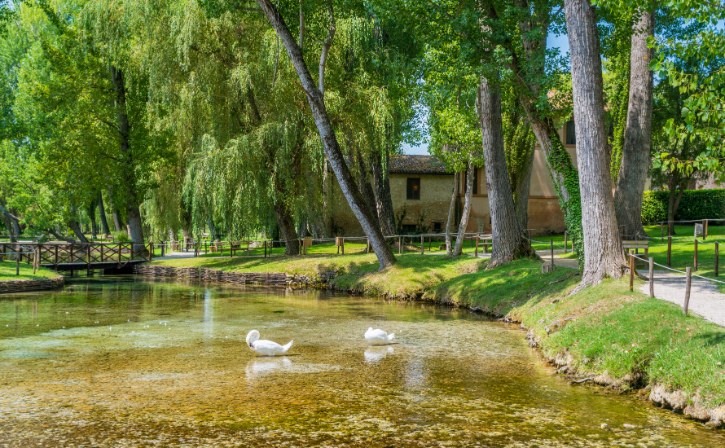
The Fonti del Clitunno are a peaceful surprise. Natural springs feed a clear emerald pool, shaded by weeping willows and poplars, that has inspired artists for over two thousand years.
- In Roman times this was a navigable river that flowed all the way to the Tiber and on to Rome.
- It was sacred to the river god Clitumnus, and Romans came here to consult oracles and bathe.
- The springs were praised by Virgil and Pliny the Younger, and much later by Lord Byron.
b. A Tiny Temple with a Big Story
A short distance north, along the old Via Flaminia, stands a small architectural gem, the Tempietto del Clitunno.
- For a long time people believed it was a Roman temple.
- It is actually an early Christian church dedicated to San Salvatore, built under the Lombard Duchy of Spoleto.
- In 2011 it became a UNESCO World Heritage site, and inside you can see some of the oldest wall paintings in central Italy.
It sits a little apart from the springs, so treat it as a second, separate stop nearby.
c. A Hilltop Hamlet Above It All
Higher on the ridge, the fortified hamlet of Campello Alto keeps its medieval gate and quiet stone lanes, with wide views over the plain. It is a charming detour if you have time to climb.
d. Pure, Simple Calm
This combined stop is all about slowing down. After the medieval towns, vineyards, and olive hills, the spring-fed waters offer a gentle change of pace.
- Still reflections and clear pools make for beautiful, peaceful photos.
- Shady paths and birdlife invite you to simply sit and breathe.
It is the kind of place where you lose track of time in the best way.
From the springs, the valley narrows and the forested slopes close in, leading you toward one of Umbria’s most dramatic towns.
10. Spoleto
a. A Town with a Dramatic Skyline
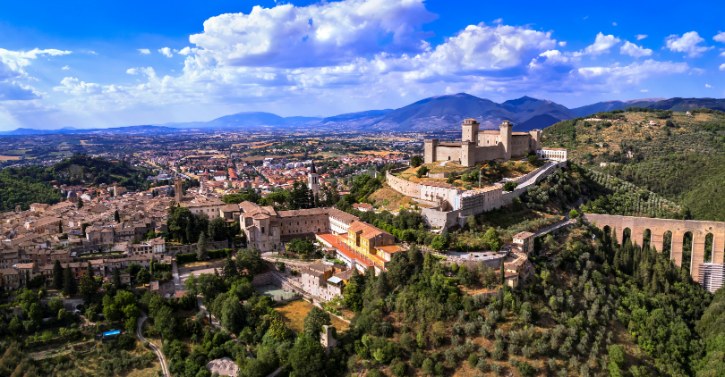
Spoleto is one of Umbria’s most impressive destinations, rising up a steep hillside where the valley meets the southern mountains. Settled by the Umbri and colonized by Rome in 241 BC, it later became the capital of the powerful Lombard Duchy of Spoleto. Two landmarks dominate the skyline:
- Rocca Albornoziana: A massive 14th-century fortress with six square towers and a courtyard of chivalric frescoes, its ramparts looking over the rooftops, the gorge, and the forests of Monteluco.
- Ponte delle Torri: A remarkable medieval aqueduct-bridge, 230 meters long and 80 meters high, carried on ten tall stone pillars.
After years closed for earthquake repairs, the bridge has reopened and is once again open to walk across, so you can take in the views from the middle.
b. A Cathedral and Its Treasures
Down in the historic center lies the lovely Piazza del Duomo, framed by the Cathedral of Santa Maria Assunta.
- The Romanesque facade is crowned with eight rose windows and a glittering mosaic completed in 1207.
- Inside, the apse holds a masterpiece, a fresco cycle on the life of the Virgin by Fra Filippo Lippi, painted between 1466 and his death here in 1469.
- His marble tomb, designed by his son, rests in the right transept.
c. A Stage for World-Class Arts
Spoleto is also a celebrated arts town, thanks to the Festival dei Due Mondi, or Festival of the Two Worlds.
- Founded in 1958 by the composer Gian Carlo Menotti, it runs from late June through mid-July.
- The city’s squares, its Roman theater, and its historic auditoriums fill with opera, ballet, music, and drama.
Even outside festival season, those same beautiful theaters and piazzas give the town a rich cultural feel.
d. Views Worth the Climb
Spoleto is made for admiring from above and within.
- Public viewpoints near the fortress frame the gorge, the great bridge, and the rolling forests beyond.
- Steep medieval streets and quiet piazzas reward slow, curious walking.
Few places combine impressive engineering, remarkable art, and mountain scenery quite like this.
Leaving Spoleto, the road turns west across forested ridges, opening toward the Tiber basin, where another elegant hill town crowns the horizon.
11. Todi
a. A Perfectly Balanced Hilltop Town
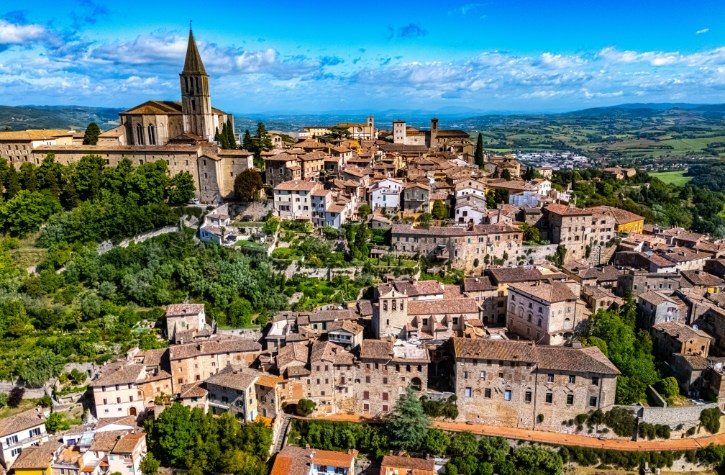
Todi sits high above the Tiber valley, where Umbrian, Etruscan, and Roman history meet.
- That layered past even shows in its triple ring of defensive walls, each from a different era.
- At the top lies Piazza del Popolo, one of the most harmonious medieval squares in central Italy, built over the old Roman forum.
- Around it stand three grand palaces and the Cathedral of Santa Maria Annunziata, reached by a flight of twenty-nine stone steps.
b. A Secret Beneath Your Feet
Todi hides a wonder right under the main square.
- The Cisterne Romane are a system of twelve barrel-vaulted chambers from the 1st century BC.
- Built of Roman concrete, they stored rainwater and steadied the hilltop.
- Their plaster still carries the shoe-nail prints of the workers who made them.
Nearby rises the Tempio di San Fortunato, a Gothic church whose crypt holds the tomb of Jacopone da Todi, a poet who helped shape early Italian verse.
c. Lanes and Viewpoints to Explore
Todi is a joy to explore on foot, with quiet lanes, old gateways, and lovely viewpoints.
- Giardini Oberdan: A shaded terrace looking north across the Tiber valley.
- Santa Maria della Consolazione: Just outside the walls, this striking Renaissance church, linked to designs by Bramante, forms a perfect Greek cross crowned by a tall dome.
Its setting in the open countryside makes it one of the most memorable sights on the route.
d. The Charm of Everyday Life
Beyond its monuments, Todi has an easy, lived-in charm. Traditional shops, inviting piazzas, and local food culture give the town a warm, genuine feel. Linger a while and you will find the quieter corners just as rewarding as the famous sights.
From this high plateau, the road follows the Tiber north, where the river’s rich clay has nurtured one of Italy’s most famous crafts.
12. Deruta
a. Seven Centuries of Ceramics
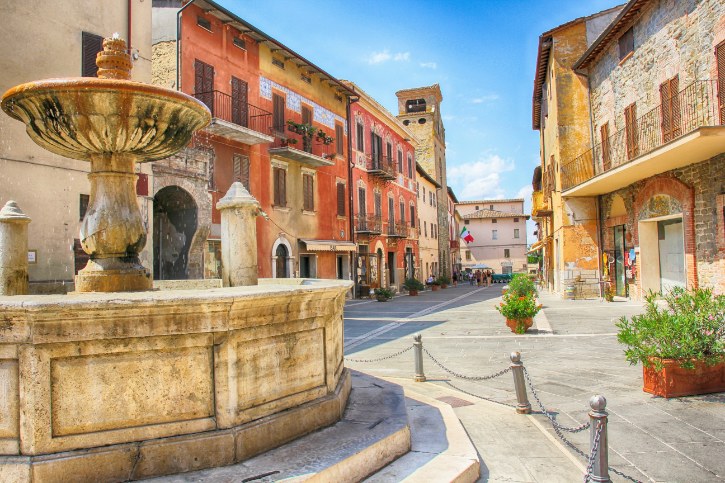
Deruta is a fitting finale, a town that has devoted itself for more than seven hundred years to a single art, glazed maiolica ceramics.
- Enter through the old Porta San Michele Arcangelo and you find pottery everywhere.
- Workshops, studios, and even hand-painted street signs and house numbers line the streets.
- The craft grew from the rich clay left by the Tiber and the wood that fired the kilns.
b. The Patterns That Made It Famous
By the 1500s, Deruta was one of Europe’s great ceramic centers, known for shimmering luster glazes and classic designs:
- Raffaellesco: Winged dragons and scrolling vines
- Ricco Deruta: Dense acanthus leaves in cobalt blue, turquoise, and ochre
- Piatti da Pompa: Renaissance display plates with portraits and mottoes
c. Wandering the Old Center
The medieval heart of Deruta is a pleasure to explore.
- At its core lies the long Piazza dei Consoli, bordered by the 14th-century Palazzo dei Consoli and the Gothic Church of San Francesco.
- Throughout the streets, traditional stone architecture mixes beautifully with colorful ceramic details.
It is a lovely reminder that here, art is part of daily life, not just a trade.
d. See the Craft Up Close
For a deeper look, two spots stand out:
- Museo Regionale della Ceramica: Founded in 1898 and the oldest ceramics museum in Italy, with over six thousand pieces, plus a walkway over the archaeological area of the old San Salvatore kilns.
- Sanctuary of the Madonna dei Bagni: Just south of town, its walls are lined with around seven hundred hand-painted tiles, each a small story of thanks.
e. One Last View
Climb toward the upper streets and the belvedere near the Church of Sant’Antonio Abate for a final, wide view across the Tiber valley. In the distance you can even make out the hill of Perugia, where your journey began.
It is a lovely way to close the loop. Across these twelve stops, Umbria shows you its whole character, hilltop fortresses and sacred springs, Renaissance frescoes and flowing water, great wines and timeless crafts. Every town holds its own quiet story, and the winding roads between them are half the pleasure. Take your time, follow the views, and let Umbria reveal itself one beautiful bend at a time.