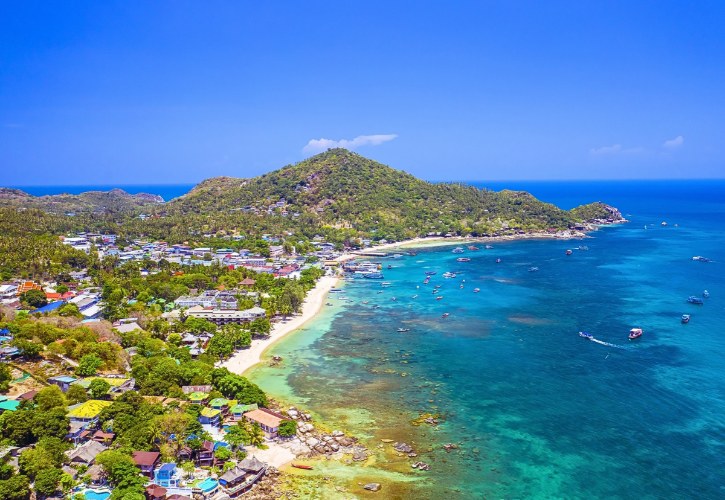
Imagine stepping off a boat onto sand so soft it squeaks, with water so clear you can count the fish beneath you.
Thailand’s islands have a way of pulling you into their rhythm, where time stretches out and plans melt away with the tide.
Some are buzzing and social, others quiet enough to hear the palms. What they all share is a hold on you. Once you settle into island life here, you start inventing reasons to stay just one more day. 😊
1. Koh Lipe (Satun)
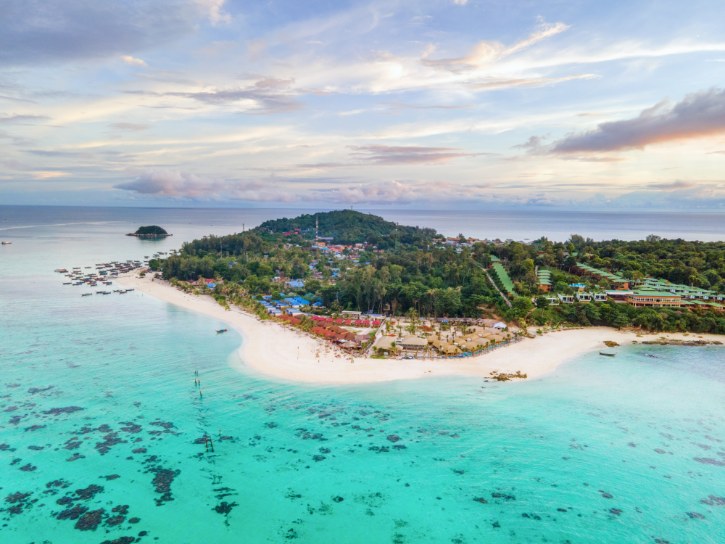
Tucked into the far south of the Andaman Sea in Satun Province, Koh Lipe is the inhabited gateway to the Adang-Rawi Archipelago, sitting around sixty kilometers off the mainland near the Malaysian border.
It is wrapped on all sides by Tarutao National Marine Park, yet the island itself sits outside the park boundaries because of long-standing settlements and private land. That gives you a rare mix: dive shops, small resorts, and open-air dining right next to strictly protected, uninhabited islands.
a. The Three Beaches That Define the Island
- Sunrise Beach (Hat Chao Ley): Over a kilometer of fine white coral sand on the east, with a shifting sandbar at its northern tip that is made for sunrise photos and deep-water swims straight off the shore.
- Pattaya Beach: A sheltered southern crescent with powdery sand and calm water in the dry season. It is the main ferry arrival point by day and a lively seafood dining strip by night.
- Sunset Beach (Hat Pramong): A quieter, rockier northwest cove with golden sand and the best spot to watch the sun drop.
b. Where to Get in the Water
- Snorkel straight off Sunrise Beach around the granite outcrops of Koh Kra and Koh Usen, where shallow coral gardens hide brain corals, staghorns, and clownfish.
- Take a longtail boat to Jabang, a submerged granite pinnacle famous for soft corals in purple, crimson, and gold. Currents run strong here, so fixed mooring lines help you hold on.
- Visit Koh Hin Ngam, an island with no sand at all, just polished black stones, plus a reef full of staghorn coral. Nearby Koh Rawi adds powdery sandbars and the odd green sea turtle.
c. Rules Worth Knowing Before You Snorkel
You will need to pay park entry fees, and boats must use designated mooring buoys rather than dropping anchor. Don’t touch the reefs or pocket stones from Koh Hin Ngam, and remember that some outer reefs close seasonally between June and September so the coral can recover.
d. Life on Walking Street
There are no private cars here. You move around on foot or by local motorcycle sidecar, known as a saleng. The island’s heart is Walking Street, a pedestrian lane between Pattaya and Sunrise beaches that fills each evening with bakeries, street food, and seafood grills.
Koh Lipe is also home to the Urak Lawoi, an indigenous maritime community, and around the eastern settlements you can still see traditional boatbuilding. With no traffic and easy beachfront strolls, a few nights here has a habit of turning into a week.
2. Koh Kradan (Trang)
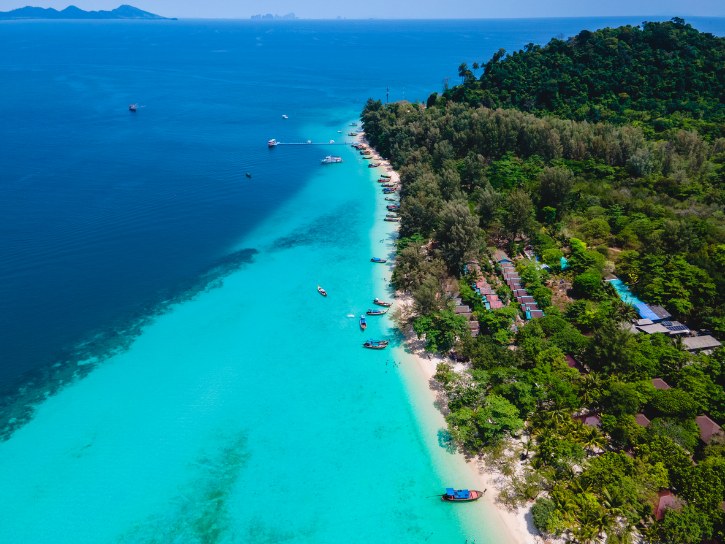
Lying about ten kilometers off the coast of Trang, Koh Kradan is a slim, jungle-covered island roughly four kilometers long and only a few hundred meters wide, most of it inside Hat Chao Mai National Park, with a few privately owned plots.
With wide shallow reef flats, powdery coral sand, and barely any development, it is the island to pick when you want a quiet, beautiful beach escape and not much else.
a. A Beach That Topped the World
- The main eastern beach, called Paradise Beach or Kradan Beach, runs nearly two kilometers with white sand shaded by casuarina trees.
- In April 2023, the UK publication World Beach Guide ranked it number one on its “Top 100 Beaches on Earth” list.
- Looking east, you get an open view of limestone cliffs at Koh Muk and Koh Libong, with mainland Trang beyond.
b. Why the Tide Changes Everything
The tides here reshape the whole island. At low spring tide the sea pulls back hundreds of meters, exposing white sandbars you can walk out onto. At high tide the water returns gently to the forest edge. It is worth checking a tide chart so your swims and photos line up with the water you want.
c. Snorkeling Straight Off the Sand
- A fringing reef runs along the eastern coast, roughly twenty-five to fifty meters out, so you can snorkel without a boat.
- Expect staghorn and brain corals, giant clams, and blue-spotted rays over the sandy patches.
- It is best for beginners at mid-to-high tide, when there is plenty of water over the coral.
- After bleaching in 2024, park officials set up resting zones and now steer snorkelers toward the deeper southern flats of Ao Niang.
d. The Wild Western Shore
Sunset Beach, on the west coast, is the untamed flip side of the calm east. You reach it by a signposted forest trail of fifteen to twenty minutes over the island’s interior ridge. Facing the open Andaman, it has rolling waves, rugged rocks, and a clear horizon for sunsets. Bring a flashlight and sturdy shoes if you plan to walk back after dark.
e. The Island After the Day-Trippers Leave
Koh Kradan has no roads, cars, banks, or villages, just a handful of low-density resorts and eco-bungalows. Day boats from Koh Lanta and Pak Meng Pier arrive late morning and cluster near the park station. Once they head home, the island falls quiet and the long beaches belong to overnight guests. Boats run from mid-October to mid-May, then the southwest monsoon shuts most things down.
3. Koh Kood (Trat)
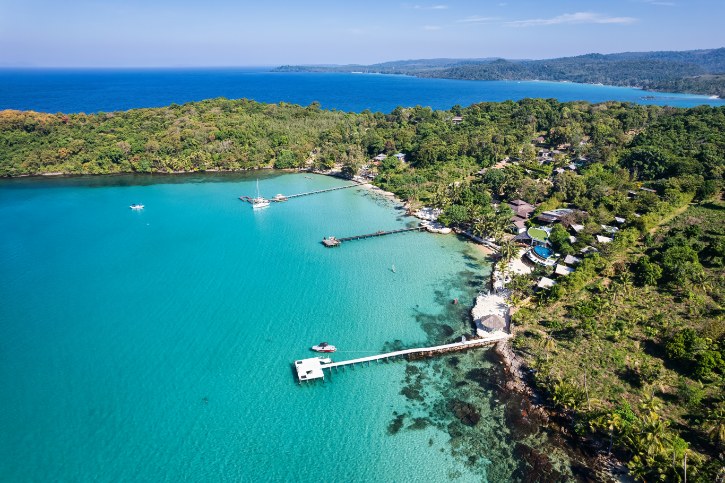
Over in the eastern Gulf near the Cambodian border, Koh Kood (also spelled Ko Kut) is Thailand’s fourth-largest island at around 105 square kilometers. Think primary rainforest, freshwater rivers, mangroves, and coconut plantations. It suits you perfectly if you want peaceful beaches and real nature to explore inland.
a. Bays Worth Hopping Between
- Klong Chao Beach: A roughly six-hundred-meter arc of soft white sand, widely rated the island’s prettiest, where a river mouth lets you kayak straight from the sea into mangrove canals.
- Ao Tapao: A wide, uncrowded stretch under tall palms, with a historic wooden jetty made for sunset walks.
- Ao Phrao: The island’s longest beach, framed by leaning palms and the quiet grounds of Wat Ao Phrao.
- Bang Bao Bay: A calm emerald lagoon that is safe for swimmers of any level.
- Ao Khlong Hin: An intimate four-hundred-meter pocket of sand between jungle headlands.
b. Chasing Waterfalls in the Rainforest
More than seventy percent of the island is intact rainforest, and the waterfalls are a highlight.
- Klong Chao Waterfall: Three tiers dropping into a clear pool that is safe to swim most of the year. King Rama VI visited in 1911 and left a carved royal monogram on a riverside boulder. You get there by a twenty-minute kayak up the river and a short jungle walk.
- Huang Nam Khiao Waterfall: A multi-tiered cascade reached on trails past ancient Makka ironwood trees.
- Khlong Yai Kee Waterfall: A swimmable pool on the northwest coast after a short forest walk.
Flow peaks after the rains from August through November and thins out in the late dry season.
c. Finding the Best Coral Here
The real coral lies offshore around Koh Rang, an uninhabited island cluster within Mu Ko Chang National Park, reached by day boat from Koh Kood’s piers. Trips head to Koh Rang and its neighboring islets, where shallow reefs hold staghorn, table, and brain corals, along with green turtles, moray eels, and barracuda. Visibility is best from November through April, while monsoon swells from May to October often cut off the boat trips.
d. Villages Built Over the Water
- Ao Salad: A fishing village on timber stilts, with boardwalks linking houses, squid-drying racks, and waterside kitchens. The golden Buddha of Wat Ao Salad watches over the harbor.
- Ao Yai: Another stilted village on the southeast shore where fishermen land blue crab, squid, and grouper.
The island stays calm and nature-focused, with no big nightlife, and most people get around by rented scooter or bicycle.
4. Koh Tao (Surat Thani)
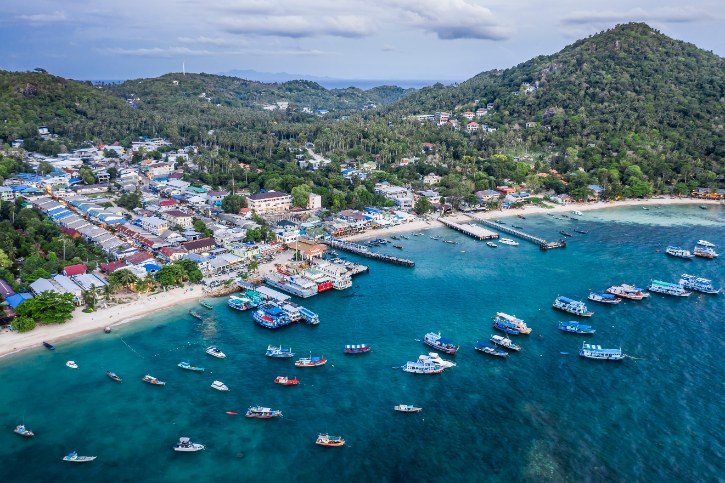
Koh Tao, meaning “Turtle Island”, sits in the western Gulf about forty-five kilometers north of Koh Phangan. Across twenty-one square kilometers of rugged granite hills and sheltered bays, it earned fame as a scuba diving hub. But even without a tank, you will love its snorkeling bays, beaches, and ridge-top views.
a. Bays Where You Might Meet Sharks and Turtles
- Aow Leuk: A beginner-friendly southeast bay with a sandy seabed and shallow reef, where you may spot juvenile blacktip reef sharks and staghorn coral.
- Tanote Bay: Deeper water on the east coast, with a famous granite boulder for cliff jumping and moray eels and groupers below.
- Shark Bay (Thian Og): A shallow southern bay known for blacktip sharks and green turtles grazing on seagrass.
Sightings are never guaranteed, and Shark Bay is best in calm morning water, since afternoon chop can challenge less confident swimmers.
b. Beaches for Every Mood
- Sairee Beach: The social heart, 1.7 kilometers of golden sand with dive shops and sunset views.
- Mae Haad: Clean sand and calm water beside the ferry piers, with a shallow shipwreck offshore.
- Hin Wong Bay: A quiet northeastern inlet with clear deep water, great for kayaking.
- Freedom Beach: An intimate southern cove sheltered by trees and granite cliffs.
c. Climbing to the Island’s Best View
John-Suwan Viewpoint on the southern peninsula is the one to aim for. It gives you a dual-bay panorama over Chalok Baan Kao to the west and Shark Bay to the east. The trail takes about fifteen to twenty minutes with a moderate scramble over boulders, helped by fixed ropes on the steep parts.
Wear closed-toe shoes, especially after rain when the granite turns slippery. Up north, Mango Bay Viewpoint and Fraggle Rock offer more sweeping looks over the forested interior.
d. The Sandbar Island Next Door
- Koh Nang Yuan sits five hundred meters off the northwest coast, a ten-minute longtail ride away.
- Three tiny granite islets are joined by a bright white coral sandbar, making it one of the most photogenic spots in the Gulf.
- The Japanese Gardens reef is ideal for novice snorkelers, and a stairway climbs to the famous viewpoint over the sandbar.
- To protect the reef, single-use plastic bottles and swimming fins are banned at the pier.
e. The Diving Town Vibe
Koh Tao has a young, ocean-focused feel driven by its diving community, and evenings fill casual cafes with travelers swapping stories. The island is a municipality rather than a national park, but its waters are strictly regulated: boats use mooring buoys, and fish feeding and wastewater discharge are banned. Local groups run coral restoration and turtle monitoring, so it is a fine place to learn to dive or just bay-hop for a few days.
5. Koh Ngai (Trang)
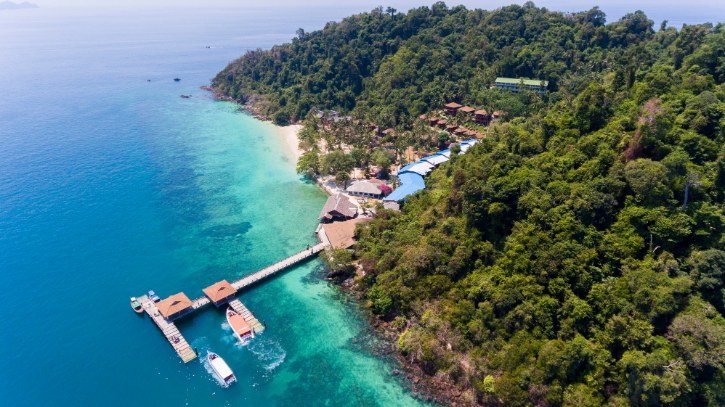
Reached through Trang’s Pak Meng Pier but administratively part of Krabi, Koh Ngai (also written Ko Hai) is a triangular island inside Mu Ko Lanta National Park. At four square kilometers, it is covered in hill forest and ringed by shallow reefs, which makes it a gentle, romantic escape.
a. A Beach Built for Slow Mornings
The main beach runs 2.5 kilometers along the sheltered east coast, with pale coral sand and calm turquoise water through the high season. There are no high-rises, just coastal trees and jungle hills behind you. Look east and you will see the limestone towers of Koh Ma and Koh Chueak, with the Trang mainland karsts in the distance. Because it faces east, this shore is made for sunrises followed by quiet swims.
b. The Cove You Have to Work For
- Paradise Beach (Ao Muang) sits on the southwest coast, hemmed in by jungle cliffs.
- You reach it by a thirty-to-forty-five-minute interior trail or by hiring a longtail boat.
- There are no resorts here, and the water drops off faster than the east coast, which makes for great swimming and quiet snorkeling on calm days.
c. Snorkeling and Island-Hopping
- A fringing reef lies fifty to one hundred meters off the main beach, so you can wade in to see corals, sea fans, and parrotfish.
- Koh Chueak: Marine caverns with vibrant sea fans and schooling fusiliers.
- Koh Ma: Vertical wall snorkeling among anemonefish and feather stars.
- Koh Waen: A rocky islet ringed by shallow table corals.
Kayaking around the southern headlands is doable on calm days, but check the tides, since the channels between islands can run strong.
d. Into the Jungle Interior
A designated trail links the east-coast beach with Paradise Beach and the southern ranger station.
- Terrain: Moderate elevation over dirt paths, tree roots, and rocky steps.
- Pack: Closed-toe shoes, insect repellent, and water.
- Wildlife: Monitor lizards, dusky leaf monkeys, sea eagles, and hornbills.
Steep cliffs block the northwest, so there is no loop trail around the island. Moving between coves means forest paths or a boat.
e. An Island That Rewards Doing Nothing
Koh Ngai has no roads, cars, or villages, and your days revolve around swimming, reading, and beachfront dining. Passenger boats run from mid-October through mid-May, while the southwest monsoon halts transfers. The real appeal is unhurried days surrounded by beautiful scenery, not a packed sightseeing list.
6. Koh Mak and Koh Kham (Trat)
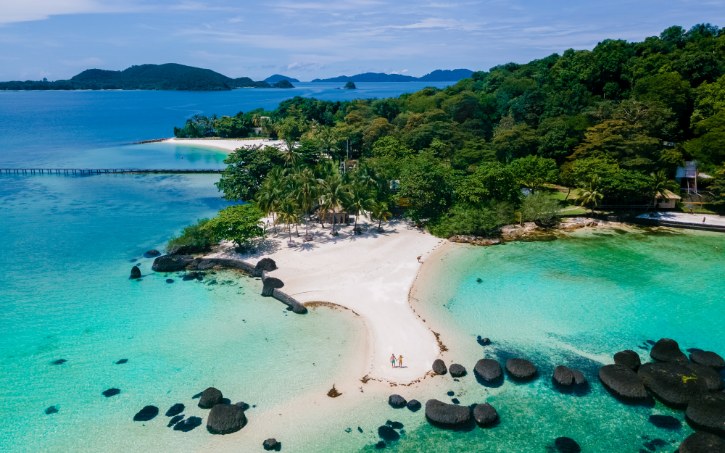
Koh Mak is a low-lying, uncrowded island of about sixteen square kilometers in the eastern Gulf, sitting between Koh Chang and Koh Kood. Coconut plantations, rubber estates, and calm bays give it a rural, peaceful feel, and just one kilometer offshore is Koh Kham, a private islet of white sand and dark volcanic boulders.
a. The Bays of Koh Mak
- Ao Suan Yai: A two-kilometer northwest bay widely seen as the most scenic, with curving palms, calm water, views of Koh Kham, and a historic pier that shines at sunset.
- Ao Kao: The main traveler beach on the southwest shore, with fine sand, calm shallows, and small family-run cafes in the tree line.
- Ao Nid: A rocky southeastern shore with the main cargo pier and traditional seafood restaurants.
- Ao Phra: A quiet, undeveloped northwestern cove for real privacy.
b. An Island That Takes Sustainability Seriously
Koh Mak is a leader in community-based sustainable tourism. In 2022 and 2023 it was named among the Green Destinations Top 100 Stories and earned second place globally at the ITB Berlin Green Destinations Story Awards, guided by DASTA.
At the center is the Koh Mak Charter, a local pact that bans jet skis and banana boats, keeps out imported cars, and promotes solar energy and low-impact recreation. These are community commitments rather than national park rules, and they are a big part of why the island feels so considered.
c. The Islet With Black Boulders and a Hidden Lagoon
- Koh Kham sits one kilometer northwest of Ao Suan Yai, reached by a ten-minute longtail ride or a thirty-minute kayak.
- Its signature look is powdery white sand against dark basalt boulders.
- A shallow emerald lagoon is good for swimming and snorkeling over brain and staghorn coral.
- Day visitors pay an environmental fee at the pier, and a trail climbs the rocky spine to lookouts worth the photos.
d. Everyday Life on Koh Mak
Most of the land has been cared for over a century by five Thai families descended from the official who bought the original coconut estates. Residents live mainly in Ban Ao Nid and Ban Laem Son, and daily life runs on rubber tapping, coconut harvesting, and fishing.
Because the roads are gentle and quiet, cycling is the main way to get around, with local pickup-truck taxis filling in. You can pedal between organic farms, art studios, and family-run restaurants serving island-grown produce and fresh seafood.
7. Koh Yao Noi (Phang Nga)
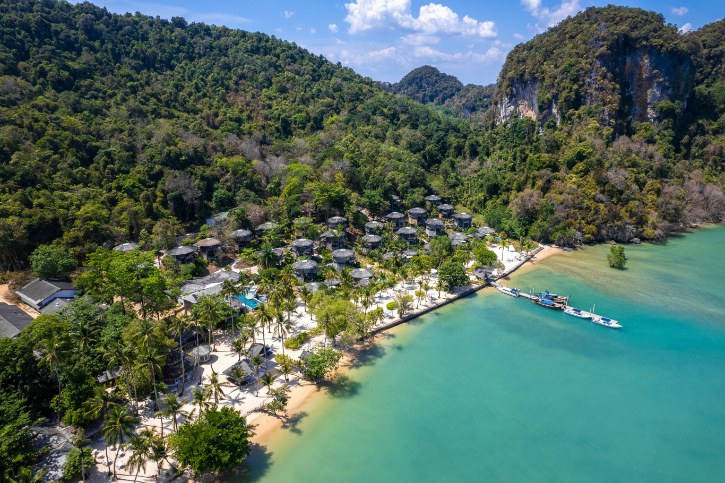
Sitting in Phang Nga Bay halfway between Phuket and Krabi, Koh Yao Noi trades the classic white-sand template for something different: panoramic views of towering limestone karsts, coastal mangroves, and a preserved rural way of life. You come here for the scenery and the local character more than for swimming beaches.
a. Where the Karsts Steal the Show
The eastern coast faces the Hong Archipelago and the Krabi limestone bluffs, and the view shifts with the light and tide.
- Sunrise panoramas: Early light turns the limestone golden, often with mist above the calm sea, and dawn longtail boats add a classic local touch.
- Tidal shifts: Low tide exposes sandbanks and mudflats dotted with fiddler crabs and wading birds, while high tide brings emerald water back to the casuarinas.
The best vantage points are the coastal road near Tha Khao Bay and the overlooks behind Pasai Beach.
b. Meeting the Local Community
The island is home to a warm, predominantly Muslim community living on fishing, rubber tapping, and rice farming, and its Community-Based Tourism programs are internationally praised. You can:
- Tour floating crab banks, where egg-bearing crabs are protected until they hatch.
- Visit batik workshops in Ban Tha Khao to watch wax patterns and natural dyes applied.
- Cycle through rice paddies where water buffalo graze against a jungle backdrop.
Dress modestly in village areas by covering shoulders and knees, and note that traditional eateries do not serve pork or alcohol.
c. Quiet Beaches With Big Views
- Pasai Beach: The most popular eastern beach, two kilometers of golden sand under casuarinas, with calm water at high tide and long walks at low tide.
- Klong Jark and Tha Khao Beaches: Quieter east-coast beaches near the village, north of Pasai. At Tha Khao, a sandbank links the shore to tiny Koh Nui at low tide, which is the reverse of the usual high-tide swimming here, so it is worth checking a tide table.
One point to remember: the famous Laem Had sandbar is on neighboring Koh Yao Yai, across the strait, not here.
d. Easy Days, One Activity at a Time
- Cycling and scooters: A quiet paved loop past rubber groves, villages, and mangroves.
- Longtail karst trips: Charter a boat to uninhabited islands like Koh Nok, with a steep summit hike, and the quiet cove of Koh Kudu.
- Sea kayaking: Paddle sheltered mangroves to spot mudskippers and archerfish.
- Rock climbing: Bolted routes on the northeast cliffs, away from the busier climbing spots down south.
8. Koh Phangan (Surat Thani)
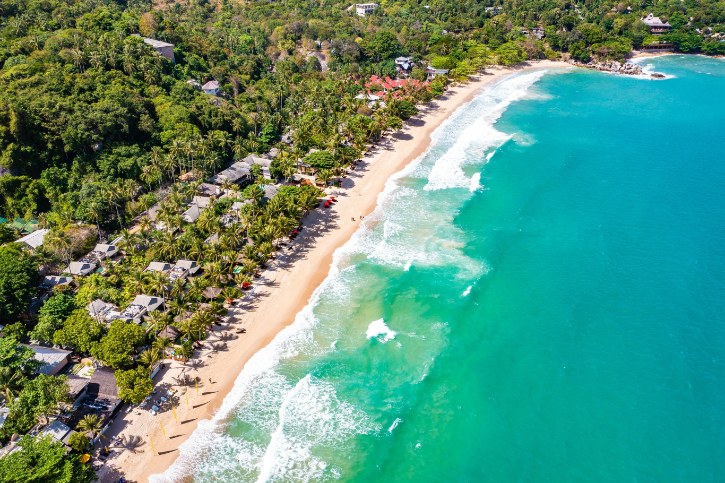
Koh Phangan sits in the western Gulf, fifteen kilometers north of Koh Samui, and spreads across 125 square kilometers of granite peaks, rainforest, and secluded bays. The Full Moon Party made it famous, but that is confined to Haad Rin on the southern tip. The rest of the island is a scenic retreat of waterfalls, viewpoints, and protected reefs.
a. Beaches Beyond the Party
- Bottle Beach (Haad Khuat): An isolated northern cove with pale sand and deep water, reached by a tough 1.5-to-2-hour hike or a longtail from Chaloklum.
- Thong Nai Pan Noi and Yai: Twin northeast bays with soft golden sand, calm water, and low-key boutique resorts.
- Haad Salad: A sheltered northwest bay with shallow reef and family-friendly swimming.
- Haad Yuan and Haad Tien: Remote eastern bays reached by boat taxi, with a bohemian, yoga-friendly feel.
b. Reefs You Can Reach, and One You Shouldn’t
- Mae Haad and Koh Ma: On the northwest point, Mae Haad links to the islet of Koh Ma by a sandbar, and Koh Ma’s protected reef holds staghorn corals, giant clams, and anemonefish.
- Haad Salad Reef: A shallow reef about eighty meters offshore, good at mid-to-high tide.
- Sail Rock (Hin Bai): Twelve kilometers north, one of the Gulf’s premier scuba sites with barracuda and seasonal whale sharks. It sits in open ocean with strong currents, so it is strictly for certified divers, not casual snorkeling.
c. Waterfalls and the Climb to the Summit
Over half the interior is protected within Than Sadet-Ko Pha-ngan National Park. Phaeng Waterfall sits near the park headquarters, and a steep jungle trail climbs past Domsila Viewpoint toward Khao Ra, the island’s highest point at 627 meters, a roughly three-hour ascent best started early.
Than Sadet Waterfall tumbles over giant boulders where King Rama V left royal ciphers during fourteen visits between 1888 and 1909. Flow is strong from October through December but thins in the dry season, and wet granite gets dangerously slippery.
d. Chasing the Sunset
- Zen Beach (Sri Thanu): Casual late-afternoon gatherings as the sun drops over the Gulf.
- Hin Kong and Haad Yao: Broad beaches mirroring sunset colors across tidal flats, with distant views of Koh Samui.
- Elevated lookouts: The Bottle Beach Viewpoint and Secret Mountain overlook pair jungle canopy with ocean.
e. The Island’s Quiet, Mindful Side
Beyond Haad Rin, the western village of Sri Thanu has grown into a hub for yoga, meditation, and plant-based dining, with daily teacher trainings and sound healing sessions. If you want the introspective side of Koh Phangan, this is it. The social scene is there when you want it, and easy to leave behind when you do not.
9. Koh Chang (Trat)
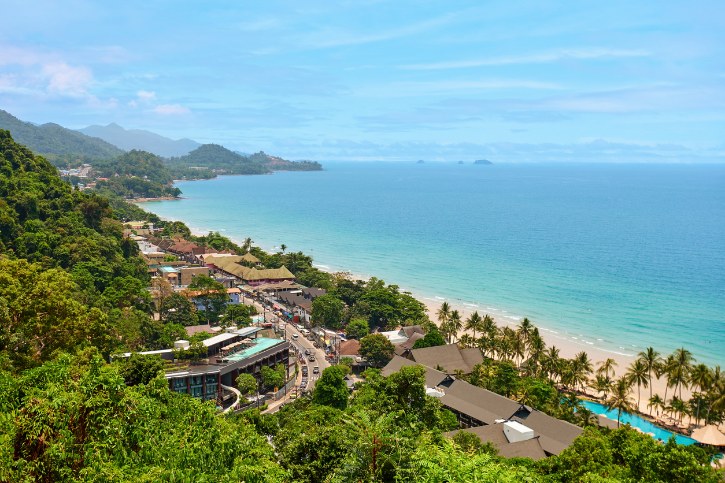
At more than 210 square kilometers in the eastern Gulf, Koh Chang (meaning “Elephant Island”) is Thailand’s third-largest island and the heart of Mu Ko Chang National Park, a reserve taking in 52 islands. Steep granite peaks, virgin rainforest, waterfalls, and long beaches give it a bigger, wilder feel than the small beach islands.
a. A Mountain Covered in Rainforest
More than seventy percent of Koh Chang is dense evergreen rainforest, crowned by Khao Salak Phet at 744 meters. The forest shelters macaques, civets, wild boars, and over a hundred bird species, including the great hornbill. Guided treks take you through canopy, ravines, and river valleys. Prepare for high humidity, wear leech socks in the rainy season, and hire a licensed guide, since many paths are unmaintained.
b. Waterfalls With Royal History
- Khlong Plu Waterfall: The most accessible falls, dropping thirty meters into a deep basin you can swim in, reached by a well-kept 600-meter trail.
- Than Mayom Waterfall: A multi-tiered eastern cascade where King Rama V and King Rama VII carved their royal initials into the boulders.
- Khlong Neung and Khlong Nonsi: Remote southeastern falls with quiet natural settings.
Flow peaks from August through November and drops in the late dry season.
c. The Long Beaches of the West Coast
- White Sand Beach (Hat Sai Khao): A 2.5-kilometer sweep backed by palms and beachfront dining, with good swimming at high tide.
- Klong Prao Beach: A broad, tranquil beach split by river estuaries and shaded by coconut groves.
- Kai Bae Beach: A narrower palm-lined strand, with Kai Bae Viewpoint looking over four uninhabited islets.
- Bang Bao Village: A historic stilt village on the southwest tip, with boardwalks linking homes, dive centers, and seafood markets.
d. Finding the Clear Water Offshore
Runoff from the mountain rivers clouds the water near the main shoreline, so the best snorkeling and diving are out around the islands. Mu Ko Rang, about twenty kilometers south, has shallow reef flats with staghorn corals, giant clams, and green turtles, though sightings are never guaranteed.
Divers can also explore the HTMS Chang, a naval ship sunk in 2012 as an artificial reef and now home to barracuda and groupers. Park rules require mooring buoys and ban removing shells or marine life.
e. Comfort and Adventure in One Place
Koh Chang balances resort comfort with real outdoor adventure. You can stay in a boutique resort, kayak to the islets off Kai Bae, ride steep switchbacks by scooter, and explore the mangrove boardwalks at Salak Khok. When choosing nature activities, favor independent trekking, marine trips, and community-run tours over unaccredited captive wildlife attractions. It is the island for travelers who want dramatic scenery without giving up comfort.
10. Koh Phayam (Ranong)
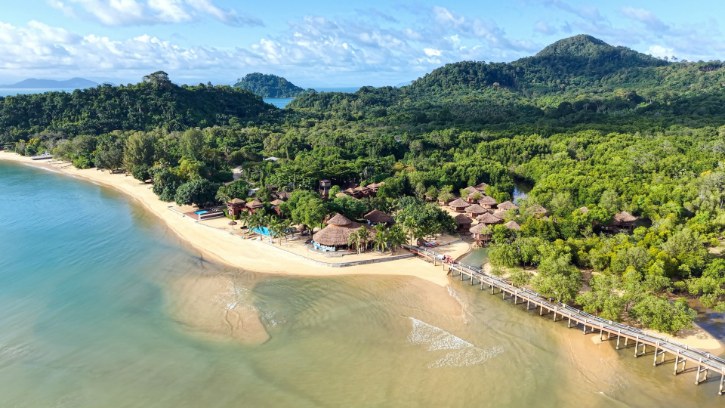
Up in the northern Andaman Sea near the Myanmar border, Koh Phayam is a cashew-shaped island of around thirty-five square kilometers, known for wide crescent bays, coastal pine-like forests, and an easygoing, bohemian mood. It is for you if you want something rustic and genuinely slow.
a. Wide Bays Made for Walking
- Ao Yai (Long Beach): Three kilometers on the southwest coast, with gentle breaking waves that make it a laid-back surfing spot and plenty of room for long walks and sunsets.
- Ao Khao Kwai (Buffalo Bay): A curved northern bay split by a mangrove estuary, with calm, shallow, swim-friendly water and Hin Talu, a natural sea arch beloved for sunset photos.
- Ao Kwang Peeb (Monkey Bay): A secluded northern cove reached by a dirt track, with golden sand and real solitude.
b. Honest Talk About the Water
The water here changes a lot with the seasons, so it helps to know what you are getting.
- Dry season (November to April): Clear aquamarine, especially in Buffalo Bay, with clean surf breaks at Ao Yai from November to January.
- Monsoon season (May to October): Powerful swells, heavy rain, strong surf, and reduced clarity, since Ranong is Thailand’s wettest province.
- Snorkeling reality: There are few coral reefs along the beaches, so for coral you will want a day boat to Mu Ko Surin or Koh Chang Noi. Treat Koh Phayam itself as a place for surfing, relaxing, and scenery.
c. The Forests and the Hornbills
- Coastal trees: Shorelines fringed with casuarina and sea almond.
- Interior: Low hills of cashew orchards and rubber groves bordered by jungle.
- Mangroves: Tidal channels around Buffalo Bay you can kayak at high tide.
- Birdlife: A thriving population of great hornbills, often seen roosting in the beach trees at Buffalo Bay.
d. An Island That Runs on Its Own Time
Koh Phayam has no cars. You get around by scooter, bicycle, or on foot along narrow concrete paths winding through the plantations. Power still comes mainly from a mix of diesel generators and solar, so electricity is not always round-the-clock except at the more upmarket resorts. Accommodation stays low-density, mostly bamboo huts and eco-bungalows under the trees. The creative streak shows in places like the Hippy Bar, a driftwood structure built from salvaged timber, and Wat Koh Phayam, a seaside ordination hall on stilts above the shallows.
e. Why You Will Linger
This is a place made for slow travel, where days drift by reading in a hammock, walking Ao Yai at low tide, and eating seafood curries and roasted cashews at beach cafes. The rhythm here nudges you to drop the itinerary and follow the tides and sunsets instead. For anyone who loves rustic surroundings and beautiful coastal scenery, Koh Phayam is the kind of island that is genuinely hard to leave.