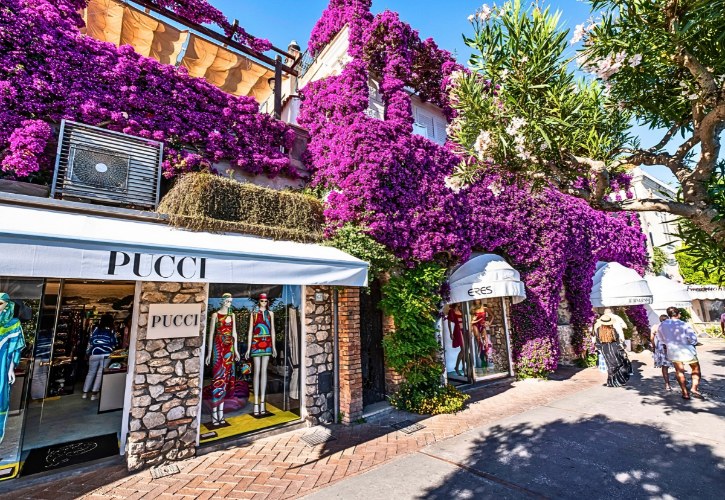
It’s easy to come to Campania for the Amalfi Coast and give the island of Capri just a few hurried hours across the water. Give it more time, though, and the island rewards anyone who slows down and stays a while.
The island splits into two separate towns at very different heights: Capri town, with its glamorous square, Roman ruins, and towering sea stacks, and higher Anacapri, with its calmer lanes, country walks, and wide summit views. Let’s start with the glamorous one, then climb to its quieter neighbor. 😊
1. Capri: Glamour, Roman Ruins, and Cliffs That Drop Into the Sea
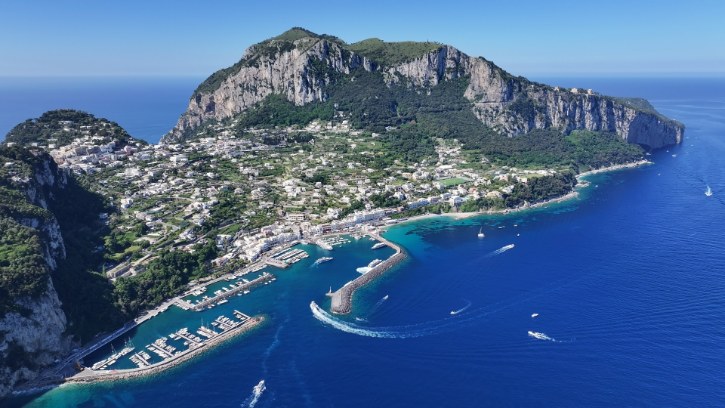
Capri town is where you first feel the island’s pulse. It sits above the arrival port of Marina Grande, packing designer streets, Roman history, and some of the Mediterranean’s best viewpoints into a compact, walkable center.
a. Start in the Piazzetta, Capri’s Open-Air Living Room
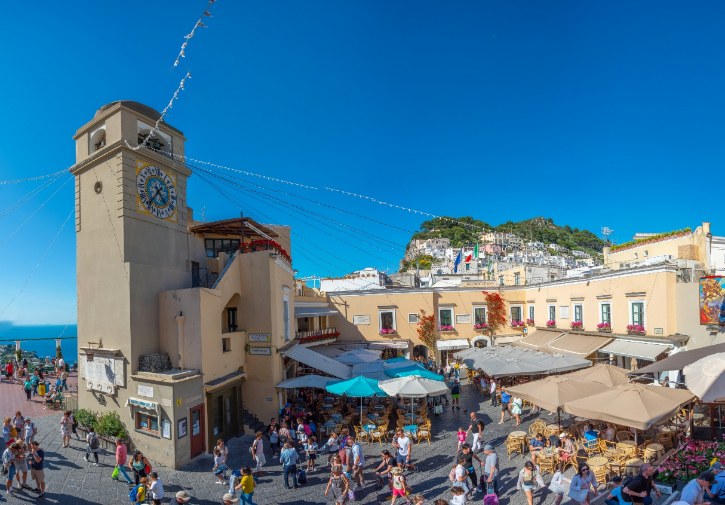
The heart of town is Piazza Umberto I, known to everyone as the Piazzetta. Locals and visitors share its café terraces side by side, which earned it a fond nickname, il salotto del mondo, “the drawing room of the world”.
- Order an espresso or an evening aperitivo and settle in for some of the best people-watching on the island.
- Look up at the Clock Tower (Torre dell’Orologio) and the Baroque former Cathedral of Santo Stefano, which you can step inside for a quiet pause.
- Walk Via Camerelle for high-fashion boutiques, then Via Le Botteghe for handmade sandals, local limoncello, and Carthusia’s island fragrances.
- Slip into quiet lanes like Via Longano and Via Sant’Aniello to see the older, residential side of town.
b. Catch the Faraglioni From the Gardens of Augustus
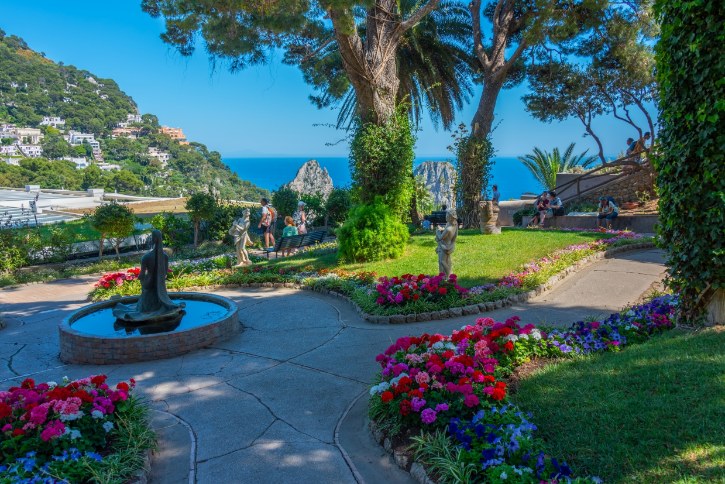
A ten-minute walk from the Piazzetta brings you to the Gardens of Augustus (Giardini di Augusto), a run of cliffside terraces above the sea. German industrialist Friedrich Alfred Krupp laid them out before donating them to the town, and they were later renamed in tribute to Rome’s first emperor.
- One side gives you a clear panorama of the Faraglioni sea stacks.
- The other looks down on Marina Piccola and the tight switchbacks of Via Krupp.
- Visit in the morning or late afternoon, since the open terraces offer little shade at midday.
- Via Krupp, the famous zigzag path cut into the cliff, has reopened after maintenance but still closes at times for safety checks, so confirm its status locally. You can always admire it from the terraces above.
c. Step Into Quiet History at the Charterhouse of San Giacomo
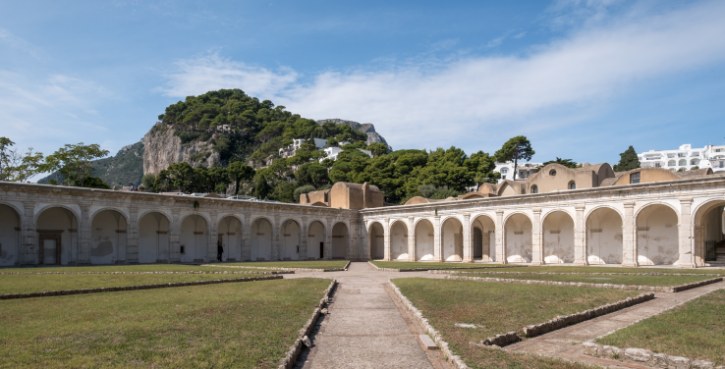
Right beside the gardens stands the Charterhouse of San Giacomo (Certosa di San Giacomo), a former Carthusian monastery built in the 1370s. It is the island’s most important medieval monument, and a calm contrast to the busy streets.
- Wander its two silent cloisters, which frame glimpses of the Mediterranean.
- Visit the Museo Diefenbach, dedicated to a German Symbolist painter who lived on Capri around the turn of the twentieth century.
- See the National Archaeological Museum of Capri, which opened inside recently and displays Roman sculptures recovered from the Blue Grotto.
d. Walk Via Tragara for the Classic Faraglioni View
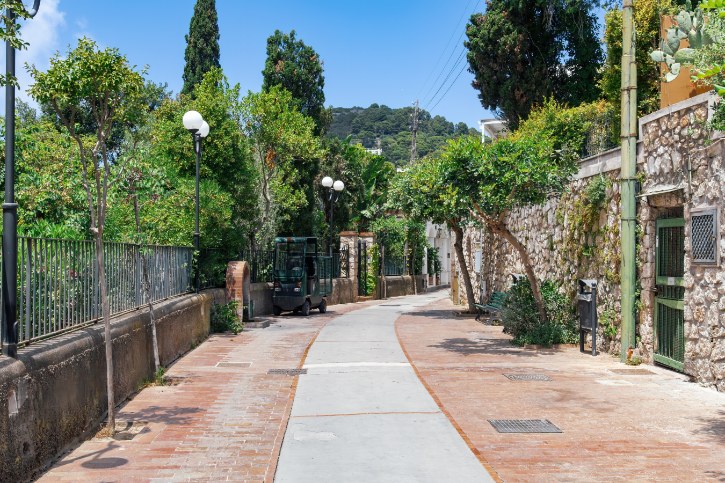
If you want coastal drama without a steep hike, Via Tragara is your walk. The gentle, paved route winds past gardens and historic villas to the Belvedere di Tragara, a wide terrace that looks straight out at the Faraglioni. It is especially lovely at sunset.
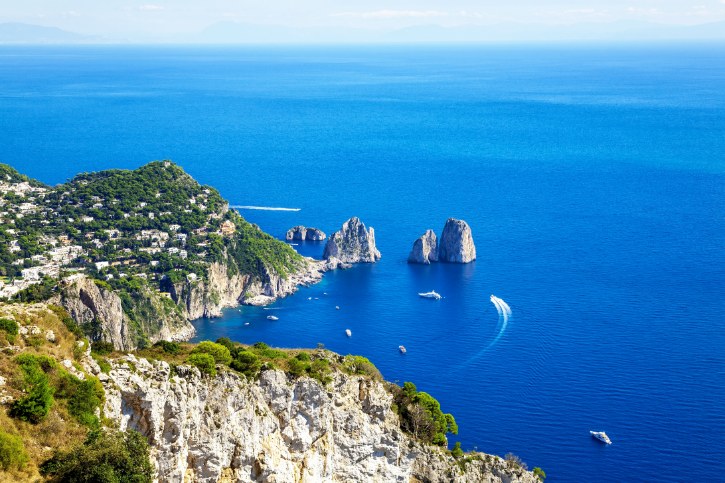
The three limestone stacks each have their own character:
- Stella, nearest the cliff, is the only one still attached to the island.
- Mezzo is pierced by a famous natural arch, though motorboats are no longer allowed to pass under it.
- Scopolo, furthest out, is home to a rare blue lizard found nowhere else.
- From the overlooks, spot Villa Malaparte, a red modernist house on a rocky point, closed to the public but easy to admire from a distance or the water.
e. Hike the Natural Arch and Pizzolungo Trail
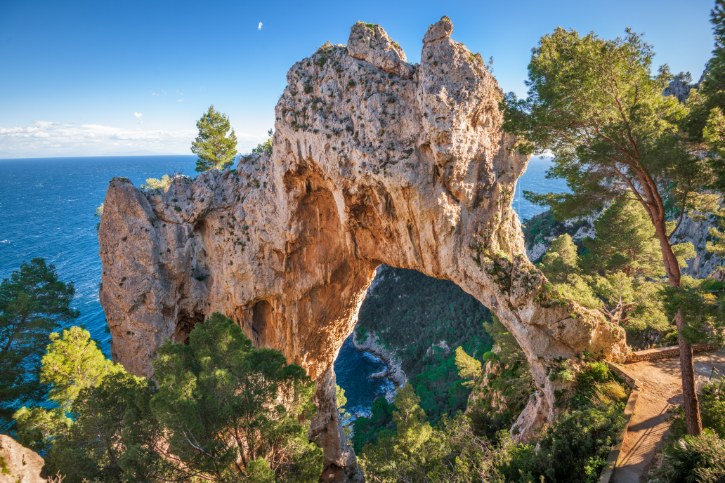
For the island’s raw, rocky side, head to the eastern cliffs and the Arco Naturale, an 18-meter limestone arch left behind when an ancient grotto collapsed. Steep steps nearby drop onto the scenic Pizzolungo coastal path, which passes the Grotta di Matermania, a cave the Romans turned into a shrine.
Know the route before you go:
- It runs roughly 3.3 to 3.5 kilometers and takes 1 to 3 hours depending on your pace, forming a loop back to town.
- Expect steep steps, exposed ledges, and surfaces that get slippery after rain.
- It is not suitable for strollers or anyone with walking difficulties.
- Wear sturdy closed-toe shoes, carry water, and skip it in wet or windy weather.
f. Climb to Villa Jovis and Emperor Tiberius’s Ruins
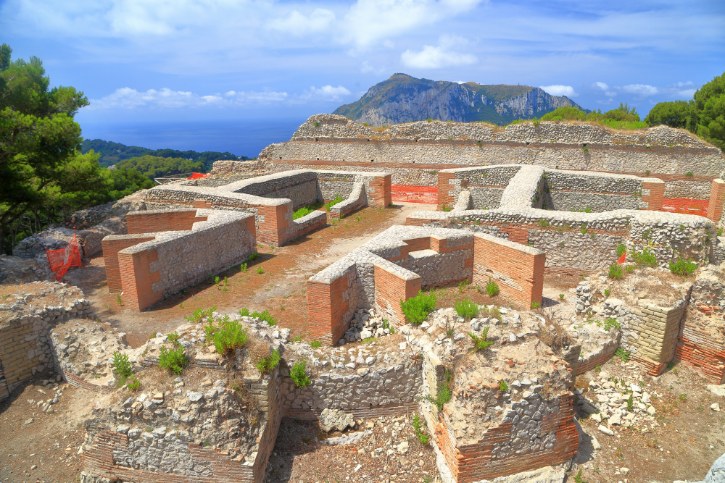
Nothing brings ancient Rome to life like the climb to Villa Jovis, perched on Monte Tiberio at 334 meters. Emperor Tiberius made it his main residence on the island, ruling from this lofty, isolated peak. Reaching it is about a 45-minute uphill walk from the Piazzetta.
What you can still see:
- A mosaic-paved corridor leading into the Roman bath complex.
- The emperor’s private apartments on the northern summit, with a panoramic terrace.
- The Salto di Tiberio, a sheer cliff tied to lurid legends of victims thrown into the sea.
- Sweeping views over the Gulf of Naples, the Sorrento Peninsula, and Mount Vesuvius from the palace’s commanding perch.
g. Swim Below the Cliffs at Marina Piccola
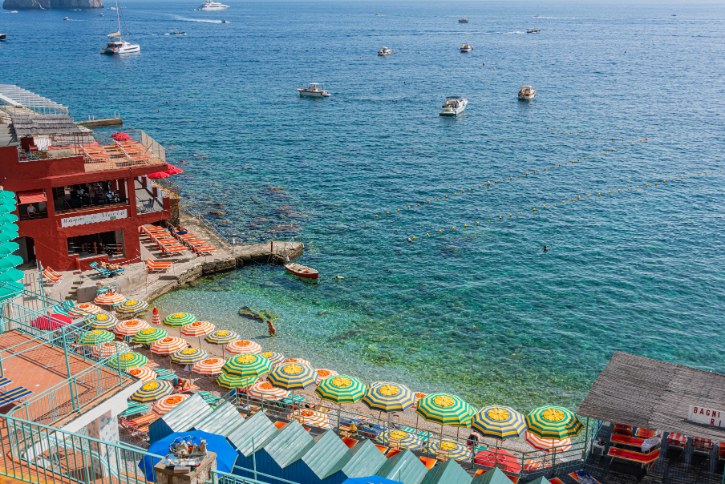
Down at sea level on the southern coast, Marina Piccola trades the high viewpoints for direct access to the water, framed by sheer rock walls and the Faraglioni just offshore.
- Set your expectations: this is pebble and rock, not soft sand.
- You do not need a beach club. Free public beaches (spiagge libere) sit on both sides of the Scoglio delle Sirene.
- It gets crowded in high summer, but a quick walk down to photograph the stacks from the water is worth it.
- Steep cliffs shift the light and shade through the day, so check sun and sea conditions on site.
h. See the Cliffs the Way They’re Meant to Be Seen: By Boat
The footpaths show only half of Capri. Circling the island by boat reveals the full scale of its cliffs dropping straight into deep water, and landmarks look monumental from below.
- Shared cruises loop the island in around 75 minutes, or two hours with a pause outside the Blue Grotto.
- Private charters offer flexible pacing and optional swimming stops.
- Boats glide past sea caves like the White Grotto and Green Grotto, with the Faraglioni towering overhead from sea level.
- To protect the stacks, motorboats can no longer go right up to the Faraglioni or under the Mezzo arch, so that stretch is now reserved for swimmers and rowing boats.
- Standard tours do not enter the Blue Grotto, which needs calm seas and a separate rowboat transfer, so treat that as a bonus, not a given.
2. Anacapri: Calmer Streets, Big Panoramas, and Hidden Treasures
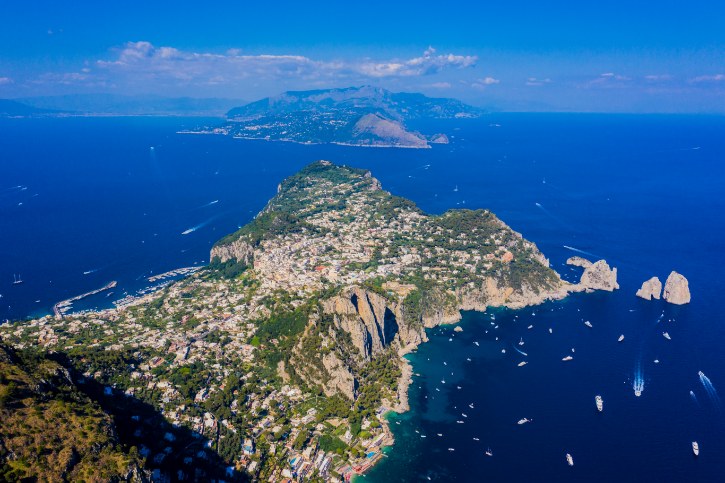
Climb westward and you reach Anacapri, the island’s second town, spread across a high plateau. It feels more relaxed and less commercial than Capri town, though it is far from empty. It holds roughly half the island’s residents, so it is a living, working town rather than a sleepy outpost. For centuries its only link to the port below was the steep Scala Fenicia staircase of 921 steps.
a. Slow Down Along Via Giuseppe Orlandi
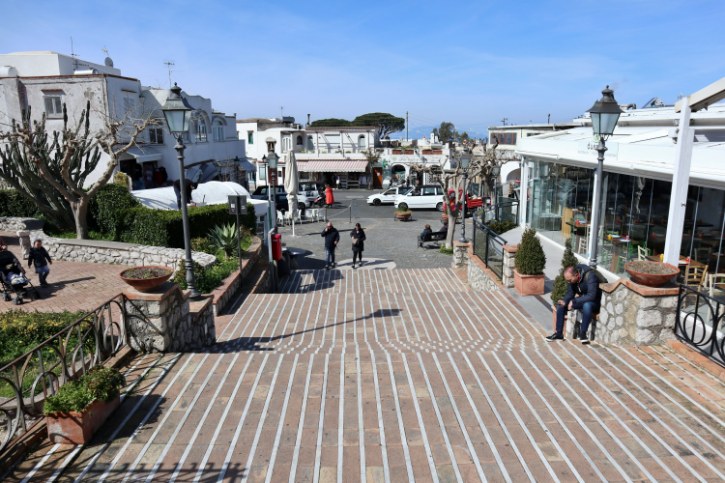
The historic center runs along Via Giuseppe Orlandi, a flat pedestrian street lined with independent shops and restaurants. Ceramic plaques point you down quiet side lanes.
- Follow them between the main squares, from Piazza Vittoria, where the chairlift departs, to Piazza San Nicola and Piazza della Pace.
- Give the center real time rather than rushing through it, and enjoy its whitewashed, village feel.
- This is the easiest place to sense how different Anacapri’s pace is from Capri town’s.
b. Look Down on a Painted Floor in the Church of San Michele
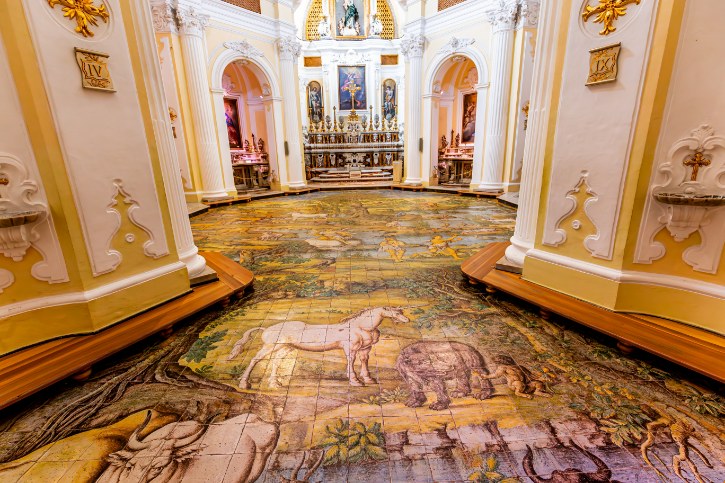
In Piazza San Nicola, the plain white Church of San Michele Arcangelo hides one of southern Italy’s great decorative surprises.
- The octagonal Baroque church was designed by a leading Neapolitan architect, but you come for the floor.
- The entire nave is a majolica tile pavement of about 1,500 tiles, laid in the eighteenth century.
- It depicts the Garden of Eden, with Adam and Eve among a parade of animals, reading like one continuous painted canvas rather than simple tiling.
- You view it from an elevated gallery, which protects the fragile tiles and lets you take in the whole scene at once.
c. Uncover the Red House and Its Eccentric Owner
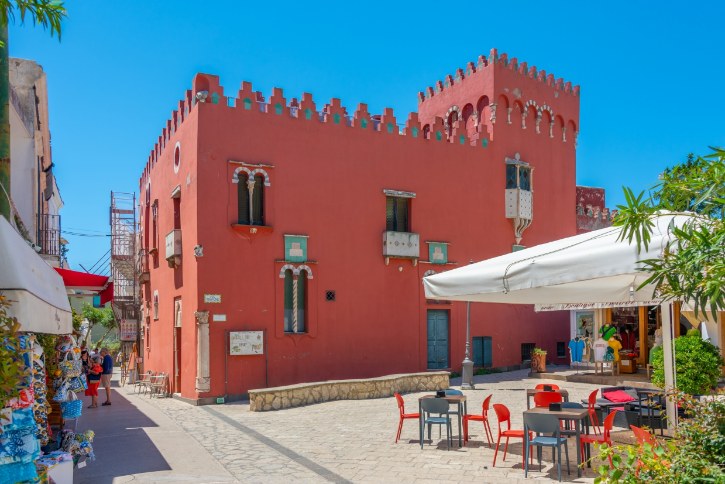
Casa Rossa is a vivid bright-red building raised beside an old Aragonese tower by an eccentric American colonel, John Clay MacKowen, in the late nineteenth century.
- It is now a public museum and one of the island’s official heritage sites.
- Admire the bold hybrid exterior, unlike anything else in town.
- Inside, see L’Isola Dipinta (“The Painted Island”), a collection of paintings of Capri and Anacapri by resident and visiting artists.
- Note that the Roman statues once linked to Casa Rossa are now exhibited at the National Archaeological Museum in the Certosa di San Giacomo, so the current display can vary.
d. Wander Axel Munthe’s Villa San Michele and Gardens
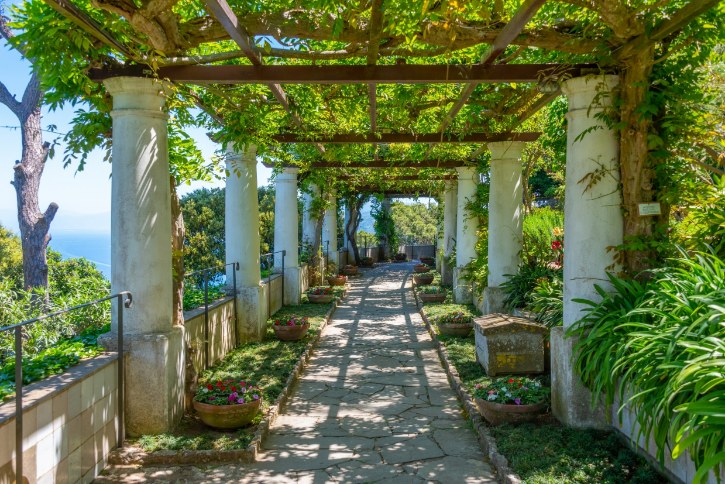
Perched where the Scala Fenicia meets the plateau, Villa San Michele was built by Swedish doctor and author Axel Munthe on the ruins of a Roman villa. It inspired his international bestseller, The Story of San Michele.
- Tour the light-filled rooms, filled with classical antiquities, including a bust of Emperor Tiberius and a head of Medusa.
- Walk the terraced gardens to the villa’s famous 3,200-year-old Egyptian sphinx, gazing out to sea.
- Enjoy the mix of art, greenery, and panoramic coastal views, which makes this more than a simple viewpoint.
- Plan around one closure: the villa and gardens shut completely during February.
e. Ride the Chairlift to the Top of the Island
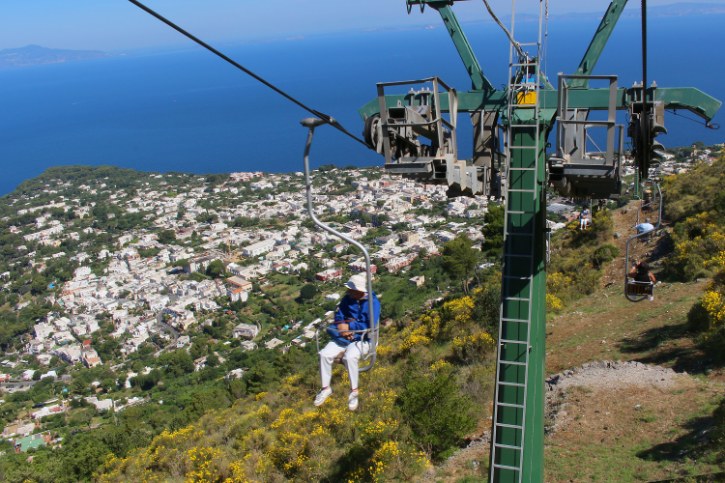
From Piazza Vittoria, the Seggiovia Monte Solaro carries you to the island’s highest point at 589 meters.
- The open single-seat ride takes about 12 minutes, and the journey itself is half the fun as the coastline widens beneath you.
- From the summit terraces, on clear days you can see the Gulf of Naples, the Sorrento Peninsula, the Amalfi Coast, Mount Vesuvius, and the island of Ischia.
- Every chair is single-seat and fully open, so it can feel daunting if you fear heights.
- It is not ideal for reduced mobility or very young children who cannot ride alone.
- Wind and winter timetables can halt service, so check conditions before you go.
f. Stroll Through Farmland to Belvedere della Migliera
For Anacapri’s rural side, start at Piazza della Pace and follow Via Migliera, a flat country lane of about two kilometers through vineyards and fields. It ends at a dramatic clifftop.
- The Belvedere della Migliera looks across a rocky gorge toward the Punta Carena Lighthouse.
- A nearby viewpoint, the Belvedere del Tuono, faces the lighthouse one way and the Faraglioni the other.
- Local signs help you tell the two apart, since maps often blur the names.
- The walk is easy, but the cliff edge drops away sharply, so wear practical shoes and watch your footing.
g. Glide Into the Blue Grotto’s Glowing Water
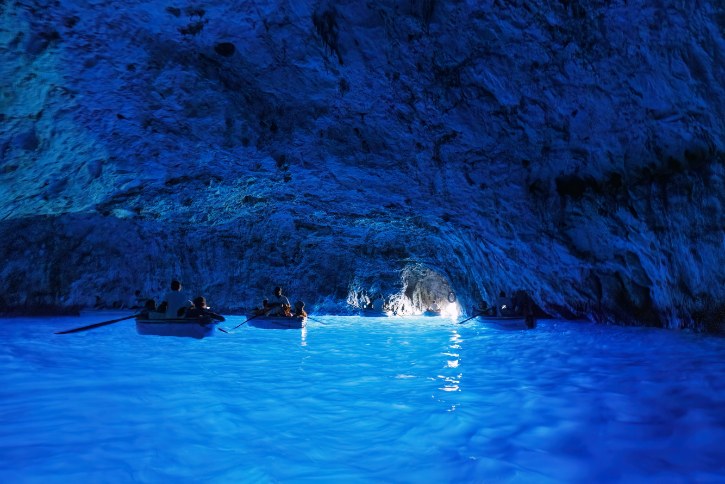
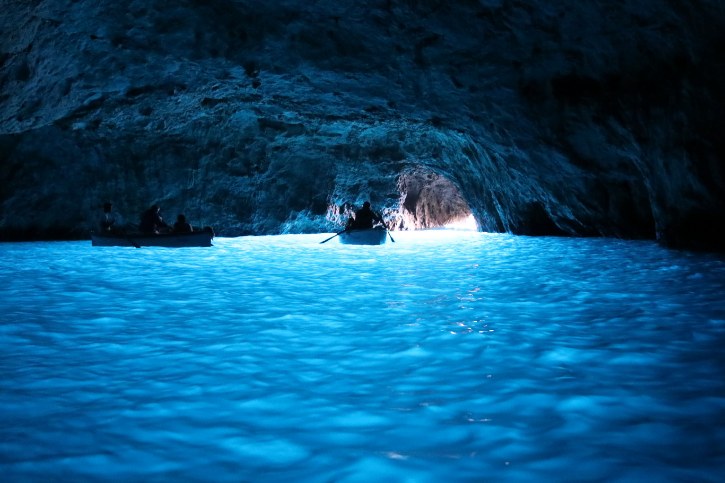
The Blue Grotto (Grotta Azzurra) is the island’s most famous natural wonder, a sea cave on the northwest coast lit by an almost unreal blue glow.
Here is why it glows and how a visit works:
- Sunlight enters through a submerged opening below sea level, filtering through clear water to light the cave in silvery blue, brightest between noon and 2 p.m. on sunny days.
- You enter only in small rowboats with local boatmen, lying flat to pass under a one-meter-high arch.
- Swells, wind, or high tides can seal the entrance, even on fine days, so arriving never guarantees entry.
- Beyond the spectacle, the cave was a Roman marine shrine, and statues were later recovered from its floor.
h. End the Day at Punta Carena Lighthouse
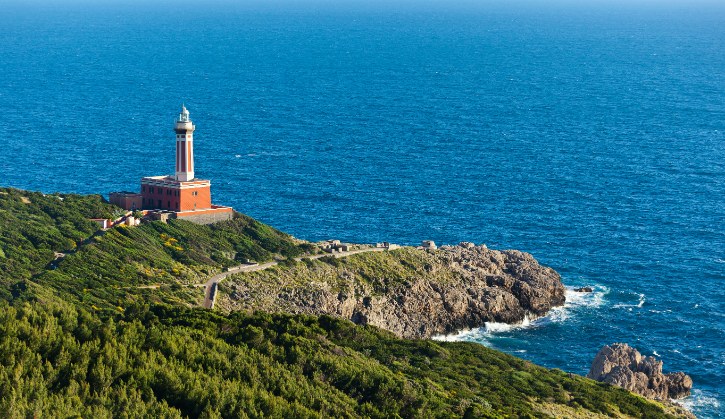
At the wild southwestern tip, the Punta Carena Lighthouse (Faro di Punta Carena) marks one of Anacapri’s most elemental stretches of coast, facing the open sea. Reach it by the local Staiano bus or a walk of about 40 minutes.
- The shore is rugged rock, with ledges for lounging and clear water for swimming.
- It is the island’s most celebrated spot for watching the sunset.
- Wear practical footwear for uneven rock, and check the sea before swimming.
Getting There: Ferries, Funiculars, and Buses
Reaching the island is straightforward. Conventional ferries and faster hydrofoils run year-round from Naples and Sorrento, with extra seasonal links from Amalfi Coast ports like Positano, Amalfi, and Salerno. Every boat docks at Marina Grande. Because routes shift with the season and the weather, check current crossings with official operators shortly before you travel.
Once ashore, Capri town and Anacapri are two separate journeys:
- The quickest way up to Capri town is the scenic funicular to the Piazzetta, backed up by buses, taxis, and pedestrian paths.
- Reaching Anacapri means a separate bus or taxi ride, uphill from Marina Grande or onward from Capri town.
- From Anacapri, local Staiano buses connect to the Blue Grotto and Punta Carena.
- Allow extra time during busy summer middays and reduced winter schedules.