You already know the Colosseum and the Pantheon. What most visitors miss is the older city hiding along quiet lanes, busy squares, and even inside church walls.
These seven survivors reach back before AD 26, into the world of Republican builders and Augustan merchants.
They sit beside modern apartments and newer monuments, so they are easy to walk right past. Slow down, and each one rewards you. 😊
1. Pyramid of Cestius
a. A Pharaoh’s Shape on a Roman Corner
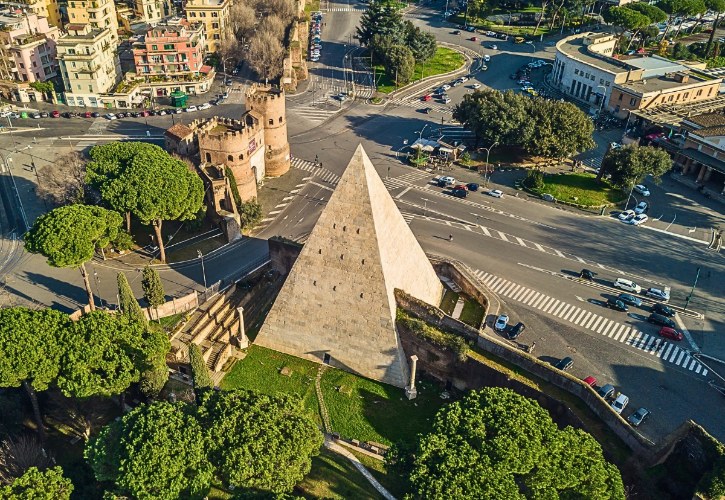
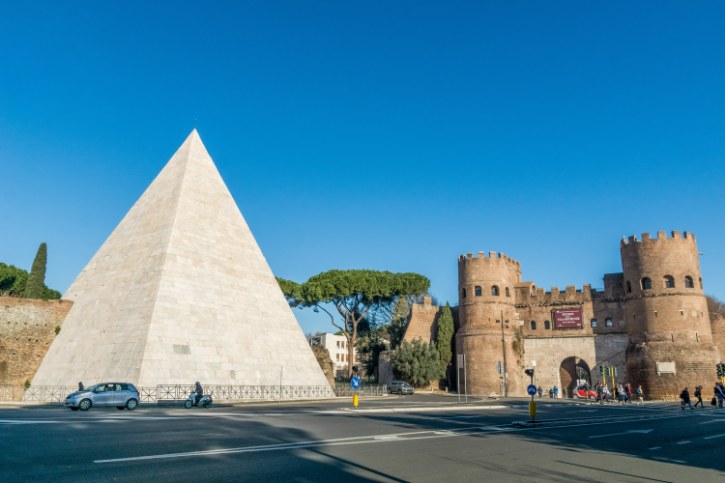
Beside the Porta San Paolo square, a sharp white marble pyramid rises where you least expect it. It looks so out of place that you will wonder how an Egyptian monument landed next to Rome’s ancient brick walls.
b. The Man Who Raced His Own Tomb
- Built between 18 and 12 BC as the private tomb of Gaius Cestius Epulo, a wealthy magistrate and member of a major priestly college
- Carved inscriptions name him as a senior magistrate and record that the tomb was finished in just 330 days
- The inscription itself states the work was completed in accordance with his will, so that famous deadline is written into the stone rather than just legend
c. Egyptian Outside, Roman at Heart
Choosing a pyramid was pure fashion. After Rome’s conquest of Egypt, Egyptian style became the height of taste.
- Stands 36.40 meters tall on a base of 29.50 meters per side, far steeper than the pyramids at Giza
- Hides a core of brick-faced concrete beneath a skin of white Carrara marble
- Remains the only ancient pyramid still standing in Rome
d. The Secret Room No One Was Meant to See
Sealed inside is a single barrel-vaulted burial chamber, painted with Roman frescoes of nymphs and four winged Victories in a space meant to stay closed forever. Robbers reached it long before its official reopening, so no sarcophagus or grave goods remain, only the painting.
e. What You Can See Today
- Admire the bright marble, steep shape, and ancient inscriptions freely from the square
- Note where the third-century Aurelian Walls meet the marble, those walls are far younger than the tomb
- Enter the painted chamber only on special scheduled openings run by Rome’s archaeological heritage office, with free booking required
2. Clivus Scauri
a. One of Rome’s Oldest Streets, Still Underfoot
Tucked between the Palatine and Caelian hills, this narrow uphill lane follows one of the city’s oldest street corridors. It feels a world away from the crowds, yet it traces an ancient route almost exactly.
b. How Old Is What You Actually See?
Here honesty matters, because the street’s line is far older than its visible stones.
- The route and origins run well past 2,000 years
- The exposed stones and brick walls you see today are not confirmed to predate AD 26
- Enjoy the ancient alignment without assuming every block is Republican
c. The Name That Keeps Its Secret
- Tradition links it to Marcus Aemilius Scaurus, consul in 115 BC, but no surviving source confirms which Scaurus
- The name appears only in medieval documents, though scholars still consider the street genuinely ancient
- In the Republic this was a lived-in neighborhood of tall apartment blocks, not a monument
d. The Arches That Fool Everyone
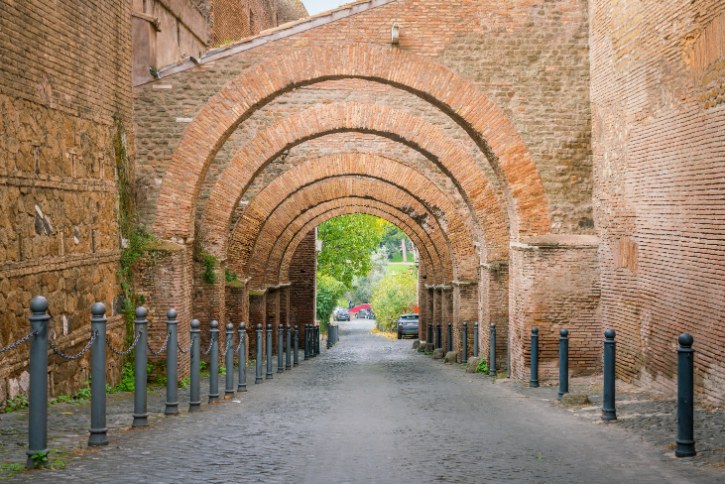
The row of brick arches leaping over the lane is the image you will remember, but their dates vary widely.
- Seven arches brace a tall reused facade built into the Basilica of Santi Giovanni e Paolo
- Only the westernmost arch is Late Antique (third century AD); the rest are medieval
- The grand facade beside you belongs to Imperial Rome, not the Republic
e. A Walk Worth Taking Anyway
- Pass beneath the arches and spot old stone fragments set into the southern wall
- Glance toward the ruins of the Temple of the Divine Claudius by the bell tower
- Visit the adjacent frescoed Roman houses separately if you want to go underground
3. Servian Wall
a. Rome’s First Great Fortress Wall
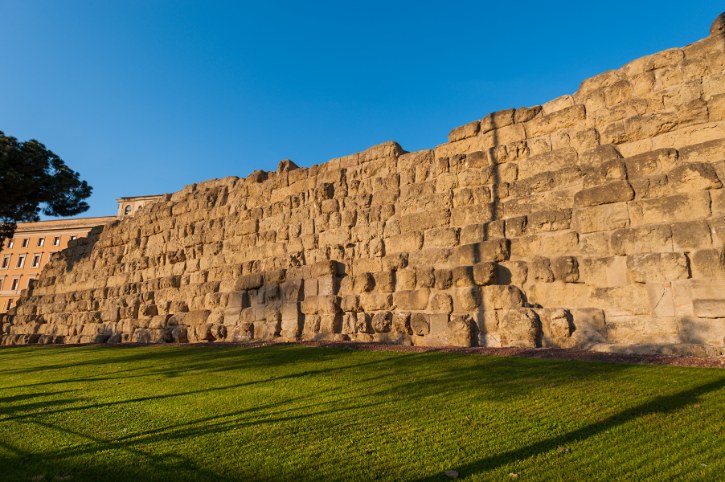
Centuries before the Aurelian Walls, the young Republic guarded its hills behind a massive barrier of volcanic stone. You can still stand beside it in the middle of the modern city.
b. Separating the Legend From the Stone
- Tradition credits the sixth-century BC king Servius Tullius, and early earthworks from that era do survive
- The monumental stone sections visible today belong mostly to a mid-fourth-century BC rebuild, roughly 2,400 years old
- That rebuild followed the Gallic sack of Rome in 390 BC
c. Engineering Built to Survive a Siege
- Cut from superior yellow Grotta Oscura tuff, quarried from land won by conquering nearby Veii
- Blocks up to 60 centimeters high, laid without mortar in alternating rows
- Ran roughly 11 kilometers around the city and stood up to about 10 meters high
d. Where to Stand Beside It
Two stretches give you the clearest sense of early Roman engineering, both out in the open.
- Piazza dei Cinquecento by Termini station holds the largest fragment, towering courses of 2,400-year-old tuff, with one section even standing inside a station McDonald’s
- The Aventine Hill preserves another imposing section that doubled as a retaining wall
- Look on the Aventine for a late-Republican catapult arch, still over 2,000 years old
e. A Few Honest Caveats
- Two surviving gateways mark original gate sites but preserve later Roman rebuilds, not fourth-century BC stone
- Other fragments survive across the city, including at Largo Magnanapoli and the earthwork remains by the Municipal Aquarium
- Treat the Termini and Aventine stretches as the reliable highlights
4. Temple of Hercules Victor and Temple of Portunus
a. Two Temples That Shouldn’t Still Be Here
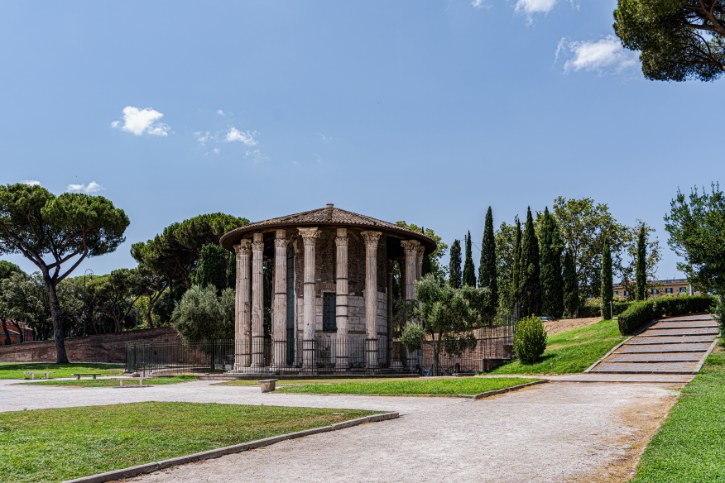
Beside the Tiber in Piazza Bocca della Verità stand two ancient temples so intact they look almost unreal. This riverfront was once the Forum Boarium, Rome’s cattle market and busy river port, where merchants prayed for safe, profitable ventures. Both date back over 2,000 years and survived by later becoming churches.
b. The Round One: Rome’s Oldest Marble Building
- The circular Temple of Hercules Victor was built in the late second century BC
- It holds the distinction of being the oldest surviving marble building in Rome
- A ring of 20 slender Corinthian columns in imported Greek marble, 19 of which still stand
- Its original roof is gone, replaced long ago by the low tiled cone you see now
Popular accounts name a specific patron and architect, but the records do not confirm either, so enjoy those as educated theories.
c. The Square One: Greek Style on a Roman Base
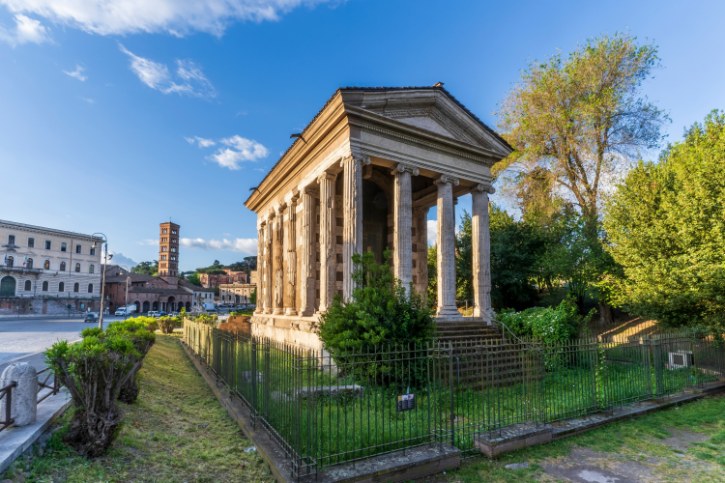
- The rectangular Temple of Portunus honored the god of harbors and gateways
- The standing building dates to the Late Republic, around 120 to 80 BC
- Graceful Greek Ionic columns sit atop a high Roman podium reached by a single front stair
- Built from local tufa and travertine, once coated in white stucco to mimic marble
For centuries it was wrongly called the Temple of Fortuna Virilis, a name now corrected.
d. How to Read Them Side by Side
A fence rings the round temple, and both interiors open only for occasional guided or heritage-day visits, so you will usually enjoy them from the piazza. That is plenty, because a slow loop gives you a lesson in Republican design:
- Imported marble against local tufa and travertine
- Corinthian capitals against Ionic volutes
- A circular colonnade low on steps against a rectangular temple on a tall podium
5. Tomb of Eurysaces the Baker
a. A Monument to Bread, Not Battles
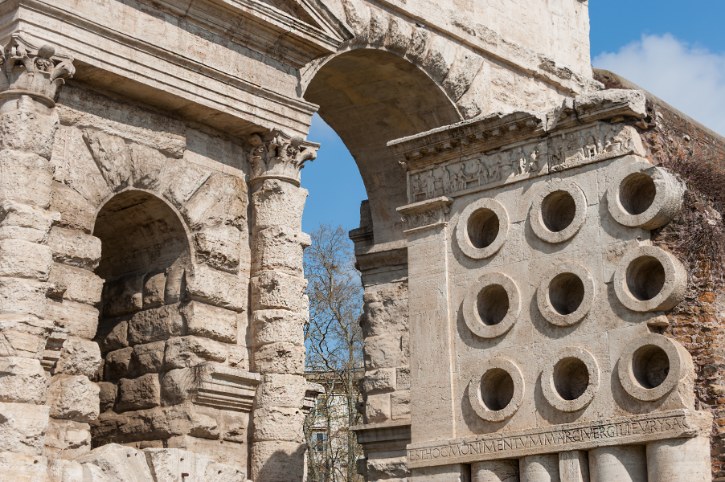
Just outside the arches of Porta Maggiore stands one of Rome’s strangest tombs. It honors neither a consul nor a general, but a baker. Built around 30 to 20 BC, it comfortably clears 2,000 years old.
b. The Self-Made Man in the Stone
- Commemorates Marcus Vergilius Eurysaces and his wife Atistia
- Widely thought to be a wealthy freedman who grew rich through large-scale baking
- Proudly advertises a manual trade that Rome’s elite rarely celebrated
- The inscription leaves his exact status open, so he may instead have been a freeborn entrepreneur
c. A Shape Like Nothing Else in Rome
You will not mistake it for any other tomb.
- A roughly ten-meter (about 33-foot) trapezoidal structure faced in travertine
- Three upper walls pierced by rows of hollow circular openings
- Those circles are read as giant grain jars or dough-mixing vessels from a commercial bakery
d. Bread, Carved in Stone
A sculpted frieze wraps the top and turns baking into monumental art, scene by scene.
- Workers deliver grain, grind it, and sift flour
- Bakers knead dough, shape round loaves, and bake in a domed oven
- Finished loaves are stacked into baskets and carried off for weighing
- A bold Latin inscription names him plainly as baker and contractor
e. Saved by Accident, Seen for Free
Late-Roman builders sealed the tomb inside a defensive tower, which protected it until the tower came down in 1838. You can now study three surviving facades from the sidewalk. The couple’s carved portraits moved to Rome’s museums, so look for those indoors, not on the tomb.
6. Portico of Octavia
a. A Grand Gateway in the Old Ghetto
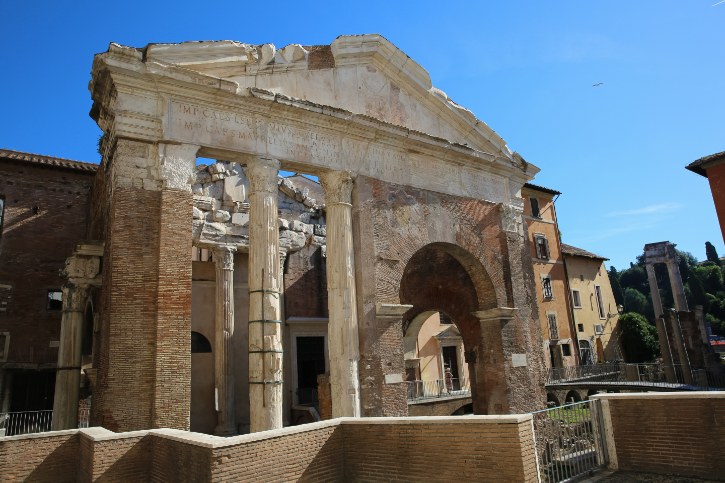
Walking through Rome’s historic Jewish Ghetto, you meet a towering marble pediment and tall Corinthian columns rising beside the street. The Portico of Octavia looks ancient, and its roots truly are, but the stones ask you to look carefully.
b. Deep Roots, Younger Stones
- Rebuilt between 27 and 23 BC under Augustus, who dedicated it to his sister Octavia
- Once a vast enclosure of some 300 Corinthian columns framing two temples
- The grand entrance standing today is not the intact Augustan structure
c. Why the Dates Don’t Quite Add Up
Fires repeatedly swept this neighborhood, forcing a major rebuild.
- Emperors Septimius Severus and Caracalla rebuilt the portico in AD 203
- Those Severan remains are a bit over 1,800 years old, nearly two centuries short of 2,000
- The foundations and footprint trace to Augustus, but the standing gateway is largely Severan
d. What You Can Admire
- Tall marble Corinthian columns and a carved pediment, free to view from the street
- A later brick archway inserted across the span during repairs
- Excavated walkways that let you step behind the colonnade
e. Reading It Honestly
Most of what physically stands here dates to around AD 203. The origins clear two millennia, the visible gateway does not. That gap is part of the appeal, because it shows Rome’s endless cycle of fire, rebuilding, and reuse in a single view.
7. San Nicola in Carcere
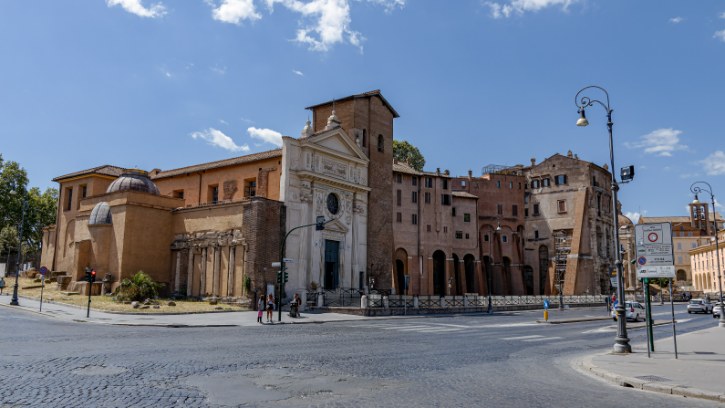
a. A Church Built Straight Into Three Temples
Along Via del Teatro di Marcello, this looks like an ordinary late-Renaissance church. Walk along its side walls or step beneath the altar, though, and you meet one of Rome’s most extraordinary mergers.
b. The Church Is Younger Than You Think
- The building itself is far younger than 2,000 years, founded and rebuilt across the medieval centuries
- What reaches back further are three Republican temples of the old fruit and vegetable market
- Their columns are fused directly into the church’s walls and foundations
c. Three Temples You Can Still Pick Out
Each temple is still surprisingly easy to read from the street.
- Temple of Spes (left side): six fluted Doric travertine columns embedded in the wall
- Temple of Juno Sospita (center): the largest, an Ionic temple whose podium survives underground
- Temple of Janus (right side): the best preserved, with seven standing columns in peperino stone
d. Ancient Columns Holding Up the Church
- Inside, three naves are divided by 14 ancient columns salvaged from classical temples
- They differ in stone, height, and carving, so admire them as genuine but mixed in origin
- One column near the entrance even carries a tenth-century inscription
e. The View That Stays With You
The most memorable perspective lies underground. Narrow steps beneath the altar, reached with a small ticket bought on site, bring you beside Republican temple foundations more than 2,100 years old, still holding up the church above. Standing there, you catch Rome at its most revealing: a city that rarely swept its past away, choosing instead to build straight into the stone of what came before.