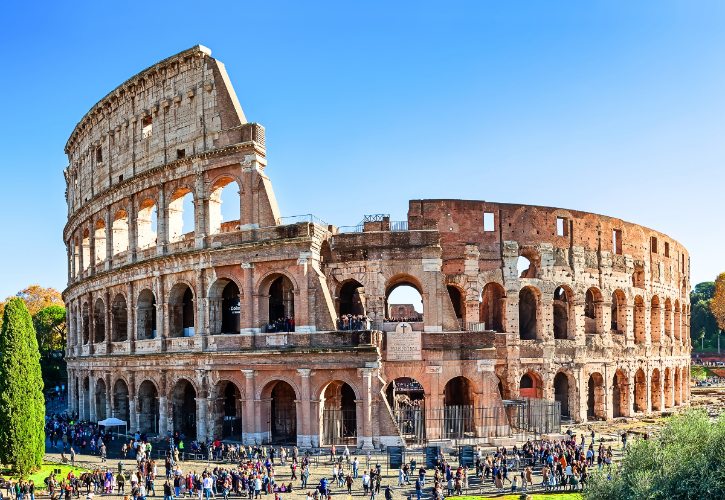
The route is known as the Colosseum to Trevi Fountain walk, but it actually begins a few minutes uphill from the arena, at the quiet Basilica of San Pietro in Vincoli.
From there you come back down past the Colosseum, drift through the open ruins of the ancient city, then weave through the busy historic center before the streets suddenly deliver you to a famous fountain.
Every stop sits just one to five minutes from the next. The history piles up as you go, quietly and without any rush. 😊
1. Basilica of San Pietro in Vincoli
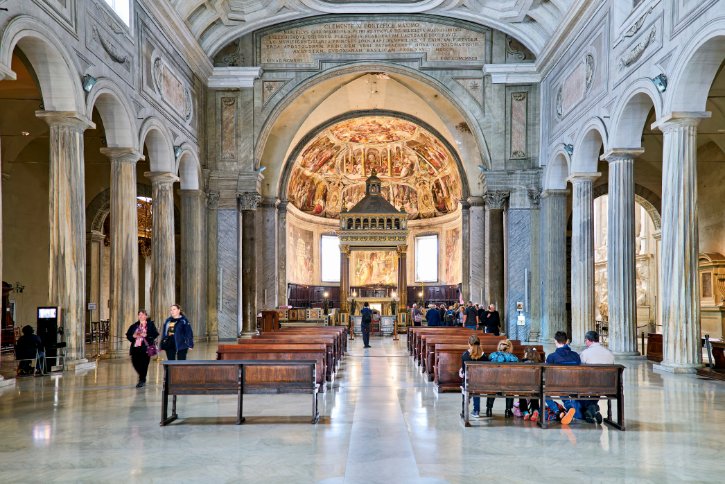
a. A quiet place to begin
Most visitors walk straight past this one. Up on the Oppian Hill, a plain looking church hides one of Michelangelo’s greatest works and one of Rome’s most famous relics. It is a calm start, and that calm matters, because the scale is about to explode.
b. The chains and the legend
- The church was founded in the mid fifth century by a Western Roman empress.
- Its purpose was to hold the iron chains believed to have bound Saint Peter in Jerusalem.
- Tradition says these fused with a second set from his imprisonment in Rome into a single chain.
- Treat that as an old legend, not proven history. The relic is very real, kept beneath the high altar in a gilded bronze and crystal case.
c. Michelangelo’s Moses, up close
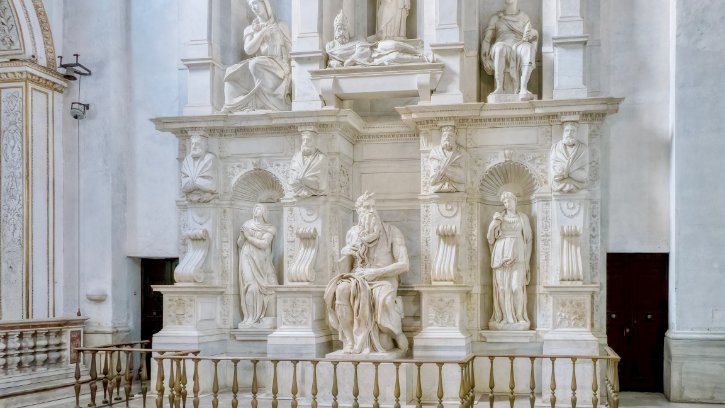
The main reason to step inside is the wall tomb of Pope Julius II, anchored by Michelangelo’s seated marble Moses. It was meant to be a huge freestanding monument, but the plan was cut down over four decades. Look for these details:
- The head turns sharply left, caught in a moment of quiet, simmering anger.
- The pose is full of coiled energy, with the left foot pulled back as if Moses is about to rise.
- The right arm holds the Tablets of the Law, while the fingers twist into the deeply carved beard.
- The veins and tension show a figure frozen the instant before movement.
- The two small horns come from an old translation of a Hebrew word meaning “to shine”.
d. What else to notice inside
- Moses is not a lone statue. He sits in the lower tier of the tomb, flanked by figures of Leah and Rachel.
- Twenty fluted columns of Greek marble, taken from older Roman buildings, line the nave.
- Look up for the oak tree symbol of the Della Rovere family, stamped across the ceilings.
Step out and follow the shaded brick stairs downhill. The walls fall away, the sky opens, and a vast ancient valley spreads out below you.
2. Colosseum and Arch of Constantine
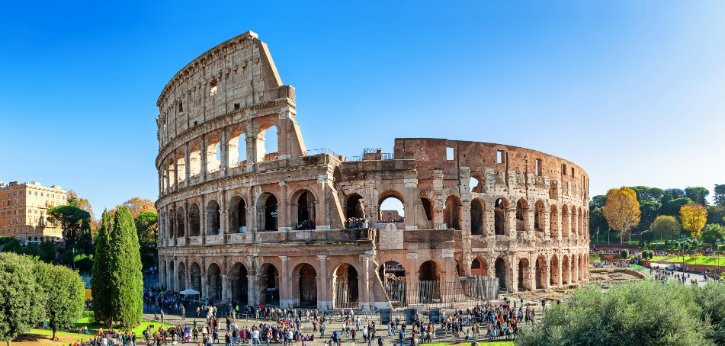
a. The walk turns monumental
After the hush of the church, the scale here feels almost unreal. Two giants stand side by side, and both deserve your attention, even from the outside.
b. The real story of the Colosseum
- Its true name is the Flavian Amphitheatre, begun under Emperor Vespasian around 70 AD.
- It was paid for with the spoils of war and opened by his son Titus in 80 AD.
- Vespasian drained the private lake of Nero’s palace to build it, a clear message of land returned to the people.
- The name “Colosseum” came later, from the Colossus of Nero, a giant bronze statue that once stood nearby.
c. What to spot from outside
- Eighty arches once let 50,000 to 70,000 spectators flow in and out, seated by social rank.
- The outer wall stacks different classical styles as it rises, heavier below and lighter above.
- High up, look for the stone brackets that held masts for a canvas awning over the crowd.
- Notice where the tall outer wall survives and where the inner rings are exposed, like a cutaway model.
- Much of the lopsided look comes from earthquakes and centuries of stone quarrying.
d. The Arch of Constantine
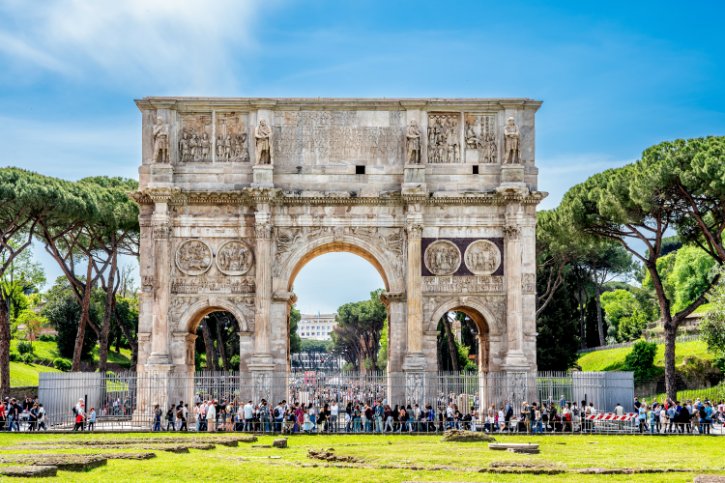
- Dedicated in 315 AD to mark Constantine’s victory over Maxentius at the Milvian Bridge.
- It is the largest surviving honorary arch from antiquity, on Rome’s ancient triumphal route.
- Much of its decoration was borrowed from older monuments, including Dacian prisoners and panels of Marcus Aurelius.
- Keep those Marcus Aurelius panels in mind. You will meet him again near the end.
e. A monument built from the past
This borrowing was deliberate. By wrapping himself in the images of Rome’s respected “good emperors”, Constantine tied his rule to the city’s golden age. Just east of the arch, look for a circle marked on the ground. It shows where the Meta Sudans once stood, a tall cone shaped Roman fountain that was pulled down in the 1930s to open up the road around the Colosseum.
Now turn away from the amphitheatre and look northwest, where the ruins gather along a low slope.
3. Roman Forum and Basilica of Maxentius Viewpoint
a. A simple roadside view
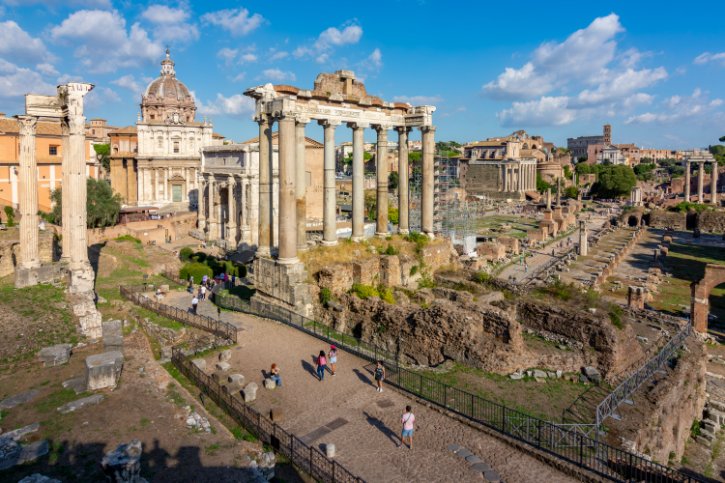
A short stroll brings you to a plain railing along the avenue. It is not an official lookout, just a spot where the ground drops away. This was the Roman Forum, the political and religious heart of the ancient city for over a thousand years.
b. What you are looking at
- The remains of streets, temples, meeting halls, and monuments, built and rebuilt across centuries.
- A mix of periods, from Republican podiums to early Christian churches inside pagan shells.
- Do not try to name every stone. Pick one anchor and read the rest around it.
c. Read it through one building
Let the huge Basilica of Maxentius be your anchor, the tall three arched brick giant on this side.
- It was begun by Maxentius and finished with changes by Constantine.
- Its central space soared to around thirty five meters, spanned by concrete vaults instead of a timber roof.
- The three big openings you see are the surviving north side aisle, with deep coffered vaults.
- Use them to picture the lost scale of the whole Forum.
d. Layers beneath, and a missing giant
Beneath the basilica lie old warehouses that once stored exotic spices, perfumes, and Indian pepper, later filled in as a platform. Rome simply built on top of itself. This basilica also held a colossal statue of Constantine, over twelve meters tall.
Do not look for it here. The surviving fragments, including the famous giant head, are kept on the Capitoline Hill.
Step away from the railing. The ruins stretch out beside you as you join the wide avenue.
4. Via dei Fori Imperiali
a. The street is part of the experience
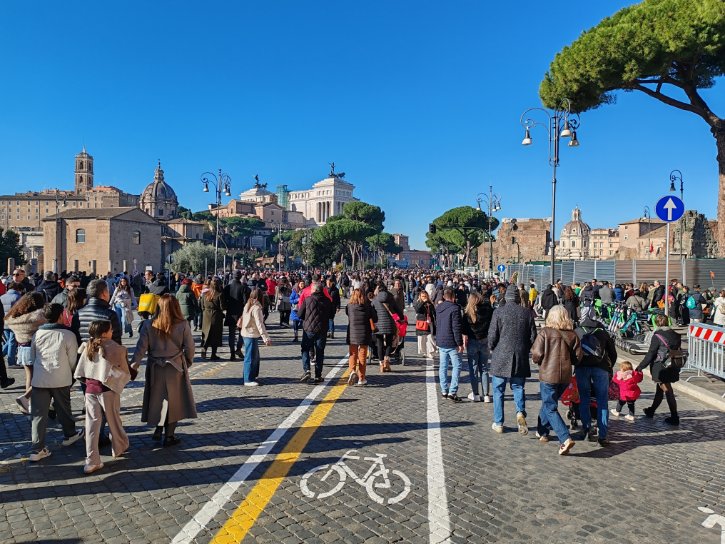
This broad, straight avenue runs between the Colosseum and Piazza Venezia, lined with umbrella pines and framed by ruins. It feels ancient, but it is not, and that changes how you see everything around it.
b. Not as old as it looks
- The avenue was opened in the 1930s as a route for military parades.
- It was built in about eleven months.
- Creating it meant demolishing a dense old neighborhood and displacing thousands of residents.
- A small hill was even excavated away to make room.
c. Two different fora
- The Roman Forum lies to your southwest, the shared center of the Republic and early Empire.
- The Imperial Fora lie to your northeast, separate squares each built by a different ruler.
- These were added because the old Forum could no longer handle the workload of a growing empire.
d. What to look for on both sides
- Do not only stare ahead toward Piazza Venezia.
- Look over the railings for column drums, marble paving, and brick walls below street level.
- Remember that tunnels run beneath the road, proof that much of the ancient city survives under the traffic.
Ahead, the view narrows toward a striking contrast: white marble columns against an enormous dark wall.
5. Forum of Augustus
a. Architecture as a message
This stop is about how Augustus used buildings to send a political message, linking himself to Rome’s past and its future.
b. The Temple of Mars Ultor
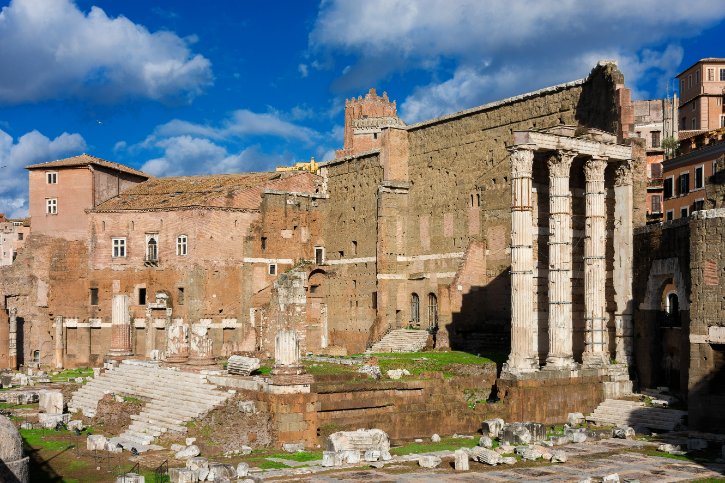
- The forum centered on the Temple of Mars Ultor, or “Mars the Avenger”.
- The name honored Augustus’s vow to avenge the murder of Julius Caesar.
- It also celebrated the recovery of military standards lost to a rival empire.
- Three fluted Corinthian columns still stand on a high podium, in pale marble.
c. The great wall
The best surviving feature is the huge boundary wall behind the temple.
- It rose around thirty three meters above the ancient ground.
- It was built from dark volcanic stone, tied with courses of white travertine.
- It worked as a firebreak, shielding the marble temple from fires in the crowded district behind it.
- It also split the dignified forum from the noisy streets beyond.
d. The strongest view
Look for this exact combination, one of the best along the whole avenue:
- The surviving temple columns in pale marble.
- The fragments scattered around them.
- The massive dark wall rising behind.
e. Later life of the ruins
High on the wall, spot a fifteenth century loggia, built when a religious order settled into the ancient ruins and made them part of their palace. Later generations did not abandon these spaces. They moved in and kept building.
A few steps on, the wall gives way to a more open scene, where a single tall column rises above the skyline.
6. Trajan’s Column and Trajan’s Forum
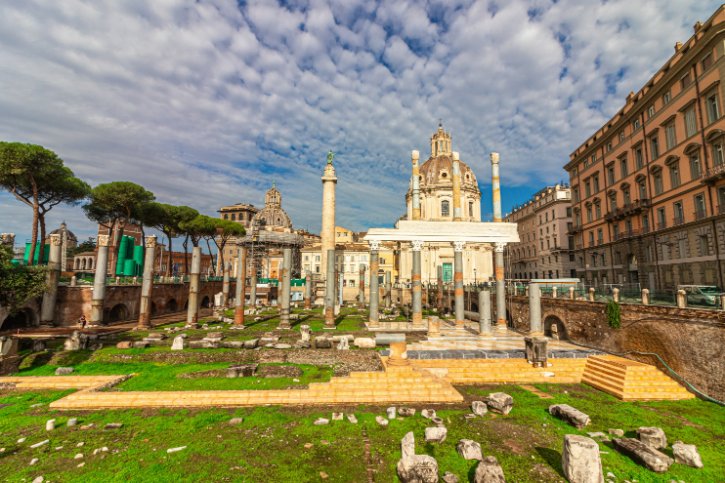
a. A story in stone
Think of Trajan’s Column not as a stone pillar but as a giant illustrated story, spiraling all the way up and circling the shaft more than twenty times.
b. What the carvings show
The scenes record Trajan’s wars against Dacia, roughly modern Romania. What surprises people is how little is pure battle.
- Around half the scenes show soldiers building camps, cutting timber, and paving roads.
- You will spot river crossings on bridges of boats.
- Look for battles, sieges, and the emperor appearing to his troops.
- Be realistic. From the ground, individual scenes are hard to make out without binoculars.
c. The engineering feat
- The column stands 100 Roman feet tall, close to thirty meters for the shaft alone.
- It was built from around twenty marble drums, each weighing thirty to forty tons.
- A staircase of 185 steps was cut inside the solid marble, lit by narrow slits.
- The base doubled as a tomb for Trajan and his wife.
d. The forum and a link back
The column was the centerpiece of the largest of all the Imperial Fora, funded by the riches of the Dacian conquest. Today a field of broken granite columns marks the great hall that once stood here.
Remember the Dacian prisoners on the Arch of Constantine. They were taken directly from this forum, so something you noticed near the start now means a little more.
From these ruins, the path climbs toward a very different kind of grandeur.
7. Piazza Venezia and Monument to Victor Emmanuel II
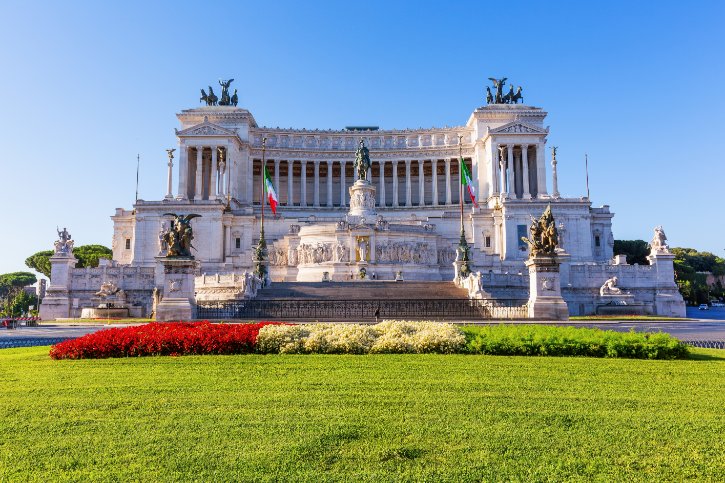
a. The turning point of the walk
Until now the story belonged to ancient Rome. Here, modern Italy takes over. The great white monument, the Vittoriano, was built to celebrate the unification of Italy and made to stand out against the warmer tones of the old city.
b. Knowing what you see
- The Vittoriano is the whole complex, with its staircases, colonnade, bronze chariots, and gilded equestrian statue.
- The Altare della Patria, the Altar of the Fatherland, technically means only the central part, though the name is often used for the whole thing.
c. The Tomb of the Unknown Soldier
At its heart lies the Tomb of the Unknown Soldier, holding a serviceman from the First World War. With its eternal flame and honor guard on duty around the clock, this is a living memorial, not just a viewpoint. Watch for the changing of the guard.
d. Details and views
- Notice the monumental staircases and the bronze chariots on the rooftops.
- Climb the mid level terraces and turn around.
- From there you can see back across the Imperial Fora, the Basilica of Maxentius, and the Colosseum in one sweep, tying together earlier stops.
e. A note on the construction
- Piazza Venezia is a major construction site for a new metro station.
- Work walls and adjusted traffic routes currently affect parts of the square.
- The dig has uncovered remarkable finds, being folded into a future underground museum station.
- Do not expect a perfectly open plaza right now.
Leave the traffic behind and slip into narrower streets. The next surprise moves indoors.
8. Church of the Gesù
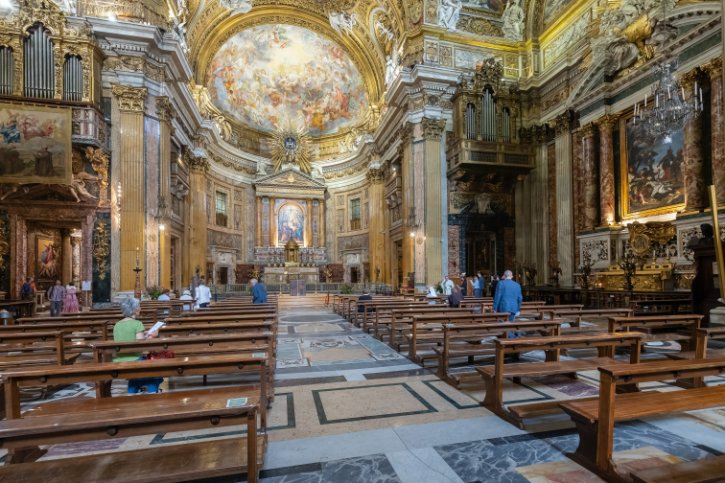
a. Baroque made to overwhelm
If San Pietro in Vincoli was about restraint, this is the opposite. The Gesù is spectacle by design, the mother church of the Jesuits, and a model copied worldwide.
b. The ceiling that breaks its frame
Look up at the nave for The Triumph of the Name of Jesus, a masterclass in illusion.
- Painted clouds and figures appear to spill out beyond the frame into the church.
- At the center, golden light surrounds the sacred monogram IHS.
- Saints rise upward while the damned appear to fall toward the floor.
- Painted shadows on the gilded frame fool your eye into thinking the figures truly float.
c. The Chapel of Saint Ignatius
- One of the richest corners in Rome, in the left transept.
- Columns are faced with deep blue lapis lazuli.
- The materials include alabaster, gilded bronze, and rare marbles.
- Beneath the altar, a gilded bronze urn holds the remains of Saint Ignatius.
d. A theatrical touch and a quiet contrast
There is a famous trick here. A large painting can be lowered by hidden gears to reveal a silver statue of the saint, with music and light. The research points to a daily late afternoon showing, but timings can change, so treat it as a possibility.
Nearby, do not miss the small, older Madonna della Strada, a gentle counterpoint to all the surrounding gold, and a fine bust of Saint Robert Bellarmine by Bernini.
Step outside, and within moments the mood flips again onto a sunken pit of far older ruins.
9. Largo di Torre Argentina
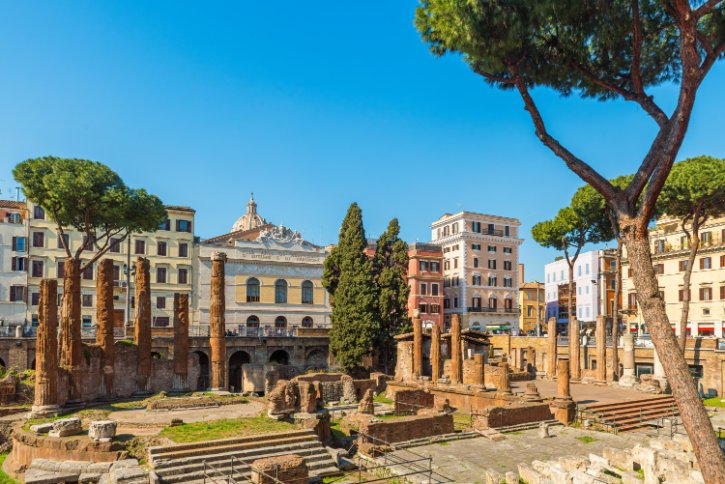
a. Older than the emperors
Here you meet a Rome older than the emperors: the Republic, in four ancient temples sitting several meters below the modern street.
b. Four temples, four letters
Because ancient writers never clearly named them, archaeologists label them A, B, C, and D. Scholars have proposed dedications, but these are careful guesses:
- Temple C may honor an old goddess of fertility and freed slaves.
- Temple A may honor a water goddess, later turned into a small church.
- Temple B, the round one, may honor “Fortune of This Present Day”.
- Temple D may honor the protectors of sailors.
Even from street level, notice the round shape of Temple B against the rectangular temples, and the changes in height that reveal a sacred area that grew over time.
c. Where Caesar really fell
This site holds one of history’s most famous moments, though not where people assume. Julius Caesar was assassinated on 15 March, 44 BC, but not inside one of these temples. With the Senate House being rebuilt, senators met in a temporary hall attached to Pompey’s Theatre nearby, and its foundations sit right behind Temples B and C.
d. New access and an old name
- A raised walkway now lets you descend into the archaeological area instead of only peering down.
- You can walk beside the podiums and see the finds up close.
- The ruins are also home to a long running cat sanctuary.
- The name Argentina has nothing to do with the country. It comes from a churchman born in Strasbourg, which the Romans called Argentoratum.
From this open pit, the streets tighten, then open onto an unlikely trio: an Egyptian obelisk, a Baroque elephant, and a Gothic church.
10. Piazza della Minerva and Santa Maria sopra Minerva
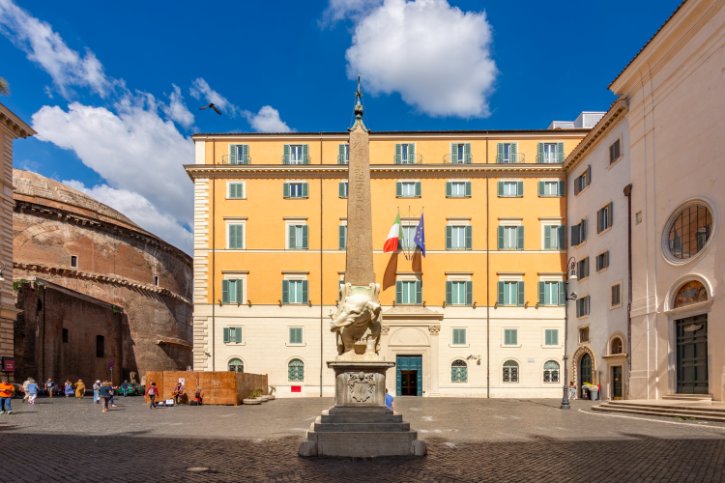
a. Many eras, one small square
Few corners of Rome pack in so many periods at once: Egyptian antiquity, medieval Gothic, Renaissance art, and Baroque wit, all within a few steps.
b. The elephant and the obelisk
- In the middle stands a small Egyptian obelisk, carved in the sixth century BC and later brought to Rome.
- Its playful base is by Bernini, who set the obelisk on the back of a cheerful marble elephant.
- The pairing of a whimsical animal with a solemn monument is exactly why people love it.
c. The flood plaques
- On the right corner of the church front, look for a row of marble flood markers.
- Little carved hands point to how high the Tiber once rose, before modern river walls were built.
- The highest marks a flood that left people crossing the square by boat.
- Most visitors never spot them.
d. Rome’s only Gothic church
Inside, Santa Maria sopra Minerva is the city’s only major surviving Gothic church. After all the Baroque, its pointed vaults and deep blue, star spangled ceiling feel calm and completely different.
e. Michelangelo’s Risen Christ
- Standing left of the high altar, the marble figure holds the instruments of the Passion.
- Michelangelo abandoned a first version when a dark vein appeared across the face.
- The second version was finished by assistants, with some repairs before installation.
- The gilded bronze cloth was added later for modesty, so do not mistake it for his original work.
f. A chapel and two famous graves
- Seek out the Carafa Chapel, with frescoes of Saint Thomas Aquinas triumphing over heresy and the Annunciation.
- Two major figures rest here: Saint Catherine of Siena, co patron of Italy, and the painter Fra Angelico.
Leave the elephant behind and thread through a few short streets. Then the space opens onto one of the ancient world’s greatest buildings.
11. Pantheon and Piazza della Rotonda
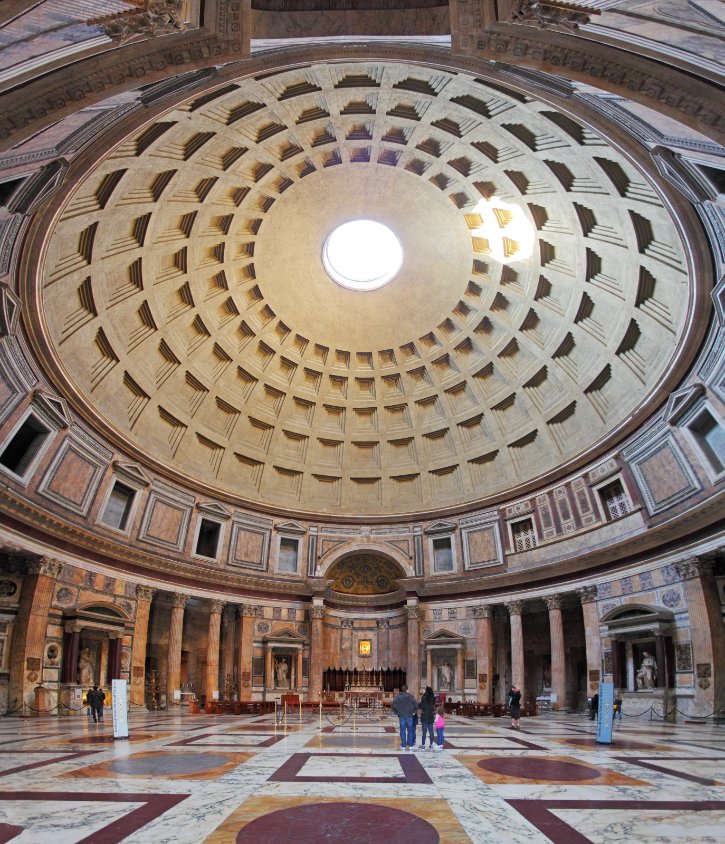
a. Famous, yet still astonishing
The Pantheon can still astonish you once you understand what you are seeing. It survived partly because it never fell out of use, becoming a church that protected it from being stripped for stone.
b. The reveal from the square
- Admire the portico of sixteen huge granite columns.
- Notice how that flat front hides the giant round hall behind it.
- The surprise as you step through the doors is part of the design.
- In the square stands a fountain topped by another Egyptian obelisk.
c. The geometry inside
- The height from floor to the opening at the top is about 43 meters, the same as the width of the hall.
- That means a perfect sphere would fit exactly inside, touching the floor and the top of the dome.
- The dome is still the largest unreinforced concrete dome in the world.
- Its builders used heavier material low down and lighter material higher up to reduce the weight.
d. The oculus and the floor
- The oculus at the top is about nine meters across and is the only source of daylight.
- As the sun moves, a beam of light slides across the interior like a giant clock.
- Rain falls through it, and an ancient drain quietly carries the water away.
- Look down too. The colored marble floor is easy to miss when everyone stares upward.
e. Look for the tombs
Near the wall you will find the tomb of Raphael, along with tombs of Italy’s kings. Enjoy the contrast between the bustle of the piazza outside and the stillness within.
Leave the Pantheon and walk east. The genuine ancient dome is about to be answered by a painted one.
12. Church of Sant’Ignazio di Loyola
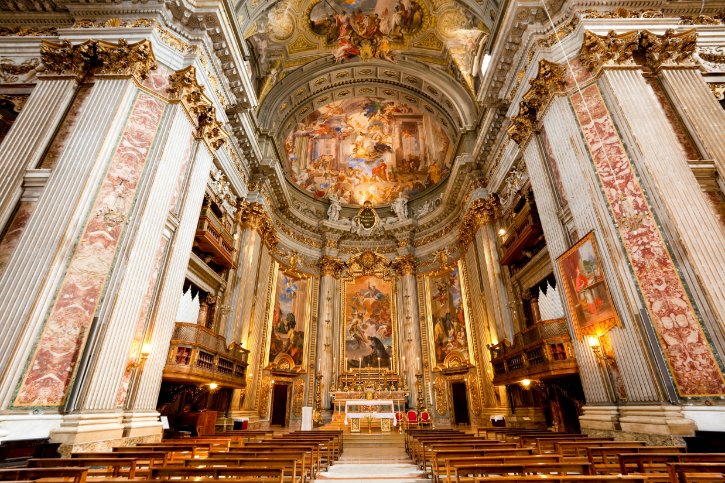
a. Real or painted?
The whole idea of this stop is a game. What here is real architecture, and what is only clever paint? The answer will surprise you more than once.
b. The square outside
- Pause first in Piazza Sant’Ignazio, a small square with curving Rococo facades.
- The undulating fronts feel almost like theatrical stage scenery.
- They quietly prepare your eye for the tricks inside.
c. The ceiling that becomes sky
The nave ceiling, by the master of perspective Andrea Pozzo, makes the flat surface open into heaven.
- He painted a two story colonnade that seems to continue the real walls into the sky.
- Saint Ignatius floats above, lit by beams reaching toward figures of the continents.
- Look for the yellow marble disc in the floor near the center of the nave.
- Stand on it and the painted columns snap upright. Walk to the side and watch them tilt and warp.
d. The dome that is not there
- Look up at the dome near the crossing. It looks deep and real. It is not a dome at all.
- It is a flat canvas, painted because funds ran out and neighbors objected to a real cupola.
- Stand on the second floor marker and it looks convincing.
- Move toward the altar and the illusion collapses into a flat surface.
e. A word on the mirror
A tilted mirror on the floor now draws big crowds, letting people photograph the ceiling without leaning back. For the true experience of Pozzo’s illusion, skip the mirror line and walk the central aisle between the two floor markers instead.
Inside this church, flat paint pretends to be architecture. At the next stop, the trick is reversed.
13. Piazza di Pietra and Temple of Hadrian
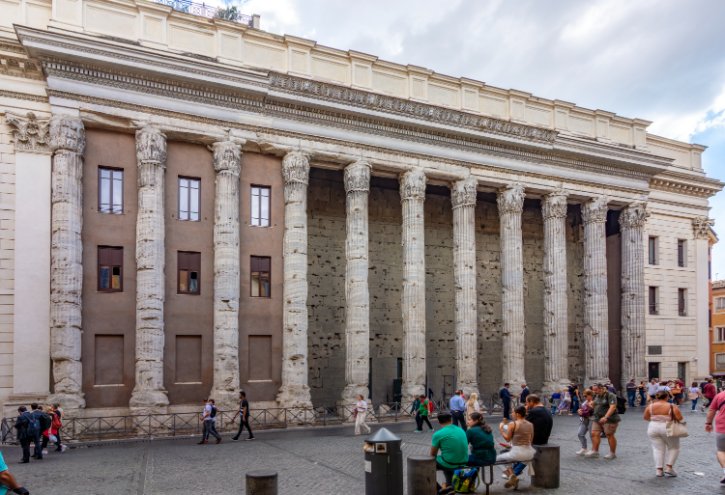
a. Ancient built into modern
Rome often absorbed its ancient buildings into newer ones rather than leaving them apart. This square is the perfect example, where a row of enormous ancient columns is built straight into a later facade.
b. The columns up close
- Eleven fluted Corinthian columns survive from the Temple of Hadrian.
- They are carved from white marble and stand around fifteen meters tall.
- Behind them is the old cella wall, built from dark peperino blocks.
- Their size hints at how large the original sanctuary once was.
c. Rising ground levels
Look at the base of the columns. The ancient ground level sits about four meters below today’s square, visible in the trench along the colonnade. This is one of the clearest places in Rome to see how the city’s street level slowly rose, buried by flood silt and rubble.
d. Where old meets new
- Later, an architect wrapped a new building around the temple to house the Stock Exchange and Chamber of Commerce.
- He deliberately left the ancient columns fully visible, threading the new facade around them.
- Try to spot exactly where the ancient marble ends and the later stonework begins.
e. The atmosphere here
There is something special about seeing columns this size in an intimate square, right up against everyday life, rather than fenced off in a field of ruins. On some evenings the Chamber of Commerce runs a light projection on the columns, but it is seasonal and not guaranteed, so check locally.
Carry the imperial theme forward, but expect the form to change once more.
14. Piazza Colonna and Column of Marcus Aurelius
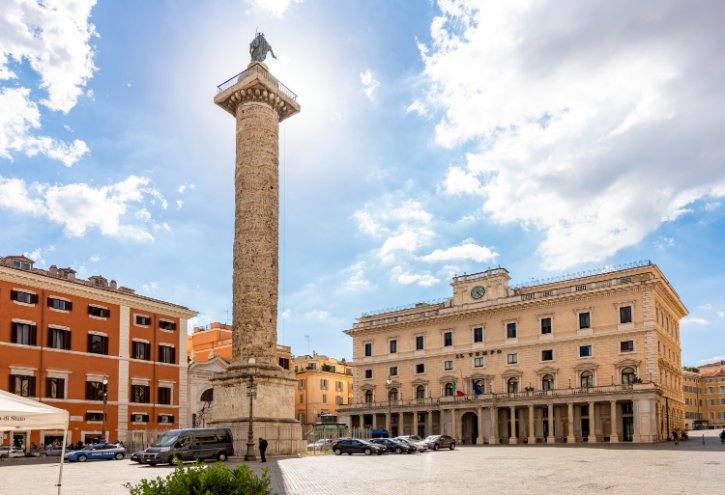
a. An echo of Trajan
Think back to Trajan’s Column. This stop is a deliberate echo of it, and comparing the two is the whole point. The Column of Marcus Aurelius copies the earlier design, standing about thirty meters tall with a staircase hidden inside.
b. The story it tells
- The carvings follow Marcus Aurelius’s wars along the Danube frontier.
- Look for river crossings, marching troops, camps, battles, and sieges.
- One famous scene is the Rain Miracle, where a winged storm god pours rain to save thirsty Roman soldiers.
- Marcus Aurelius appears again and again, bearded and solemn, a picture of imperial duty.
c. How it differs from Trajan’s
- The carving here is much deeper, cut to create strong shadows, where Trajan’s was shallow and smooth.
- The figures have larger heads and bolder outlines, easier to read from the ground.
- The mood is tense and dramatic, full of hardship, where Trajan’s felt ordered and disciplined.
- Neither is simply better. See what you remember from Stop 6 and judge for yourself.
d. The statue on top
The figure at the very top is not the emperor. It is a statue of Saint Paul, placed there when a later pope restored the column. From up high, it looks across the rooftops toward the statue of Saint Peter that crowns Trajan’s Column.
e. The square today
- Piazza Colonna is framed by Palazzo Chigi, the official seat of Italy’s government.
- Notice the graceful fountain on the southern edge, a good spot to study the lower carvings.
- There is something remarkable about an ancient imperial monument beside the working heart of Italian politics.
From this grand square, the streets narrow. The traffic fades, replaced by the faint sound of rushing water. The finale is close.
15. Trevi Fountain
a. The reward at the end
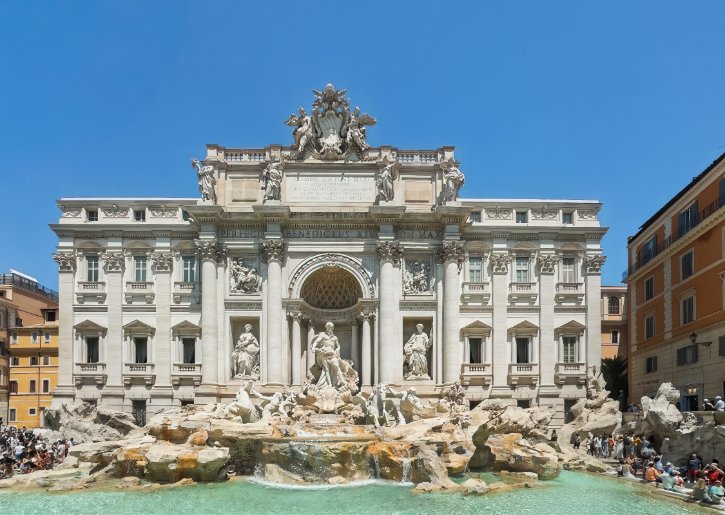
Save your energy for this one. You approach through narrow, shadowed streets, then the walls suddenly fall away and a colossal wall of white marble, sculpture, and crashing water fills almost the entire small piazza. After all the wide open ruins earlier, this close, sudden reveal is unforgettable.
b. Ancient roots
The fountain marks the end point of the Aqua Virgo, an ancient aqueduct built more than two thousand years ago. It is the only one of Rome’s ancient aqueducts still in use today, and it still feeds the fountain with fresh spring water. The grand fountain you see today preserves that old link between Rome and its water.
c. The fountain you see today
- The current design dates to the eighteenth century, completed by 1762.
- The architect Nicola Salvi built it against the wall of Palazzo Poli, turning the palace into a dramatic backdrop.
- At the center stands Oceanus, god of the ocean, riding a shell shaped chariot.
- The chariot is pulled by two sea horses, one rearing for stormy water, one calm for a gentle sea.
- To either side stand figures of Abundance and Health, with relief panels telling the story of the aqueduct.
d. Traditions and a famous scene
- The best known custom is the coin toss, thrown with your right hand over your left shoulder.
- One coin means you will return to Rome. Extra coins for romance or marriage are later add ons.
- The coins are collected by the city and donated to charity.
- Off to the right, look for the small Fountain of the Lovers, tied to a legend about couples staying faithful.
- The fountain owes some of its worldwide fame to the classic film La Dolce Vita.
e. The current access rules
To protect the fountain and ease the crowds, Rome now runs a managed access system.
- Viewing from the upper piazza remains completely open. You can still see and enjoy the fountain freely.
- Access to the lower basin area, the steps and coin tossing zone by the water, is controlled through barriers and marshaled entry.
- Do not assume the old, unrestricted setup right beside the basin still exists, as older photos might suggest.
f. Take it all in
Stand back and enjoy the full picture: the water, the rockwork, the sculpture, the palace wall, and the tight little square holding it all together. You have crossed roughly two thousand years of Roman history to get here, one easy stop at a time, and this is exactly the reward that journey deserves.