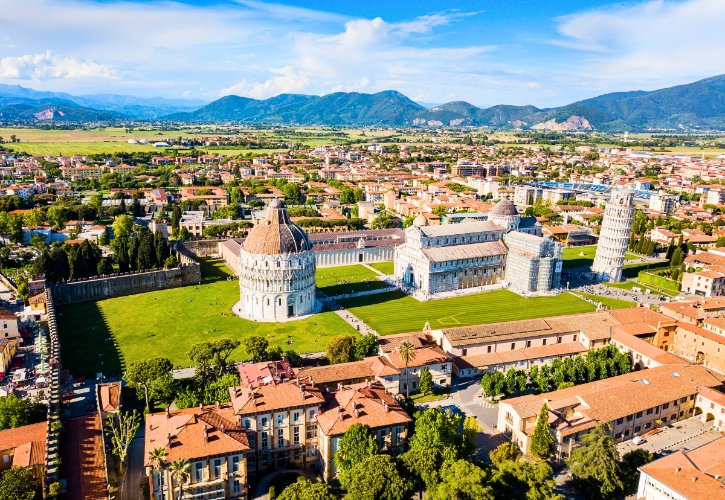
Most people come to Pisa for one photo of the Leaning Tower and leave within the hour. The real city sits just beyond it, packed into a compact historic center you can cross on foot in a single afternoon.
Morning café counters give way to medieval walls, then to marble monuments, shadowed stone streets, grand civic squares, market arcades, and the wide open light of the Arno. The mood shifts block by block, and every turn gives you something to notice. 😊
1. Po’stò Cafè Pisa
a. Why start here
You could go straight to the monuments, but a slower start suits Pisa. Po’stò Cafè sits on Piazza Manin, right where the busy modern city meets the walled cathedral quarter, and it gives you an honest taste of everyday Pisa before the history begins.
b. What you will find
This is not a historic landmark, and that is the charm of it.
- It is an all-in-one spot rather than a plain espresso bar, working as a café, bakery, light-lunch counter, and gelateria at once.
- The crowd is local and mixed: university researchers, city workers, and travelers passing through.
- Sweet choices run to fresh brioches, cream-filled cornetti, and bakery breads.
- Savory options include pizza al taglio, focaccia, and pressed paninis.
- Gelato is here too, if you would rather start with something cold.
c. The mood shift
Here is the fun part. The moment you turn from these café tables, you are facing the massive stone ramparts of the old city walls. Casual coffee culture gives way to medieval defenses in a single step.
2. Walls of Pisa
a. What you are looking at
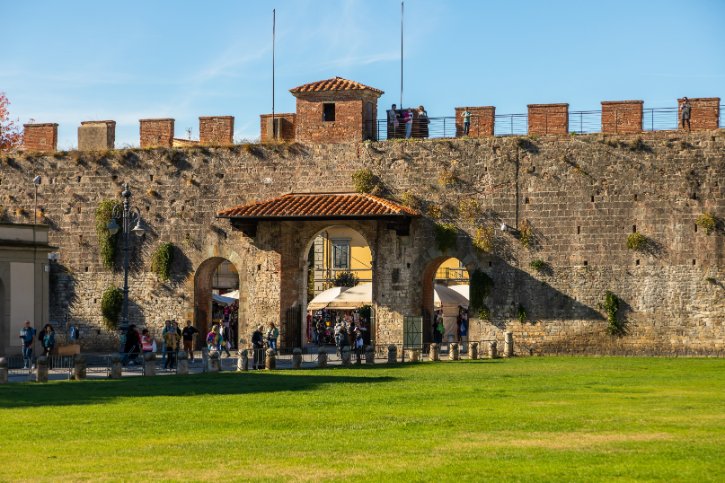
The Mura di Pisa are the best way to understand Pisa as a city rather than a set of separate sights. Climb the walkway and the whole layout suddenly makes sense.
b. The story in the stone
- Construction started in 1154, aimed at defending the city against rival Lucca.
- At full scale the circuit ran roughly seven kilometers and stood about eleven meters high.
- Today around three kilometers of elevated walkway survive and can be walked.
- The lower courses use pale San Giuliano limestone and dark, purplish Verrucano stone, topped with medieval brick.
- All of it was paid for by the wealth pouring in from Mediterranean sea trade.
c. Two gates, two eras
Near the cathedral quarter, two gates sit side by side and tell a story of shifting power.
- Porta del Leone was the proud 12th-century ceremonial entrance, set beneath a carved marble lion. It was deliberately walled up in 1562.
- Porta Nuova was opened that same year by Grand Duke Cosimo I de’ Medici, who wanted everyone funneled through his own controlled gate instead of the old communal one.
d. Best visitor experience
- Walk the walkway for high views over rooftops, hidden monastic gardens, and the monuments of the Campo dei Miracoli.
- Use the height to see how the famous marble complex sits inside the wider walled city, rather than floating on its own.
3. Piazza dei Miracoli
a. One square, four monuments
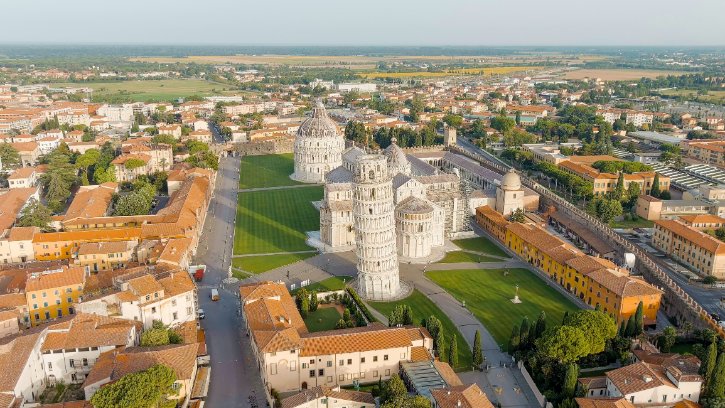
This is one of the most carefully planned sacred spaces in medieval Europe, and it deserves more than a quick tower selfie. It became a UNESCO World Heritage site in 1987.
The Cathedral, Baptistery, bell tower, and Camposanto were not scattered at random. Together they trace a Christian life: baptism, worship, the passing of time, and eternal rest.
They share one style too, the Pisan Romanesque, born from Pisa’s life as a sea power and shaped by Byzantine, Roman, and Islamic influences brought home by its fleets.
b. The Cathedral
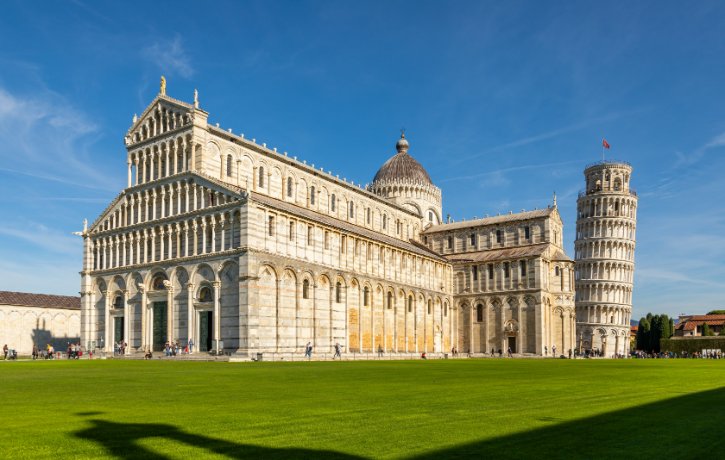
- It was begun in 1063/1064 under the architect Buscheto, funded by spoils from naval raids.
- The plan is a huge Latin cross with five aisles, its tall granite columns taken from ancient Roman ruins.
- Look for Giovanni Pisano’s carved marble pulpit, Cimabue’s shimmering apse mosaic of Christ, and the gilded ceiling the Medici added after a 1595 fire.
c. The Baptistery
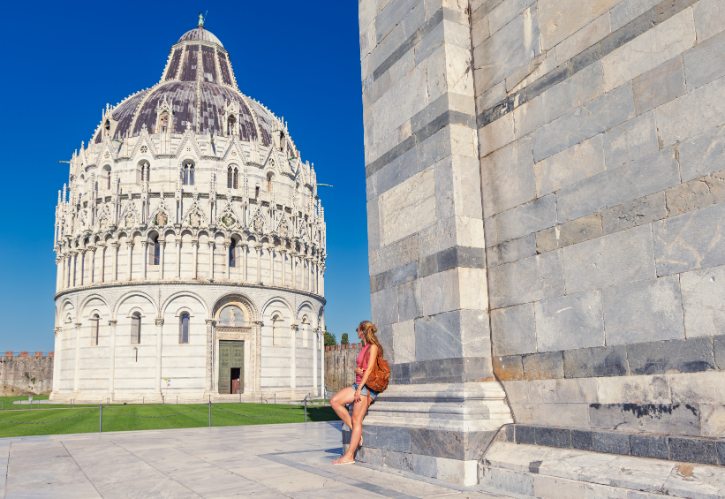
- It was begun in 1152 by Diotisalvi, who built the rounded Romanesque lower level.
- Later builders added the Gothic upper tiers, which is why two styles sit together so happily.
- Its real magic is the acoustic. A single sustained note can ring on for more than ten seconds, layering into overlapping chords from one voice.
d. The Camposanto
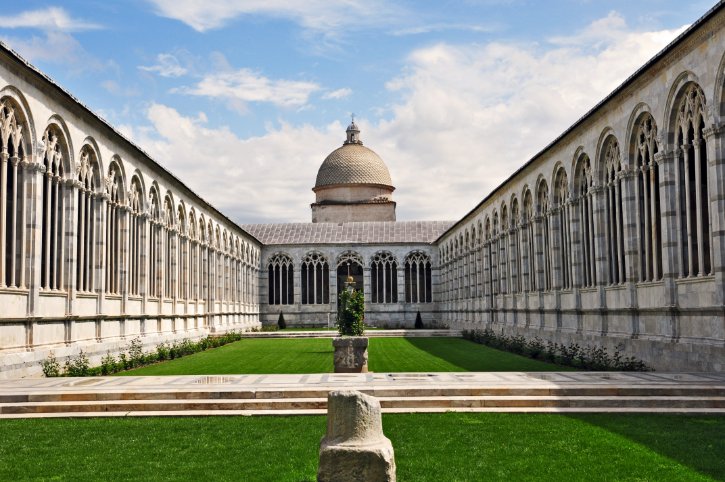
This is the quiet, contemplative corner most visitors skip. Do not.
- It was established in 1277 as a cloistered burial ground, built by tradition around holy earth carried back from the Crusades.
- Pisa’s leading merchants and professors were laid to rest here, often in reused Roman sarcophagi.
- Wartime bombing in 1944 scorched its famous frescoes, and in removing them conservators uncovered the reddish preparatory drawings beneath, now shown in the nearby Sinopie Museum.
e. The Leaning Tower
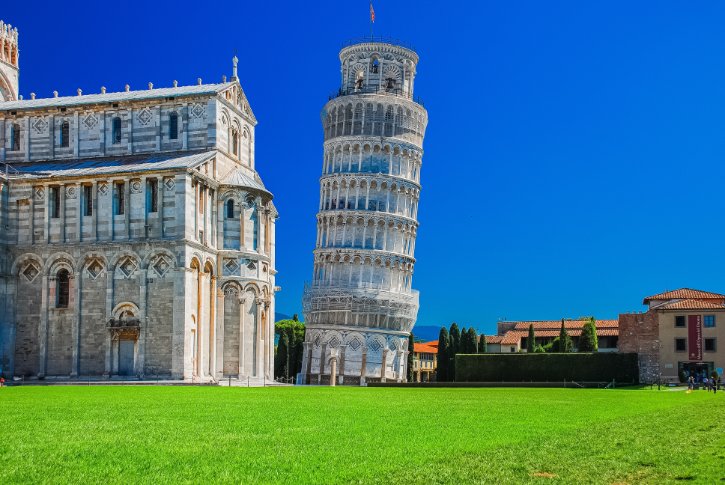
- The famous tower is really the Cathedral’s bell tower, founded in 1173 and rising about 56 meters.
- The lean began early, because the foundations rest on soft, water-logged ground.
- A careful project between 1990 and 2001 reduced the tilt by about 45 centimeters and made it safe.
- See it as one voice in a quartet rather than the whole performance.
f. The lawn that fooled everyone
That smooth green lawn is not medieval at all.
- For centuries this ground was a working, paved space crowded with workshops and clergy houses.
- The grass came only in the 19th century, planted to show off the monuments like sculptures.
g. How to look at the square
- Before rushing up to any one building, stand back at the edge and take in how the four line up together.
- Then move closer and compare the marble, arches, columns, and galleries.
The goal is to learn how to look at the square, not just to photograph it.
4. Via Santa Maria
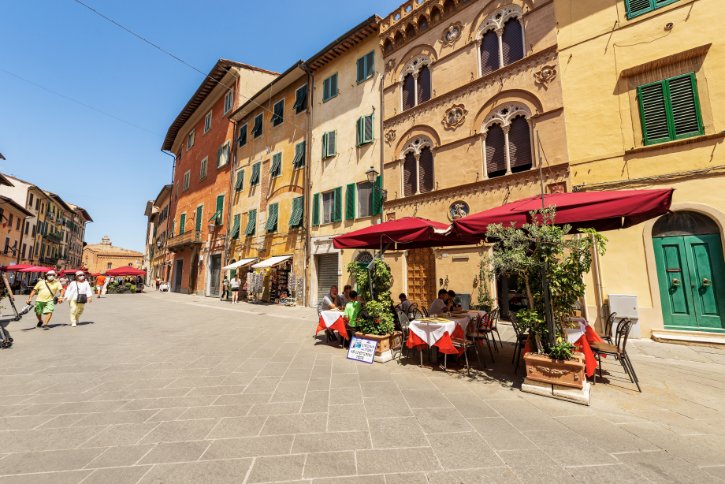
a. Look up as you walk
After all that open marble, this street feels close and enclosed. It once linked the cathedral to the river wharves, following the line of an ancient Roman road. The trick here is simple. Keep looking up.
b. Spotting the tower houses
The real treasures are the surviving medieval tower houses, tall fortified homes built by rival families during the city’s feuds.
- Watch for narrow fronts, thick stone walls, and broad relieving arches.
- Look for rows of small square holes in the masonry that once held wooden balconies.
- These towers were about status as much as safety. Building upward was how proud families showed their power.
c. The little stone mouse
Now for a small treasure hunt.
- At Palazzo Agonigi da Scorno, a carved marble capital is credited to the workshop of Master Biduino.
- Tucked beneath its acanthus leaves hides a tiny stone mouse.
- Little carvings like this served as workshop signatures, good-luck charms, or gentle reminders of humility and passing time.
Finding it rewards the habit this whole street asks for: slow down and study the old stone.
5. Piazza dei Cavalieri
a. From free commune to Medici stage
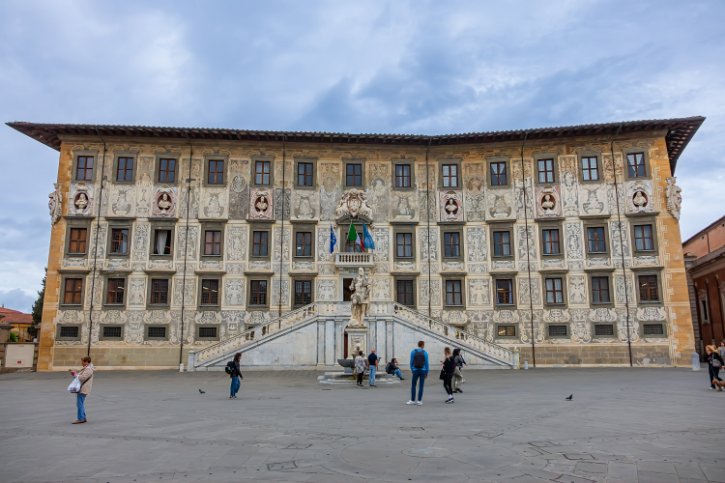
This is Pisa’s great civic and political square, and it feels deliberately staged because it was. For centuries it was the beating heart of the free Commune of Pisa.
After Florence took over, Grand Duke Cosimo I de’ Medici set out to erase those republican memories, founding the Order of the Knights of Saint Stephen in 1561 and handing the square to the architect Giorgio Vasari to redesign.
b. The façade to decode
The dominant building is Palazzo della Carovana, reworked by Vasari, who wrapped the old medieval palace in an elegant new front.
- Look for the sgraffito scratched into the plaster: allegorical figures, zodiac signs, and coats of arms.
- Above sit niches holding marble busts of the Medici grand dukes.
- It is now home to the Scuola Normale Superiore, an elite university institute.
Every detail was chosen to send a message about power. Read the wall and you read the politics.
c. The Hunger Tower
- Palazzo dell’Orologio was created by joining two older towers.
- One of them holds a grim story. In 1289 Count Ugolino was walled up here with his sons and grandsons and left to starve.
- Dante retold the horror in his Inferno, which is why it is often called the Hunger Tower.
d. The statue and the church
- At the center stands the marble statue of Cosimo I, his foot resting on a dolphin, a proud symbol of Florentine power at sea.
- On the east side, the Church of Santo Stefano dei Cavalieri was fitted out like a museum of naval victory, hung with banners and lanterns captured in Mediterranean battles, including Lepanto in 1571.
e. How to take it in
- Stand in the middle and slowly turn to face each side in turn.
- Compare the palace, the clock tower, the church, and the statue, and notice how each was built to speak of authority.
This is a square you read rather than simply photograph.
6. Borgo Stretto
a. A trading street that never stopped
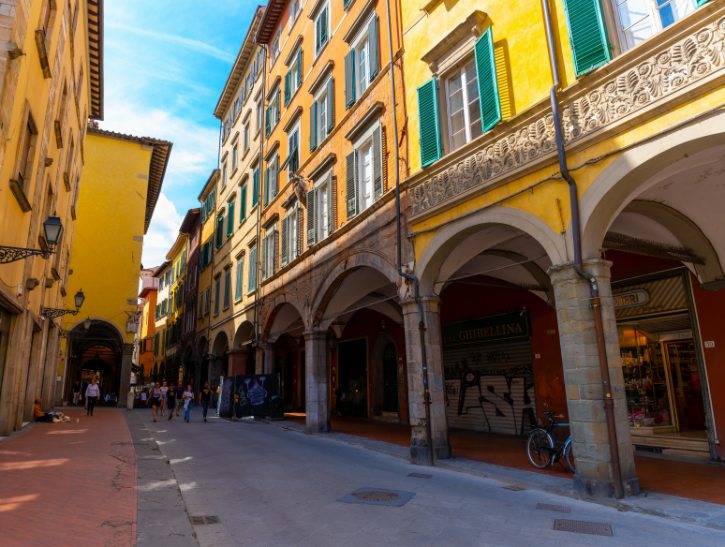
Borgo Stretto looks like a modern shopping street, and it is. But it has been a trading street for close to a thousand years, and the old logic still shows.
b. Under the arcades
The covered porticoes are the heart of it.
- They were built in the 13th and 14th centuries with stone piers and brick vaults.
- Merchants once laid out textiles, leather, and spices in this shelter, with storage cellars below and homes above.
- Think of it as a street that keeps updating itself, not one frozen in the Middle Ages.
c. Clues above the shopfronts
- Casa Vanni is the best-preserved survivor, with an elegant Gothic three-light window and the carved arms of Pisa’s patron saint of travelers.
- Palazzo Bocca, at the corner of Via Mercanti, was once home to Vincenzo Galilei, the music theorist and father of Galileo.
7. Church of San Michele in Borgo
a. A façade in two styles
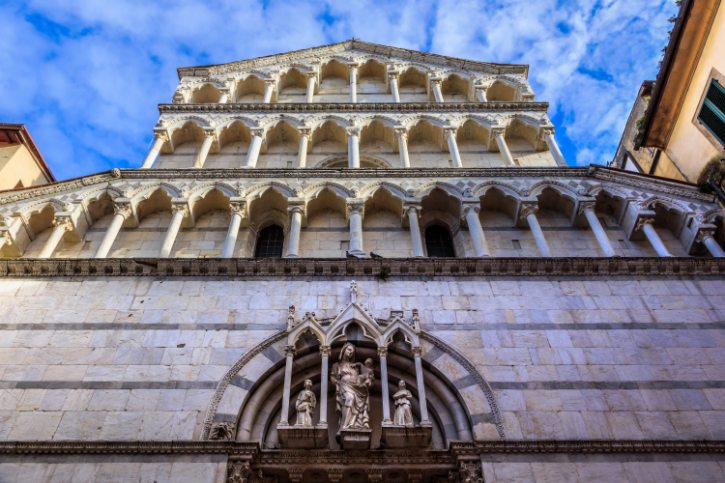
This church rewards travelers who like small details that open into big stories. Its west front is a lesson in Pisan taste shifting from Romanesque to Gothic.
- The lower level keeps rounded Romanesque arches faced in white marble and limestone.
- The upper tiers turn Gothic, with pointed arches, spiky gables, and statues of the Madonna, the Archangel Michael, and saints.
- It clearly borrows the Cathedral’s look, then carries the idea further.
b. What to look for inside
- The interior is a three-aisled basilica divided by antique granite columns.
- Wartime bombing destroyed the later ceiling, so today you see bare medieval brick and open wooden roof beams.
- Notable survivors include a 14th-century marble crucifix linked to Nino Pisano.
c. The student graffiti
Here is the unexpected detail. On the lower marble between the doorways, faded red lettering survives from the 16th century.
- The slogans read W IL CATONE and W IL MORO 1597, 1598.
- They were election cheers, painted by University of Pisa students backing candidates for student rector.
- It is a charming contrast: old student life scrawled across a solemn church front.
d. A note on the crypt
The 10th-century crypt is closed to the public. It was flooded during the great Arno flood of 1966, and mud and debris still lie beneath the floor, so enjoy the façade and interior instead.
8. Piazza delle Vettovaglie
a. A square built for food
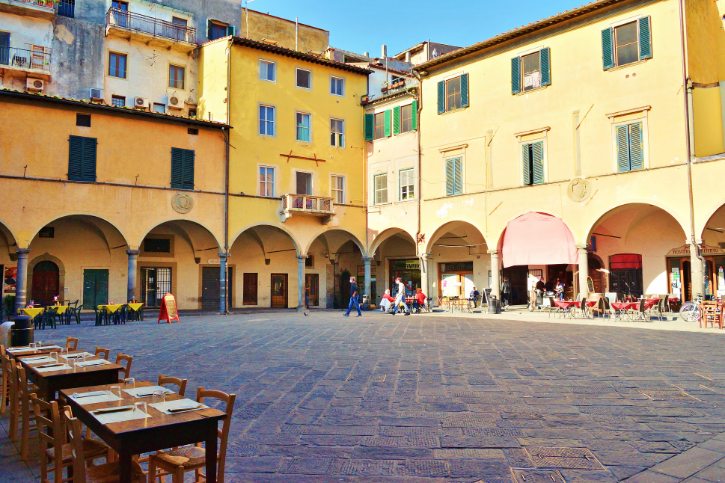
People often know this square for its nightlife, but its real story is food. It has been Pisa’s provisioning heart for a very long time.
- In the early Middle Ages this was a dense cluster of cookshops, butcher stalls, and grain depots.
- Grand Duke Ferdinando I de’ Medici cleared the old quarter in the 1590s to build a proper market square.
- The name comes from vettovaglie, the Italian word for food supplies.
b. Details that show how it worked
The design followed the function, and a few small survivors prove how tightly trade was controlled.
- The square is ringed by covered loggias on sturdy sandstone columns, with cellars below and rooms above.
- Under the southern loggia, a marble panel of official weights and measures still survives, once used to check that goods were sold by the correct standard.
- Tucked into the southwest corner of the arcade is an old public well, now only partly visible, from the days before Pisa had an aqueduct.
c. The square today
- The arcades still shelter food shops, delis, bakeries, and osterie, and stalls still appear in the square, though the busy daily market of past decades has faded.
- By late afternoon it turns into a lively social square of wine bars and student spots.
- Take a slow loop beneath the arcades and notice the columns, upper floors, and old market fittings.
9. La Bottega del Gelato
a. A well-earned break
After several stops heavy on stone and history, this one is pure pleasure. It sits on Piazza Garibaldi, right where the streets open toward the river, and has been run by the Giaquinto family since 1993.
b. About that “oldest gelateria” claim
You will often see it called the oldest gelateria in Pisa. It is worth understanding that claim clearly.
- The phrase is the shop’s own branding rather than an independently proven fact.
- Older cafés in the city go back to the 18th century.
- What is fair to say is that it was among the first shops in the postwar center to focus entirely on fresh gelato made daily from natural ingredients.
- It is a nice reminder that a city’s heritage is not only medieval. A long-running family business becomes part of local memory too.
c. What to get
- It is known for seasonal fruit sorbets, Sicilian pistachio, and classic Tuscan cremas.
- Grab a cup or cone, take your break, and enjoy the change of pace.
10. Lungarno Antonio Pacinotti
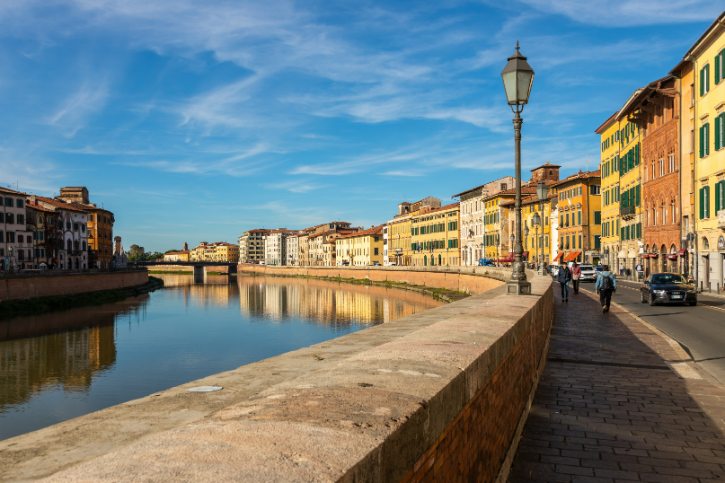
a. A riverfront that was engineered
This riverfront is more than a pretty photo. It is a piece of deliberate engineering, and the neat embankment you see is surprisingly recent.
b. Before and after
- Before the 1860s, the banks were muddy working shores crowded with timber landings, floating mills, and boatbuilders’ shacks.
- In the 1860s and 1870s, city engineers built stone walls to control flooding, paved wide roads, and added the continuous parapets known locally as the spallette.
- That project swept away the old sheds and created the broad promenade of today.
c. The poet who loved this view
The poet Giacomo Leopardi lived here in 1827 and 1828, finding relief from ill health and a burst of creativity.
- In a letter to his sister, he praised the Lungarno warmly and said Pisa pleased him more than Florence.
- He described the riverfront as wide, luminous, and cheerful, with an open grandeur he had not found elsewhere.
- He loved how the river’s gentle curve gathered the low winter sun, a light that fed some of his most famous poems.
d. A building to notice
- Palazzo Agostini, often called Palazzo Rosso, shows off a 14th-century red terracotta façade covered in molded hunting scenes and mythical beasts.
- On its ground floor sits Caffè dell’Ussero, open since 1775, a historic meeting place for writers, scientists, and students.
11. Lungarno Mediceo
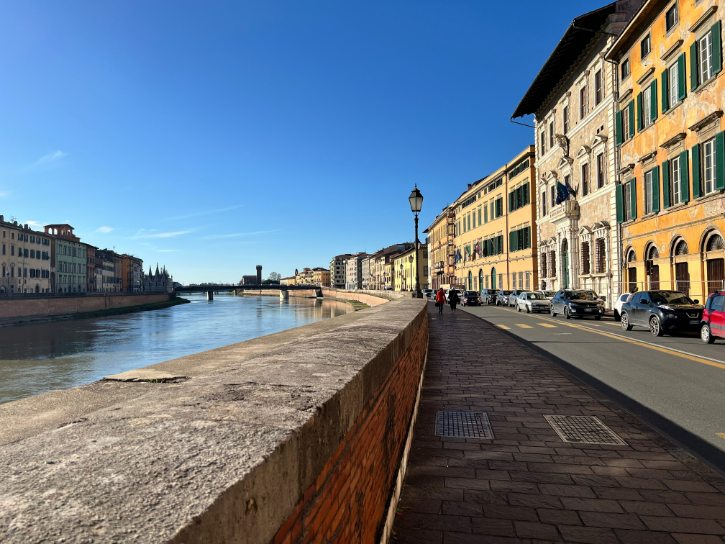
a. The palace riverfront
If Pacinotti is the riverfront of engineers and poets, Mediceo is the riverfront of nobles and film directors. Facing south, it catches bright light all day, which made it a favorite address for grand families for centuries. Take your time alternating between the palace façades and the water.
b. A memory of light
One story captures the mood better than any adjective. The film directors Paolo and Vittorio Taviani remembered arriving in Pisa by cart just after the city was liberated in 1944.
- They passed through dark, bomb-damaged streets, then came out suddenly onto this open riverfront.
- The bright sky and golden light on the water struck them as a burst of hope amid the ruins.
- They later said it helped spark their lifelong love of cinema.
c. Palazzo Toscanelli
- Built in the 16th century, this palace hosted Lord Byron in 1821 and 1822, while he worked on Don Juan and entertained Shelley and Leigh Hunt.
- Since 1913 it has held the State Archive of Pisa, with city documents reaching back to the 8th century.
d. The Medici house
- Palazzo Medici, also called Palazzo Spinola, began as a 13th-century tower house.
- The Medici bought it in 1446 as their main Pisan home and hosted Lorenzo the Magnificent here.
- It was reworked in a Neo-Gothic style in the late 19th century, a good example of how a building that looks historic today may blend several very different periods.
12. Ponte di Mezzo
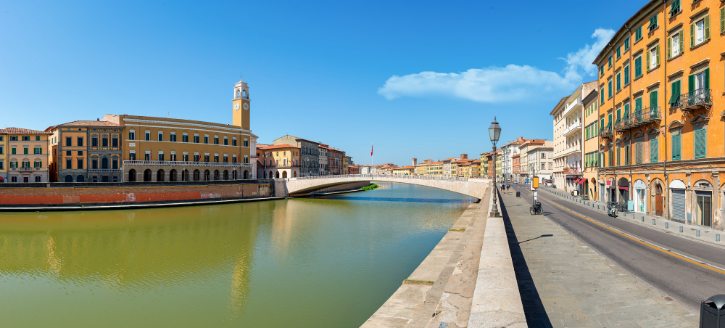
a. More than a river crossing
This is not just a handy crossing. It is the hinge of the whole city, and it carries one of Pisa’s fiercest traditions.
b. A history of collapse and rebuilding
- A bridge has stood here since Roman times.
- In the Middle Ages it was lined with wooden butcher shops and stalls, a busy market held up over the water.
- A marble bridge completed in 1660 was destroyed in 1944.
- The present bridge, a single concrete arch faced in white limestone, opened in 1950.
c. The Game of the Bridge
The bridge’s most famous role is the Gioco del Ponte, held every year on the last Saturday of June.
- The city divides into two sides: Tramontana to the north and Mezzogiorno to the south.
- A costumed procession of more than 700 people in 16th-century dress opens the day.
- Teams of twenty then push against a heavy seven-ton iron cart running along a rail down the middle of the bridge.
- The side that shoves the cart across the other’s line wins the honor for their half of the city.
d. The view
From the center, look east and west along the Arno, taking in the bridges and riverfront palaces in both directions. This split between north and south still runs deep in local identity.
13. Lungarno Gambacorti
a. The civic riverfront
The south bank is the civic and cultural riverfront, home to Pisa’s town hall and its main art center. Look back across the Arno from here for a fresh view of the façades you have already walked.
b. Palazzo Gambacorti and its exhibition
- Palazzo Gambacorti was built in the late 14th century and has served as Pisa’s town hall since 1871.
- Its river front is a fine example of Pisan civic Gothic, with rows of mullioned windows and slender marble columns.
- On the ground floor, a free Permanent Exhibition of Pisa’s Traditions and Identity first opened in 2024 and reopened in an expanded form in 2026.
- It displays historic costumes, banners, and documents tied to the Gioco del Ponte, the Regatta of the Ancient Maritime Republics, and the Luminara di San Ranieri.
c. Palazzo Blu
- A little further along stands Palazzo Blu, easy to spot for its bright 18th-century blue front.
- Today it is a leading cultural center, showing local archaeological finds alongside major visiting art exhibitions.
14. Piazza Chiara Gambacorti
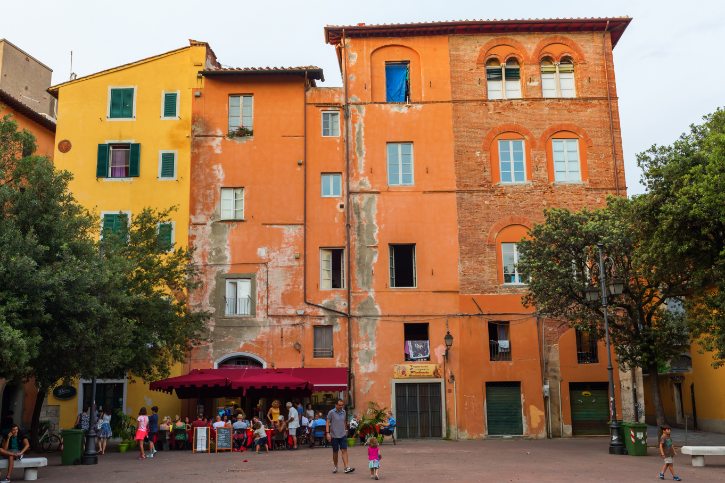
a. The square locals call “the pear”
This intimate square has a strong neighborhood feel and a surprising amount buried beneath it. Locals almost always call it Piazza della Pera, the Pear Square. It sits in the old Kinzica quarter, once the district where foreign merchants settled during Pisa’s great sea-trading days.
b. Find the pear
The nickname comes from a small stone you can go and find.
- At the corner of Via San Martino stands a small pear-shaped stone.
- It is a copy of an ancient Etruscan funerary marker, later reused as a street bumper to protect building corners from cart wheels.
- The original is kept in the San Matteo museum, while this copy stays on as the neighborhood’s quiet mascot.
c. The church beneath your feet
The real surprise is underground.
- Beneath the paving lie the foundations of the lost Church of San Lorenzo in Kinzica, demolished in the 18th century.
- Excavations in the early 2000s uncovered the church walls, a parish cemetery, and deep layers of household rubbish.
- Those finds included broken cooking pots, animal bones, and imported Islamic pottery, small clues to what local people ate and traded.
d. What you can still see above ground
- Look for the Domus dei Del Bagno, a surviving 12th-century stone townhouse with mullioned windows and old relieving arches.
- Its market days are long gone, and the square is now a relaxed evening gathering spot, formally pedestrianized in 2024.
15. Corso Italia
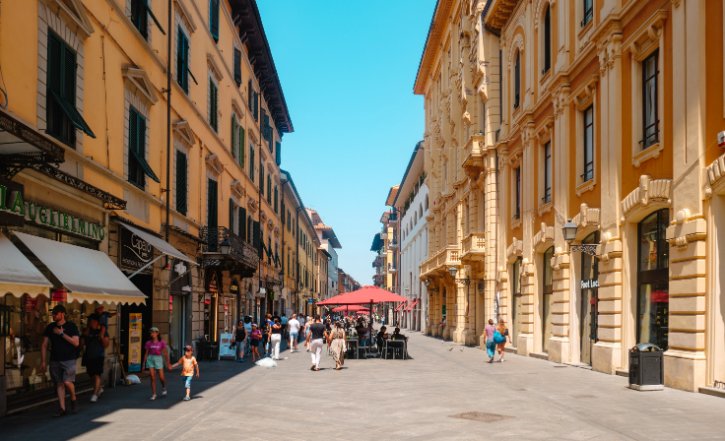
a. A shopping street with medieval bones
The final stop looks, at first, like an ordinary shopping street. It is much more than that, and it delivers the whole walk’s best lesson: keep looking up.
- Corso Italia is the main pedestrian shopping street south of the Arno.
- It follows the line of a medieval trading road through the old Kinzica district.
- At eye level you see modern shops. Above the windows you see medieval masonry, pointed arches, and restored palaces.
b. The palace to anchor your last look
The building to focus on is Palazzo Gambacorti on Corso Italia, which is a different building from the town hall of the same name on the riverfront.
- It was built in the 13th and 14th centuries and hosted two Holy Roman Emperors, Henry VII in 1312 and Charles IV in 1355.
- The crucial point: the Gothic front you see today is not untouched medieval stonework.
- In 1913 it was thoroughly restored to recreate an idealized 14th-century look, with warm brickwork and slender marble columns.
- It is genuine and beautiful, but partly a careful early 20th-century reconstruction.
c. Keep looking up
This last building sums up the whole route. Across the walk you have seen the same idea again and again.
- Walls reworked by new rulers, market squares that changed their function, a riverfront redesigned by engineers, palaces restyled centuries later, and medieval homes absorbed into modern streets.
- Pisa is not frozen at one moment. It is a living stack of layers.
- As you walk, compare the busy shopfronts at street level with the historic windows and stonework just above them.
Locals still shop, meet, and live along a street where several centuries of Pisa remain visible at once. That, more than any single monument, is the real reward of exploring this city on foot.