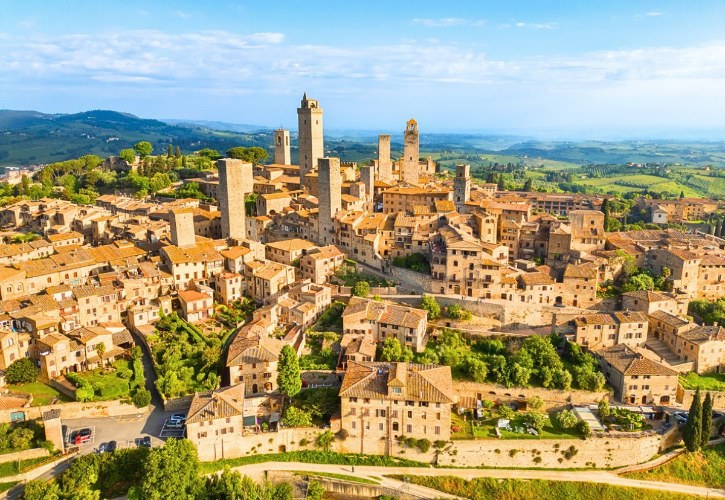
Some places stay with you long after you fly home. Tuscany is one of them.
You will find rolling hills, cypress-lined roads, and stone villages sitting above olive groves and vineyards. Renaissance domes rise over terracotta rooftops, and the light turns everything golden in the late afternoon.
It is a region that asks you to slow down, eat well, and take the long road.
Here are twelve places that show you why travelers keep coming back. 😊
1. Val d’Orcia & Its Beautiful Cypress Roads
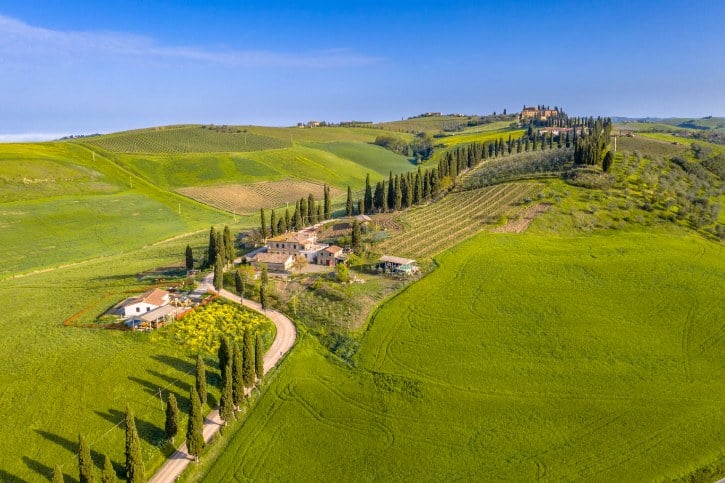
a. Why This Valley Earned UNESCO Protection
This countryside was shaped on purpose, which is why it joined the UNESCO World Heritage list in 2004. The Republic of Siena turned these chalk plains and clay hills into farmland that was productive and, by Renaissance standards, beautifully ordered.
- The protected area covers 61,188 hectares across five municipalities: Castiglione d’Orcia, Montalcino, Pienza, Radicofani, and San Quirico d’Orcia.
- The Orcia River carves the basin through ancient marine clays and chalky flats.
- Cone-shaped hills rise toward Monte Amiata, a volcanic peak on the southern edge.
- The open terrain feels nothing like the wooded Casentino or the enclosed valleys of Chianti.
b. The Cypress Views You Came For
Those cypress rows were planted to break the wind and mark farm boundaries. They became the symbol of Tuscany.
- Cypress Grove (Cipressini di San Quirico). A tight cluster on a low knoll, seen from the Via Cassia (SR2).
- Cappella della Madonna di Vitaleta. A small chapel framed by two lines of cypresses, on the gravel roads toward Pienza.
- Podere Belvedere. A farmhouse on a cypress-covered rise.
Keep to public roads and verges. The fields around you are working farmland.
c. Hill Towns Along the Old Pilgrim Road
- San Quirico d’Orcia. Its Romanesque Collegiata has a doorway carried by columns resting on two carved lions, plus a side portal attributed to Giovanni Pisano. Nearby are the Horti Leonini, a Renaissance garden laid out around 1580.
- Castiglione d’Orcia. Anchored by the Rocca di Tentennano, a thirteenth-century watchtower.
- Radicofani. A stone fortress on a basalt peak, once guarding the Sienese and Papal border.
- Monticchiello. A walled hamlet reached by a winding road lined with cypresses.
d. How the Valley Changes Through the Year
- Spring. Emerald wheat and wild clover cover the clay hills.
- Late June onward. The same fields turn into golden seas of durum stubble.
- Autumn. Hillside vineyards shift into warm ochre and russet.
- Winter mornings. Fog fills the riverbed and hilltop villages float above it.
e. Two Stops Most Visitors Drive Past
- Quercia delle Checche. A protected sessile oak more than 260 years old, near the road to Radicofani.
- Bagno Vignoni. The main square is not a square at all, but a vast sixteenth-century thermal basin of steaming mineral water. Trust me, it is worth the detour on a cold morning.
2. Florence
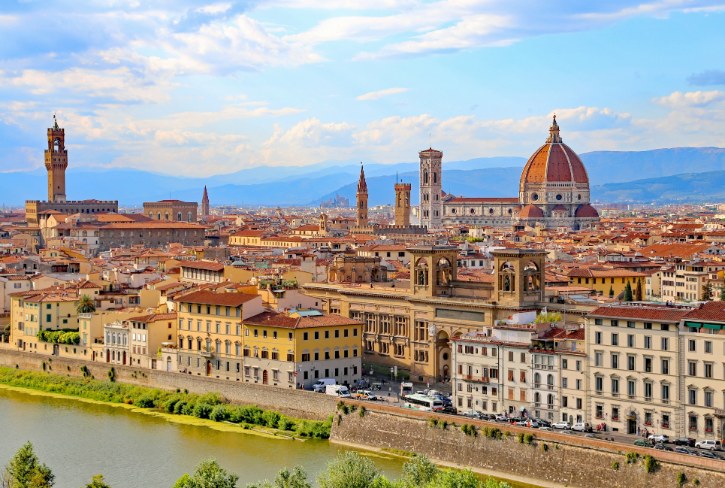
a. The City That Started the Renaissance
Florence was the artistic heart of the Renaissance, and its historic core joined the UNESCO World Heritage list in 1982.
It helps to know who paid for what.
- The cathedral belonged to the wool guild, the Arte della Lana
- The Baptistery and its bronze doors belonged to the cloth merchants’ guild, the Arte di Calimala
- The Medici came later, backing the Uffizi, Palazzo Pitti, and the Boboli Gardens
b. Landmarks You Should Not Rush
- Cathedral of Santa Maria del Fiore. Begun in 1296 by Arnolfo di Cambio, faced in white Carrara, green Prato, and pink Maremma marble, and crowned by Brunelleschi’s dome between 1420 and 1436. Built without wooden supports, it is still the largest masonry dome ever raised.
- Giotto’s Bell Tower. An 84.7-metre Gothic campanile covered in carved reliefs.
- Baptistery of San Giovanni. Famous for Ghiberti’s gilded bronze doors, which Michelangelo called the Gates of Paradise.
- Palazzo Vecchio. A crenellated fortress with a 95-metre tower, on Piazza della Signoria.
c. Where to Catch the Best Skyline Views
The Arno River cuts through the centre. At its narrowest point sits the Ponte Vecchio, rebuilt in 1345 and still lined with goldsmith shops.
- Piazzale Michelangelo. Designed in 1869 by Giuseppe Poggi. You see the red cupola, Giotto’s campanile, and Palazzo Vecchio against the hills of Fiesole.
- San Miniato al Monte. A short walk farther uphill gives an even higher view from its marble terrace.
Here is the fun part. You can enjoy both in a single evening walk.
d. Art and a Quieter Side of the City
- Uffizi Gallery. Built by Vasari as city offices, now holding Giotto, Botticelli, Leonardo, Raphael, and Caravaggio.
- Galleria dell’Accademia. Michelangelo’s original marble David stands in the central tribune.
- Loggia dei Lanzi. An open-air arcade with Cellini’s bronze Perseus and Giambologna’s Rape of the Sabine Women. No ticket needed.
Cross into the Oltrarno and the mood changes. Workshops along Via Maggio still practise gilding, paper marbling, and leatherwork, and Piazza Santo Spirito faces the unfinished facade of Brunelleschi’s last basilica.
e. Two Gardens Worth Your Afternoon
- Boboli Gardens. Begun in 1549 for Eleonora di Toledo and Cosimo I de’ Medici. Look for the terraces, Buontalenti’s Grotta Grande, and the Viottolone, a cypress avenue descending to the Piazzale dell’Isolotto.
- Bardini Gardens. A four-hectare estate with a baroque staircase and orchards. Its wisteria pergola blooms purple each spring, framing a lovely view of the cathedral dome.
Read More: The Perfect Florence Walking Route to Explore the City’s Best Sights in One Day
3. Pienza
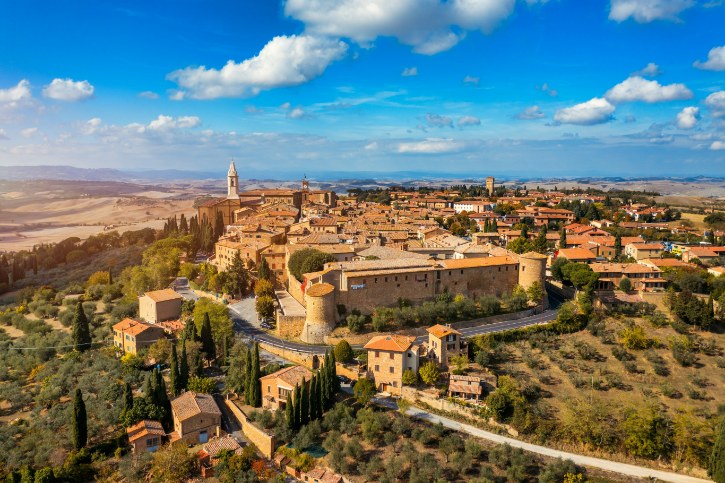
a. A Small Town Built on One Big Idea
Pienza is tiny, yet it changed architectural history, joining the UNESCO World Heritage list in 1996 as the first real attempt at a complete humanist town. In 1459, Pope Pius II set out to rebuild his birth village of Corsignano as a model Renaissance city, with the Florentine architect Bernardo Rossellino.
b. What to See Around the Main Square
Piazza Pio II is trapezoidal, paved in herringbone brick. That odd shape is deliberate, stretching the perspective so the cathedral stays your focus.
- Cathedral of Santa Maria Assunta. A three-part classical facade with the Piccolomini papal arms, and a bright hall-church interior lit by tall lancet windows.
- Palazzo Piccolomini. Rusticated stone walls, an arcaded courtyard, and a three-tiered rear loggia opening onto a hanging garden.
- Palazzo Borgia and Palazzo Comunale. They complete the square, the latter with a low ground-floor portico.
c. The Balcony Walk Above the Valley
Pienza sits on a ridge at 491 metres, and Rossellino aligned the cathedral and garden terraces with the southern cliff edge on purpose. Your best walk is the Via del Casello, a public path along those battlements, looking out over:
- Rolling clay basins, cultivated fields, and isolated stone farmhouses
- Lines of cypress tracing the ridges
- Monte Amiata on the horizon
- The fortress outlines of Castiglione d’Orcia and Radicofani
d. Romantic Lanes and Famous Cheese
Step off the main Corso Rossellino and the scale turns domestic. Along the southern rim run Via dell’Amore, Via del Bacio, Via della Fortuna, and Via Buia, lined with sandstone houses and external staircases known as profferli.
Pecorino di Pienza is the town’s famous export. The sheep graze on wild aromatic herbs, which gives the milk a distinctly herbal character.
- Wheels rubbed with tomato paste
- Cheese preserved in walnut leaves
- Varieties cured in oak ash inside underground tufa cellars
e. Why You Should Stay Until Evening
Once the day visitors leave, the town settles into its everyday self. The low sun warms the sandstone of Piazza Pio II and draws long shadows from the cypress ridges. If you can stay the night, take it.
4. San Gimignano
a. The Town of Stone Towers
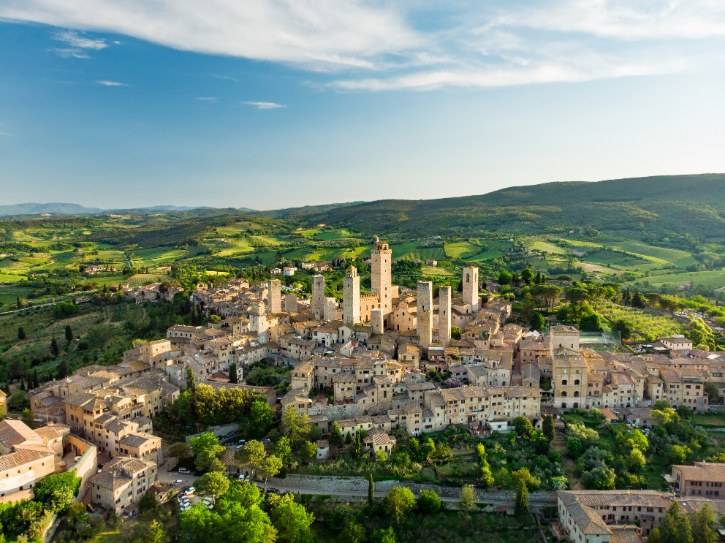
You will spot San Gimignano long before you arrive. Its skyline rises above the Val d’Elsa like nothing else in Europe, and it earned UNESCO World Heritage status in 1990 for its intact medieval fabric. The wealth came from position, since the town sat on the Via Francigena.
b. Why Wealthy Families Built So High
Merchant families built tall tower-houses as refuges during the Guelph and Ghibelline fighting, and as displays of wealth.
- Seventy-two towers once stood here at the medieval peak
- Fourteen survive today
- Built with thick travertine blocks, narrow arrow slits, and timber-support sockets called buche pontaie
c. Two Squares at the Heart of Town
- Piazza della Cisterna. A triangular square paved in herringbone brick, framed by the Torre del Diavolo and the twin Torri degli Ardinghelli. At its centre is a thirteenth-century cistern, capped by the octagonal travertine wellhead added in 1346.
- Piazza del Duomo. The civic and religious hub, with the twelfth-century Romanesque Collegiata and the Palazzo Comunale. The twin Torri dei Salvucci, rivals of the Ardinghelli, stand beside it on Piazza delle Erbe.
- Torre Grossa. Completed in 1311 and rising 54 metres. The commune ordered it taller than every private tower, to show that civic law outranked family power.
d. Where to Look Out Over the Valley
At 334 metres, the town gives you wide views over gentle farming country.
- The open belfry of Torre Grossa, the highest point in town
- The ramparts of the Rocca di Montestaffoli, a fourteenth-century Florentine fortress on the western ridge
The Val d’Elsa is greener and more densely farmed than the chalk plains farther south.
e. Frescoes, Wine, and Saffron
Inside the Collegiata is a complete cycle of fourteenth-century frescoes.
- Right wall. The Life of Christ by Lippo Memmi and Barna da Siena.
- Left wall. Old Testament scenes by Bartolo di Fredi, finished in 1367.
- Chapel of Santa Fina. Designed by Giuliano da Maiano, with frescoes painted in 1475 by Ghirlandaio.
- Vernaccia di San Gimignano. A crisp white wine, and Italy’s first DOC wine in 1966.
- Zafferano di San Gimignano DOP. Local saffron was once valuable enough to serve as currency.
5. Podere Baccoleno (Crete Senesi)
a. The Farm Lane You Have Already Seen
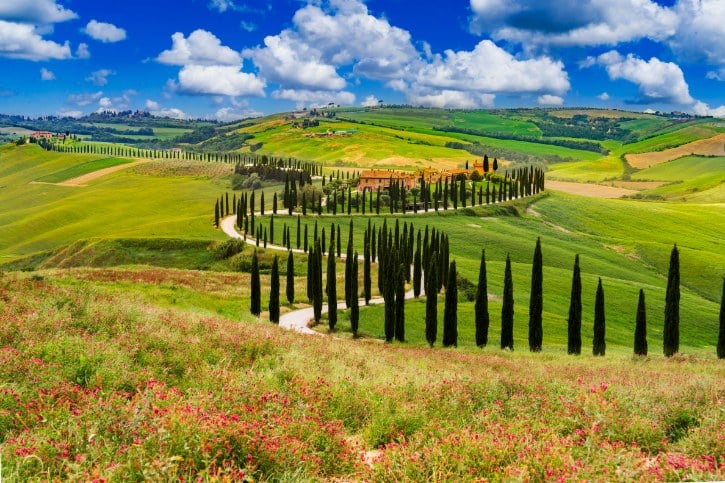
If you have seen a photo of a curving cypress lane climbing to a lone farmhouse, there is a good chance it was taken here. Podere Baccoleno is the romantic image of rural Tuscany.
b. Getting the Location and Access Right
People mix this one up constantly, so it helps to be clear.
- It sits in the Crete Senesi, near Asciano, along the SP438 Lauretana
- It is not in the Val d’Orcia and not near the coast at Bolgheri
- The property is an active private farm and agriturismo
- The gate, private lane, and farm grounds are closed to visitors
The good news is you do not need to go in. The whole scene is visible from the public roadside embankment beside the SP438.
c. Why the Land Looks So Unusual
This area once lay under a prehistoric sea, leaving Pliocene marine clays known locally as argille azzurre, or blue clays.
- Calanchi. Narrow, knife-edge gullies cut deeply into steep hillsides.
- Biancane. Low, bare, dome-shaped knolls with a whitish crust formed by salt rising to the surface.
- Spring. Vibrant green pastures across the clay.
- Midsummer. Bare ochre and ash-grey earth under hard sunlight.
d. What You Can See From the Roadside
- The cypress lane curving in an elegant double S through folds in the clay
- A small retention pond at the foot of the hill
- The brick farmhouse crowning the crest of the knoll
- Open clay hills receding toward the Sienese ridgeline
e. Two Stops to Add to the Drive
- Asciano. A historic hilltop village along the SP438, keeping sections of fourteenth-century Sienese walls.
- Abbey of Monte Oliveto Maggiore. Founded in 1313 inside an isolated cypress and pine forest. Its Great Cloister holds a Renaissance fresco cycle on the life of Saint Benedict by Luca Signorelli and Il Sodoma.
6. Siena
a. A Medieval City That Barely Changed
Siena’s historic centre joined the UNESCO World Heritage list in 1995 and preserves one of the most complete Gothic cityscapes anywhere. While other cities redesigned their streets later, Siena’s core stayed frozen after the Black Death of 1348.
b. Standing in Piazza del Campo
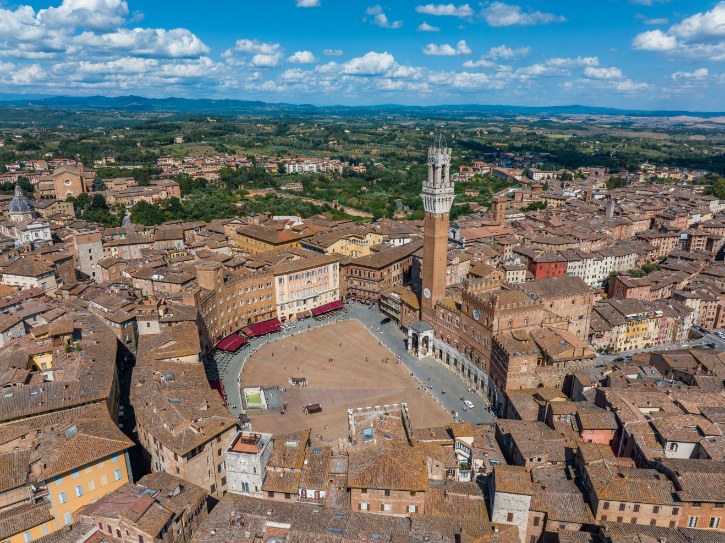
The heart of the city is a wide square shaped like an inverted scallop shell, sloping toward Palazzo Pubblico.
- Built between 1297 and 1348 over a natural dip where three hills meet
- Paved in red brick laid on edge in a herringbone weave
- Divided into nine sectors by white travertine bands
- Those sectors honour the Governo dei Nove, the merchant council that ruled the Republic of Siena
Sit on the warm brick for half an hour and you will understand the reputation.
c. The Landmarks and the Cathedral
- Palazzo Pubblico. A Gothic civic palace with distinctive tripartite arched windows.
- Torre del Mangia. An 88-metre campanile completed in 1348, built to match the cathedral tower exactly.
- Sala dei Nove. Holding Lorenzetti’s Allegory and Effects of Good and Bad Government, painted 1338 to 1339.
- Cathedral of Santa Maria Assunta. Clad in alternating white marble and dark green serpentine from Prato.
- The cathedral floor. 56 narrative panels of inlaid marble, designed by around forty artists between the fourteenth and sixteenth centuries.
- Also inside. Nicola Pisano’s carved pulpit, Donatello’s bronze Saint John the Baptist, and the Piccolomini Library frescoed by Pinturicchio.
d. Views Over the Red Rooftops
- Fortezza Medicea. Built between 1561 and 1563 for Cosimo I de’ Medici to a design by the engineer Baldassarre Lanci. The cathedral dome and Torre del Mangia stand framed against open hills.
- The Facciatone. The unfinished nave wall of a cathedral expansion abandoned after 1348. Its terrace gives a full circle of views.
e. The Palio and the Neighbourhood Districts
- Siena is divided into seventeen contrade, including the Aquila, Oca, Tartuca, and Bruco
- Each has its own colours, museum, fountain, and church
- The Palio di Siena is a bareback horse race held in Piazza del Campo on July 2 and August 16
- The Corteo Storico procession comes first, with drummers and flag-throwers
- The race then runs three fast laps around the clay-packed perimeter
Even outside those dates you see banners, carved emblems, and street dinners. This is a living medieval city, not a preserved one.
7. Montepulciano
a. A Town Perched on a High Ridge
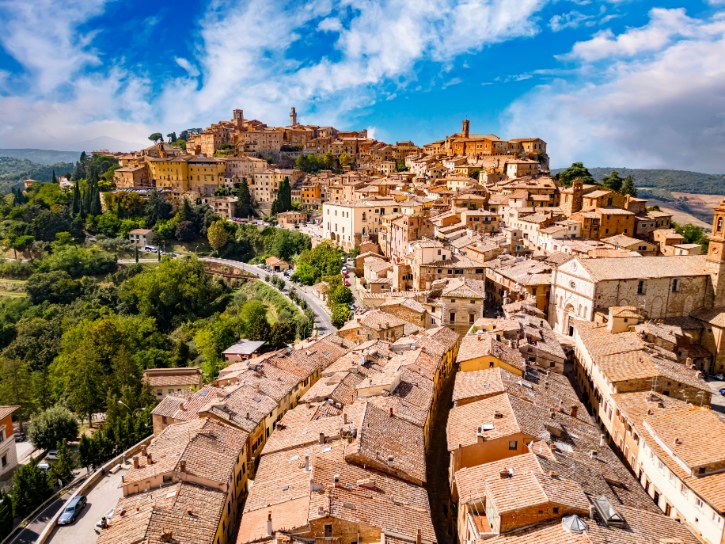
Montepulciano sits on a narrow limestone ridge at 605 metres, one of the most dramatic settings in Tuscany.
It began as an Etruscan and Roman settlement, then became a border fortress allied with Florence against Siena, which brought leading Florentine architects here in the sixteenth century.
b. What Surrounds the Main Square
Piazza Grande crowns the top of the town.
- Palazzo Comunale. A fourteenth-century Gothic palace renovated by Michelozzo, with a crenellated tower recalling Florence’s Palazzo Vecchio.
- Palazzo Nobili-Tarugi. Known for its elegant travertine facade.
- Palazzo Contucci. Designed by Antonio da Sangallo the Elder.
- Cathedral of Santa Maria Assunta. Still showing its unfinished brick facade.
c. Two Valleys, Two Very Different Views
Because the town sits on a dividing ridge, each side shows you a different landscape.
- Looking east. From the eastern battlements and the terraces near San Francesco, you see the flat farming basin of the Val di Chiana, stretching toward Lake Trasimeno.
- Looking west. From the western overlooks and public gardens, you see the rolling clay hills, oak forests, and cypress rows of the upper Val d’Orcia, ending at Monte Amiata.
The two valleys are often treated as one. They look nothing alike.
d. The Church Below the Walls
The finest building here is not inside the town at all.
- Temple of San Biagio. In a meadow at the end of a cypress avenue, by Antonio da Sangallo the Elder, built between 1518 and 1545. Its Greek cross plan and central dome look almost weightless from a distance.
- Palazzo Bucelli. Etruscan funerary urns are embedded in its lower facade.
- Porta al Prato. The fortified northern gateway, carrying the Medici coat of arms.
e. Wine Cellars Under the Streets
The town is known for Vino Nobile di Montepulciano DOCG, made mostly from Sangiovese, known locally as Prugnolo Gentile. The poet Francesco Redi once called it “the king of all wines”.
- Monumental cellars, the cantine storiche, run beneath the Renaissance streets, carved directly into the tufa bedrock
- Cantina De’ Ricci is known for cathedral-like vaulting and huge Slavonian oak casks
- Cantina Contucci is a working historic barrel-aging room under the living town
Walking from a sunlit square into a cool, silent stone cellar is one of the best transitions in Tuscany.
8. Montalcino
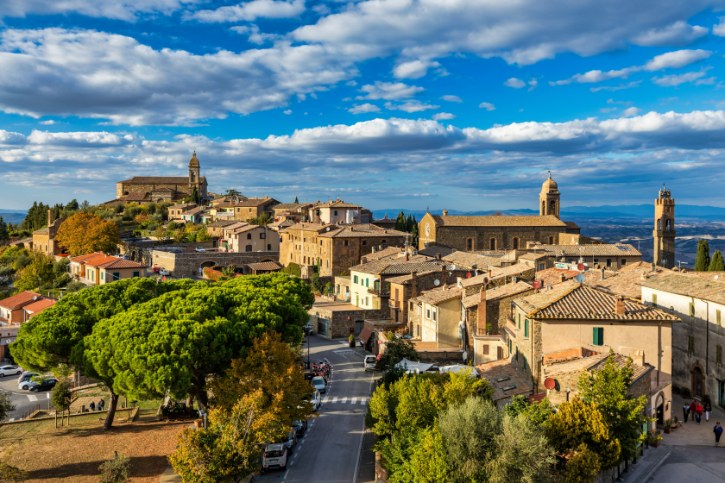
a. A Fortress With a Last Stand Story
Montalcino occupies a ridge at 567 metres, dominated by La Rocca, a pentagonal fortress built in 1361 by Sienese architects Mino Foresi and Domenico di Feo.
- After Florentine and Spanish forces took Siena in 1555, exiled patriots held out here
- They kept the “Republic of Siena in Montalcino” alive until 1559
- From the ramparts you look over the Ombrone valley, the Val d’Orcia, and Monte Amiata
b. The Land Behind Brunello
- Soils here mix galestro, a crumbly clay schist, with alberese, a hard limestone
- Mediterranean scrub, olive parcels, and holm oak woods frame the slopes
- Monte Amiata shelters the area, and sea breezes off the Tyrrhenian keep it moderate
- Those conditions suit Sangiovese Grosso, the grape behind Brunello di Montalcino DOCG
- Brunello needs at least two years in oak casks and four months in bottle before release
- Terraced vineyards descend in neat bands from the town walls before fading into forest
c. Streets That Feel Lived In
Montalcino is less grand than Montepulciano and more relaxed. Its civic heart is Piazza del Popolo, anchored by the Palazzo dei Priori, a thirteenth-century palace with a clock tower and open loggia.
d. Corners Worth Wandering Into
- Steep stone-paved lanes known locally as coste
- Traditional enoteche set into old stone frontages
- Butcher shops and stone-arched residences along the slopes
- Garden terraces near the Church of the Madonna del Soccorso, opening onto views across the Ombrone basin
e. The Abbey in the Olive Groves
Nine kilometres south, in a clearing among olive groves, stands the Abbey of Sant’Antimo.
- Tradition says Charlemagne founded it in 781, though the surviving Romanesque basilica is early twelfth century
- Look for the ambulatory with radiating chapels and the travertine and alabaster walls
- The carved capital showing Daniel in the Lions’ Den is the detail to find
- The French canons who sang live Gregorian chant here left in late 2015, and recorded chants now keep the calm atmosphere
9. Lucca
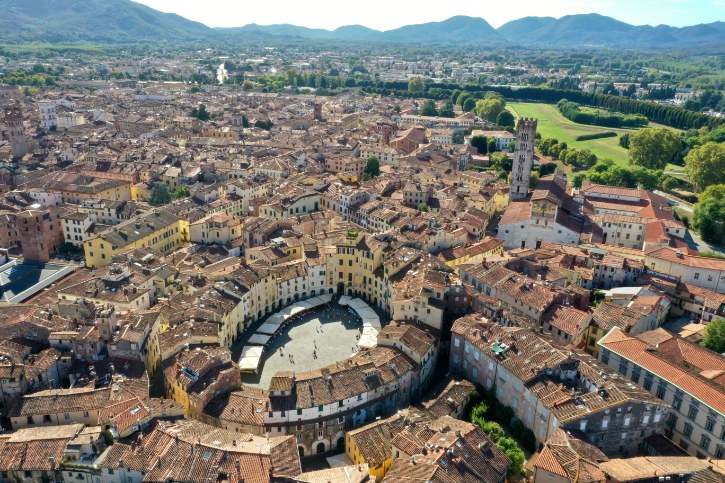
a. A City Wrapped in a Park
Lucca is encircled by an unbroken ring of Renaissance walls measuring 4.2 kilometres around, built between 1504 and 1645 with eleven heart-shaped bastions.
Then something unusual happened. In the nineteenth century, Lorenzo Nottolini turned the ramparts into a public park thirty metres wide. A full loop takes about an hour, past rooftops, church spires, and the distant Apuan Alps.
b. Roman Shapes Still in the Streets
- The old town still follows its original Roman grid plan
- Piazza dell’Anfiteatro is an elliptical square built on the foundations of a second-century Roman amphitheatre
- In 1830, Nottolini cleared the old arena interior, leaving a ring of pastel townhouses entered through four vaulted gates
- Torre Guinigi rises 45 metres, with centuries-old holm oaks growing in a roof garden at its summit
- Via Fillungo, the main shopping street, winds past medieval palaces and Liberty-style shopfronts
c. Churches Worth Stepping Into
Lucca is called the “City of a Hundred Churches”, and its Pisan-Lucchese Romanesque buildings are the reason.
- Cathedral of San Martino. Its asymmetrical facade was finished in 1204 by Guidetto da Como, with three tiers of marble loggias shaped around an earlier bell tower.
- San Michele in Foro. Built on the ancient forum, with an open-loggia facade topped by a colossal statue of the Archangel Michael.
- Basilica di San Frediano. Known for its exterior mosaic of the Ascension, reflecting Byzantine traditions.
d. The Oldest Wooden Sculpture in the West
Inside San Martino stands the Tempietto, an octagonal marble chapel sculpted in 1484 by Matteo Civitali to hold the Volto Santo, or Holy Face of Lucca.
Carbon-14 analysis in 2020 by the National Institute of Nuclear Physics dated this walnut crucifix to between 770 and 880 AD, making it the oldest monumental wooden sculpture in the Western world. Scholars had long assumed it was a twelfth-century copy. Restoration was unveiled in September 2025, so the detail is far clearer than in older photographs.
e. Slow Days, Bread, and Puccini
- Limited vehicle access makes the centre calm and easy to walk, and most locals cycle
- Caffè Di Simo on Via Fillungo was the haunt of Puccini, Pascoli, and Ungaretti. It closed as a café in 2012 and now opens only for occasional cultural events, so treat it as a landmark, not a coffee stop
- Local bakeries sell buccellato, a sweet anise bread studded with raisins
- Giacomo Puccini was born here in 1858, and his home on Corte San Lorenzo is now a museum of scores and letters
- Summer brings classical recitals to the squares and cloisters
10. Cortona
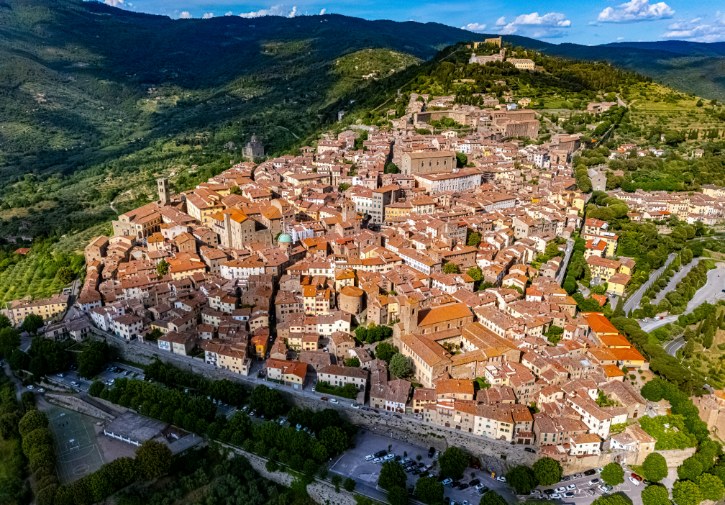
a. A Town Older Than Rome
Cortona stands on a ridge of Monte Sant’Egidio at 600 metres, looking over the southern Val di Chiana. It was one of the twelve city-states of the Etruscan Confederation, and its origins predate Rome.
The walls still include cyclopean stone from the fifth and fourth centuries BC. Walk the steep streets and you move through those layers directly.
b. Where the Views Open Up
Not every square here has an open outlook, so head to the right spots.
- Piazza Garibaldi. Near the entrance to the historic core, this square forms a wide viewing terrace. Looking south and south-west, you see olive groves and the waters of Lake Trasimeno, just across the border in Umbria.
- Fortezza del Girifalco. At the summit, renovated in 1556 by Cosimo I de’ Medici over Etruscan and medieval work. Its ramparts give a full circle of views over the Chiana valley and the Amiata ridge.
The climb is steep. Go in the late afternoon when the heat eases.
c. The Squares and Their Treasures
Both Piazza della Repubblica and Piazza Signorelli sit on the site of the ancient Roman forum, the first anchored by the thirteenth-century Palazzo Comunale with its clock tower and external stone staircase.
- Palazzo Casali. Thirteenth-century, now home to the MAEC museum.
- Etruscan Bronze Chandelier. Fifth century BC, with sixteen oil lamps and reliefs of dolphins and gorgons.
- Tabula Cortonensis. A bronze tablet from the late third century BC bearing the third-longest known Etruscan inscription.
- Diocesan Museum. Fra Angelico’s Annunciation, around 1433 to 1434, plus panels by Luca Signorelli, born here.
d. Walking the Town Without the Climb
- Via Nazionale, known locally as Ruga Piana, is level and gives your legs a break
- Via del Gesù and the residential lanes keep a quiet neighbourhood feel
- Antique restoration workshops continue a genuine local craft tradition
- Trattorias serve Chianina beef, raised in the valley below
- Local Syrah wines do well in the warm Cortonese microclimate
e. The Book That Brought the Crowds
Cortona gained international attention through Frances Mayes’s 1996 memoir Under the Tuscan Sun, centred on her countryside home at Villa Bramasole. The 2003 film widened the audience further.
Be honest about the effect. The book and film turned a quiet hill town into an international destination, lifted the economy, pushed up property prices, and brought a steady stream of visitors to the road below Bramasole.
The older Cortona is still here underneath, in the Etruscan collections, the Signorelli paintings, and the upper lanes.
11. Pitigliano
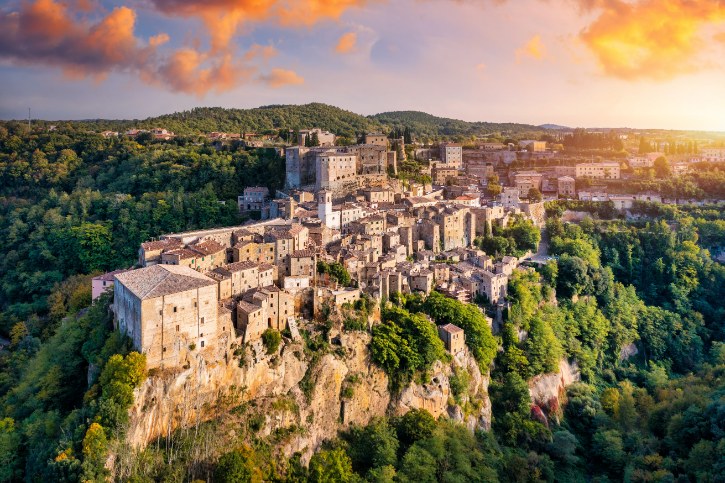
a. A Town Growing Out of a Cliff
Your first view of Pitigliano is unforgettable, because the town appears to rise straight from the rock.
It sits in the southern Tuscan Maremma on a volcanic tuff plateau at 313 metres. Cliffs drop into gorges carved by the Lente, Meleta, and Prochio rivers, leaving a fortress reached only by a narrow land bridge. The houses were built from tuff quarried on site, so buildings and cliff look like one mass.
b. How the Rock Shaped Everything
- The landscape came from volcanic activity in the Monti Volsini complex
- The collapse of a prehistoric caldera formed nearby Lake Bolsena
- Eruptions laid down thick layers of ash and ignimbrite
- Erosion cut those layers into ravines, isolated spurs, and vertical cliffs
- That terrain decided the town’s defensive position, building material, and vertical shape
c. The Best View of the Town
Approaching along the SR74, stop at the public overlook near the Sanctuary of the Madonna delle Grazie. You get the classic panorama across the ravine, with the whole town hanging above the canyon.
d. Little Jerusalem and the Old Ghetto
Pitigliano is known as La Piccola Gerusalemme, or Little Jerusalem. When papal decrees expelled Jewish residents from Rome in the mid-sixteenth century, the Counts of Orsini welcomed refugees, and the community settled and led local trade.
- A restored sixteenth-century synagogue
- A subterranean complex carved into the rock, including a historic mikveh, or ritual bath
- A kosher bakery for unleavened bread, a kosher butcher, and rock-hewn cellars
- Lo Sfratto di Pitigliano, a pastry of honey, walnuts, and orange peel, shaped like the batons once used to deliver eviction notices
Above ground, expect narrow lanes, stone arches, and quiet squares, plus Palazzo Orsini, a fortified citadel fronted by a seventeenth-century Medicean aqueduct.
e. Ancient Roads Cut Through Stone
In the gorges nearby lie the Vie Cave, sunken corridors cut through solid tuff by the Etruscans between the eighth and second centuries BC.
- Most are only two to three metres wide
- The vertical rock walls can rise more than twenty metres
- They served defensive, transport, and ritual purposes
- Via Cava di San Giuseppe climbs from the Lente valley, with Etruscan drainage channels and niches called scacciadiavoli
- Via Cava dei Fratenuti winds between rock faces past ancient necropolis tombs
12. Bolgheri
a. The Famous Avenue of Cypresses
Bolgheri is known for one approach road, and it earns the reputation.
The Viale dei Cipressi runs straight inland for close to five kilometres, from the Oratorio di San Guido on the Via Aurelia to the village gateway. Tree counts vary between about 2,400 and 2,540, and the local council uses the higher figure.
The road was laid out in the nineteenth century, when the rebuilding of the old Via Regia created new routes inland. Count Guido Alberto della Gherardesca then framed it with cypresses.
b. The Poem and the Difference
- Nobel laureate Giosuè Carducci immortalised the avenue in his 1874 poem Davanti San Guido, describing the trees as towering giants
- A stone obelisk raised in 1908 by Giuseppe della Gherardesca stands near the Oratorio
- The avenue began as a dirt track planted with poplars, and was only asphalted in 1954
- This is a long, straight, coastal avenue, nothing like the curving inland farm lanes of the Val d’Orcia or the Crete Senesi
c. A Village You Can Cross in Minutes
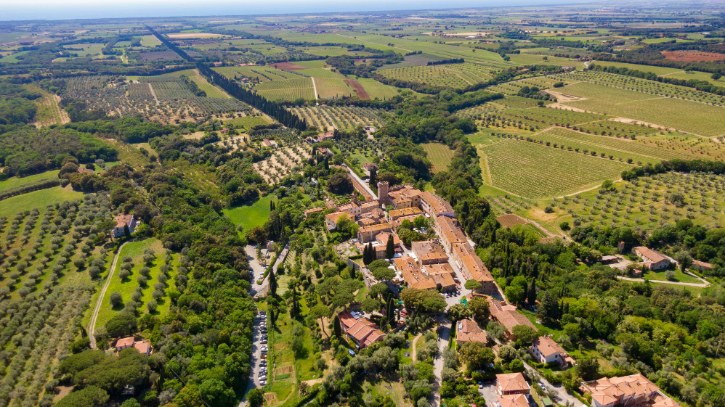
Do not expect a dramatic hilltop silhouette. Bolgheri sits on a low rise of the Colline Metallifere at just 96 metres.
- You enter through a single vaulted stone gateway beneath the red-brick tower of the Castello della Gherardesca
- The castle is thirteenth century, with neo-Gothic battlements added later, and is still a private family residence
- Inside are pedestrian streets, two small squares, Piazza Alberto and Piazza Teresa, plus stone cottages, enoteche, and artisan shops
The whole village takes fifteen minutes to cross, which is exactly why it feels so calm.
d. Vineyards Beside the Sea
The Bolgheri DOC district sits on a coastal plain between the hills and the sea, with strong sunlight and constant breezes. Its soils of alluvial gravel, marine clay, and limestone closely resemble Bordeaux.
That resemblance changed Italian wine history. In 1944, Marchese Mario Incisa della Rocchetta planted Cabernet Sauvignon at Tenuta San Guido, creating Sassicaia and launching the Super Tuscan movement. Ornellaia and Guado al Tasso now define the zone.
e. Drives, Nature, and a Good Place to Finish
- Strada Bolgherese (SP16). The local “Wine Road”, passing vineyard estates, olive groves, and maritime pine stands.
- Padule di Bolgheri. A protected WWF sanctuary near the shoreline, with coastal lagoons, marshes, umbrella pines, and migratory waterfowl.
Cypress avenues, a walled village, vineyard rows, pine forest, and salt air all sit within a few kilometres. It is a very different Tuscany from the one most travelers picture, and a relaxed place to finish a trip.