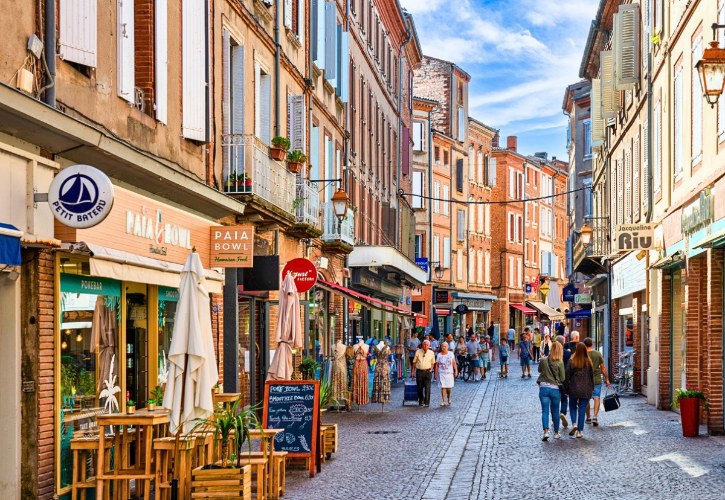
You do not need a car to see the best of southern France. Regional trains across Occitanie and Provence-Alpes-Côte d’Azur drop you into historic cities, walled towns, and Mediterranean harbors.
Along the coast the stops come quickly, many just 20 to 40 minutes apart. You can stand under a red brick cathedral in the morning and watch fishing boats unload by evening.
Roman monuments, canal towpaths, salt marshes, and quiet lanes all sit within walking distance of a platform. 🙂
1. Albi
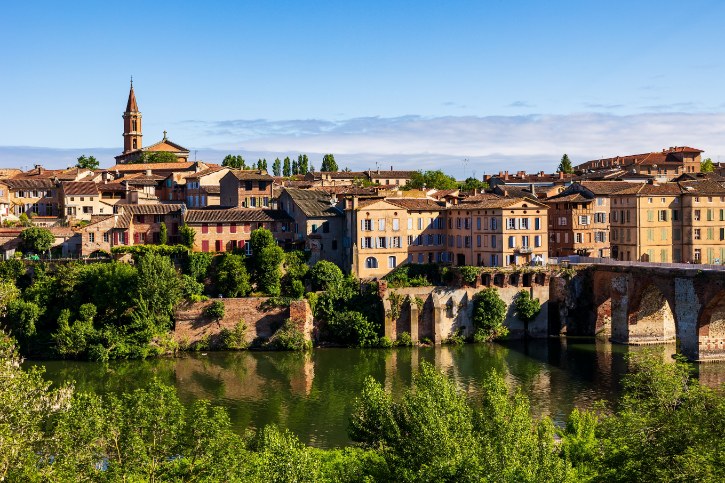
a. A Town Built Almost Entirely in Red Brick
Albi rises on a hillside above the Tarn, and nearly every wall is red fired brick, known as brique foraine.
After the 13th century Albigensian Crusade, prince-bishops rebuilt it as a fortress of church power. UNESCO listed the result in 2010.
b. The Cathedral You Will Not Forget
- Cathédrale Sainte-Cécile. Begun in 1282, consecrated in 1480, with sheer brick walls and a 78 meter tower.
- The painted ceiling. Painters from the Bologna region covered the vaults in mineral blue and gold, 1509 to 1512.
- Le Jugement Dernier. A late 15th century Last Judgment fresco beneath the organ.
- The jubé. A carved limestone screen of Gothic lacework wraps the high altar.
c. Art, Palaces and River Views
- Palais de la Berbie. The 13th century bishop’s fortress beside the cathedral.
- Musée Toulouse-Lautrec. The world’s fullest collection of the painter’s work.
- Pont Vieux. Built between 1035 and 1040, still in daily use.
d. The Quiet Medieval Quarter
Walk into the Saint-Salvi quarter and the mood softens. The Collégiale Saint-Salvi mixes Romanesque stone with Gothic brick, and its 13th century cloister grows herbs.
On Rue Sainte-Cécile, look up at the open top floor lofts, called soleilhos, once used for drying woad.
e. Easy Trips Out of Town (Day Trips)
- Cordes-sur-Ciel. A hilltop bastide village of 1222, with Gothic merchant houses above the Cérou valley.
- Gaillac. A brick old town and riverside park, with cellars pouring Mauzac and Duras.
2. Toulouse
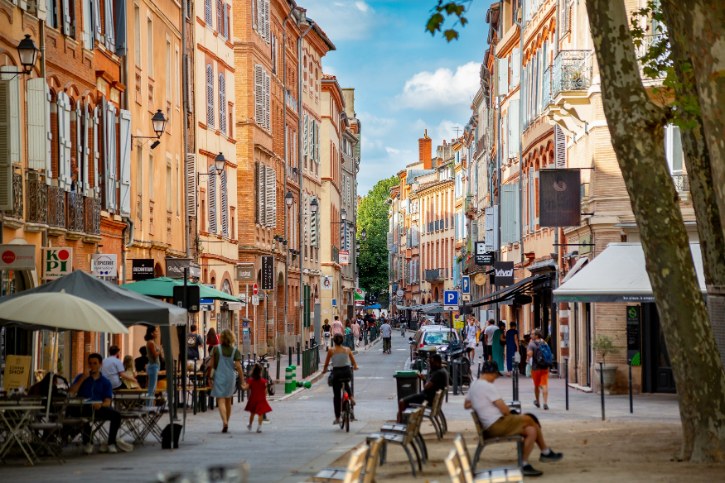
a. Why Locals Call It the Pink City
Toulouse is the capital of Occitanie, and the nickname La Ville Rose comes from its terracotta brick.
The city grew on the Garonne from a Roman settlement into the Visigothic capital, then the seat of the Counts of Toulouse.
b. The Grand Civic Heart
- Place du Capitole. The main square, bordered by the Capitole and its 128 meter façade.
- Salle des Illustres. Inside hang late 19th century canvases of regional history.
- The Occitan cross. A bronze cross by Raymond Moretti is set into the pavement.
c. Churches Worth the Detour
- Basilique Saint-Sernin. Europe’s largest preserved Romanesque church, on the Santiago pilgrim road.
- Couvent des Jacobins. A column called Le Palmier throws out 22 ribbed vaults, above the relics of Thomas Aquinas.
d. Water, Art and Riverbanks
- Canal du Midi. Walk the towpaths near Port Saint-Sauveur past brick locks and houseboats.
- Musée des Augustins. Medieval stone capitals and French painting, reopening in stages.
- Pont Neuf. Seven uneven arches cross the Garonne, with open spillways for floodwater.
- Place de la Daurade. The quays frame the Saint-Joseph de la Grave dome.
e. Two Brick Towns (Day Trips)
Montauban is a brick bastide town where Place Nationale is ringed by double arcades, and the Musée Ingres Bourdelle fills the Episcopal Palace.
Moissac is quieter. Its Abbey of Saint-Pierre keeps 76 carved capitals from around 1100 and a portal showing the Apocalypse.
3. Carcassonne
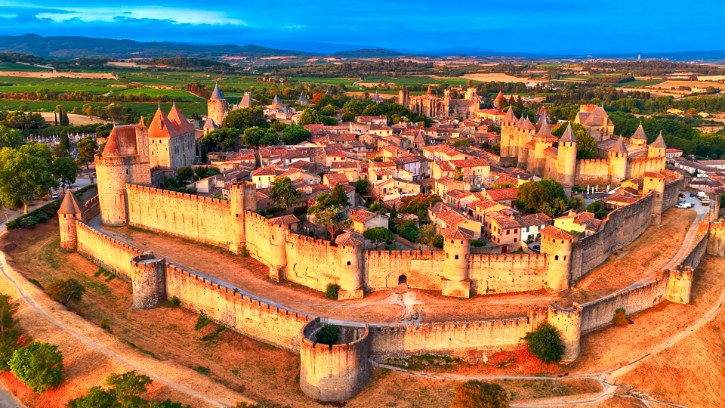
a. Europe’s Most Complete Fortified City
Carcassonne stands on an isolated plateau between the Montagne Noire and the Pyrenean foothills, UNESCO listed since 1997.
Its three kilometer circuit of double walls and 52 towers records Roman through royal French defenses, and survives thanks to the 19th century restoration by Eugène Viollet-le-Duc.
b. Walking the Double Walls
- Porte Narbonnaise. You enter east across a dry moat guarded by spur towers.
- Les lices. The wide space between inner and outer walls makes the best walk here.
c. Inside the Castle
- Château Comtal. A fortress within a fortress, built by the Trencavel viceroys.
- Rampart walkways. They open onto the lower town and the Corbières hills.
- The lapidary museum. Carved stone from antiquity to the 17th century, plus a late 12th century wall painting of knights fighting Saracens.
d. The Basilica and the Best Free View
Basilique Saint-Nazaire joins a late 11th century Romanesque nave to a Gothic choir of the late 13th. Look up for the Tree of Jesse and Tree of Life windows.
Then walk down to Pont Vieux over the Aude. From there you finally grasp the fortress, and it costs nothing.
e. Along the Valley and the Canal (Day Trips)
- Limoux. Built around an arcaded square, home of Blanquette de Limoux, recorded by monks in 1531.
- Castelnaudary. The home of cassoulet, beside a 17th century canal reservoir with four locks.
4. Narbonne
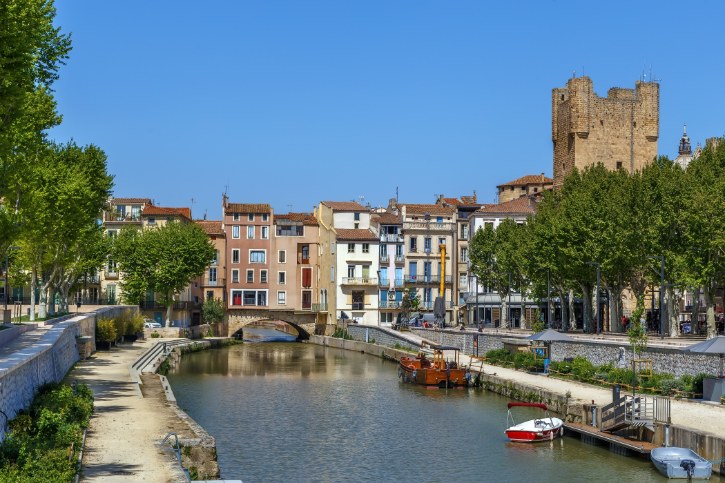
a. Rome’s First Colony Outside Italy
Narbonne was founded in 118 BCE as Colonia Narbo Martius, Rome’s first colony beyond the Italian peninsula.
It later became a powerful archbishopric. Today the Canal de la Robine, a UNESCO listed waterway, runs through a town that still feels unhurried.
b. A Cathedral That Was Never Finished
Work on Cathédrale Saint-Just-et-Saint-Pasteur began in 1272, and the vaults climb over 40 meters. Then it stopped.
The consuls refused to demolish the Roman ramparts for the nave, so the choir has stood alone since. Inside, look for the 14th century stone altarpiece.
c. The Palace and the Roman Road
- Palais des Archevêques. One complex joining the Romanesque Palais Vieux, the Gothic Palais Neuf, and keeps.
- Donjon Gilles Aycelin. Climb 162 steps for a panorama toward the Clape and sea.
- Via Domitia. An excavated Roman road below street level, chariot ruts still visible.
- Roman Horreum. Vaulted galleries from the 1st century BCE, once a grain warehouse.
d. Museums, Markets and Waterways
- Narbo Via. A Foster + Partners museum around a wall of 760 carved Roman blocks.
- Les Halles de Narbonne. An iron and glass hall of 1901, where you eat what the next stall sells.
- Pont des Marchands. A bridge on Roman foundations still carrying houses and shops.
e. Abbey and Seaside Escapes (Day Trips)
- Abbaye de Fontfroide. A Cistercian monastery in a quiet Corbières valley, with a late 12th century cloister and a garden of some 2,500 roses.
- Gruissan. A fishing village of circular streets below a 10th century tower, with salt pans and stilt house beaches.
5. Béziers
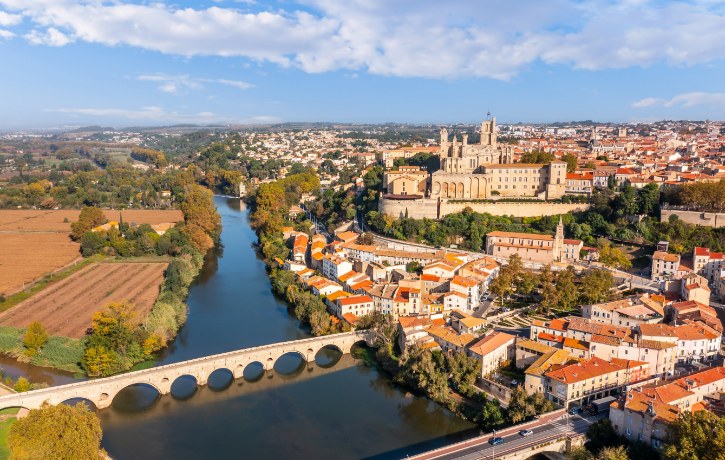
a. A City on a Rock Above the Orb
Béziers is among France’s oldest inhabited settlements, founded by Greeks around 575 BCE above the Orb.
It was sacked in 1209 during the Albigensian Crusade, then grew rich on the 19th century wine boom. It is also home to Pierre-Paul Riquet, builder of the Canal du Midi.
b. The Fortress Cathedral and Its Terrace
- Cathédrale Saint-Nazaire. Rebuilt in Gothic style in the 13th and 14th centuries, with a huge rose window.
- Jardin des Évêques. The terrace opens onto the Orb Valley and the Caroux mountains.
- Pont Vieux. A 12th century bridge on fifteen arches, with the classic view up to the cathedral.
c. Canal du Midi Engineering
The Écluses de Fonseranes are the canal’s technical high point and a UNESCO listed site. Eight basins and nine gates climb 21.5 meters over 312 meters.
Only the upper locks still carry boats. The rest closed in 1858, when the Pont-canal de l’Orb nearby took the canal 240 meters across the river, above the floods.
d. Promenades, Parks and Local Art
- Les Allées Paul Riquet. The broad shaded promenade of the upper town.
- Plateau des Poètes. A 19th century English park with exotic trees, swans, and fountains.
- Musée des Beaux-Arts. Head for the Hôtel Fayet. The Hôtel Fabrégat is under conservation.
- Parc de la Plantade. A quiet riverside retreat around the Moulin Cordier watermills.
e. Black Stone and Molière (Day Trips)
- Agde. A black basalt town with a fortified 12th century cathedral on the river.
- Pézenas. A town of old stone mansions tied to Molière, full of artisan workshops.
6. Sète
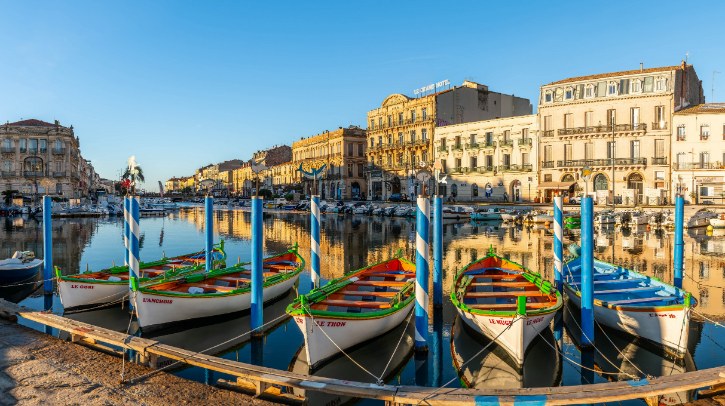
a. A Working Port Between Sea and Lagoon
Sète is often called the Venice of Languedoc, wedged between the sea and the lagoon of the Étang de Thau.
Founded in 1666 under Louis XIV as the deep water end of the Canal du Midi, it still works for a living.
b. Canals, Quays and Fishing Boats
- The Canal Royal. Italianate townhouses line the docks above fish markets and bistros.
- What to eat. Try tielle sétoise, a spicy octopus pie, or bourride, monkfish stew with aioli.
- Quai Maximin Licciardi. Walk here to catch boats unloading for the dockside auction.
c. The Neighborhoods That Climb the Hill
- Pointe Courte. A fishing hamlet of gravel paths and drying nets, where Agnès Varda filmed in 1955.
- Quartier Haut. A steep enclave settled by Italian fishermen, now full of stairways and galleries.
- Mont Saint-Clair. From the terrace 175 meters up you see sea, canals, and oyster tables.
d. Museums for a Poet and a Songwriter
- Musée Paul Valéry. Manuscripts and drawings, above the cemetery where the poet is buried.
- MIAM. The Musée International des Arts Modestes fills a wine storehouse with folk art and pop toys.
- The lido beaches. Twelve kilometers of sand run southwest toward Marseillan.
e. Oysters and Muscat (Day Trips)
Bouzigues, across the lagoon, is the cradle of Mediterranean oyster farming. Waterfront shacks serve shellfish with chilled Picpoul de Pinet.
Frontignan sits between salt marshes and the La Gardiole massif, with a fortified 12th century church, flamingos in the old salt pans, and sweet Muscat de Frontignan.
7. Montpellier
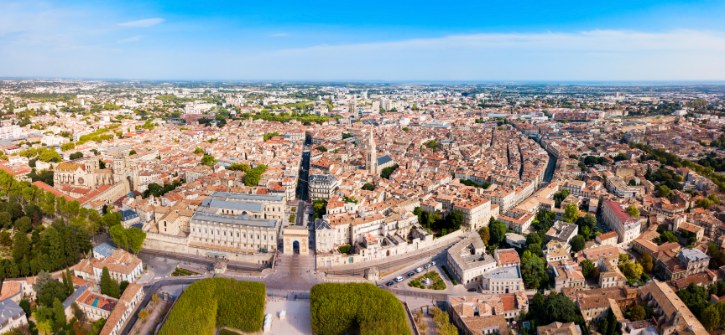
a. Medieval Streets Beside Bold Modern Design
Montpellier began in the 10th century on medieval trading routes and grew without any Roman foundation.
Its reputation came from the medical faculty of 1220, the oldest continuously operating medical school in the Western world.
b. The Square Everyone Meets At
- Place de la Comédie. Locals call it L’Œuf, the Egg, after its original oval paving.
- Fontaine des Trois Grâces. Carved by Étienne d’Antoine in 1776 and moved here in 1797.
c. Inside the Écusson
- A medieval maze. Pale limestone lanes include Rue de l’Ancien Courrier and Rue du Bras de Fer.
- Hidden courtyards. Heavy doors hide private mansions with open stone staircases.
- Cathédrale Saint-Pierre. Founded in 1364, its porch rests on two pillars like castle towers.
- The Faculty of Medicine. Beside the cathedral, where Rabelais and Nostradamus studied.
d. Gardens, Arches and Great Painting
- Jardin des Plantes. France’s oldest botanical garden, created by Henri IV in 1593.
- Promenade du Peyrou. A 1691 arch leads to a terrace with a statue of Louis XIV.
- Aqueduc Saint-Clément. A two tiered 18th century aqueduct that carried water fourteen kilometers.
- Musée Fabre. Veronese, Rubens, Delacroix, and Courbet, plus Soulages’ Outrenoir canvases.
- Antigone. Ricardo Bofill’s postmodern district of classical façades and vast plazas.
e. Beaches and Bold Architecture (Day Trips)
Palavas-les-Flots and Carnon sit on the barrier beach between sea and lagoon, where flamingos and gray herons feed.
La Grande-Motte is Jean Balladur’s 1960s resort, listed as modern heritage for its pyramid shaped concrete blocks.
8. Aigues-Mortes
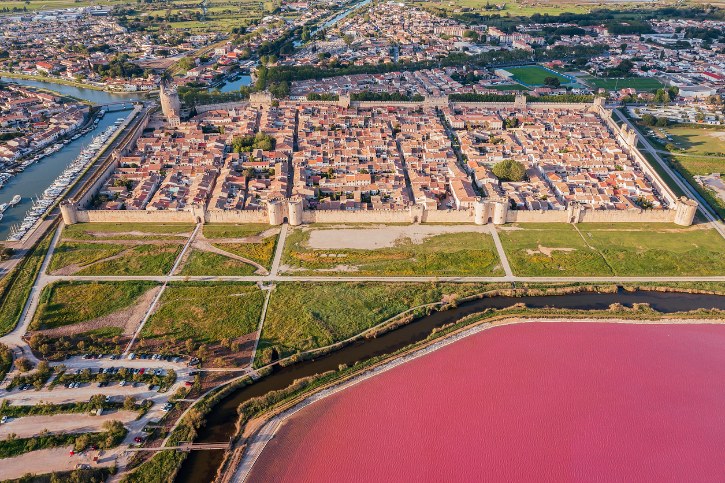
a. A Crusader Port in the Salt Marshes
Aigues-Mortes rises out of the flat lagoons of the Petite Camargue, a well preserved 13th century fortified town.
King Louis IX founded it in the 1240s as the crown’s Mediterranean harbor, launching crusades in 1248 and 1270. Silting later cut it off from the sea.
b. Walking the Ramparts
- The circuit. A continuous 1,634 meter wall, twenty towers and ten gates.
- The chemin de ronde. From the walkway you look over tiled roofs and marshes.
- Tour de Constance. A circular keep of 1242 to 1254, walls up to six meters thick.
c. The Tower With a Hard History
After the Revocation of the Edict of Nantes in 1685, the keep became a Protestant prison.
Among them was Marie Durand, held for 38 years. She is traditionally believed to have scratched REGISTER, meaning resist, into the rim of the well room.
d. Inside the Walls and Out to the Salt
- Logis du Gouverneur. An interpretation centre on Saint Louis and the walls.
- Place Saint-Louis. A plane shaded square with a bronze statue by James Pradier, 1849.
- Notre-Dame des Sablons. The Gothic church where Louis IX prayed before sailing.
- Salins d’Aigues-Mortes. In dry summer, algae turn the pans pink, beside white mountains of salt.
e. Fishing Port and Pilgrim Town (Day Trips)
- Le Grau-du-Roi. A working port where trawlers pass through town under a swing bridge, near the Espiguette dunes.
- Saintes-Maries-de-la-Mer. A pilgrimage town whose fortified church guarded relics from pirates, with the shrine of Saint Sara in its crypt.
9. Nîmes
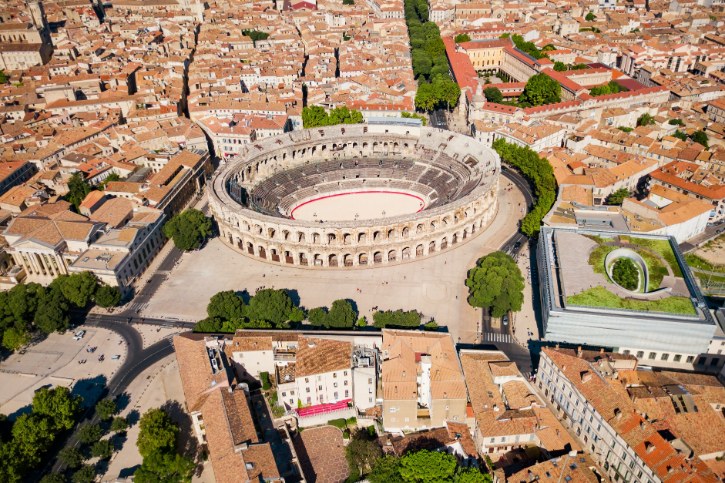
a. The City They Call the French Rome
Nîmes began as a Celtic settlement around a sacred spring, then grew under Augustus into Colonia Augusta Nemausus.
What makes it special is how casually the ancient city sits inside the modern one. Nîmes also gave the world denim, from de Nîmes.
b. The Arena That Never Stopped Working
- Arènes de Nîmes. One of the most intact Roman amphitheaters anywhere, built around 100 CE.
- Then and now. It once held over 20,000 spectators. Today it hosts concerts and regional ferias.
c. A Temple That Survived by Staying Useful
The Maison Carrée is a Roman temple from the turn of the 1st century CE, raised to Augustus’s adopted heirs. It stands on a high podium, with carved friezes and fluted columns.
It lasted because it stayed in use as a consular hall, a church, and an archive. UNESCO listed it as World Heritage in 2023.
d. Gardens, Towers and Old Lanes
- Jardins de la Fontaine. Laid out in the 1740s around the original spring, mixing statues and Roman ruins.
- Temple of Diana. A barrel vaulted ruin inside the gardens whose purpose is still debated.
- Tour Magne. The only surviving watchtower from Augustus’s wall, with views over red roofs.
- Musée de la Romanité. A folded glass façade holding mosaics, statues, and household objects.
e. The Aqueduct and the Hill Town (Day Trips)
- Pont du Gard. A UNESCO listed aqueduct nearly 50 meters tall, built without mortar. Make this your one trip if time is short.
- Uzès. A hill town of vineyards, with an arcaded square below the Romanesque Fenestrelle tower.
10. Avignon
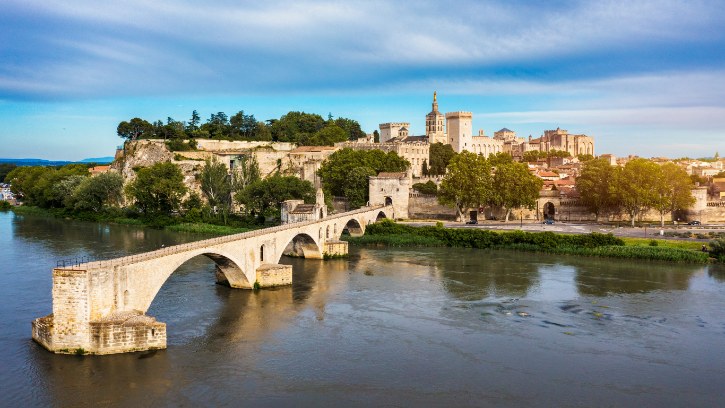
a. When the Popes Lived Here
From 1309, seven French popes governed from Avignon instead of Rome, kept away by feuding Roman families and the French crown. Gregory XI took the papacy back to Rome in 1377, and rival popes followed during the Great Western Schism.
Intact 14th century ramparts still enclose the UNESCO listed centre, and the Festival d’Avignon keeps its arts reputation alive.
b. Inside the Papal Palace
- Palais des Papes. The world’s largest Gothic palace fortress, over 15,000 square meters, with the Grand Tinel banquet hall.
- Two palaces. Benedict XII raised the austere Palais Vieux, Clement VI the lavish Palais Neuf.
- Chambre du Cerf. Hunting frescoes of 1343, a rare survival of non religious medieval art.
c. The Bridge From the Song
The Pont Saint-Bénézet is the bridge of Sur le Pont d’Avignon, finished in the late 12th century and once running 900 meters across the Rhône.
Floods swept away most of its 22 arches, leaving four spans that stop mid river. A Romanesque chapel still sits on the surviving stonework.
d. Gardens, Squares and Waterwheels
- Rocher des Doms. A limestone promontory turned public garden, with views to Mont Ventoux.
- Cathédrale Notre-Dame des Doms. A 12th century church topped by an 1859 gilded Virgin.
- Place de l’Horloge. The busiest square, framed by the Town Hall and Gothic clock tower.
- Rue des Teinturiers. The most atmospheric street here, with four mossy waterwheels.
- Les Halles d’Avignon. A food market behind a living plant façade by Patrick Blanc.
e. A Cardinals’ Retreat and Roman Theatre (Day Trips)
- Villeneuve-lès-Avignon. A cardinals’ retreat with the Chartreuse du Val de Bénédiction and 14th century Fort Saint-André.
- Orange. A UNESCO listed Roman theatre with a 103 meter stage wall, plus an arch carved with Roman victories.
11. Aix-en-Provence
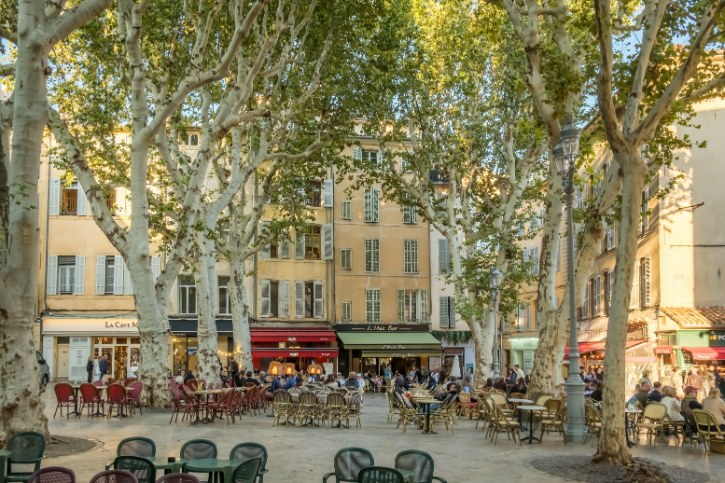
a. Fountains, Plane Trees and Slow Mornings
Aix is the picture most people carry of Provence. The Roman consul Sextius Calvinus founded it in 122 BCE around hot springs, as Aquae Sextiae.
It was the regional capital until the Revolution, and after the big ports the change of pace hits you immediately.
b. The Avenue at the Center of Everything
- Cours Mirabeau. A plane shaded avenue splitting the medieval quarter from the Quartier Mazarin, ending at the Fontaine de la Rotonde.
- Fontaine d’Eau Chaude. Known as the Fontaine Moussue, thick with moss and steaming on cool mornings.
- Historic cafés. Les Deux Garçons has hosted writers and artists since the 18th century.
c. Elegant Streets and Hidden Squares
- Quartier Mazarin. Laid out in the late 17th century by Archbishop Mazarin.
- Place des Quatre-Dauphins. A 1667 fountain with four baroque dolphins spouting water.
- Place d’Albertas. A small jewel paved with river pebbles. Come early and have it alone.
- Cathédrale Saint-Sauveur. A thousand years in one building, Roman foundations to Gothic doorway.
d. Cézanne’s Aix
The Musée Granet fills a former priory with European masterpieces, a Cézanne gallery, and the Jean Planque collection. The cathedral holds the Burning Bush triptych of 1476.
North of the centre, on Les Lauves hill, the Atelier Cézanne still holds his easel, pottery, and props.
e. The Mountain He Painted Again and Again (Day Trips)
- Montagne Sainte-Victoire. The limestone ridge that appears in dozens of Cézanne’s landscapes.
- The trails. They run past red clay foothills, stone chapels, and the Bimont Dam.
- Gardanne. A hillside town where Cézanne painted in the 1880s, with reproductions at his viewpoints.
12. Marseille
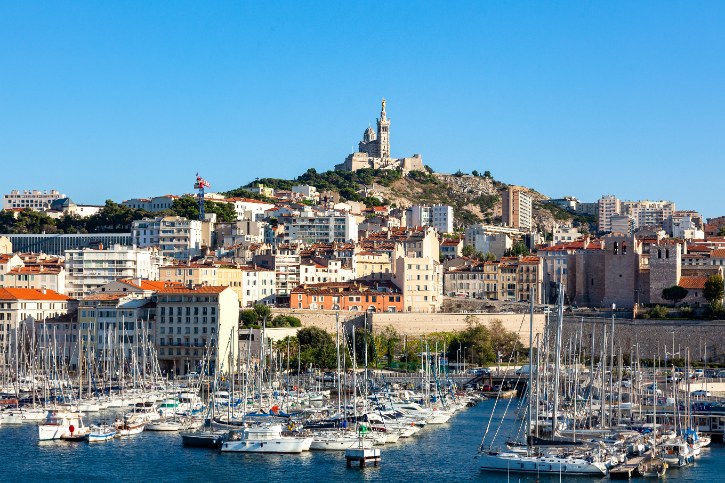
a. France’s Oldest City, Still Facing the Sea
Greek seafarers from Phocaea founded Marseille around 600 BCE as Massalia, the oldest major city in France.
Set between limestone massifs and the water, it keeps a maritime identity shaped by trade and migration. It is louder than inland Provence, and that is the point.
b. Around the Old Port
- Vieux-Port. The anchor of the city, guarded by 17th century forts Saint-Jean and Saint-Nicolas.
- Quai des Belges. The morning fish market runs under Foster’s Ombrière, a mirrored steel canopy.
- Vallon des Auffes. Follow the Corniche Kennedy to a fishing cove known for bouillabaisse.
c. The Basilica Above the City
Notre-Dame de la Garde, which locals call La Bonne Mère, was built from 1853 to 1864 in Romano-Byzantine style, crowned by an eleven meter gilded Virgin and Child.
Inside are gold leaf mosaics and hundreds of maritime offerings, including model boats hung from the vaults. The terrace gives you city, sea, and islands.
d. Old Alleys and New Architecture
- Le Panier. The oldest quarter, built on the Greek agora, full of alleys and murals.
- Vieille Charité. A 17th century almshouse with a domed chapel in an arcaded courtyard.
- MuCEM. Ricciotti wrapped this museum in dark concrete lattice, linked to Fort Saint-Jean.
- Abbaye Saint-Victor. A 5th century abbey with crypts of early Christian sarcophagi.
e. Cliffs, Coves and Island Forts (Day Trips)
- Parc National des Calanques. Limestone cliffs and hidden coves. Access is limited in fire season.
- Îles du Frioul. Dry, wind scoured islands with bird nesting grounds and secluded rocky coves.
- Château d’If. The island prison of The Count of Monte Cristo, with cells and gun terraces facing the city.
13. Cassis
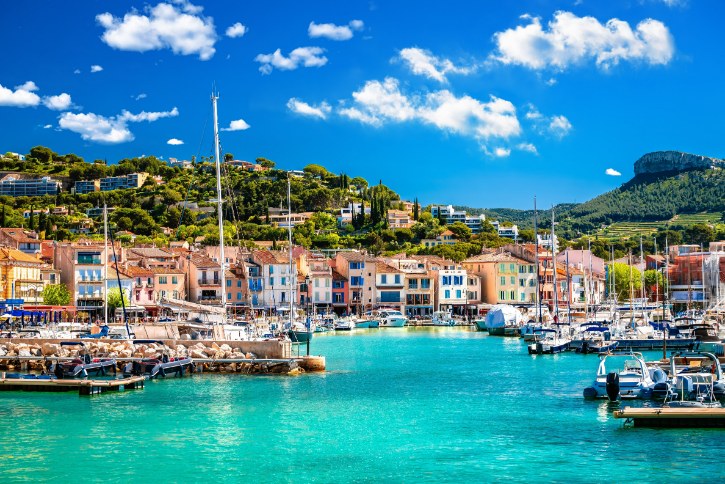
a. A Pastel Harbor Under White Cliffs
Cassis sits in a natural amphitheater between the white Calanques and the red headland of Cap Canaille.
It grew from a coral fishing port into a village of pastel houses and steep vineyards. Cassis AOC, created in 1936, makes dry mineral whites from Marsanne and Clairette.
b. The Port and the Village
- Port de Cassis. Quaysides of restaurants, shaded benches, and wooden boats called pointus.
- Château de Cassis. Look up from the quays to a private 14th century castle on its spur.
- Plage de la Grande Mer. A mix of sand and shingle just behind the port, below the castle.
c. Three Calanques You Can Reach on Foot
- Port-Miou. A winding inlet, once a quarry, now sheltering boats below white walls.
- Port-Pin. A cove fringed with Aleppo pines, with a pebble beach and clear water.
- En-Vau. The most dramatic, lined by vertical cliffs. Wear proper footwear and check fire closures.
d. The Red Cliff and the Vineyards
- Cap Canaille. One of Europe’s highest sea cliffs at 394 meters, red sandstone that glows at dusk.
- The terraced estates. Clos Sainte Magdeleine and Domaine du Paternel run cellar tastings.
e. The Park Is the Excursion (Day Trips)
Cassis is hemmed in by marine park boundaries and cliffs, so the park itself is your best excursion.
The marked coastal path west of town leads to the calanques, and the belvedere above En-Vau gives the finest view into the inlet. Routes deeper into the massif are long and strenuous, so judge your day honestly.
14. La Ciotat
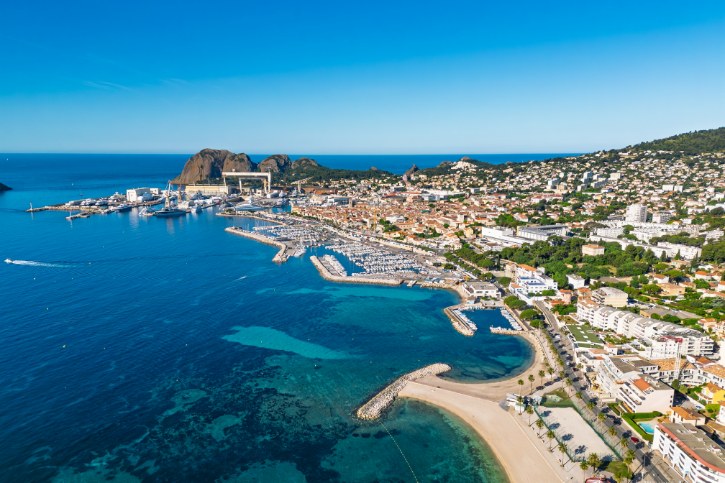
a. Shipyards, Cinema and Pétanque
Just around the headland from Cassis, La Ciotat grew around naval shipyards building liners and cargo ships from the mid 19th century.
It also holds a place in cultural history. The Lumière brothers filmed their earliest pictures here in 1895, and pétanque began on local courts in 1910.
b. The Oldest Cinema Still Running
The Eden Théâtre opened in 1889 as a theatre and music hall, and is recognized as the world’s oldest operating cinema. The Lumière brothers held private showings here in 1895 and 1896.
Restored to Belle Époque elegance, it still shows films and exhibitions. Watching one here is a small thrill.
c. The Port and Its Cranes
- Vieux-Port. Fishing boats, fish stalls, and pastel townhouses line the northern quay.
- The shipyards opposite. Colossal cranes still work, now refitting superyachts.
- Plage Lumière. A sandy beach named for the cinema pioneers, behind a palm lined promenade.
d. Gardens and Red Rock Coves
- Parc du Mugel. A botanical garden below the Bec de l’Aigle, with a clifftop viewpoint.
- Calanque de Figuerolles. An inlet of eroded red ochre rock, known for its sea stacks.
- The cliffs above. Enjoy the red rock from the park. The clifftop road is a separate trip.
e. A Roman Villa by the Beach (Day Trips)
- Les Lecques. A crescent bay of sand at Saint-Cyr-sur-Mer, quieter than the coves nearer town.
- Musée Tauroentum. An open air museum over the mosaic floors of a 1st century Roman villa.
15. Sanary-sur-Mer
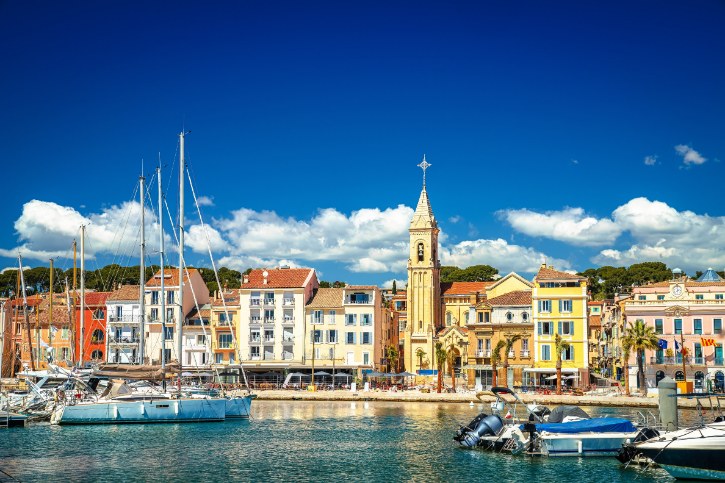
a. A Harbor That Still Feels Local
Sanary-sur-Mer keeps a working fishing fleet and an unhurried rhythm many resorts on this coast have lost.
In the 1930s it sheltered German and Austrian writers fleeing Nazism, among them Thomas Mann, Bertolt Brecht, and Lion Feuchtwanger.
b. Wooden Boats and a Medieval Tower
- Port de Sanary-sur-Mer. Traditional pointus with swept prows and brightly painted hulls, many recognized as heritage craft.
- The quayside. Palms, cafés, and terraces wrap around the water.
- Tour Romane. A 13th century tower, 21 meters tall, with a rooftop terrace over the harbor.
c. Where Diving History Lives
Sanary matters in diving history, because Cousteau, Philippe Tailliez, and local son Frédéric Dumas tested early breathing gear here.
The Musée Frédéric-Dumas, in the tower and the Salle Maurice-Fargues, shows early Aqua-Lung regulators, masks, and amphorae raised from local wrecks.
d. Old Town, Market and a Hilltop Chapel
- The old streets. Pastel lanes with bougainvillea, fountains, and a frescoed church.
- The Wednesday market. Hundreds of stalls fill the harbor front with cheese, olives, and soap.
- Chapelle Notre-Dame de Pitié. Climb the Montée des Oratoires to a 16th century chapel of sailors’ offerings.
- Plage de Portissol. A horseshoe bay with clear water and a snorkeling trail.
e. Wine Town and a Small Island (Day Trips)
- Bandol. A seaside town of sandy coves like Plage de Renécros, heart of Bandol AOC and its Mourvèdre reds.
- Île de Bendor. The private island offshore, bought by Paul Ricard in the 1950s and recently reopened.