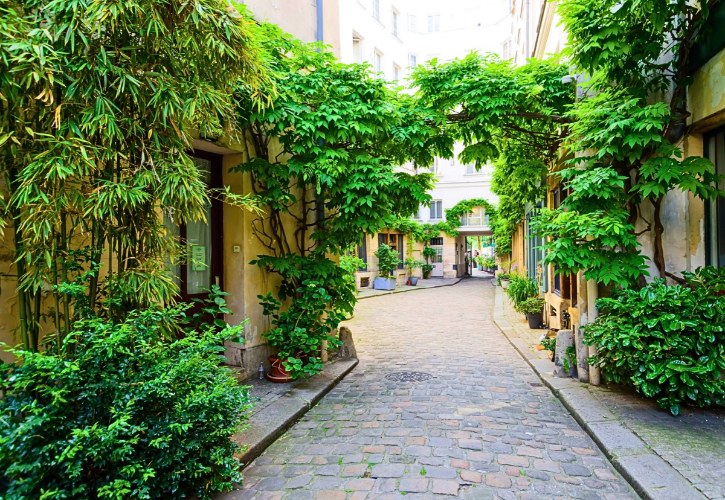
Paris hides a quieter, older city just off its busy boulevards. Slip through a plain carriage door or a narrow archway, and the traffic fades behind you.
Suddenly you are standing on worn cobblestones, surrounded by former workshops, painted storefronts, delicate ironwork, and glass roofs that glow with daylight.
Some corners open to the sky, others shelter under soaring canopies. Each one holds centuries of craft and history, and each rewards you for slowing down and looking closely. 😊
1. Cour Damoye
a. Where the City Noise Suddenly Stops
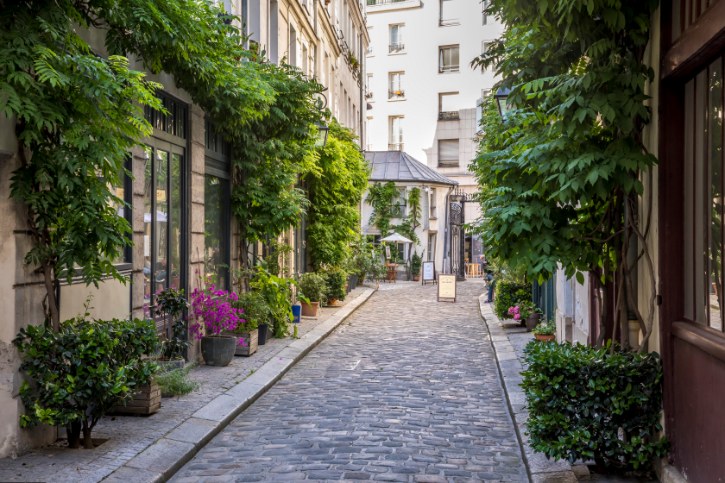
Tucked between two cafés just off Place de la Bastille, a discreet carriage door opens onto a long, narrow cobbled lane. Take a few steps in, and the roar of traffic around the July Column drops to a hush. You feel the change almost at once.
b. A Working Lane Built Over Old City Walls
- Created in 1780 by hardware merchant Antoine-Pierre Damoye, on land he bought two years earlier
- Laid directly over the old defenses of eastern Paris, above a covered sewer and the former defensive slope (glacis) of the Porte Saint-Antoine
- Designed as a self-contained lane of ground-floor workshops with workers’ lodgings above
- Home over time to woodworkers, ironworkers, ragpickers, and scrap-metal dealers
- Documented by photographer Eugène Atget in 1914, when its workshops repaired carts
c. The Details Worth Slowing Down For
- Cobblestone paving and weathered old façades along the former workshops
- Understated metal signs marking the studios behind each door
- A restored vintage freight elevator (monte-charge) on your right as you enter from Bastille
- A small wall fountain set beneath a niche holding a statue of the Virgin
- In spring, cascades of mauve wisteria framing the old walls
d. Who Fills the Old Workshops Today
The lane has traded industry for a quieter creative life without losing its face. Behind the doors you will now find:
- Creative agencies and offices
- Private apartments on the upper floors
- An art gallery near the Rue Daval end
- An antique poster restorer
- A coffee roaster
2. Passage de l’Ancre
a. A Village Lane Behind a Blue Door
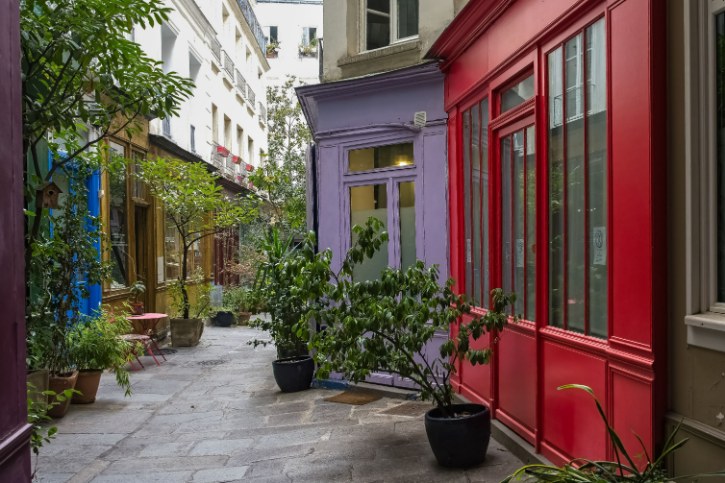
Behind a tall blue carriage door on Rue Saint-Martin, this passage looks less like a Paris street than a secluded village lane. Unlike the city’s famous glass-roofed arcades, it sits completely open to the sky. Narrow walls, uneven cobbles, and bright painted façades draped in greenery give it a warm, tucked-away feel.
b. The Story Behind the Anchor Name
- One of the city’s oldest private passages, with roots reaching back to the seventeenth century
- The name comes from an anchor-shaped signboard that once marked a seventeenth-century inn called Au Grand Saint-Pierre
- Around 1637, transport pioneer Nicolas Sauvage used the yard to house some of Paris’s earliest public horse-drawn cabs (fiacres)
- Known over time as Passage de l’Ancre Royale, and briefly Passage de l’Ancre Nationale during the Revolution
An honest note for you: accounts differ on whether Sauvage owned the inn or leased nearby space. What is solid is the link to the anchor sign and the birth of public transit.
c. The Colorful Corner Most People Miss
- Painted shutters and cheerful ground-floor façades
- Vintage lettering and old shop signs
- Climbing plants and flowerpots that look fullest in the warmer months
- The historic frontage of Pep’s, long known as Paris’s oldest umbrella and cane repair shop
d. A Quiet Place Today
Pep’s has closed for good, but its period storefront still stands as a small monument to the lane’s craft. Here is what remains:
- No public cafés or active shops along the lane
- Discreet offices and creative studios behind closed doors
- A mood that stays peaceful and village-like
3. Cour du Commerce-Saint-Andre
a. One Short Lane, Centuries of History
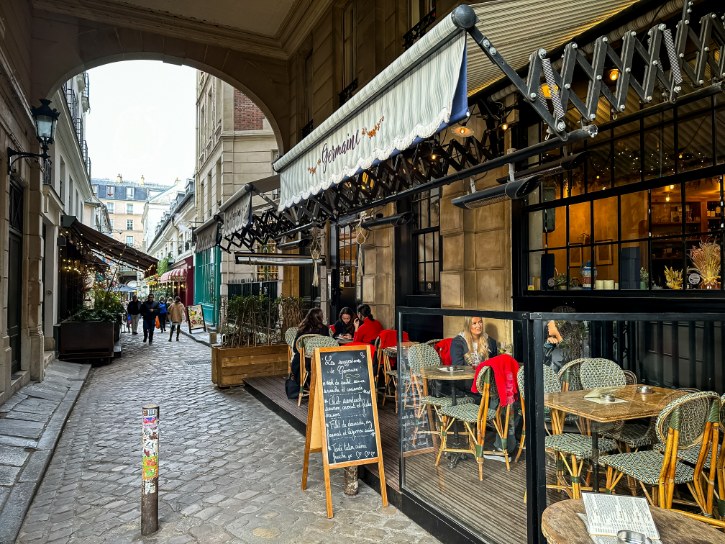
Stretching between Rue Saint-Andre-des-Arts and Boulevard Saint-Germain, this narrow walk links old commerce, a legendary café, literary secrets, and the French Revolution in a single stroll. One quick clarification, because guidebooks often get it wrong: this is not a continuous covered arcade. Only its northern tip sits under glass, and the rest is open to the sky.
b. From Medieval Moat to Cobbled Walk
- Traces the line of the old moat of King Philippe Auguste’s medieval city wall, built around 1190 to 1215
- Opened as a private passage in 1776, on land once used for jeu de paume (an early form of tennis)
- Most of the low shopfronts you see were built the same year by the Ducellier family
- Lost its southern tip when Boulevard Saint-Germain was later cut across the Left Bank
- Protected today as a Monument historique, preserving the tight texture of pre-Haussmann Paris
c. The Famous Café on the Corner
The historic rear façade of Le Procope is woven deep into the lane’s identity. Founded in 1686, it drew Enlightenment thinkers like Voltaire, Diderot, and Rousseau, and later hosted Revolutionary figures including Danton, Marat, and Robespierre. From the courtyard you can admire its façade, hung with portraits, memorabilia, and commemorative plaques, without stepping inside.
A friendly caution: popular tales tie its tables to the Encyclopédie and to Benjamin Franklin, but those belong to tradition rather than proven history.
d. Plaques That Bring the Revolution to Life
- At No. 2, a plaque remembers literary critic Sainte-Beuve, who lived here for a decade
- At No. 8, Jean-Paul Marat printed his radical newspaper L’Ami du Peuple
- At No. 9, in the workshop of harpsichord maker Tobias Schmidt, the first guillotine was built and reportedly tested on sheep
e. What You Can and Cannot See
- The base of a tower from King Philippe Auguste’s medieval wall survives inside the shop at No. 4, out of sight from the open lane itself
- Nearby Cour de Rohan, a set of secluded Renaissance courtyards, is gated and closed to the public
- The public façades and their plaques are the real reward here
4. Passage du Grand-Cerf
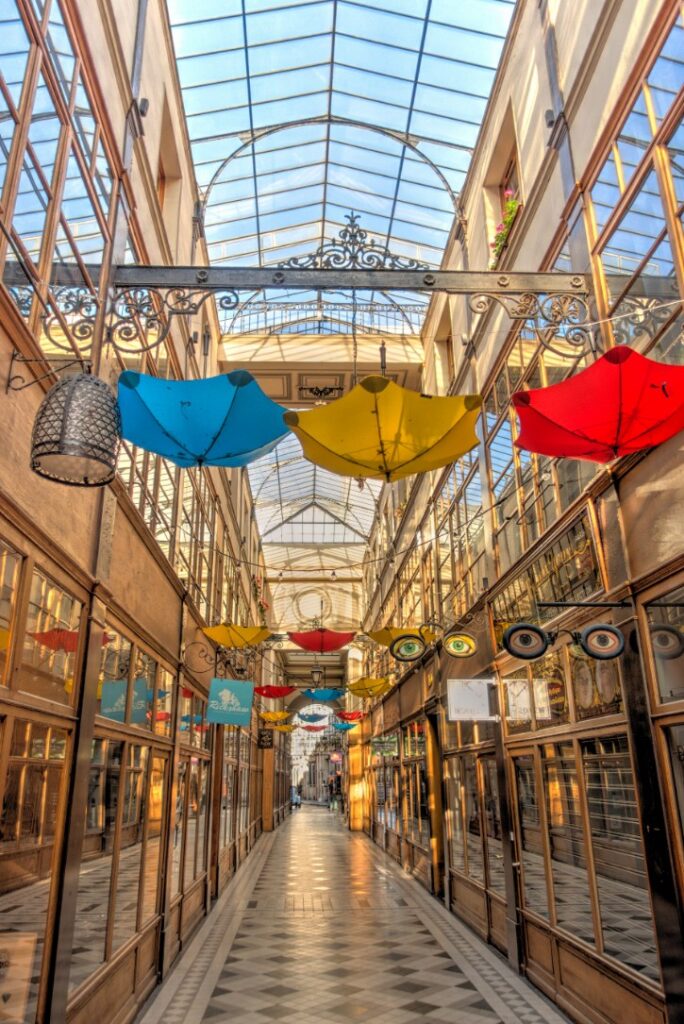
a. The Tallest Passage in the City
Where most arcades wrap you in low, cozy proportions, this one pulls your eye straight up like a narrow cathedral of iron and glass. It is the tallest covered passage in Paris, and the height is the whole experience.
b. Built on the Site of an Old Coaching Inn
- Named after the Grand-Cerf coaching establishment, a former stagecoach terminus demolished in 1825
- Opened soon after, in the great wave of early nineteenth-century arcades
- One of only around thirty covered passages still standing in Paris today
- Built mainly for craft workshops, not luxury shopping, which shaped its plain, practical grandeur
c. The Numbers That Make You Look Up
- Runs roughly 117 meters long and just 3 meters wide
- Rises to 11.80 meters beneath its peaked glass roof
- Stacks two full glazed stories of wooden shopfronts before the apartments begin
- Lets daylight pour straight down through iron trusses across the full height
d. The Makers Who Keep It Alive
Around thirty independent boutiques fill the timber-framed ground bays beneath hanging shop signs. You will find:
- Goldsmiths and jewelry designers
- Fashion creators
- Interior decoration studios
- Art galleries
e. How to Enjoy It for Free
- Stand on the center axis and look straight up
- Notice how restrained trim keeps the upper structure airy and plain
- Let the soaring iron-and-glass canopy become the star of your visit
- Enjoy one of the finest commercial spaces in nineteenth-century Paris without spending a thing
5. Galerie Vivienne
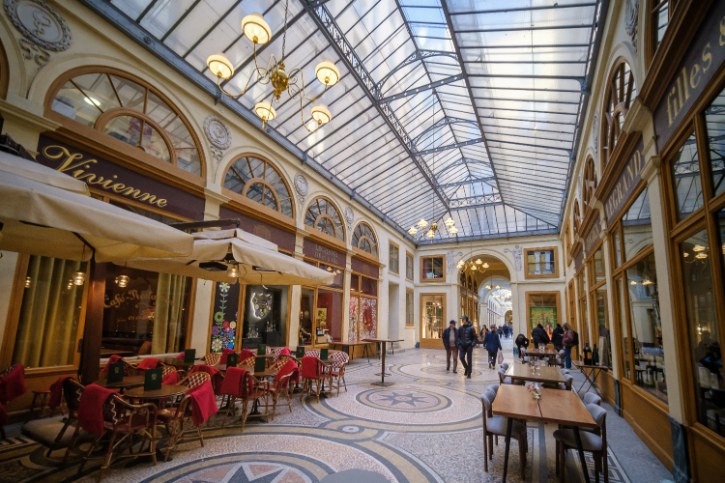
a. The Grandest of Them All
Opened in 1826 after three years of work, Galerie Vivienne is the crowning showcase of Restoration-era elegance. At 176 meters, it anchors a prime triangle near the Palais-Royal and the old stock exchange, and it still thrives as a living gallery you can stroll by day.
b. Classical Beauty Overhead
The architect François-Jacques Delannoy filled the interior with refined neoclassical detail. Watch for a cheerful program celebrating French trade:
- Laurel wreaths and wheat sheaves for success
- Overflowing cornucopias for wealth
- Mercury’s winged caduceus for commerce
- A glass-domed rotunda that scatters sunlight across the sculpted plaster
c. The Floor That Fools Everyone
Here is a fact many guides get wrong. The famous geometric mosaic floor is not original to the gallery. It was laid around 1880 by the Italian mosaicist Giandomenico Facchina, who was born the very year the gallery opened. Give yourself a moment to sweep your gaze from the floor up to the dome.
d. Storefronts With Real History
- Librairie Jousseaume, a historic bookshop trading in antiquarian books since 1826
- Legrand Filles et Fils, a fine wine house with cellars dating to 1880
- The retro tea room Le Valentin
- Bistrot Vivienne for a classic sit-down meal
e. The Birthplace of the Parisian Stroller
Grand arcades like this one shaped the nineteenth-century figure of the flâneur, the unhurried stroller linked to the writer Charles Baudelaire. Understand that connection through the culture of the arcades rather than as a claim that he haunted this exact gallery. Either way, you are walking through a true emblem of elegant old Paris.
6. Galerie Colbert
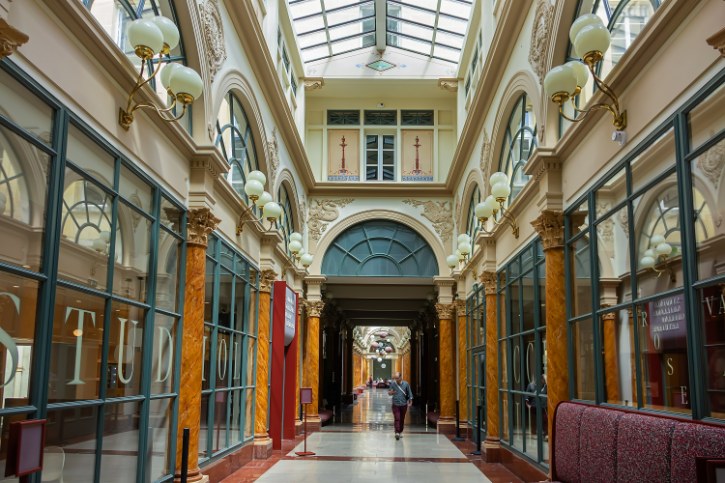
a. The Rival Next Door
Just steps from Galerie Vivienne runs its great rival, Galerie Colbert. It was built in the late 1820s with one clear goal: to lure well-dressed shoppers away from its thriving neighbor. It never quite succeeded.
b. The Rotunda You Came to See
The showstopper is the rotunda, and this single room is why the gallery matters:
- A soaring circular hall capped by a vast glass dome
- Even, overhead daylight that floods the classical proportions
- A rare sense of height and symmetry, unlike the neighboring passages
c. How Failure Saved the Architecture
- The gallery never captured steady crowds and slipped into quiet neglect
- That commercial failure spared it from the piecemeal changes that reshaped busier arcades
- A careful three-year restoration has brought its classical interior back to crisp condition
d. A Passage for Scholars, Not Shoppers
- Unlike every other stop here, it has no retail boutiques
- It anchors a respected campus for art history and heritage, home to national research institutes
- The mood is calm and studious, a luxury space that now serves teaching and research
e. Clearing Up Two Common Mix-Ups
- You can enter the public corridor and pause beneath the restored rotunda, which sometimes hosts exhibitions
- The surrounding seminar rooms, offices, and library are reserved for students and researchers
- Do not confuse the gallery with Le Grand Colbert, a separate brasserie often mistaken for it
7. Galerie Vero-Dodat
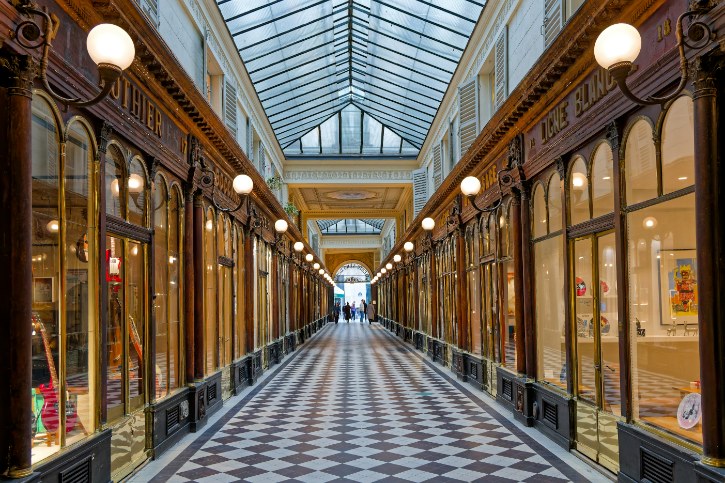
a. A Passage Built by Two Butchers
Set between the Palais-Royal and the old market district of Les Halles, this 80-meter corridor opened in 1826. It began as a clever real-estate venture by two prosperous pork butchers, Benoît Véro and François Dodat, who cashed in on heavy foot traffic between nearby stagecoach hubs and the Palais-Royal.
b. The Floor That Plays Tricks on Your Eyes
- Black-and-white marble tiles laid in a diagonal diamond grid
- A corridor only 4 meters wide, yet it feels deep and elongated
- A striking sense of depth created by careful optical geometry
- Low ceilings that alternate between glazed skylights and painted panels of mythological scenes
c. Small Treasures to Hunt For
- Matching shopfronts in dark wood, with brass and copper trim
- Mirrors, arched windows, and uniform metallic lettering
- Historic globe lamps, once fueled by gas and now electric
- Gilded details and sculpted classical motifs along the façades
d. Shops With a Collector’s Soul
The gallery has always leaned toward specialized trades. Today you will find:
- Art and decorative-arts galleries
- Antique furniture specialists
- Master stringed-instrument makers
- Christian Louboutin’s boutique and workshop, one thread among many here
e. The Best Spot to Take It All In
- As a privately owned passage with street grilles, you can walk its length when the gates are unlocked
- Stand just inside either arched portal for the finest view down the axis
- Linger a moment, and you will see why the writer Colette described its quiet elegance as having an “air of Venice”