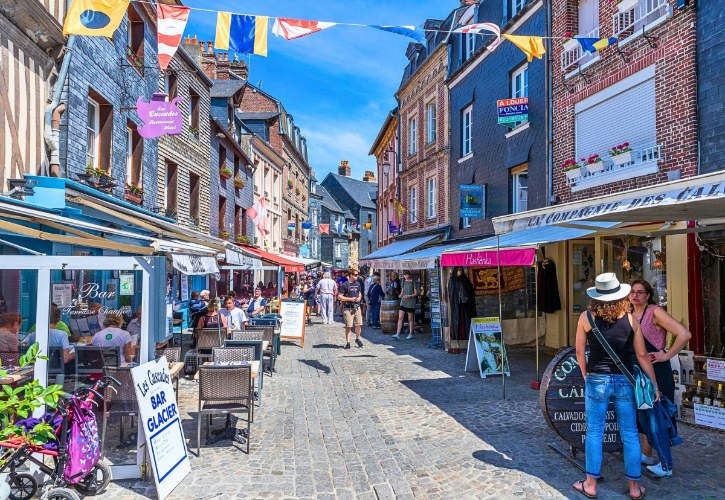
Most people drive straight from Paris to Mont Saint-Michel and miss the best part. Curve north through Normandy instead, and the journey becomes the reason to go.
You will roll past riverside gardens that shaped famous paintings, white cliffs that fall into the sea, timbered medieval towns, and harbors full of fishing boats.
Take the long way, and the stops you find along the route may stay with you just as long as the famous island at the end. 😊
1. Paris
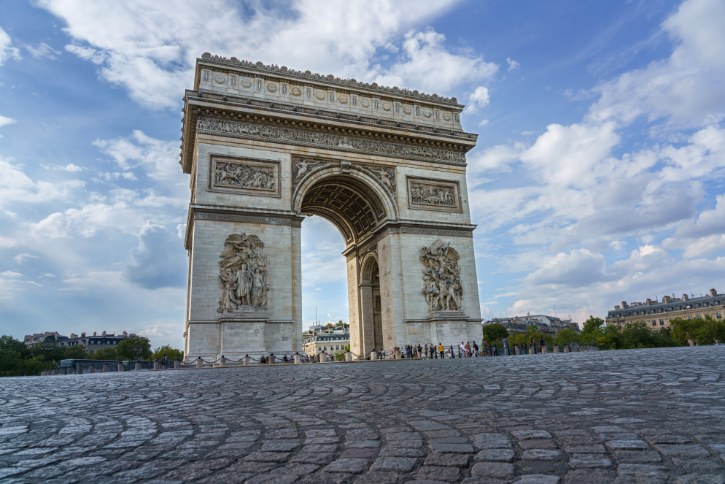
a. Your Starting Line in the Capital
Paris sets the mood before you point the car toward Normandy. The city lines up centuries of grand architecture along the Seine, and a slow morning here eases you into the journey.
Think of it as a gentle warm-up. You will see echoes of these same buildings and painters all along the road ahead.
b. Landmarks You Should Not Rush Past
- Eiffel Tower: its wrought iron frame still owns the western skyline and makes an easy first stop.
- Notre-Dame de Paris: an early Gothic church on an island in the river, with soaring flying buttresses, carved stone figures, and twin western towers.
- The Louvre: a former royal fortress turned palace, stretched along the Right Bank of the Seine.
- Haussmann boulevards: cream limestone fronts, long iron balconies, and steep zinc roofs give the city its elegant, uniform look.
Read More: The Best Walking Route: Louvre to Sainte-Chapelle and Notre-Dame
c. Green Corners for a Slow Morning
- Jardin des Tuileries: straight gravel paths and marble statues running toward the Place de la Concorde.
- Jardin du Luxembourg: shady chestnut groves, stone terraces, and the old Medici Fountain in the Latin Quarter.
- A sidewalk café: the easiest way to shift into holiday pace before you leave the city behind.
d. Art That Points Toward Normandy
The Musée d’Orsay, set inside a former railway station, holds a superb collection of Impressionist art. Canvases by Monet, Pissarro, and Renoir show how the light of the Seine pulled painters outdoors, the same light you will chase along the coast.
Up in Montmartre, the white domes of the Sacré-Cœur crown a hill of cobbled lanes and old vineyards, with wide views across the rooftops of the city.
Read More: These 15 Beautiful Montmartre Stops Are All So Close to Each Other
e. Easing Out Toward the Countryside
Head west and the change comes fast. Ring roads give way to rolling farmland, open wheat fields, and chalk bluffs along the widening Seine.
Poplars, river barges, and old stone farmhouses take over the view, a gentle lead-in to the village where Monet built his garden.
2. Giverny (Monet’s Gardens)
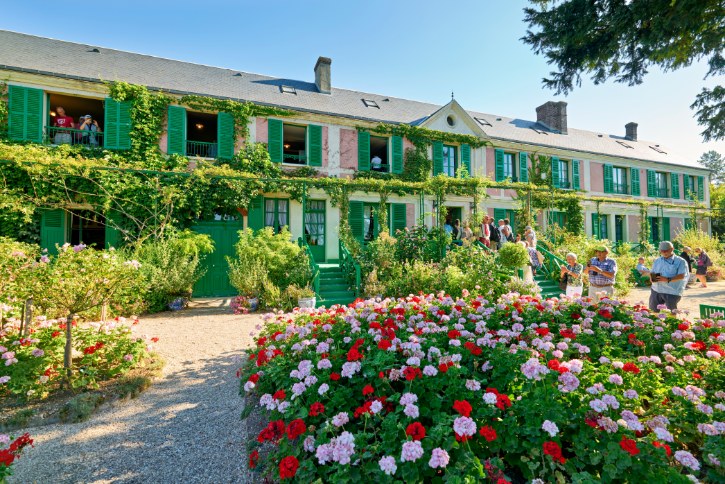
a. The Village Where Monet Painted
In 1883, Monet settled in Giverny and spent more than forty years turning an old cider farm into a living work of art. Two gardens sit at its heart, and each one has its own character, so plan to see both.
b. The Flower Garden in Full Color
- A walled flower garden of about one hectare spread right in front of the house.
- Beds packed with flowers at different heights, arranged like brushstrokes of color.
- Iron arches over the central path, draped in climbing roses through the warm months.
- A rolling bloom across the year: tulips and irises in spring, poppies and peonies in summer, sunflowers and dahlias in autumn.
c. The Water Garden and Its Famous Bridge
- A curving pond Monet created by diverting a small branch of the Epte River.
- The green Japanese footbridge hung with wisteria, the scene you picture first.
- Weeping willows, bamboo, and Japanese maples crowding the edges.
- Water lilies in white, pink, and crimson that inspired his huge Nymphéas canvases.
d. A Look Inside the Pink House
- Walls of pink plaster, bright green shutters, and a grey slate roof.
- A dining room painted in two cheerful shades of yellow, lined with Japanese prints.
- A kitchen tiled in blue and white Rouen ceramic, with rows of gleaming copper pots.
- Rooms carefully restored to look as they did in Monet’s day, from the studio to the bedchambers upstairs.
e. Beyond the Garden Walls
The village keeps its Norman feel along lanes draped in wisteria, with small galleries and the old church where Monet is buried. American painters once lodged here too, turning Giverny into a lively artists’ colony.
From here the road follows the widening Seine downstream to Rouen, the grand old capital of Normandy.
3. Rouen
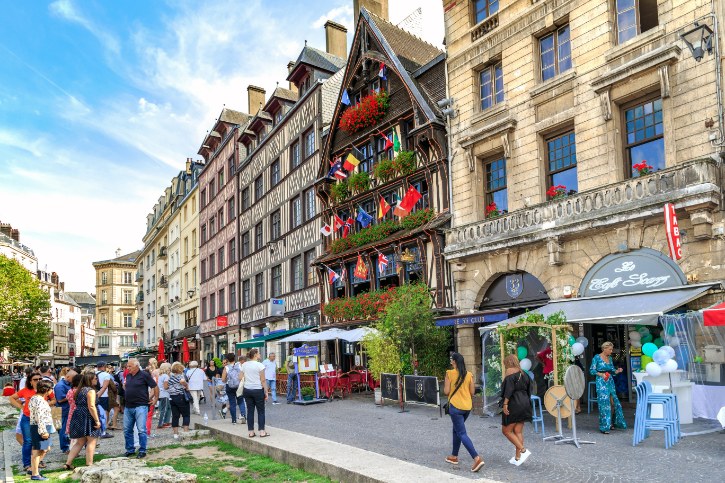
a. The Old Capital of Normandy
Rouen sits in a bend of chalk cliffs on the lower Seine, and it rewards slow wandering. History sits just under the surface of its busy streets and lively squares.
b. A Cathedral That Captivated Monet
- A French Gothic masterpiece built across four centuries.
- A cast iron spire reaching 151 meters, the tallest church spire in France.
- The “Butter Tower”, paid for by donations that let locals eat dairy during Lent.
- The west front that Monet painted more than thirty times, chasing the shifting light.
- The nearby Gros-Horloge, a Renaissance archway holding an astronomical clock from 1389.
c. Timbered Lanes Worth Getting Lost In
- More than 2,000 half-timbered houses packed into the old town.
- Fine stretches along Rue Saint-Romain, Rue Damiette, and Rue des Chanoines.
- Leaning upper floors and carved corner posts showing saints and strange faces.
- Quiet courtyards and cafés tucked behind the busy shopping streets.
d. Walking in Joan of Arc’s Footsteps
- Place du Vieux-Marché: a stone cross and garden mark where Joan was burned at the stake in 1431.
- Église Sainte-Jeanne-d’Arc: a modern church with a roof shaped like flames and old rescued stained glass.
- Historial Jeanne d’Arc: set in the very halls where her trial ended and her name was later cleared.
e. One More Layer of History
Inside the cathedral rests the heart of Richard the Lionheart, buried here out of affection for the Norman people. The writer Gustave Flaubert was born in the city, and the fine arts museum holds works by Caravaggio and Delacroix.
From Rouen, the road climbs the chalk plateaus and heads north to the coast at Fécamp.
4. Fécamp
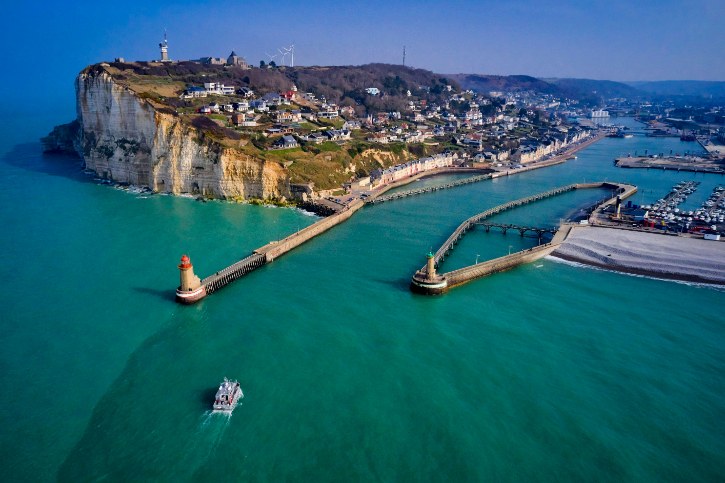
a. Your First Taste of the Alabaster Coast
Fécamp greets you with white chalk cliffs streaked with black flint. For centuries it was a major fishing port, sending fleets on long six-month voyages to the cold waters off Newfoundland.
b. A Palace Built for Liqueur
- A striking building in Neo-Gothic and Neo-Renaissance style that works as both distillery and museum.
- The home of Bénédictine liqueur, made from a secret blend of 27 herbs and spices.
- A liqueur revived in 1863 by merchant Alexandre Le Grand, who tied it to a monk’s recipe said to date back to 1510.
- Cellars where copper stills and big oak casks are still part of the working distillery.
c. An Abbey Church Fit for Dukes
- As long as Notre-Dame de Paris, stretching 127 meters.
- A spiritual seat of the early Norman dukes, two of whom are buried in the choir.
- A treasured relic said to hold drops of Christ’s blood, tied to an old local legend.
- An astronomical tidal clock from 1667 that still tracks the rhythm of the sea.
d. Cliffs and Sea Views at Cap Fagnet
- Cap Fagnet, the highest point on the Alabaster Coast, rising more than 100 meters above the sea.
- Wide views over the harbor and the long white walls of the coast.
- A sailors’ chapel filled with model ships and offerings for those lost at sea.
- Wartime bunkers and radar posts from the old Atlantic Wall standing nearby.
e. On Toward the Arches
From Fécamp, the clifftop road runs southwest along the coast toward a view that many travelers remember most of all.
The natural arches of Étretat are your next stop, and they are worth the short drive.
5. Étretat
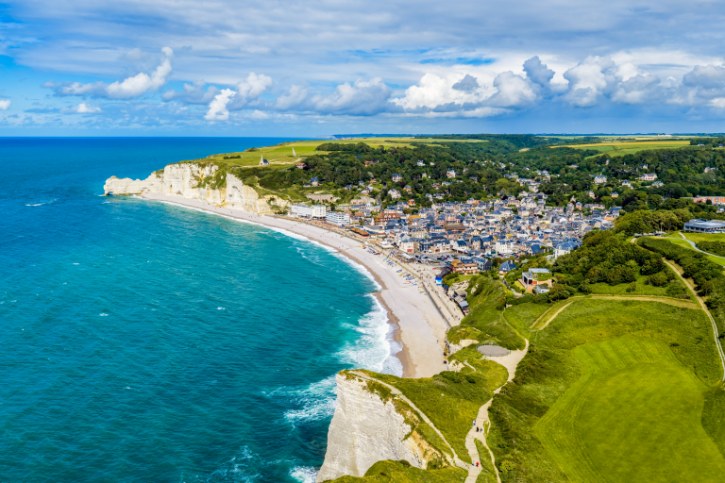
a. Normandy’s Cliffs at Their Boldest
If Fécamp introduces the cliffs, Étretat is where they steal the show. The sea has carved the white chalk into arches, caves, and lone spires, framed by two tall headlands.
b. The Arches and the Needle
- Porte d’Aval, a natural arch once compared to an elephant dipping its trunk into the sea.
- The Needle, a 70-meter chalk spire rising straight out of the water.
- La Manneporte, a larger arch said to be tall enough for a ship to pass under.
- The cliffs that Monet painted again and again through the 1880s.
c. A Clifftop Garden Like No Other
- Sculpted topiary gardens set high above the bay and the beach.
- More than 150,000 evergreen plants clipped into flowing, wave-like shapes.
- Modern sculptures scattered through the greenery, including oversized human faces.
- Shaped hedges that line up neatly against the real stone arches below.
d. The Village by the Pebble Beach
- A beach of smooth flint pebbles backed by a raised seafront promenade.
- Belle Époque villas from the town’s days as a retreat for Parisian artists and writers.
- A timber covered market with a wooden clock tower and regional cider merchants.
- Walking paths that climb the clifftops in both directions for the best views.
e. Light That Never Looks the Same
Here is the fun part: the cliffs change through the day. Soft morning mist can turn the chalk silver, while afternoon sun lights it up white and gold.
From here the road crosses the Seine estuary over the Pont de Normandie to reach the colorful harbor of Honfleur.
6. Honfleur
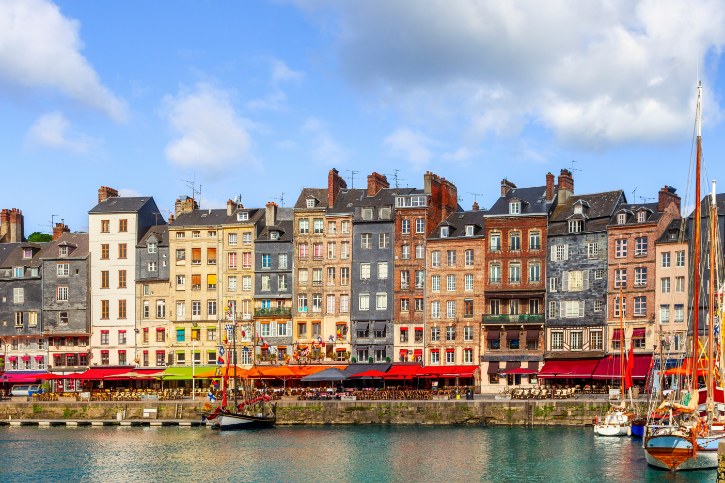
a. A Harbor That Painters Fell For
Honfleur sits where the Seine meets the sea, and its old harbor is one of the most photographed spots in Normandy. The light and the reflections here drew artists for generations.
b. The Old Harbor Up Close
- An inner dock dug out in 1681 under King Louis XIV’s finance minister.
- Tall, narrow houses up to seven stories high along the Quai Sainte-Catherine.
- Grey slate tiles cladding the fronts against the salt air and Atlantic storms.
- Fishing boats and sailboats mirrored in the calm water of the basin.
c. A Church Built by Shipwrights
- The largest wooden church in France, raised without any stone vaulting.
- Built by local shipwrights, with ceilings shaped like upturned boat hulls.
- Oak cut from the nearby Touques Forest and worked with boatbuilding tools.
- A bell tower set well apart so the ringing would not shake the timber naves.
d. Streets, Artists, and Hilltop Views
- Cobbled lanes lined with timbered houses, craft shops, and small galleries.
- The birthplace of Eugène Boudin, who taught the young Monet to paint outdoors.
- The Musée Eugène Boudin, full of his soft pastels and marine scenes.
- The Côte de Grâce viewpoint, looking over the harbor and the Pont de Normandie.
e. An Easy Place to Pause
Honfleur makes a relaxed stop before the next stretch of coast. Wander the quays, sit with a coffee, and watch the harbor go about its day.
When you are ready, the road runs west to a pair of seaside towns that could hardly be more different.
7. Trouville-sur-Mer and Deauville
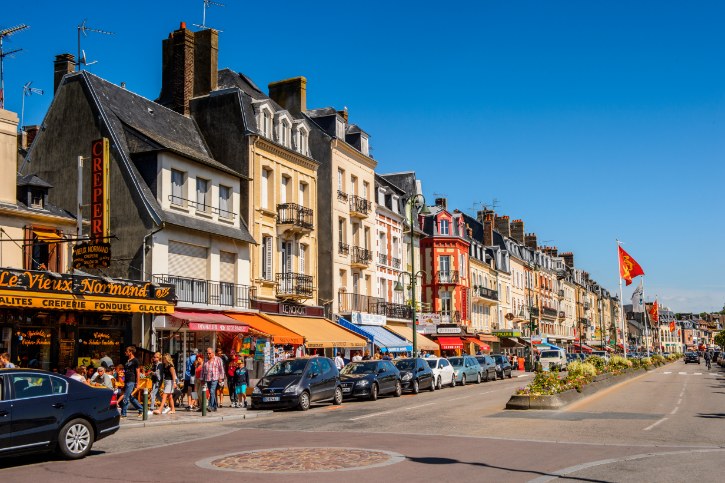
a. Two Resorts, Two Personalities
West along the coast sit two seaside towns separated only by a river, yet worlds apart in style. Seeing both gives you the full picture of Norman beach life, so give each a little time.
b. Deauville, Dressed for Elegance
- A polished resort built in the 1860s as a retreat for wealthy Parisians.
- Les Planches, a wooden boardwalk laid in 1923 and lined with Art Deco beach cabins.
- Cabins named after stars of the town’s long-running American film festival.
- Grand hotels, a casino, and two racecourses that host summer horse racing.
c. Trouville, the Working Fishing Town
- A real fishing village that grew into one of Normandy’s earliest resorts.
- Quays still busy with trawlers landing sole, sea bass, mackerel, and scallops.
- A timber fish market where you can eat oysters straight from the ice.
- A seafront promenade backed by grand villas from the 1800s.
d. How the Two Towns Compare
- Deauville: quiet luxury, film glamour, and manicured boardwalks.
- Trouville: a lively fish market, neighborhood bistros, and a working harbor.
- A footbridge and a small ferry link the two across the narrow river.
e. Making the Most of Both
- Start in Deauville for the boardwalk, the beach cabins, and the grand hotels.
- Cross to Trouville for the fish market and a plate of fresh seafood.
- Walk or ride between them in just a few minutes, then rejoin the coast road west.
8. Arromanches-les-Bains
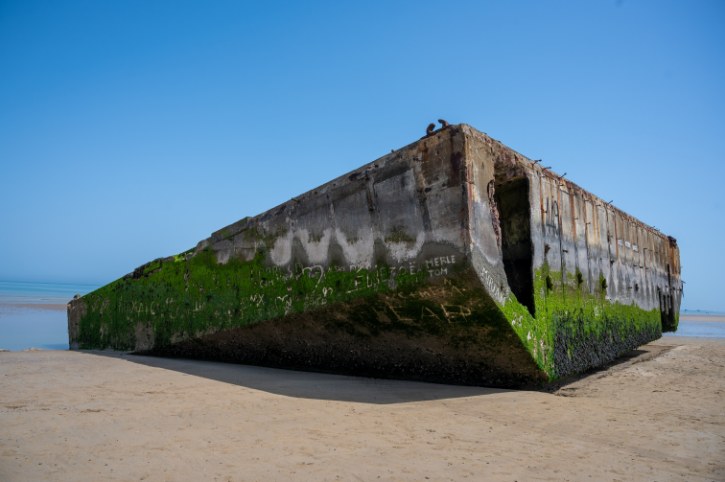
a. Where the Allies Built a Harbor
On the Calvados coast, Arromanches holds a remarkable D-Day story. The key here is not a landing beach but an entire harbor towed across the Channel.
b. The Mulberry Harbor, Made Simple
- Two giant prefabricated harbors, code-named Mulberry, were floated over after D-Day.
- Mulberry B, nicknamed “Port Winston”, was set up offshore at Arromanches.
- It survived a storm that wrecked its twin and kept working for ten months.
- Through it came over 2.5 million men, 500,000 vehicles, and millions of tons of supplies.
c. What You Can Still See
- Huge concrete caissons still resting on the sandbanks offshore.
- Stranded pontoons on the beach, exposed when the tide pulls back.
- The clifftop east of town, where the full semicircle of breakwaters comes into view.
- A separate German gun battery preserved a few miles west at Longues-sur-Mer.
d. Inside the D-Day Museum
- The first museum built to remember Operation Overlord, later rebuilt with glass walls facing the sea.
- A large relief map that shows how Port Winston was built and run.
- Uniforms, equipment, and artifacts recovered from the harbor floor.
- A rooftop terrace that looks out over the bay and the breakwaters.
e. A Peaceful Beach With a Heavy Past
Today children play on the sand where one of the busiest ports in the world once stood. That quiet contrast tends to stay with you long after you leave.
From here the road turns inland to the beautifully preserved medieval city of Bayeux.
9. Bayeux
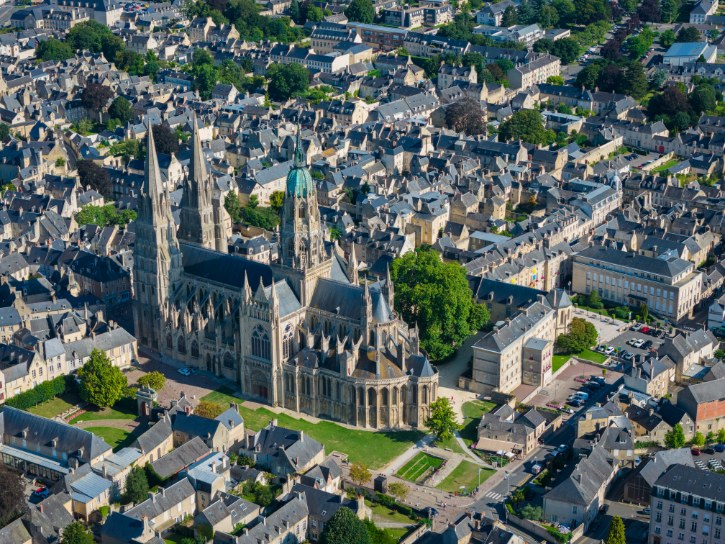
a. The Town the War Spared
Just inland from the coast, Bayeux was the first sizable French town liberated after D-Day, and it escaped the bombing that flattened its neighbors. Its medieval heart came through intact.
b. Streets Straight Out of the Middle Ages
- Cobbled lanes of Norman half-timbered houses and golden stone townhouses.
- Fine old streets such as Rue Saint-Martin, Rue des Cuisiniers, and Rue Saint-Malo.
- The Aure River running through town, with old waterwheels still turning in the current.
- Small bakeries, butchers, and weekly open-air markets under the shadow of the cathedral.
c. A Cathedral of Two Styles
- A graceful blend of Norman Romanesque and French Gothic, consecrated in 1077.
- An 11th-century crypt, later decorated with 15th-century frescoes of angels playing instruments.
- Lower walls carved with dragons and grotesque stone faces.
- Twin towers topped with Gothic spires and a copper dome over the crossing.
d. The Famous Bayeux Tapestry
- A 68-meter embroidery telling the story of the Norman Conquest of 1066.
- Fifty-eight stitched scenes that build to the Battle of Hastings.
- A rare medieval survivor, listed on UNESCO’s Memory of the World register.
- One key note: the museum is closed for a long renovation, and the original cannot be seen until its planned reopening in autumn 2027.
e. A Story That Still Feels Close
While the tapestry rests safely in storage, the cathedral and the old lanes still bring 1066 to life around you.
From Bayeux, the road returns to the coast and a place of quiet remembrance above Omaha Beach.
10. Normandy American Cemetery (Colleville-sur-Mer)
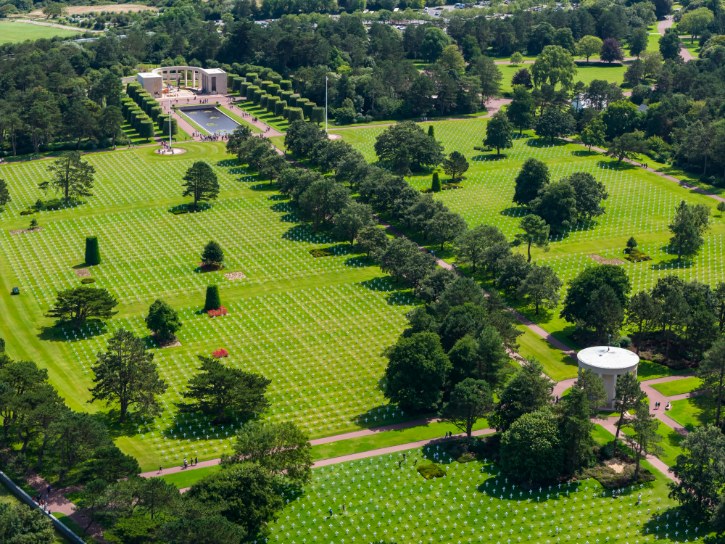
a. A Solemn Place Above Omaha Beach
High on a plateau above Omaha Beach, this cemetery is one of the most moving stops of the whole drive. It stands on land that France granted to the United States in perpetuity.
b. The Scale of the Sacrifice
- The resting place of 9,388 American service members.
- Rows of white marble headstones, crosses and Stars of David, set among pines and roses.
- Markers aligned so precisely that they form straight lines running toward the sea.
- Among them, brothers buried side by side and a few Medal of Honor recipients.
c. The Memorial and the Missing
- A visitor center that tells the human stories behind the landings.
- A tall bronze statue facing a long reflecting pool.
- Walls of the Missing listing more than 1,500 names.
- A quiet limestone chapel at the center of the grounds.
d. Looking Down on the Beach
From an overlook at the edge of the grounds, you look out over the wide sands of Omaha Beach below. Standing there, the distance those soldiers crossed under fire becomes painfully clear.
e. Taking It Slowly
Give yourself time and quiet here. Read a few names, walk the paths, and let the scale of it settle in before you drive on. A short way west, the same morning in June has another chapter waiting at Pointe du Hoc.
11. Pointe du Hoc
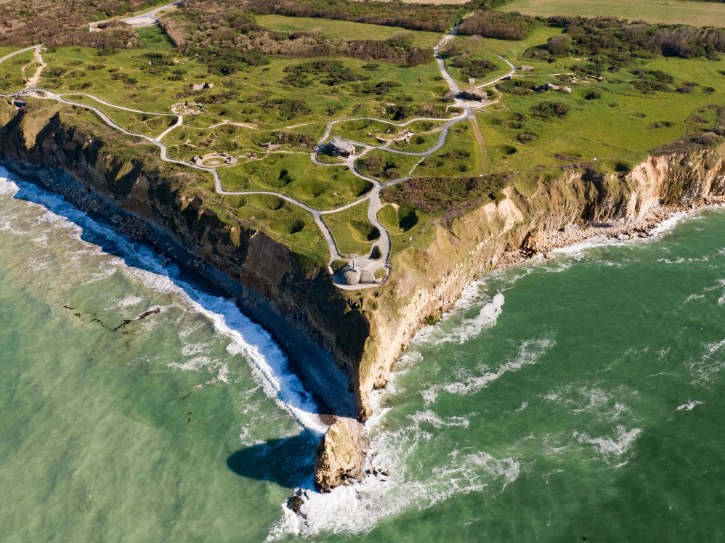
a. The Cliff the Rangers Had to Climb
Pointe du Hoc is one of the most dramatic D-Day sites, a headland where sheer cliffs rise 100 feet straight from the sea. The German army chose it to anchor a battery of long-range guns.
b. The Assault at First Light
- A tough mission handed to a force of about 225 Rangers from the U.S. Army 2nd Ranger Battalion.
- Rangers firing grapnels and climbing ropes and ladders under heavy fire.
- The 100-foot cliffs scaled in about fifteen minutes.
- The big guns found moved inland, then tracked down and destroyed.
c. Holding On Against the Odds
Cut off behind enemy lines, the Rangers held out through two days of counterattacks. By the time relief arrived, only about 90 of them were still standing. The numbers alone tell the story.
d. Walking the Battlefield Today
- A cratered, almost lunar landscape left by heavy bombardment.
- Shattered German bunkers and pillboxes you can walk among.
- The Ranger Monument, shaped like a dagger, set atop an old observation post.
- Open views east to Omaha Beach and west toward Utah Beach.
e. On to the Grand Finale
From this battered headland, the road turns southwest through green hedgerow country toward the Gulf of Saint-Malo.
Ahead, across the shifting tides, waits the sight that ends your journey.
12. Mont Saint-Michel
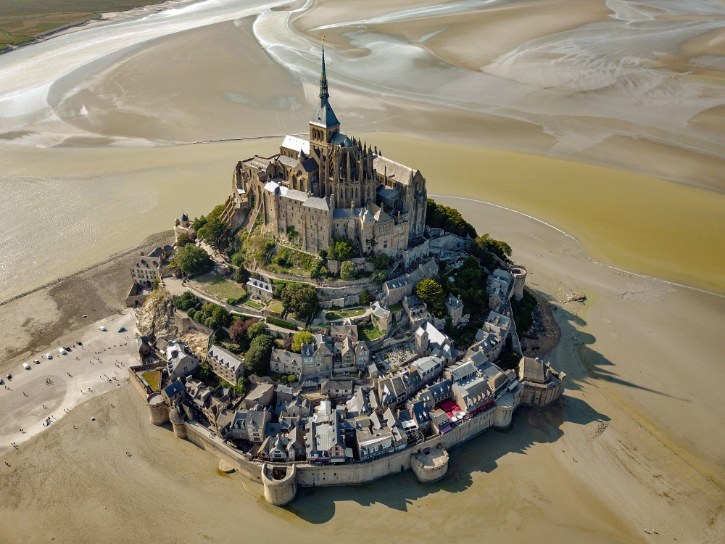
a. The Island That Ends Your Journey
After everything behind you, Mont Saint-Michel is a spectacular finish. A granite island crowned by a Benedictine abbey rises out of a vast tidal bay, a sight that has stopped travelers in their tracks for centuries.
b. The Approach and the Tides
- A first view across salt marshes where sheep graze, the abbey floating on the horizon.
- A pedestrian footbridge that lets the sea flow freely around the rock again.
- The highest tides in continental Europe, reaching up to 14 to 15 meters.
- The biggest tides, which briefly cut the island off from the mainland.
c. Climbing Through the Village
- The Grande Rue, winding up past timber-framed houses, shops, and old inns.
- Stone ramparts you can walk for wide views across the sand flats.
- A famous omelet house that has fed hungry pilgrims for generations.
- A climb that mirrors the old order, with the village below and the abbey on top.
d. The Abbey at the Summit
- A sanctuary first founded in 708 after a bishop’s reported visions of the Archangel Michael.
- Halls and crypts built against the slopes to hold up the great church above.
- The Cloister, seemingly suspended between sky and sea.
- A gilded statue of Saint Michael crowning the spire, 156 meters up.
e. A Finish to Remember
Stay past the day-trippers and the island grows quiet. At dusk, floodlights set the abbey glowing above the dark water, and the whole bay seems to hold its breath.
One honest word of caution:
- The bay hides patches of quicksand and fast-moving tides.
- Cross the sand flats only with a licensed local guide.
Standing here at the end, you will know the long way was worth every single mile.
Read More: Mont Saint-Michel Road Trip: 12 Amazing Stops You Shouldn’t Miss