You already know Paris for the Eiffel Tower, Notre-Dame, and the grand museums. But if you look past the famous sights, you will find a quieter layer of history carved in stone.
All over the city stand old triumphal arches, fortified gateways, and grand entrances that thousands of people hurry past every day.
Each one hides a surprising story, from royal boasting to looted treasure to the scars of revolution. Slow down, look closely, and a whole other Paris opens up to you. 😊
1. Porte Saint-Denis
a. Why a King Tore Down the City Walls
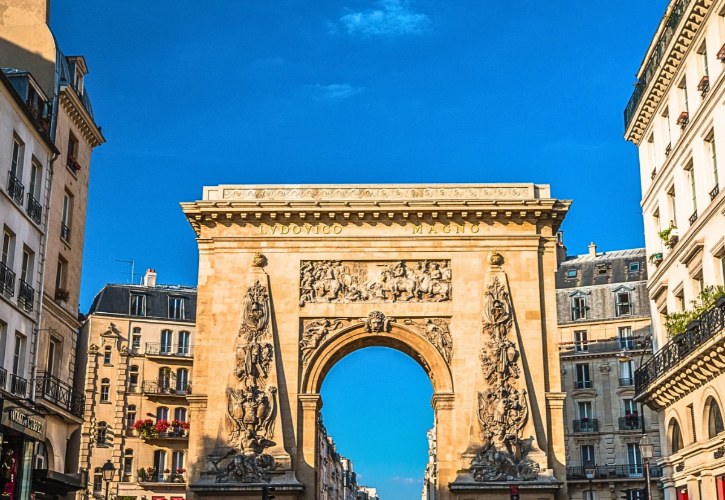
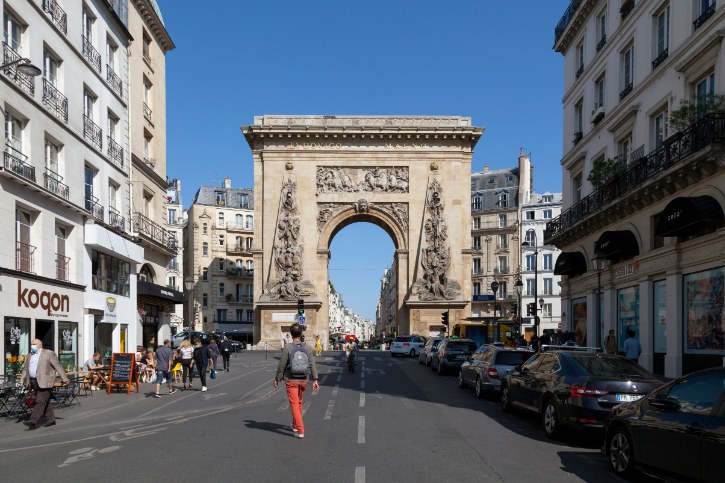
In the late 1600s, Paris began shedding its medieval shell. After a run of victories in the Franco-Dutch War (1672 to 1678), King Louis XIV decided the city no longer needed its old defensive walls. He had the Porte Saint-Denis raised in 1672 near the site of an old medieval gate, not to defend the city, but as pure royal propaganda built to show off the power of the French crown.
b. The Design at a Glance
- Designed by François Blondel, founding director of the Royal Academy of Architecture
- Modeled on the ancient Roman Arch of Titus, then scaled up much larger
- Built entirely of limestone, standing about 24.65 meters (81 feet) tall
- One soaring central archway, more than 15 meters high
- Two old side passages that you will find sealed shut today
c. A War Story Carved in Stone
- The sculptor Michel Anguier covered the arch in scenes of the king’s campaigns
- Two pyramid-shaped obelisks sit flat on the wall, loaded with carved weapons, shields, and armor
- Two seated figures slump at the base: a grieving woman for the beaten Dutch Republic, and a man for the conquered River Rhine
- Panels above the arch show the king crossing the Rhine on one side and the swift capture of Maastricht on the other
d. The Hidden Boasts to Read
- “LUDOVICO MAGNO” in gilded bronze near the top, meaning “To Louis the Great”
- Latin inscriptions claiming the army crossed three rivers, took three provinces, and seized forty towns in under sixty days
- A gilded royal coat of arms crowned with three fleurs-de-lis (royal lilies) beneath a crown
e. Where You Will Find It
The arch stands at a busy intersection on the edge of the 10th arrondissement, ringed by cafes and traffic. Most people rush past it, but step back onto the pavement and take in the obelisks, the anguished captives, and the proud inscriptions for a direct window into the Louis XIV era.
2. Porte Saint-Martin
a. The Arch Right Next Door
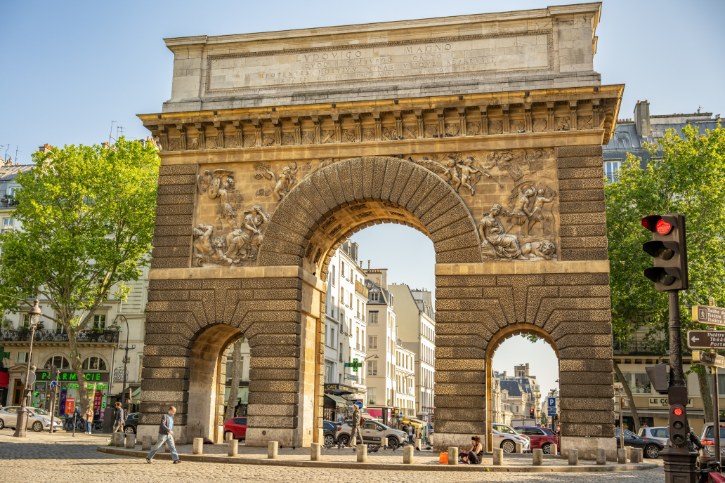
Just a five-minute walk down the boulevard from the Porte Saint-Denis, you will find its close companion, the Porte Saint-Martin. The City of Paris raised it in 1674, only two years later, to celebrate another run of the king’s victories.
b. What It Celebrates
- The conquests of Franche-Comté and Limbourg
- The breaking of the anti-French Triple Alliance
- Built close to the site of an old gate from the Charles V wall
- The historic edge where the packed city gave way to the northern suburbs
c. A Completely Different Look
- Designed by Pierre Bullet, a former student of Blondel
- Shaped as a near-perfect square, about 18 meters on each side
- Wider and lower than its neighbor, with a bolder, heavier feel
- Three openings instead of one: a tall central arch and two smaller side arches
d. The Details That Set It Apart
- Rough, grooved “vermiculated” stone, carved to look like worm tracks in mud, for a fortress-like feel
- A crisp band of white marble on top, balancing raw strength with fine art
- Four carved reliefs, each by a different master sculptor
- The king shown as Mars (the Roman war god) and Hercules, crushing his enemies
- Long Latin inscriptions listing his victories at Besançon, Limbourg, and beyond
e. A Lesson in Two Styles
Standing between the two arches gives you a small lesson in design. Two architects got the very same job, to glorify an absolute king, and you can see how each one answered it in a completely different way.
3. Arc de Triomphe du Carrousel
a. The Famous Arch’s Smaller Sibling
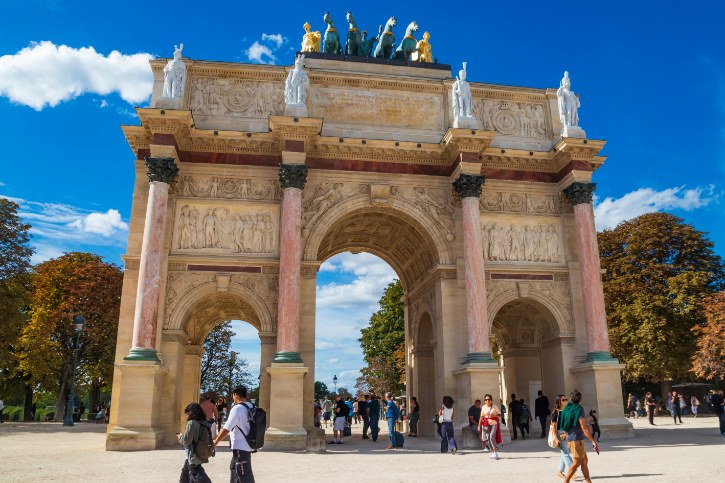
Almost everyone knows the giant Arc de Triomphe on the Champs-Élysées. Far fewer stop at its older, smaller, and far more detailed sibling beside the Louvre, the Arc de Triomphe du Carrousel. Napoleon I ordered it in 1806 to celebrate his army’s victories.
b. A Gateway That Outlived Its Palace
You might not guess it today, but this arch was built as the grand entrance to the courtyard of the Palais des Tuileries, Napoleon’s main Paris home. After the palace burned and its ruins were cleared, the arch was left standing alone. It became the eastern start of the great view that runs up through the gardens to the Champs-Élysées.
c. Rich Materials in a Small Frame
- Modeled on the ancient Roman Arch of Septimius Severus
- Fairly compact at about 19 meters high, but packed with detail
- Eight Corinthian columns of rose-colored marble, saved from a demolished royal château
- Pale limestone walls that make the pink columns glow
- Carved marble panels, each showing a victory from the 1805 campaign
d. The Famous Horses on Top
- Napoleon first crowned the arch with the Horses of Saint Mark, four ancient bronze horses looted from Venice
- After his fall, the horses were returned to Venice under armed guard
- The sculptor François Joseph Bosio then created the bronze group you see now
- It shows Peace riding a chariot pulled by four horses, flanked by gilded figures of Victory and Peace
e. Why It Is Worth a Stop
Stand beneath it and you are looking at a monument that outlived the very palace it once guarded. In one small arch, you get empire, stolen treasure, and royal image-making all at once.
4. Porte de l’Hôtel de Sens
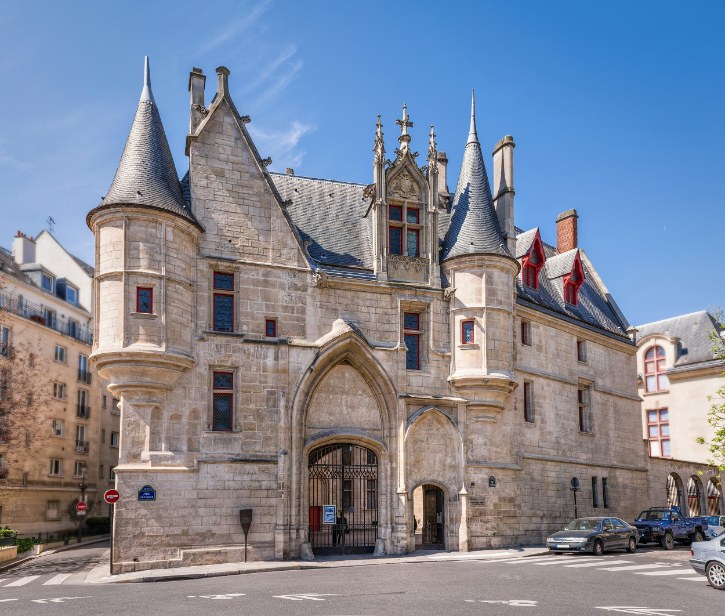
a. A Castle Hiding in the Marais
Leave the wide boulevards, wander into the narrow streets of the Marais, and you step into another century. On the Rue du Figuier you will find the Hôtel de Sens, which looks less like a Paris townhouse and more like a fortified fairytale castle. It was built between 1475 and 1519.
b. Why an Archbishop Built It
- Never a city gate, but the entrance to a rare medieval private mansion (hôtel particulier)
- Built for Tristan de Salazar, the powerful Archbishop of Sens
- In that era, Paris still answered to the distant Archdiocese of Sens
- He needed a grand Paris base to match his political and religious standing
c. The Medieval Features to Spot
- A pointed Gothic arch framed by stout “pepper-pot” turrets
- Steep slate roofs lined with ornate carved stone dormer windows
- Machicolations (openings for dropping stones or oil on attackers) and a high watchtower
- A heavy, romantic, unmistakably medieval shape that is very rare in central Paris
d. The Cannonball in the Wall
- High on the wall, near the left turret, a fist-sized iron cannonball sits stuck in the stone
- It is a real relic from the July Revolution of 1830, the “Three Glorious Days” that toppled King Charles X
- A stray shell struck the mansion during the street fighting
- The city left it in place and carved the date “28 Juillet 1830” (July 28, 1830) into the stone below
e. What You Can Visit Today
The building now holds a public library focused on the arts. The reading rooms are kept for researchers, but you can freely enjoy the exterior, the grand entrance, and the formal French garden in the rear courtyard.
5. Rotonde de la Villette
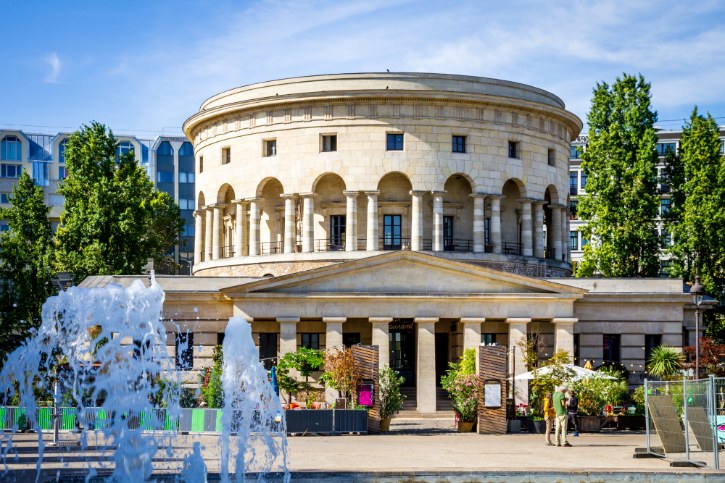
a. A Wall Built for Taxes, Not War
Before the French Revolution, Paris got a new border. It was not a wall against armies, but a wall against tax dodgers, called the Wall of the Farmers-General. Built in the 1780s, it existed to collect the octroi (a tax on goods entering the city) on things like wine, wood, and food.
b. A Grand Tollhouse by a Visionary
To guard the main roads in, the government hired the bold architect Claude-Nicolas Ledoux. The Rotonde de la Villette is the largest and finest tollhouse he built, and it still stands today overlooking the Bassin de la Villette.
c. Why It Looks So Severe
- A massive round drum rising from a square base shaped like a Greek cross
- Heavy Doric columns, thick and plain, that look carved from solid rock
- A deliberately stern style, meant to project the power of the tax collectors
- Not a passage for carts, but a fortress for inspectors and armed guards
d. The Building Everyone Loved to Hate
- Parisians mocked it with a pun: “Le mur murant Paris rend Paris murmurant” (the wall walling Paris makes Paris murmur)
- When the Revolution began, crowds attacked and burned tollhouses days before the Bastille fell
- Ledoux was accused of building “palaces for taxation” and was dismissed
- Most of the wall was later torn down, yet the Rotonde survived
e. What Stands There Now
- One of only four tollhouses left from the roughly fifty-five that Ledoux built
- Now home to a restaurant, gallery, and cultural space
- Set where the Canal Saint-Martin meets the Canal de l’Ourcq
- A striking reminder of the heavy taxes that helped fuel the Revolution
6. Grand Gateway of Hôtel de Sully
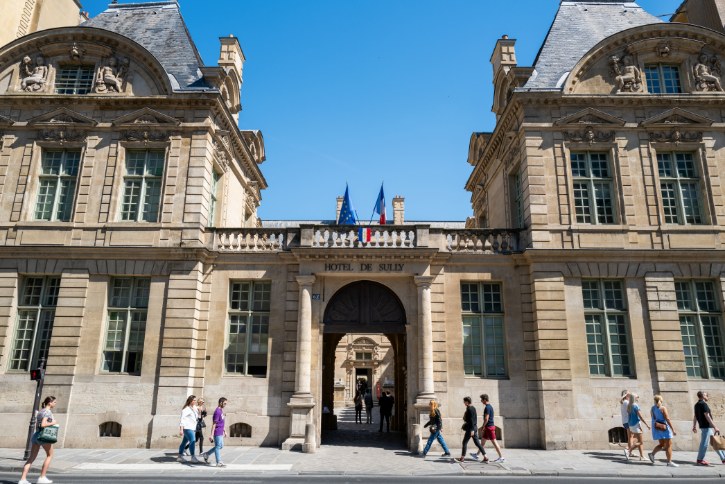
a. The Gate You Always Walk Past
Paris is full of public monuments, but some of its best architecture hides behind the gates of private mansions. On the busy Rue Saint-Antoine in the Marais, it is easy to breeze past the gateway of the Hôtel de Sully, never guessing it guards one of the most perfectly preserved courtyards in France.
b. The Mansion and Its Famous Owner
- Begun in 1624 and usually credited to the architect Jean Androuet du Cerceau
- Built in the strict, symmetrical Louis XIII style
- Bought in 1634 by Maximilien de Béthune, Duke of Sully, finance minister to King Henri IV
- Still carries the Duke’s name to this day
c. From the Street to the Courtyard
The gateway is a doorway between two worlds, the noisy public street and the calm private world of the nobility. It is a large, symmetrical arch of pale stone, built wide enough for horse-drawn carriages to roll straight into the cour d’honneur (courtyard of honor).
d. The Carvings to Find Inside
- The Four Seasons on the main building’s front, marking the passing of time
- The Four Elements (Earth, Water, Air, and Fire) on the side wings
- Theatrical masks on the dormer windows, framed by stone scrolls and flowers
- Strict symmetry and tall windows that make the courtyard feel like a stage
e. A Secret Shortcut to Place des Vosges
The mansion is now a heritage office, but you can visit the gateway, the courtyard, and the garden for free. Here is the insider move: cross the courtyard, follow the path through the rear garden, and you will reach a hidden doorway that opens straight into the arcades of the Place des Vosges, one of the loveliest secret shortcuts in all of Paris.