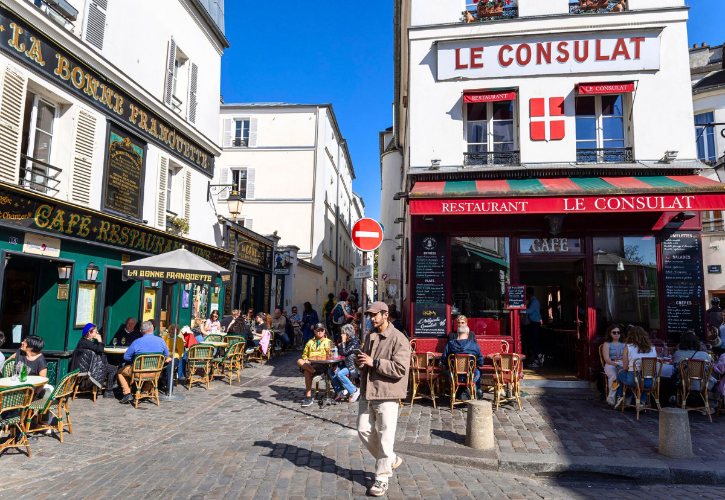
You climb Montmartre for the famous white church and a few busy streets, then usually head back down. Here is what you miss.
This hill sits about 130 meters above Paris and still feels like the old village it once was, full of vineyards, windmills, and quarries.
The best part is how close everything sits. Its cobbled lanes, hidden villas, and historic cabarets are often just 1 to 5 minutes apart.
So, lace up your most comfortable shoes, start at the top, and let the hill unfold one easy stop at a time. 😊
1. Sacré-Cœur Basilica
a. Why you start here
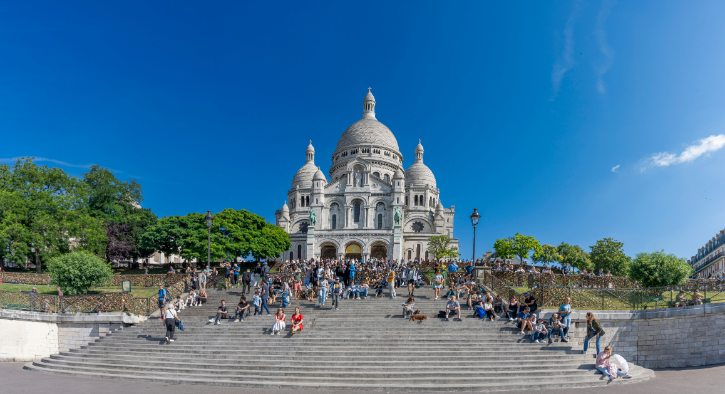
You begin at the top because that is exactly where Sacré-Cœur stands, crowning the summit and glowing white over the city. From the steps you look out across all of Paris. Its Romano-Byzantine shape looks nothing like the pale stone and Gothic churches below, so it feels striking the moment you see it.
b. What makes it special
- A central dome rising 83 meters, with four smaller domes modeled on Saint-Front Cathedral in Périgueux.
- A huge inside mosaic by Luc-Olivier Merson, about 474 square meters of enamel and gold, among the largest ceiling mosaics in the world.
- A bell called La Savoyarde, the largest bell in France, cast in 1891 and weighing about 18.8 tons.
- Bronze statues of Saint Louis and Joan of Arc on the southern porch.
c. The story behind the white walls
- It was built as a national vow after the Franco-Prussian War and the unrest of the Paris Commune.
- Work began in 1875 under architect Paul Abadie, who beat 77 other designs.
- Builders sank 83 stone shafts up to 33 meters deep because old gypsum mines had hollowed out the hill.
- The white color comes from Château-Landon travertine, a stone that releases calcite in the rain and keeps cleaning itself.
d. How it feels to be here
Outside, the forecourt and gardens buzz with people, music, and wide city views. Inside, the noise drops away at once. The quiet here is real, helped by nonstop prayer that has continued day and night since 1885.
2. Église Saint-Pierre de Montmartre
a. Why this quiet church matters
You are standing beside one of the oldest churches in Paris. It was founded in 1133 to 1134 by King Louis VI and Queen Adelaide of Savoy, served the royal abbey until the Revolution, and was consecrated in 1147. If you want the Montmartre that came long before the artists, this is it.
b. What to look for inside
- Four black marble columns, taken from a Roman or early sanctuary that once stood on the hill.
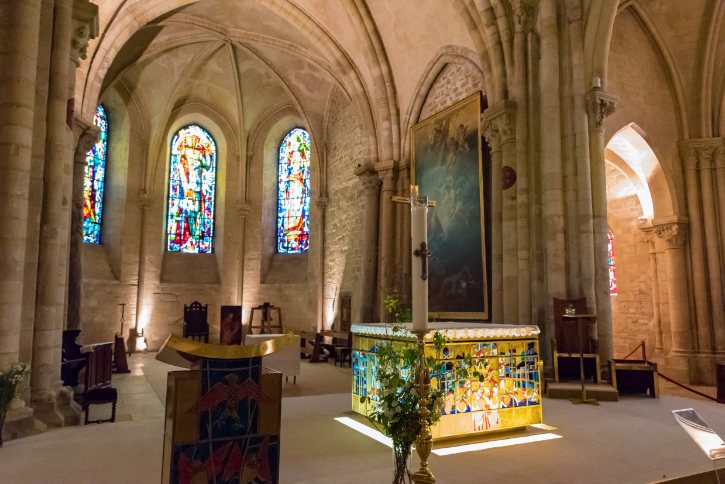
- A mostly Romanesque interior, with early Gothic rib vaults in the choir and apse.
- Three sets of bronze doors cast in 1980 by sculptor Tommaso Gismondi.
- The flat tombstone of Queen Adelaide of Savoy, who died at the abbey in 1154.
c. One myth worth clearing up
You may hear that Saint Ignatius of Loyola founded the Jesuit Order in this church. The vows he took in 1534 actually happened in a crypt downslope on Rue Yvonne Le Tac, not here.
d. How it feels
The low stone nave stays calm and cool, lit softly through stained glass made by Max Ingrand in 1953. After the crowds outside, the stillness is the whole point.
3. Place du Tertre
a. Why this square is famous
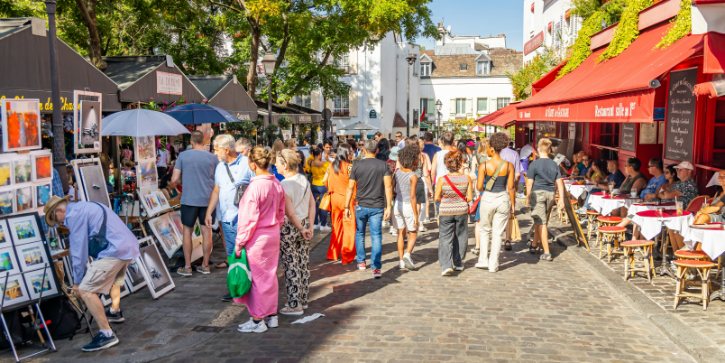
You have reached the old heart of the village. Laid out in 1635 within the abbey grounds, this cobbled square was where grape growers, millers, and quarry workers once gathered, long before it became known for its painters.
b. What gives it character
- An enclosed, cobbled courtyard lined with 18th-century houses, trees, and café terraces.
- The Carré des Artistes (Artists’ Square) at its center, regulated by the city since 1983.
- Painters, caricaturists, and portraitists working on small assigned spots of about one square meter each.
c. What to notice as you walk
- Number 3 was the first town hall of the independent commune back in 1790.
- Number 6 holds À la Mère Catherine, a tavern opened in 1793.
- A nearby corner once housed artists like Erik Satie, Amedeo Modigliani, and Maurice Utrillo.
d. A detail most people miss
The word “tertre” simply means a small mound, a nod to this being the hill’s highest point. In March 1871, the square held 171 cannons guarded by the National Guard, and the army’s attempt to seize them helped spark the Paris Commune.
e. When to come
Arrive early. Before the awnings open and the easels come out, the quiet cobbles reveal the shape of the old village underneath.
4. Rue Norvins
a. Why this street is special
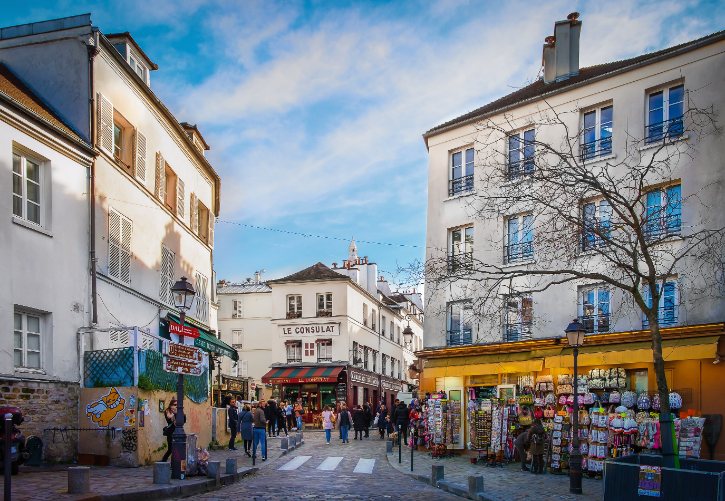
You are on one of the oldest paths across the hill. It was formed from two older village streets, once called Rue Traînée and Rue des Moulins, and still keeps the crooked, unstraightened shape of early Montmartre. The two were joined under the name Rue Norvins in 1868.
b. What you see along it
- Old cobblestones and classic cast-iron streetlamps.
- Two- to four-story village houses in lime plaster, with uneven rooflines.
- Painted wooden shopfronts that still feel old.
c. What to notice
- The Fontaine du Château d’Eau (Water Tower Fountain), built in 1835, once supplied the neighborhood’s water.
- A wall plaque at Number 26 marking the home of novelist Marcel Aymé.
- Old iron anchors, called tirants, set into some façades to hold the buildings steady over the quarries below.
d. How it feels
The busy summit fades behind you here. As the road bends downhill, the shops grow fewer and the mood turns residential, with shuttered homes and quiet garden walls.
5. Le Passe-Muraille
a. Why you stop here
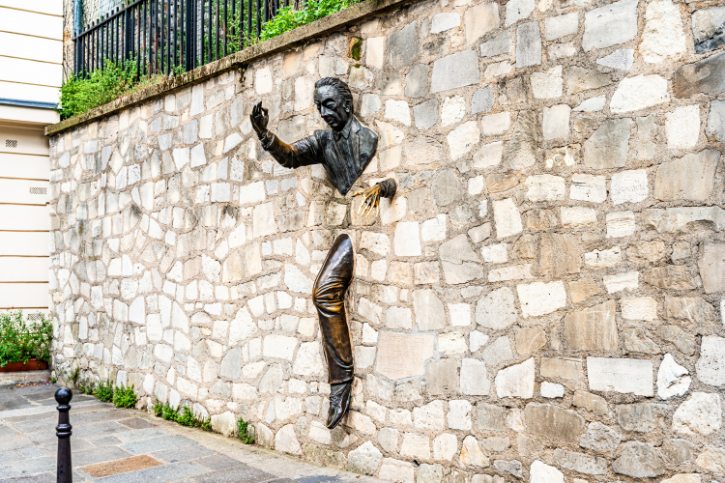
Set into a stone wall, this bronze figure honors the writer Marcel Aymé and one of his best-loved stories. It is a quiet, clever surprise after all the churches and grand views.
b. The story in the stone
- The figure is Dutilleul, from Aymé’s 1943 tale about a clerk who could walk through walls.
- In the story, his power fails him mid-stride and traps him in the stone forever.
- The sculpture catches that exact moment, with his head, torso, hand, and leg pushing out of the wall.
c. Who made it, and why it looks like this
The work was created by Jean Marais, a French actor and artist and a close friend of Aymé. He modeled the face on the writer himself. It was unveiled in 1989, and Aymé had lived just nearby for decades.
d. A note on the golden hand
- Years of visitors gripping the right hand have polished it bright gold.
- The idea that touching it brings luck is popular visitor folklore, not an official tradition.
- If you touch it, do it gently, since firm handling wears down the old metal.
6. Place Dalida
a. Why this square exists
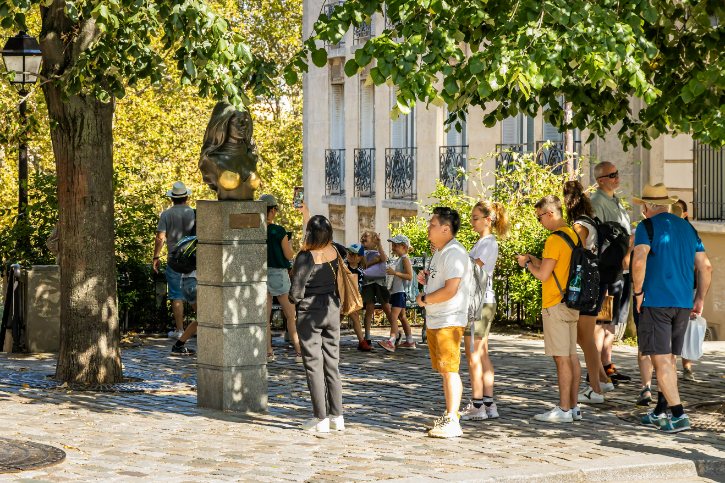
You are in a small square honoring Dalida, the singer who sold more than 140 million records. She lived in Montmartre for over 25 years, and the city dedicated this spot in 1997, ten years after her death.
b. What you see here
- A quiet triangle where three lanes meet, shaded by mature trees.
- A granite base holding a life-size bronze bust, made by sculptor Alain Aslan.
- An inscription showing her real name, Yolande Gigliotti, beside her stage name.
c. How it feels
This is one of the calmer corners of the hill. The surrounding streets are too narrow for tour buses, so it stays peaceful, visited mostly by locals and fans. You may sometimes spot fresh flowers at the base, though it is not something to expect.
d. A bit of background
Dalida lived close by on Rue d’Orchampt, in a townhouse from 1900, until her death in May 1987. The city chose this intersection so her memorial would sit within one of Montmartre’s best-kept historic lanes.
7. Rue de l’Abreuvoir
a. Why this lane is worth it
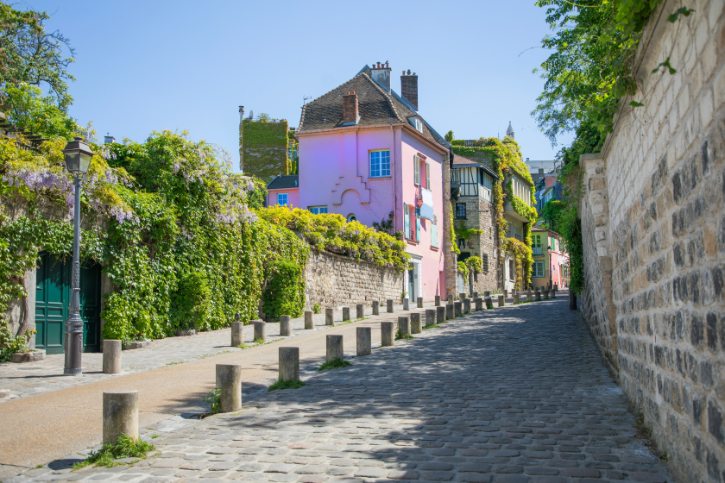
You walk down a lane that appears in city records as far back as 1325. It once linked the abbey to the farms and springs below, and it still keeps its early rural shape, untouched by the wide avenues of central Paris.
b. What makes it stand out
- An S-curve running downhill, paved with old cobbles.
- Stone walls, green shutters, creeping ivy, and old iron lamps.
- The scale of a village, not a city.
c. What to look for
- Irregular building plots that reflect the hill’s farming past.
- The white dome of Sacré-Cœur rising above the rooftops as you look up the slope.
d. The story behind the name
The street is named after a communal watering trough (abreuvoir) that stood near the bottom until the mid-19th century. Farm and quarry workers brought their horses here to drink from hillside spring water.
e. How it feels
With little traffic and no modern shops, sounds echo softly off the garden walls. It is easy to picture the hill as it looked over a century ago.
8. La Maison Rose
a. Why this little house is famous
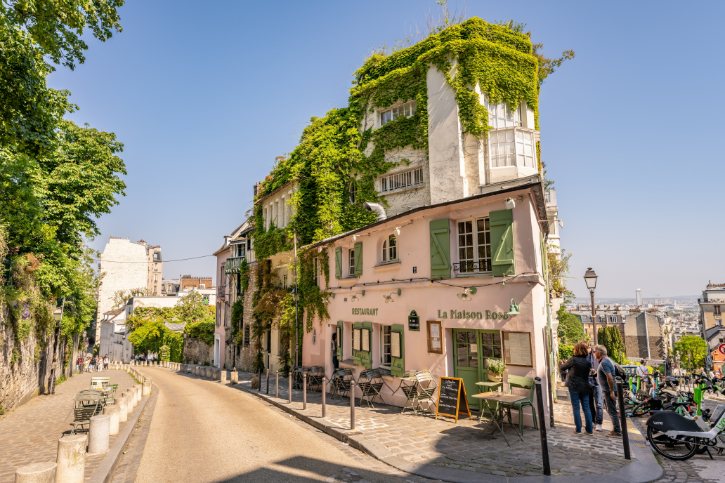
You have reached one of the most recognizable buildings on the hill. Its fame goes well beyond the pink paint. This small village house became a meeting point for early 20th-century artists, linking the Spanish painters of the Bateau-Lavoir to the wider Montmartre scene.
b. What it looks like
- A modest two-story house with pink plaster and deep green shutters.
- A low hip roof and an angled corner position.
- Compact proportions that stand out against the big apartment blocks of central Paris.
c. The artists behind it
- Around 1905, Catalan painter Ramon Pichot bought it as a studio, and Picasso and Dalí both visited.
- His wife, Germaine Gargallo, painted the outside pink and opened a small eatery on the ground floor.
- Maurice Utrillo, who worked nearby, made it famous by painting it around 1914.
- From 1948, the Miolano family ran the restaurant, hosting names like Albert Camus and Alain Delon.
d. A detail to notice
Inside, the original hexagonal floor tiles, called tommettes, are still in place. At the base of the walls, worn stone curbing shows where carriage wheels once turned the corner.
9. Musée de Montmartre
a. Why this place is worth your time
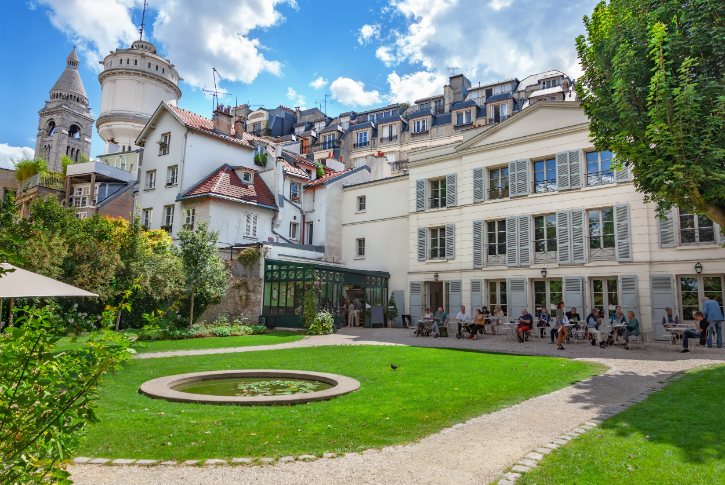
If the streets show you Montmartre, this museum explains it. It was founded in 1960 inside the oldest house on the hill, a late 17th-century manor, and it focuses on the years from 1870 to World War I, when the neighborhood led modern European art.
b. What you will find inside
- Original prints by Théophile-Alexandre Steinlen made for the Chat Noir cabaret.
- The preserved studio-apartment of Suzanne Valadon, kept with its skylights, easels, and palettes.
- Paintings, posters, and objects that trace the hill’s creative life.
c. The gardens and the vineyard
- The Renoir Gardens, restored to match the grounds that inspired Renoir when he lived here in 1876.
- A reconstruction of the rope swing from his painting La Balançoire (The Swing).
- A terrace view over the Clos Montmartre vineyard, which is separate from the museum but best seen from here.
d. Who actually lived and worked here
You can keep the names straight easily:
- Renoir worked here in 1876.
- Émile Bernard, Raoul Dufy, and Othon Friesz painted here around the turn of the century.
- Suzanne Valadon, Maurice Utrillo, and André Utter lived in the central studio from 1912 to 1926.
e. How it feels
Behind high walls on Rue Cortot, the noise fades into gravel paths, fruit trees, and flower beds. It is a calm break from the busy streets.
10. Villa Léandre
a. Why this lane surprises you
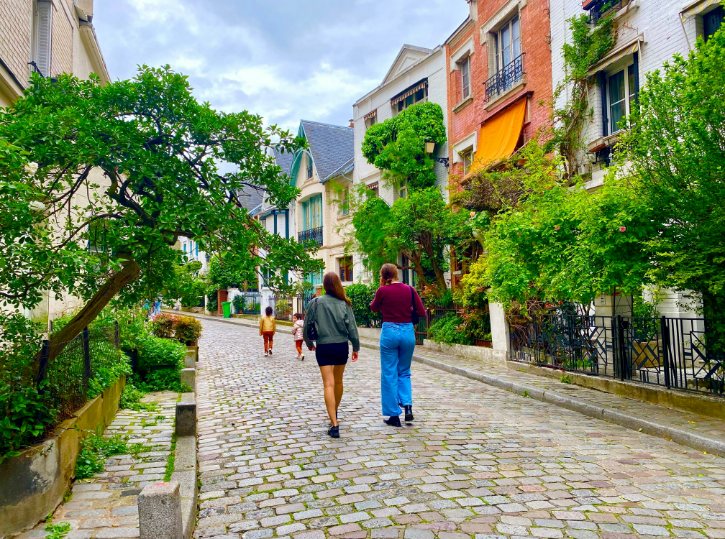
You turn off Avenue Junot into one of the hill’s most unusual streets. Built in 1926 as a dead-end lane, it chose English and Art Deco style houses instead of the usual Paris apartments, over land that was once quarries and old shacks.
b. What makes it stand out
- Two- and three-story brick and stucco houses.
- Decorative timber framing, bow windows, and steep slate roofs.
- Small gated gardens that give it the feel of an English suburb.
c. A playful detail
Outside Number 10, a homeowner added a joking brass plaque reading “10 Downing Street”, a nod to the row’s British look. Along the way, gates show off 1920s ironwork and climbing wisteria.
d. How it feels, and how to behave
This lane is remarkably quiet, with no shops and no through traffic. Because people live here, keep your visit respectful, stay on the public street, and avoid looking into private yards or windows.
11. Moulin de la Galette
a. Why these windmills matter
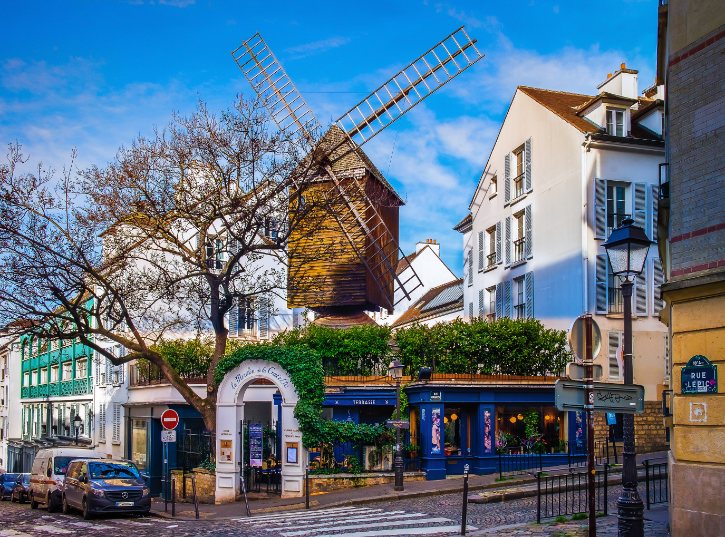
You are looking at the only two original windmills left on the hill, out of more than thirty that once ground flour and crushed gypsum. The Impressionists painted them, and they mark the shift from a milling village to a famous dance spot.
b. Telling the mills apart
- The Moulin de Blute-Fin dates to 1621, its name from bluter (to sift flour).
- The Moulin Radet was built in 1717.
- A modern restaurant uses the “Moulin de la Galette” name today, so do not mistake it for the original mill.
c. How it became a dance hall
- Both mills were bought by the Debray family, local millers.
- In 1834, the family turned the site into an open-air dance ground.
- They served small rye cakes called galettes with local wine, and the pairing gave the whole place its name.
d. The art connection
- Renoir painted his famous Bal du moulin de la Galette (Dance at the Moulin de la Galette) here in 1876, showing ordinary Parisians dancing under outdoor lamps.
- Van Gogh, Toulouse-Lautrec, Picasso, and Utrillo all painted the site too.
e. What you can see today
- The Moulin Radet sits on the bistro roof at the corner of Rue Lepic and Rue Girardon.
- The Moulin de Blute-Fin stands behind private gates, its wooden tower visible above the wall.
12. Rue Lepic
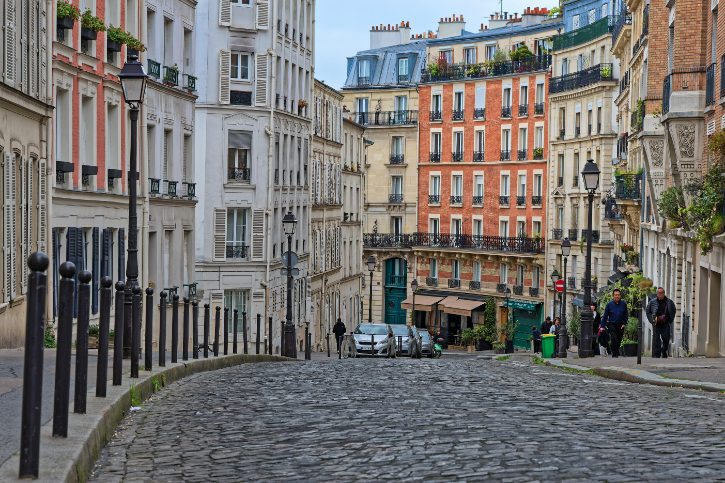
a. Why this street feels alive
You are on one of the main streets crossing the hill, and one of its busiest. Unlike the straight avenues of central Paris, it winds down the slope in an irregular curve. It was named in 1864 after a Napoleonic general.
b. How it changes as you walk
- The upper part near the windmills is mostly residential and quiet.
- Farther down, it becomes a market street, full of bakeries, cheese shops, and greengrocers.
- Café tables spill onto the sidewalk along the lower stretch.
c. The Van Gogh connection
At Number 54, a plaque marks where Vincent van Gogh lived with his brother Theo from 1886 to 1888. While here, he painted views over Paris and the nearby windmills, and his colors grew lighter and brighter as he met the Impressionists.
d. How it feels
This is everyday Paris at its best. The calls of shopkeepers, the smell of fresh bread, and the chatter at café tables give the street a warm, busy rhythm.
13. Rue des Abbesses and Place des Abbesses
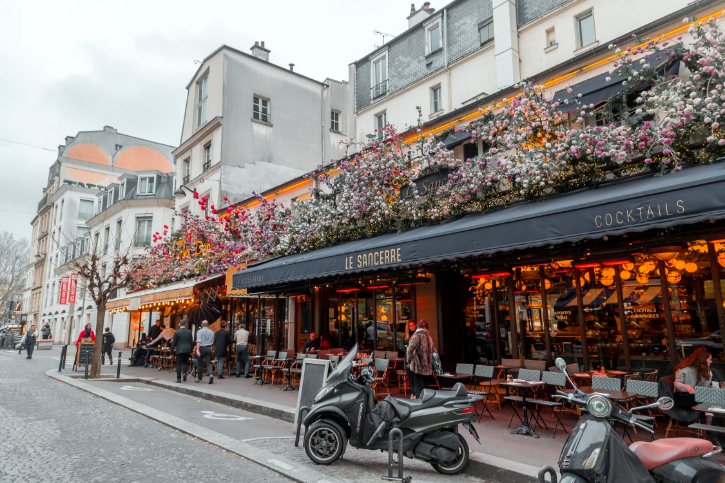
a. Why this area is the local heart
You have reached the social center of lower Montmartre, named after the 46 abbesses who once led the royal abbey. It still feels like a real neighborhood rather than a tourist stop.
b. Knowing the street from the square
- Rue des Abbesses is a lively shopping street, with boutiques, food markets, and cafés.
- Place des Abbesses is a sloped square shaded by plane trees and ringed by old apartment buildings.
c. What to see around the square
- The Abbesses Métro entrance, with its Art Nouveau glass canopy designed by Hector Guimard around 1900 and moved here from another station in 1974. The platforms below sit about 36 meters down, long the deepest in the Paris network.
- Église Saint-Jean de Montmartre, the first church built using reinforced cement, finished in red brick and glazed tiles.
- The Mur des Je t’aime (Wall of Love), where “I love you” appears 311 times in more than 250 languages.
d. How it feels
The square stays lively and local. Musicians often play near the metro stairs, and residents meet at café tables, keeping the place a true neighborhood hub.
e. A film you may know
The square and its metro entrance both appear in the 2001 film Amélie, which strengthened how people around the world picture Montmartre.
14. Café des Deux Moulins
a. Why you stop here
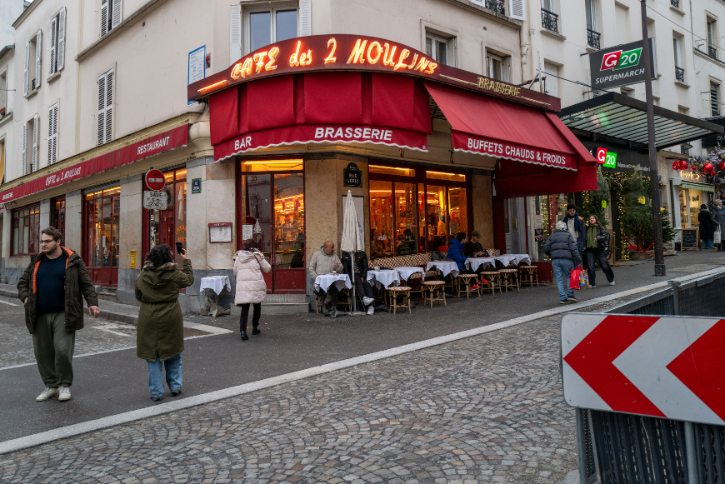
At 15 Rue Lepic, this bistro is famous as the workplace of the title character in the 2001 film Amélie. It is more than a film set, though. It has served the neighborhood since the early 20th century and still works as a real brasserie.
b. What it looks like
- Large wraparound windows and a bold red awning.
- A curved zinc bar and tiled floors.
- A lit vintage clock that appeared in the film.
c. What film fans can spot
- The neon clock above the bar, still in place.
- Framed posters and memorabilia near the entrance, added later for visitors.
- The tobacco counter where Georgette worked in the film was a real, working counter, but it closed in 2002 after the café changed hands, so it is no longer there.
d. The story behind the name
The café took its current name in the 1950s. “Deux Moulins” means “Two Windmills”, pointing to its spot midway between the Moulin de la Galette up the hill and the Moulin Rouge down on the boulevard.
15. Moulin Rouge
a. Why this is the perfect finish
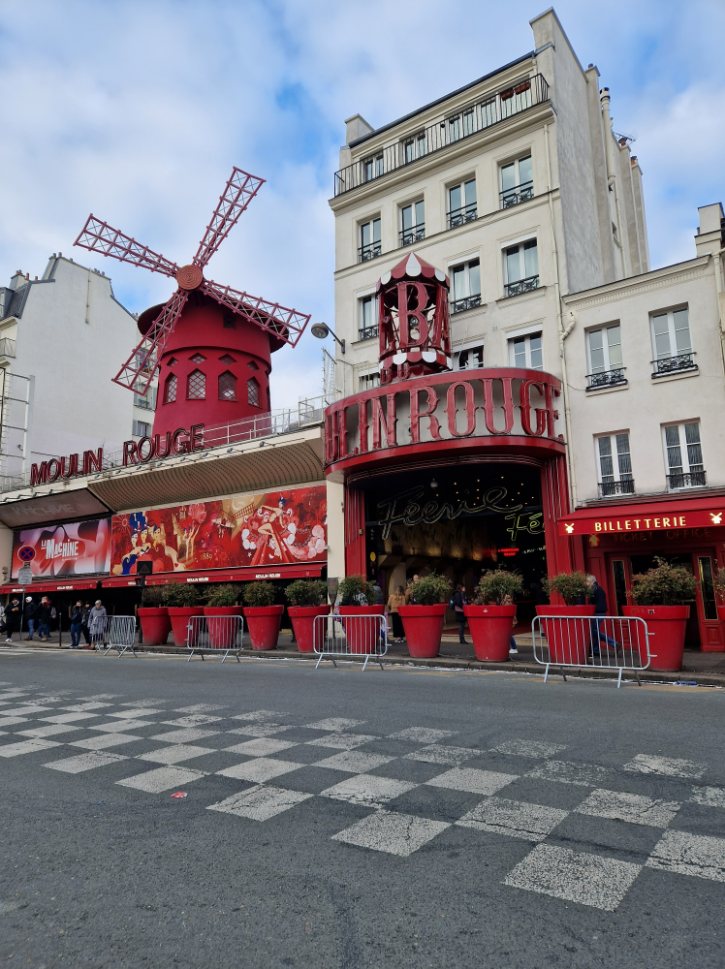
You end at 82 Boulevard de Clichy, at one of the most famous symbols of Paris nightlife. The Moulin Rouge opened on October 6, 1889, the same year the Eiffel Tower was finished, built as a grand hall where all kinds of people could mix.
b. What you see today
- The huge red windmill on the roof, with turning sails and bright neon.
- Lit marquees and poster displays celebrating its history.
- A façade from the 1921 rebuild, after a fire destroyed the original in 1915.
c. The home of the cancan
- The modern French cancan was shaped here into a full stage show.
- Dancers like La Goulue, Jane Avril, and Valentin le Désossé made it famous.
- The painter Henri de Toulouse-Lautrec kept a table inside and captured the scene in his posters.
d. A detail to notice
The red windmill was chosen as a deliberate nod to the real windmills that once covered the hill above, tying this bright boulevard back to the quiet village where you started.
e. How the walk comes together
In one short, connected route, you pass from the medieval roots of Saint-Pierre and the heights of Sacré-Cœur, through artist squares, quiet lanes, and old windmills, down to the markets, movie corners, and famous cabaret below. That layered mix is exactly what makes exploring Montmartre on foot so rewarding.