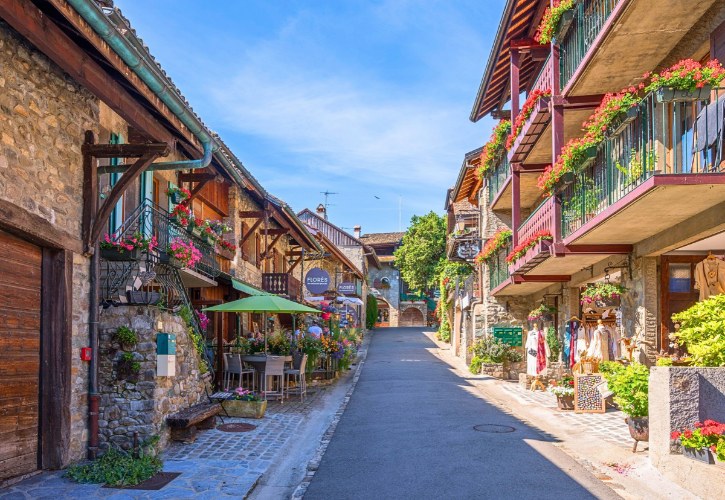
You are about to trade one steering wheel for two countries, a string of medieval towns, vineyard hills, hilltop castles, and some of the bluest lakes in Europe.
This drive carries you from the timbered streets of eastern France deep into the Swiss Alps and back again. Every stop brings a new view worth slowing down for.
Pack light, keep your camera close, and start the engine in Alsace. 😊
1. Strasbourg
a. Lose Yourself in the Island Old Town
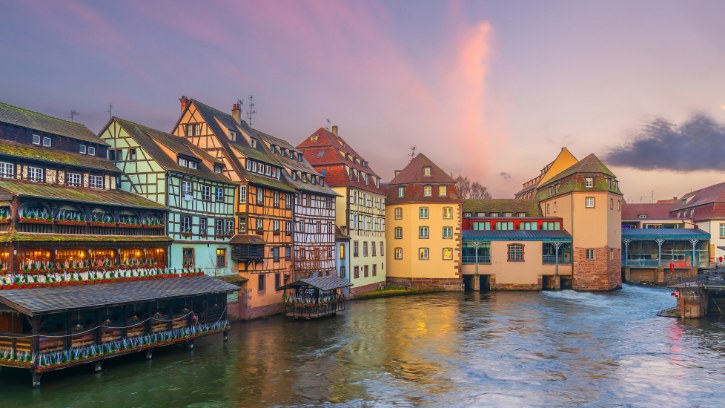
Strasbourg’s historic heart sits on an island wrapped by the two arms of the Ill River, and it became the first whole city center named a UNESCO World Heritage site. Narrow cobbled lanes weave between tall half-timbered houses with steep roofs that once held grain and leather lofts.
Do not miss Maison Kammerzell on the cathedral square, or the flower-lined canals of Petite France, once home to tanners and millers and now the prettiest corner in the city.
b. Stand Beneath the Pink Cathedral
- The Cathédrale Notre-Dame is one of Europe’s great Gothic buildings, built from rosy Vosges sandstone.
- Its single spire climbs 142 meters, and for centuries it was the tallest building in the Christian world.
- Inside, a tall astronomical clock brings little mechanical figures to life each midday.
- Climb 332 steps to the platform for views across the rooftops to the Rhine plain and the Vosges.
- Rest afterward in Place de la Cathédrale, then step over to nearby Place Gutenberg.
c. Cross the Historic Covered Bridges
- The Ponts Couverts still keep four square stone towers from the old river defenses.
- Climb the roof terrace of the Barrage Vauban for the best view of the towers and the cathedral spire.
- Pause along the canals here, where timber galleries and flowers hang over the quiet water.
d. Taste Alsace by Boat and by Plate
- Take an Ill River cruise for low-angle views of Petite France and the modern European Parliament.
- Eat in a winstub, a cozy wood-paneled tavern built around local wine.
- Order tarte flambée, a thin flatbread with cream, bacon, and onion.
- Try choucroute garnie, wine-simmered cabbage with smoked pork and sausages.
- Save room for baeckeoffe, a slow-cooked casserole of beef, pork, and lamb in white wine.
- Pair your meal with a dry Riesling or an aromatic Gewurztraminer.
e. Step Into the Grand Neustadt
North of the island, the mood changes completely in the Neustadt, the imperial district added to the city’s UNESCO listing later on. Here you walk wide boulevards lined with grand public buildings in Neo-Renaissance, Neo-Baroque, and Art Nouveau styles. The grand Place de la République anchors it all, framed by the Palais du Rhin, the national library, and the theatre.
As you leave the city, the land rises into the Vosges and a medieval fortress appears on the ridge ahead.
Read More: Strasbourg Travel Guide: Best Things to Do, See, and Know Before You Visit
2. Château du Haut-Kœnigsbourg
a. Climb Toward a Castle on the Ridge
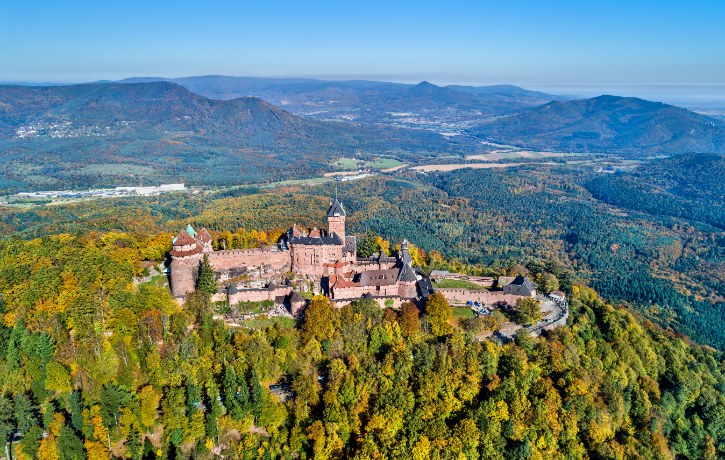
The drive up leaves the wine villages behind and winds through thick Vosges forest. Gaps in the trees reveal the vineyards of the Alsace plain and the silver line of the Rhine far below. Soon the fortress rises on its rocky spur, 757 meters up.
b. Take In One of the Finest Views in Eastern France
- From the Grand Bastion you look over the Vosges, the Alsace plain, and the Black Forest.
- On clear days the snowy Swiss Alps appear on the far southern horizon.
- A double ring of walls and towers stretches 270 meters along the mountain ridge.
- The great keep rises above it all as the castle’s last refuge and lookout.
c. Step Inside a Rebuilt Medieval Stronghold
- Walk through courtyards, cellars, and living quarters that show daily fortress life.
- See the armory of crossbows, hunting weapons, plate armor, and early cannon.
- Admire the Kaiser’s Hall, with vaulted ceilings and large historic frescoes.
- Step into the reconstructed herb garden, planted from old botanical texts.
d. Learn the Castle’s Long Story
The fortress fell to a long siege in 1633 and then sat in ruins for more than two centuries. A careful rebuild between 1900 and 1908 brought it back to life, guided by archaeology and surviving fragments. That careful rebuild is why you can explore so much of the fortress today.
Back downhill, neat rows of vines lead you to one of the prettiest villages on the Wine Route.
3. Riquewihr
a. Step Into a Village Frozen in Time
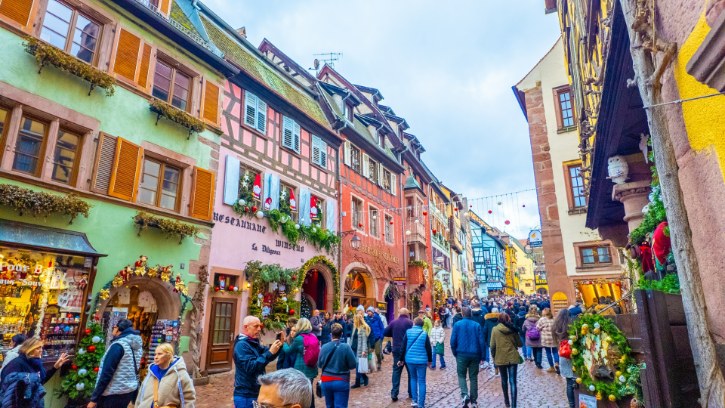
Tucked inside a bowl of vine-covered hills, Riquewihr is one of the Most Beautiful Villages of France. Fortified long ago and enriched by the wine trade, it escaped wartime damage. So you walk through a near-perfect picture of a wealthy 16th century winegrowing town.
b. Follow the Colorful Main Street
- Rue du Général de Gaulle climbs past houses painted in ochre, mint, rose, and amber.
- Look for carved corner posts, stone oriel windows, and arched carriageways.
- At the top stands the Dolder Tower from 1291, half fortress and half belfry.
c. Taste the Wines of the Hillsides
- The village sits beside the prized Schoenenbourg and Sporen Grand Cru slopes.
- Visit historic cellars where giant oak casks still age the wine.
- Try dry, mineral Riesling or spicy, perfumed Gewurztraminer.
- Sample rich Pinot Gris or sparkling Crémant d’Alsace.
d. Find the Quiet Corners
- Seek out the Thieves’ Tower, which once held the town dungeon.
- Spot the old Fontaine de la Sinne, once used to test wine barrels.
- Wander the narrow alleys that run along the medieval walls.
- Come in summer for cascading geraniums, or winter for the Advent market.
A short drive through sunlit vines brings a round hilltop ruin into view.
4. Kaysersberg
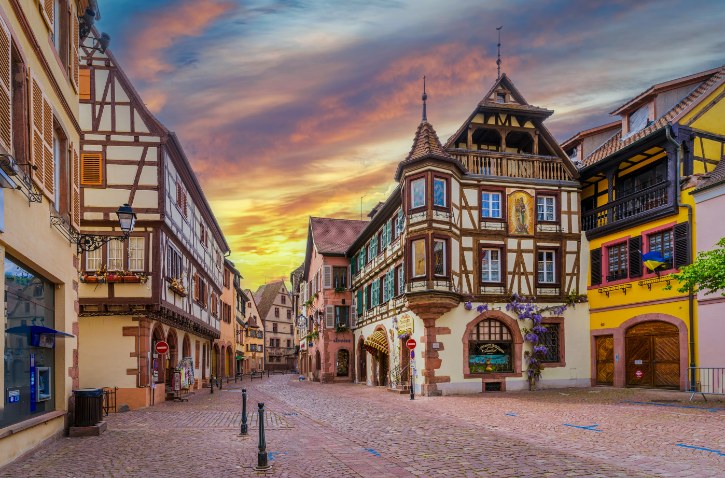
a. Reach the Emperor’s Mountain
Kaysersberg means “Emperor’s Mountain”, and castle ruins still crown the vine-wrapped crag above town. Climb the steps through the vineyards and up the round stone keep. From the top you see the Weiss valley, the surrounding slopes, and the Alsace plain reaching east.
b. Cross the Famous Fortified Bridge
- The pink sandstone Pont Fortifié from 1514 spans the rushing Weiss River.
- A small chapel sits in its middle with an 18th century statue of the Virgin Mary.
- Colorful half-timbered houses lean over the water around it.
c. Meet the Church and the Town Hall
- The Church of Sainte-Croix holds a 13th century Romanesque portal and a carved wooden altarpiece.
- The Renaissance Town Hall shows a sandstone oriel window and a step-gabled roof.
- Flower-draped balconies line the cobbled streets nearby.
d. Savor Wine and History
- Kaysersberg sits below the Schlossberg, the first classified Grand Cru in Alsace.
- Taste Riesling alongside Munster cheese and local fruit brandies.
- As a free imperial city, it once belonged to a ten-town Alsatian federation.
- This is the birthplace of Nobel laureate Dr. Albert Schweitzer, whose home is now a museum.
- French viewers once voted it France’s Favourite Village.
Across the flat Rhine valley waits the colorful canal city of Colmar.
5. Colmar
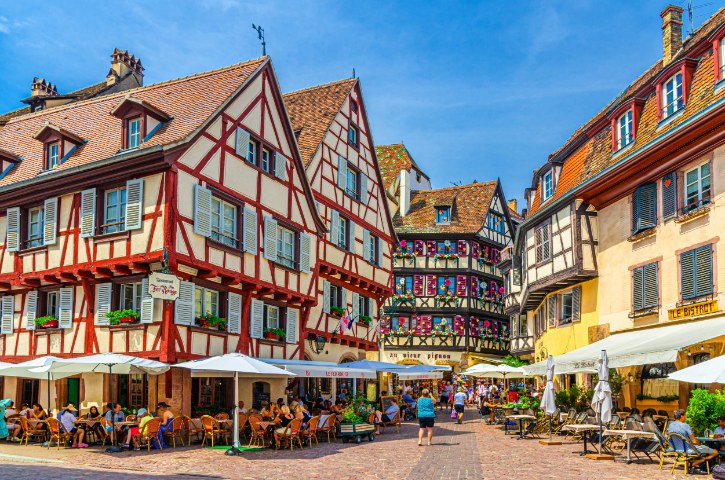
a. Drift Through Little Venice
Colmar gathers all the charm of Alsace on a bigger canvas. Its prettiest corner is Petite Venise, where the Lauch River splits into flower-lined canals once used by gardeners and tanners. Glide beneath low stone bridges on a flat wooden boat for the finest view.
b. Admire the Grand Old Houses
- Maison Pfister, a 1537 Renaissance masterwork with painted panels.
- Koïfhus, the 1480 Gothic customs house at the city’s old heart.
- Collégiale Saint-Martin, a Gothic sandstone church with a colorful tiled roof.
- Maison des Têtes, famous for its 106 carved stone faces.
c. See a Masterpiece at the Unterlinden
- The museum fills a 13th century convent joined to a modern wing.
- Its treasure is the Isenheim Altarpiece, painted between 1512 and 1516.
- The raw, moving panels make it one of the great works of its age.
d. Relax in the Lively Squares
- Settle at a café on Place de l’Ancienne Douane or Place de la Cathédrale.
- Try fleischnacka, savory meat rolled in egg pasta.
- Order fresh Alsatian pretzels to eat as you walk.
- Browse the red brick covered market by the canal for cheese and pastries.
South across the Swiss border, your first Swiss city sits on the Rhine.
6. Basel
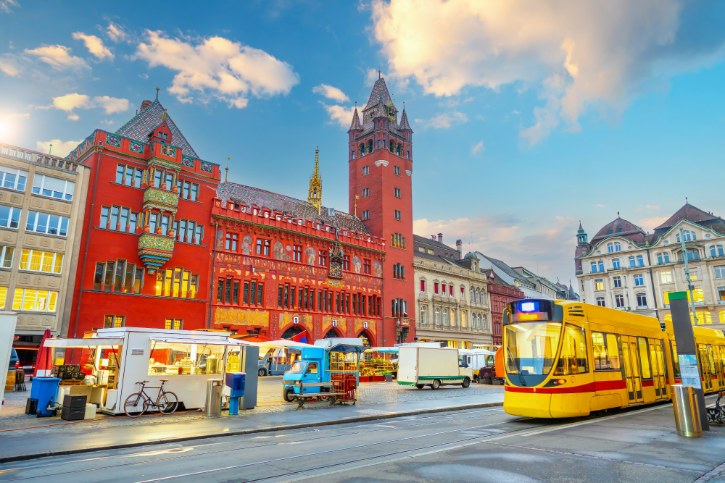
a. Settle Beside the Rhine
Life in Basel turns around the Rhine, which splits the city into two halves. The Mittlere Brücke has linked them since 1226. On sunny days the promenades fill with locals, and old cable ferries still cross the water using only the force of the current.
b. Explore the Red Sandstone Minster
- The Basler Münster blends Romanesque and Gothic in deep red stone.
- Its roof shines with patterned tiles in green, yellow, and black.
- Inside rests the tomb of the scholar Erasmus, and a peaceful double cloister.
- Climb the twin towers for wide views over city and river.
c. Find the Best Viewpoints and Gates
- The Pfalz terrace behind the Minster overlooks the Rhine and the Black Forest hills.
- The Spalentor is one of Europe’s finest surviving medieval city gates.
- Its square tower wears a colorful tiled roof between two round towers.
d. Wander the Old Town and St. Alban
- Marktplatz is crowned by the bright red Rathaus and a bustling market.
- Climb cobbled lanes like Augustinergasse past old townhouses and fountains.
- Slip into the quiet St. Alban quarter, laced with canals, old mills, and a paper museum.
e. Catch Basel’s Playful Modern Side
Basel is also Switzerland’s capital of modern architecture, with work by famous names such as Herzog and de Meuron. In the old center, the Tinguely Fountain churns and sprays water through ten whirring sculptures made from scrap metal. The fountain runs year-round and always draws a crowd.
The road climbs through the Jura hills toward a lakeside city beneath a pointed peak.
7. Lucerne
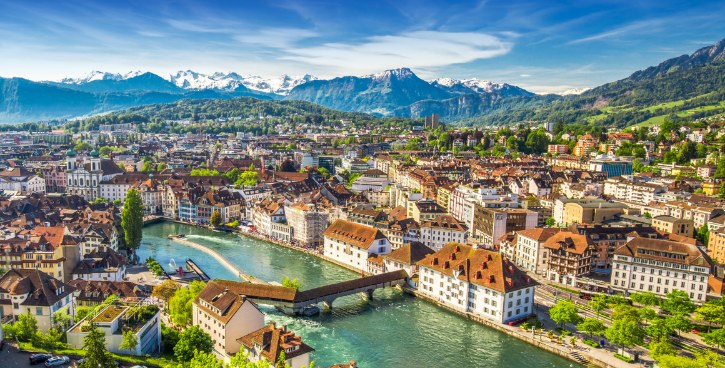
a. Meet the Chapel Bridge and Water Tower
- The Kapellbrücke is Europe’s oldest covered wooden bridge, dating from the 14th century.
- Painted panels under its roof tell stories from Swiss history and local legend.
- The stout octagonal Water Tower beside it is even older.
- Together they form Switzerland’s most photographed scene.
b. Soak Up the Lake and Mountains
Lucerne sits where deep blue Lake Lucerne meets steep slopes. Mount Pilatus rises to the south, reached by the world’s steepest cogwheel railway, while Mount Rigi, the “Queen of the Mountains”, stands to the east. Ride a historic paddle steamer or stroll the willow-lined promenades for the full effect.
c. Explore the Painted Old Town
- Linked squares like the Weinmarkt show frescoed merchant houses.
- Walk the 14th century Musegg Wall and climb several of its towers.
- One tower holds Lucerne’s oldest clock, which chimes a minute early.
- The Spreuerbrücke, another covered bridge, carries old “Dance of Death” paintings.
d. Stand Before the Lion Monument
A dying lion carved into a cliff honors the Swiss Guards who fell in 1792. Mark Twain called it the most moving piece of stone in the world, and in its quiet, tree-shaded park you will feel why.
e. Add a Few Cultural Stops
- The Baroque Jesuit Church, the first large church of its kind in Switzerland.
- The modern KKL center, with a vast copper roof reaching over the water.
- A lakeside bistro serving creamy Luzerner Chügelipastete.
Over the Brünig Pass lies a town wedged between two lakes.
8. Interlaken
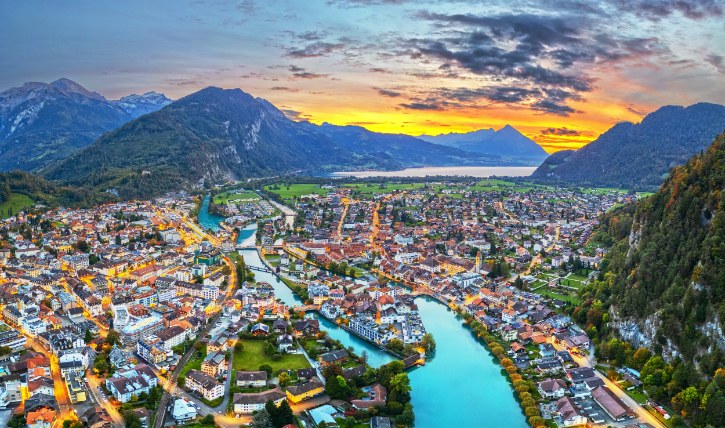
a. Stand Between Two Lakes
Interlaken rests on a flat plain between turquoise Lake Brienz and sapphire Lake Thun. Above rise the famous peaks of the Eiger, Mönch, and Jungfrau. The whole setting feels almost too scenic to be real.
b. Ride Up to Harder Kulm
- A funicular climbs the forested slope to the viewpoint at 1,322 meters.
- The Two-Lakes Bridge juts out into open air.
- You see both lakes at once, with the great peaks across the valley.
c. Chase a Little Adventure
- Launch on a tandem paragliding flight over the town.
- Sail, paddle, or kayak on the two lakes.
- Hike trails from easy lakeside walks to the high meadows of Schynige Platte.
d. Stroll the Town Center
- Walk the Höheweg past grand old hotels and chocolatiers.
- Rest on the protected Höhematte meadow, kept open for its Jungfrau view.
- Cross to quiet Unterseen for wooden chalets and an old church tower.
Turn south and the valley walls rise into sheer cliffs.
9. Lauterbrunnen
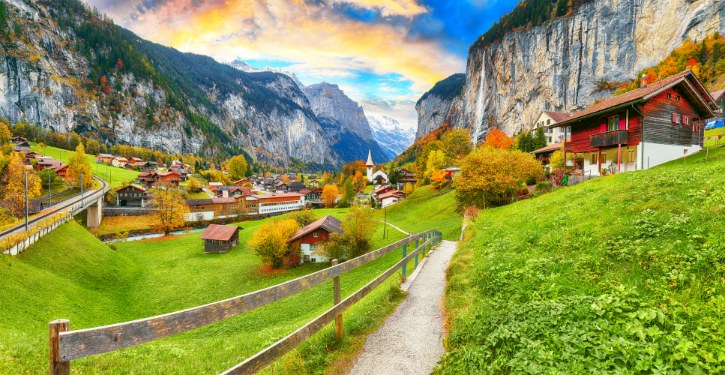
a. Enter the Valley of Waterfalls
Known as the valley of 72 waterfalls, Lauterbrunnen is one of the deepest glacial valleys on earth, lined by cliffs up to 300 meters high. Water spills over the edges in long, graceful falls, and the scenery once inspired Tolkien’s drawings of Rivendell. Staubbach Falls drops 297 meters behind the village church.
b. Go Inside the Mountain at Trümmelbach
- Ten glacier-fed falls thunder through a gorge hidden inside the rock.
- A tunnel lift carries you up to walkways beside the roaring water.
- It is loud, powerful, and unlike any outdoor waterfall you know.
c. Breathe In the Village and Cliff Towns
- Timber chalets and grazing cattle fill the green valley floor.
- Ride up to car-free Wengen on the eastern cliff.
- Reach car-free Mürren by cable car on the western cliff.
d. Climb to the Top of Europe
- Mountain railways reach the Jungfraujoch at 3,454 meters.
- See ice palaces carved straight into the glacier.
- Look out over the long Great Aletsch Glacier on a clear day.
The road returns to the lake and follows its shore to a castle town.
10. Thun
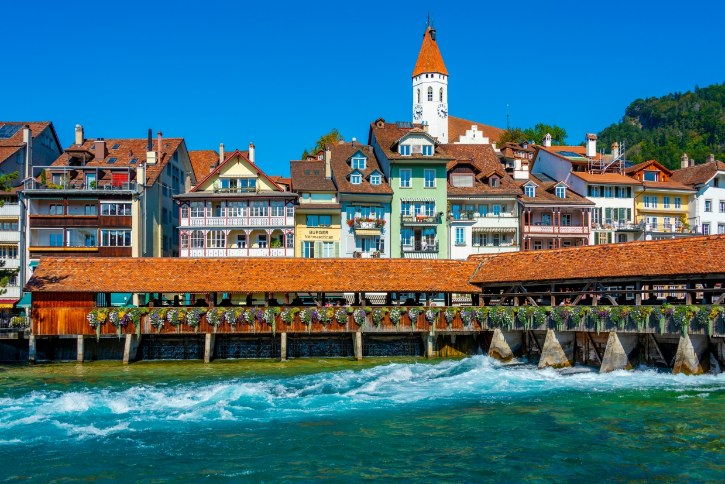
a. Climb to the Lakeside Castle
Where Lake Thun meets the Aare, Schloss Thun crowns the town with its four-turreted keep. Inside lies one of Switzerland’s largest medieval halls, with huge fireplaces and timber ceilings. From the turrets you look over rooftops, the lake, the cone of the Stockhorn, and the Bernese Alps.
b. Walk the Two-Level Old Town
- Along Obere Hauptgasse, shop roofs form a raised sidewalk above the street.
- You stroll this upper terrace to reach the second-floor shops and cafés.
- It opens onto the cobbled Rathausplatz below the castle hill.
c. Follow the Lake Promenade
- Walk the parks to the Neo-Gothic Schloss Schadau by the water.
- Watch the century-old Blümlisalp paddle steamer glide across the lake.
- Catch the snowy Jungfrau range reflected in the sapphire surface.
d. Enjoy the River Aare
- Clear water wraps the island of Bälliz in two channels.
- Two covered wooden bridges still work as old sluice gates.
- River surfers ride a standing wave while cafés fill the old mill quays.
The gentle Aare leads you on to the medieval capital, Bern.
11. Bern
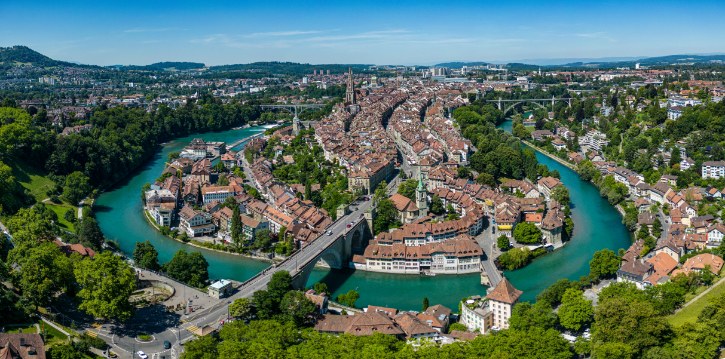
a. Walk the Arcaded Old Town
- Bern sits inside a tight horseshoe loop of the Aare River.
- Six kilometers of sandstone arcades form one of Europe’s longest covered walks.
- The Zytglogge clock tower puts on a show before each hour.
- Einstein developed his theory of special relativity in a flat on Kramgasse.
b. See the Cathedral and the Fountains
- The Berner Münster has the tallest church spire in Switzerland.
- Climb 344 steps for views over rooftops, river, and distant Alps.
- Eleven painted Renaissance fountains dot the old streets.
- Look for the Lady Justice fountain and the curious Child-Eater fountain.
c. Visit the Federal Quarter
The Bundeshaus, seat of the Swiss parliament, anchors the quarter with its domed Renaissance front. On the square, 26 fountains rise from the ground, one for each canton. Behind it, a terrace overlooks the rushing Aare below.
d. Watch the Bears by the River
The bear is Bern’s age-old symbol. At the riverside BärenPark, brown bears forage, climb wooded slopes, and swim in a roomy habitat. They hibernate in winter, so a sighting is a nice chance rather than a promise.
e. Take In the View from the Rose Garden
- The Rosengarten reveals the whole Old Town in its river loop.
- You see red-tiled roofs, the Münster spire, and the green Aare.
- Below, locals float down the cool, clean current all summer.
Southwest through green hills, the land drops to Lake Geneva and the Swiss Riviera.
12. Montreux
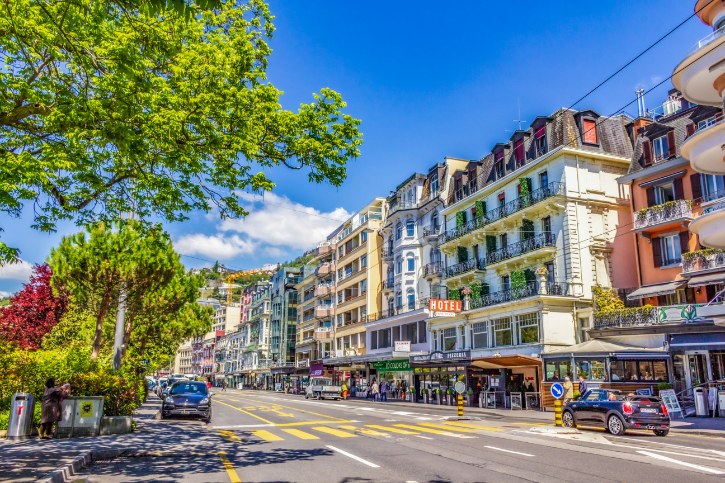
a. Stroll the Swiss Riviera
A mild climate gives Montreux its Riviera name. Walk the lakeside Quai des Fleurs beneath palms and cypresses, past grand hotels like the opulent Fairmont Le Montreux Palace. The mood here is relaxed and quietly refined.
b. Explore the Castle on the Water
- The Château de Chillon stands on its own rock island in the lake.
- Wander its three courtyards, keeps, and vaulted dungeons.
- A prisoner once chained here inspired a poem by Lord Byron.
c. Pass Through the Lavaux Vineyards
- UNESCO-listed terraces climb the slopes toward Lausanne.
- Monks shaped them with thousands of dry-stone walls.
- The vines enjoy “three suns”: sky, lake reflection, and warm stone.
- The Chasselas grape makes the region’s renowned white wine.
d. Follow the Music
- Montreux hosts a world-famous jazz festival each July.
- A bronze statue of Freddie Mercury stands on the promenade.
- Queen recorded here at Mountain Studios, now an interactive exhibition.
e. Gaze at the Alpine Backdrop
- The jagged Dents du Midi frame the far shore of the lake.
- Ride old paddle steamers across the water.
- Climb by cogwheel railway to Rochers-de-Naye for a wide panorama.
Cross into France along the shore to a flower-filled medieval village.
13. Yvoire
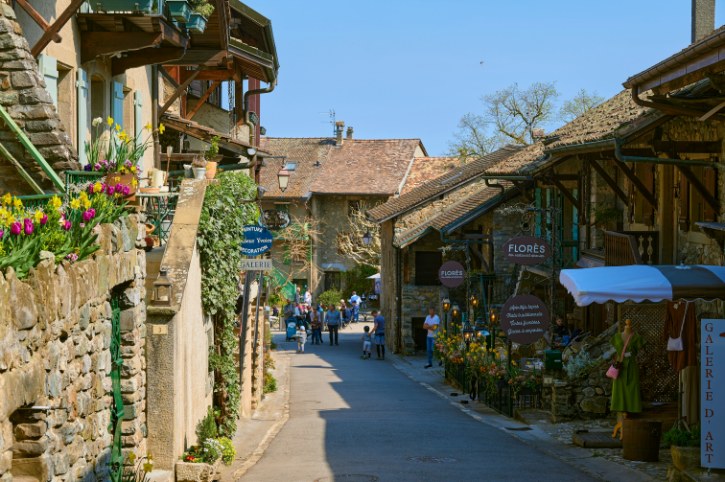
a. Discover a Medieval Flower Village
On a point jutting into Lake Geneva, Yvoire was fortified in 1306 and still keeps its 14th century layout. One of the Most Beautiful Villages of France, it is a repeat national winner for floral displays, so its old stone houses glow with bright blossoms through the warmer months.
b. Wander the Gates and the Gardens
- Enter through two surviving 14th century stone gateways.
- Narrow lanes lead past limestone houses and artisan workshops.
- Explore the Garden of Five Senses, a cloister-style maze of hedges.
- Rooms here play on touch, sight, smell, taste, and sound.
c. Linger at the Harbor
- Fishing boats and pleasure craft share the small harbor.
- The square keep of the Château d’Yvoire watches over the water.
- A steel-domed church nearby reflects the shifting blues of the lake.
d. Taste the Lake’s Catch
- Order filets de perche, fresh perch fried in butter with lemon and parsley.
- Dine on an open terrace right beside the water.
- Pair it with a crisp Savoyard white wine.
Back across the border waits the lively city of Geneva.
14. Geneva
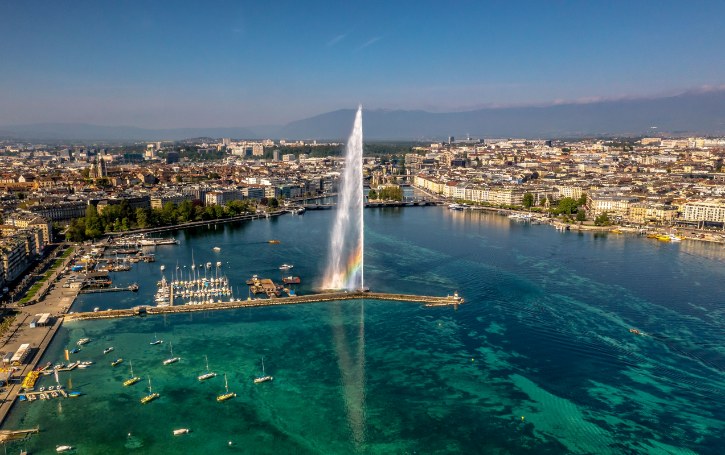
a. Watch the Jet d’Eau Soar
Geneva greets you with the Jet d’Eau, which pushes 500 liters of water per second to a height of 140 meters, making it one of the tallest fountains in the world. Walk out along the stone jetty to feel the mist, then take in the harbor views. On a clear day, Mont Blanc shines white in the distance.
b. Climb Through the Old Town
- St. Pierre Cathedral was John Calvin’s base during the Reformation.
- Beneath it lies one of Europe’s largest archaeological sites.
- Climb 157 steps for sweeping views over rooftops and lake.
- Rest at Place du Bourg-de-Four, the city’s oldest square.
c. Discover the International Quarter
- The Palais des Nations is the European headquarters of the UN.
- The giant Broken Chair stands as a statement against landmines.
- The Red Cross Museum tells Geneva’s humanitarian story.
d. Relax Among Parks and Flowers
- See the working Flower Clock in the lakeside Jardin Anglais.
- Walk the Parc des Bastions past the long Reformation Wall.
- Find the carved figures of the Protestant leaders set into the stone.
The final leg returns to France and the turquoise water of Annecy.
15. Annecy
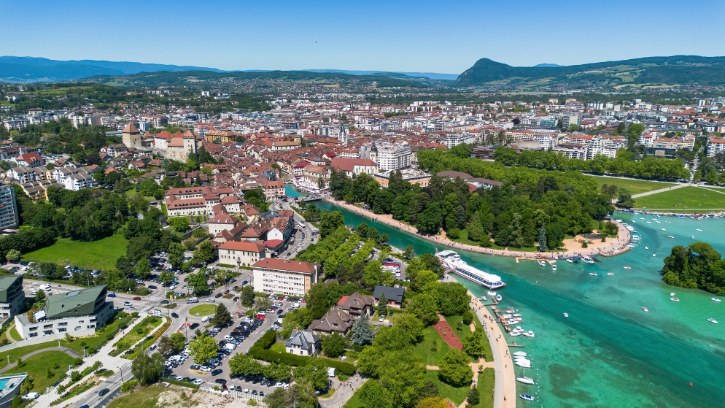
a. Arrive in the Venice of the Alps
Annecy sits at the tip of its lake, ringed by the limestone peaks of the Bauges and Bornes. The short Thiou River threads the old town with canals. Pastel houses in rose, yellow, and apricot line the water, linked by little stone bridges.
b. See the Island Palace and the Castle
- The Palais de l’Isle sits on a rock island like a stone ship.
- It has served as a home, a courthouse, a mint, and a prison.
- Above town, the Château d’Annecy offers views over roofs and mountains.
c. Wander the Promenades
- Walk Rue Sainte-Claire with its old arcades and market stalls.
- Taste local cheeses like Beaufort, Reblochon, and Tomme de Savoie.
- Cross the Pont des Amours for lake and mountain views.
- Relax on the lakeside lawns of the Jardins de l’Europe.
d. Get Out on the Water and Trails
- Ride the lakeside greenway along the western shore, part of a roughly 40-kilometer loop around the lake.
- Pass lakeside villages like Talloires and Menthon-Saint-Bernard.
- Paddle, cruise, or swim in one of Europe’s cleanest lakes.
- Hike Mount Semnoz for a sweeping view of the French Alps.
- Fly tandem from Col de la Forclaz over the turquoise water.
e. End the Journey by the Canals
As evening falls, lights glow along the Thiou and the smell of Savoyard cooking fills the arcades. Settle in for fondue, tartiflette, or raclette scraped over ham and potatoes. Then look back on a drive through wine villages, hilltop castles, Swiss lakes, and high mountain valleys. One road trip, two countries, and fifteen stops you will remember for years.