Florence packs centuries of art and history into a center you can cross on foot in minutes. You’ll move from soaring churches and Medici palaces to grand piazzas and quiet river views, all a short stroll apart.
This walking route links 15 beautiful stops into one easy journey through the city’s spiritual, civic, and artistic heart.
Take it all in a single day, or split it across two for a slower pace. Either way, you meet Florence one wonderful corner at a time. 😊
1. Basilica of Santa Maria Novella
a. Where Your Florence Walk Begins
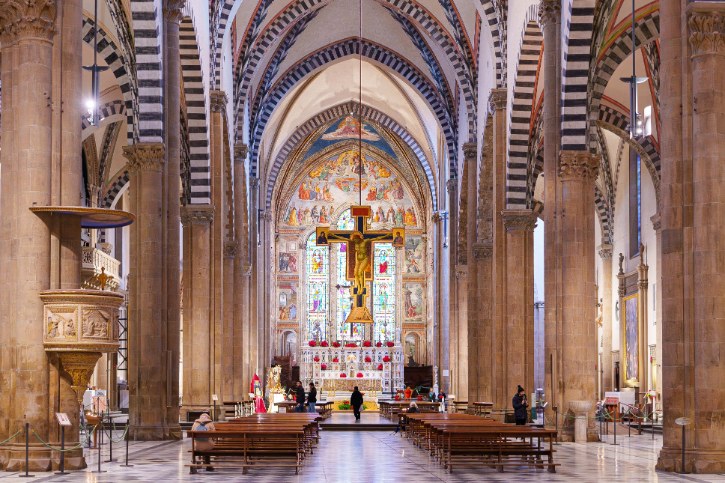
You’re starting at the leading church of the Dominican Order in Florence. The present Gothic building was begun in 1279 by two Dominican friars, and inside you’ll find a wide Latin-cross plan, soaring vaults, and slender piers, all built to hold the big crowds who came to hear the friars preach.
b. The Façade That Stops You in Your Tracks
The green-and-white marble front is the first thing to catch your eye. The humanist architect Leon Battista Alberti finished it between 1458 and 1470, and the details reward a closer look:
- A classical Roman temple front with fluted pilasters
- Dark green serpentine marble from Prato set against white Carrara marble
- An attic frieze carrying the Rucellai family emblem, an unfurled sail
- Two S-scroll volutes that neatly hide the sloping side-aisle roofs
- A perfect-square design built on simple 1:1, 1:2, and 1:4 proportions
c. The Artworks You Shouldn’t Miss
Step inside for some of the Renaissance’s most important paintings:
- Masaccio’s Holy Trinity (1425 to 1427), a milestone for its pioneering single-point perspective, with a painted chapel that seems to sink into the wall
- Ghirlandaio’s Tornabuoni Chapel frescoes (1485 to 1490), where a teenage Michelangelo got his first fresco training
- Brunelleschi’s wooden Crucifix, carved in friendly rivalry with Donatello
- Giotto’s painted Crucifix (around 1290), which broke from stiff Byzantine style to show real human weight and suffering
- The Strozzi Chapel, with frescoes by Nardo di Cione picturing Dante’s Divine Comedy
d. Cloisters and a Clever Photo Trick
Before you leave, don’t miss these final touches:
- The peaceful Green Cloister, named for the green pigment in Paolo Uccello’s Old Testament frescoes
- The best façade photo, taken from across the piazza
- A clever trick inside, where the vault spacing narrows toward the altar and makes the church feel far longer than it is
2. Piazza di Santa Maria Novella
a. A Square Built for Big Crowds
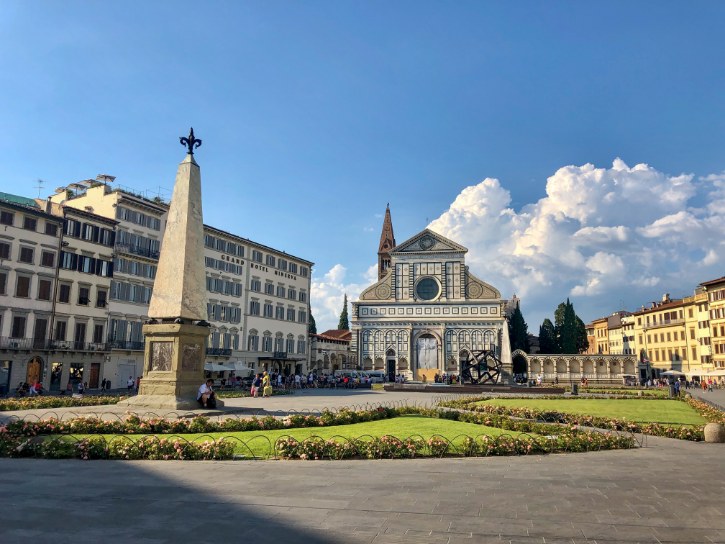
You’re now in one of Florence’s most elegant squares, created in 1287 to hold the overflow crowds who gathered for the Dominican sermons. Over time it became a stage for civic pageants, tournaments, and athletic contests, a lively past you can still feel in its wide-open space.
b. The Chariot Races and Marble Obelisks
The square’s most colorful tradition is worth picturing as you stand here:
- The Palio dei Cocchi, a chariot race started in 1563 by Grand Duke Cosimo I, ran every year on June 23
- Competitors raced ancient-style two-wheeled Roman chariots around the square
- Two marble obelisks, set up in 1608, marked the turning points
- Each obelisk rests on four bronze tortoises cast by the sculptor Giambologna
- Gilded bronze lilies, the emblem of the Florentine Republic, crown their tops
c. The Handsome Buildings Around You
The buildings around the square span several eras:
- The Loggia di San Paolo, built in the 1490s to echo Brunelleschi’s famous hospital design
- Glazed terracotta medallions above its arches by Andrea della Robbia
- A lunette showing Saint Francis and Saint Dominic embracing
- Historic townhouses and palaces completing the elegant frame
d. Small Details Most Visitors Walk Past
Slow down and you’ll spot the quieter touches that give the square its character:
- Decorative wrought-iron torch-holders on the old façades
- Stone family crests tucked into masonry corners
- Geometric pavement markers tracing the old boundaries of the Dominican precinct
From here, the streets lead east into the quarter long tied to the Medici family, toward their grand burial complex.
3. Medici Chapels (Cappelle Medicee)
a. The Resting Place of Florence’s Rulers
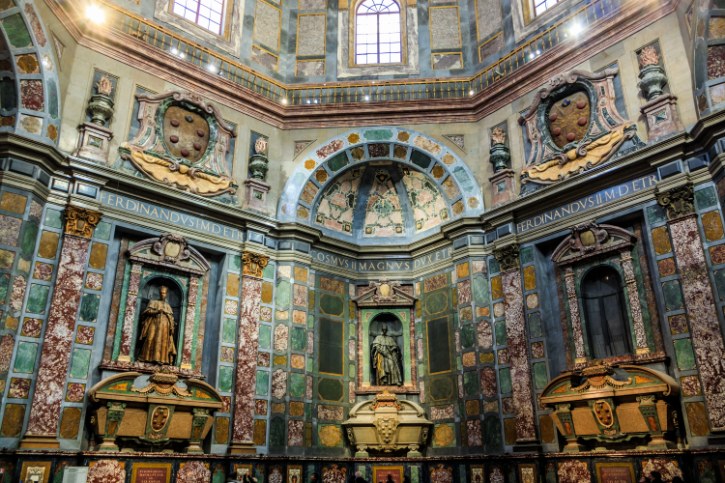
You’re entering the dynastic burial complex of the family that shaped Florence. It centers on two very different masterpieces: Michelangelo’s restrained New Sacristy and the lavish Chapel of the Princes.
b. Michelangelo’s Powerful Tombs
The New Sacristy, begun in 1520, holds some of Michelangelo’s most moving sculpture. Look for:
- The Tomb of Giuliano, with the allegories of Night (an owl, a mask, and poppies at her side) and Day, whose rough, unfinished face glares over his shoulder
- The Tomb of Lorenzo, showing the duke lost in thought, flanked by a weary Dusk and a stirring Dawn
- The Tomb of the Magnifici, crowned by Michelangelo’s tender Madonna and Child, with the Christ Child turning toward his mother
- Giant pilasters of dark grey pietra serena stone that create a sense of upward tension
c. A Dazzling Hall of Precious Stone
The Chapel of the Princes goes for pure spectacle:
- A huge octagonal hall rising to 59 meters, under Florence’s second-largest dome
- Walls completely covered in cut and polished semiprecious stones
- Inlays of red porphyry, jasper, mother-of-pearl, and deep blue lapis lazuli
- Giant stone sarcophagi ringing the room
d. Two Styles, One Family Story
Moving between the two chapels is the real experience here:
- The New Sacristy wins you over with quiet proportion and deep feeling
- The Chapel of the Princes impresses through scale and rare, glittering materials
- Seeing both shows the family’s reach into Florence’s art, religion, and politics
A doorway leads straight into the neighboring church that served as the Medici family’s parish for generations.
4. Basilica di San Lorenzo
a. One of Florence’s Oldest Churches
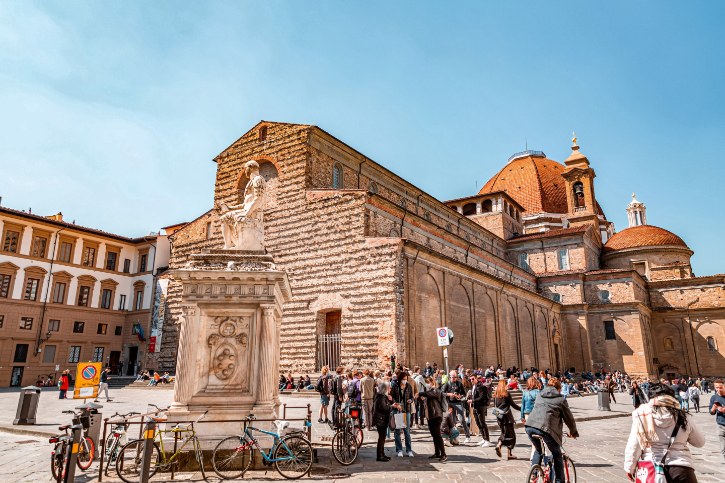
You’re standing in a church first dedicated in 393 AD, once the city’s cathedral. By the early 1400s it had fallen into disrepair, so Giovanni di Bicci de’ Medici paid to rebuild it and brought in Filippo Brunelleschi in 1419. He reimagined it as a manifesto for the Early Renaissance, built on calm, classical proportions.
b. The Famous Unfinished Front
Here’s the surprise that greets you outside:
- The west façade was never finished and remains bare brickwork
- In 1515, Pope Leo X held a competition and gave the marble front to Michelangelo
- Michelangelo built models and quarried marble for years
- High costs and political turmoil killed the project in 1520
- That plain exterior hides one of the most harmonious interiors in the city
c. Brunelleschi’s Calm, Balanced Interior
Inside, Brunelleschi’s sense of order takes over:
- Grey pietra serena columns splitting the nave into three aisles
- Semi-circular arches beneath a flat, gilded ceiling
- Proportions built on one simple mathematical ratio
- The Old Sacristy, finished in 1428, the earliest fully intact Renaissance space
d. The Treasures Inside
The church gathered important works across generations. Seek out these highlights:
- Donatello’s Bronze Pulpits, his final works, packed with crowded, expressive figures
- Filippo Lippi’s Annunciation, loved for its soft light and garden-loggia setting
- Rosso Fiorentino’s Marriage of the Virgin, bright and theatrical in Mannerist style
- The Tomb of Cosimo the Elder, marked before the high altar, who earned the title Pater Patriae, “Father of the Fatherland”
From here, the Medici story continues just down the street at their private palace.
5. Palazzo Medici Riccardi
a. The Palace That Set the Standard
You’re looking at the blueprint for Renaissance palaces across Europe, commissioned around 1444 by Cosimo the Elder and designed by Michelozzo. Cosimo turned down a grander design by Brunelleschi, worried too much show would stir up jealousy, so the result projects quiet authority rather than flashy power.
b. Reading the Three-Layer Front
The façade tells its story in three stacked levels, easy to pick out as you stand before it:
- The ground floor, built with rugged, deeply cut stone for a fortress-like base
- The middle floor, faced with smoother blocks and elegant two-light windows
- The upper floor, clad in flat, smooth stone so the walls seem lighter as they rise
- A tall Corinthian cornice crowning the whole 25-meter front
- A peaceful inner courtyard ringed with columns and carved Medici emblems
c. The Chapel That Glows With Gold
The jewel inside is the Chapel of the Magi, frescoed in 1459 by Benozzo Gozzoli in lapis blues, greens, and gold leaf. The sacred procession doubles as a Medici family album:
- The youngest king rides a white horse, long thought to resemble a young Lorenzo the Magnificent, though many scholars now place Lorenzo among the riders who follow
- Cosimo the Elder rides humbly on a mule behind the kings
- Real guests from the 1439 Church Council appear in the crowd
- Gozzoli signed it with a self-portrait, his red hat reading “The work of Benozzo”
d. A Later Baroque Makeover
When the Riccardi family bought the palace in 1659, they gave it a Baroque update:
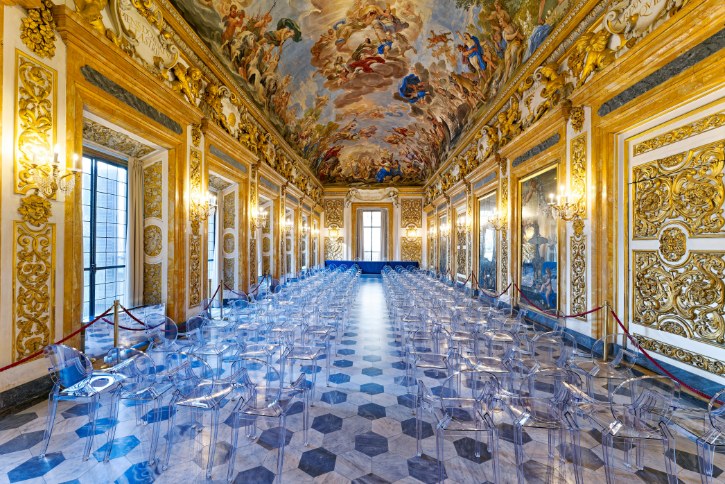
- A dazzling Hall of Mirrors, its ceiling painted by Luca Giordano in the 1680s
- A vivid contrast with Gozzoli’s quiet earlier chapel
- Walls that once hosted Cosimo’s Platonic Academy and a young Michelangelo
Leaving the palace, you turn south along Via de’ Martelli.
6. Via de’ Martelli
a. A Street With Medici Roots
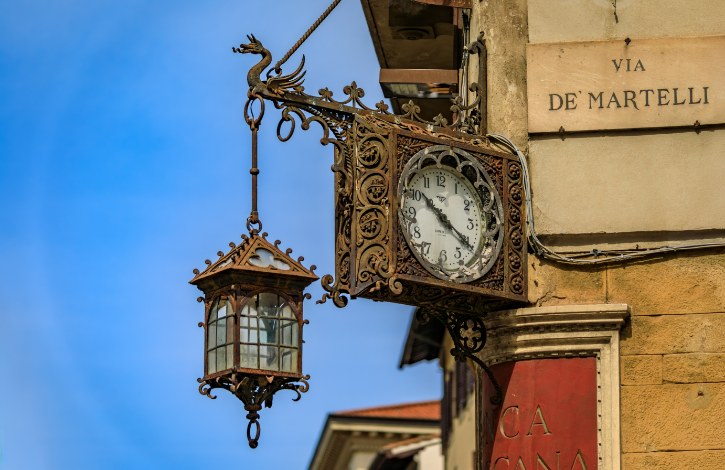
You’re on an old thoroughfare linking the Medici quarter to the religious center of Florence. It takes its name from the Martelli family, powerful bankers who stood with the Medici during their rise to power, and the street still carries a sense of that history.
b. The Landmark on the Corner
The street’s anchor is the Church of San Giovannino degli Scolopi, facing the Medici palace. A few things make it worth a glance:
- Founded in 1351 and rebuilt over the 1500s and 1600s under Bartolomeo Ammannati
- Later a center of science, home to a historic astronomical observatory
- A Mannerist façade and an interior with paintings by Jacopo Ligozzi, Alessandro Allori, and Francesco Curradi
c. The Everyday Buzz Around You
Compared with the grand palace, this street feels alive with people:
- Traditional four-story Florentine fronts with sandstone moldings
- Wrought-iron balconies above ground-floor shops
- A short, busy, pedestrian-friendly stretch between the Medici palace and the Duomo
d. The View That Builds Anticipation
Here’s the moment to watch for as you head south:
- The green, white, and pink marble of Florence Cathedral slowly rises between the rooftops
- The street then opens into the vast Piazza del Duomo
- You get the full scale of the cathedral and its soaring red-tiled dome all at once
That dramatic reveal sets the stage for one of Florence’s most famous landmarks.
7. Florence Cathedral (Duomo di Firenze)
a. The Heart of the City
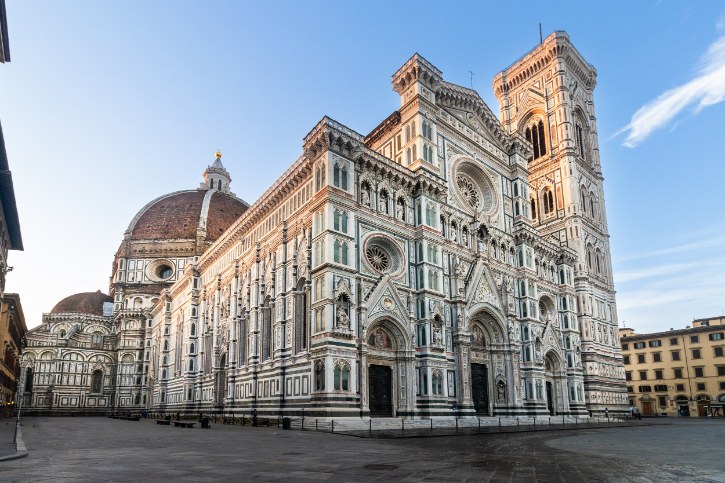
You’ve arrived at the architectural centerpiece of Florence, and its story spans generations:
- Begun in 1296 to replace a decaying older church
- First designed by Arnolfo di Cambio, who aimed for something larger than anything in Tuscany
- Carried forward over the next century by master builders, including Giotto
b. How the Impossible Dome Got Built
By 1418 the cathedral was nearly done, except for a 45.5-meter gap no one knew how to cover. In 1420, Brunelleschi won the job with a self-supporting dome built without wooden scaffolding. His clever solutions included:
- A double shell, with a thick structural inner dome beneath a thinner protective outer one
- Herringbone brickwork that passed the load safely downward
- Hidden stone and timber chains to resist the outward push
- Work rising on all eight sides at once, so it held itself up at every stage
- Custom ox-driven hoists to lift millions of pounds of material
Finished to the lantern base in 1436, it remains the largest masonry vault ever built.
c. The Marble Exterior and Bell Tower
Walk around the outside for the building’s exterior highlights:
- Colored Tuscan marbles, white from Carrara, green from Prato, and soft rose from Monsummano Terme and Maremma
- An elaborate western front built in the late 1800s to replace the medieval one
- Giotto’s Bell Tower, begun in 1334 and standing 84.7 meters tall
d. What to Look For Inside
Step in and look up for the interior’s best features:
- The Last Judgment Fresco, covering 3,600 square meters beneath the dome
- Paolo Uccello’s painted clock, which runs counter-clockwise on old Italian time
- Two painted horseback monuments honoring mercenary commanders
- An intricate inlaid marble floor begun in 1526
From this grand square, the route turns south along the city’s liveliest street.
8. Via dei Calzaiuoli
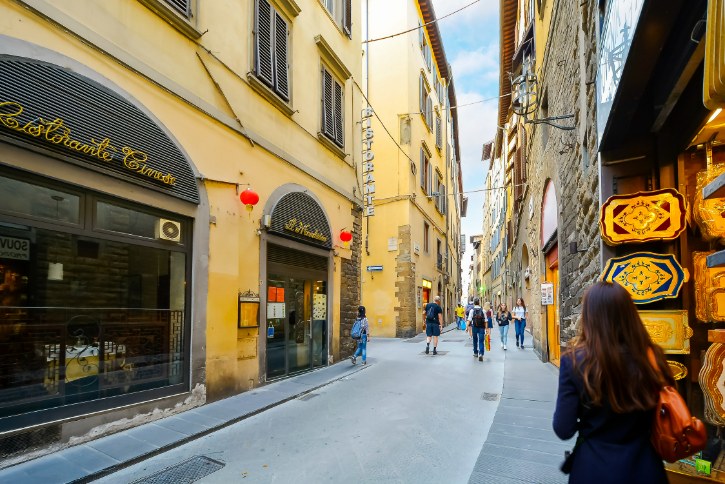
a. Florence’s Main Pedestrian Street
You’re on the artery that connects the cathedral with the civic heart at Piazza della Signoria:
- Narrower in medieval times and split into sections named after the trade guilds
- Widened into a single boulevard in the 1840s
- Now lined with cafés, boutiques, and traditional leather shops
b. The Church of the Guilds
The street’s great landmark is Orsanmichele, a former grain market turned guild church. Its outer walls hold one of the Early Renaissance’s defining sculpture programs, with casts standing in for the originals now kept in museums:
- Saint John the Baptist by Ghiberti, the first life-sized hollow bronze cast of the Renaissance
- Saint Mark by Donatello, which revived the classical weight-shift pose and drew Michelangelo’s praise
- Christ and Saint Thomas by Verrocchio, a dynamic two-figure bronze
- Saint George by Donatello, with a finely carved perspective relief on its base
c. The Views at Each End
As you walk, the framed views are worth pausing for:
- Looking north, you frame the Duomo’s marble flank and Giotto’s Bell Tower
- Looking south, the street ends at Palazzo Vecchio and its soaring tower
- Across the way stands the simple Gothic church of San Carlo dei Lombardi
d. A Street That’s Still Alive
The street still hums with daily life:
- Fully pedestrian, busy with shops and a steady flow of people
- An easy way to feel the city’s rhythm between its major monuments
- A westward turn that opens into a square with a very different story
9. Piazza della Repubblica
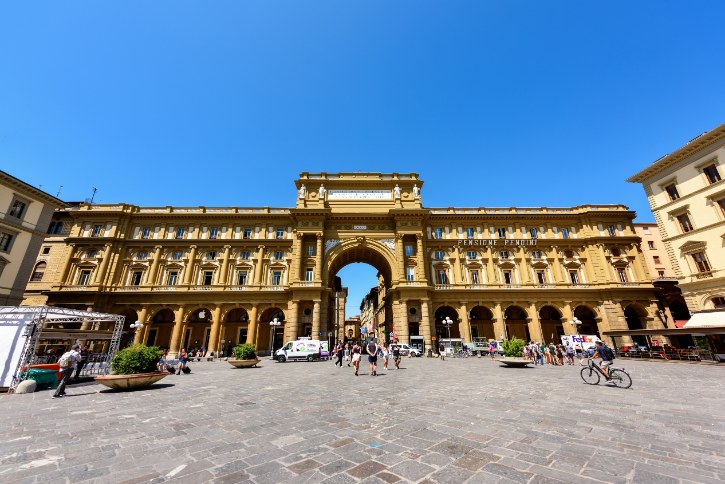
a. Standing on Ancient Roman Ground
You’re on the oldest ground in Florence, the founding center of the Roman city in 59 BC:
- Built on the site of the Roman Forum, where the two main roads crossed
- Marked by a tall granite Column of Abundance
- Once the hub of civic life, and a pillory for bankrupt debtors
b. From Old Market to Grand Square
The square’s look today comes from a dramatic 19th-century overhaul:
- For centuries this was the Mercato Vecchio, a dense maze of stalls and shops
- In the 1880s and 1890s the city demolished the medieval quarter
- Over twenty old churches, palaces, and towers came down
- A spacious neoclassical square rose in their place, inspired by the boulevards of Paris
- A monumental triumphal arch, the Arcone, closes the western side
c. The Historic Cafés
The square still keeps the literary café culture that flourished here around the turn of the last century:
- Caffè Gilli, established in 1733, with Belle Époque woodwork and Murano chandeliers
- Caffè Paszkowski, founded in 1846, once an elegant literary salon
- Antico Caffè Giubbe Rosse, headquarters of the Italian Futurist movement in the 1910s
d. A Square of Contrasts
The real charm here is the contrast:
- Grand 19th-century arcades opening onto narrow medieval lanes nearby
- A vintage carousel with painted horses that makes a lovely photo
- A short walk south that leads to the market and its famous bronze boar
10. Fontana del Porcellino
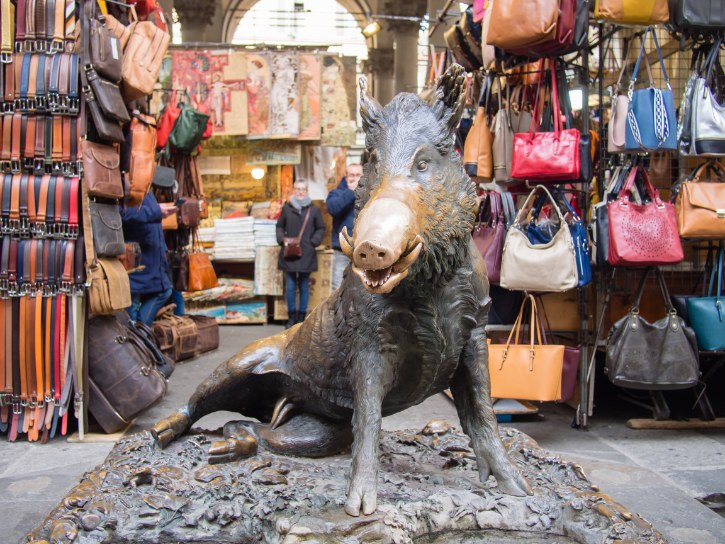
a. Florence’s Lucky Bronze Boar
You’ve reached one of the city’s best-loved small landmarks. Despite the nickname “Fountain of the Piglet”, the bronze shows a wild boar rising alert from the reeds. The sculptor Pietro Tacca cast it in bronze in 1633, copying an ancient marble boar now kept in the Uffizi, and it was turned into a public fountain for the market’s merchants.
b. The Good-Luck Ritual to Try
Here’s the fun part, and a tradition you can join in:
- Rub the boar’s snout for good luck and a future return to Florence
- The constant rubbing has polished the snout to a golden shine
- Place a coin in the boar’s open jaws and let it slide toward the grate below
- If the coin falls cleanly through, good fortune follows; if it lands on the bars, the wish goes unfulfilled
- The city collects all the coins to support local charities
c. The Market Hall Around It
The fountain sits beneath the Loggia del Mercato Nuovo, a historic market hall:
- Built in the mid-1500s and carried on twenty stone columns
- Once used to trade silks and wools, later famous for straw hats
- Home to the Stone of Shame, where bankrupt merchants once faced public humiliation
d. A Quick but Memorable Stop
You don’t need long here, but a few things make it worth the pause:
- The fine detail of the bronze boar and its fountain basin
- The good-luck ritual and the chance for a fun photo
- A nearby plaque remembering Hans Christian Andersen, inspired to write The Metal Pig
A short corridor now leads you into the grand square of Florence’s civic power.
11. Piazza della Signoria
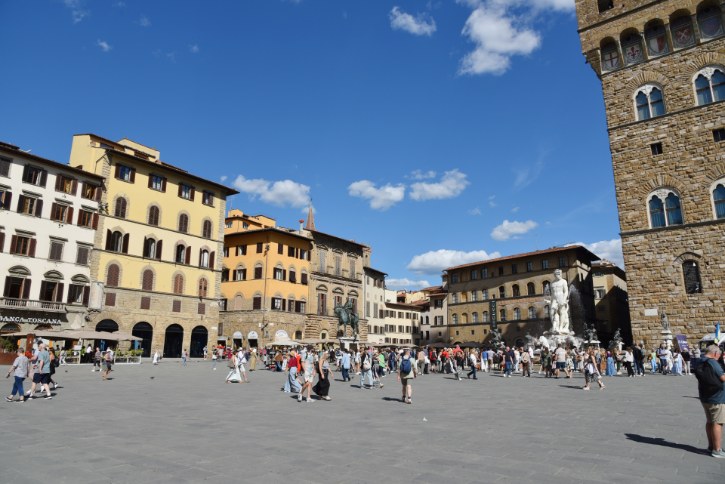
a. An Open-Air Museum of Sculpture
You’re standing in the political heart of Florence, a civic center since the 14th century:
- An L-shaped square dominated by the fortress-like Palazzo Vecchio, built between 1299 and 1314
- The towering 94-meter Torre d’Arnolfo rising above it
- An open-air gallery of powerful sculpture, rather than a square built around a church
b. The Statues You’ll Recognize
Famous works line the square, each with a story:
- Michelangelo’s David (a replica), marking the spot where the original stood for centuries
- Bandinelli’s Hercules and Cacus, a statement of Medici strength
- Donatello’s Judith and Holofernes (a replica), once an emblem of liberty
- Donatello’s Marzocco (a replica), the lion resting its paw on the Florentine lily
- Giambologna’s bronze horseback monument to Grand Duke Cosimo I
c. The Grand Fountain and a Solemn Marker
Two more landmarks anchor the square:
- Ammannati’s Fountain of Neptune, built around a colossal marble sea god nicknamed Il Biancone
- A round pavement plaque marking where the friar Girolamo Savonarola was burned in 1498
- A yearly ceremony that lays flower petals on the marker
d. Why This Square Still Matters
This is where many of the city’s defining moments played out:
- The struggles of the Florentine Republic and the rise of the Medici
- Buildings and statues raised to broadcast political authority
- A setting that flows right into the Loggia dei Lanzi and the Uffizi next door
For the best photos, set the statues against the palace and its tower. Along the south corner, a set of soaring arches invites a closer look.
12. Loggia dei Lanzi
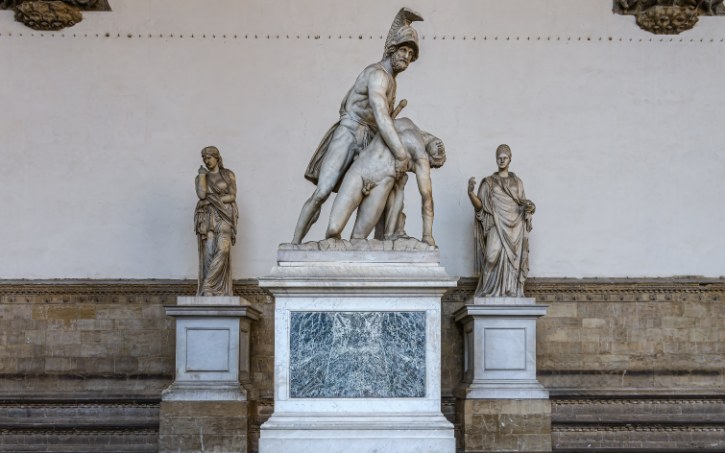
a. An Outdoor Gallery of Masterpieces
You’re at a covered sculpture gallery right on the square, built between 1376 and 1382. It first served as a stage for public ceremonies and official proclamations, and its broad arches already hinted at the Renaissance to come. It took its name from the German guards a Medici duke once stationed beneath its vaults.
b. The Sculptures to Study Closely
Beneath the stone vaults stand some of Europe’s great sculptures:
- Cellini’s Perseus with the Head of Medusa, a bronze masterpiece with a dramatic casting story
- Giambologna’s The Rape of the Sabine Women, carved from a single block of marble and spiraling through three figures
- Giambologna’s Hercules and Nessus, a display of twisting, dynamic anatomy
- Two marble Medici Lions guarding the steps, one an ancient Roman original
c. A Hidden Detail Worth Hunting For
Here’s a secret to look for: on the back of Perseus’s helmet, Cellini carved a hidden self-portrait. His own autobiography tells how he threw his household pewter plates and pots into the furnace to keep the metal flowing during the difficult casting.
d. Seeing Art in Natural Light
The real gift of the Loggia is simple:
- You see major sculpture in daylight, out in a public square
- Shifting shadows bring out the marble’s contours and the bronze’s patina
- Circling each figure reveals new angles against the historic arches
From here, the route moves into a world-class painting collection.
13. Uffizi Gallery (Galleria degli Uffizi)
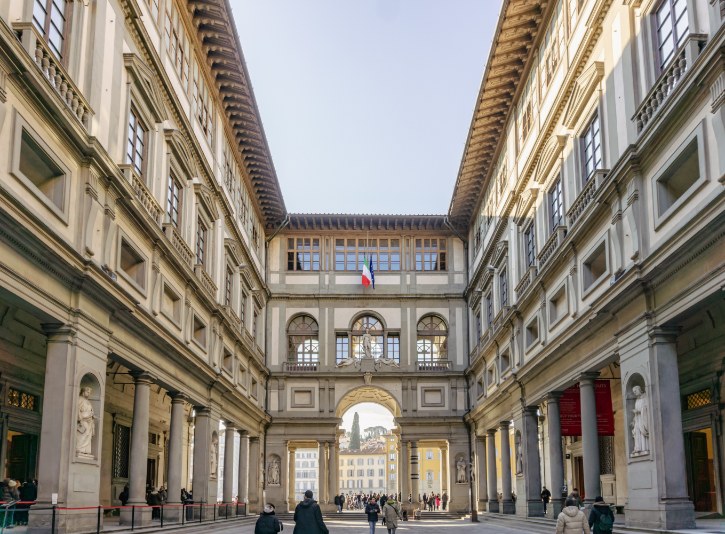
a. From Government Offices to Great Museum
You’re at one of the world’s most important art museums, and its name tells its origin. Duke Cosimo I commissioned it in 1560 as government offices (uffizi) and gave the job to Giorgio Vasari. The top floor was later turned into a private gallery for the Medici collection, becoming one of the first modern museums in Europe.
b. The Paintings Inside
If you go in, you’ll find one of the richest collections of Renaissance art anywhere:
- Botticelli’s The Birth of Venus and Primavera, two famous tempera masterpieces
- Leonardo da Vinci’s Annunciation, rich in detail and soft atmospheric depth
- Michelangelo’s Doni Tondo, his only surviving finished panel painting
- Caravaggio’s Medusa, painted on a round tournament shield
- Major works by Titian and Raphael
c. Beauty You Can Enjoy for Free Outside
You don’t even have to go in to appreciate the building. The long courtyard is a work of art in itself, lined with marble statues of famous Tuscans, grouped by their fields:
- Artists like Leonardo, Michelangelo, and Donatello
- Writers like Dante, Boccaccio, and Petrarca
- Thinkers like Machiavelli, Galileo, and Amerigo Vespucci
At the far end, the arches frame a lovely view toward the river and the hills beyond.
d. The Woman Who Saved It All
You can thank one person for the collection staying in Florence. Anna Maria Luisa de’ Medici, the last of the family line, signed a pact in 1737 that bound the entire collection to the city forever, so it would remain, in her words, “for the ornament of the State, for the utility of the Public, and to attract the curiosity of Foreigners”. From here, the route heads down to the river.
14. Lungarno degli Archibusieri
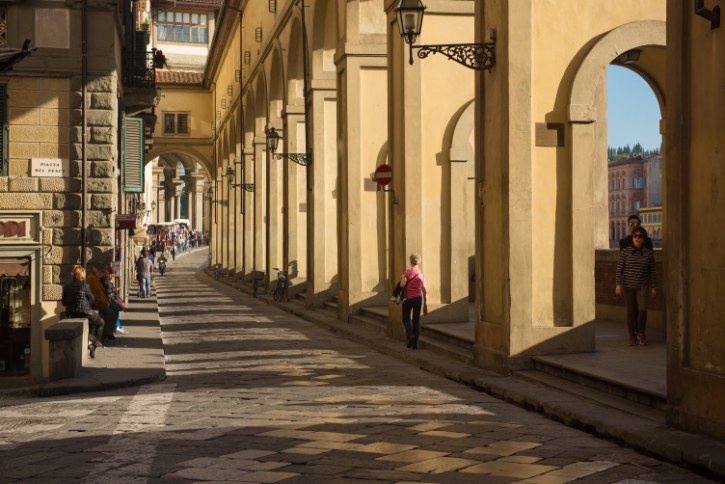
a. A Quiet Walk Along the River
You’ve left the busy streets behind for a peaceful embankment along the north bank of the Arno. It runs between the Uffizi and Ponte Vecchio, and takes its name from the 16th-century firearm makers who once built and tested their weapons along this stretch of the river.
b. The Famous Passage Overhead
The dominant feature here is easy to spot above you:
- The elevated Vasari Corridor, carried on large stone pillars and round arches
- Designed by Vasari in 1565 as a private passage for the Medici
- Built so the grand dukes could cross the river without walking at street level
c. The Views That Make It Worth It
This is where the river scenery really opens up. Come in the late afternoon for the best of it:
- Clear views of Ponte Vecchio and its shops hanging over the water
- Warm reflections as the setting sun lights the ochre and terracotta façades
- The green slopes of the Boboli Gardens and a hilltop fortress across the river
d. A Stretch to Simply Enjoy
This is a short walk, best enjoyed by slowing down:
- Watch the river and study the arches overhead
- Notice how the views shift with each step as the city meets its waterfront
- Let the details and the play of light give you a reason to linger
Continuing west, the arches draw your eye toward the city’s most famous bridge.
15. Ponte Vecchio
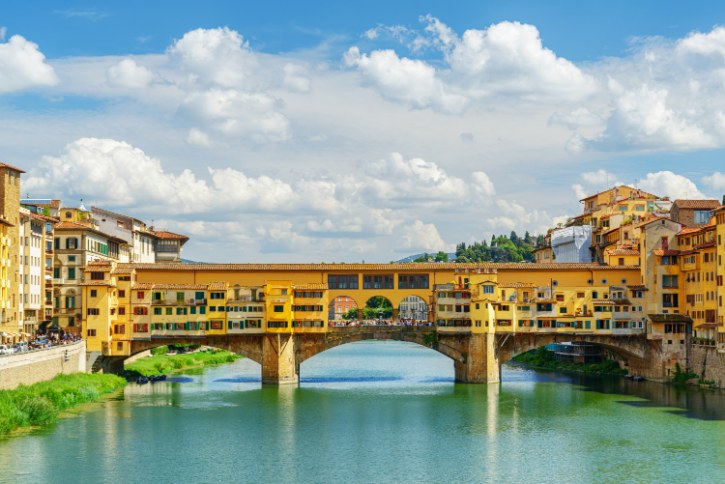
a. Florence’s Legendary Old Bridge
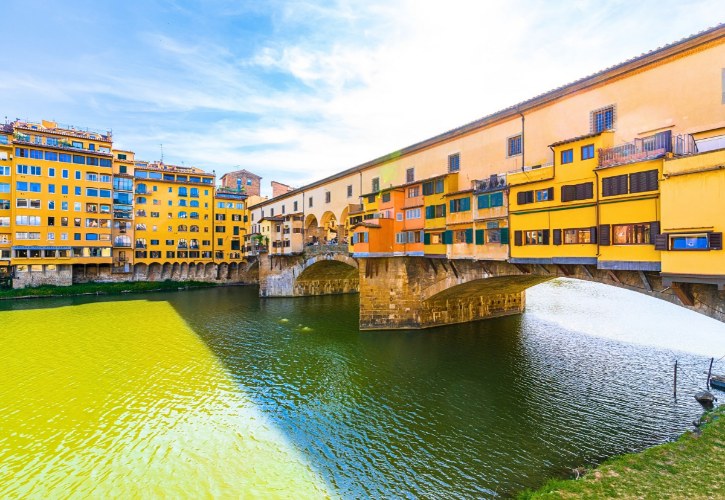
You’ve reached the oldest stone bridge in Florence, crossing the Arno at its narrowest point. The current bridge went up in 1345, after floods repeatedly swept away earlier wooden ones. Its three low, segmented arches were an engineering triumph, letting floodwaters and debris pass through with far less resistance.
b. The Bridge of Goldsmiths
Crossing it feels unlike any ordinary bridge, thanks to the shops lining both sides:
- The shops first went to butchers and tanners, who dumped waste into the river
- In 1593, Grand Duke Ferdinando I, tired of the smell, evicted them
- He ruled that only goldsmiths, jewelers, and silversmiths could work here
- That decree turned the bridge into the renowned jewelry destination it still is
- Overhead runs the Vasari Corridor, built in just five months to link two Medici palaces
c. How It Survived War and Flood
The bridge has weathered centuries of disaster, and the stories are remarkable:
- In the great flood of November 1966, the water smashed through the shops, but the stone arches held firm
- During World War II, retreating forces blew up every other bridge on the Arno
- Only Ponte Vecchio was spared, its approaches instead blocked with rubble from demolished buildings
- Popular legend credits an order from Hitler, though a plaque on the bridge credits the German consul, Gerhard Wolf, with saving it
d. Your Final View Over the Arno
At the center, the shops open to a panoramic viewing terrace:
- A bronze bust of the goldsmith Cellini on the balustrade
- A view west framing the graceful curves of Ponte Santa Trinita
- Great photos from the riverbank, the central opening, and the jewelry-shop fronts
And that completes your route. From the marble façade of Santa Maria Novella to the goldsmiths of Ponte Vecchio, you’ve walked through the spiritual, civic, and artistic soul of Florence, all within a few easy minutes between stops. Take your time, follow your curiosity, and let the city reveal itself one beautiful corner at a time.