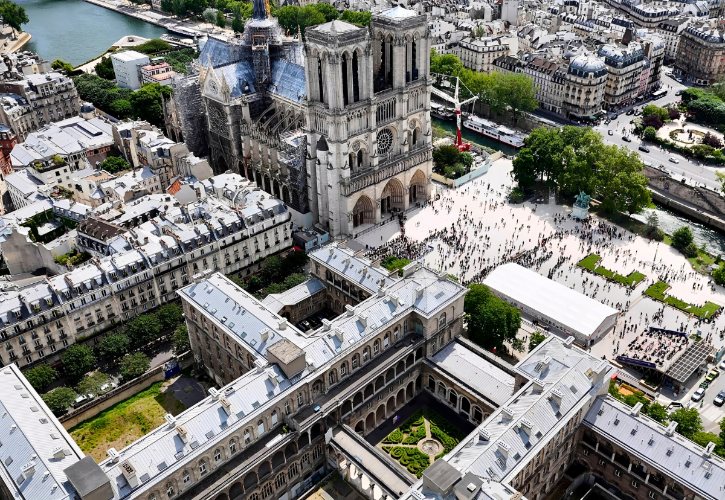
Picture a stretch of Paris where two thousand years of history sit within a short, easy walk. Along the Seine, grand squares, world-class art, formal gardens, old bridges, and Gothic landmarks line up almost next to each other.
You can stroll from one to the next in just 1 to 5 minutes, peeling back another layer of the city with every step. Lace up comfortable shoes, because this gentle route rewards you at every turn. 😊
1. Place de la Concorde
a. The Grand Square That Sets the Scene
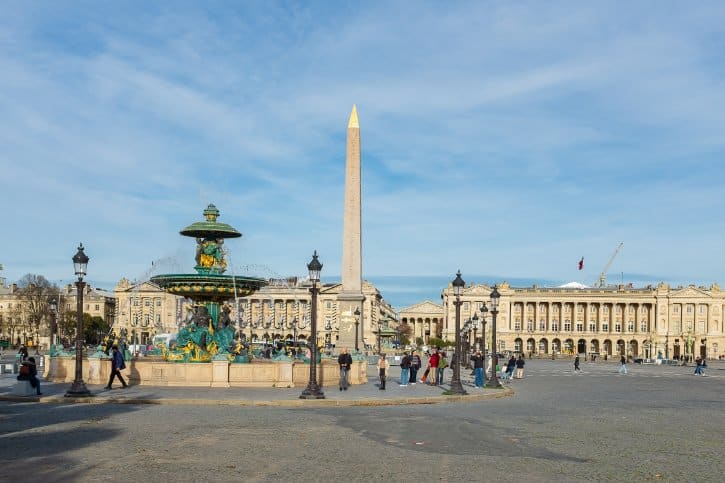
You start in the largest and most open square in Paris, and it makes a perfect opening act.
- Commissioned in 1755 to honor King Louis XV.
- Designed by royal architect Ange-Jacques Gabriel.
- First named Place Louis XV.
- Built as an open, eight-sided plaza, left wide to the river and gardens instead of enclosed like older squares.
b. Stand Here and Read the City
From the center, you are standing on Paris’s great east-west line, the Axe Historique (Historical Axis). Turn slowly and follow the views:
- West: up the Champs-Élysées to the Arc de Triomphe.
- East: through the Tuileries Garden gates toward the Louvre.
- North: up Rue Royale to the Madeleine
- South: across the river to the Palais Bourbon, home of the National Assembly.
That single spot shows you how Paris was planned, with monuments lined up on purpose.
c. The Ancient Egyptian Obelisk
The tall stone needle at the heart of the square is the Luxor Obelisk, and it is genuinely ancient:
- Around 3,300 years old, carved from a single block of granite.
- About 23 meters tall and roughly 220 metric tons.
- Once stood at the Luxor Temple in Egypt, linked to Pharaoh Ramesses II.
- Given to France and raised here in 1836.
Look closely for the carved hieroglyphs, the gilded diagrams on the pink granite base, and the gold-topped tip.
d. Fountains, City Statues, and Photo Spots
Architect Jacques Ignace Hittorff added two grand cast-iron fountains and a ring of statues:
- Fontaine des Mers (Fountain of the Seas) on the south side, honoring the oceans.
- Fontaine des Fleuves (Fountain of the Rivers) on the north side, honoring river trade.
- Eight corner statues standing for major French cities like Marseille, Lyon, and Strasbourg.
- Best photo: line up the gilded obelisk tip so it frames the distant Arc de Triomphe.
e. A Square With a Dark Past
This calm space once held the guillotine during the French Revolution:
- It was renamed Place de la Révolution.
- King Louis XVI and Queen Marie Antoinette were both executed here.
- In 1795 it took the name Place de la Concorde, meaning harmony, to mark reconciliation.
Knowing this adds quiet weight to the wide, peaceful plaza around you.
f. On to the Orangerie
Head to the southwest corner of the Tuileries and climb the ramp toward the river, where a small museum trades grand views for pure painted calm.
2. Musée de l’Orangerie
a. A Greenhouse Turned Art Museum
This building began in 1852 as a winter shelter for the orange trees of the Tuileries, and its design still shows that purpose:
- The south wall facing the Seine is almost all glass, to catch winter sun.
- The north wall is solid stone, to block cold winds.
- It later became a museum for modern painting, reshaped to bring back natural daylight.
b. Monet’s Water Lily Rooms
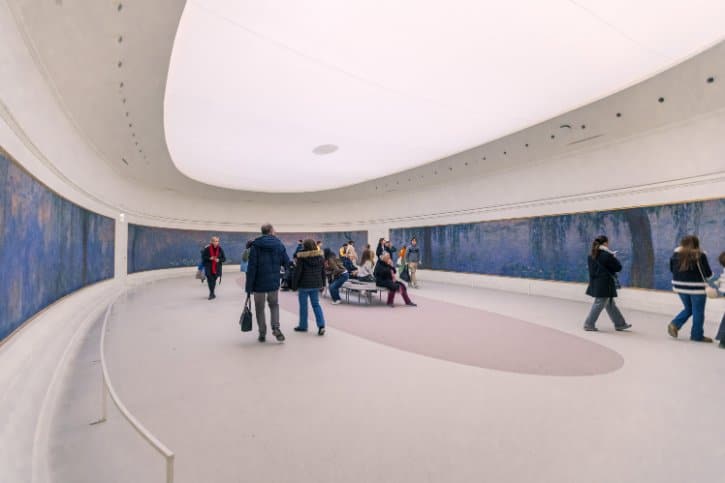
The heart of the museum is Claude Monet’s giant Nymphéas (Water Lilies):
- Eight curved panels, each about 2 meters
- Around 91 meters long in total.
- Set in two oval rooms built just for them.
- Given to France as a gift for peace after World War I.
Monet planned every curve and light opening himself, so the paintings wrap around you like a calm horizon.
c. How to Truly Enjoy the Panels
Take your time in these rooms and try this:
- Sit first on the central bench and take in the whole room.
- Walk the walls slowly, letting the scenes surround you.
- Step close to see Monet’s thick brushwork.
- Step back and watch it melt into water, clouds, and sky.
The soft skylight shifts with the weather, so the colors quietly change through the day.
d. A Bonus Collection Downstairs
Head down the stairs for a superb collection tracing the path from Impressionism into modern art. Look for works by:
- Cézanne and Renoir, warm and luminous.
- Picasso and Modigliani, bold and modern.
- Henri Rousseau and Soutine, dreamlike and full of feeling.
e. Why It Feels So Restful
Trust me, after the huge Louvre later on, this place is a real breath of fresh air:
- It is small and easy to see in one relaxed visit.
- Natural light pours into Monet’s oval rooms, giving them a soft glow.
- Moving between the downstairs collection and Monet’s sunlit rooms feels almost meditative.
f. Back Into the Gardens
Step back outside and you go from painted lilies to the real thing, onto the gravel paths of one of the world’s most famous gardens.
3. Tuileries Garden
a. The Oldest Garden in Paris
The Jardin des Tuileries covers about 25.5 hectares (63 acres) between Place de la Concorde and the Louvre:
- Started in 1564 by Queen Catherine de’ Medici.
- Redesigned in 1664 by André Le Nôtre, the mastermind behind Versailles.
- Built as a jardin à la française (formal French garden).
- Given a strong central line that later grew into the Champs-Élysées.
b. Reading the Deliberate Design
This is open-air architecture, not just a park. Look for:
- Neat lawns and boxwood scrolls at the eastern end.
- Tidy groves of linden and chestnut trees in strict rows.
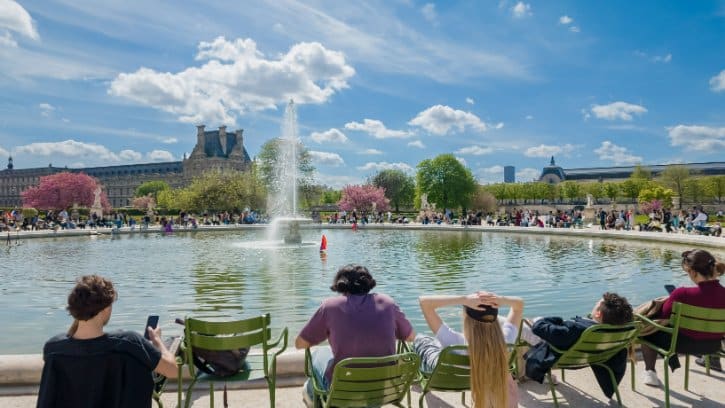
- Two big basins, one round and one eight-sided.
- Raised terraces running along the edges.
Once you spot the symmetry, the whole garden clicks into place.
c. Sculptures and the Famous Green Chairs
The garden doubles as an outdoor art gallery:
- Rodin sculptures on the Orangerie terrace, including The Kiss and Eve.
- Maillol bronzes near the eastern end.
- Modern works by Louise Bourgeois and others.
- Movable green metal chairs you can drag to the water’s edge and settle into like a local.
d. A Garden for Every Season
Even if garden history is not your thing, this space is a joy year-round:
- Spring: blossoms on the chestnut trees.
- Summer: shady canopies, with kids sailing wooden boats on the big octagonal basin.
- Autumn: warm gold and russet leaves.
- Winter: bare branches showing off the clean, sculpted lines.
e. Free Views of Famous Landmarks
The main path offers some of the best free views in the city:
- West: the obelisk lined up inside the distant Arc de Triomphe.
- East: a small arch framing the Louvre.
- South: the Musée d’Orsay with its big glass clock across the river.
f. Toward the Little Arch
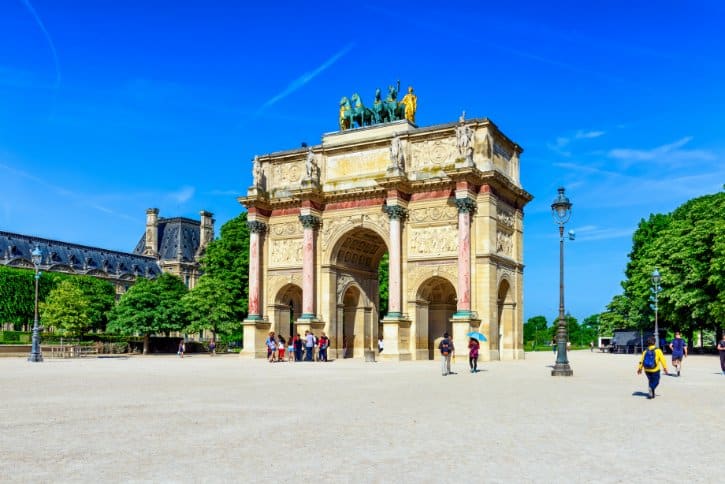
Keep walking east and the garden funnels your eye toward a small pink-and-white arch standing guard at the gate of the Louvre.
4. Arc de Triomphe du Carrousel
a. Napoleon’s Smaller Victory Arch
This arch was ordered by Napoleon I in 1806 to celebrate his victories, and finished in 1808:
- About 19 meters
- Built by his court architects Percier and Fontaine.
- Modeled on ancient Roman triumphal arches.
b. Why It Looks So Different
You may wonder why it feels unlike the giant Arc de Triomphe across town:
- It keeps the old Roman love of colored stone, mixing red and white marble.
- The larger arch is huge and plain by comparison.
- This one has a triple-arch shape, one tall passage with two smaller ones.
c. The Horses With a Backstory
The bronze chariot and horses on top have a wild history:
- Napoleon first placed the famous Horses of Saint Mark, taken from Venice.
- They were returned to Italy in 1815 after his defeat.
- What you see now is a replacement, cast in 1828, showing Peace in a chariot.
d. What “Carrousel” Really Means
The name goes back to a royal celebration on this ground:
- In 1662, King Louis XIV held a grand horse pageant here for the birth of his son.
- During that event he first adopted his sun emblem.
- That moment marked the birth of his image as the Sun King.
- The event was so grand that it gave this whole area its lasting name.
e. The Best Frame for Photos
This little arch is a natural picture frame:
- Looking west: it frames the whole axis, the obelisk, and the far Arc de Triomphe.
- Looking east: it frames the glass Pyramid against the classical Louvre.
f. Into the Palace Grounds
Walk under the arch and you pass straight into the great courtyard of the Louvre, with the glass Pyramid shining ahead.
5. Louvre Museum
a. A History Book Written in Stone
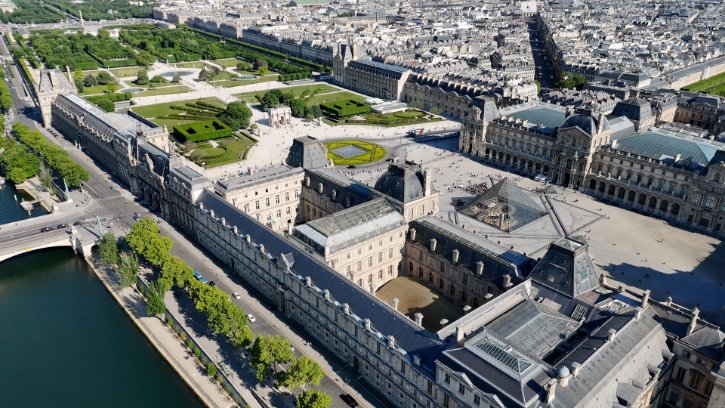
The Louvre was built and rebuilt over more than eight centuries:
- Began around 1190 as a medieval fortress.
- Turned into a royal palace in the Renaissance.
- Grew wing by wing under kings and emperors.
- Gained its glass Pyramid by architect M. Pei in 1989.
Just walking the outside, you can trace French architecture from medieval walls to modern glass.
b. The Must-See Masterpieces
The Louvre holds over 35,000 works, so knowing a few helps. Seek out:
- The Mona Lisa by Leonardo da Vinci, famous for her soft, smoky edges.
- The Winged Victory of Samothrace, with wind-blown “wet drapery”.
- The Venus de Milo, with her graceful curving pose.
- The Raft of the Medusa and Liberty Leading the People, huge and dramatic.
c. Beyond the Big Names
Give yourself time for these too:
- The Great Sphinx of Tanis in the Egyptian crypt.
- The lavish Napoleon III Apartments, dripping with gilt and crimson.
Read why a work matters, not just its fame, and the visit sticks with you.
d. The Courtyards You Can Enjoy for Free
You do not even need a ticket to appreciate the outside:
- Cour Carrée: a calm, harmonious courtyard.
- Cour Napoléon: Pei’s Pyramid reflecting the sky and old façades.
- Passage Richelieu: views down into glass-roofed sculpture courts.
e. Hidden Details Most People Walk Past
Slow down and find these small treasures:
- The medieval moat beneath the courtyard, where you can touch the old keep.
- Carved monograms of Henri II and Catherine de’ Medici on the walls.
- Bullet marks from the 1944 Liberation along the riverside stone.
f. Out to the River
To swap crowded galleries for open sky, head south toward the Seine and step onto a wooden footbridge.
6. Pont des Arts
a. The First Iron Bridge in Paris
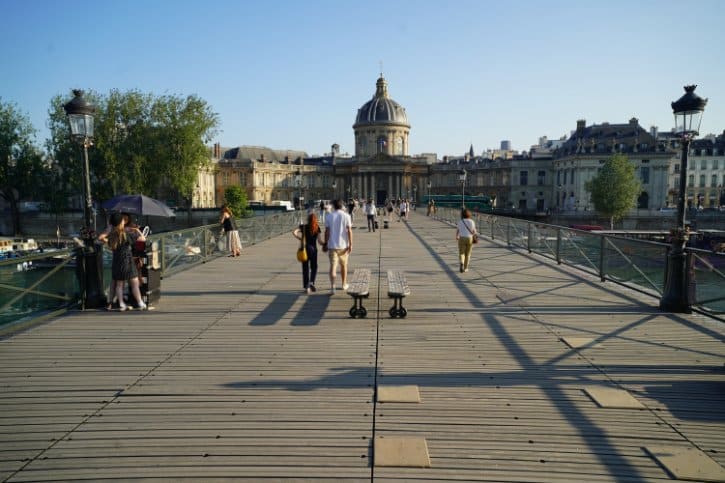
The Pont des Arts links the Louvre to the Institut de France on the Left Bank:
- Built between 1801 and 1804.
- The first iron bridge in the city.
- Named after the Louvre, once called the Palais des Arts.
- Rebuilt in the 1980s with steel arches, keeping its light, airy look.
b. The Truth About the Love Locks
You may have heard about the padlocks, and here is what really happened:
- Around 2008, visitors clipped locks to the railings.
- By 2014 there were up to a million locks, over 45 metric tons of metal.
- The weight collapsed part of the railing.
- The city replaced the panels with clear glass, so no new locks stick.
Please leave the locks at home. The glass panels make that clear.
c. One of the Best River Views on the Walk
This is a top spot for river scenery:
- Upstream (east): the pointed tip of the Île de la Cité, with the spires of Sainte-Chapelle and Notre-Dame
- Downstream (west): the Seine stretching toward the Grand Palais and the upper Eiffel Tower.
Some far landmarks only peek out depending on where you stand, so move around for the best angle.
d. A Bridge Loved by Artists
This crossing has drawn creative people for two centuries:
- Painters like Renoir and Pissarro captured its river views.
- Photographers Doisneau and Brassaï shot Parisian life here.
- It appears in French films, including Amélie.
e. Part of a World Heritage Riverbank
The bridge sits inside a protected treasure of the city:
- It belongs to the UNESCO site Paris, Banks of the Seine, listed in 1991.
- That listing protects the whole riverbank and its bridges together.
- So the Pont des Arts is one piece of it, not a separate title of its own.
f. Back to the Right Bank
Cross back and walk through the Louvre’s eastern courtyard toward a quiet Gothic church that is easy to miss.
7. Église Saint-Germain-l’Auxerrois
a. The Kings’ Own Parish Church
This is one of the oldest church sites in central Paris:
- Founded in the 6th century.
- Rebuilt in the 11th century.
- Served as the royal parish church for kings living at the Louvre.
- Deeply tied to the crown thanks to its spot right across from the palace.
b. Five Centuries in One Building
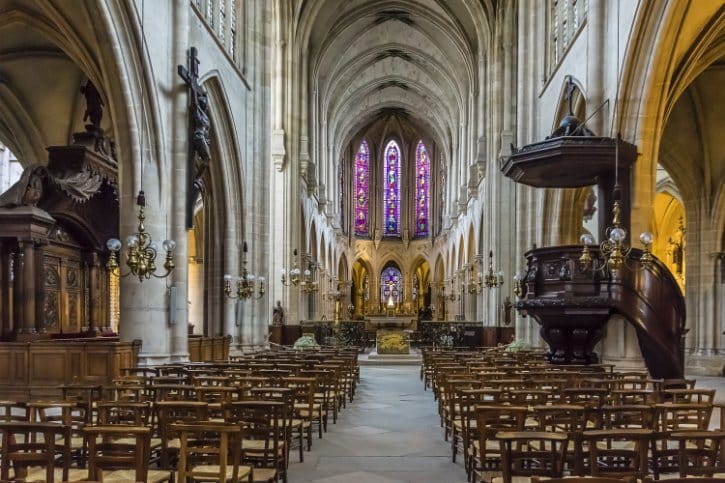
The church is really many eras stacked together. Look for:
- A Romanesque bell tower from the late 12th century, the oldest surviving part.
- A Gothic choir, the oldest part of the interior.
- A nave rebuilt in the 15th century.
- A lacy Flamboyant Gothic porch from the 1430s, worth a slow look on the façade.
c. Where Royal Artists Rest
Because kings worshipped here, the church became a resting place for artists who served the crown:
- Sculptor Antoine Coysevox.
- Painters François Boucher and Jean-Baptiste-Siméon Chardin.
d. A Church Tied to a Dark Night
The church is linked to one of the darkest nights in French history:
- In 1572, its bell is recorded as ringing the signal for the Bartholomew’s Day Massacre.
- Catholic mobs then attacked Protestant Huguenots across the city.
- The bell detail comes from historical tradition, so treat it as a recorded association rather than a hard fact.
e. Treasures Inside
Keep an eye out for these:
- A carved Flemish altarpiece from Antwerp, made around 1515.
- A grand carved royal pew commissioned by Louis XIV.
- Renaissance stained glass in the transept.
The interior is dark and hushed, lit by candles, so you can usually stand in quiet here.
f. A Splash of Modern Color
Now for a complete change of mood. Turn onto Rue de Rivoli toward a building covered head to toe in art.
8. 59 Rivoli
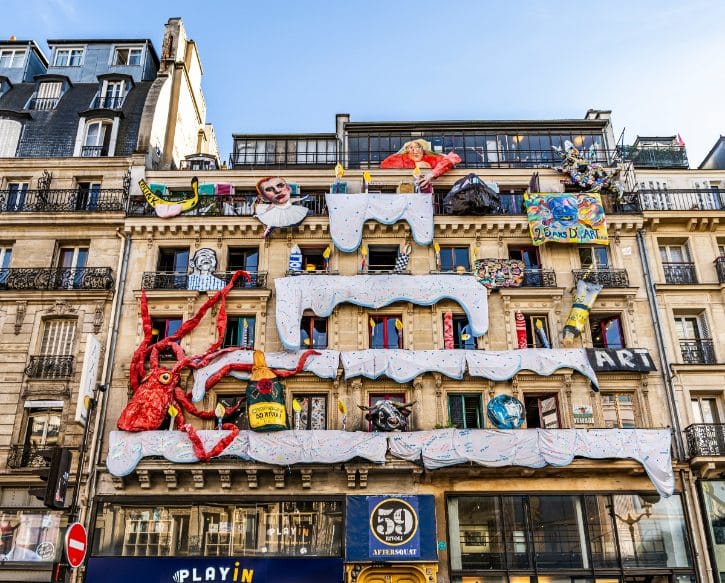
a. From Empty Bank to Art House
59 Rivoli is a burst of modern creativity in a very historic district:
- Once a bank, left empty in the mid-1980s.
- Taken over by an artist collective in 1999.
- Bought and made legal by the City of Paris in 2002.
- Now run as a supported creative space, open to all.
b. A Living, Working Studio
This is a working art house, not a normal gallery:
- Artists create here in painting, sculpture, collage, and digital art.
- It mixes long-term residents with visiting artists.
- An open-door policy lets you wander in for free.
- The ground floor hosts exhibitions, concerts, and readings.
c. Climb the Staircase
The real magic is the central spiral staircase:
- Nearly every surface is covered in murals and graffiti.
- Each floor holds different studios, from painting to textiles.
- You can chat with artists, watch them work, and buy pieces directly.
d. A Façade That Never Stays the Same
This building happily breaks the neat rules of Rue de Rivoli:
- The front is treated as a living canvas.
- You might see giant sculpted eyes, bright banners, or painted masks.
- It stands out instantly from the plain shopfronts nearby.
The playful energy is permanent, but the specific art on the front keeps changing.
e. Old Street, New Spirit
Rue de Rivoli is all uniform stone and cast-iron balconies, so this splash of color feels like a joyful surprise, and a fun reminder that Paris is not only about the past.
f. Down to the Oldest Bridge
Head south toward the river to reach a bridge with a name that will make you smile.
9. Pont Neuf
a. The “New Bridge” That Is Actually the Oldest
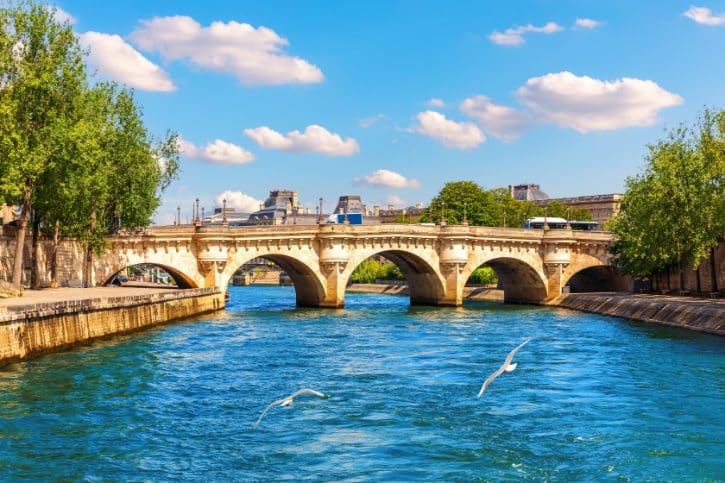
Here is a fun bit of irony. Pont Neuf means “New Bridge”, yet it is the oldest surviving bridge across the Seine in Paris:
- First stone laid in 1578 by King Henri III.
- Finished and opened in 1607 under King Henri IV.
b. Why It Changed Paris
It was a real breakthrough for its time:
- No houses on it, so the views and air stayed open.
- The first raised sidewalks in the city, keeping walkers safe.
- The first stone bridge to join both banks and the island in one crossing.
It turned a river crossing into open public space.
c. Details You Might Walk Past
Slow down and look for these:
- Cutwaters, the pointed stone shapes that push back river ice.
- Semicircular stone balconies where you can lean out over the water.
- 381 carved stone masks (mascarons) ringing the edge, each with a different face.
- Mostly later copies today, with a few originals kept in city museums.
d. The King on Horseback
At the center stands the bronze statue of Henri IV:
- The first version went up in 1614.
- It was melted for cannon during the Revolution.
- The current statue was placed in 1818.
e. The Beating Heart of Old Paris
For centuries this bridge was the city’s social stage, alive with:
- Street performers and singers.
- Tooth-pullers and fire-eaters.
- Book peddlers, the ancestors of today’s riverside sellers.
An old saying claimed you could not cross without seeing a monk, a white horse, and a courtesan.
f. Down to the Riverbank
At the center, behind the statue, look for stone stairs leading down into a quiet green garden.
10. Square du Vert-Galant
a. A Garden at the Water’s Edge
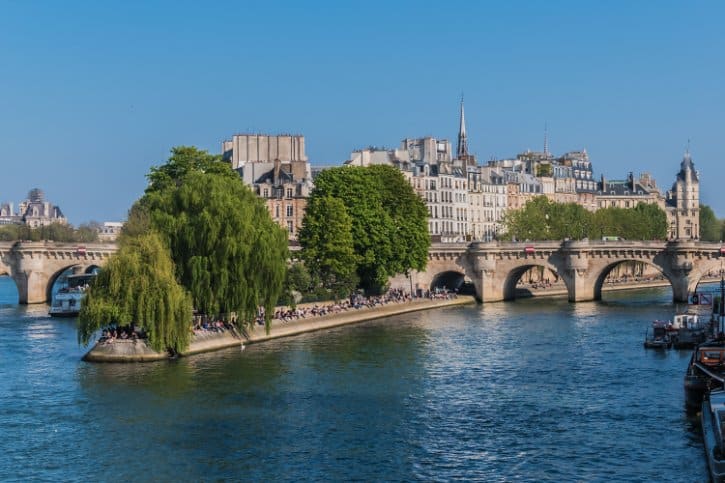
This little park sits at the western tip of the Île de la Cité, low and close to the Seine:
- Created in 1884.
- Sits about seven meters below street level.
- Shaped like a triangle, following the narrow point of the island.
b. The Story Behind the Name
The name carries a little wink of Parisian history:
- Vert-Galant (the Green Gallant) was Henri IV’s nickname.
- It nodded to his charm and lively spirit into old age.
- The name ties this quiet garden right back to his statue on the bridge above.
c. Views You Cannot Get From Above
Because you are down at river level, the perspective feels completely different:
- Look east at the heavy stonework of Pont Neuf rising above the trees.
- Watch the two arms of the Seine rejoin just off the downstream tip.
- See boats glide by just yards from the stone edge.
This low angle is perfect for catching reflections on the water.
d. Trees and Riverside Calm
The garden’s signature features make a peaceful green pocket in the middle of the city:
- A weeping willow at the western point, branches trailing to the river.
- Lawns and walnut trees.
- Stone embankments right at the water’s edge.
e. A Grim Medieval Marker
On the stone wall at the entrance, a plaque records a dark event:
- Jacques de Molay, the last Grand Master of the Knights Templar, was burned here in 1314.
- Legend says he cursed the king and pope from the flames.
- Take that curse story as tradition rather than fact.
f. Up to a Hidden Square
Climb back to the bridge and slip through a narrow passage into one of the island’s most charming corners.
11. Place Dauphine
a. A Royal Square With a Triangle Shape
Place Dauphine was planned in 1607 by King Henri IV:
- The second royal square built in Paris.
- Named for his son, the Dauphin, the future Louis XIII.
- Shaped like a triangle to fit the narrowing island.
b. The Original Look
Henri IV wanted a unified design of matching houses:
- Arcaded stone ground floors for shops.
- Red brick upper floors trimmed with white stone.
- Steep slate roofs with dormer windows.
The best-preserved originals are the two western houses facing Pont Neuf.
c. A Quiet, Leafy Center
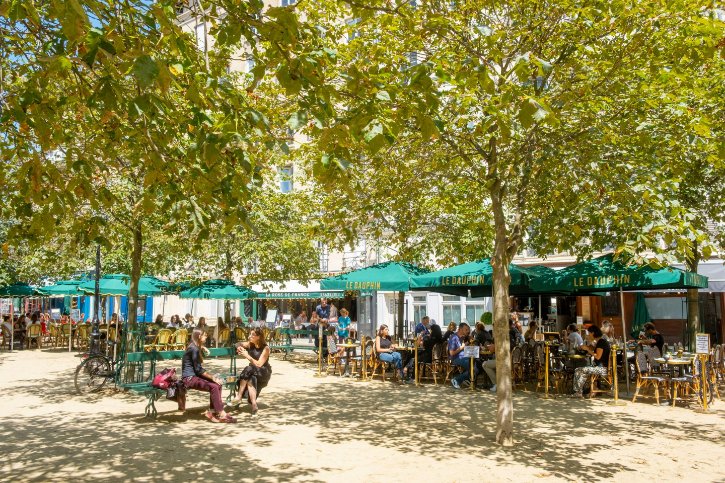
The open middle is a simple retreat:
- Gravel paving under horse chestnut trees.
- Benches where locals play pétanque in the afternoon.
- Small café terraces glowing under iron lamps at night.
That shaded center gives the square its cozy, tucked-away feel.
d. Small Details to Notice
Look for the little touches that make it memorable:
- Wrought-iron window guards and carved stone keystones.
- Historic brass door knockers.
- Glimpses through to Pont Neuf.
e. Calm in the City Center
It can feel remarkably peaceful for a spot in the heart of Paris:
- With only two narrow ways in, no traffic passes through.
- The noise of the quays fades away.
- All you hear is the clack of pétanque balls and clinking glasses.
f. Toward the Medieval Palace
Walk out the eastern end and follow the quay, where round medieval towers rise from the riverbank.
12. Conciergerie
a. A Palace Older Than the Kings’ Memory
The Conciergerie is the main surviving part of the Palais de la Cité, the earliest seat of royal power in Paris:
- Home to Roman, Merovingian, and Capetian rulers.
- Abandoned as a royal home in 1358.
- Later became a large state prison.
- Shares the same medieval grounds as Sainte-Chapelle and today’s law courts.
b. The Riverside Towers
The front along the Seine is one of Europe’s finest medieval scenes. Four towers stand out:
- Tour Bonbec: the oldest, once used for torture.
- Tour de César and Tour d’Argent: round towers for offices and the treasury.
- Tour de l’Horloge: home to Paris’s first public clock.
Seen from across the river, this façade lets you feel the weight of medieval Paris.
c. The First Public Clock
The clock on the Tour de l’Horloge is a treasure:
- First installed in the 1370s.
- Turned into a Renaissance monument in 1585.
- Restored in recent years.
- Watch for the gilded hands on deep blue, the golden lilies, and the figures of Law and Justice.
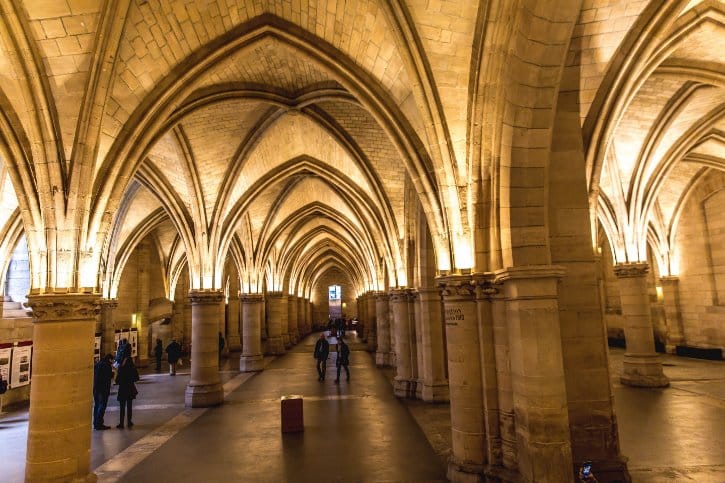
d. The Great Gothic Halls
Inside are two of the largest surviving Gothic secular halls in Europe:
- Salle des Gens d’Armes (Hall of the Men-at-Arms), about 64 meters
- Salle des Gardes (Guard Room), with heavy columns and carved capitals.
Stand in the big hall and take in the forest of stone pillars. It shows how ambitious builders were seven centuries ago.
e. The Revolution’s Most Famous Prison
During the Reign of Terror, this became the main prison:
- The tribunal upstairs sent thousands to the guillotine.
- Marie Antoinette was held here before her execution.
- You can see a reconstructed cell and a memorial chapel on the site of her old cell.
Displays help you picture prison life during that harrowing time.
f. Next Door to the Chapel
The Conciergerie tells the palace’s worldly story. Right beside it stands its spiritual jewel.
13. Sainte-Chapelle
a. A Chapel Built From Light
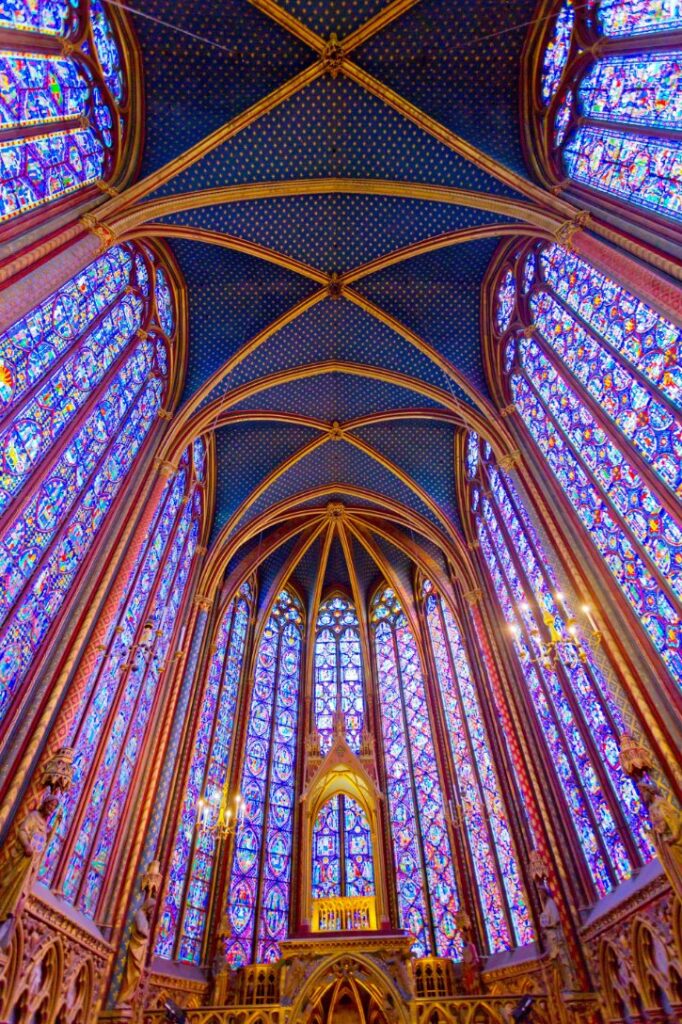
Sainte-Chapelle is widely seen as the masterpiece of Rayonnant Gothic architecture:
- Commissioned by King Louis IX (Saint Louis).
- Built fast, between 1242 and 1248.
- Designed so the walls seem to dissolve into stained glass.
- Held up by slim outside supports, freeing the walls to become towering windows.
b. Two Chapels, Two Worlds
The building has two levels, matching the old social order:
- The lower chapel was for servants and staff, low and painted deep blue with golden lilies.
- The upper chapel was for the king, soaring high and flooded with colored light.
Climbing from the modest lower level into the blazing upper chapel is the heart of the whole visit.
c. The Greatest Stained Glass in the World
This is the most complete set of 13th-century stained glass anywhere:
- About 618 square meters of glass.
- Roughly 1,113 scenes.
- Around 70 to 75 percent is original medieval glass.
- Best read bottom to top within each window, working left to right around the room.
d. Scenes to Search For
While the whole room dazzles, hunt for these details:
- Bible stories from Genesis and Exodus on the north wall.
- The Passion of Christ in the central apse.
- Louis IX carrying the Crown of Thorns barefoot into the city.
On a bright day the colors flood the room, though the light shifts with the weather.
e. The Holy Relics That Started It All
Louis IX built this chapel as a giant reliquary:
- He bought the Crown of Thorns in 1239.
- He paid more than three times the cost of the chapel itself.
- He later added pieces linked to the True Cross.
- The relics are no longer kept here, but the chapel was designed entirely around them.
f. Out to the Flower Market
After all that color, you will want fresh air. Just across the boulevard, a covered market offers a gentle, fragrant pause.
14. Marché aux Fleurs de Paris
a. A Flower Market With Deep Roots
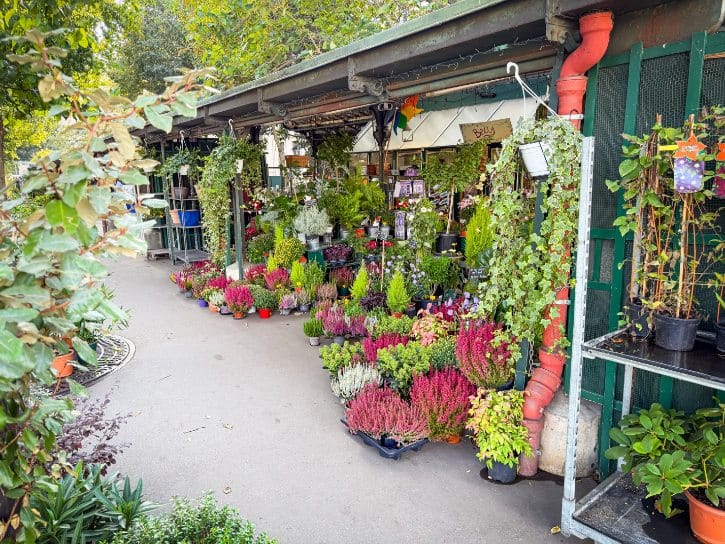
This market on Place Louis Lépine is one of the oldest of its kind in Paris:
- First set up on the island in 1808.
- Moved to its present square in the 1860s.
- Officially named after Queen Elizabeth II, who visited during a state trip.
b. Green Iron and Glass
The market’s charm is in its old ironwork:
- Dark green cast-iron pavilions from around 1900.
- Glazed gabled roofs
- A mix of covered aisles and open-air stalls.
Rather than just calling it a “typical market”, look for the specific green columns and botanical iron details.
c. A Changing Show of Color
What you see depends on the season:
- Spring: tulips, hyacinths, lilacs, and peonies.
- Summer: lavender, hydrangeas, roses, and herbs.
- Autumn: dahlias and chrysanthemums.
- Winter: holiday trees, holly, and mistletoe.
- Year-round: planters, watering cans, and botanical prints.
d. A Feast for the Senses
Even if you buy nothing, wandering here is a treat:
- The scent of soil, cut flowers, and eucalyptus.
- Soft light through the green glass roofs.
- Constantly changing displays on the cobbles.
e. Grand Neighbors All Around
The market sits wrapped in history, close to:
- Sainte-Chapelle and the Conciergerie.
- The Palais de Justice and the domed Tribunal de Commerce.
- Notre-Dame, just a short walk east.
- An old green Wallace Fountain right at the corner.
f. Toward the Grand Finale
Walk east along Rue de la Cité, and the twin towers of the city’s most famous cathedral rise ahead.
15. Notre-Dame Cathedral of Paris
a. Built Over Many Generations
Notre-Dame de Paris is a defining monument of French Gothic architecture, and it was not built in one go:
- Construction began around 1163 under Bishop Maurice de Sully.
- The choir, nave, and towers rose over roughly a century.
- Later builders added the great rose windows and soaring buttresses.
Each generation shaped the last, which is why it became such a landmark.
b. The West Front Up Close
Stand on the square and read the famous façade:
- Three carved portals, with the dramatic Last Judgment in the center.
- The Gallery of Kings, a row of 28 statues (today’s are recreations after the originals were destroyed).
- The central rose window and the twin towers rising 69 meters.
You do not need any special knowledge to enjoy this. Just let your eye travel up.
c. The Three Rose Windows
The rose windows are among Europe’s greatest medieval survivals:
- The north rose keeps almost all its original 13th-century glass, glowing deep blue.
- The south rose shines with New Testament scenes.
- All three survived the fire and were cleaned or restored.
Seek out the north rose for the richest medieval color.
d. Inside the Restored Cathedral
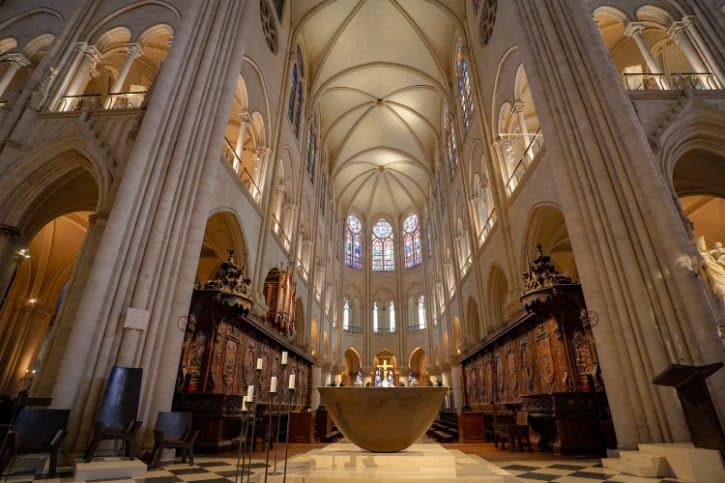
The cathedral is open to visitors again after its long restoration, and the interior looks transformed:
- Cleaned pale stone vaults soaring 33 meters overhead.
- New bronze furnishings by a French designer.
- 1,500 oak chairs with low backs that keep the view clear.
- The great organ, cleaned and playing once more.
Some outdoor stonework and landscaping continue, so expect a little work outside.
e. Understanding the 2019 Fire
The fire of 15 April 2019 shaped what you see today:
- The wooden roof was destroyed.
- The spire collapsed into the nave.
- The main stone structure, towers, rose windows, and key relics survived.
Firefighters saved the towers and bells, which could have brought down the whole front.
f. The Rebuilt Spire and Roof
The skyline is whole again:
- The spire was rebuilt as an exact copy of the 19th-century design.
- The old oak roof, nicknamed la forêt (the forest), was rebuilt with traditional hand tools.
- From the surrounding bridges, you can see the spire back in place.
g. Gargoyles Versus Chimeras
Know the difference and the cathedral gets more fun:
- Gargoyles are working waterspouts, medieval and practical.
- Chimeras are the eerie decorative monsters between the towers, added in the 1840s.
So the creepy creatures everyone photographs are 19th-century additions. Look up to find them.
h. The Best Views Around the Cathedral
Different angles reveal different beauty:
- The square in front: best for the symmetry of the west front, and home to Point Zéro, the marker from which all road distances in France are measured.
- The Left Bank quays: great for the south rose and the spire.
- Pont de la Tournelle to the southeast: the classic view of the apse and its flying buttresses.
- Square René-Viviani across the river: frames the towers against greenery, near the oldest tree in Paris.