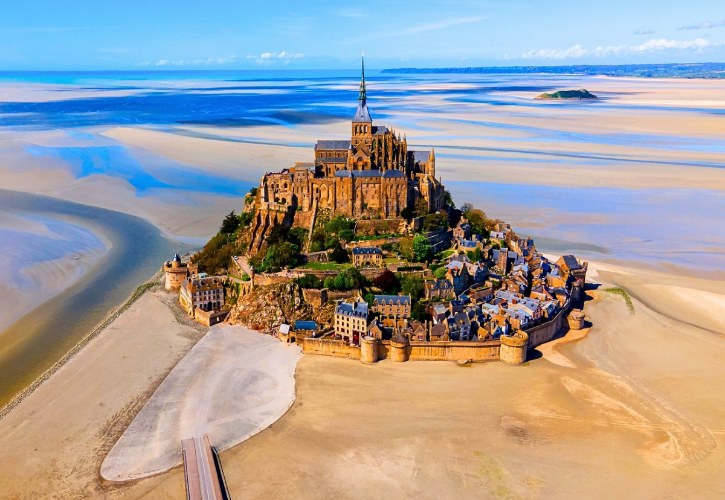
Mont Saint-Michel is unforgettable, but if it is your only stop, you miss so much. The borderlands of Brittany and Normandy are full of castle towns, oyster harbors, pink cliffs, and elegant resorts, many of them just 20 to 40 minutes apart along one easy loop.
Follow this route and the famous abbey becomes the high point of a far richer journey. Here are twelve stops you will love along the way. 😊
1. Rennes
a. Why You Should Begin Your Trip Here
Rennes is the capital of Brittany, and the perfect place to start. You get deep history and modern energy side by side, set where the Ille and Vilaine rivers meet.
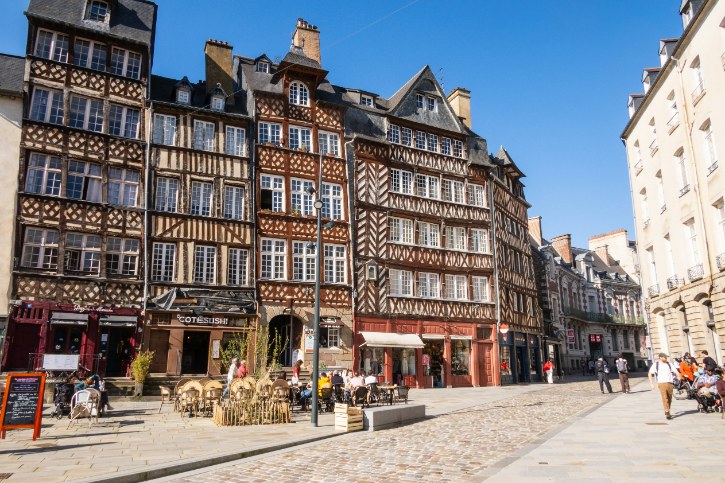
- The old center holds more than 280 timber-framed houses from the 15th to 17th centuries
- Their upper floors lean out over the street, their corner posts carved and painted in bright colors
- It is a warm, lively welcome before the quieter towns ahead
b. The Streets and Squares to Explore First
Wander these spots to see the best of the historic core:
- Place Sainte-Anne and Rue Saint-Michel, lined with colorful old houses and plenty of life
- Rue du Chapitre and Place du Champ-Jacquet, quieter corners rich in Breton carpentry
- The lanes around them, where leaning upper floors and painted beams reward a slow stroll
c. Two Landmarks That Tell the City’s Story
- Palais du Parlement de Bretagne: built between 1618 and 1655 as a symbol of Breton judicial power, with gilded woodwork and painted ceilings inside. A 1994 fire caused heavy damage, and the long restoration that followed became a model for heritage craft.
- Saint-Pierre Cathedral: a surprise behind its plain front, with a neoclassical interior and a gilded 16th-century Flemish altarpiece from Antwerp.
d. The Market and the Food You Must Try
Come on a Saturday morning to the Marché des Lices. Running since 1622, it is the second-largest food market in France, with around 250 producers under two handsome iron-and-brick halls.
Here is the one to order:
- The galette-saucisse, a grilled pork sausage wrapped in a cold buckwheat galette
- Eaten hot on the spot, plain or with a little Dijon mustard
- Breton street food at its simplest and best
e. Green Escapes and a Lively Student City
When you need a breather, Rennes gives you two very different parks:
- Parc du Thabor: more than ten hectares mixing formal French gardens, an English-style park, and a rose garden with over 2,000 varieties
- Prairies Saint-Martin: thirty hectares of rewilded wetland along the canal, with grazing meadows
- A busy student scene too, with the Trans Musicales music festival and Les Tombées de la Nuit street arts
Leaving the boulevards, the road rolls east through farmland and hedgerows, and a castle town comes into view.
Read More: The Best Route to Explore Brittany’s Most Beautiful Towns, Coastlines, and Hidden Gems
2. Vitré
a. A Castle Town That Guarded Brittany’s Border
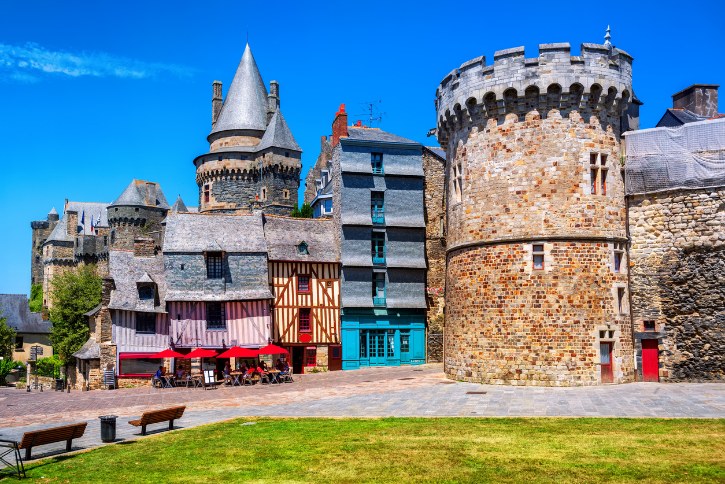
Vitré is one of Brittany’s best-preserved medieval towns. It once guarded the old frontier known as the Marches of Brittany, and you can still feel that watchful past in its walls.
Its showpiece is the Château de Vitré, perched on a dark rocky ridge above the Vilaine. First built in stone in the late 11th century, it took its triangular shape in the 13th and was reinforced for two centuries after.
b. What to Look For at the Château
As you approach the castle, keep an eye out for:
- Rounded corner towers topped with cone-shaped slate roofs
- Machicolations along the walls, built to defend the approach
- A double-towered gatehouse with its drawbridge and portcullis
- The town hall and museum inside, holding sculpture, Flemish tapestries, and natural history
c. The Medieval Street You’ll Remember Most
The heart of old Vitré is Rue de la Baudrairie, named for the leather dressers who once worked here. Its four-story half-timbered houses lean over the street, their beams carved with animal figures, faces, and guild emblems.
- Look up at numbers 25 and 27 for sculpted brackets and lion heads
- Spot the old ground-floor counters, where artisans once served customers from the street
- Enjoy the calm, quieter than Brittany’s larger historic cities
d. The Church, the Towers, and a Famous Letter Writer
A few more sights reward a short walk:
- The Tour de la Bridolle, a horseshoe-shaped artillery tower on the old ramparts
- Notre-Dame church, with its Flamboyant Gothic decoration and a rare stone outdoor pulpit on the south wall
- The nearby Château des Rochers-Sévigné, where Madame de Sévigné wrote close to 300 of her famous letters
From here the road leaves this quiet castle town behind. The next fortress is on a whole different scale.
3. Fougères
a. One of the Largest Fortresses You’ll Ever Walk
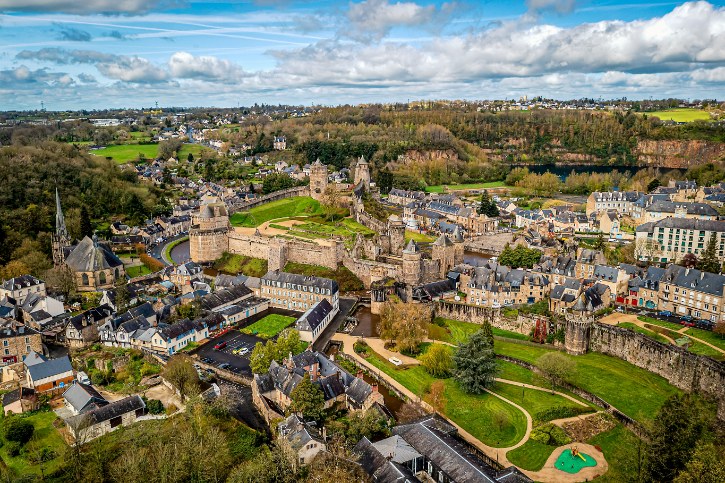
Fougères is one of Brittany’s great fortress towns, and the Château de Fougères has one of the largest medieval fortress footprints in Western Europe.
What makes it clever is where it sits. Built low in a river loop rather than high on a ridge, it let the Nançon flood the moats and ponds around it. Raised mainly between the 12th and 15th centuries, it was the eastern defense of the Duchy of Brittany.
b. Reading the Castle Through Its Towers
You can trace the whole history in its thirteen surviving towers:
- After an English king burned the first fort in 1166, the rebuilding raised the oldest surviving stonework, including the Tour des Gobelins
- Later artillery towers like the Tour Surienne and Tour Raoul have massively thick walls, built to absorb the shock of early cannon fire
- The tall Tour Mélusine, from the 15th century, is the castle’s most striking tower
- From the ramparts you get sweeping views up to the Upper Town and across the valley
c. The Old Lower Town Below the Walls
Below the fortress sits the old quarter of Bourg Saint-Sulpice, once home to tanners, dyers, and millers who relied on the river.
- Place du Château and Rue des Marchands still hold granite and timber houses from the 16th century
- The Église Saint-Sulpice has an oak ceiling shaped like an upturned ship’s hull
- Inside stands a medieval granite statue that survived the Wars of Religion
d. Gardens and the Views They Open Up
Climb the terraced Jardin du Val Nançon for a gentler side of Fougères, with floral banks, little stone bridges, and some of the best views of the castle’s water defenses. Up in the Upper Town stands Le Beffroi, Brittany’s oldest surviving civic belfry, raised by cloth merchants in 1397.
From here the road climbs toward Normandy, to open sky and your first distant view of the bay.
Read More: The Perfect Route to Explore Normandy’s Most Beautiful Towns, Dramatic Coastlines, and Hidden Gems
4. Avranches
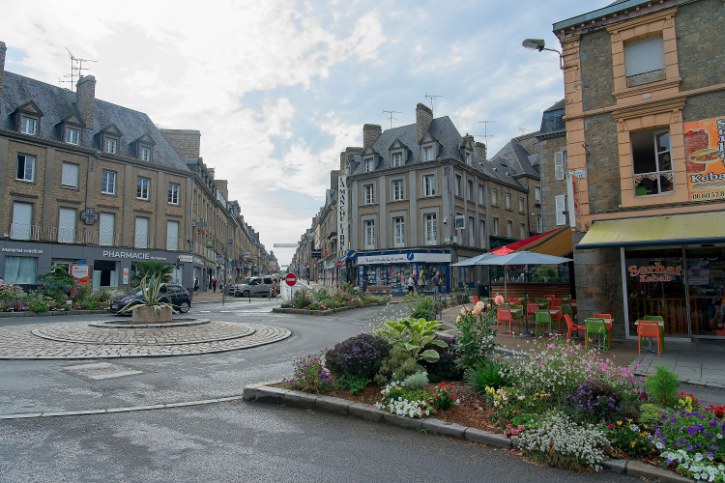
a. The Grandstand View Over the Bay
Avranches sits on a granite bluff more than 100 meters above the rivers below, and that height gives you a wide view over Mont Saint-Michel Bay.
The best spot is the Jardin des Plantes, a 19th-century botanical garden on former monastery grounds, where the western terrace opens onto the bay among magnolias and tall sequoias.
b. Spotting the Abbey From Far Away
On a clear day, look to the horizon from the garden:
- Across twelve kilometers of tidal salt marshes, the pyramid of Mont Saint-Michel rises in the distance
- You can watch the light shift across the sands as the tide floods the river mouths
- Seeing it small and far off makes it even more striking when you arrive later
c. A Museum Guarding the Abbey’s Books
The Scriptorial d’Avranches keeps the medieval manuscript library of Mont Saint-Michel, moved here for safety during the French Revolution in 1791.
- It holds around 200 medieval manuscripts from the abbey, including illuminated works, plus early printed books
- Displays show how medieval books were made, from preparing animal vellum to mixing inks
- A climate-controlled treasury rotates originals dating from the 8th to the 15th centuries
It all explains why the mount earned its old nickname, the “City of Books”.
d. The Relic Tied to the Abbey’s Origin
The Basilique Saint-Gervais holds a skull attributed to Saint Aubert, the bishop said to have founded the first sanctuary on Mont Saint-Michel in 708.
Legend says the small hole in the skull was left by the Archangel Michael’s finger, pressing the hesitant bishop to build the shrine. Modern study dates the skull to between 662 and 770 and explains the hole as early surgery or a cyst, which does nothing to spoil a good story. Nearby you will also find the neo-Gothic Notre-Dame-des-Champs and the older Saint-Saturnin.
From this hilltop town the road drops toward the coast, and a cliff-top port with a famous name appears.
5. Granville
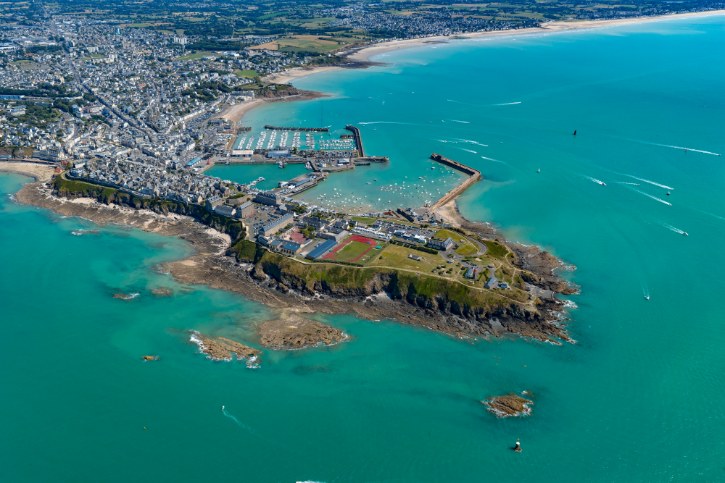
a. A Cliff-Top Port With Sea in Its Blood
Granville clings to a rocky headland called Cap Lihou, at the western edge of the Cotentin.
Its old upper town, the Haute-Ville, is wrapped in granite ramparts first built in 1439 during the Hundred Years’ War. It grew into a seafaring citadel of tall granite houses, fortified gates, and the church of Notre-Dame du Cap Lihou.
b. The Town That Shaped Christian Dior
There is a fashion story here too:
- Granville is the birthplace of designer Christian Dior
- His childhood home, the pink-and-grey Villa Les Rhumbs, now houses the Musée Christian Dior
- Its cliffside garden, planted in the English style by his mother, tumbles toward the sea among pines and roses
c. A Side Trip to the Chausey Islands
For an easy add-on, think about the Îles Chausey, about 17 kilometers offshore. It is the largest cluster of granite islands in Western Europe, and the tides here put on a show:
- At high spring tide, roughly 52 islets stay above water
- At low water, more than 365 reefs and rocky islets appear
- Their granite helped build Saint-Malo’s ramparts and parts of Mont Saint-Michel Abbey
- A seasonal ferry reaches the main island, which has no cars, only quiet paths and seabirds
d. Beaches, a Sea Pool, and a Famous Carnival
Granville also has a lovely seaside side:
- Plage du Plat Gousset runs beneath the ramparts, with a promenade and an open-air seawater pool
- The busy harbor is France’s leading shellfish landing port, known for its prized whelks
- The Carnaval de Granville, recognized by UNESCO as Intangible Cultural Heritage, fills the streets with satirical floats and marching bands
Started long ago by cod fishermen before their Atlantic voyages, the carnival is the town’s biggest celebration. Leaving the harbor, the shoreline grows more dramatic, until land and sea meet around the sight you came to see.
6. Mont Saint-Michel
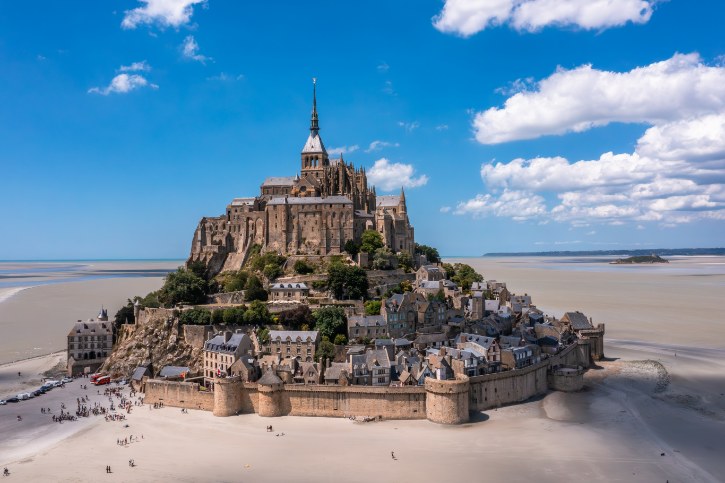
a. Why This Island Abbey Stands Alone
Few places on earth look like Mont Saint-Michel. Added to the UNESCO World Heritage list in 1979, this rocky island rises 80 meters straight out of its ever-changing bay.
Its story began in 708, when Bishop Aubert dedicated a small chapel on the mound to the Archangel Saint Michael. In 966, Benedictine monks arrived, and it grew into one of Europe’s great pilgrimage sites.
b. Monastery and Fortress in One
Over the centuries it became both a holy place and a stronghold:
- During the Hundred Years’ War, the surrounding land fell to the English
- The island held out behind its walls and was never captured
- That double life shaped the way it climbs, from ramparts to fortified village to abbey church
c. The Spaces You Shouldn’t Rush Past
The high point is La Merveille, a soaring 13th-century Gothic complex built in three tiers against the northern cliff. Look for these inside:
- The cloister, suspended about 80 meters above the sea, with a delicate double row of slender columns
- The Refectory, washed in soft light from narrow hidden windows
- The Salle des Chevaliers, a vaulted workroom with huge granite fireplaces
Two more spots stand out as you climb:
- The abbey church, where a solid Romanesque nave meets an airy Gothic choir
- The medieval Grande Rue below, winding up through the village past old ramparts and the fortified King’s Gate
d. The Tides That Change Everything
The real magic here is the tide. The bay has the highest tidal range in Europe, with water rising and falling as much as 15 meters.
- During the grandes marées, the sea wraps around the causeway and the mount becomes a true island again
- You may catch the mascaret, a wave that sweeps across the sands as the tide races in
- The scene shifts hour by hour, so the mount never looks the same twice
e. Staying Safe and Finding the Best View
The mudflats hide quicksand and fast-moving water, so never cross the bay without a certified local guide.
For the view you will remember most, look back at the mount from the salt marshes or the western terrace at sunset, when the light plays across granite and wet sand. Crossing back into Brittany, the open flats give way to the Emerald Coast, and the best oysters you will ever taste.
7. Cancale
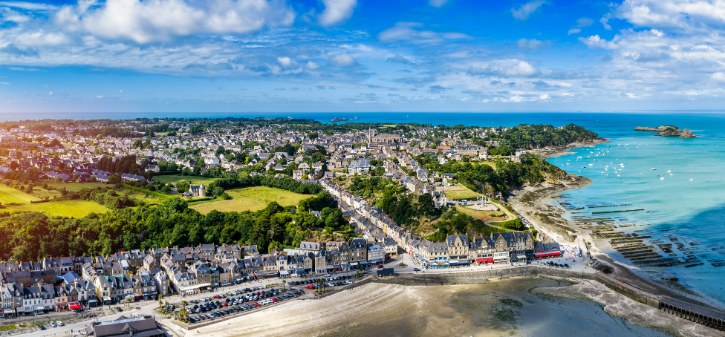
a. The Oyster Capital of Brittany
Cancale has built its whole identity around the oyster. The town sits at the western edge of the bay, with 500 hectares of oyster beds across the tidal flats.
- It raises the prized native flat oyster, the European species (Ostrea edulis)
- It also raises the more common cupped oyster
- The huge tides are the secret, flushing the beds with fresh, nutrient-rich water
b. Clearing Up the UNESCO Question
You may see Cancale’s oyster tradition called a UNESCO listing, but that is not quite right:
- The craft was officially inscribed on France’s National Inventory of Intangible Cultural Heritage
- This is a national recognition, not an international UNESCO one
- It is still a genuine mark of a living, protected craft
c. Eating Oysters by the Harbor
The experience to seek out is the open-air Marché aux Huîtres by the harbor. Here is how to do it like a local:
- Buy a platter of freshly shucked oysters from the blue-and-white stalls
- Add a squeeze of lemon and perch on the seawall to eat them
- Toss the empty shells onto the beach below, which is all part of the ritual
d. A Working Harbor and the Food Beyond Oysters
Cancale has two sides you will enjoy:
- An upper town on the bluffs, and the lively lower port, Port de la Houle, full of granite cottages and seafood bistros
- A working harbor at low tide, with flat-bottomed barges and tractors heading out to the oyster racks
- Food well beyond oysters, from steamed mussels and spider crab to salted-butter crêpes and local cider
From here the road climbs north past small coves, until the land runs out at a bold granite headland.
8. Pointe du Grouin
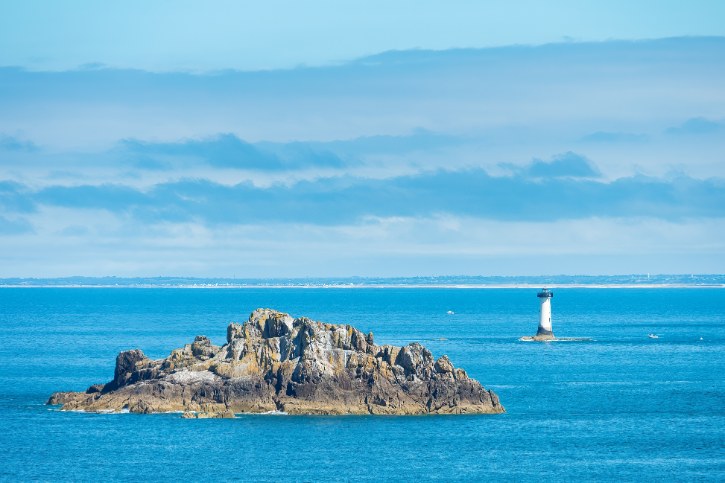
a. A Headland With Views in Every Direction
Pointe du Grouin is one of the most dramatic viewpoints on the whole Emerald Coast. This rugged headland marks the western edge of Mont Saint-Michel Bay, rising more than 40 meters above the Channel.
From the tip, the view is enormous:
- East toward Granville and the silhouette of Mont Saint-Michel
- North to the Îles Chausey
- West along the jagged cliffs heading toward Cap Fréhel
b. Walking the Famous Coastal Trail
The well-loved GR34 coastal trail runs through here, winding across open heathland and scrub:
- An old semaphore station still stands on the crest
- The headland is the starting line for the Route du Rhum, the great solo transatlantic yacht race
- You can simply follow the path for the landscapes and viewpoints, at your own pace
c. A Haven for Birds and Dolphins
This is protected country, and the wildlife is a big part of its appeal. Just offshore lies Île des Landes, a nature reserve and an important refuge for nesting seabirds:
- Look for great cormorants, European shags, and gulls on the island
- The swirling waters below draw fish, and with them a resident group of bottlenose dolphins
- You may spot the dolphins hunting in the currents on a calm day
d. The Wild, Windswept Feel of the Place
What stays with you here is the feel: constant wind, the roar of water hitting the rocks, and wide, shifting light over the sea. Unlike a tidy resort, Pointe du Grouin is raw and open, a true piece of wild Brittany.
To protect it, stay on the marked gravel trails so the thin cliff-top soil is not worn away. From this exposed headland, the road rolls west toward a walled city with pirates in its past.
9. Saint-Malo
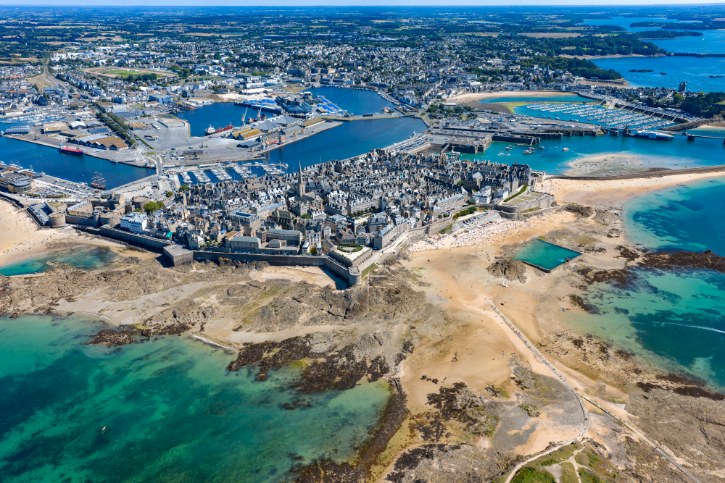
a. The Famous Corsair City
Saint-Malo stands guard on a rocky point at the mouth of the Rance, famous as the cité corsaire. Its walled old town, known as Intra-Muros, is a tight maze of tall granite houses, slate roofs, and cobbled lanes.
There is a remarkable story behind how it looks today. In 1944, around 80 percent of Intra-Muros was destroyed, then carefully rebuilt using the same Chausey granite to recreate its 17th- and 18th-century face.
b. Walking the Ramparts and Key Landmarks
The best way to take it in is from the ramparts, a continuous 1.8-kilometer walk first raised in the 12th century and later rebuilt by Vauban’s engineers:
- Plage du Sillon and the offshore islands
- The busy marina and the Rance barrage beyond
- The Cathédrale Saint-Vincent, mixing a Romanesque nave with a soaring Gothic choir
- The Château de Saint-Malo, now holding the city’s history museum and civic offices
c. Pirates, Privateers, and Famous Sailors
Here is the fun part. Saint-Malo’s sailors were not ordinary pirates. They were corsaires, private captains given official royal permission to seize enemy ships in wartime, in return for a share of the spoils.
The city produced some legendary names:
- René Duguay-Trouin, who captured Rio de Janeiro in 1711
- Robert Surcouf, who raided British routes in the Indian Ocean
- Jacques Cartier, who explored the Gulf of St. Lawrence in 1534 and claimed Canada for France
d. Two Islets to Reach at Low Tide
Out in the bay sit two small islands worth knowing:
- Fort National, built by Vauban in 1689, which you can reach on foot at low tide
- Grand Bé, holding the simple tomb of the Romantic writer François-René de Chateaubriand
Both depend on the tides, so always check the timetable before you set out, since the water can cut off the path quickly.
e. Great Food and a Breezy Atmosphere
Beyond the history, Saint-Malo is a fine place to soak up sea air, with old cannons along the ramparts looking out over swimmers at the seawater pool below.
For a proper Breton meal, order la complète, a buckwheat galette with cheese, egg, and ham, with a bowl of dry cider. Just across the mouth of the Rance lies a town that could not be more different, where granite walls give way to grand villas.
10. Dinard
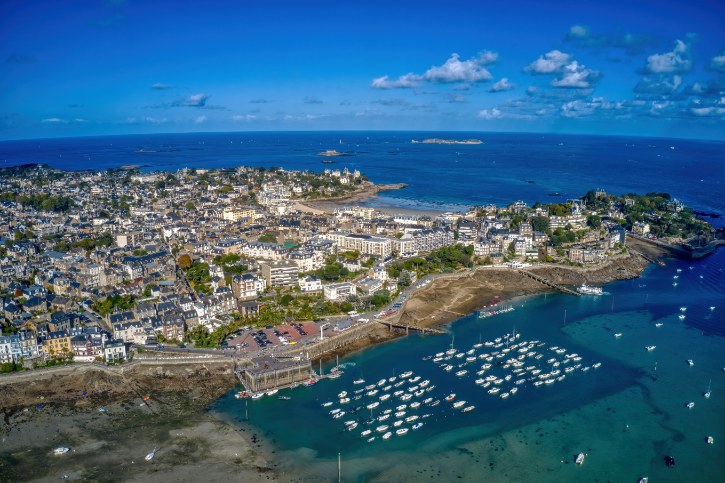
a. The Elegant Resort of a Golden Age
Dinard grew up as a glamorous seaside retreat. Through the mid-19th century, this quiet fishing village became the summer playground of wealthy British, American, and Parisian visitors. They came for the clean air, sheltered beaches, and mild climate, and the town soon earned the nickname the “Cannes of the North”.
b. The Villas That Line the Cliffs
They left behind a feast of resort architecture:
- More than 400 villas and estates are now protected within the town’s heritage zone
- Styles mix Neo-Gothic, Queen Anne, Italianate, and Anglo-Norman, with bow windows and slate turrets
- The standout is Villa Les Roches Brunes, set on the cliffs and now used for art shows and concerts
c. Beaches and a Beautiful Seaside Walk
Dinard’s heart is Plage de l’Écluse, a wide stretch of sand backed by grand hotels and rows of blue-and-white striped bathing cabins. For a gentle stroll, follow these:
- The Promenade du Clair de Lune along the estuary, sheltered and planted with palms and tree ferns
- Pointe du Moulinet, with panoramic views straight across to Saint-Malo
- Plage du Prieuré, a quiet cove named for an old religious foundation on its shore
d. A Town That Loves Art and Film
Dinard has long had an artistic streak. Each autumn it hosts the Dinard Festival of British and Irish Film, which hands out its Golden Hitchcock trophy. The town’s clear estuary light even drew painters of the stature of Monet and Picasso, who both captured its beaches and cliffs.
Settle onto a waterfront terrace with a coffee and watch the sailboats drift by. Leaving the villas and promenades, the coastline grows wild again, toward towering pink cliffs and a storybook fortress on the rocks.
11. Fort La Latte & Cap Fréhel
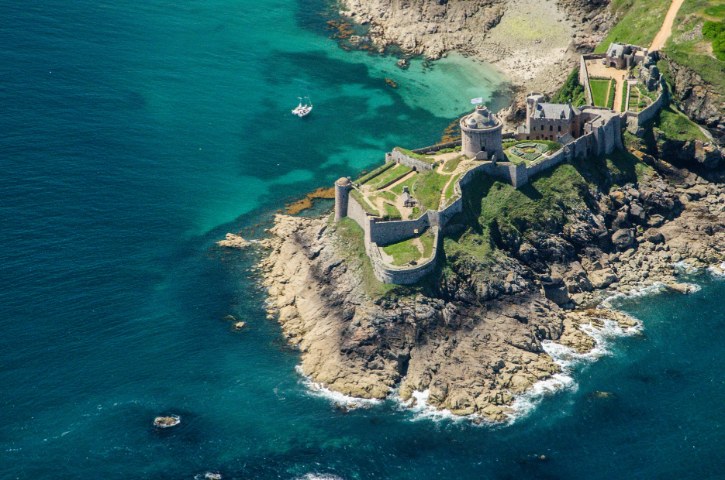
a. Where Pink Cliffs Meet a Castle on the Rocks
Together, Cap Fréhel and Fort La Latte give you one of Brittany’s most spectacular meetings of nature and history, both protected within a national Grand Site.
At Cap Fréhel, cliffs of pinkish-red sandstone drop around 70 meters to the sea, topped by a powerful lighthouse whose beam reaches far out across the water.
b. Exploring the Medieval Fortress
A short way along the coast stands Fort La Latte, also called the Château de la Roche-Goyon. Built in the 14th century on a finger of rock jutting into the sea, it is reached by drawbridges over natural chasms:
- A round granite keep with machicolations, a vaulted chapel, and a rainwater cistern
- An 18th-century oven once used to heat cannonballs red-hot in defense of the coast
- Views from the keep that stretch far across open water
- A starring role as a Viking stronghold in the 1958 adventure film The Vikings
c. Moorland That Changes With the Seasons
Beyond the castle spreads more than 400 hectares of coastal moorland, and it shifts color through the year:
- From spring into early summer, yellow gorse and pink sea thrift light up the heath
- Through high summer, deep purple heathers take over
- The open, treeless land gives you a wonderful sense of space
d. Seabirds and the Clifftop Walk Between Them
The cliffs are a major seabird reserve. Keep an eye out for:
- Razorbills, common murres, and black-legged kittiwakes on the ledges
- European shags and fulmars riding the wind
- The scenic stretch of the GR34 between the two headlands, where you can watch the colonies as you walk
Stay on the marked paths and respect the fences that protect the fragile heath. From these wild cliffs, the road turns inland and softens into wooded river valleys.
12. Dinan
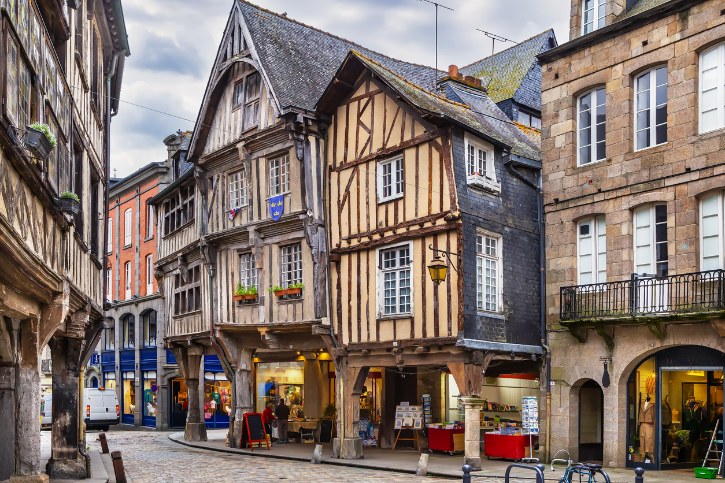
a. A Medieval Jewel Above the River
Dinan is one of the most complete medieval towns in all of northwestern France, and a perfect place to end the journey, sitting 75 meters up on a granite bluff above the River Rance.
Its defenses are astonishing for how much survives. Dinan is ringed by 2.7 kilometers of continuous ramparts, the longest stretch of medieval town walls in Brittany, with 14 towers and four grand fortified gates.
b. The Walls, the Castle, and the Best Views
- The Château de Dinan, built in the 1380s, has an oval keep rising 34 meters that now holds a museum
- Walk the top of the ramparts near the Tour Sainte-Catherine for the best views
- From there you look out over the tiled rooftops and down into the wooded river valley
- Linger up here. It is worth it.
c. The Streets You’ll Want to Wander
Within the walls, Dinan keeps more than 115 half-timbered houses from the 15th to 17th centuries. The prettiest gathering points are Place des Cordeliers and Place des Merciers, with carved brackets and wooden arcades.
The street you will remember is Rue du Jerzual, which plunges steeply from the upper town down through its old gate to the river port:
- Once home to tanners and weavers
- Now lined with workshops of wood-turners, glassblowers, and bookbinders
- Topped by the Tour de l’Horloge, a 43-meter clock tower that Anne of Brittany raised to belfry rank, with a bell added in 1507
d. A Basilica With a Knight’s Heart
Nearby, the Basilique Saint-Sauveur blends a carved Romanesque doorway with a Gothic choir. Inside it holds a touching relic: the preserved heart of Bertrand Du Guesclin, the great Breton knight who once defended the town against English forces.
e. A Peaceful Ending by the Water
Follow the street all the way down to the Port de Dinan, resting on the calm waters of the Rance and crossed by a 15th-century stone bridge. After the fortified town above, this riverside quarter feels gentle and relaxed, with pleasure boats, waterside bistros, and open-air terraces. If you have time, the nearby village of Léhon, just upstream, makes a lovely final detour, with its 9th-century abbey and hilltop castle ruins.
And that is a fitting place to close the loop. From the castles of Rennes, Vitré, and Fougères, through the scholarship of Avranches and the wonder of Mont Saint-Michel, to the windswept capes of the Emerald Coast, you will come home with a journey that stitches the very best of Brittany and Normandy into one unforgettable road trip.