Rome rewards walkers more than almost any other city. Across one compact stretch of the historic center, fifteen remarkable places sit just one to five minutes apart.
You pass from open market squares to hushed church interiors, from ancient stone to Baroque marble, often within a single block. Every turn peels back another layer of art, architecture, and daily life. 😊
1. Campo de’ Fiori
a. From Wild Meadow to Morning Market
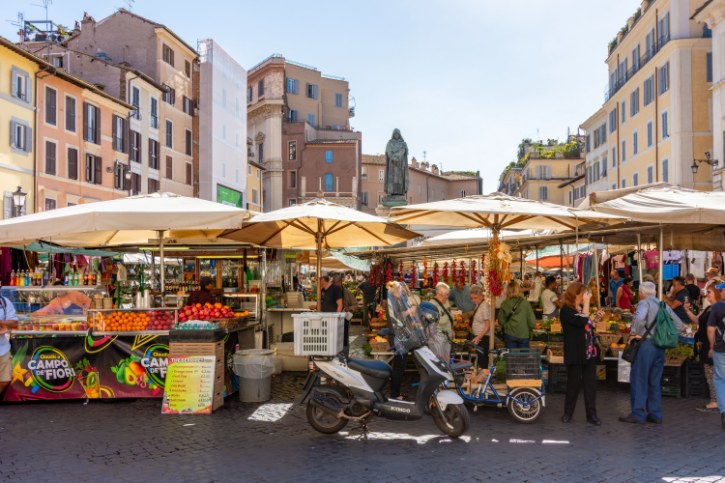
The name means field of flowers, and until the mid-fifteenth century that is what you would have found: an unpaved meadow sloping toward the Tiber. The ground was paved in 1456 under Pope Callixtus III. The daily food market you see today is much younger, arriving in 1869 when traders moved here from Piazza Navona.
b. What Fills the Stalls Today
- Seasonal flowers sold beside the food vendors
- Prosciutto and wheels of aged Pecorino Romano
- Mounds of Roman artichokes and puntarelle
c. The Hooded Philosopher at the Center
- The bronze monument honors Giordano Bruno, burned for heresy here on February 17, 1600
- Ettore Ferrari designed it, and it was unveiled on June 9, 1889
- Bruno’s hooded figure faces directly toward the Vatican, hands clasped over his book
- The plinth carries eight medallions of free thinkers, including John Wycliffe and Jan Hus
d. The Fountain With a Lid and a Motto
Giacomo della Porta built the original between 1590 and 1595. Vendors kept washing fish in it, so in 1622 authorities capped it with a travertine lid shaped like a soup tureen, a terrina. Its inscription reads “Love God and do not falter, do good and let them talk”. The authentic fountain now sits in Piazza della Chiesa Nuova, and the basin here is a lidless 1924 copy.
e. The Palace Watching Over the Square
- Palazzo della Cancelleria stands to the northwest, built between 1489 and 1513
- It is regarded as Rome’s earliest Renaissance palace of grand scale
- Its travertine came from the Theater of Pompey and the Colosseum
- It encloses San Lorenzo in Damaso, founded in the late fourth century by Pope Damasus I and rebuilt into the palace
2. Piazza di Pasquino (Pasquino Statue)
a. The Statue That Spoke for Rome
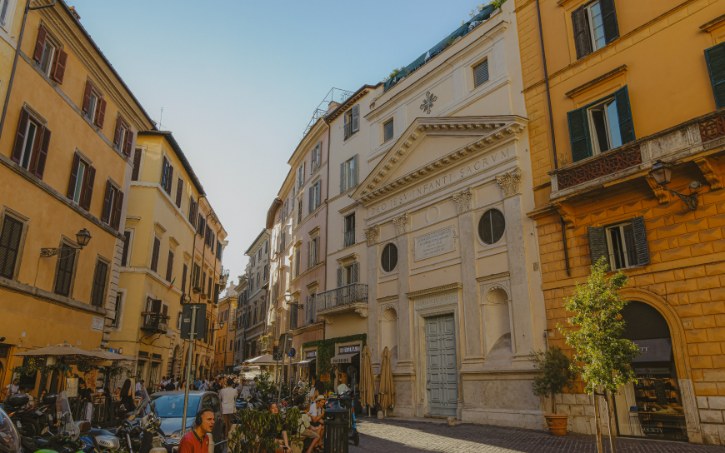
Tucked against Palazzo Braschi, this small square holds the original of Rome’s talking statues. The battered marble was dug from the street mud in 1501, and Cardinal Oliviero Carafa mounted it beside his home.
b. What the Broken Marble Actually Shows
- A first-century AD Roman copy of a third-century BC Hellenistic original
- Scholars call it the Pasquino Group, an interpretation rather than documented fact
- It is thought to show Menelaus supporting the dying Patroclus
- Limbs and polish are gone, yet Bernini praised it as among antiquity’s finest work
c. How the Pasquinades Worked
- Anonymous verses were pinned to the base after dark from the early sixteenth century
- These pasquinades mocked popes, nepotism, and civic corruption
- Pasquino led the Congresso degli arguti, the Congress of Wits
- Five other statues answered him, including Marforio and Il Babuino
- A notice board beside the pedestal still carries handwritten commentary
d. Two Verses That Infuriated Popes
When Urban VIII stripped bronze from the Pantheon portico to cast cannons, a Latin jab appeared overnight: “What the barbarians didn’t do, the Barberini did”. Pope Adrian VI threatened to throw the statue into the Tiber, until his cardinals warned him the frogs would croak the verses louder.
e. What to Notice Up Close
- The muscular tension across the hero’s back, still expressive despite the damage
- Carafa’s Latin inscription on the plinth
- Its corner position, set against a wall rather than in the open
- Modern protest notes posted nearby
3. Chiesa di Sant’Agnese in Agone
a. A Church Built on the Exact Spot
The church stands where thirteen-year-old Agnes was martyred around 304 AD under Diocletian. Church tradition, rather than documented record, places her ordeal in the arcades of the Stadium of Domitian.
b. The Architects Who Reshaped It
- Commissioned in 1652 by Pope Innocent X as a family mausoleum
- Girolamo and Carlo Rainaldi began the work
- Francesco Borromini took over in 1653 and transformed the design
- He resigned in 1657, and Carlo Rainaldi was brought back to finish it
- Bernini later designed the main entrance pediment and the interior entablature
c. Reading the Façade From the Square
- The concave sweep of the travertine front, pulling your eye inward
- A high windowed drum lifting the dome above the roofline
- Twin openwork bell towers, pierced rather than solid
- A composition designed to be read from the middle of the piazza
d. What to Look For Inside
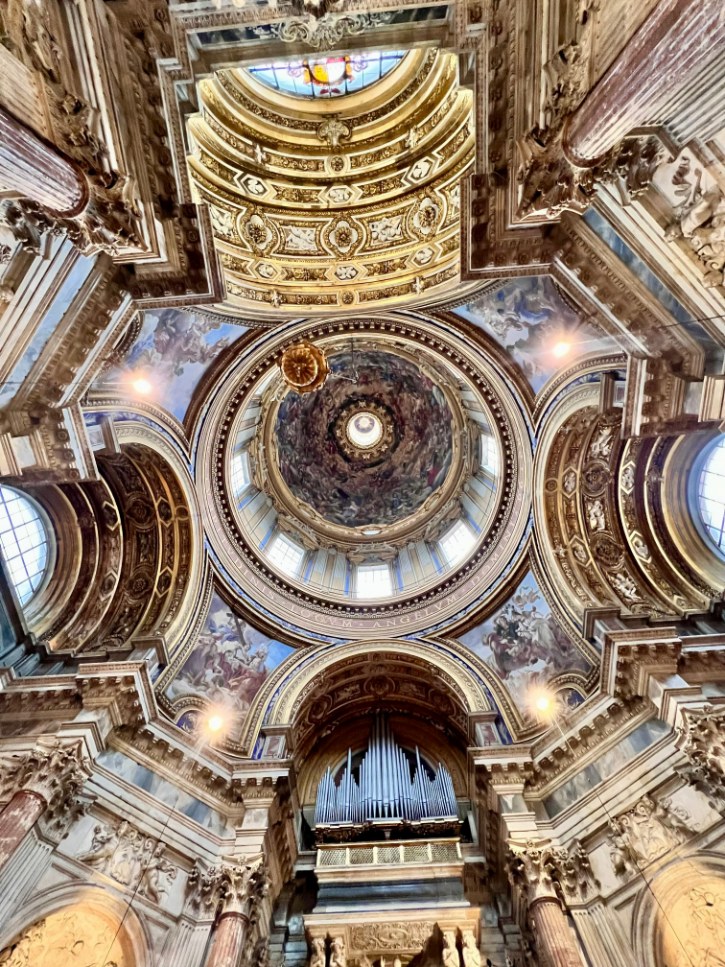
- A Greek-cross interior in polychrome marble and gilded stucco
- The dome fresco, the Apotheosis of Saint Agnes, begun by Ciro Ferri in 1670 and finished by Sebastiano Corbellini in 1689
- Pendentives with the Cardinal Virtues by Giovanni Battista Gaulli, 1668 to 1672
- The skull of Saint Agnes, set in a temple-shaped tabernacle in the Chapel of Saint Philip Neri
- The crypt below, with the original Roman brick barrel vaults
e. The Rivalry Story That Doesn’t Add Up
You will hear that Bernini carved the nearby river gods to mock this façade, one figure raising an arm as if the dome might fall. The dates rule it out. Bernini finished his fountain in 1651, two years before Borromini was appointed here.
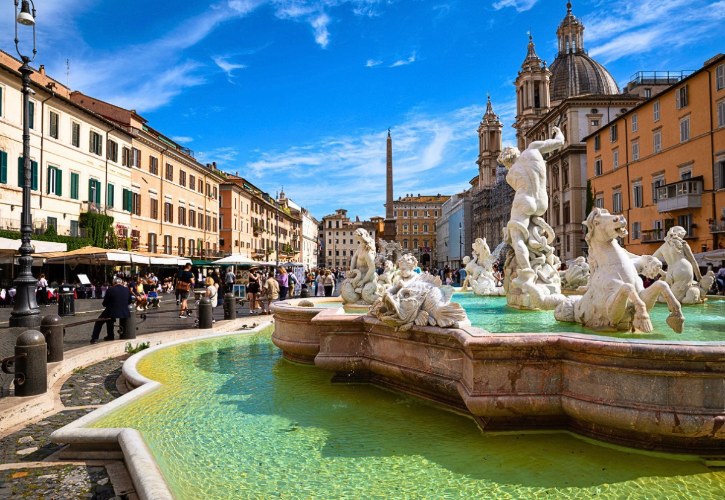
4. Piazza Navona
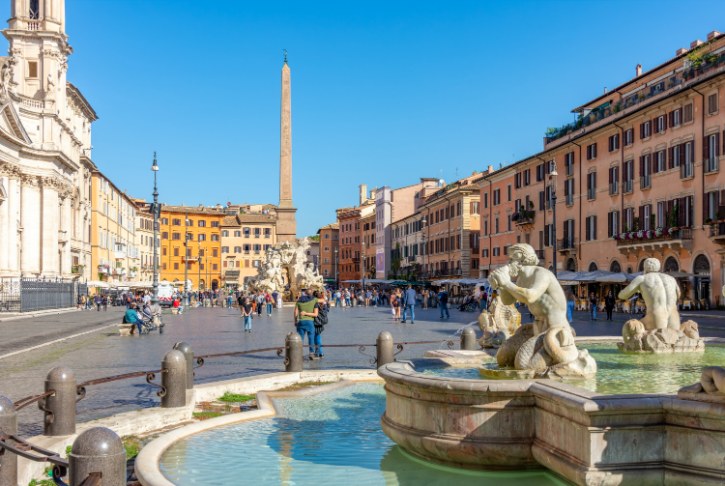
a. A Roman Stadium Hiding in Plain Sight
The long oval shape is not a design choice. It traces the outline of the Stadium of Domitian, dedicated in 86 AD for Greek-style athletic games and seating roughly 30,000 spectators. The palazzi around you rest on its ancient brick arcades.
b. The Four Rivers and What They Mean
Bernini’s Fontana dei Quattro Fiumi was unveiled in 1651, a hollowed travertine grotto supporting a red granite obelisk quarried at Aswan.
- The Danube (Europe): looks up toward the obelisk, touching the papal coat of arms
- The Nile (Africa): head shrouded, because its source was still unknown
- The Ganges (Asia): holds a long oar, signifying navigable waters
- The Rio de la Plata (Americas): rests on spilled silver coins
c. The Two Fountains at Either End
- Fontana del Moro (south): basin from Giacomo della Porta’s design, 1575, with the Moor wrestling a dolphin designed by Bernini and carved by Giovanni Antonio Mari in 1653 to 1654
- Its surrounding tritons are 1874 copies, the originals now in the Galleria Borghese
- Fontana del Nettuno (north): fountain also by Della Porta, 1574, but it stood without figures for three centuries
- Its Neptune spearing an octopus group came only in 1878, by Antonio della Bitta
- Both basins date from the 1570s, yet their sculptural groups arrived roughly two centuries apart
d. The Palace That Ties It Together
- Palazzo Pamphilj anchors the western side, by Girolamo Rainaldi, 1644 to 1650
- Its gallery is frescoed with Virgil’s Aeneid by Pietro da Cortona
- Palace, church, and fountains were built within the same few decades
- That shared moment is why the square reads as one unified setting
e. When the Square Became a Lake
- Every weekend in August between 1652 and 1866, the fountain drains were sealed
- The water stayed shallow, probably no more than a few tens of centimeters
- Aristocratic carriages splashed through while ordinary Romans cooled their feet
- The pavement was raised in the nineteenth century, so the dip that held the water is no longer visible
5. Church of Saint Louis of the French (San Luigi dei Francesi)
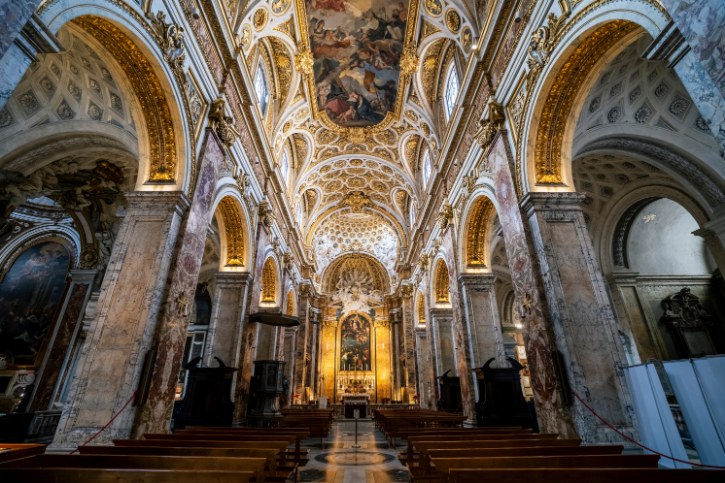
a. France’s Church in the Heart of Rome
Founded in 1518 by Cardinal Giulio de’ Medici and consecrated in 1589, this is the national church of France in Rome. Its late-Renaissance façade was designed by Giacomo della Porta and built by Domenico Fontana.
b. Four Figures on the Façade
Four statues carved in the early eighteenth century by Pierre de l’Estache:
- King Charlemagne and Queen Saint Clotilde
- King Saint Louis IX, to whom the church is dedicated
- Saint Joan of Valois
c. Caravaggio’s Three Canvases
The Contarelli Chapel holds the Saint Matthew cycle, painted between 1599 and 1602.
- The Calling of Saint Matthew (left wall): a shadowy Roman tavern, with Christ’s pointing hand echoing Michelangelo’s God on the Sistine ceiling
- The Inspiration of Saint Matthew (altarpiece, 1602): the second version, after the church rejected a first showing Matthew as an illiterate peasant
- The Martyrdom of Saint Matthew (right wall): the most violent, with Caravaggio’s own face in the shadows at the far left
d. How to Read Them as One Story
Take them in order rather than as separate pictures. The left wall shows a man called out of ordinary life, the altarpiece shows him at work, the right wall shows how that life ended. Watch the single hard light source picking out hands and faces across all three.
e. What Else Deserves Your Attention
- Domenichino’s fresco cycle on Saint Cecilia, 1612 to 1615, in the right aisle
- Charles-Joseph Natoire’s 1756 nave ceiling fresco, the Apotheosis of Saint Louis
- Gilded molding and rich polychrome marble through the nave
- The contrast between Domenichino’s calm classicism and Caravaggio’s drama
6. Pantheon (Santa Maria Rotonda)
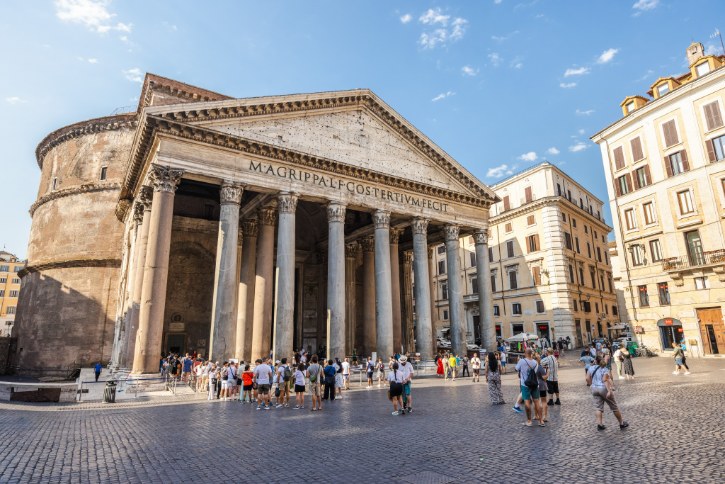
a. Two Thousand Years and Still Standing
Marcus Agrippa commissioned the first building in 27 BC. After fires, Emperor Hadrian rebuilt it between roughly 118 and 125 AD, keeping Agrippa’s bronze dedication across the frieze. Consecration as a church in 609 AD saved it from being stripped for materials.
b. The Portico Before You Step Inside
- Sixteen monolithic Corinthian columns in gray and pink Egyptian granite
- Each stands 11.8 meters tall and weighs around 60 metric tons
- Every column was floated down the Nile and hauled up the Tiber
- Ancient bronze entrance doors, still in use
- A rectangular portico that gives no hint of the circular room behind it
c. How the Dome Holds Itself Up
The interior diameter of 43.4 meters matches the interior height, so a perfect sphere would fit inside. It remains the largest unreinforced concrete dome ever built, and the trick is weight.
- Base: walls six meters thick, with dense travertine aggregate
- Middle: volcanic tuff, broken brick, and ceramic tile
- Upper dome and apex: light tufa, porous slag, and pumice
- Ceiling: five rings of 28 recessed coffers that cut the deadweight
d. The Eye in the Ceiling
At the summit sits the oculus, an unglazed opening 8.8 meters wide and the only source of natural light. Through the day a bright shaft travels across the coffers like a slow clock. Rain falls straight in and drains through 22 concealed holes in the gently convex floor.
e. Who Is Buried Here
- Raphael, who died on Good Friday in 1520 at the age of 37
- His tomb sits beneath an ancient sarcophagus, below the Madonna del Sasso by his pupil Lorenzetto
- The inscription says Nature feared to be conquered while he lived
- Nearby, the House of Savoy tombs: Victor Emmanuel II, Umberto I, Queen Margherita
7. Basilica of Saint Mary of Minerva (Santa Maria sopra Minerva)
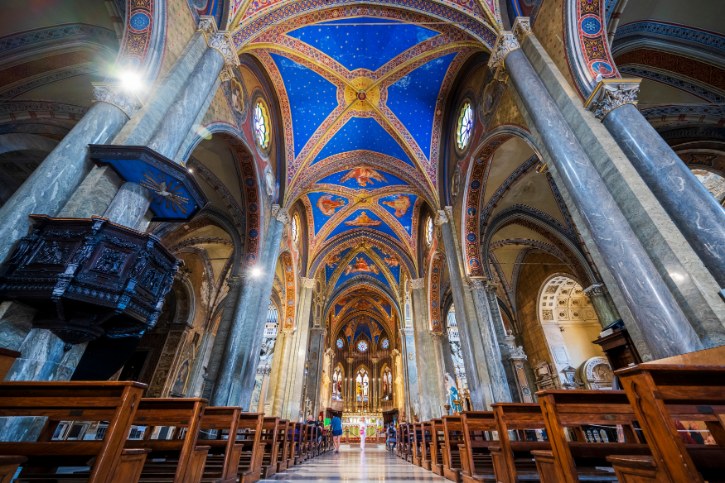
a. Rome’s Only Gothic Church
A quiet square behind the Pantheon holds the Dominican Order’s chief seat in Rome and the city’s only surviving medieval Gothic church, founded in 1280 and finished around 1370. Excavation found three ancient sanctuaries beneath it, not the single temple of Minerva the name suggests.
b. The Blue and Gold Ceiling
- A restrained Renaissance façade that hides everything behind it
- Clustered marble piers supporting ribbed pointed vaults
- Deep ultramarine blue studded with gold stars, from a nineteenth-century restoration
- Worth knowing: the arches are medieval, the color scheme is modern
c. Michelangelo’s Risen Christ
- Christ the Redeemer stands left of the main altar, installed in 1521
- Christ holds the Cross, the reed, and the sponge in classical contrapposto
- The gilded bronze loincloth is not Michelangelo’s, added for Counter-Reformation modesty
- The calm expression owes more to classical sculpture than to devotional imagery
d. The Art and Tombs Around You
- The Carafa Chapel, frescoed by Filippino Lippi between 1488 and 1493, showing the Annunciation and the Triumph of Saint Thomas Aquinas
- Saint Catherine of Siena’s body beneath the main altar, while her head is kept in Siena
- The tomb slab of Fra Angelico, who died in the adjoining convent in 1455
- Wall tombs of Medici popes Leo X and Clement VII in the choir
- Bernini’s Memorial to Maria Raggi, a bronze medallion riding billowing marble drapery
e. The Elephant Outside
In Piazza della Minerva stands Bernini’s Elephant and Obelisk, nicknamed Il Pulcino della Minerva. Ercole Ferrata carved it in 1667 from Bernini’s sketches, and the elephant carries a sixth-century BC Egyptian obelisk found in the Dominican garden.
8. Galleria Doria Pamphilj
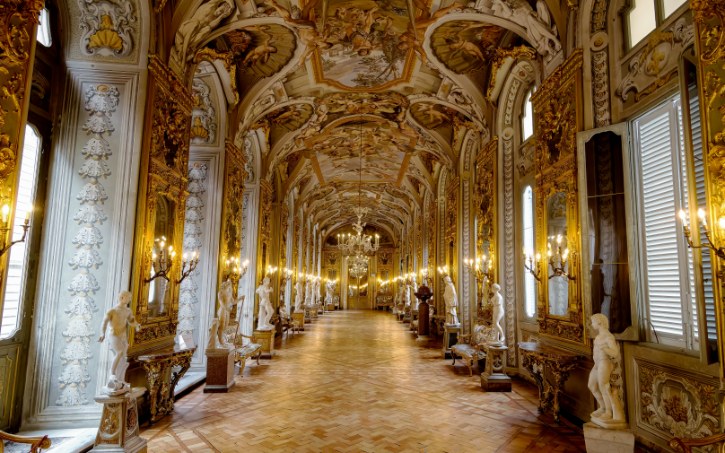
a. A Family Home, Not a Museum
This is one of the largest privately owned aristocratic residences in Rome. The paintings still hang according to eighteenth-century inventories, frame to frame, exactly as the family arranged them.
b. The Gallery of Mirrors
Designed by Gabriele Valvassori in the 1730s:
- Gilded mirrors running the full length of the hall
- Venetian chandeliers overhead
- Vaulted ceilings frescoed with the Labors of Hercules by Aureliano Milani, 1731 to 1734
- Paintings hung to a 1767 arrangement, large canvases high on the wall and smaller landscapes below
c. The Portrait That Was “Too Real”
Diego Velázquez painted his Portrait of Pope Innocent X in 1650.
- The pope sits in crimson silk, his guarded, suspicious gaze fixed on you
- He holds a petition carrying the artist’s signature
- Innocent reportedly called it “Troppo vero!”, meaning “Too real!”
- It hangs beside Bernini’s marble bust of the same pope, so you can compare how a painter and a sculptor read one difficult face
d. Two Early Caravaggios
Both painted in the 1590s, while he was still finding his style:
- Penitent Magdalene: a young woman weeping on a low chair, pearls abandoned on the floor
- Rest on the Flight into Egypt: an angel playing violin from sheets held by Saint Joseph, while Mary sleeps with the infant Christ
- Both turn religious subjects into believable human moments
e. More Names on These Walls
- Raphael’s double portrait of Andrea Navagero and Agostino Beazzano
- Titian’s dramatic Salome with the Head of John the Baptist
- Works by Guercino, Tintoretto, and Claude Lorrain
- A lived-in feel, since the family still occupies private wings of the palace
9. Church of Sant’Ignazio di Loyola
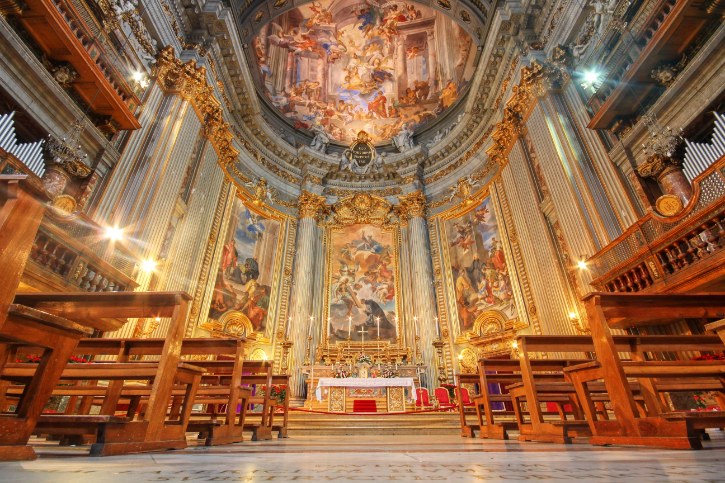
a. The Ceiling That Opens to the Sky
Begun in 1626 for students of the adjacent Collegio Romano and opened for worship in 1650, this church honors Saint Ignatius of Loyola, canonized in 1622. The Jesuit mathematician Orazio Grassi designed it, with Alessandro Algardi contributing sculpture and helping design the nave stucco. Its classical front hides one of the most astonishing optical illusions in Europe.
b. What Andrea Pozzo Painted Overhead
The Apotheosis of Saint Ignatius covers the nave vault, painted by Pozzo and finished in 1694.
- Pozzo used quadratura, painted perspective, to dissolve the stone ceiling
- The walls appear to continue upward into soaring colonnades open to the heavens
- Christ sends a beam of light into the heart of Saint Ignatius
- It splits into four rays falling toward Europe, Asia, Africa, and the Americas
c. The Dome That Was Never Built
- Funds ran low, and neighboring friars objected that a real dome would block their light
- So in 1685 Pozzo painted a dome instead, a flat canvas 17 meters across, complete with drum, coffers, and lantern
- Fire later destroyed the original, and the canvas overhead today is Francesco Manno’s faithful 1823 copy, worked up from Pozzo’s own drawings
- From the right spot it still reads as solid architecture
d. Where to Stand
- The perspective marker: a small disc in the floor marks where the illusion locks into place
- The nave mirror: a large tilted mirror lets you study the vault without straining your neck
- Step a few paces off the disc and the painted columns visibly bend and flatten
- Seeing the illusion break is almost better than seeing it work
e. The Saints Resting Here
In the transept chapels, Pierre Le Gros the Younger’s monument to Saint Aloysius Gonzaga, made between 1697 and 1699, sits above an urn holding the young saint’s remains. Saint Robert Bellarmine lies beneath a side altar close by, placed next to his former student at his own request.
10. Piazza di Pietra (Temple of Hadrian)
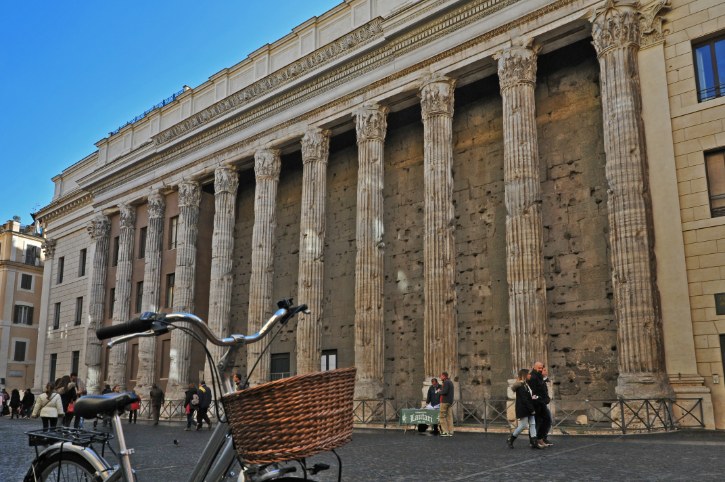
a. An Emperor’s Temple in a Working Square
The Hadrianeum was dedicated in 145 AD by Antoninus Pius to honor his deified adoptive father. Hadrian did not build it for himself. His successor built it for him, after his death.
b. The Eleven Columns
- Eleven fluted Corinthian columns in white Proconnesian marble survive
- Each stands roughly 15 meters tall
- Each is nearly 1.5 meters in diameter
- They rise from a high peperino stone base
- A section of the original entablature still rests above the capitals
c. How the Temple Got Swallowed
- In 1695, Carlo Fontana built the columns into the Papal Land Customs House
- He filled the gaps between the shafts with brickwork, keeping the colonnade as a frame
- In 1879 it was adapted again, for the Stock Exchange and the Chamber of Commerce
- Evening projections called Luci su Adriano trace that transformation across the fluting
d. Imagining the Whole Building
The complete temple had thirteen columns along each flank and eight across the front, inside a porticoed court decorated with reliefs personifying the empire’s provinces. Many of those reliefs are now in the Capitoline Museums. Stand close to a base and mentally extend the row around the missing sides.
e. Finding the Best Angles
- Shoot along the colonnade rather than straight at it, for depth
- Frame a single capital against the modern upper façade
- Cross to the far side for the full eleven-column sweep
11. Trevi Fountain (Fontana di Trevi)
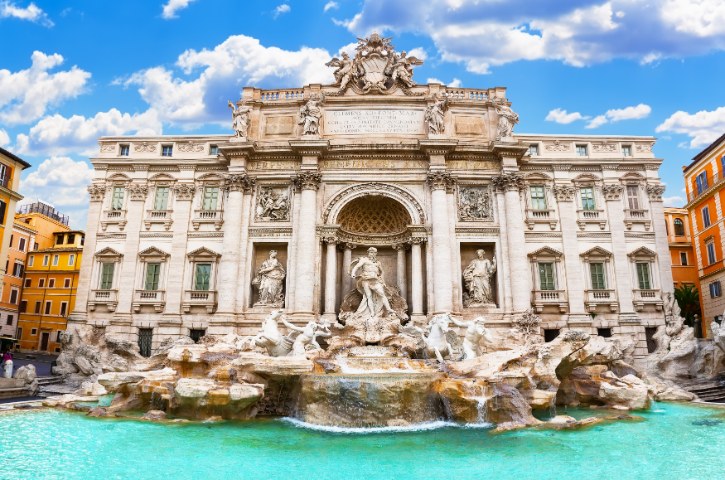
a. Water Arriving in Style
This is the monumental terminus of an ancient aqueduct, and that is the key to understanding it. A functional water outlet became the most theatrical sculpture in Rome. The name comes from tre vie, meaning three roads.
b. Who Built It and When
- In 1732, Pope Clement XII held a competition to replace an earlier basin begun by Bernini
- Nicola Salvi won and worked on it from 1732 until his death in 1751
- Giuseppe Pannini completed the project in 1762
- It is anchored against Palazzo Poli, fusing palace and fountain into one composition
c. The Figures and What They Mean
Carved primarily by Pietro Bracci:
- Oceanus rides a shell-shaped chariot drawn by winged seahorses
- Two horses: one rearing for the stormy sea, one calm for tranquil waters
- Tritons guide them and blow conch-shell trumpets
- Abundance holds a cornucopia on the left, Health sits on the right
- Bas-reliefs show Agrippa approving the aqueduct plans
d. Older Than It Looks
The water is the oldest thing in front of you. The Acqua Vergine was built in 19 BC by Marcus Agrippa, drawing on springs at Salone, around the eighth mile of the Via Collatina east of the city. It is the only one of Rome’s eleven ancient aqueducts still running today, so an eighteenth-century stage set is supplied by ancient engineering.
e. Coins, Rules, and One Famous Film
- Non-residents now pay a €2 ticket to enter the inner perimeter beside the basin
- The fountain stays free to view from outside that perimeter
- Tossing a coin is still allowed, from your right hand over your left shoulder
- One coin means a return to Rome, two romance, three marriage
- Around €1.5 million in coins is collected each year and goes to the Catholic charity Caritas
- Sitting on the basin edge, eating, and wading are prohibited and carry fines
- At the far right edge, find the Fontanina degli Innamorati, where couples who drink together are said to stay faithful
- The fountain entered global culture through Fellini’s La Dolce Vita in 1960
12. Basilica Sant’Andrea delle Fratte
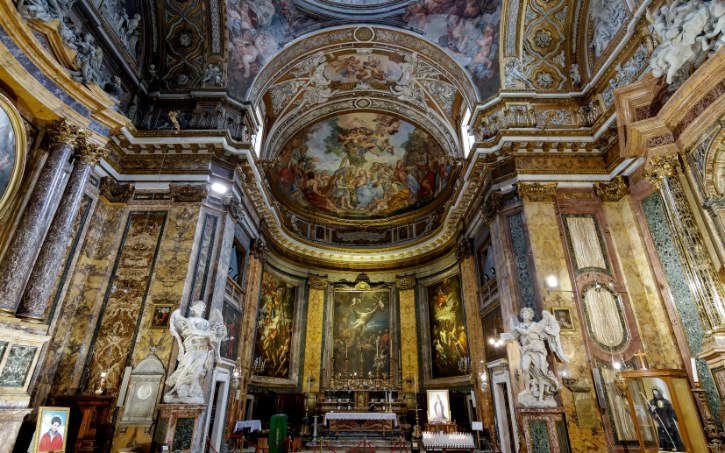
a. A Quiet Church With Two Famous Angels
First built in 1192 as Sant’Andrea de Hortis, when this slope below the Pincian Hill was still wooded and thinly settled. The later name comes from the fratte, the thickets and rough scrub that covered it. Francesco Borromini took over the renovation in 1653 and left his mark on the apse, dome drum, and bell tower.
b. Borromini’s Strange Bell Tower
- The campanile rises from two polygonal stages into upper orders that turn circular and undulating
- Its first round stage carries Corinthian columns capped with two-faced Janus herms
- Above them stand angel caryatids with folded wings, then flaming torches and volutes
- Romans nicknamed it il ballerino, the dancer, because the tower sways when the big bell rings
- Borromini died in 1667 with the dome unfinished, its drum still bare brick, lacking plaster and its planned lantern
- The plain upper façade came later, finished by Pasquale Belli in 1826
c. Why Bernini’s Angels Ended Up Here
Pope Clement IX commissioned ten angels in 1667 for Ponte Sant’Angelo, and the aging Bernini carved two of them himself. The pope judged those two too precious to leave exposed to wind and river damp, so copies went to the bridge instead. The originals stayed in Palazzo Bernini until 1729, when they were donated to this church.
d. What to Examine on the Marble
- Angel with the Crown of Thorns (left): looks down in grief, body twisting in a serpentine curve
- Angel with the Superscription (right): steps forward holding the inscription I.N.R.I.
- The drapery is undercut so deeply that the folds cast real shadows
- The fingers holding the crown, where solid stone turns almost weightless
e. The Shrine of the Miracle
- The church is a pilgrimage shrine to the Madonna del Miracolo
- In the third chapel on the left, an altar marks the events of January 20, 1842
- Alphonse Ratisbonne, a skeptical French Jewish banker, reported an apparition and converted on the spot
- He later entered the priesthood and co-founded the Congregation of Our Lady of Zion
- Saint Maximilian Kolbe celebrated his first Mass here in 1918
13. Via dei Condotti
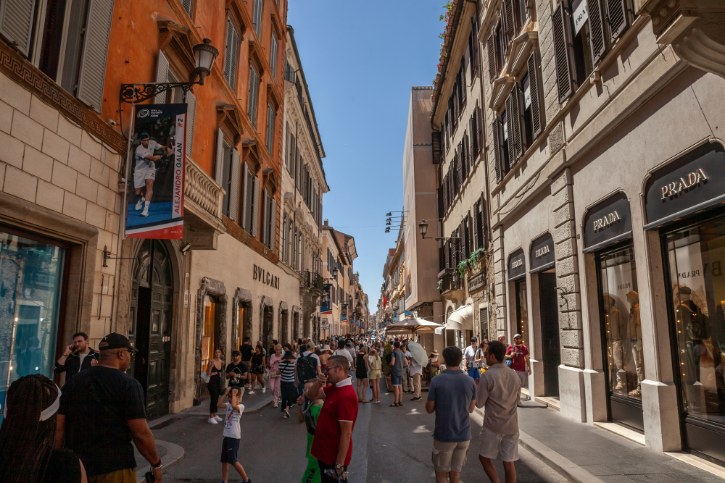
a. The Street That Frames the Staircase
Rome’s premier boulevard of luxury fashion runs along a straight east-west axis, and that geometry is the real attraction. Walk its length and the Spanish Steps grow steadily larger ahead of you.
b. Where the Name Comes From
- The street’s origins date to antiquity, but the name is sixteenth century
- Pope Gregory XIII laid underground conduits, or condotti, beneath it
- They carried water from the Acqua Vergine to the fountains of the Campus Martius
- The name records water infrastructure, not fashion
c. Fashion Along the Façades
- Long an enclave for foreign travelers, artisans, and diplomats
- Greek silversmith Sotirio Bulgari opened his first Rome shop on Via Sistina in 1884
- He moved the business to Via dei Condotti in 1905, and number 10 has been the Bulgari flagship since
- Today the street holds Gucci, Prada, Armani, Cartier, and Hermès
- Each sits inside a historic palazzo, the more interesting half of the view
d. A Street Built for Visitors
Long before the fashion houses arrived, this was an enclave for foreign travelers, artisans, and diplomats drawn to the city on the Grand Tour. That history still shows in the scale of the buildings, which went up as residences rather than shopfronts.
Walk it slowly and the pleasure is the contrast: contemporary Italian design set inside seventeenth and eighteenth-century stonework, with the staircase closing the view at the far end.
e. Architectural Details to Spot
- Classical pediments above the upper windows and carved stone cornices
- Original palace doorways, often framed by modern shopfronts
- The straight perspective pulling your eye toward Trinità dei Monti
14. Fontana della Barcaccia (Fountain of the Boat)
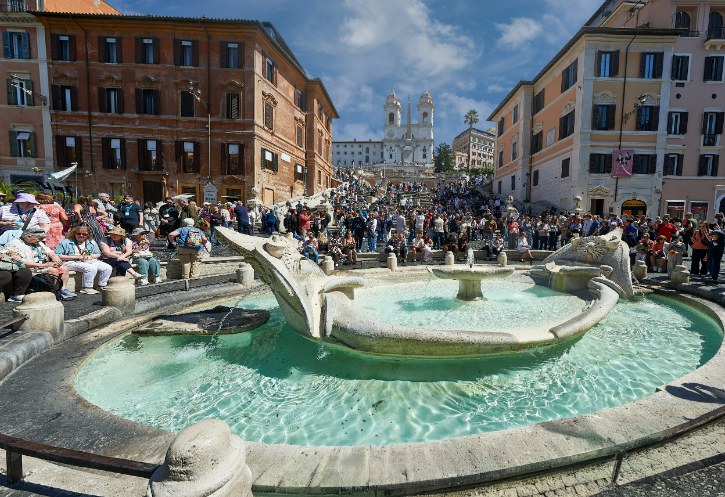
a. A Boat Sinking Into the Pavement
Pope Urban VIII commissioned this fountain in 1627. It was built between 1627 and 1629 by Pietro Bernini, with help from his son Gian Lorenzo Bernini, who finished it after Pietro’s death.
b. The Legend and the Engineering
- Legend ties the design to the Christmas flood of 1598, when a barge was supposedly stranded here
- Treat that as a story rather than documented fact
- The better-supported reason: the Acqua Vergine arrived with very low pressure
- Tall spouts were impossible, so Pietro Bernini sank the fountain below street level
- The gentle flow could then spill over the gunwales, like a sinking vessel
c. Barberini Bees and Suns
- Papal bees: two Barberini coats of arms topped by the papal tiara, set at the outer ends of the hull
- Sun faces: two carved suns with human features, spouting water into basins inside the boat
- Simulated cannons: four round openings, two on each side, firing water outward like gun ports
d. Why the Design Still Matters
The Barcaccia broke with formal Renaissance fountains. Instead of an elevated monument to admire from a distance, it sits low and invites you right to the water’s edge, a quiet contrast to the theatrical scale of the Trevi Fountain.
e. Best Photo Angles
- Stand behind the stern and shoot upward so the staircase rises behind the boat
- Get low and close to catch water spilling over the gunwales
- Frame a bee or sun face in the foreground with the piazza behind
15. Spanish Steps (Scalinata di Trinità dei Monti)
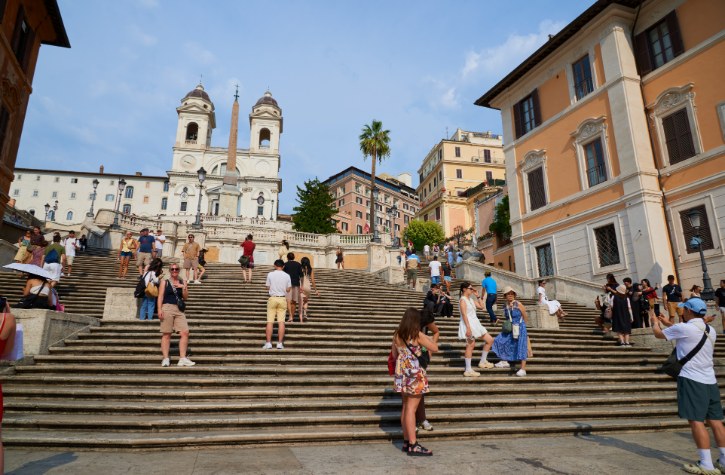
a. The Grand Finish
The Scalinata di Trinità dei Monti is one of the grandest public staircases in Europe. Francesco de Sanctis designed it with Alessandro Specchi, and it was built between 1723 and 1725, rising in convex and concave curves like a theatrical stage.
b. The Numbers Behind the Staircase
- 135 travertine steps
- A steep elevation change of 29 meters
- Flights that narrow and widen as you ascend
- Intermediate terraces breaking the climb into stages
- French fleur-de-lis and the Conti family eagle carved on the balustrades
c. French Money, Spanish Name
- French funding: a bequest of 10,000 scudi left in 1660 by diplomat Étienne Gueffier
- Spanish presence: the square took its name from the Spanish Embassy to the Holy See, there since 1647
- Papal approval: Pope Innocent XIII signed off on the design
- The result is a French-funded staircase with a Spanish name, approved by a pope
d. The Church and Obelisk Above
At the summit stands Santissima Trinità dei Monti, founded in 1502 by King Louis XII of France, its twin bell towers framing the skyline. In front of it rises the Obelisco Sallustiano, erected in 1789 by Pope Pius VI. Look up at both before you climb, then look back down from the top.
e. The Rules, and the Azaleas
- The steps are protected as a cultural monument under municipal regulations updated in 2019
- Sitting, lying down, eating, or dragging wheeled luggage across the stone is prohibited, with fines from €250 to €400
- Climbing, descending, and pausing on the terraces are all perfectly fine
- Every spring the Mostra delle Azalee lines the terraces with pink and white azaleas
- At the base, the Keats-Shelley House marks where the poet died in 1821