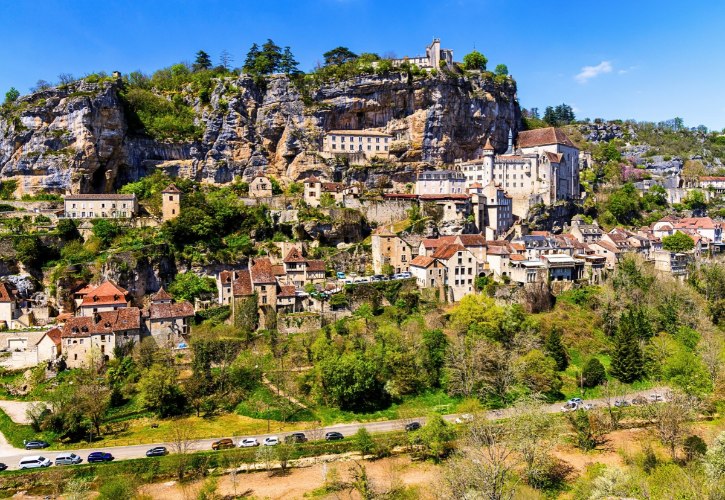
Deep in southwest France, the Lot and the upper Dordogne valleys pack a huge amount of beauty into a small corner of the map: golden medieval villages, dramatic limestone cliffs, a glowing red-stone town, hilltop castles, and secret rivers underground.
Best of all, these stops sit just 10 to 30 minutes apart, so you can link them into one easy loop with only short, pretty drives. Your adventure begins with the most jaw-dropping sight of all, the cliffside village of Rocamadour. 😊
1. Rocamadour
a. A Village That Clings to the Cliff
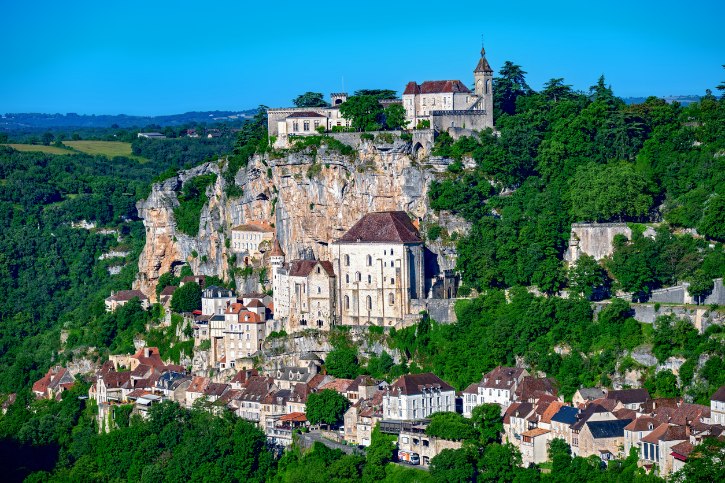
Few first glimpses in France can match Rocamadour, which grips a near-vertical limestone cliff around 120 meters above the Alzou Valley floor, as though chiseled from the rock.
b. The Story Behind the Pilgrimage
Rocamadour’s fame began in 1166, when the preserved body of the hermit Saint Amadour was found at the foot of the rock.
- Kings, bishops, and pilgrims bound for Santiago de Compostela began coming here.
- The Grand Escalier, a stairway of 216 steps, became the centerpiece of the pilgrimage.
- The most devout once climbed every step on their knees as penance.
c. Sacred Treasures Along the Climb
The main sights are stacked up the cliff in layers. Watch for:
- Chapelle Notre-Dame (Miracle Chapel): Home to the Black Madonna, carved from walnut wood in the twelfth century. Above the altar hang votive gifts, including iron chains from freed prisoners and ship models from thankful sailors.
- Durandal: The spot by the chapel door where an iron sword long sat wedged in the rock, linked in legend to the knight Roland, nephew of Charlemagne. The sword vanished in 2024 and has not been recovered, so today you see the empty cleft and its story.
- Basilique Saint-Sauveur: A Romanesque-Gothic church with a vaulted wooden ceiling, listed by UNESCO on the Santiago de Compostela routes.
- Crypte Saint-Amadour: The crypt beneath the basilica, consecrated in 1166 to hold the hermit’s relics, and also UNESCO-listed.
d. Life in the Lower Village
Below the sanctuaries, the secular village runs along a single narrow terrace:
- The main artery is the Rue Roland-le-Preux, once guarded by fortified gates such as the Porte du Figuier.
- Houses are built from pale local limestone, with tile roofs and overhanging upper floors, lovely for slow wandering.
e. The Spot for That Perfect Photo
To grasp how this village defies gravity, view it from across the canyon:
- Head to the far side, near the hamlet of L’Hospitalet.
- From there, all three levels line up: town at the base, chapels on the cliff, castle ramparts along the top.
- It’s the single frame that sums up Rocamadour.
Next, the road leads beneath the plateau, where one sinkhole opens into a world you have to see to believe.
2. Gouffre de Padirac
a. A Vast Opening in the Earth
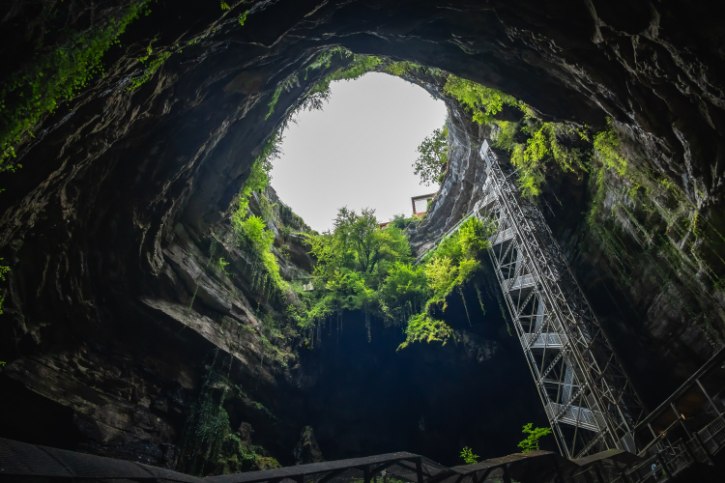
The Gouffre de Padirac is an enormous collapse sinkhole in the limestone of the Causse de Gramat, formed as water dissolved the rock until a cavern roof gave way.
b. Figures That Are Hard to Believe
The scale sinks in once you see the numbers:
- The surface opening is roughly 33 to 35 meters across.
- The vertical drop plunges about 75 meters to the debris cone below.
- Pathways continue to around 103 meters, where an active river still runs.
c. From Feared Pit to Famous Site
For generations, locals steered clear and called it the “Devil’s Hole”.
- Everything changed on July 9, 1889, when explorer Édouard-Alfred Martel descended with rope ladders and canvas boats.
- He charted the underground river and opened the way for exploration.
- The site welcomed its first visitors on April 10, 1899.
d. A Boat Ride Through the Dark
Here’s the part you’ll remember most. You ride an elevator or iron stairs into the chasm, then board a flat-bottomed boat and glide along an underground river beneath glowing limestone vaults, the air a cool 13°C all year.
e. The Underground Wonders to Spot
As you move through the caverns, watch for:
- Lac de la Pluie: An underground lake fed by rainwater seeping through the rock above.
- La Grande Pendeloque: A huge stalactite about 60 meters long, suspended over that lake.
- Lac des Gours: A staircase of natural calcite dams stepping across the floor.
- Salle du Grand Dôme: A chamber whose ceiling rises 94 meters overhead.
Back in the sunshine, the road rolls east to a natural stone amphitheater with a tall waterfall.
3. Autoire
a. A Waterfall Tucked in the Cliffs
Autoire sits inside the Cirque d’Autoire, a blind valley ringed by cliffs as high as 150 meters. At its head, a stream spills over a 30-meter drop to form the Cascade d’Autoire, the tallest single-drop waterfall in the Lot.
b. Enjoying the Viewpoints With Care
Footpaths climb to the top of the falls, where the views open over the green basin:
- Lookout points gaze straight down into the cirque.
- The upper trails cross uneven, rocky ground.
- Wear sturdy shoes and stay cautious near the unguarded cliff edges.
c. The Little Village They Call Versailles
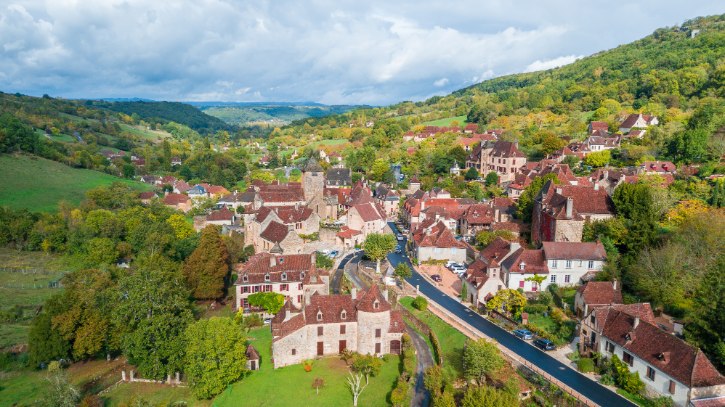
Autoire is one of Les Plus Beaux Villages de France, nicknamed “Little Versailles”:
- In the 1500s and 1600s, well-off families from nearby Saint-Céré built seasonal homes here.
- The result is a village of elegant stonework, far more refined than its small size suggests.
d. Charming Details to Look For
As you stroll the lanes, keep an eye out for:
- Honey-colored stone manors with octagonal stair turrets, carved windows, and tall tiled roofs.
- Église Saint-Pierre, a Romanesque church with carved stone heads and animals on its outer apse.
- The Château des Anglais, a tiny fortress built into a cliff cavity and used during the Hundred Years’ War.
e. A Green and Gentle Retreat
High walls shelter the valley, giving Autoire its own gentle microclimate:
- Plum and walnut trees flourish along the stream, past old footbridges and washhouses.
- A central square and stone fountain anchor the quiet side lanes.
Climbing north, the cliffs open into wide countryside as the road gains the ridge of Loubressac.
4. Loubressac
a. A Balcony Above Three Valleys
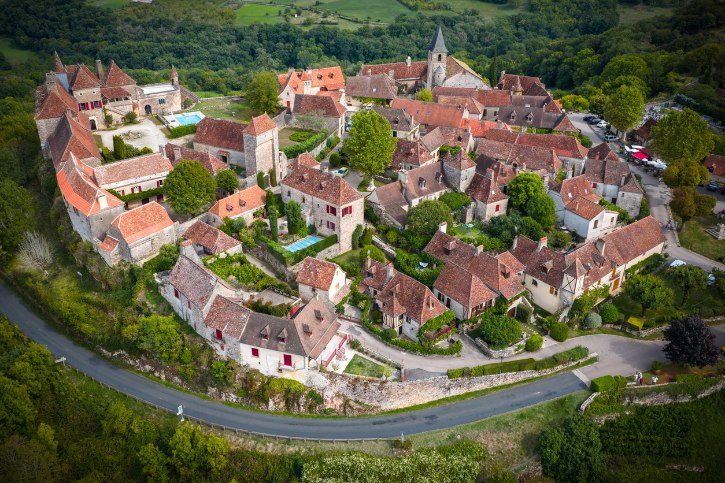
Loubressac perches on a slim limestone ridge above where three river valleys meet: the Bave, the Cère, and the broader Dordogne. A lookout in the Middle Ages, it now makes for glorious sightseeing.
b. The Landmarks You Can Pick Out
From the viewing platform at the tip of the village, a whole landscape unfolds:
- The towers of Château de Montal.
- The cliffside ruins above Autoire.
- The red bastions of Château de Castelnau-Bretenoux to the northeast.
- The granite foothills of the Massif Central in neighboring Cantal.
c. Strolling the Golden Lanes
Loubressac is another of Les Plus Beaux Villages de France:
- It is built almost entirely in warm golden Quercy limestone.
- Its narrow, curving lanes, once designed to break the wind, are trimmed with flowers today, one of the prettiest walks on the route.
d. A Church Tied to the Town’s Defenses
At the heart of the village stands a landmark bound to its old protections:
- The Église Saint-Jean-Baptiste is a fourteenth-century Gothic church on older Romanesque foundations.
- Its fortified bell tower once formed part of the town’s defensive network.
- Inside, carved details survive from an earlier sanctuary.
e. A Castle Best Seen From the Lanes
At the point of the spur sits the Château de Loubressac:
- First built in the thirteenth century, it stands over a sheer drop, ringed by round watchtowers and high walls.
- It’s a private home, so the inside is closed, but its gates and striking outline are clear from the lanes and ramparts.
From the eastern ramparts, your gaze is drawn across the valley to a broad hill crowned by a massive red fortress.
5. Castelnau-Bretenoux Castle
a. The Fortress That Burns Red
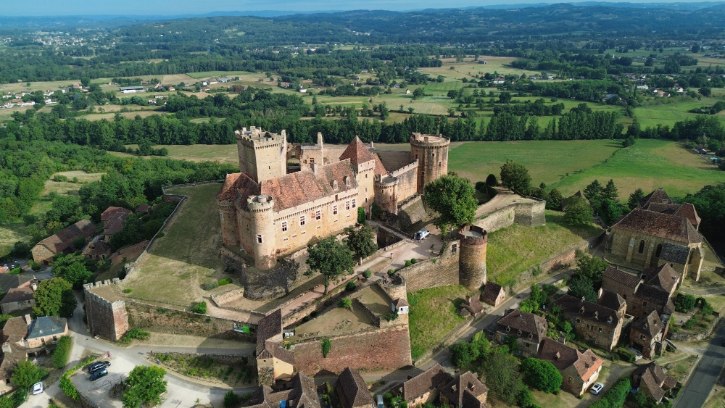
The Château de Castelnau-Bretenoux rises from a lone rocky ridge as one of the mightiest medieval fortresses in southern France, and its most striking feature is its color:
- It was built from local red sandstone loaded with iron oxide.
- That iron lends the whole fortress an intense crimson glow.
- The shade shifts beautifully as the daylight moves.
b. Defenses Built to Hold Back Armies
Laid out on a triangular plan over six centuries, each outer face runs about 85 meters. Its main defenses still impress:
- The Donjon (Keep): A square Romanesque tower reaching 30 meters, later topped with stone machicolations.
- The Tour Militaire (Artillery Tower): A round bastion over 14 meters wide, pierced with arrow loops and gunports for early firearms.
- The Outer Defense Ring: A long curtain wall with six flanking towers, spur bastions, and a fortified gatehouse.
c. Panoramas From the Battlements
The castle guards the lands where four rivers meet: the Dordogne, Bave, Cère, and Mamoul. From the upper platforms, the whole basin spreads before you, once a line-of-sight link to Loubressac and Montal.
d. The Opera Star Who Rescued It
The castle’s story took a remarkable turn in the nineteenth century:
- After the Revolution, it slid into ruin and was badly damaged by fire in 1851.
- In 1896, Jean Mouliérat, an opera tenor from the Lot, bought the ruins.
- He poured his fortune into restoring the ramparts and rooms.
- He assembled a collection of medieval statues, altarpieces, tapestries, and furniture.
e. A Treasure Open to All Today
Shortly before his death in 1932, Mouliérat gave the castle and its collections to the French State:
- It is now cared for by the national monuments service.
- You can explore both its medieval military defenses and its restored, furnished rooms, feeling the full span of its history.
From imposing towers, the road turns to a quiet village beside the Dordogne, shaped by faith rather than war.
6. Carennac
a. A Calm Village on the Riverbank
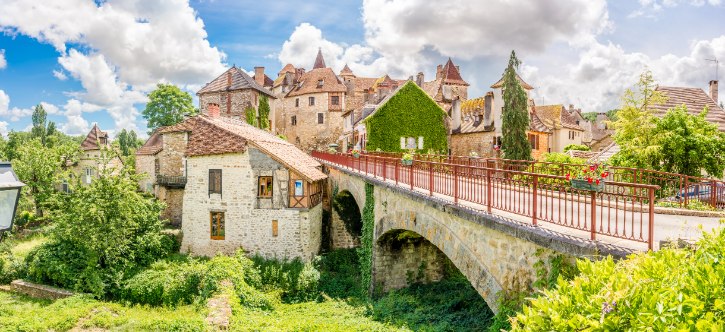
Carennac grew up around an eleventh-century Benedictine priory tied to the great Abbey of Cluny, resting on the south bank of the Dordogne, the sort of place where the pace eases.
b. A Church and Its Remarkable Doorway
The centerpiece is the Église Saint-Pierre, whose sculpted tympanum, under a later Gothic porch, rewards a close look:
- It shows Christ in Majesty inside an almond-shaped frame.
- Around him stand the symbols of the four evangelists and the twelve apostles.
- The carving reflects the influence of the famous Moissac sculpture school.
c. Two Hidden Masterpieces
Beyond the doorway, the complex holds two more highlights:
- The cloister, blending twelfth-century Romanesque arches with Flamboyant Gothic wings rebuilt after the Hundred Years’ War.
- A fifteenth-century Mise au Tombeau (Entombment of Christ) in the chapter house, carved from local limestone with eight solemn figures.
d. The Dean’s Castle and a Famous Author
Overlooking the priory stands the Château des Doyens, the sixteenth-century home of the priory’s deans:
- It carries tall cross-windows, corner turrets, and painted wooden ceilings.
- Its most famous resident was the writer Fénelon, dean here between 1681 and 1695.
- Local tradition says he wrote parts of his novel Les Aventures de Télémaque beneath a garden arbor above the river.
e. Old Streets and Quiet Quays
Around the priory, the village keeps a lovely tangle of old buildings:
- Fifteenth- and sixteenth-century stone houses with outside stairs and rounded doorways.
- Dovecotes that once signaled a family’s standing.
- The Canal des Moines and old quays, where timber, walnut oil, and wine were loaded for Bordeaux.
Following the river downstream, you reach another riverside town with its own great abbey and carved doorway.
7. Beaulieu-sur-Dordogne
a. A Riverside Town With Ancient Roots
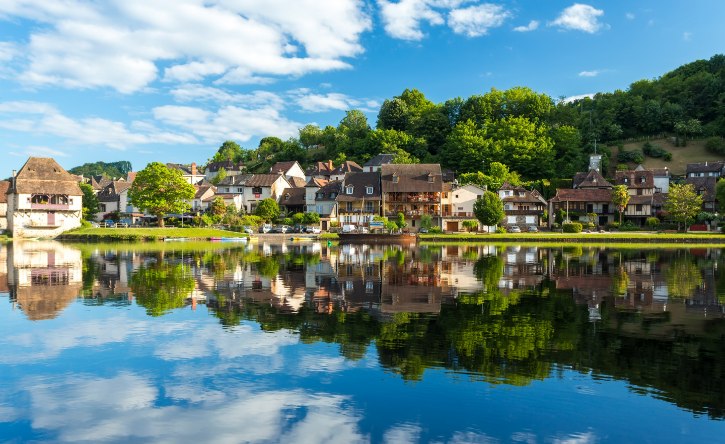
On the eastern bank of the Dordogne in the Corrèze, Beaulieu-sur-Dordogne began around 850, when an archbishop founded a Benedictine abbey here. Joined to Cluny in 1095, it became an important pilgrim stop and later earned a place among Les Plus Beaux Villages de France.
b. A Doorway Unlike Any Other
The great landmark is the twelfth-century Abbatiale Saint-Pierre, whose southern doorway, carved around 1130 to 1140, is a masterpiece:
- Rather than the usual hellfire, it shows the triumphant Second Coming of Christ.
- Christ stands with arms outstretched, flanked by the twelve apostles in lively conversation.
- Below runs a frieze of mythical beasts and dragons, symbolizing good’s victory over chaos.
- Inside, the treasury holds a rare twelfth-century statue of the Virgin and Child wrapped in embossed silver.
c. Streets That Invite a Wander
Beaulieu’s old center keeps a half-circle shape tracing its vanished medieval walls. Worth seeking out:
- The Maison Renaissance, with sixteenth-century carved medallions on its facade.
- The Porte Sainte-Catherine, a surviving medieval gateway.
- The riverside Chapelle des Pénitents, on a rock spur above the water, with a bell-wall that mirrors in the calm river.
d. The Rhythm of Riverside Life
Beaulieu was once a lively river port with its own working traditions:
- Flat-bottomed boats called gabares carried timber, barrel staves, and walnut oil toward Bordeaux.
- A rebuilt gabare named “Adèle et Clarisse” is moored along the quays today, keeping that story alive.
e. The Warm “Limousine Riviera”
Thanks to its sheltered, south-facing position, the town enjoys a surprisingly warm climate:
- It earned the nickname “La Riviera Limousine”.
- Fig trees, grapes, and strawberries all thrive here.
- The town is a center for strawberry growing, celebrated each spring at the Fête de la Fraise.
Staying in the Corrèze, the road leads to a village carved entirely from glowing red stone.
8. Collonges-la-Rouge
a. A Village Painted in Red Stone
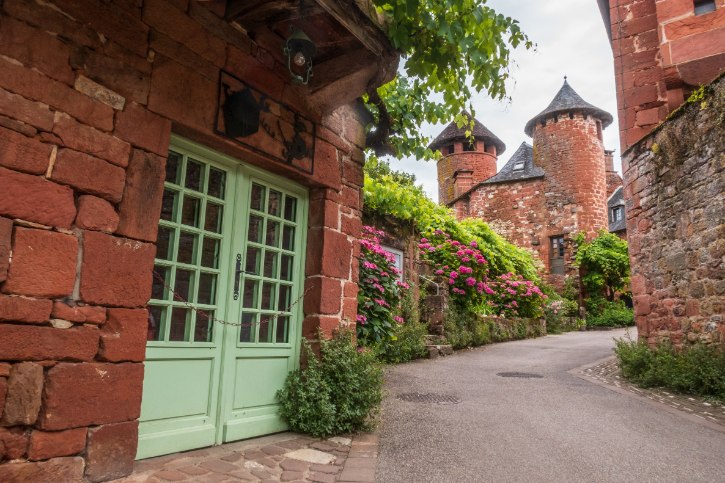
Collonges-la-Rouge is built entirely in deep red sandstone, its high iron content turning every wall a rich carmine. Set against green chestnut and walnut groves, the effect is unlike anywhere else on your route.
b. A Surprisingly Powerful Past
The village carries a grand history for its size:
- It grew around an eighth-century priory.
- It later joined the powerful Viscounty of Turenne, gaining real independence.
- In 1982, mayor Charles Ceyrac founded Les Plus Beaux Villages de France, with Collonges as its very first member.
c. The City of Twenty-Five Towers
Collonges earned the nickname “The City of 25 Towers” for its many turrets, built by wealthy magistrates once the Viscounts of Turenne let the village run its own courts. The key buildings to find:
- Maison de la Sirène: A sixteenth-century house with a carved mermaid holding a comb and mirror, now a small museum of local tools and furniture.
- Château de Vassinhac: Built in 1583 for the governor of the viscounty, with hexagonal stair towers and high machicolations.
- Halle aux Grains: A covered market hall with stone pillars and an intact communal bread oven.
d. A Church With Two Faces
The Église Saint-Pierre was founded in the eleventh century, crowned with an octagonal Limousin-style bell tower, one of the oldest around:
- During the Wars of Religion, it was fortified for protection.
- Its interior was split into two parallel naves so Catholic and Protestant congregations could share the roof.
- Its carved tympanum stands out in white limestone against the red, showing the Ascension of Christ.
e. A Humble Corner of Devotion
Across from the parish church stands the fifteenth-century Chapelle des Pénitents Noirs:
- It once gathered a lay brotherhood devoted to burials and caring for the sick.
- Its simple stone bell-gable adds a gentle layer beyond the village’s famous red walls.
The village’s ties to the Viscounts of Turenne lead to the next stop, where their old seat of power still looms above the rooftops.
9. Turenne
a. A Village Beneath a Citadel
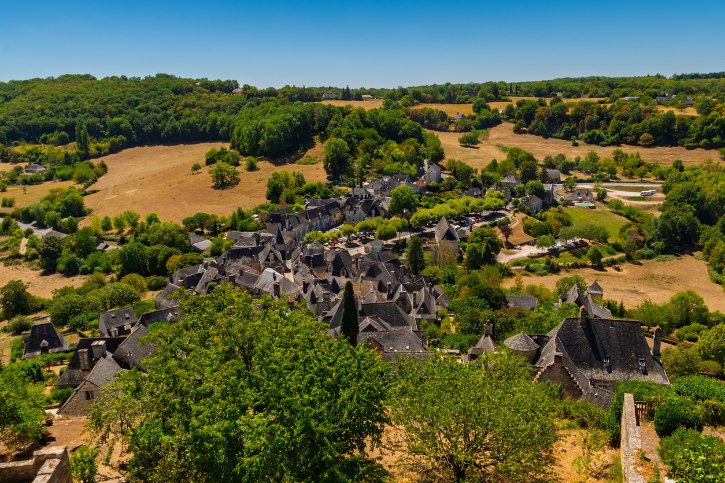
Turenne rises on a sharp limestone peak above southern Corrèze, climbing in rings toward the summit, where two surviving towers cut an unforgettable silhouette. It is another of Les Plus Beaux Villages de France.
b. The Two Towers That Remain
When the crown took over the viscounty in the eighteenth century, most of the castle was pulled down, but two towers survive to explore:
- Tour César (Caesar’s Tower): A round watchtower from the early thirteenth century, with walls 2.5 meters thick and a spiral stair to an open parapet with an orientation table.
- Tour du Trésor (Treasury Tower): A square fourteenth-century keep that once held the viscounty’s archives, armory, and coin mint.
c. A Garden With Endless Horizons
The old courtyard between the towers is now a tidy French garden, and it comes with a real reward:
- 360-degree views across the surrounding countryside.
- A panorama reaching over the Causse de Martel.
- On clear days, the volcanic peaks of Cantal.
d. Climbing the Vaulted Alleys
Heading down from the summit, the village reveals its layered streets:
- Steep, stone-vaulted alleys hold residences like the Maison des Chanoines, with watch-turrets and pointed carriage gates.
- Partway down stands the Collégiale Notre-Dame Saint-Pantaléon, with a gilded baroque altarpiece inside.
e. A Small State That Ruled Itself
Turenne’s real claim to fame is its past as the capital of an almost independent state, the Viscounty of Turenne:
- For centuries, its viscounts paid no taxes to the king.
- They collected their own duties, minted their own coins, and raised their own armies.
- Its most famous son was Henri de La Tour d’Auvergne, one of France’s greatest military commanders.
- The independence ended on May 8, 1738, when the last viscount sold the territory to the king to settle his gambling debts.
From there, the route returns to the Lot, toward a town famous for commerce and a skyline full of towers.
10. Martel
a. The Town Crowned With Seven Towers
Unlike the clifftop villages, Martel spread out as an open market town on a gentle plateau. Its nickname, “The Town of Seven Towers”, comes from the stone towers raised by merchant families to display their wealth.
b. The Towers That Shape the Skyline
Records suggest dozens of towers once stood here, though tradition settles on seven favorites. Among the ones to spot:
- The Belfry of the Palais de la Raymondie, a 35-meter square tower holding the town clock.
- The fortified bell tower of the Église Saint-Maur.
- The Tour Tournemire, later used as a town prison.
- The Tour des Cordeliers, a remnant of a former Franciscan monastery.
c. The Lively Historic Center
Martel’s center gathers around the Place des Consuls, a medieval square framed by stone arcades and worth settling into:
- In the middle stands a covered market hall, rebuilt in 1792 on an older site, with a chestnut-wood roof on limestone pillars.
- Carved into one pillar are old stone grain measures, once used to check the day’s wheat and walnuts.
- Overlooking the square is the Palais de la Raymondie, a civic manor from between 1280 and 1330, with Gothic windows and carved gargoyles.
d. A Church Doubling as a Fortress
A short walk from the square brings you to the Église Saint-Maur:
- A fourteenth-century Gothic church, fortified to shelter the town during the Hundred Years’ War.
- It carries a 48-meter defensive tower and preserves old stained glass inside.
e. Truffles, Walnuts, and Market Mornings
Martel’s prosperity was rooted in the land, and that tradition is still alive and delicious:
- The area is known for walnuts and prized black winter truffles from the surrounding oak groves.
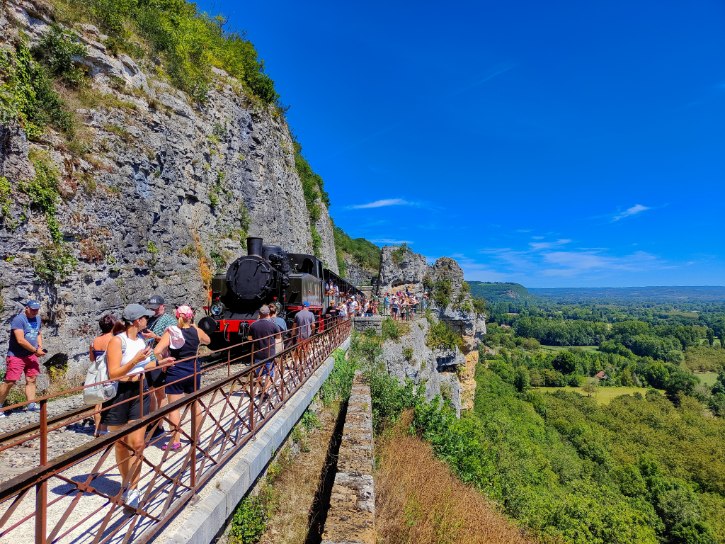
- In the railway age, the town shipped truffles across Europe, and the steam train earned the nickname Le Truffadou.
- A weekly market still fills the old hall with walnut oil, Cabécou cheeses, truffles, and regional wines.
Martel’s lively streets lead on to a river town known for a remarkable abbey and a local spirit.
11. Souillac
a. Where Rivers and Stories Converge
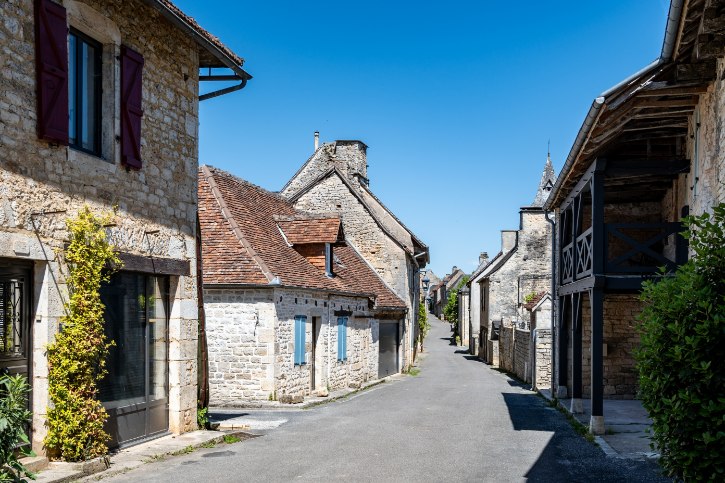
Souillac grew up where the Borrèze meets the Dordogne, around an abbey founded by Benedictine monks in the tenth century, a riverside town that blends great art with good food.
b. An Abbey Beneath Three Domes
Its great landmark is the twelfth-century Abbatiale Sainte-Marie, and what makes it special is its roof:
- It’s topped by three grand stone domes set on pendentives.
- That design echoes the Byzantine Mediterranean.
- It links the church to the great cathedrals of Périgueux and Cahors.
c. Carvings That Reward a Close Look
Against the inside of the west wall are the saved carvings from the original doorway, the work of sculptors from the Moissac workshop. Three stand out:
- The Prophet Isaiah: A lively figure caught mid-stride, with crossed legs and swirling robes, famous for breaking from stiff earlier styles.
- The Sculpted Trumeau: A central pillar writhing with intertwined beasts and struggling figures, an image of temptation and sin.
- The Legend of Theophilus: A carved tale of a man who makes a pact with the devil, then repents and is saved by the Virgin Mary, an early cousin of the Faust story.
d. A Distillery Worth a Taste
Founded in 1905, the Maison Louis Roque is an artisan distillery famous for La Vieille Prune de Souillac, a plum spirit:
- Five generations have kept the same method: local plums, fermented, distilled in copper pot stills, and aged in oak.
- The aging gives it an amber color and notes of dried plum, almond, and oak.
- An on-site museum displays antique copper stills, glass carboys, and old distilling tools.
One quick note: the town’s old automaton museum has closed permanently, so Souillac’s highlights now center on the Louis Roque cellars and the restored abbey quarter.
e. A Fitting Finish by the Water
Down by the river sits the Pont Louis-Vicat, an early nineteenth-century stone bridge, while the old town’s lanes lead to the Place Saint-Martin and its cheerful Friday market of duck confit, walnuts, Rocamadour goat cheese, and seasonal fruit.
From Souillac, the road follows the Dordogne back toward Rocamadour, where one last underground wonder waits beneath the cliffs.
12. Grottes de Lacave
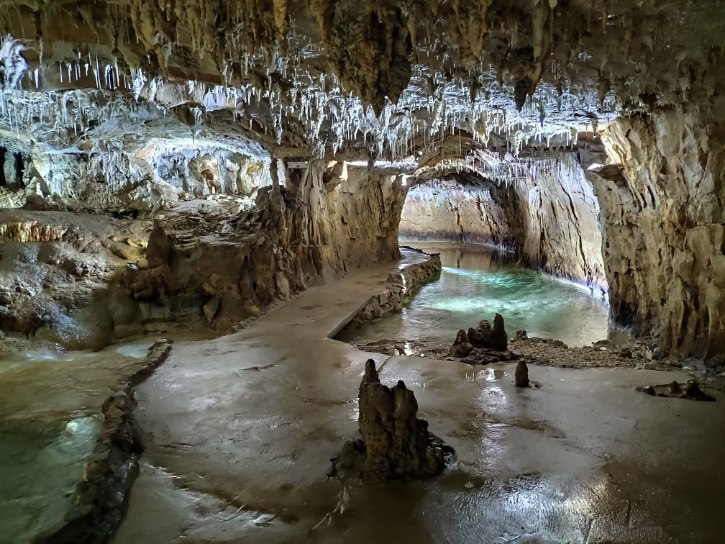
a. A Cave Found by Martel’s Pupil
The Grottes de Lacave sit in the limestone cliffs above the Ouysse valley, a short drive from Rocamadour. They were discovered on April 9, 1902, by Armand Viré, a naturalist and pupil of the great cave explorer Édouard-Alfred Martel, whose work you met earlier at Padirac.
b. Getting Underground Is Half the Fun
Reaching the caves is an adventure in itself, so take your time with each stage:
- A little electric train carries you through a long tunnel bored into the hillside.
- From there, a lift or a flight of steps climbs to the main cavern.
- The full guided route runs about 1,600 meters and takes around 90 minutes.
c. Twelve Chambers of Stone and Water
Two galleries branch off the central cavern into a string of 12 chambers, each with its own character:
- Still underground pools mirror the ceilings so perfectly the rock seems to float.
- Delicate concretions rise and hang in every direction, shaped over thousands of years.
- Fenced walkways protect the formations, so you follow a clear, easy path throughout.
d. The Glowing Hall of Wonders
The highlight is the Salle des Merveilles, or Hall of Wonders, a chamber of roughly 2,000 square meters. Here the guides switch on ultraviolet light, and the living, water-fed concretions begin to glow in ghostly whites and greens. It’s a genuinely magical moment, and the kind of thing you’ll want to tell people about afterward.
e. A Fitting End Beneath the Cliffs
Set deep in the rock yet only minutes from where your journey began, Lacave makes a perfect final stop:
- The cool, quiet air offers a calm contrast to the villages and castles above ground.
- Nearby, the valley frames views back toward Rocamadour and the medieval Château de Belcastel.
- It bookends the trip neatly, closing underground just as Padirac opened the earth earlier on.
And so the loop closes. In one easy circuit you’ve gone from cliffside sanctuaries and underground rivers to red-stone villages, mighty castles, and carved abbeys. For a corner of France this small, the Lot delivers an astonishing variety, and leaves you dreaming up your return.