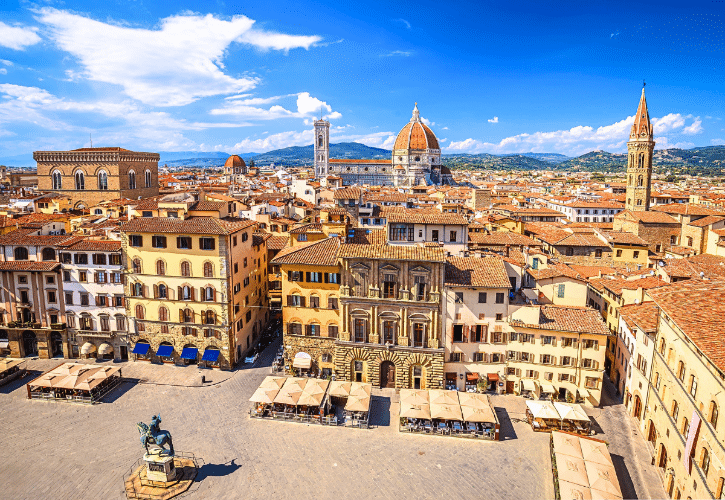
Florence rewards the traveler who slows down and looks closely. In a single day on foot, you can stand before the tombs of geniuses, climb into the belly of a Renaissance dome, and watch the sun soften the rooftops from a hillside terrace.
The secret is not to see everything, but to see the right things at the right moments. Here is how to spend one unforgettable day walking through the heart of the city. 😊
9:00 AM – Basilica di Santa Croce
a. Why start your day here
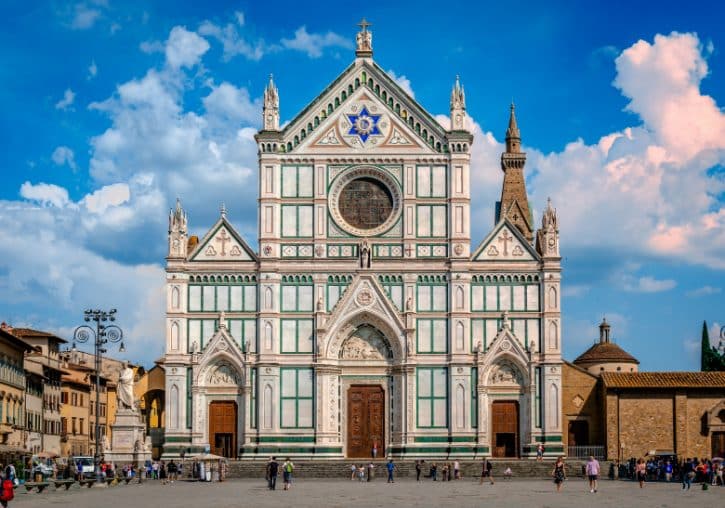
There is no gentler, grander way to ease into Florence than the wide open square in front of Santa Croce. Arriving early gives you the place at its best:
- The crowds are still thin and the light is soft.
- You have space to simply stand and take it all in.
- This is the burial place of the people who shaped the modern world.
- Beginning here sets the tone for everything that follows.
b. Make the most of the square first
Here is a handy thing to know: the basilica does not open to visitors until 9:30 AM, so your first half hour naturally belongs to the square. That is no loss at all.
- Use the time for photos in the gentle morning light.
- Get your bearings before the doors open.
- Enjoy the sense of history in a space that once hosted Franciscan sermons and the city’s rowdy historic football match.
c. What to notice on the façade
Take a moment to really look at the striped marble front before you go in.
- Let your eye travel to the very top of the central gable, where you will spot a Star of David, an unusual and moving detail placed by the architect.
- Admire the bands of colored marble across the whole façade.
- For the classic photo, drift to the southeastern edge of the square to capture the full front with all that open paving before it.
d. The tombs that tell Florence’s story
Inside, the side aisles read like a roll call of history. The trick is knowing who is really here and who is only honored.
- Michelangelo rests here, beneath figures of Painting, Sculpture, and Architecture.
- Galileo lies directly across from him, holding a telescope and gazing upward.
- Machiavelli is buried here too, under an epitaph saying no praise could match his name.
- Dante is not. His monument is a beautiful but empty tribute, as he remains buried in Ravenna.
If your time is short, stand in the aisle between Michelangelo and Galileo. Two of the greatest minds in history, facing each other across the nave, is a sight you will not forget.
e. Giotto’s frescoes, and what you can really see
Santa Croce is famous for Giotto, but be realistic about which of his work is visible today.
- The Bardi Chapel, with its stories of Saint Francis, is wrapped in scaffolding for a long restoration and is largely hidden from ordinary visitors.
- The neighboring Peruzzi Chapel has faded over the centuries, but you can still see its frescoes from the chapel entrance.
- This is the Giotto cycle to focus on today, so do not let a guidebook send you chasing the hidden one.
f. A calm finish in the Pazzi Chapel
Before you leave, step out into the cloister to find the Pazzi Chapel, an early masterpiece by Brunelleschi. You do not need to know the architecture to feel it.
- The room is serene and perfectly balanced.
- It is framed in soft gray stone.
- Round terracotta medallions of the Apostles sit high on the walls.
It is the ideal quiet moment before the busier hours ahead.
10:30 AM – Duomo Complex (Piazza del Duomo)
a. Why this square stops you in your tracks
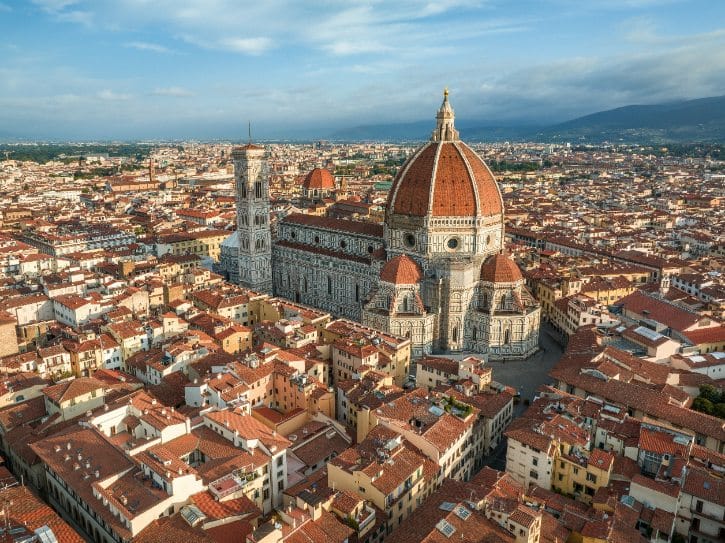
Nothing quite prepares you for turning a corner and seeing the Duomo fill the sky. The cathedral, the soaring bell tower, the octagonal baptistery, and Brunelleschi’s monumental dome all crowd together in one piazza. Take a slow lap of the outside first and simply look up, because the exterior is the real show here.
b. Choose your Duomo: climb or wander
You cannot do it all in one visit, so pick the experience that fits your energy.
- The climber’s route: conquer the Dome, drink in the view, then admire the rest from the ground.
- The gentle route: stroll the exteriors, step into the Baptistery, and lose yourself in the cathedral museum.
Be honest with yourself about how much your legs can take, because a long hillside climb waits for you at the end of the day.
c. If you climb the Dome
Should you go up, the reward comes in stages. Watch for these along the way:
- The vast interior frescoes of the Last Judgment, painted across the inside of the dome.
- The close-up look at Brunelleschi’s astonishing engineering.
- The rooftop view at the top, one of the finest panoramas in the city.
Choose the Dome over the bell tower if you only climb once, since the views overlap and doing both is exhausting.
d. The Baptistery and its golden doors
The Baptistery holds one of Florence’s best lessons in looking carefully.
- The gleaming golden doors facing the cathedral are modern replicas.
- The originals, Ghiberti’s celebrated Gates of Paradise, are safely displayed indoors in the cathedral museum.
- Enjoy the doors outside for their glow, then see the real ones inside if you can. It is a genuinely different experience.
e. The low-effort route worth loving
If you skip the climbs, you lose nothing. A relaxed hour here can be just as rich:
- Walk the full perimeter and study how the Gothic base, the marble façade, the bell tower, and the dome fit together.
- Step inside the Baptistery for its glittering ceiling mosaics.
- Save time for the cathedral museum, home to Ghiberti’s original doors, Donatello’s Penitent Magdalene, and a late Pietà by Michelangelo.
f. A pause at Piazza della Repubblica
As you head south toward the market, drift for a moment through Piazza della Repubblica, a grand, café-lined square with a history all its own.
- It sits on the site of the ancient Roman forum and the old city center.
- Grab a quick coffee at one of the historic cafés.
- Watch the world go by under the huge arch.
It is a lovely in-between moment before your next stop, and a nice shift from sacred architecture to everyday Florentine life.
12:00 PM – Mercato Nuovo
a. Why stop at the little boar market
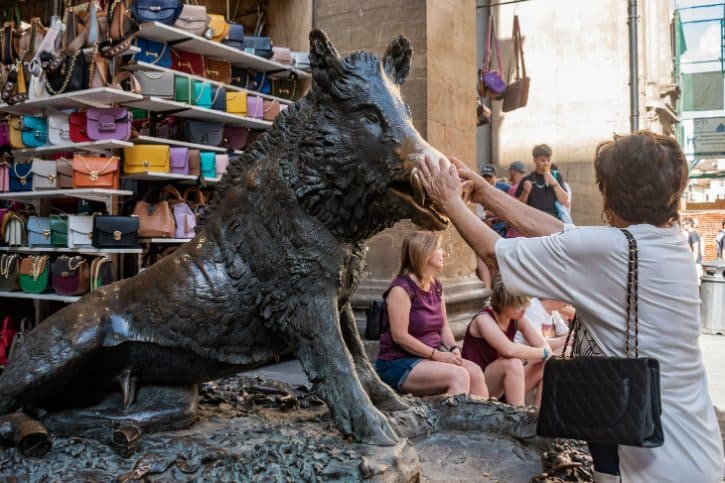
Tucked under an elegant open arcade, Mercato Nuovo is a short, playful break rather than a major sight. It is worth a few minutes for the atmosphere, the tradition, and one very famous bronze pig.
b. The Porcellino and its lucky ritual
The bronze boar at the edge of the loggia is beloved by visitors, and there is a fun custom attached to it.
- The boar you see today is a replica, while the original was moved to a museum to protect it.
- Rub the boar’s snout to guarantee your return to Florence.
- Place a coin in its mouth, and if it slips through the grate below, good luck is yours.
- The coins are collected for local charities, so you are doing a small good deed either way.
c. Under the loggia
The graceful arcade dates to the 16th century, when it buzzed with trade.
- It was once a hub for selling silk, fine fabrics, and money among Florentine merchants.
- Today the stalls are stocked with leather goods, silk scarves, and souvenirs.
- Even if you are not shopping, a slow loop under the arches gives you a taste of the city’s old market life.
d. A quick, joyful stop
Do not overthink this one. Rub the boar, snap a photo, browse for a minute, and move on with a smile. It is meant to be light, and it makes a nice palate cleanser between the heavyweight sights on either side.
12:30 PM – Piazza della Signoria & Piazzale degli Uffizi
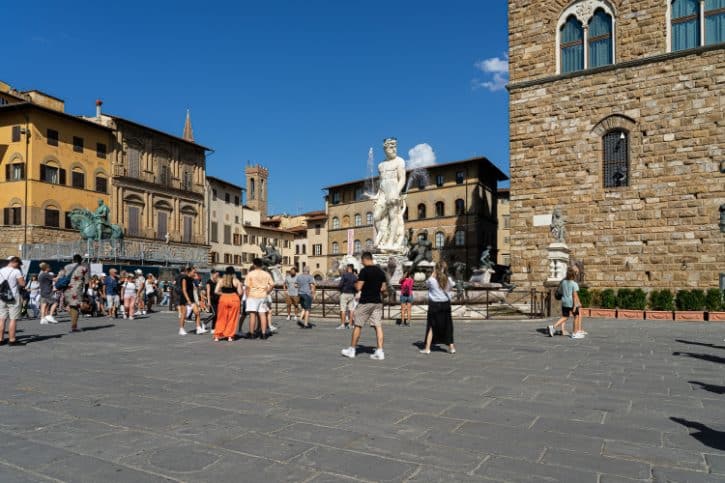
a. Florence’s open-air stage
Piazza della Signoria has been the political heart of Florence for seven hundred years, and it doubles as a free outdoor sculpture gallery. Fountains, statues, and the fortress-like town hall all crowd together, and the whole square hums with energy. Take it in as one grand scene before you zoom in on the details.
b. Originals or copies? Know before you look
Half the fun here is knowing what you are actually seeing.
- The David at the palace door is a replica, marking the exact spot where the real marble once stood.
- The Fountain of Neptune, nicknamed “the big white one” by locals, is an original.
- The Palazzo Vecchio itself, with its tall tower, is the real, centuries-old seat of Florentine power.
c. The Loggia dei Lanzi
Step under the vaulted arcade to the side of the square, because here the sculptures are the real thing.
- Perseus with the Head of Medusa is a bronze triumph, the hero holding his trophy aloft with total calm.
- The Rape of the Sabine Women twists upward in marble, revealing a new figure from every angle.
Circle the Sabine group slowly and watch it change as you move around it.
d. Step into the free courtyard
You can slip inside the entrance of Palazzo Vecchio to see its inner courtyard without a ticket, and it takes only a moment.
- Look up at the richly painted vaults.
- Notice the decorated columns.
- Find the small fountain topped by a playful cherub.
It is a quiet, elegant contrast to the busy square outside.
e. The Uffizi from outside
The long, narrow courtyard of the Uffizi runs from the square down to the river, and you do not need to go inside to enjoy it.
- Admire the columns marching toward the Arno.
- Find the marble statues of famous Tuscans tucked into the niches.
- Walk to the far end, where the buildings frame a perfect arch of river and sky.
- Save the gallery interior for a return trip, since it needs the better part of a day.
1:30 PM – Lunch & Gelato at Via dei Neri
a. Why eat here
By now you have earned a proper break, and Via dei Neri is one of the best streets in the center for classic Tuscan street food. It is casual, delicious, and unmistakably local. This is the kind of lunch you will still be talking about later.
b. All’Antico Vinaio and the schiacciata
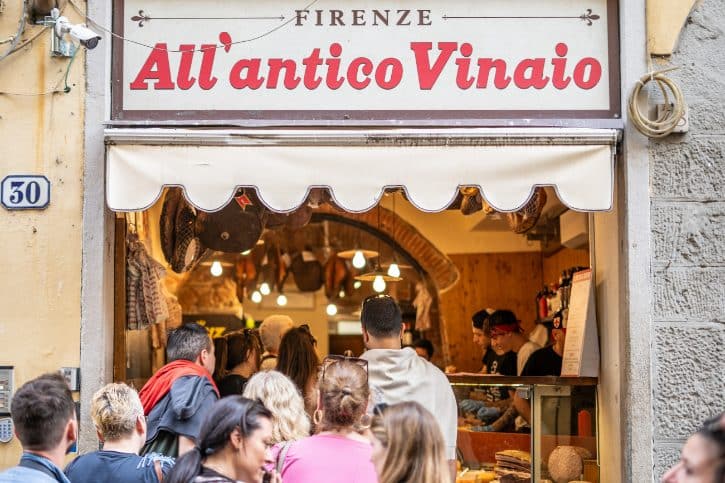
This is Florence’s most famous sandwich shop, and the hype is real. The star is schiacciata, a soft, salted Tuscan flatbread stuffed generously to order. Look for these fillings:
- Local cured meats like finocchiona, a fennel-scented salami.
- Tuscan cheeses such as pecorino.
- The house-made spreads, especially the creamy artichoke and truffle options.
If the choices feel overwhelming, just point to one of the signature combinations. They are popular for a reason.
c. Gelato worth the detour
Follow lunch with gelato a few steps away at Gelateria dei Neri, widely loved as one of the city’s finest.
- Everything is made fresh on site, from silky gelato to dark chocolate sorbet.
- Ask for Salted Caramel, Pistachio, or the lovely Ricotta with Fig for the house favorites.
It is the perfect sweet reward halfway through your day.
d. Quick Tip
Do not go looking for a table.
- Seating is limited, so take your sandwich and cone to go.
- Eat in the sun the way Florentines do, because food always tastes better with a view of the Arno.
2:30 PM – Historic Bridges (Arno River)
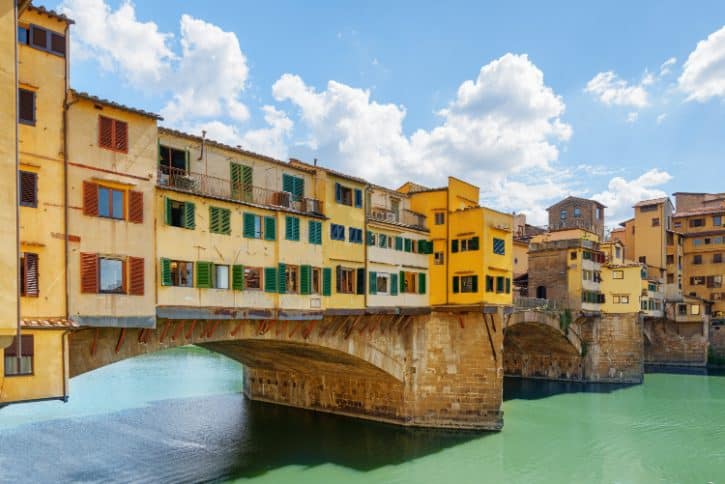
a. Why the bridges matter
The afternoon takes you to the river, where Florence shows a softer, more romantic side. This is a stretch made for strolling, photographing, and soaking up centuries of history built right over the water.
b. Ponte Vecchio
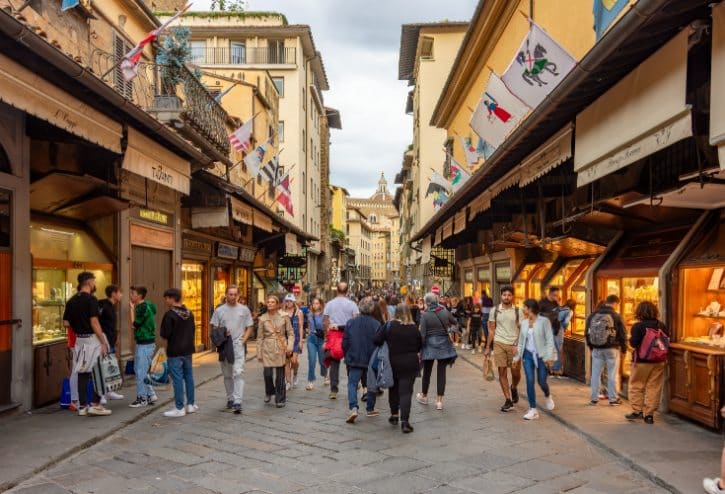
The Ponte Vecchio is the oldest and most famous bridge in the city, lined with shops that seem to cling to its sides.
- For centuries these were butcher shops, until a Medici duke replaced them with goldsmiths and jewelers.
- Walk to the middle, where the shopfronts open up and you can lean out over the Arno.
- Look for the small bronze bust of a famous goldsmith on the open terrace.
Do not linger too long, because the best view of this bridge is actually from somewhere else.
c. Spotting the Vasari Corridor
Above the shops runs a secret passageway once used by the Medici to move through the city unseen. Tracing it from the street is free and genuinely fun.
- Watch it emerge from the corner of the Uffizi.
- Follow it along the covered arches beside the river.
- Spot it running above the shop roofs on the far side of Ponte Vecchio.
- Notice how it bends around a stubborn medieval tower whose owners refused to let the Medici tear it down.
d. The best view of Ponte Vecchio
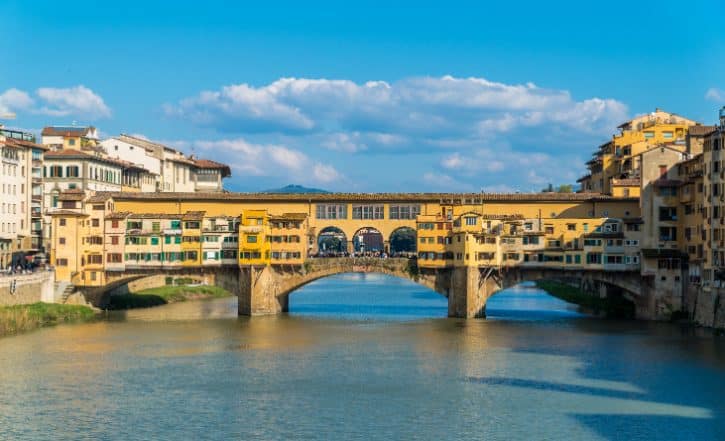
Walk on to the next bridge, Ponte Santa Trinita, and this is where the magic happens.
- From its eastern railing you get the postcard view of Ponte Vecchio, its arches framed against the city.
- The afternoon light here is soft and warm, ideal for photos.
- You will likely find this the finest river view in Florence, so do not rush past it.
3:30 PM – Palazzo Pitti & Boboli Gardens
a. Why skip the palace interior
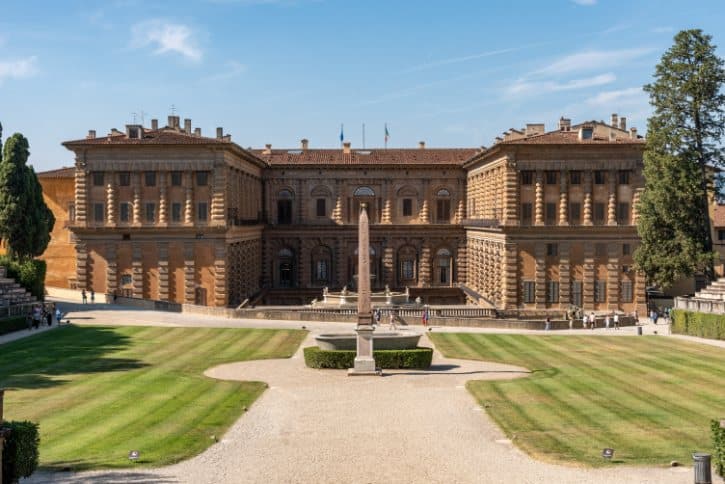
The enormous Pitti Palace was built by an ambitious banker and later became the grand home of the Medici. Its galleries are magnificent, but they would swallow your whole afternoon. On a one-day route, the smarter choice is to admire the palace from the outside and spend your time in the gardens behind it.
b. The courtyard and the climb into green
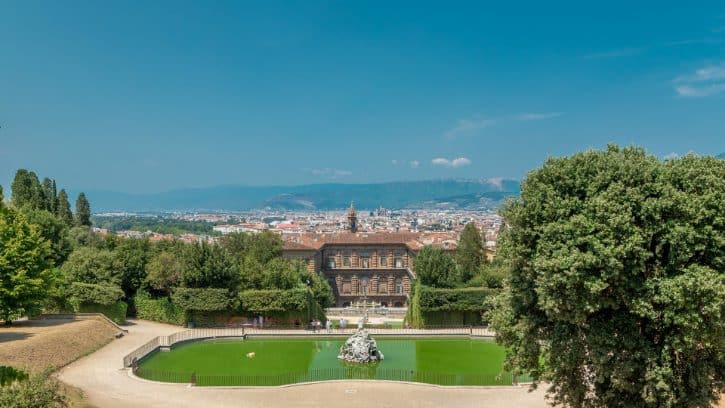
Before you head up, take in the transition from stone to garden.
- Pass through the grand inner Ammannati Courtyard on your way in, the elegant threshold that opens onto the gardens behind the palace.
- Let its heavy columns lead your eye up the hillside.
- Climb into the terraced Boboli Gardens, among the most beautiful Renaissance gardens in Italy.
They feel like a leafy escape from the busy streets below.
c. Boboli’s must-sees
The gardens are huge, so follow a short, high-value loop rather than trying to see it all.
- The amphitheater and Egyptian obelisk, sitting right behind the palace.
- The Fountain of Neptune, higher up the slope, with a terrace that opens onto sweeping city views.
- The Viottolone, a dramatic avenue lined with towering cypress trees. Walk a little way down for the grand perspective, then turn back.
d. The Buontalenti Grotto
If you see one thing in Boboli, make it the Buontalenti Grotto.
- This fantastical cave-like structure drips with sculpted rock and hidden figures.
- It is a strange and wonderful piece of Renaissance imagination.
- Seek it out near the garden’s northern edge, as it is easy to miss.
It feels more like a dream than a garden feature.
e. A seasonal reality check
Keep the time of year in mind, because it shapes your afternoon.
- In the colder months the gardens close earlier, which can leave you a shorter window inside.
- Bad weather can close them entirely for safety.
- If that happens, explore the charming Oltrarno neighborhood instead, browsing its artisan leather and paper workshops or stepping into the calm church of Santo Spirito.
This side of the river is full of quiet local character.
5:30 PM – Ponte alle Grazie
a. A bridge that marks a turning point
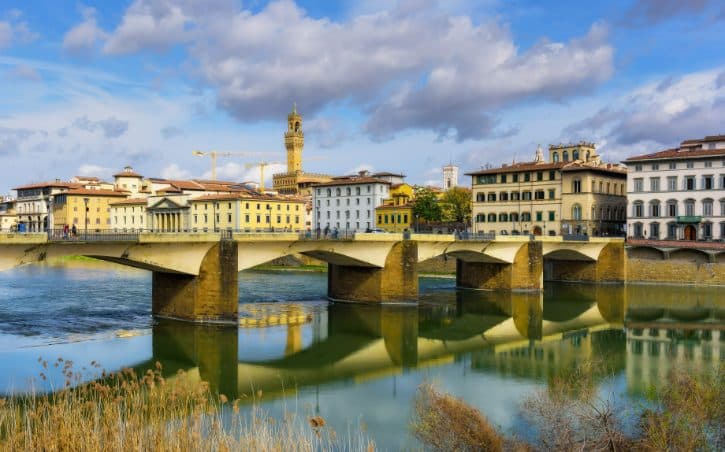
This wide, understated bridge is not a destination in itself, but a meaningful pause. It is the moment your day pivots away from the crowded center and turns toward the hills. Stop here and catch your breath.
b. What to look for
The two sides of the bridge offer very different views.
- Face west for a lovely downstream view of Ponte Vecchio, the corridor, and the Uffizi.
- Turn east to see the Tuscan hills rising, crowned by the walls of San Miniato.
c. Why pause here
After a full day of monuments and museums, this open stretch of river gives you room to slow down and reset. The light is beginning to change, the pace eases, and you can feel the grand finale coming.
d. The shift ahead
From here the route climbs, and what waits above is the reward for the whole day. Gather your energy and start upward with a sunset over the city to look forward to.
6:00 PM – Hillside Panoramic Viewpoints
a. The climb that earns the view
The path up to the hills is a real climb, with steady inclines and plenty of steps, but every traveler who makes it agrees it is worth it. Take it slowly, pause when you need to, and know that the finest views in Florence are waiting at the top.
b. San Miniato al Monte
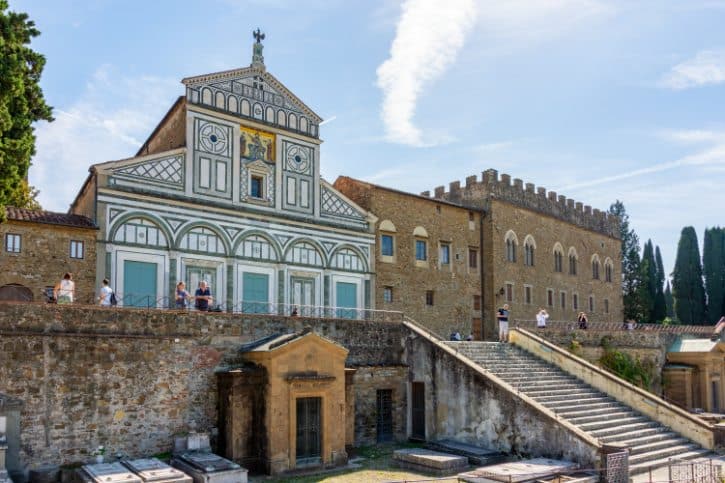
Your first hilltop stop is the ancient basilica of San Miniato al Monte, one of the loveliest Romanesque churches in Tuscany.
- Its façade is a striking geometric pattern of green and white marble.
- A golden mosaic near the top catches the late light beautifully.
- It sits higher and quieter than the busier viewpoint below, so you can enjoy the panorama with fewer people.
- Arrive during the evening service and you may hear the monks singing Gregorian chant, a haunting and unforgettable sound.
c. Inside the basilica
Step in quietly and look for these treasures:
- The marble floor, inlaid centuries ago with signs of the zodiac and mysterious animals.
- A delicate central chapel topped with glazed terracotta.
- The crypt, where the evening chant echoes off ancient stone.
- The surrounding cemetery, resting place of the man who created Pinocchio.
d. Piazzale Michelangelo
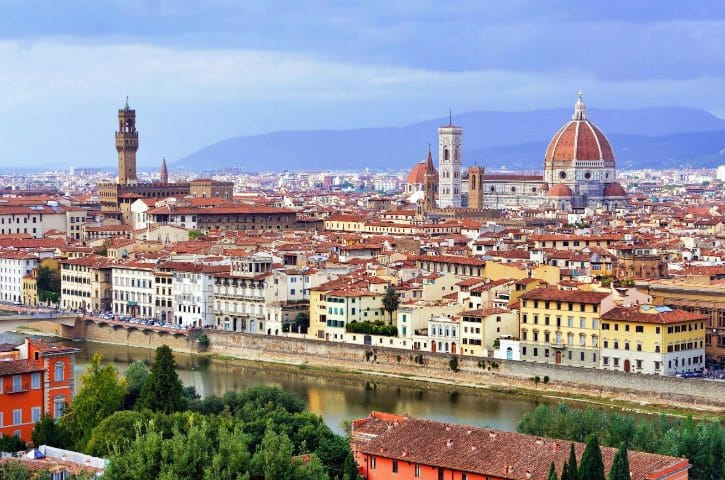
A short walk downhill brings you to Piazzale Michelangelo, the most famous viewpoint in the city. From the terrace, play a little game of finding the landmarks you visited earlier:
- The great Dome and the bell tower beside it.
- The tower of Palazzo Vecchio.
- The Santa Croce church where your day began.
- The Arno and its string of bridges.
A bronze copy of the David stands guard in the center of the square. It is livelier and more crowded here than at San Miniato, but the sweeping view is unbeatable.
e. Golden hour by season
The light you get at this hour depends entirely on the time of year, so set your expectations accordingly.
- Winter: the sun is already down, so you trade the sunset for a glittering, illuminated night skyline.
- Spring: gorgeous late-afternoon light easing into golden hour over the rooftops.
- Summer: the sun sits high and bright, giving clear, sun-drenched daytime views.
- Autumn: often the sweet spot, with golden light, sunset, and the soft blue of dusk all rolling in together.
Sunset can never be guaranteed at a fixed hour, but the view delivers something beautiful in every season.
f. Down the Rampe del Poggi
To finish, descend the Rampe del Poggi, a graceful cascade of stone ramps and stairs.
- The path is woven with restored fountains and little grottoes.
- It is fully paved and lit, so the evening descent is easy.
- It winds gently downhill and delivers you close to dinner.
Walking down in the evening glow, with the city softening behind you, is a perfect way to close the sightseeing day.
7:30 PM – Dinner at the Foot of the Hill (San Niccolò)
a. Why end here
The ramps deliver you right into the atmospheric San Niccolò district, where Osteria Antica Mescita San Niccolò, a classic Tuscan osteria, waits at the bottom of the hill. After the climb and the sunset, there is nothing better than sinking into a warm, welcoming dining room just steps from where the descent ends.
b. The setting
The restaurant occupies a historic building with real character.
- Its lower dining level is a vaulted cellar that once stored wine.
- The cellar was linked long ago to the medieval church next door.
Eating beneath those old stone arches feels like a fitting end to a day spent among centuries of history.
c. What to eat
This is the place to try the great classics of Tuscan cooking. Look for:
- Bistecca alla Fiorentina, the legendary thick-cut grilled steak, best shared.
- Ribollita, a hearty, soul-warming bread and vegetable soup.
- Pappa al Pomodoro, a comforting tomato and bread dish.
- Crostini Toscani, toasted bread topped with a rich chicken liver spread.
d. The perfect finish
There is a lovely logic to ending here. You have walked from one side of the city to the other, climbed to the hills, watched the light fade over Florence, and now you settle in for an honest, delicious Tuscan meal exactly where your feet come to rest. It is the ideal final chapter to a perfect day on foot.