Paris trains can take you almost anywhere, quickly and cheaply, once you understand the system. But the ticket rules changed recently, so much of the older advice online is now out of date.
Getting it wrong means wasted money, blocked gates, awkward luggage moments, or a missed airport train. A little planning saves all of that. Here is what actually matters before you tap in. 😊
1. Paris Has a New Train Ticket System
a. Forget the Old System
Forget most of what older guides say about tickets. The transport authority, Île-de-France Mobilités, rolled out a big fare simplification. The old zones-based single tickets and point-to-point paper tickets are gone.
The old paper “t+” tickets and distance-based Origin-Destination tickets are being phased out, with leftover paper stock valid only for a limited time. So the classic tip to grab a carnet of paper Métro tickets no longer works.
b. The Single Tickets You Will Use
The new system keeps rail and surface travel separate.
- Metro-Train-RER ticket: €2.55. A flat fare, no matter how far you go. Covers the whole Métro, RER, and suburban Transilien network across Zones 1 to 5. Valid for one journey up to 2 hours, with rail-to-rail transfers included. It does not cover airport rail stations.
- Bus-Tram ticket: €2.05. Covers ordinary buses, Noctilien night buses, and standard trams. Valid 90 minutes with surface transfers. No express trams or airport buses.
- Paris Region to Airports ticket: €14.00. For airport rail only, covering RER B to Charles de Gaulle and Métro Line 14 or Orlyval to Orly.
c. The Ticket and the Card Are Different Things
The ticket is the travel right. The card is just what holds it.
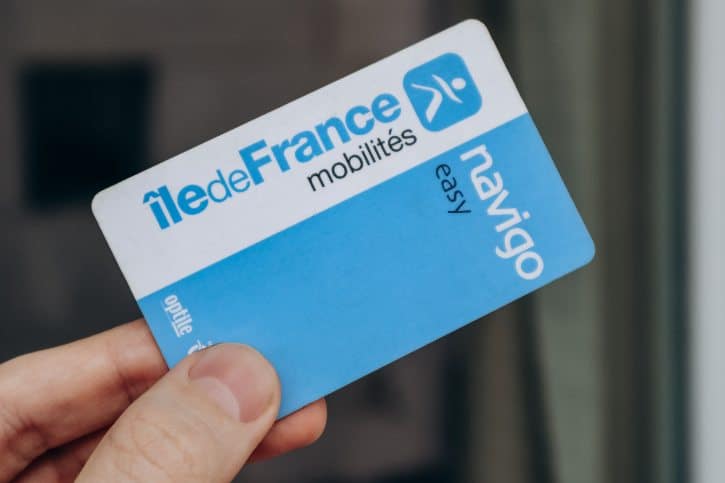
- Navigo Easy card: €2.00 at a station counter or machine. It is not personalized, so you can hand it to someone else if it has unused tickets on it.
- Your smartphone, through the Île-de-France Mobilités or Bonjour RATP apps, or in Apple Wallet and compatible Android wallets.
Even with ten tickets loaded on a single card, one card cannot validate for several people at once. Each person still needs their own card or phone to tap through.
d. The Passes at a Glance
- Navigo Day (Navigo Jour), €12.30. Unlimited travel on all modes in Zones 1 to 5 for one calendar day (00:00 to 23:59). Does not cover airport rail or Orlyval.
- Navigo Week (Navigo Semaine), €32.40. Unlimited on all modes in Zones 1 to 5. Covers the rail airport routes (RER B to CDG and Métro Line 14 to Orly), but not Orlyval or the dedicated airport buses. Runs a fixed calendar week, Monday to Sunday. Needs a €5 Navigo Découverte card or the app.
- Paris Visite, €30.60 (1 day) to €78.00 (5 days). Unlimited on all modes in Zones 1 to 5, including all airports. Covers 1, 2, 3, or 5 consecutive days. Children aged 4 to 9 get 50% off.
- Navigo Liberté+, €2.04 rail / €1.64 surface. Pay-as-you-go, billed after travel, capped at €12.30 a day (airport trips excluded). Needs registration and a linked bank account.
e. The Weekly Pass Trap
The Navigo Week works on a fixed calendar week, not a rolling seven days. It runs Monday morning to Sunday night, whatever day you buy it. So buy it on a Thursday or Friday and you only get the days through Sunday, not a full week.
Paris Visite is more flexible for a trip that spans a weekend, since its days count from your first use. Before you buy, ask one question: does your journey involve ordinary rail, bus or tram, airport rail, or a mix? That points you to the right ticket.
2. Metro and RER Tickets Do Not Cover Buses and Trams
a. Two Separate Lanes
This is still true, and it applies to single tickets, not the unlimited passes. Think of the network as two lanes.
- The Metro-Train-RER ticket (€2.55) covers rail: the Métro, RER, Transilien, and the Montmartre funicular.
- The Bus-Tram ticket (€2.05) covers surface transport: buses, Noctilien night buses, and standard trams.
b. What Happens When You Switch
Get off the Métro and hop on a connecting bus, and your rail ticket will not work. You need to validate a separate Bus-Tram ticket. The same goes the other way: a Bus-Tram ticket will not open a Métro or RER gate.
c. Transfers Within Each Lane
- Rail transfers: One Metro-Train-RER ticket gives unlimited transfers between Métro, RER, and Transilien for 2 hours from your first tap, as long as you do not exit the gated area.
- Surface transfers: One Bus-Tram ticket gives unlimited transfers between buses and trams for 90 minutes between your first and last validation. Round-trips and stops on the same line are not allowed on one ticket.
d. Express Trams Follow Rail Rules
One exception. Lines T11, T12, and T13 count as express rail, not surface trams. They follow rail ticketing and need rail validation, so do not assume every tram takes a Bus-Tram ticket.
e. Good News About Your Card
Both ticket types can live on the same Navigo Easy card or phone wallet at once. When you tap, the validator detects the mode and deducts the right ticket automatically.
And with a pass, this whole issue disappears. Navigo Day, Navigo Week, and Paris Visite give unlimited travel across rail and surface, while Navigo Liberté+ bills each trip automatically across both, so you never buy separate tickets. This is separate from the airport ticket issue in Section 6.
3. You May Need to Tap Out on the RER but Usually Not on the Métro
a. On the Métro
- Tap in at the entry gate to start your journey.
- On the way out, you usually do not tap again. Exit doors open on their own with motion sensors.
- The exception is big hubs where the Métro links straight to RER platforms underground. There you may need to validate to leave.
Keep your card, phone, or ticket until you have completely left the station. Inspectors do check tickets inside station corridors, even after the platform.
b. On the RER and Transilien
Here you must validate at both entry and exit.
- Tap out at the RER exit gate. If you forget, you can face maximum-distance charges on a pay-as-you-go contract, or card errors on your next trip.
- At suburban Transilien stations without gates, tap at the freestanding platform posts before boarding and again when you arrive.
c. Official Street Transfers
Paris allows a few official out-of-station transfers, called correspondances par la voie publique (connections via the public street). At these spots you can exit to the street and re-enter a nearby station on the same Metro-Train-RER ticket within 2 hours. Recognized locations include:
- Gare du Nord to Magenta to Poissonnière
- Saint-Lazare to Haussmann Saint-Lazare to Auber to Saint-Augustin
- Châtelet / Les Halles
- Porte Maillot
- Gare de l’Est to Gare du Nord / Magenta
- Massy-Palaiseau
Outside these official transfers, leaving the gated area normally ends your journey.
d. Wide Gates for Luggage
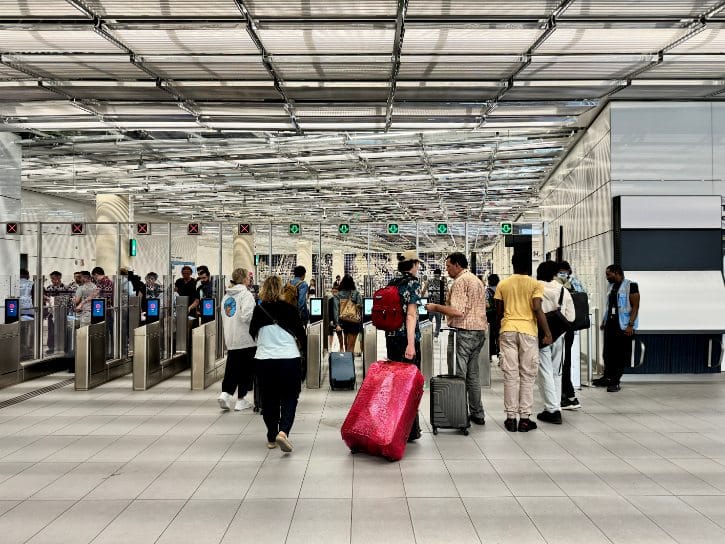
Look for the wide gates, marked Passage Élargi (widened passage), for big suitcases or a stroller. Tap your own card at the sensor next to the gate before you go through. Do not follow someone else through on a single tap. That counts as fare evasion, with on-the-spot fines of €100 or more.
e. Mistakes to Avoid
- Trying to send several people through on one Navigo Easy.
- Assuming every RER station handles exits the same way.
- Assuming no further tap can ever be needed after your first one.
- Leaving the gated area and expecting the same single ticket to still be valid.
4. Not Every RER Train Stops at Every Station
a. Why the RER Is Different
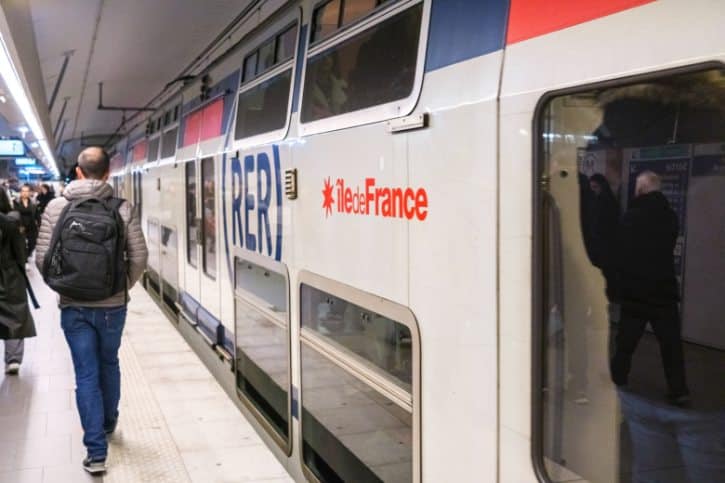
The RER is not like the Métro, where every train serves every station in order. The RER (Lines A, B, C, D, and E) splits into branches and runs different stopping patterns, so two trains on the same line can serve very different stations. Check three things before you board.
b. First, Find the Line
Confirm the line letter and color. RER B is blue, RER C is yellow, and so on. But the line alone does not tell you where a specific train will stop.
c. Second, Find the Direction by Terminus
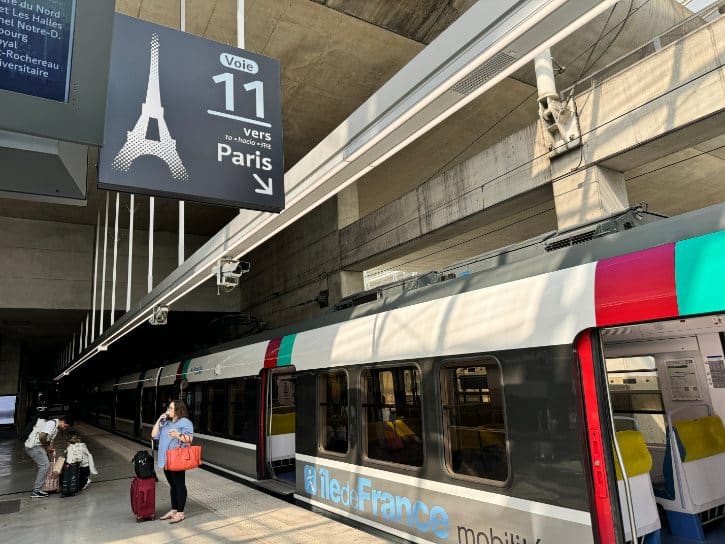
Paris signs do not say north, south, east, or west. They name the final station of the branch, so you will see something like “RER B Direction Aéroport Charles de Gaulle 2 TGV” or “Direction Saint-Rémy-lès-Chevreuse”. Follow terminus names and you will always know which way a train heads.
d. Third, Check the Stopping Pattern
Every RER platform has an overhead screen, the SIEL display. It shows the departure time, a four-letter mission code, and a lit-up list of the stations the next train will serve.
If a station is lit on the board, the train stops there. If it is not lit, the train runs straight past. Apps like Île-de-France Mobilités, RATP, and Citymapper show live mission codes, but always confirm on the platform screen first.
e. Why It Matters on RER B
Heading to Charles de Gaulle? Northbound RER B trains split at Aulnay-sous-Bois into two branches.
- Branch B3 goes to CDG Airport.
- Branch B5 goes to Mitry-Claye.
Board a Mitry-Claye train and you will miss the airport completely. Some semi-express RER B trains also skip inner suburban stations to run faster. Always check the line, the direction, and the served stops together.
5. Charles de Gaulle Airport Has Two Different RER Stations
a. Do Not Assume One Station
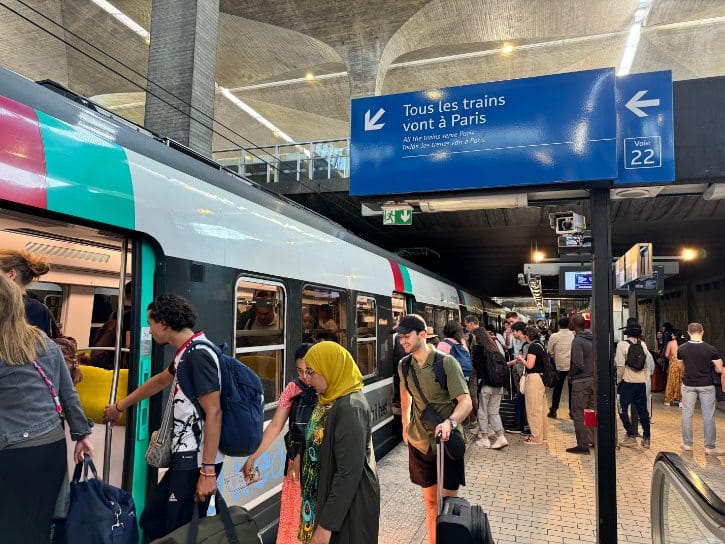
CDG has two airport stations, both on RER B, and getting off at the wrong one means a long detour across a huge airport. Match your terminal to the right station before you step off.
b. Charles de Gaulle 1
Aéroport Charles de Gaulle 1 sits at the Roissypôle complex.
- It directly serves Terminal 3, a short walk away.
- For Terminal 1, take the free automated CDGVAL shuttle, about 4 minutes.
- Despite the name, this station is not inside Terminal 1.
c. Charles de Gaulle 2 TGV
Aéroport Charles de Gaulle 2 TGV is the end of the northern RER B branch, beneath the Terminal 2 complex.
- It serves Terminals 2A through 2F on foot via walkways and moving sidewalks. Terminal 2G is a separate satellite building, reached by the free N2 shuttle bus from 2F, not on foot.
- It also holds the mainline TGV station, where high-speed trains leave for the rest of France.
Do not confuse the RER platforms with the TGV platforms here. They share the station but serve very different trains.
d. The Ticket You Need
Getting to CDG on RER B needs the €14.00 Paris Region to Airports ticket, or an all-zone pass that includes airports. The standard €2.55 Metro-Train-RER ticket and the €12.30 Navigo Day pass are not valid at CDG. Try to exit with one of those and the gate blocks you, with a penalty fee on the spot.
e. Passes, Old Advice, and Taxis
Not every pass includes the airport, even ones that sound like they cover everything. Navigo Week and Paris Visite do include airport rail. Navigo Day does not. When in doubt, treat the airport as a separate fare and use the €14 ticket.
Older guides sometimes quote airport services or prices that have since changed, so check current options first. If you prefer not to take the train, official taxis run at fixed flat rates: €56.00 to the Right Bank and €65.00 to the Left Bank.
6. Be Careful Which Navigo Easy Card Holds Your Airport Ticket
a. The Incompatibility Rule
This quiet trap can ruin your departure morning, so sort it early. The €14.00 airport ticket does not get along with every ticket on the same card or phone.
- It cannot be loaded onto a Navigo Easy or wallet that still holds unused Metro-Train-RER tickets (€2.55) or legacy t+ tickets.
- If those tickets are on the device, the machine or app simply blocks the airport ticket purchase there.
b. What Is Allowed
The airport ticket does not have to sit alone. It can share a card or phone with:
- Bus-Tram tickets
- Certain special event passes (like Fête de la Musique or Antipollution)
It clashes specifically with ordinary Metro-Train-RER single tickets and legacy t+ tickets, which block the airport ticket from loading at all.
Navigo Liberté+ is a different trap. If a Liberté+ contract is active on your phone, it takes validation priority and the airport ticket will not work until that contract ends. Keep the airport ticket on its own device.
c. Three Ways Around It
- Use up your rail tickets first, then load the airport ticket onto the same card or phone.
- Get a second Navigo Easy. A spare card costs just €2.00 and can be kept for airport tickets only.
- Split it across devices. Keep your Metro-Train-RER tickets on a physical card, and buy the airport ticket digitally in Apple Wallet or the Île-de-France Mobilités app.
d. What the Airport Ticket Covers
- Transfers across the Métro, RER, and suburban rail for up to 2 hours from your first tap, as long as you stay inside the gated rail area.
- The same €14.00 fare also works for Orly, via Métro Line 14 or the Orlyval shuttle connecting to RER B.
e. Before Departure Day
A day or two ahead, check what is loaded on the card or phone you plan to use for the airport. If ordinary rail tickets are still on it, use them up or switch to a second card. Sorting this at home beats discovering a blocked purchase while you drag a suitcase to the station.
7. Many Paris Métro Stations Have Lots of Stairs

a. An Old Network Shows Its Age
The Paris Métro is one of the oldest underground networks in the world, and it shows. Deep shafts, narrow passages, and long staircases are everywhere, while elevators are rare. Two stations that look simple on the map can feel very different with a suitcase in each hand.
b. What to Expect
- Legacy Métro Lines (1 to 13): Most older stations mean several flights of stairs between the street, the ticket hall, and the platform. Escalators appear at some busy stations, but often only going up. Elevators are almost non-existent on the historic lines.
- Line 14 and the RER: Métro Line 14 was built as a modern automated line and is 100% step-free, with full elevator and escalator coverage at every station. Main RER stations (A to E) in central Paris also have far better elevator coverage than the old Métro.
c. One Station That Says It All
Abbesses, on Line 12 beneath Montmartre, sits 36 meters (118 feet) underground, the deepest station in the network. Two elevators connect the ticket hall to the platforms. But if a lift is out of service, you face a winding spiral staircase of 176 steps. Worth knowing if you have luggage.
d. Plan Around the Stairs
If you have heavy bags or a stroller, favor routes that use Line 14 or the RER. Fewer transfers and newer stations often beat a route that looks faster on paper but hides staircases and long tunnels. Check accessibility before you leave. The Île-de-France Mobilités app has an “Accessible Route” filter that builds step-free itineraries and shows live updates on which elevators are working.
e. Do Not Assume Too Much
- An escalator may only run in one direction.
- One elevator somewhere in a station does not mean your whole route is step-free.
- A partly modernized line is not automatically accessible end to end.
8. Avoid Paris Rush Hour When Traveling With Luggage
a. This Is Advice, Not a Ban
You can travel with a suitcase whenever you like. But rush hour with bags is hard work, and there are a few rules worth knowing too. A little timing makes it smoother.
b. When the Crowds Hit
Peak periods on weekdays are:
- Morning: 07:30 to 09:30
- Evening: 17:00 to 19:30
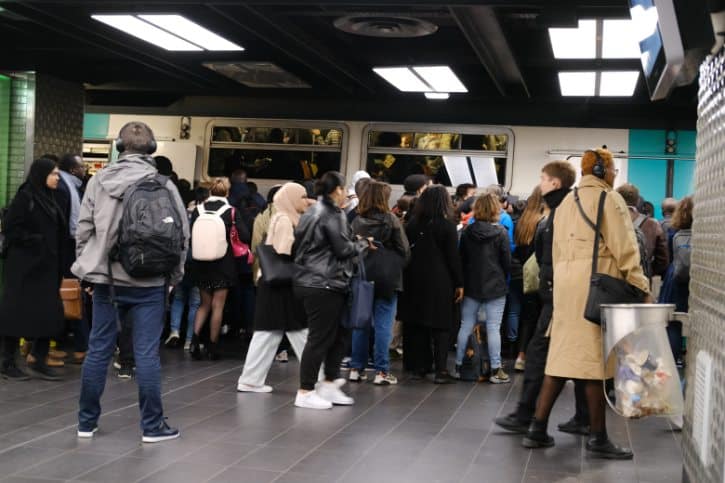
During these windows, big interchanges like Châtelet, Gare du Nord, Saint-Lazare, and Gare de Lyon get extremely packed. Boarding with several suitcases is tough, and you may have to let a few trains pass before you find room.
c. The Luggage Rules That Matter
Under RATP and Transilien rules, luggage must stay under your control and not block other passengers.
- Manageability: You should be able to carry all your bags yourself, in a single go.
- Obstruction: Do not put suitcases in the gangways, block the doors, or place bags on seats. Agents can issue on-the-spot fines of €150 for blocking circulation.
So “I can lift it” is not the whole test. Even manageable bags break the rules if they block people.
d. Never Leave a Bag Unattended
France runs strict Vigipirate security rules. An unattended bag is treated as a suspicious package. That can trigger a security perimeter, an evacuation, a bomb squad callout, and line-wide suspension for hours. Never leave luggage alone, not even for a moment.
e. Ways to Make It Easier
- Travel between 10:00 and 16:00 or after 20:00 when you can.
- Choose routes with fewer transfers.
- Use the wide gates at the barriers.
- Position your bags so doors and aisles stay clear.
- For the airport, a flat-fare official taxi can be worth it with heavy luggage.
The fastest route on a journey planner is not always the best one with bags. Weigh up travel time, transfers, stairs, elevators, and crowding.
9. TGV, Intercités, and OUIGO Have Different Luggage Rules
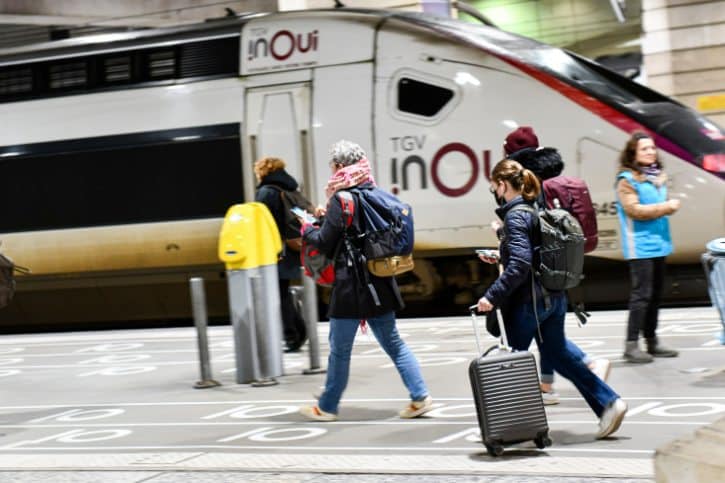
a. City Rules Do Not Apply Here
Do not assume the relaxed Métro luggage rules apply to long-distance trains leaving Paris. Reserved SNCF services have their own strict limits, and the rules depend on whether you are on a premium service (TGV INOUI or Intercités) or the low-cost OUIGO.
b. TGV INOUI and Intercités
These two share the same allowance.
- Two large bags plus one hand luggage item per passenger.
- Large bag maximum: 70 x 90 x 50 cm.
- Hand luggage maximum: 40 x 30 x 15 cm.
- Special items like folded bikes, strollers, or instruments count as one large bag and must not exceed 90 x 130 x 50 cm.
c. Labeling Is Mandatory
Every bag onboard TGV INOUI or Intercités must carry a visible tag showing your full name, mobile number, and email address. Blank tags are free at station kiosks and service counters.
Skip the label, or bring more than the two-bag limit, and you can face a fine of €50 to €150 per bag. Many visitors miss this rule, since plenty of countries do not ask for it.
d. OUIGO Runs Airline-Style Limits
OUIGO is stricter, and the same rules apply to both OUIGO Grande Vitesse and OUIGO Train Classique.
- The base ticket includes one hand bag (36 x 27 x 15 cm) and one cabin bag (55 x 35 x 25 cm).
- A standard large suitcase needs the paid “Extra Luggage”
- Extra luggage costs €5.00 per bag in advance online, rising to €20.00 per bag if you add it at the station instead.
e. OUIGO Boarding and Common Mistakes
OUIGO boarding is tight, so arrive early.
- Gates close 5 minutes before departure, firmly.
- Check-in begins 30 minutes before
- Plan to arrive at least 30 minutes early for ticket and luggage checks.
Common mistakes: assuming every SNCF train has the same rules, forgetting to label bags on TGV INOUI and Intercités, boarding OUIGO with a large bag not included in your fare, or mixing up OUIGO and TGV INOUI conditions. Always check the conditions attached to your own booking.
10. Always Check for Train Closures and Service Changes
a. Check Again Before You Leave
The network is constantly upgraded and repaired, so a route you saved weeks ago can quietly stop working. The golden rule: check again shortly before you leave, not just when you plan the trip.
b. What “Disruption” Can Mean
A line can look fine on the map while the exact station or stretch you need is closed. Disruptions come in many forms:
- Full or partial line closures
- Individual station closures
- Trains passing through without stopping
- Changed end stations, reduced frequencies, or branch changes
- Evening or weekend closures
- Replacement buses, strikes, incidents, delays, or cancellations
- Accessibility equipment failures
c. Three Things to Keep Separate
- Planned engineering works (Travaux). Scheduled ahead, often on weekends, late evenings after 22:00, and in summer. These can fully close sections of major lines, including RER B, RER C, and Métro Line 14.
- Real-time incidents. Signal faults, security alerts, or medical emergencies on the day. Live apps reroute you around them.
- Your booked SNCF train. Changes or cancellations to a specific TGV INOUI, Intercités, or OUIGO service you reserved.
Checking once at the planning stage is not enough for a time-critical trip like the airport.
d. Where to Check, by Journey
- Métro, RER, bus, tram: The Île-de-France Mobilités or Bonjour RATP apps, on the morning of travel.
- Transilien suburban rail: com or the “Info Trafic” section of the Île-de-France Mobilités app.
- TGV INOUI, Intercités, OUIGO: The SNCF Connect app, for track updates, platforms, and gate notices.
e. The Airport Example Worth Remembering
During planned maintenance on RER B between Gare du Nord and CDG, the authority runs replacement bus shuttles, the Navettes Autobus RER B (RER B replacement buses). These can add 30 to 45 minutes to your airport trip.
That is why a screenshot from three weeks ago is not a schedule. If you are catching a flight, check live information the morning you travel, allow extra time during works, and let the official journey planner suggest another route if your usual one is disrupted.