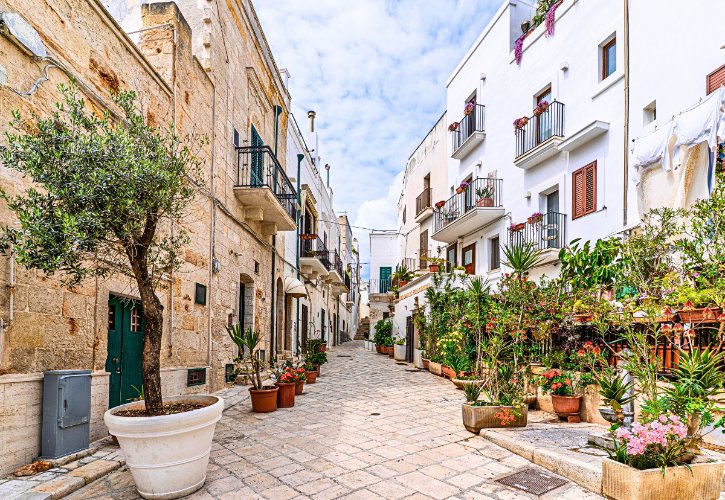
Puglia surprises you at every turn. One moment you’re standing on a sun-warmed sea wall, the next you’re deep in a shady beech forest or climbing a whitewashed lane high above endless olive trees.
That variety is what makes this region unforgettable. No two places here look alike.
In the twelve stops ahead, you’ll find dramatic sea cliffs and golden-stone cities, dry-stone villages, a sacred mountain shrine and islands floating offshore. Let’s begin on the Ionian coast, in Gallipoli. 😊
1. Gallipoli, an Island-Like Old Town Wrapped by the Ionian Sea
a. The island that floats on the sea
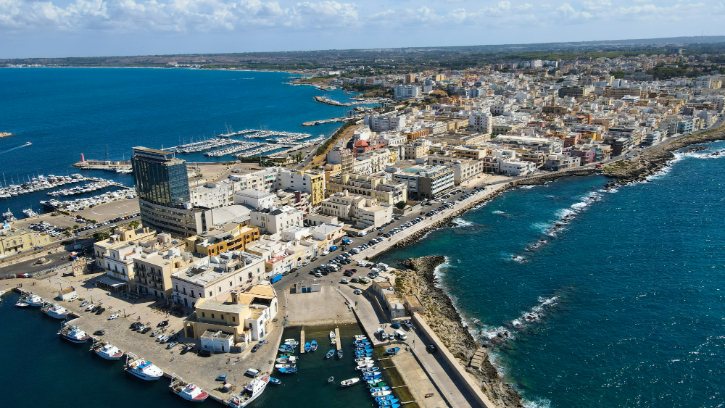
Gallipoli feels like a small island that drifted just far enough from shore to become its own world. Its old town sits completely surrounded by the Ionian Sea, linked to the mainland by a single arched stone bridge. Wherever you walk, the water is right beside you, held back by ancient defensive walls.
b. What you’ll see
- A stone bridge that carries you across the harbour into the old town, marked by the Fontana Greca and its ancient carvings.
- The Castello Angioino-Aragonese, its huge polygonal towers rising straight out of the saltwater.
- The Basilica Cattedrale di Sant’Agata at the town’s high point, its golden Baroque façade studded with carved statues.
- Spiaggia della Purità, a little crescent of golden sand tucked right beneath the medieval ramparts.
c. The colours that stay with you
The beauty of Gallipoli lives in its contrasts. Warm, honey-toned stone meets clear turquoise water, and because you often walk along the raised walls, you can look straight down into the shallows.
d. How to soak it in
- Walk the full ring of sea walls for uninterrupted views over the Ionian.
- Lose yourself in the narrow courtyards, once built to break the wind and confuse invaders.
- Save a slow stroll along the western walls for late afternoon, when the sun lights up the old stone.
2. Otranto, Fortified Adriatic Beauty with a Great Church Interior
a. A fortress by the sea
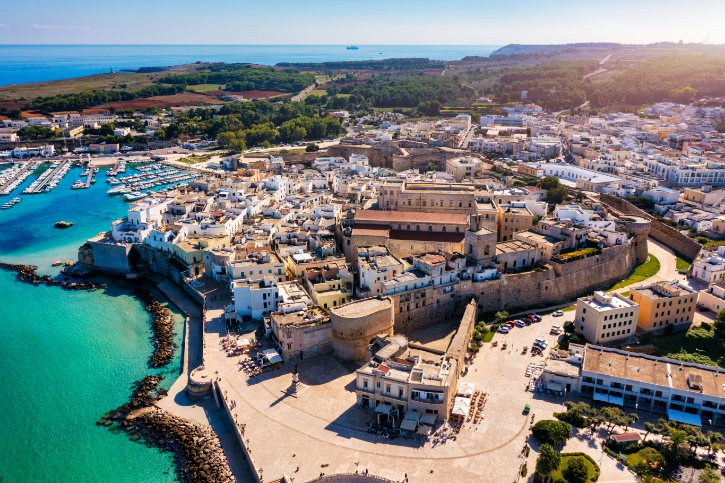
Otranto is Italy’s easternmost town, and it wears its history in stone. Built up as a fortress after a brutal siege in 1480, it stands on a promontory where mighty ramparts drop straight into a busy harbour. The sea and the fortifications are the first thing you notice.
b. The mosaic you’ll never forget
The real treasure hides indoors, so don’t miss it:
- A vast medieval floor mosaic, laid in the 1160s, spreading across almost the entire church.
- A great Tree of Life at its centre, resting on the backs of two elephants.
- Branches filled with biblical scenes, the zodiac, the seasons, and figures like Alexander the Great and King Arthur.
- A quiet crypt below, with 42 marble columns and beautifully carved capitals.
c. What to see outdoors
- Walk the upper walls for wide views across Otranto Bay, where the pale seabed turns the water soft turquoise.
- Explore the huge Castello Aragonese, with its corner towers and deep moat.
- Follow the historic lanes weaving between the walls and the cathedral.
d. Worth a short trip out
- Cava di Bauxite, an old mineral pit now filled with an emerald-green lake ringed by deep red earth.
- Punta Palascìa, the easternmost point of mainland Italy, where cliffs meet deep sea.
3. Monte Sant’Angelo, a Sacred Mountain Town of the Gargano
a. A town on top of the mountain
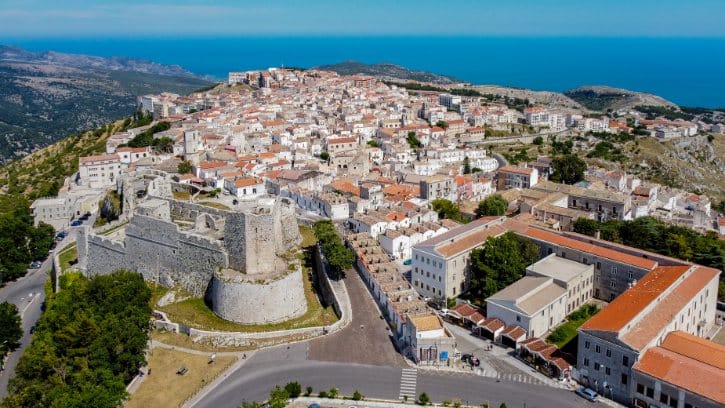
High on the Gargano promontory, at the very highest point of the massif, sits Monte Sant’Angelo. This is a completely different kind of beauty, a windswept stone town perched around 800 metres up, looking out like a balcony over the Gulf of Manfredonia far below. For centuries, pilgrims have climbed the mountain to reach its famous shrine.
b. The Sanctuary of San Michele
The heart of the town is its cave shrine, and it’s genuinely special:
- The Sanctuary of San Michele Arcangelo, the oldest shrine in Western Europe dedicated to the Archangel Michael.
- A sacred grotto set into the rock, a place of pilgrimage since the early Middle Ages, said by tradition to be a church no human hands ever consecrated.
- A UNESCO World Heritage Site, inscribed as part of the “Longobards in Italy” group of early medieval places of power.
- A striking octagonal bell tower from the 13th century standing guard in the square outside.
This is an active, deeply revered pilgrimage site, so dress modestly and tread gently when you visit.
c. What else to explore
The old town rewards a slow wander on foot:
- The Tomba di Rotari, a tall, mysterious medieval structure that may have been a baptistery, a tower or a tomb. No one is quite sure.
- The nearby church of Santa Maria Maggiore, with its finely carved interior.
- The Norman castle, crowning the town with layers of later medieval building.
- Rione Junno, the oldest quarter, where tiny whitewashed houses cluster together like figures in a nativity scene.
d. The views and the feeling
Step to the edge of town and you’re met with a huge, sweeping panorama over the gulf and the terraced hillsides of olive trees below.
There’s a hush here you don’t find on the coast. Mist, old stone, church bells and the slow footsteps of pilgrims give Monte Sant’Angelo an atmosphere all its own.
4. Torre dell’Orso and Le Due Sorelle, the Great Sandy Bay
a. The soft counterpart
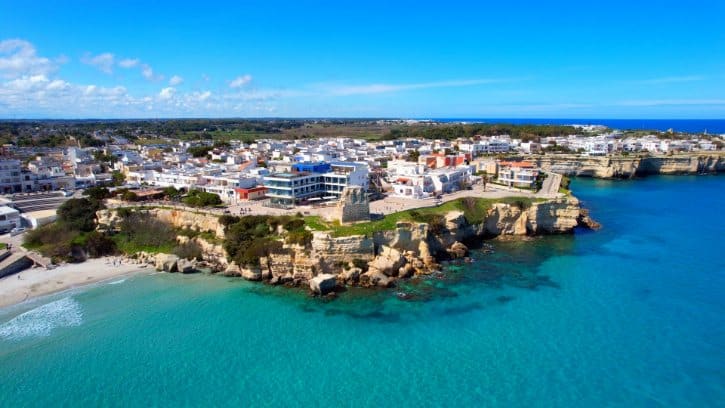
After the raw rock of Sant’Andrea, Torre dell’Orso feels like a soft exhale. It’s a long crescent of golden sand, backed by fragrant pine forest and framed by tall white cliffs. The water is shallow, clear and calm.
b. The bay and its twins
- A wide sandy beach curving gently between two rocky headlands.
- Le Due Sorelle, two limestone sea stacks standing side by side just off the southern tip.
- A pine forest right behind the sand, offering shade and a pretty approach.
- An old watchtower perched on the northern cliff.
c. The legend of the two sisters
Local legend tells of two sisters who swam out on a scorching day and drowned, and the sea, out of pity, turned them into twin rocks so they’d never be parted. It’s a tender story, and a lovely one to picture as you gaze out at the stacks.
d. See it two ways
- From the sand, where shallow water gives way to deep blue framing the sisters.
- From the wooded cliff-top path, for an aerial view over the whole sweeping bay.
5. Lecce, Beauty Created Almost Entirely by Architecture
a. Beauty made of stone
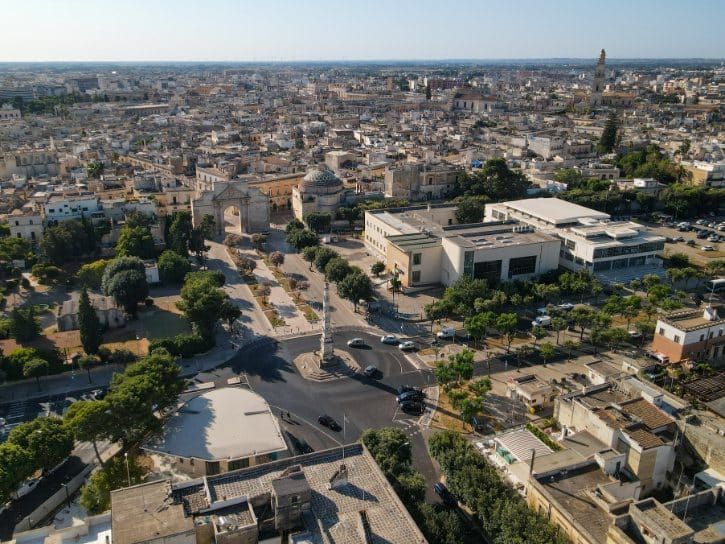
Lecce proves you don’t need the sea to take someone’s breath away. This inland city is built almost entirely from a soft golden limestone called Pietra Leccese, easy to carve when fresh and glowing warm gold with age. The result is a whole city dressed in ornate Baroque stone.
b. Walk the golden city
The old centre unfolds best on foot:
- Enter through the grand triumphal arch of Porta Napoli.
- Wander into Piazza del Duomo, a rare enclosed square ringed by elegant façades.
- Reach Piazza Sant’Oronzo, the lively civic heart.
- Finish at the Basilica di Santa Croce, the dazzling high point of it all.
c. Look closely
- The Basilica di Santa Croce, where dragons, strange figures and a huge rose window crowd the upper façade.
- The cathedral’s tall bell tower rising above the rooftops.
- The partly uncovered Roman amphitheatre in Piazza Sant’Oronzo, which once held thousands.
d. Layers of history
What makes Lecce special is the way its eras sit together. Honey-gold Baroque swirls above plain, ancient Roman stone, and the two keep talking to each other as you walk. It’s celebrated for this artistry, though it isn’t a UNESCO site.
6. Ostuni, the White City Suspended Over Olive Country
a. The white city on the hill
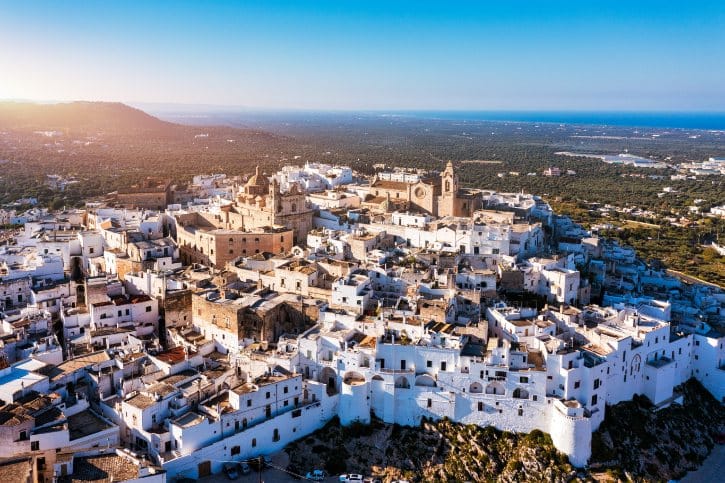
You’ll spot Ostuni long before you reach it. Nicknamed the White City, it tumbles down three hilltops in a cascade of lime-washed houses, perched high above a vast plain of ancient olive trees that rolls toward the Adriatic.
b. Inside La Terra
The old quarter is a joy to get lost in:
- Steep, narrow alleys and outdoor staircases winding upward.
- Whitewashed houses, arches and hidden little courtyards.
- A summit cathedral crowned by one of Italy’s largest and most intricate rose windows.
c. Why it’s all white
There’s a reason for the colour. The lime-wash reflected the harsh summer sun to keep homes cool, and its natural antibacterial quality helped keep the crowded medieval town healthy during outbreaks. Beauty and practicality, hand in hand.
d. Where to drink in the view
- From the streets below, looking up at the stacked white houses.
- From the valley-facing terraces, gazing over thousands of silvery olive trees to the sea.
- From the ring road, for the classic postcard of the whole white town on its hill.
7. Locorotondo, a Quieter Hilltop Panorama of the Valle d’Itria
a. Quiet and round
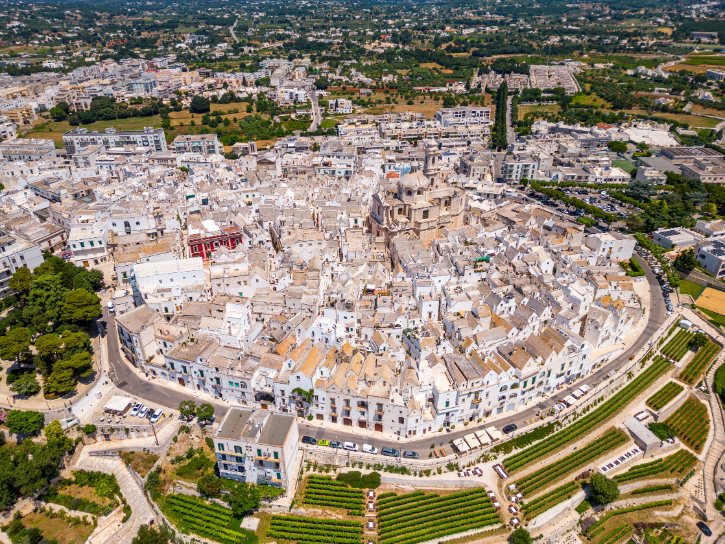
If Ostuni is dramatic, Locorotondo is gentle. Its name means “round place”, and true to that, the town curls in a neat circle atop its hill, all whitewashed walls and calm, tidy lanes overlooking the Valle d’Itria.
b. How it differs from Ostuni
- Smaller and more compact, with a rounded, orderly shape.
- A softer, sleepier, residential feel rather than a bustling one.
- Its own signature roofs, the pointed cummerse.
c. Those unusual roofs
The cummerse are the town’s quiet trademark. They’re steep, pitched roofs built from thin limestone slabs laid at sharp angles, cleverly shaped to funnel rainwater into cisterns below. Crisp white walls beneath dark stone roofs, dressed with iron balconies and flowers, give the streets their charm.
d. The panorama below
From the hilltop gardens and promenade, the Valle d’Itria spreads out beneath you:
- Red earth, vineyards and silvery olive groves.
- Low dry-stone walls threading across the fields.
- Scattered cone-roofed trulli dotting the countryside.
8. Alberobello, Understand the Trulli Rather Than Just Photographing Them
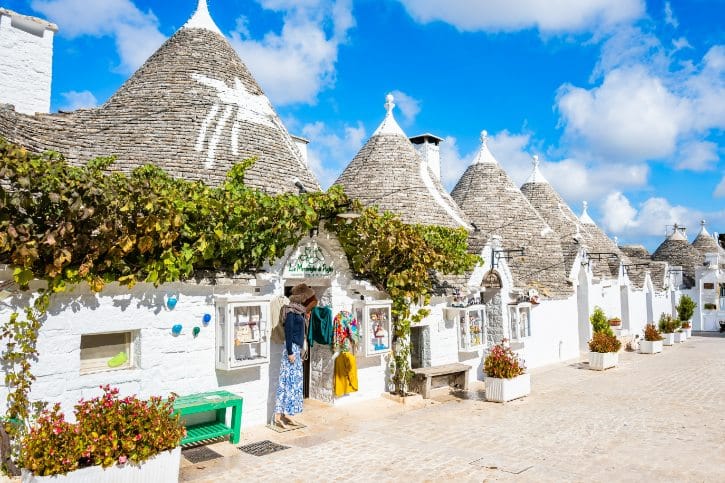
a. A town of trulli
Nowhere else looks quite like Alberobello. An entire town built from cone-roofed dry-stone houses called trulli, it’s so unusual that it earned a place on the UNESCO World Heritage List. Wandering its lanes feels a little like stepping into a fairytale made of stone.
b. Understand what you’re seeing
The magic is in how they’re built:
- No mortar at all, just carefully stacked limestone gathered from the fields.
- Thick double walls that keep interiors cool in summer and warm in winter.
- Conical roofs of overlapping stone tiles, topped with hand-carved pinnacles.
- Whitewashed symbols painted on many roofs, from Christian to ancient pagan.
c. Two districts, two moods
- Rione Monti, the larger, livelier quarter, full of little shops and cafés on sloping lanes.
- Aia Piccola, quieter and residential, where people still live in their trulli much as they always have.
d. The clever history
There’s a sly reason these houses have no mortar. Long ago, local lords ordered mortarless building so the homes could be pulled apart quickly whenever royal tax inspectors came to count permanent buildings. A clever trick then, and a treasured heritage now.
9. Monopoli, White Lanes, a Fishing Harbour and a Sea Edge
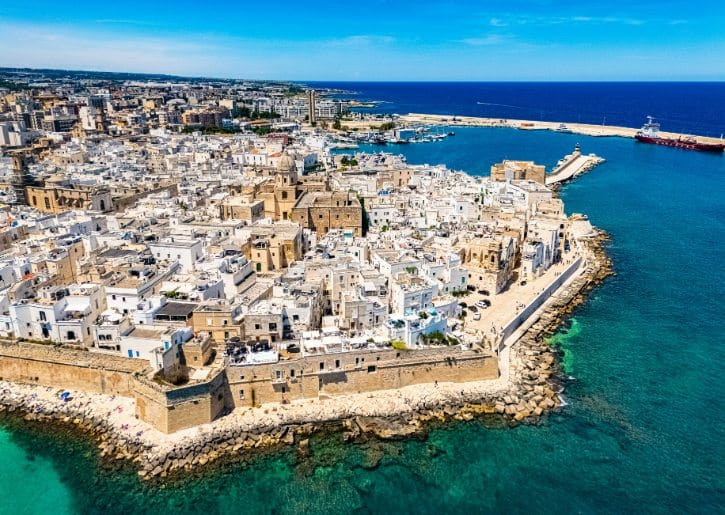
a. Where the harbour meets the town
Monopoli is a town where the sea comes right up to the doorstep. Its old fishing harbour reaches straight into the whitewashed centre, and unlike its cliff-top neighbour Polignano, Monopoli sits low at sea level, framed by old fortifications and small coves.
b. A compact walk
Everything sits close together:
- The Porto Vecchio, full of blue-and-red wooden fishing boats.
- The pentagonal Castello Carlo V, standing on a sea-ringed point.
- White intramural alleys leading to a grand Baroque cathedral.
- Porta Vecchia, an old gateway opening onto a little urban beach.
c. The working harbour
The heart of Monopoli is its working harbour. Traditional wooden boats bob beside stone arches and historic buildings, and because the port sits inside the old town rather than apart from it, the rhythm of fishing life feels woven into the streets.
d. Where the town meets the water
- Elevated sea-wall promenades linking the old defensive bastions.
- Small coves and beaches tucked right beneath the ramparts.
- Waterfront lanes where the Adriatic is never far from view.
10. Polignano a Mare, the Classic Cliff-Top Town
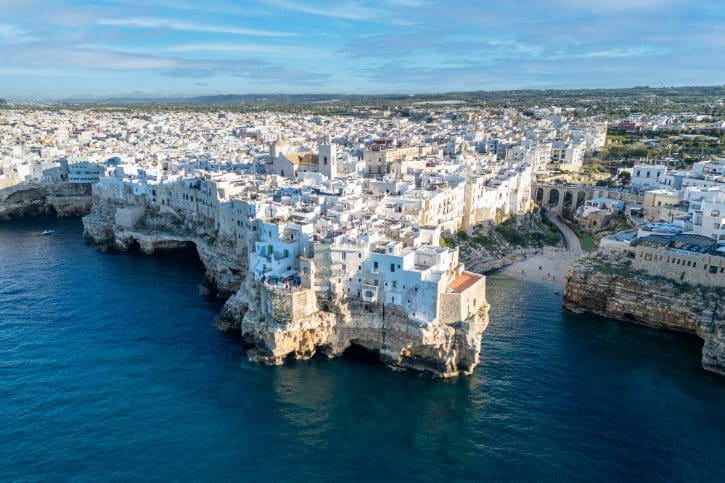
a. A town on the cliff edge
Polignano a Mare is all about height. The old town balances on a limestone plateau that overhangs the Adriatic, and the cliff below is riddled with sea caves and hidden inlets. It’s less a pretty white town than a town clinging dramatically to the edge of the sea.
b. Lama Monachile, the centrepiece
The famous view is a deep gorge opening to the sea:
- A small pebble beach wedged between two sheer white cliffs.
- An old bridge arching high above, giving the classic postcard view.
- A completely different feel down at beach level, looking up.
c. Beyond the famous view
Don’t stop at the one photo spot:
- Enter the old town through the historic Arco Marchesale.
- Find the balconies that hang right over the cliff edge.
- Walk out to the Domenico Modugno promenade for sweeping views back at the skyline.
d. The sea caves
Below the town lie dozens of marine caves, carved by the waves, some vast enough to sail into. You can explore them by small boat, kayak or paddleboard, though the sea always has the final say, and rough days close them off.
11. Vieste and the Gargano Coast, Puglia at Its Wildest
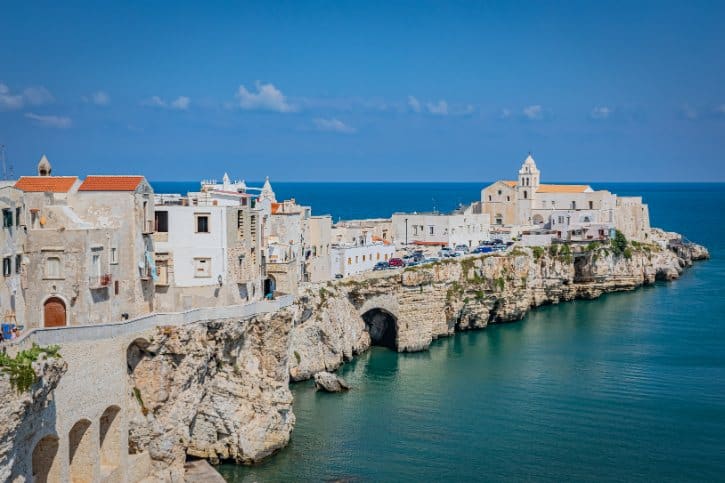
a. Puglia at its wildest
For Puglia at its most dramatic, head north to Vieste, the coastal gateway to the vast Gargano National Park. This is a land of high forested cliffs, natural arches, offshore monoliths, hidden bays and sea caves, wild on a scale nothing else in the region matches.
b. Vieste and Pizzomunno
- A white old town of stone houses on a rocky peninsula, crowned by an old castle and cathedral.
- Pizzomunno, a towering 25-metre white rock standing alone on the beach, the symbol of Vieste.
- Wide sea views wherever the streets meet the cliff edge.
c. Further along the coast
A few standout spots reward the journey south:
- Baia delle Zagare, framed by white cliffs and two lone sea stacks.
- Vignanotica, a pebble beach beneath a towering wall of layered limestone.
- Architiello di San Felice, a natural stone arch over turquoise water.
d. A forest surprise
For a complete change of mood, head inland to the Foresta Umbra, an ancient, shady forest of beech and oak whose oldest heart is protected as a UNESCO site. From white cliffs to deep green woods in one park, it shows just how varied Gargano can be. The coast itself, though, is best understood from the water, where caves and arches reveal themselves one by one.
12. Tremiti Islands, Finish with Puglia Seen from the Water
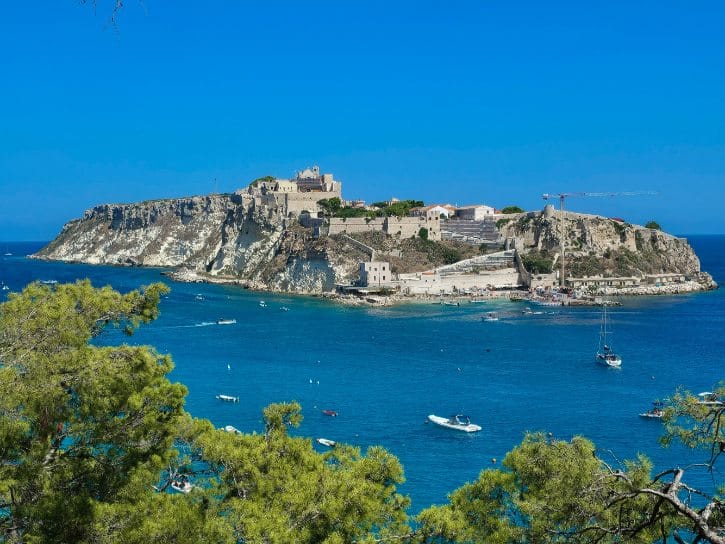
a. Islands off the coast
To end the journey, look out to sea. About twelve nautical miles off the Gargano coast float the Tremiti Islands, a small protected archipelago of green coves, historic ramparts and astonishingly clear water. After so much coastline, this is Puglia seen from the water.
b. The two islands to explore
- San Domino, the largest and greenest, cloaked in pine forest, with rocky coves, sea caves and the archipelago’s main sandy beach.
- San Nicola, the historic heart, dominated by a fortified monastery with medieval cloisters, old mosaics and stone ramparts dropping into the sea.
c. A protected sea
The islands sit within a marine protected area, so the water is cared for closely:
- Some zones are strictly off limits to protect nature, with no access at all.
- Others allow swimming and diving, but with rules on boats, anchoring and fishing.
- Boats generally moor at set buoys rather than anchoring freely.
Respecting these rules is part of visiting responsibly, and it’s a big reason the sea here stays so vivid.
d. Getting there and around
Reaching the islands is part of the adventure:
- From Termoli, boats run all year, the most reliable link in any season.
- From Vieste and other Gargano ports, services run mainly through the warmer months.
- Once you arrive, cars are left behind and you explore on foot, with small shuttle boats hopping between San Domino and San Nicola in minutes.
e. A day or an overnight?
You can visit in a day and still see plenty. But staying overnight has its own reward: once the day boats leave, the islands turn quiet and car-free, and they start to feel entirely your own.