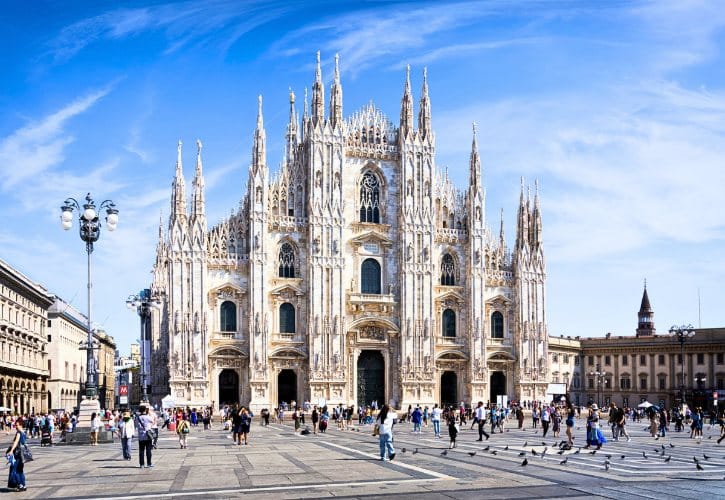
Milan rewards the traveler who plans. Its greatest sights cluster tight around the historic centre, close enough that a single day on foot can link Gothic spires, Renaissance masterpieces, a ducal fortress, and canal-side evenings.
You walk almost the whole way, with one short, scenic tram ride to carry you through the afternoon. This is a route built to flow, from the cathedral at first light to a glass of wine by the water at dusk. Start where every Milanese day begins, at the Duomo.
One quiet tip before you set off: run this route Tuesday through Saturday. Mondays and Sundays close a few key doors along the way.
8:30 AM: Piazza del Duomo and Duomo di Milano
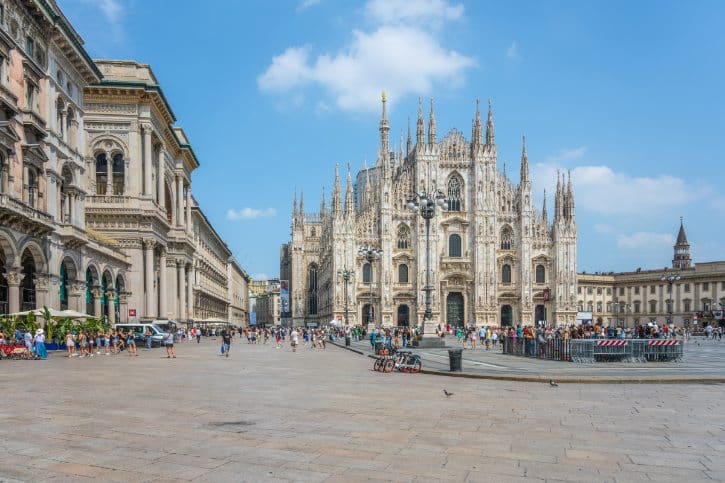
There is no gentler way to meet Milan than to stand in Piazza del Duomo while it is still half empty. Arrive around 8:30 and the great marble façade is yours to admire in soft morning light, before the crowds thicken.
The timing works nicely in your favour:
- Tourist sightseeing of both the cathedral interior and the rooftop terraces begins at 9:00 AM.
- An earlier side door opens for prayer and worship only, so it does not count as a sightseeing visit.
- Use the half hour beforehand to enjoy the piazza and study the façade up close, then head inside the moment tourist access opens.
a. Inside the cathedral
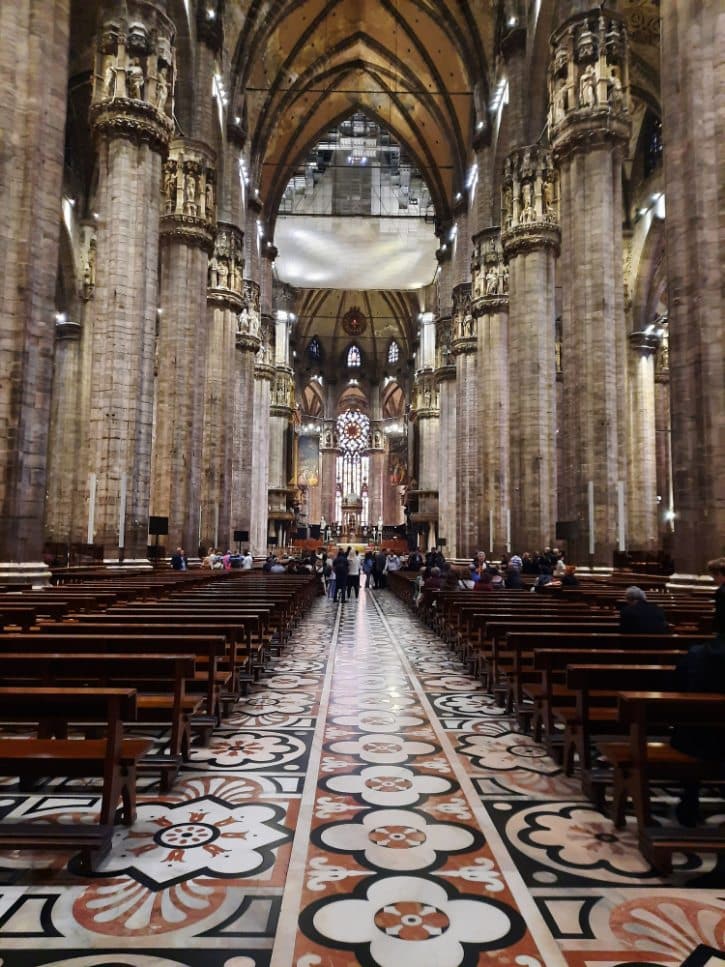
The interior is vast and hushed, a forest of soaring columns that pulls your eye upward. Take your time with:
- The stained-glass windows, among the largest in the world, glowing in the morning sun.
- The unsettling Statue of St. Bartholomew Flayed, carved with anatomical precision that stays with you.
- The presbytery and the sheer, cathedral-scale calm of the central nave.
b. On the rooftop
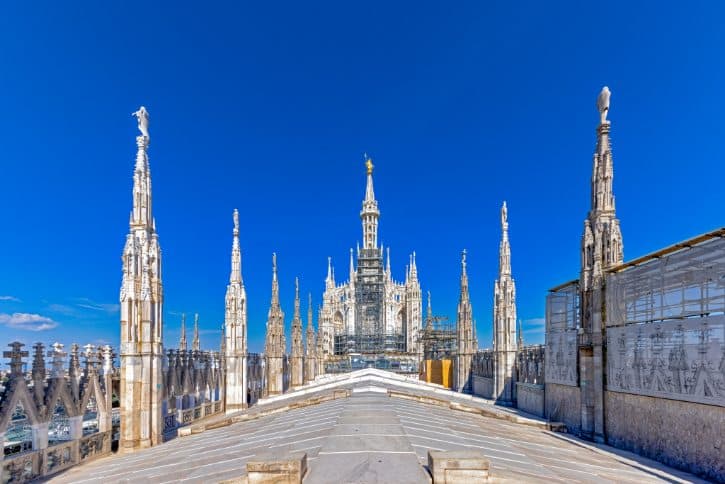
The roof is the reason people fall for the Duomo. You walk among the pinnacles as if inside a marble crown. Look for:
- The intricate flying buttresses and the carved gargoyles watching over the city.
- The spires rising in every direction, each topped with its own sculpted saint.
- The gilded Madonnina, the golden Virgin who has guarded Milan from the highest spire since 1774.
On a clear day, the Alps line the horizon. Trust me, this is the view you will remember.
10:30 AM: Galleria Vittorio Emanuele II and a Coffee Break
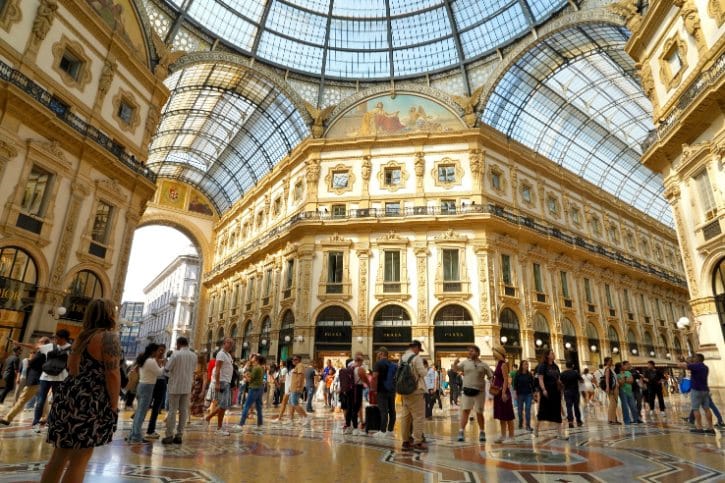
Step out of the piazza and into the Galleria Vittorio Emanuele II, and the mood shifts from sacred to splendid.
Designed by Giuseppe Mengoni and completed in 1877, this soaring arcade is one of the oldest shopping galleries in the world, and still one of the most beautiful. It also acts as a grand covered corridor, carrying you straight from the Duomo toward Piazza della Scala.
a. What to notice
Slow down and look around you:
- The iron-and-glass barrel vault, meeting at a central octagon crowned by a 47-metre glass dome.
- The floor mosaics, showing the crests of Italy’s four historic capitals: Rome, Florence, Turin, and Milan.
- The bull mosaic of Turin, where local tradition invites you to spin on your heel for good luck. You will likely see others doing it, so go ahead and join in.
b. Coffee at Marchesi 1824
Tucked inside the arcade is Pasticceria Marchesi 1824, a Milanese institution now run under the Prada Group. This is the place to pause for a proper Italian coffee break.
Here’s how to do it like a local:
- Order an espresso standing at the marble bar, the way Milanese do.
- Pair it with one of the beautiful pastries in the display case.
It is a small, civilised ritual, and a lovely way to gather yourself before the next stretch.
11:15 AM: Piazza della Scala and Teatro alla Scala
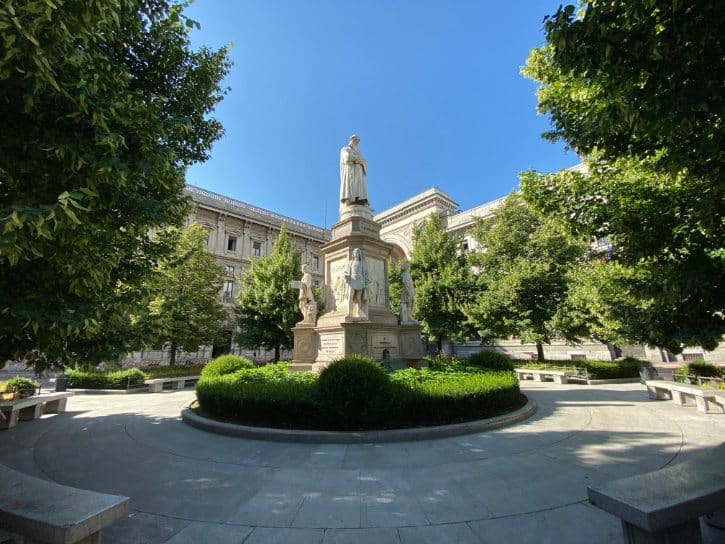
A short walk opens onto Piazza della Scala, a quietly grand square that feels worlds away from the cathedral bustle. This is opera’s holy ground.
Teatro alla Scala is one of the most storied opera houses on earth. Its stage has launched premieres by Verdi and Puccini, and its name alone carries weight for music lovers everywhere. From the outside, the theatre is deliberately understated, and that restraint is part of its charm.
a. What to take in
- The elegant neoclassical façade of the theatre, more modest than you might expect for so famous a house.
- The monument to Leonardo da Vinci at the centre of the square, honouring the years he spent in Milan.
- Palazzo Marino, the handsome city hall anchoring the eastern edge of the piazza.
On this route, La Scala is best enjoyed from the square. Opera devotees can dip into the theatre’s museum, but for most travelers, simply standing here and picturing the great voices that have filled that auditorium is experience enough.
11:35 AM: The Brera District and Pinacoteca di Brera
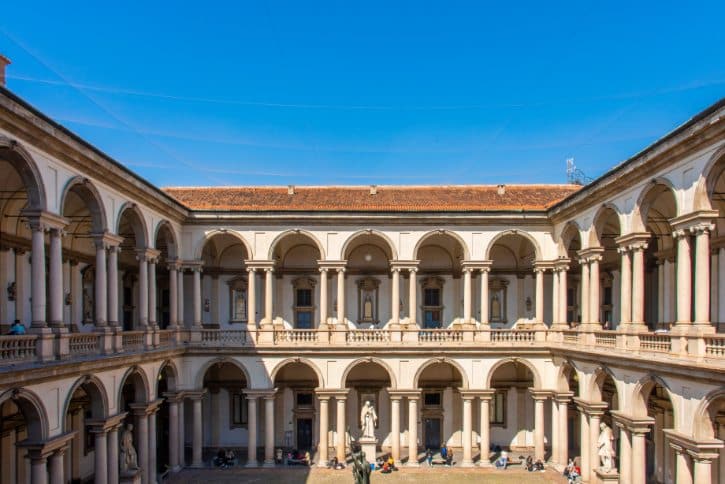
Now the day softens into something more bohemian. Brera is Milan’s artists’ quarter, a maze of narrow cobbled streets, ivy-draped palazzi, tiny galleries, and cafés spilling onto the pavement.
It is the kind of neighbourhood that invites you to slow your pace and simply look around.
a. The neighbourhood
Wander a little before you head indoors. The streets worth drifting through:
- Via Brera and Via Fiori Chiari, made for aimless strolling past boutiques and cafés.
- The courtyard of Palazzo Brera itself, which also holds the Braidense National Library and a hidden botanical garden.
b. Inside the Pinacoteca
The Pinacoteca di Brera is one of Italy’s finest collections. You could lose a whole day here, so a focused visit hits the true showstoppers:
- Mantegna’s Dead Christ, a startling exercise in foreshortening that seems to pull the body toward you.
- Piero della Francesca’s Montefeltro Altarpiece, serene and mathematically perfect.
- Raphael’s Marriage of the Virgin, a luminous masterpiece of High Renaissance harmony.
- Caravaggio’s Supper at Emmaus, all drama, shadow, and sudden light.
- Hayez’s The Kiss, the romantic icon of 19th-century Italy, and the painting everyone lingers in front of.
Give the great works your full attention and let the rest wash over you. That is the honest way to enjoy a gallery this rich in a single morning.
1:00 PM: Lunch at Osteria Da Fortunata
By now you have earned a proper meal, and Osteria Da Fortunata, right in the heart of the Brera pedestrian zone, delivers it with real character.
a. Why eat here
The first thing you notice is the pasta being made by hand in the window, dough rolled and shaped in front of you as you arrive.
It is honest, unfussy cooking rooted in Roman tradition, and the room hums with the energy of a place that clearly loves what it does.
b. What to order
This is central Italian comfort food at its best:
- Strozzapreti alla Carbonara, silky and rich.
- Fettuccine al Sugo di Coda alla Vaccinara, the classic Roman oxtail ragù.
- Tiramisù to finish, because you should.
It is casual, lively, and generous, exactly the kind of lunch that refuels you for the second half of the day.
2:30 PM: Castello Sforzesco
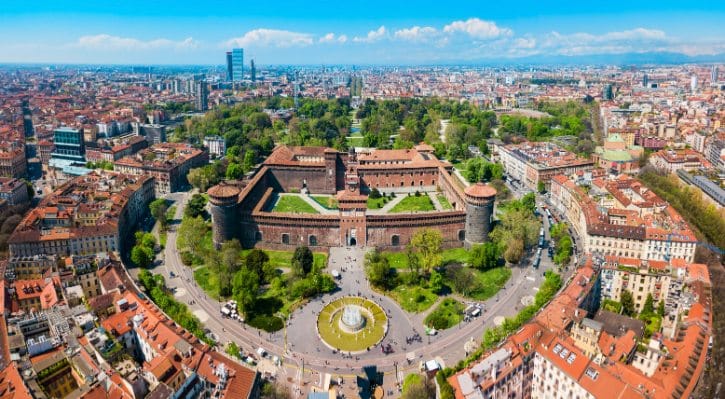
From Brera you reach the Castello Sforzesco, a mighty red-brick fortress built in the 15th century by Francesco Sforza, Duke of Milan.
Passing beneath the towering Filarete Tower into the vast Piazza d’Armi courtyard, you feel the full weight of Milan’s ducal past.
a. The grounds
You do not need to see everything to appreciate this place. Focus on:
- The great courtyards, best explored slowly on foot.
- The graceful Renaissance arcades of the Cortile della Rocchetta, the fortress’s quiet inner heart.
b. The one masterpiece to seek out
If you enter the museums for a single reason, make it Michelangelo’s Pietà Rondanini.
- This was the sculpture he was still working on in his final days.
- Unfinished and deeply moving, the marble is caught halfway between form and idea.
- You will find it in the former Spanish Hospital, near the front gates.
c. Leonardo at the castle
Milan treasures its Leonardo connection, and the castle sits at the centre of it. Here’s what you can realistically see:
- The Sala delle Asse, painted by Leonardo in 1498 with an intricate canopy of interlaced trees, has been under long-running conservation and is often closed. Treat any chance to see it as a bonus.
- A multimedia installation in the nearby Panoramic Rooms tells the story of that painted vault.
- The refreshed Room XXI gathers works by the Leonardeschi, the artists who trained in his studio.
3:30 PM: Parco Sempione and Arco della Pace
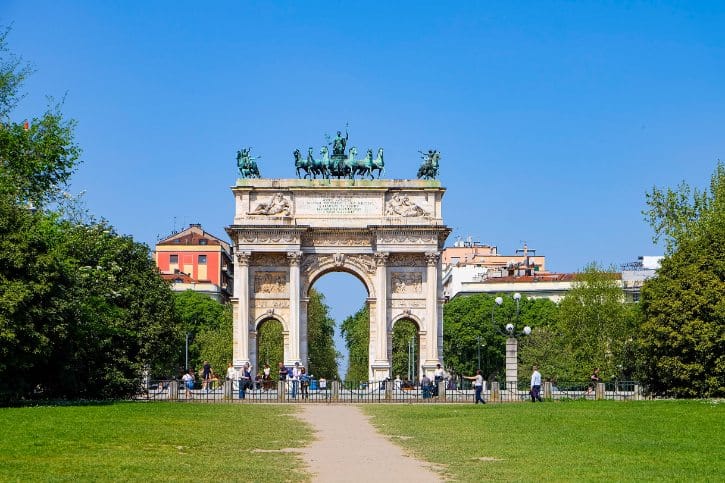
Behind the castle, the city exhales into Parco Sempione, a rolling English-style garden that offers the perfect change of pace after a morning of art and stone. This is your moment to breathe.
a. The walk
Follow the central path and let the greenery do its work. Along the way you will pass:
- Torre Branca, Gio Ponti’s slender steel tower from 1933, rising above the treetops.
- The Arena Civica, a neoclassical amphitheatre opened in the Napoleonic era.
- The Fontana dell’Acqua Marcia, a historic fountain set along the central lawn.
b. Arco della Pace
The park draws to a close at the Arco della Pace, a grand triumphal arch commissioned by Napoleon in 1807 and completed in 1838.
- It is crowned by the Sestiga della Pace, a bronze chariot pulled by six horses.
- It makes a stirring photo and a natural pause point before the afternoon moves on.
From here, the day takes its one small detour off foot. A ride on Milan’s historic Tram Line 1, with its vintage wooden carriages rattling gently through the streets, carries you toward the next stop. It is less a transfer than a small pleasure in its own right.
4:30 PM: Chiesa di San Maurizio al Monastero Maggiore
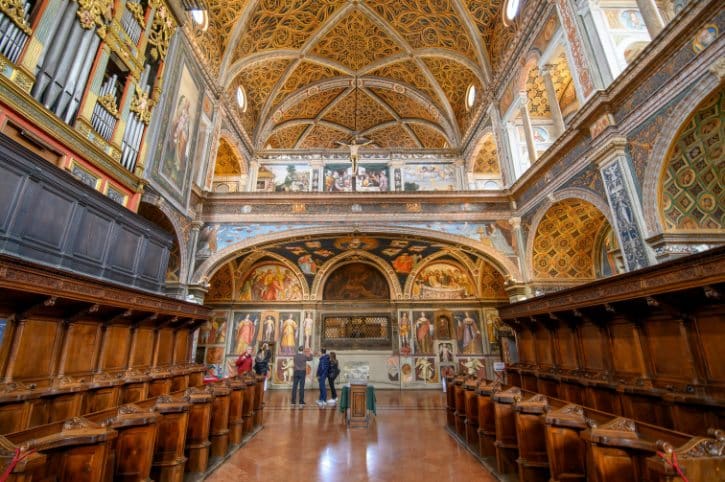
Some of Milan’s finest sights hide in plain sight, and San Maurizio al Monastero Maggiore is the best of them.
From the street it looks almost plain. Step inside, and you understand why locals call it the “Sistine Chapel of Milan”.
a. What makes it special
Every wall glows with Renaissance frescoes. The artists behind them:
- Bernardino Luini, a close follower of Leonardo, whose work fills the church.
- His sons Aurelio and Evangelista Luini.
- Simone Peterzano, the painter who would later teach Caravaggio.
The effect is overwhelming in the best way, colour and story wrapping around you on every surface.
b. The two halves
Once the church of the city’s largest Benedictine convent, the space is split in two by a partition wall:
- The Hall of the Faithful, the public church, blazing with fresco.
- The Nuns’ Choir, reached through a narrow passage, where cloistered nuns once worshipped hidden from view. Look for the sweeping Passion of Christ cycles and a beautifully preserved 1554 Antegnati pipe organ.
It is free to enter, easy to miss, and unforgettable once found.
5:25 PM: Basilica of Sant’Ambrogio
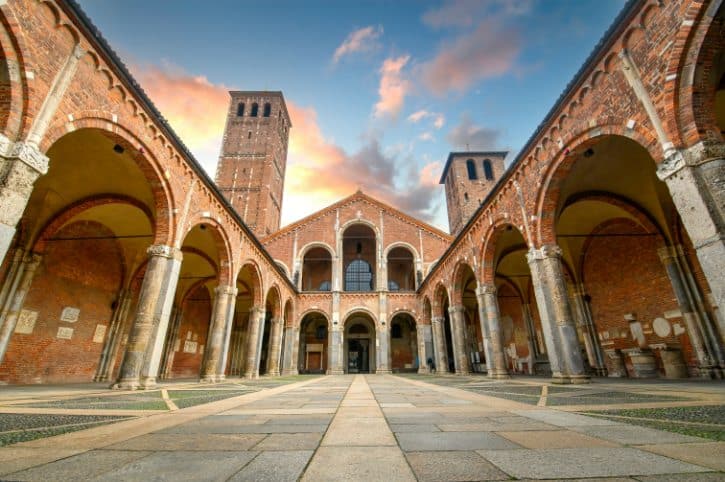
A short walk brings you to one of the oldest and most sacred places in the city, the Basilica di Sant’Ambrogio.
Consecrated in 387 AD by Saint Ambrose, Milan’s patron, and rebuilt in the 11th century, it is the defining masterpiece of Lombard Romanesque architecture.
a. What to see
- The atrium, a serene arcaded courtyard framing the façade and its two famously mismatched bell towers.
- The Golden Altar of Vuolvino, an astonishing 9th-century work of gold, silver, enamel, and gems over the high altar.
- Stilicho’s Sarcophagus, a late-Roman marble tomb carved with early Christian imagery.
- The crypt, where the remains of Saint Ambrose rest alongside Saints Gervasius and Protasius.
- The Sacello di San Vittore in Ciel d’Oro, a small chapel shimmering with 5th-century golden mosaics, if you have a few extra minutes.
b. A note on timing
This remains an active place of worship, and it is one more reason to run this route Tuesday through Saturday.
- On those days, your late-afternoon arrival lands comfortably within visiting time.
- On Sundays, the doors close to visitors earlier, so the timing here simply does not work.
6:00 PM: Colonne di San Lorenzo
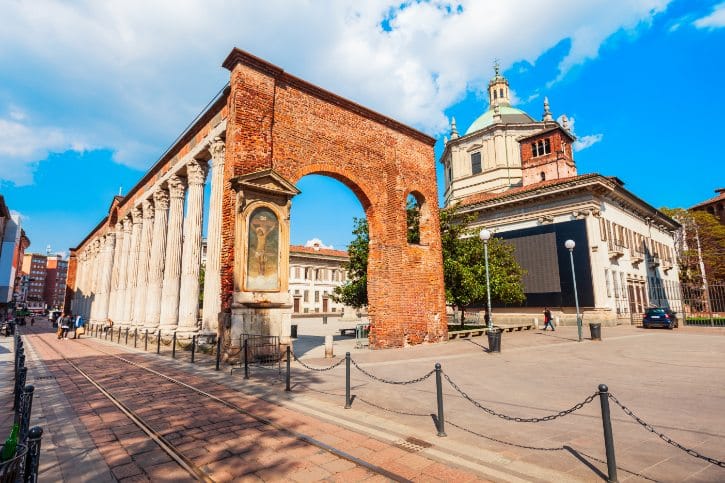
As the light turns golden, you arrive at the Colonne di San Lorenzo, sixteen Corinthian marble columns standing in a row before the Basilica of San Lorenzo Maggiore.
Dating from the 2nd and 3rd centuries and moved here in the 4th, they are among the most striking survivors of Roman Milan.
a. Why it matters
There is something moving about ancient Rome standing openly in a modern square:
- The columns are framed against the medieval Porta Ticinese gate behind them.
- This is where the city’s layers, Roman, medieval, and modern, meet in a single view.
b. How to enjoy it
By early evening the square fills with a relaxed, sociable crowd, students and locals gathering on the steps as the day cools.
- Take your photos and soak up the easy atmosphere.
- Let yourself feel the shift from sightseeing into Milan’s evening rhythm.
- If you are curious, the adjacent basilica shelters the 4th-century Chapel of Sant’Aquilino, though the columns themselves are the real draw.
6:30 PM: The Navigli Canals
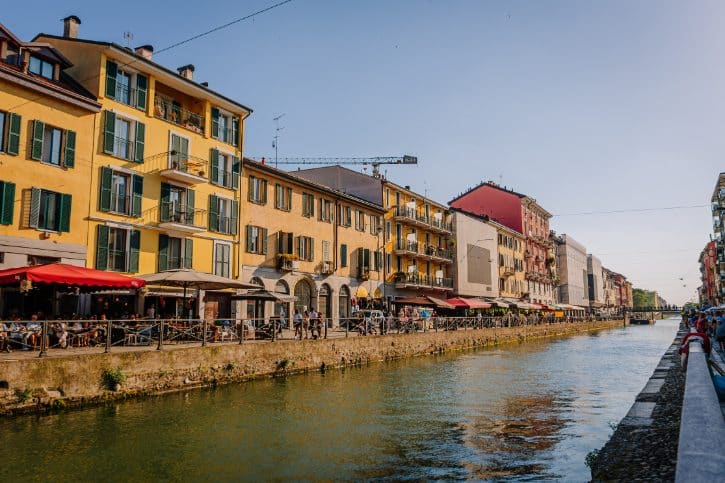
Your day ends where Milan comes alive after dark, along the Navigli canals.
This historic waterway network, whose lock system Leonardo da Vinci helped engineer, once carried the very marble used to build the Duomo. Today it is the beating heart of the city’s evenings.
a. Getting your bearings
Navigli is not one single sight but a district to wander:
- The Darsena, the old port basin, now a handsome pedestrian waterfront.
- The Naviglio Grande, the main canal, lined with vintage houses, artist courtyards, and open-air bars.
- The Vicolo dei Lavandai, a picturesque old washerwomen’s alley worth a quick detour.
b. The evening walk
Follow the canal along the Alzaia Naviglio Grande and cross the iron footbridge, the Pont de Ferr, for the classic view down the water as the lights flicker on.
This is when the district’s famous aperitivo culture begins to stir, glasses clinking, tables filling, the whole quarter warming into the night. Even a short stroll here leaves you feeling you have seen the real, living Milan.
7:15 PM: Dinner in the Navigli
Two very different dinners wait near the end of your canal walk, and neither is a wrong choice. It comes down to the evening you are in the mood for.
a. Pizzium, Via Vigevano
If you want a proper hot dinner to cap the day, Pizzium is your spot. This is Neapolitan-style pizza done seriously.
What to expect:
- Pillowy, high-cornice dough, blistered and light.
- Toppings drawn from across Italy’s regions, such as Campania buffalo mozzarella, Apulian stracciatella, and a kick of Calabrian ‘nduja.
- A casual, buzzy mood, the kind of place where you settle in and order generously.
b. La Prosciutteria Milano Navigli
If you would rather graze and linger, La Prosciutteria sits right on the water bank of the Naviglio Grande, made for a relaxed canal-side evening.
What to expect:
- Generous wooden sharing boards, the taglieri, piled with Tuscan cured meats and cheeses.
- Classics like Prosciutto di Parma, Pecorino Toscano, porchetta, crostini, and warm schiacciata
- A rustic, informal room with seats overlooking the canal, perfect with a glass of wine.
Whichever you choose, you finish your day exactly where Milan wants you to be, by the water, glass in hand, watching the city glow. Not bad for a single day on foot.