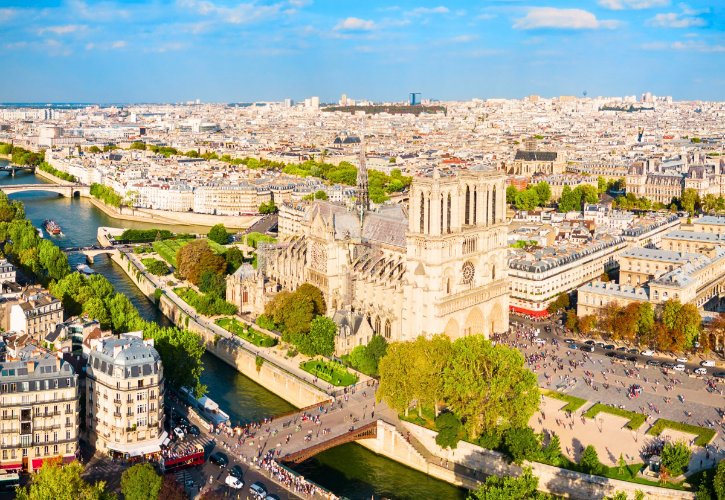
Some Paris walks tire you out. This one rewards you at every turn. You begin among old market streets and a friendly little square, then wander past churches, university corners, tiny bookshops, and narrow historic lanes.
Cross the Seine and the mood turns grand, with a famous cathedral, a glowing royal chapel, and a stern old palace. The walk ends somewhere quiet and green. The scenery changes fast, and each new stretch feels like a small gift you did not have to work hard for. 😊
1. Rue Mouffetard
a. One of the Oldest Streets in Paris
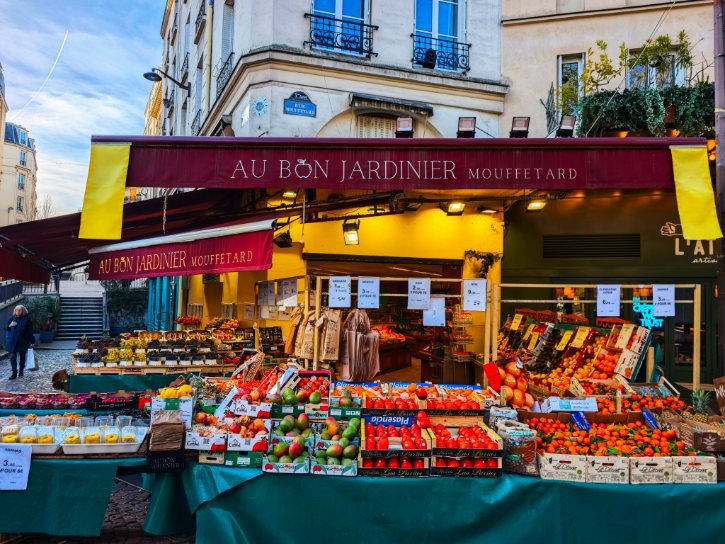
Rue Mouffetard follows the line of an old Roman road as it climbs the slope of the Montagne Sainte-Geneviève. Its curious name comes from the hill’s ancient title. It bends and wanders because it grew slowly over centuries, shaped by the land rather than by a planner.
b. Why It Feels So Different
- It escaped the wide, straight boulevards that reshaped much of Paris in the 1800s.
- The plots are irregular and narrow, many only two or three windows wide.
- Buildings rise anywhere from three to six floors.
- The road keeps narrowing and widening along gentle curves.
c. A Street Made for Food and Trade
For centuries this was a busy shopping and food street, serving butchers, tanners, and dyers of the surrounding neighborhoods. The lower part grew into an open-air market of small stalls and ground-floor shops. The photographer Eugène Atget recorded it long ago, and his images survive in the collections of the Musée Carnavalet.
d. The Neighborhood Today
- A lively, village-like feel, popular with students.
- Old façades sit above small food shops, cheese shops, and bakeries.
- Fresh greenery and clean stone paving mix with weathered older fronts.
- Plenty of everyday life to enjoy as you climb.
e. A Sign That Is No Longer There
An old painted sign once hung at 14 Rue Mouffetard, on the corner where the street meets the square ahead. Because it showed a colonial-era image that caused long debate, it was taken down and is now preserved inside the Musée Carnavalet. Do not expect to see it on the building.
2. Place de la Contrescarpe
a. Younger Than It Looks
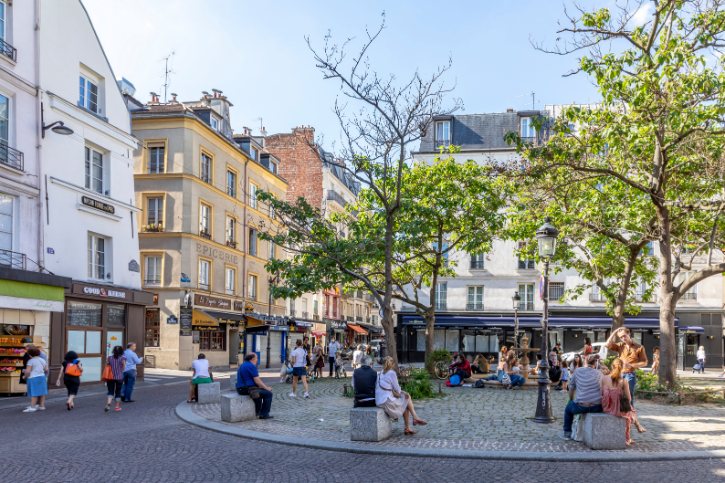
For all its cobbles and charm, this is not a medieval square. It was created in 1852, when a cramped block of houses was cleared away. The name is older, and comes from the outer slope of the ditch beside the fortified wall that King Philippe Auguste built around Paris in the late 1100s and early 1200s.
b. A Neighborhood Crossroads
- Several streets run into it, giving it a true crossroads feel.
- The ground floors are almost all café terraces.
- Nearby universities keep it full of students and locals.
- It works like a small turntable at the heart of the district.
c. Café Life and a Village Feel
The Paris visitor bureau describes this corner with real warmth, noting its village-like character, with café seating wrapped around a central stone fountain shaded by mature trees. It is one of the best spots on the walk to simply sit and watch the world go by.
d. A Corner With Literary History
- The sixteenth-century tavern La Pomme de Pin stood nearby, a haunt of the writer Rabelais and poets like Ronsard.
- Ernest Hemingway lived close by at 74 Rue du Cardinal Lemoine and wrote about this area in A Moveable Feast.
- The corner building that once held the old painted sign forms the square’s southwestern edge, facing the fountain.
e. Small Details to Notice
- How the curved fronts create an enclosed outdoor room.
- Upper windows and iron guards above the busy terraces.
- Narrow streets fanning out in every direction.
- The surprise of stepping from a tight lane into open space.
3. Église Saint Étienne du Mont
a. A Church Built Across Two Styles
This is one of the most rewarding church interiors on the route, and many people walk straight past it. It stands on the summit of the hill, beside what was once a royal abbey. Built over roughly 130 years from the late 1400s, its style shifts as you move through it, from late Gothic to Renaissance.
b. The Only Rood Screen in Paris
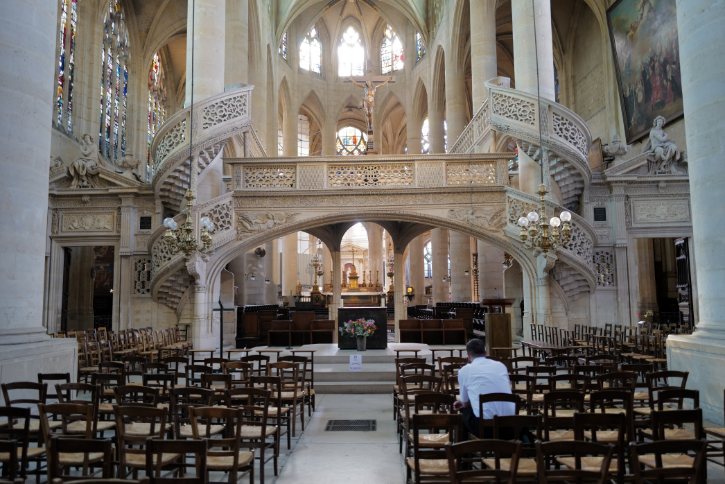
- Saint-Étienne-du-Mont holds the only surviving stone rood screen (jubé) in Paris.
- It was carved in the 1530s and 1540s from fine white limestone.
- A flattened arch spans the nave, with two open spiral staircases curling around the pillars.
- The stone is carved so finely it looks like lace. Do not leave without standing beneath it.
c. Sainte Geneviève and Her Shrine
The church carries on the memory of Sainte Geneviève, the patron saint of Paris. After her old abbey was destroyed, her cult and surviving relics came here. Her genuine sixth-century sarcophagus stones now rest inside a gilded shrine in a side chapel, lit by stained glass that shows her helping feed the city in hard times.
d. Treasures Inside
- The Mystical Wine Press, a striking stained glass image of Christ pressed like grapes.
- The organ case (1631), the oldest surviving organ case in Paris still in its original place.
- The Baroque pulpit (1651), held up by a life-size carved figure of Samson.
e. Two Great Minds Rest Here
- Blaise Pascal, the philosopher and mathematician, is buried here.
- Jean Racine, the playwright, was first buried elsewhere. His remains were later moved here, so he rests beside Pascal.
f. Small Details to Notice
- The shift from pointed Gothic arches to rounder Renaissance forms.
- The lace-like stone of the rood screen.
- Both spiral staircases, seen from directly below.
- The upper gallery running around the interior.
4. Panthéon
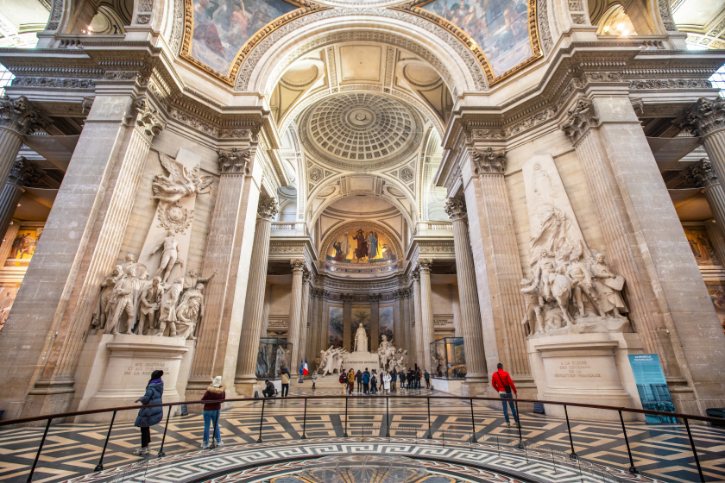
a. A King’s Vow
The Panthéon began as a promise. King Louis XV fell gravely ill in 1744 and vowed to build a grand new church if he recovered. He chose the architect Soufflot, who combined the grandeur of ancient Rome with the light of Gothic cathedrals, openly hoping to rival St Peter’s in Rome and St Paul’s in London.
b. From Church to National Shrine
The Revolution turned the new building into a resting place for national heroes, carrying the line above its front, “To great men, a grateful homeland”. The change became permanent in 1885, when the huge funeral of Victor Hugo drew around two million mourners and sealed its role as a temple of the Republic.
c. The Foucault Pendulum
- In 1851, the physicist Léon Foucault used this space to prove the Earth turns.
- He hung a heavy sphere from a very long wire under the dome.
- As it swung, the direction of its swing slowly rotated, because the Earth turned beneath it.
- A working copy swings here today over a circular dial.
d. Art and Modern Additions
- Huge murals tell the story of France, with scenes of Sainte Geneviève, Joan of Arc, and Saint Louis.
- Artist Anselm Kiefer added six glass cases about the trauma of the First World War.
- Composer Pascal Dusapin added a sound work with sung names of fallen soldiers.
e. Who Rests in the Crypt
- The crypt holds more than 80 figures, including Voltaire, Rousseau, Hugo, Zola, and Marie Curie.
- Marie Curie was the first woman placed here on her own merits.
- Not everyone honored here is actually buried here. Some have real tombs, some have symbolic memorials with soil from meaningful places, and some have only carved inscriptions.
5. Place de la Sorbonne
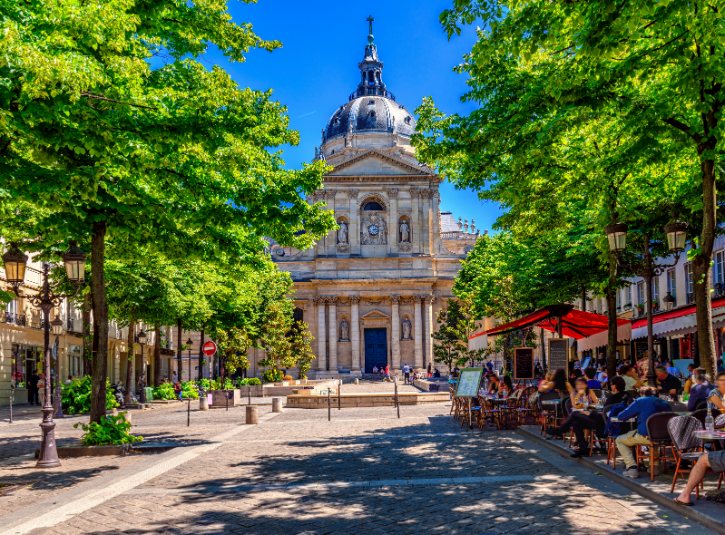
a. Where Student Paris Began
This square is the historic heart of the University of Paris. Around 1253, Robert de Sorbon founded a college here to house and teach poor scholars. The whole district became known as the Quartier Latin because Latin was the shared language of study, letting students from across Europe learn together.
b. Not as Old as It Looks
- The buildings you see come from two later rebuilds, not the Middle Ages.
- Cardinal Richelieu had the college rebuilt in the 1630s and 1640s.
- The chapel he built is the only surviving piece, crowned by the first major classical stone dome in Paris.
- The large academic palace facing the square came later, under the Third Republic.
c. A Living Square
The open pedestrian space is lined with linden trees, low fountains, and café terraces, with a bronze statue of the philosopher Auguste Comte in the center. It is a place where formal institution and everyday student life share the same view.
d. May 1968
- The square and its lecture halls became the focus of huge student protests.
- After police entered the university, students pried up paving stones to build barricades.
- The moment gave rise to the famous slogan, “Under the cobblestones, the beach”.
e. Small Details to Notice
- Carved inscriptions above the university gates.
- The contrast between the older Baroque chapel and the plainer later wings.
- Café tables and bookshop racks pressed right against the gates.
- The chapel front is currently clear, giving open views to the dome.
6. Rue de la Harpe
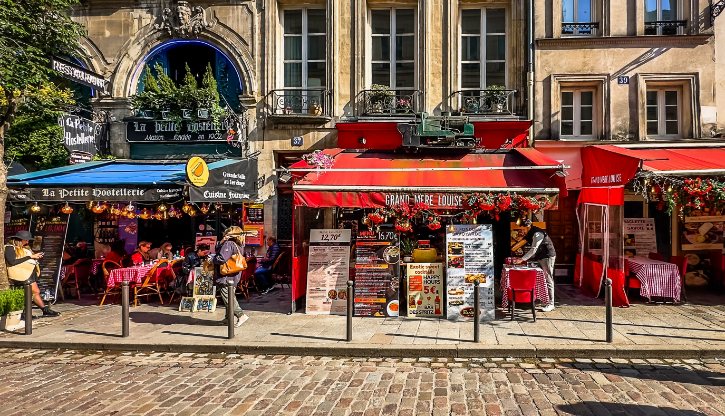
a. A Taste of Old Paris Scale
Rue de la Harpe shows how the Left Bank felt before the wide boulevards arrived. It began as a Roman-era road and grew into a main route of the district. Its name comes from a medieval trade sign showing King David playing a harp. Much of it was later demolished, and only the short northern section keeps its old width.
b. Look Up
- Very narrow plots, often only three or four meters wide, hint at reused medieval foundations.
- Upper floors mostly date to the late 1600s and 1700s.
- Iron balcony rails show curling or geometric patterns, framed by wooden shutters.
- Steep roofs and attic dormers break the skyline at odd points.
c. A Wartime Story
During the Liberation of Paris in August 1944, the corner of Rue de la Harpe and the boulevard was an active defense point. Resistance fighters and residents overturned trucks and pulled up paving stones to build a barricade, then held the spot under fire until an armored division arrived.
d. The Street Today
- The ground floors are mostly restaurants and small shops.
- It stays busy with visitors.
- The real character lives in the upper floors, above the modern signs.
e. Small Details to Notice
- Old upper stories rising above the restaurant signs.
- Tight, converging lines of the façades.
- Arched carriage doorways at numbers 35 and 45, with carved stone wheel guards.
- The clash where modern canopies meet old carved lintels.
7. The Abbey Bookshop
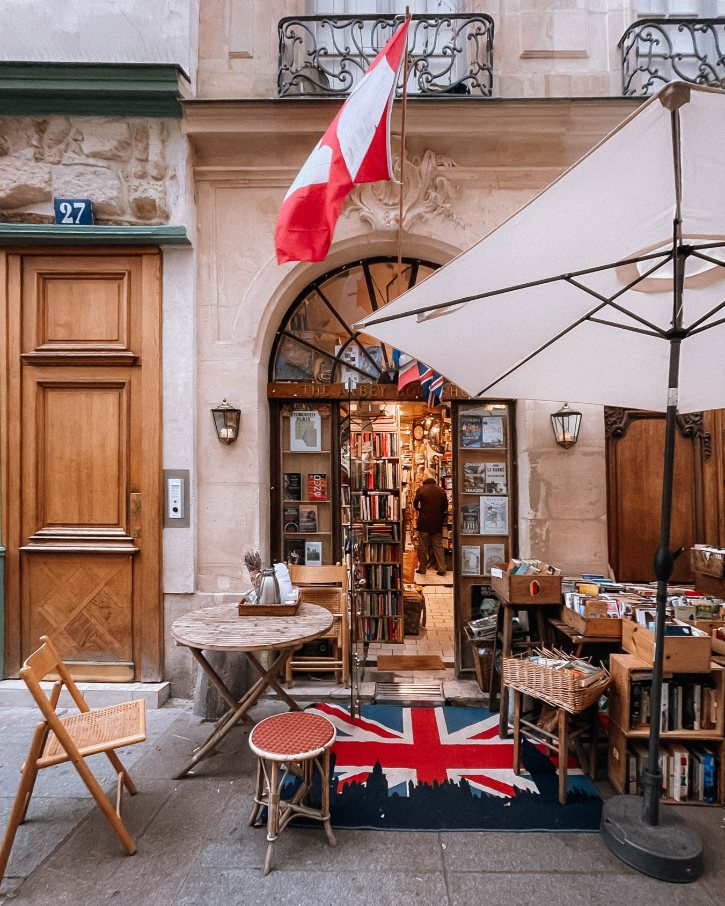
a. A Book Lover’s Hideaway
At 29 Rue de la Parcheminerie, The Abbey Bookshop is a much-loved corner of English-language literary life in Paris. It was founded by Brian Spence, originally from Toronto, and holds more than 40,000 titles, both new and secondhand, with a soft spot for out-of-print history, philosophy, and fiction.
b. The Perfect Street for It
The setting could hardly be more fitting. In the Middle Ages, this lane was home to the copyists and manuscript makers of the university, and later to the parchment makers who gave the street its name. Opening a bookshop here quietly returned the book trade to the very lane where Paris bookmaking began.
c. The Building
- The shop sits in an eighteenth-century mansion, protected as a historic monument.
- Look for the arched windows framed in dressed stone.
- The tall doorway keeps its original carved wooden doors.
- A carved stone face sits above the central arch.
d. Inside
- Floor-to-ceiling shelves line narrow corridors.
- Rolling ladders reach the highest books, stacked to the joists.
- Quiet classical or jazz music plays.
- A lovely tradition offers visitors a hot coffee sweetened with Canadian maple syrup.
e. How It Differs From Shakespeare and Company
- It stays intimate, quiet, and community-run.
- There are no big crowds or strict rules.
- It is built for relaxed browsing and quiet chats.
- Respectful photography is fine, as long as you leave room for others.
8. Église Saint Séverin
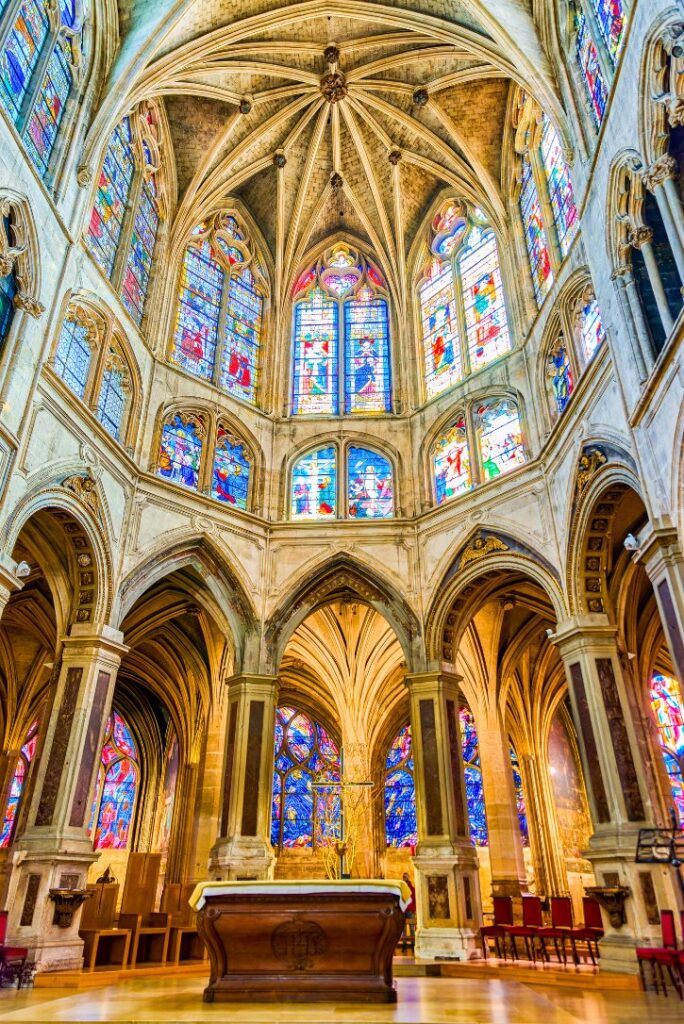
a. Centuries of Building
Named for a sixth-century hermit, Saint-Séverin is the finest Flamboyant Gothic church on the Left Bank. Earlier churches stood here before a full rebuild began in the late 1400s. The result is an unusual five-nave plan with no projecting transept, which gives it a wide, hall-like feeling inside.
b. The Stone Palm Grove
The showpiece is the double walkway behind the high choir. Here the masons let the vault ribs flow straight down into the columns, spreading overhead like palm fronds. At the center stands a famous twisted column that spirals upward. Here is the catch: you have to walk behind the altar to find it.
c. Stained Glass Across Centuries
- Late medieval glass in the upper choir windows.
- A western rose window holding a Tree of Jesse.
- Nineteenth-century glass in some side chapels.
- Modern windows by Jean Bazaine, in vivid blues, reds, and golds, standing for the Seven Sacraments and casting pools of color across the pale stone.
d. A Doorway With a Past
- The west portal was not built for this church.
- It was carefully moved here from another church that was demolished nearby.
- Its older, early Gothic style is a lovely counterpoint to the later interior.
e. Details and Ongoing Care
- The grand organ sits in a carved oak case from 1745.
- Look for the marmousets, small, lively stone figures on the corbels.
- Conservation here is ongoing, so some areas may be affected.
- The nave and walkways stay open to visitors.
f. Small Details to Notice
- The twisted pillar and its branching ribs.
- The palm-like stone shapes overhead.
- Tiny carved faces on the corbels.
- The difference between medieval and modern glass.
9. Rue Saint-Séverin
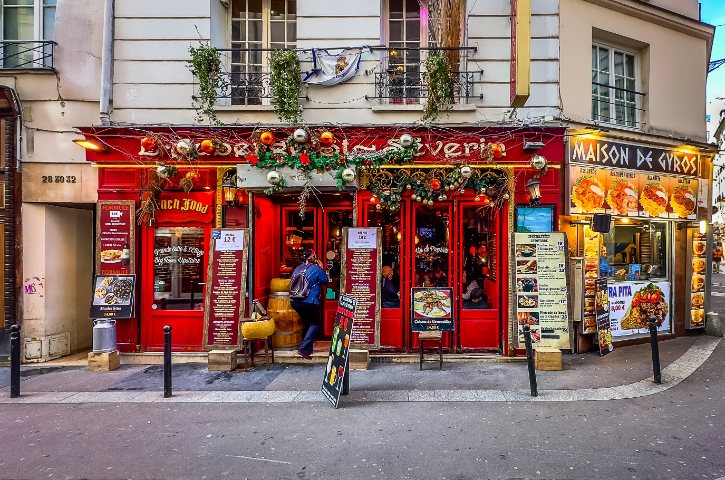
a. A Street to Read Slowly
Rue Saint-Séverin is one of the oldest recorded streets on the Left Bank. It runs parallel to the Seine and once linked the university colleges to a river crossing. The photographer Eugène Atget captured it long ago, and comparing his views with today shows how little the upper building lines have changed.
b. The Church Against the Street
- The church presses right up against the pavement.
- Heavy stone buttresses drop straight to the sidewalk.
- Carved gargoyles jut out over the street.
- Dark old church stone stands directly across from painted shopfronts.
c. Hidden Courtyards and Old Trades
For centuries, craftsmen worked in quiet inner courtyards here. Behind the archway at number 34, records show opticians and scientific instrument makers once worked, producing optical glass and parts for early projection devices. Homes, workshops, and families shared the same walls.
d. The Street Today
- Now a pedestrian corridor full of bistros and creperies.
- Bright menus fill the ground floors.
- Lift your eyes and centuries of housing rise above.
- Official walking guides point to it as a key place to feel the medieval scale of the area.
e. Small Details to Notice
- Worn stone thresholds, grooved by generations of feet and carts.
- Medieval gargoyles reaching out over the pavement.
- Glimpses of cobbled courtyards through open gates.
- How closely the church wall crowds the street.
10. Odette
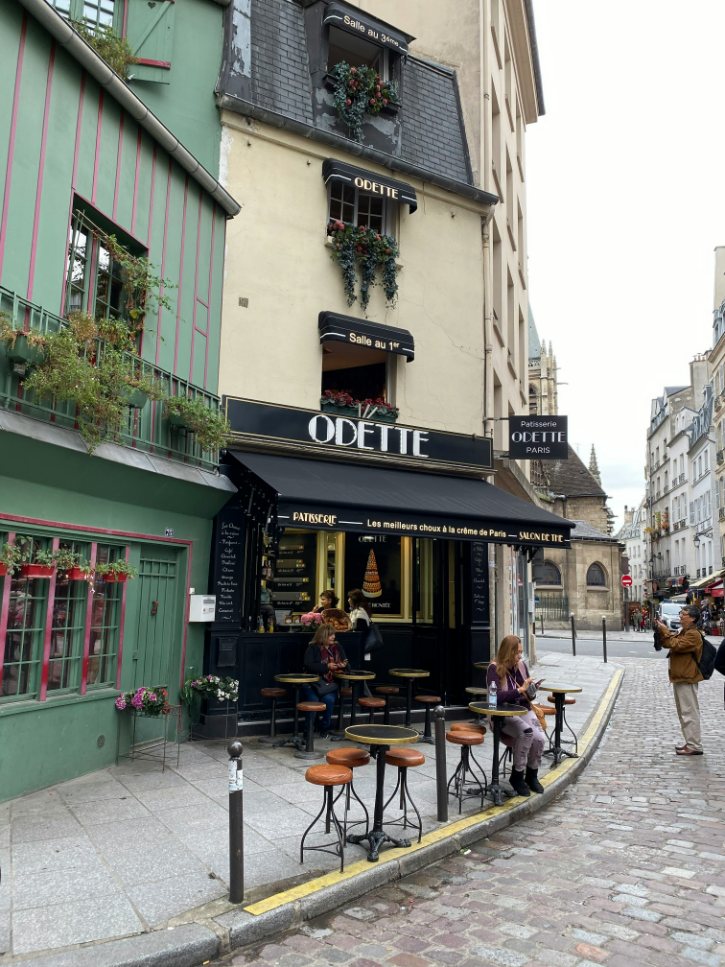
a. A Sweet Pause
At 77 Rue Galande, the original Odette boutique sits on a picturesque corner. It was founded by Frédéric Loeb, who named it after his grandmother, and it is famous for the choux à la crème, the classic French cream puff, done beautifully.
b. The Leaning Old House
- The shop fills a surviving seventeenth-century timber house.
- It leans visibly toward the street, from the soft ground settling over time.
- It has a narrow, tall shape with a steep slate roof.
- The retro storefront wears a black-and-white checkerboard pattern and gold lettering.
c. Its Old Neighbors
- Across the street is a small square with the oldest known living tree in Paris.
- Behind the trees stands the old church of Saint-Julien-le-Pauvre.
- From the doorstep, you get open views across the river toward Île de la Cité.
d. A Few Flavors
- Classic choices like vanilla, dark chocolate, salted caramel, pistachio, and espresso.
- Seasonal fruit flavors appear through the year.
- Each is small, colorful, and made fresh daily.
e. Small Details to Notice
- The whole narrow front, not just the pastry window.
- The upper floors leaning out of line.
- The graphic storefront tiles against the earthy old stone next door.
- Views along the old street toward the nearby church.
11. Shakespeare and Company
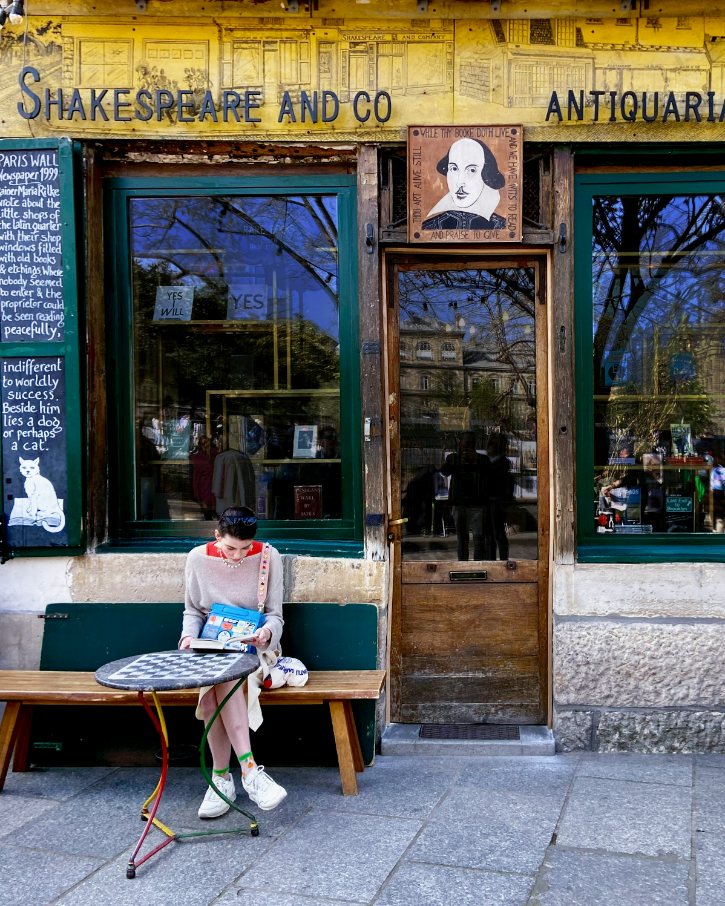
a. A Living Literary Landmark
At 37 Rue de la Bûcherie, facing the Seine and Notre-Dame, stands Shakespeare and Company, the most famous English-language bookshop in continental Europe. It is far more than a photo spot, and its history is worth knowing before you step inside.
b. Two Different Shops
- The original shop was run by Sylvia Beach, and famously published James Joyce’s Ulysses when it was banned elsewhere. It closed during the occupation.
- George Whitman opened his own bookshop in 1951 and later took the same name, with Beach’s blessing.
- The shop you visit today is a spiritual successor, not the same 1919 store.
c. Writers and the Tumbleweeds
- Writers like Ginsberg, Burroughs, Baldwin, and Henry Miller passed through Whitman’s shop.
- Its best-loved tradition is the Tumbleweeds, young travelers who slept among the books for free.
- In return, each was asked to read a book a day, help in the shop, and write a one-page life story.
- More than 30,000 people are believed to have stayed over the years.
d. The Shop Today
It is a living cultural center, hosting author talks, readings, and a literary festival. Every book bought can get the shop’s famous stamp, and a café sits next door. One key rule: photography inside is strictly forbidden, so you may only photograph the exterior from the street.
e. Small Details to Notice
- The green-and-yellow front and books piled around the entrance.
- The motto above the door about welcoming strangers as angels in disguise.
- A small wishing well inside the entryway.
- The view across the river to Notre-Dame.
12. Rue de la Huchette
a. The Street of Performance
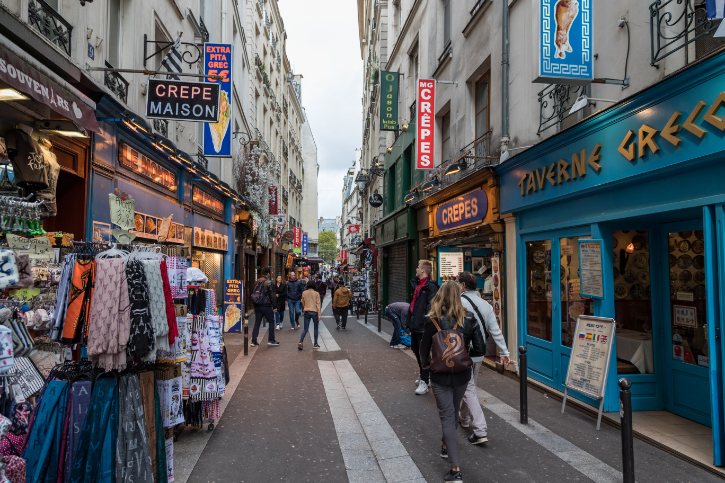
Rue de la Huchette is one of the liveliest lanes on the route, recorded as far back as the late 1100s. In the Middle Ages it was known for taverns, innkeepers, and roasting cooks who fed scholars and travelers. It has kept its tight, old layout ever since.
b. The Theater That Never Stops
- At number 23 sits the tiny Théâtre de la Huchette.
- Since 16 February 1957, it has staged two short plays by Eugène Ionesco, The Bald Soprano and The Lesson.
- That run holds the Guinness World Record for the longest continuous run at the same venue.
- Both plays are still performed, so you pass a living tradition, not a relic.
c. Jazz and the Rhythm of the Day
- A few doors down is the Caveau de la Huchette, a jazz club in a medieval vaulted cellar.
- Great names once played there.
- By day the street is quiet and sunlit.
- By evening it glows with theater crowds and jazz drifting up from below.
d. Small Details to Notice
- The retro neon sign and playbills at the theater.
- Nearby Rue du Chat-qui-Pêche, one of the narrowest lanes in Paris.
- Iron balcony brackets on the upper floors.
- Old architecture surviving above the modern restaurants.
e. Enjoy It, but Skip One Myth
You may hear this called the oldest street in Paris. That claim is not confirmed, so enjoy it instead for what it truly is, a lively, theatrical, and animated corner full of character.
13. Notre Dame Cathedral of Paris
a. Open Again After the Fire
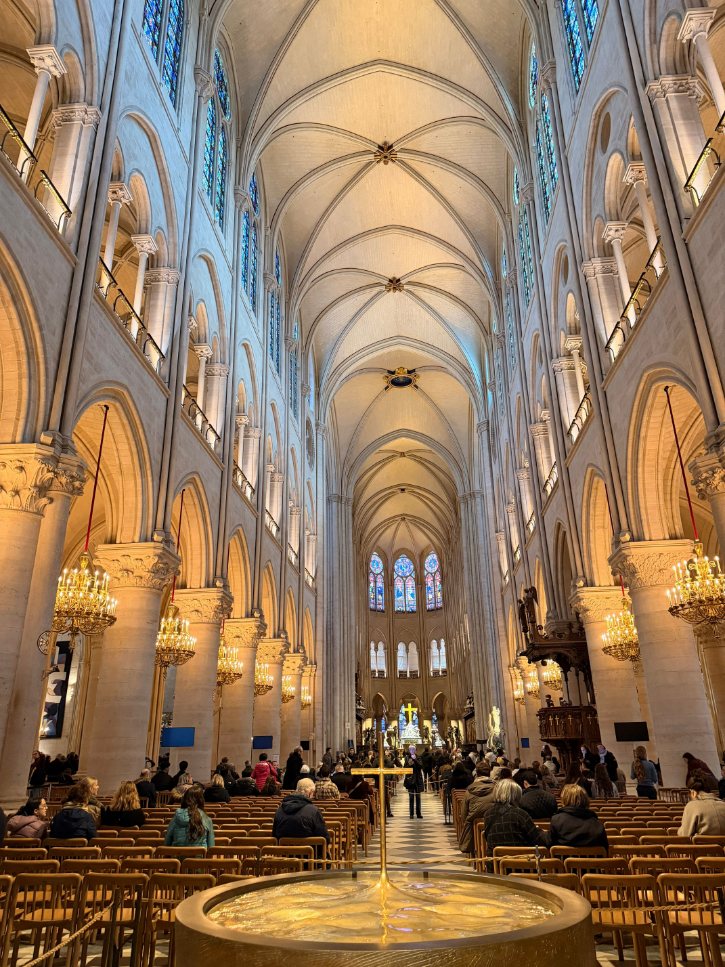
The terrible fire of 2019 destroyed the roof and spire of Notre-Dame. The good news is that the cathedral is open again, and the interior can be visited. Some work continues around the outside, so expect a few areas that are still being finished.
b. The West Front and Its Portals
- Three great portals fill the front, showing the Virgin, the Last Judgment, and Saint Anne.
- Above them runs the Gallery of Kings, a row of 28 statues.
- The original statues were torn down and beheaded during the Revolution, then remade.
- Some of the original heads survived and are now shown in the Musée de Cluny.
c. Gargoyles and Grotesques
- Gargoyles are the working water spouts on the buttresses, many of them medieval.
- The famous fantasy beasts along the towers are not medieval.
- They were designed much later, in the 1800s, during a Gothic revival.
- Knowing the difference makes the whole front more interesting.
d. The Brighter Interior
The biggest change inside is the light. Careful cleaning lifted centuries of soot and revealed the warm, blonde tone of the original stone. It is important to know that this brightness is cleaned, authentic old stone, not a modern rebuild.
e. New Furnishings and Old Treasures
- New bronze pieces, including the altar, were made for the reopening by designer Guillaume Bardet.
- The fourteenth-century statue of the Virgin and Child survived and has returned.
- The great rose windows were cleaned and repaired.
- The Crown of Thorns is shown in a striking new reliquary, and the grand organ was fully cleaned and reinstalled.
f. The Spire and Its Statues
- The rebuilt spire is a faithful copy of a nineteenth-century design, not the medieval original.
- The copper statues around its base survived only because they had been removed for cleaning just before the fire.
- Fully restored, those statues have been returned to their places around the spire.
14. Sainte Chapelle and The Conciergerie
a. Sainte-Chapelle: Built for Relics
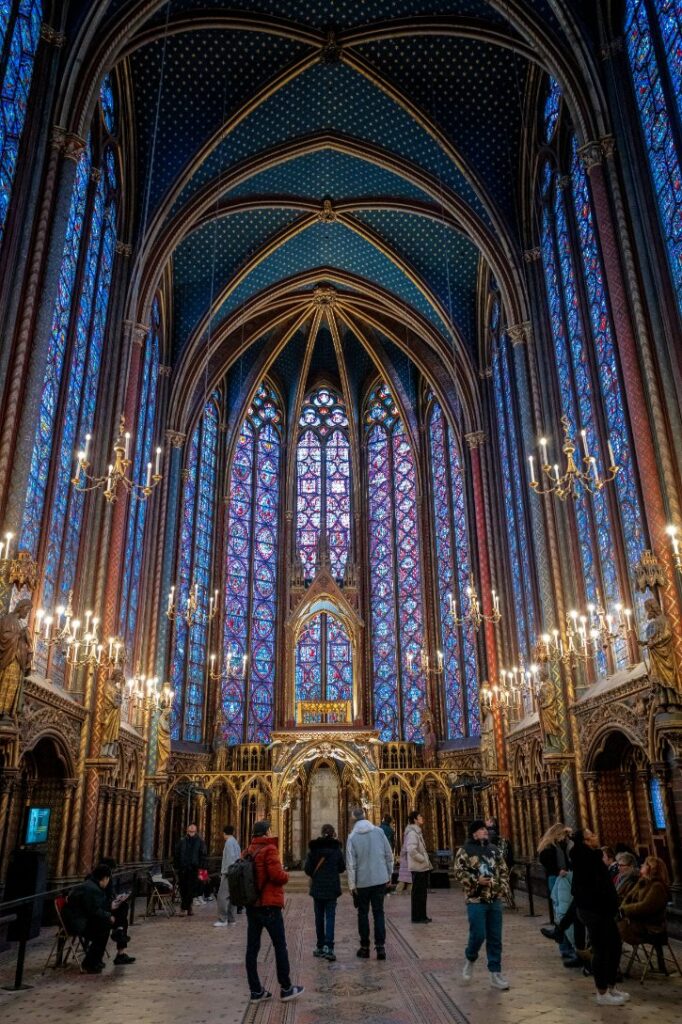
Sainte-Chapelle was built by King Louis IX to hold the most prized relics in medieval Europe, above all the Crown of Thorns. He paid an enormous sum to secure them, then had this chapel built to match. Think of it as a giant reliquary made of stone and glass.
b. Two Chapels, One Big Reveal
- The lower chapel is low and enclosed, painted in deep blues and reds, once used by palace staff.
- The upper chapel soars far higher, with walls that seem made of glass.
- It holds 15 towering stained glass windows.
- Seeing the darker chapel first makes the bright one feel breathtaking.
c. Reading the Windows
- This is the largest collection of thirteenth-century stained glass in the world.
- The windows are said to hold more than 1,000 individual scenes.
- Read each window like a page, starting at the bottom left, then moving up.
- The scenes run from the Old Testament to the life of Christ and the story of the relics coming to Paris. Right now, you can see clearly across all the windows.
d. The Conciergerie: Palace to Prison
Right beside the chapel, the Conciergerie is the surviving lower part of the old royal palace, once the seat of French kings. After a violent uprising, the monarchy moved to safer homes, and the building became a center of law and a prison.
e. Great Halls and Revolution
- The Hall of the Men-at-Arms is the largest surviving secular Gothic hall in Europe.
- Nearby are the huge medieval kitchens, with fireplaces once big enough to roast whole animals.
- During the Terror, the building became known as the ante-room to the guillotine.
- More than 2,700 people were sent from here to their deaths, including Marie-Antoinette.
f. Marie-Antoinette and Seeing It Today
- Marie-Antoinette was held here before her execution.
- The memorial chapel you see is not her original cell. It was rebuilt later as a place of mourning.
- A recreated cell nearby helps you picture the conditions.
- A tablet called the HistoPad rebuilds lost rooms in augmented reality, from royal banquets to the old prison cells.
15. Place Dauphine
a. A Royal Square
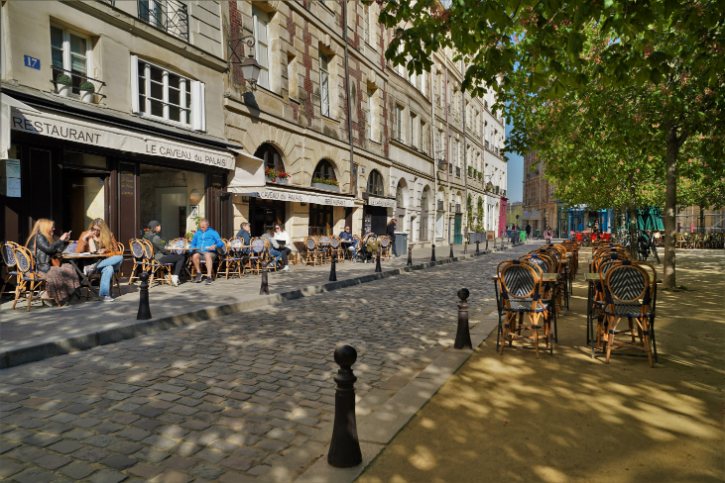
Place Dauphine was created by King Henri IV in 1607, the second planned royal square in Paris. He named it for his son, the future king, and tied it to the new Pont Neuf nearby. It was laid out as an unusual triangle to fit the narrow western tip of the island.
b. How Much Really Survives
- The square once held 32 matching houses in white stone and red brick.
- Over time, owners added floors and covered the brick with plaster.
- The entire eastern base was later demolished to reveal the grand courthouse behind it.
- Two entrance pavilions still keep their original brick-and-stone look.
c. Why It Feels So Calm
- The ring of buildings acts like a sound barrier against the traffic.
- The ground is soft gravel rather than asphalt, lined with chestnut trees and green benches.
- Locals gather to play pétanque, adding a gentle, village-like sound.
- The ground floors hold small galleries, print shops, and quiet bistros.
d. A Little Fame
The square has long drawn artists and writers. The famous actors Simone Signoret and Yves Montand lived here for decades, and the writer André Breton praised its unusual, secluded shape. It is a place people fall for quietly.
e. A Quiet Ending
From the food shops of the first street, through university corners, glowing churches, small bookshops, old lanes, and the great monuments across the river, the walk has carried you through layer after layer of Paris. It finishes here, in a calm green triangle where the noise fades. Take a bench, listen for the boules, and let the city slow down with you.