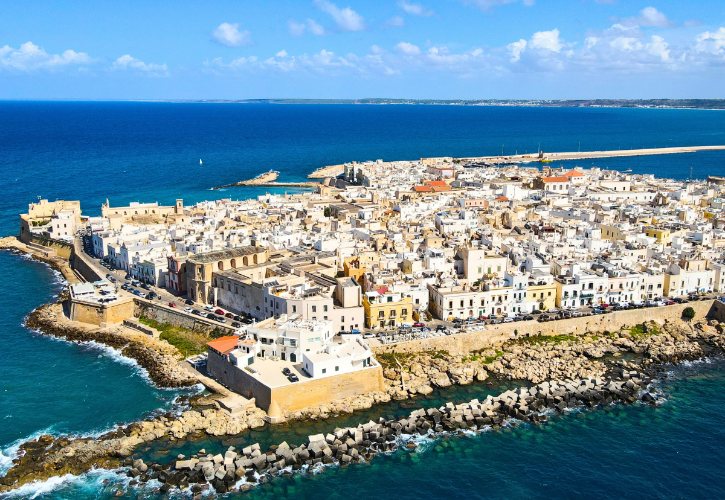
Puglia looks big on a map, and that can make a road trip feel like a lot of driving. The good news is that the best places sit close together, often just 10 to 30 minutes apart.
You will move from Adriatic port towns and old harbour quarters to limestone cliffs, through trulli and the green Valle d’Itria, past whitewashed hill towns, medieval castles, and deep Messapian roots, into golden Baroque Salento, along the Ionian coast, and finally to Otranto. Here is how to enjoy each stop. 😊
1. Trani
a. Why you should stop
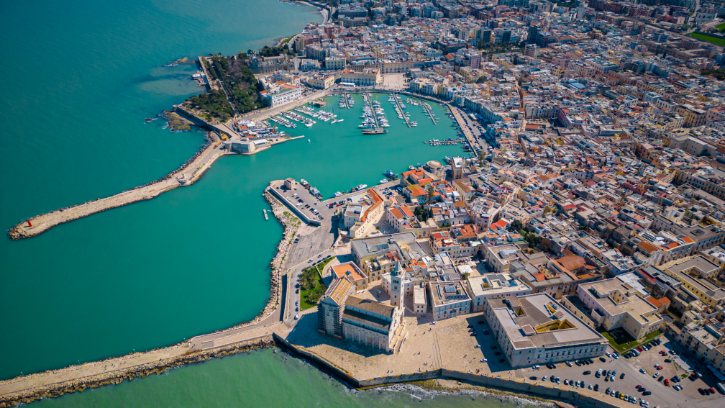
Trani is your gentle introduction to the coast, and it faces the sea completely. The cathedral, the castle, and the old harbour all sit right at the water’s edge, so the Adriatic feels like part of the town.
b. Trani Cathedral
- Its full name is the Basilica Cattedrale di Santa Maria Assunta, and work began in 1099.
- It is widely seen as the purest example of Apulian Romanesque
- It is built of pale local pietra di Trani limestone that catches the shifting sea light.
- Its 59-meter bell tower sits on a tall open arch, so light and people pass right beneath it toward the sea.
- Look for the facade’s rose window, the double staircase, and the bronze doors cast in 1175.
c. Castello Svevo
- The square coastal fortress was founded in 1233 by Emperor Frederick II.
- It sits low and heavy, a nice contrast to the slender cathedral across the square.
- Inside you will now find a permanent multimedia installation bringing the medieval court to life.
d. Jewish quarter
Trani had one of the region’s most important medieval Jewish communities. The former quarter, the Giudecca, still fills the block behind the port. There you will find the Scolanova Synagogue, built in the 13th century, later a church, and now restored as one of the oldest working synagogues in Europe.
e. Good to know
- The cathedral, crypts, and harbour quays are fully open.
- Any conservation work is minor and causes no major scaffolding.
2. Bari Vecchia
a. Why you should stop
Bari Vecchia is the old heart of the regional capital, packed onto a narrow peninsula. Grand churches, fortifications, and everyday life press together in the same tight streets, and that mix is its real character.
b. The two great churches
- The Basilica di San Nicola was founded in 1087 to hold the relics of Saint Nicholas.
- Its crypt is a shared space where Catholic and Russian Orthodox worship side by side.
- The Cathedral of San Sabino hides a Roman street and a 6th-century mosaic beneath it.
- Every summer solstice, sunlight lines up through its rose window onto a matching rose on the floor.
c. Castello Svevo di Bari
- A massive fortress with Norman foundations, later strengthened by Frederick II.
- Its courtyard and its gallery of medieval sculpture casts stay open.
d. Arco Basso and street life
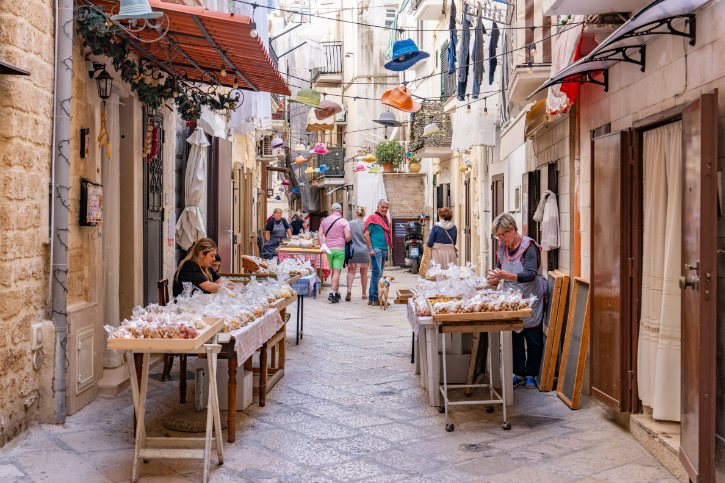
Strada Arco Basso is the lane famous for handmade orecchiette pasta. Local women shape the little ears at tables outside their doors. This is real daily life, not a show, so there is no guarantee you will catch it, but it is lovely when you do. All around you, laundry hangs overhead and churches appear suddenly at the end of lived-in alleys.
e. The main squares
- Piazza Mercantile and Piazza del Ferrarese anchor the southern edge of the old town.
- Beneath the glass pavers, you can see remnants of the Roman Via Traiana.
- Both are open and free to wander.
3. Polignano a Mare
a. Why you should stop
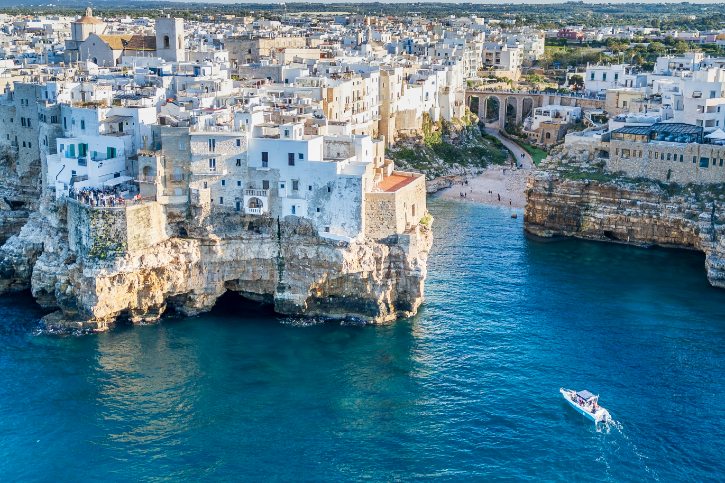
This is where Puglia’s dramatic limestone coast takes over. Whitewashed houses cling to the tops of high cliffs, with sea caves hollowed out below.
b. Lama Monachile
- The signature view is a narrow pebble cove framed by vertical cliffs.
- An arched Roman-Bourbon bridge spans high above it.
- A “lama” is an ancient dry riverbed that carved this canyon down to the sea.
- Access to the beach by the historic stone staircase stays fully open.
c. The historic centre
You enter through the old Arco Marchesale gate. Inside, quiet white lanes end suddenly at open stone terraces above the water. Trust me, reaching a low wall with nothing but the sea ahead is a feeling you will remember.
d. Sea caves and Modugno
- The cliffs hide deep caves, the largest reaching beneath the old buildings.
- Boat trips into them run under safety rules, though they are a nice add-on, not a must.
- The town is the home of singer Domenico Modugno, honoured with a seafront bronze statue.
e. Good to know
- The pavements and belvederes are well kept, with no major closures.
- You can enjoy Polignano fully just from the terraces above.
4. Monopoli
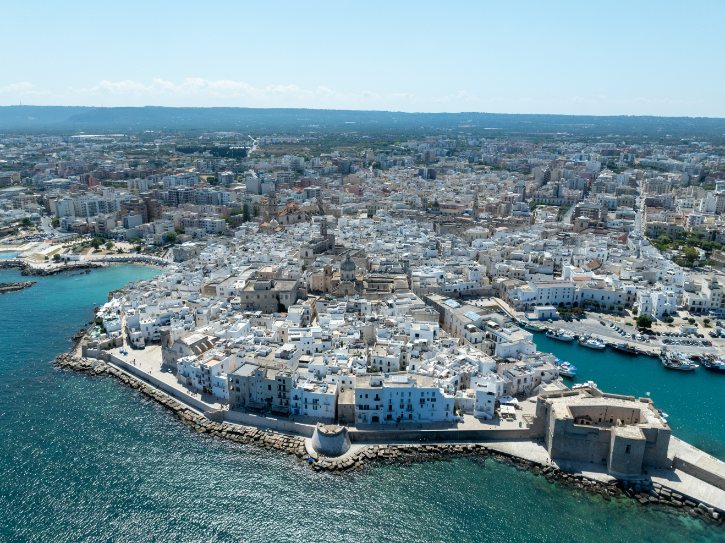
a. Why you should stop
Monopoli is a genuine working harbour town. Instead of dramatic cliffs, you get a lively port where fishing boats, sea walls, and the old centre all meet the water.
b. Porto Vecchio
- Traditional blue-and-red wooden fishing boats are still moored here.
- Fishermen repair their nets beneath Renaissance palazzi and old bastions.
- The scene feels lived-in rather than staged.
c. Castello Carlo V
- A pentagonal fortress on the point, completed in 1552 to guard the port.
- It even incorporates an older church within its walls.
d. Cathedral of the Madia
The Cathedral of Maria Santissima della Madia offers a complete change of mood, glowing inside with coloured marbles. Local tradition says a raft carrying its sacred icon drifted into the harbour just as builders needed roof timber, and the raft’s beams became the ceiling. The interior and museum are fully open.
e. Walls and beach
- The restored sea walls give you an elevated walk above the surf.
- Look for cannon barrels set into the stone and carved Spanish crests.
- Below the fortifications lies Cala Porta Vecchia, a small sandy cove.
5. Alberobello
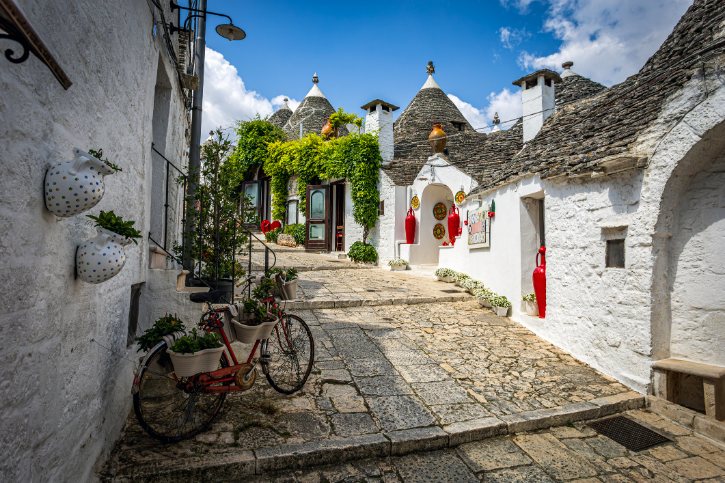
a. Why you should stop
Alberobello is the symbol of rural Puglia, home to the greatest concentration of trulli anywhere. The reward is understanding why these stone houses matter, not just that they look unusual.
b. UNESCO significance
- The trulli were added to the UNESCO World Heritage list, and the town is now marking 30 years since then.
- A trullo is built entirely without mortar, relying on carefully interlocking limestone.
- Preservation programs and routine repairs continue with little disruption.
c. The two districts
- Rione Monti is the largest area, with over 1,000 cones and lively, shop-lined lanes.
- Aia Piccola, just across the main street, is a quiet residential district of about 400 trulli.
- Visiting both shows you the tourist face and the everyday face of the town.
d. Reading the rooftops
- Cones are clad in thin overlapping limestone slabs that shed rain into cisterns.
- Pinnacles cap each roof, once serving as a builder’s signature.
- Many cones carry painted white symbols, from Christian crosses to older signs.
e. Special buildings
The Trullo Sovrano is the only two-story trullo, with an internal stone staircase. Nearby, Casa d’Amore from 1797 was the first house built with mortar, marking the end of the old feudal rule. Climb to the Belvedere Santa Lucia for a sweeping view over the grey cones.
6. Locorotondo
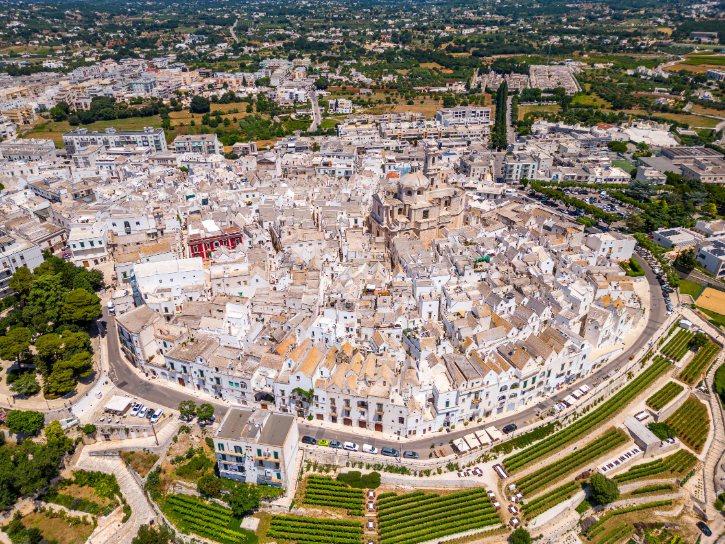
a. Why you should stop
Where Alberobello is rustic, Locorotondo is a serene, whitewashed circle on a hilltop, and it doubles as the panoramic balcony of the Valle d’Itria.
b. The circular town
- Its name means “round place”, and the medieval centre curls in concentric rings.
- The outer houses were built back-to-back as a continuous defensive wall.
- Because of this, the town has no central castle. The homes were the defense.
c. The cummerse
- The signature is the cummersa, a tall narrow house with a steep pointed gable.
- Grey limestone slabs shed rain quickly into shared cisterns.
- These sharp triangular roofs are exactly what set it apart from Alberobello.
d. The historic centre
Wandering here is a pleasure. You pass brilliant white walls, wrought-iron balconies, warm golden-stone doorways, and tiny alleys where external staircases climb to upper rooms. The main church, San Giorgio, anchors the skyline with its tall dome.
e. Views and wine
- The Villa Comunale gardens open onto wide valley views.
- Below spreads a patchwork of dry-stone walls, olive groves, and vineyards.
- The fields around produce a delicate local white wine.
7. Martina Franca
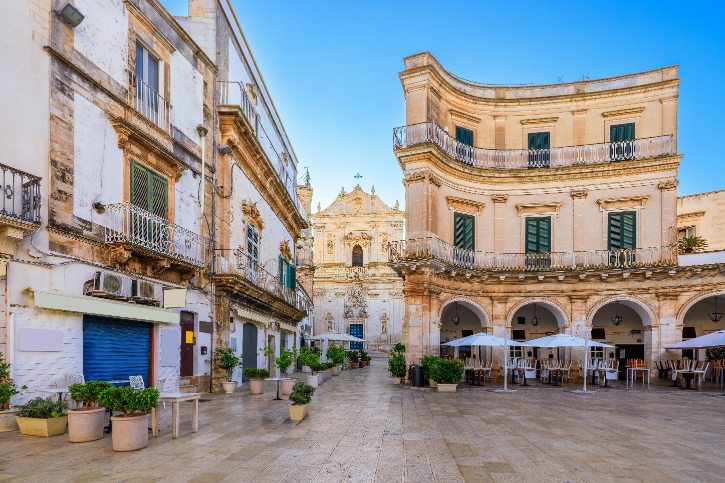
a. Why you should stop
Martina Franca is the grand, aristocratic face of the Valle d’Itria. This is no simple white village. Centuries of ducal rule left it with ornate golden Baroque palaces and theatrical squares.
b. Palazzo Ducale
- The 17th-century palace of the Caracciolo dukes opens the old town at Piazza Roma.
- Its upper floor keeps three grand halls frescoed with myths and biblical scenes.
- The courtyard and halls stay open for civic and cultural events.
c. Basilica di San Martino
The town’s great church rises over Piazza Plebiscito with a monumental facade in soft local stone. Its defining feature is a large carving above the door showing Saint Martin on horseback, cutting his cloak to share with a beggar. It is open, with no scaffolding.
d. Details to notice
- Deeply curved iron balconies, shaped to fit wide 18th-century dresses.
- Carved masks above doorways, meant to ward off bad luck.
- Golden stone framing windows and doors, set against plain white walls.
e. The opera festival
- Martina Franca hosts a famous summer opera festival, now well past its 50th edition.
- Rare bel canto works are staged in the palace courtyard and cloisters.
- It gives the town a living cultural identity to match its architecture.
8. Cisternino
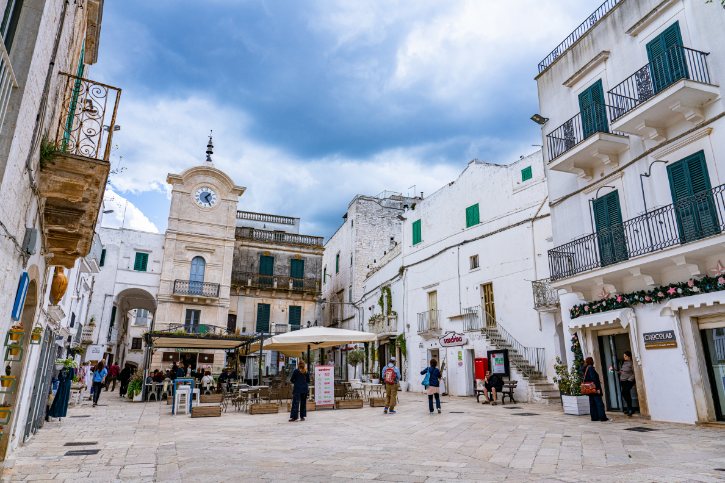
a. Why you should stop
Cisternino is an intimate hill town where the pleasure is in the spaces, not the monuments. It is one of Italy’s officially recognised most beautiful villages.
b. The old town
- It grew organically, without any master plan, shaped by daily needs.
- You will find covered archways, steep external staircases, and small courtyards.
- The brilliant white comes from thin coats of lime wash over porous stone.
- Look for iron hooks high in the walls, once used to haul grain to storage.
c. The main square
Piazza Vittorio Emanuele is the civic heart, framed by old palazzi and watched over by a clock tower. Nearby stands an older square medieval watchtower of Norman-Swabian origin.
d. Chiesa Madre di San Nicola
- Built in the 14th century atop a much older rock-cut crypt.
- Inside are two tender Renaissance stone sculptures from 1517.
- The church is fully open, with no scaffolding.
e. Views and food
The stone terraces open onto wide views across the valley’s farmland and olive groves. Cisternino is also known for its evening tradition of the fornelli pronti, butcher shops where you pick skewered meats and have them roasted over olive wood. The most famous are bombette, thin pork rolls stuffed with cheese.
9. Ostuni
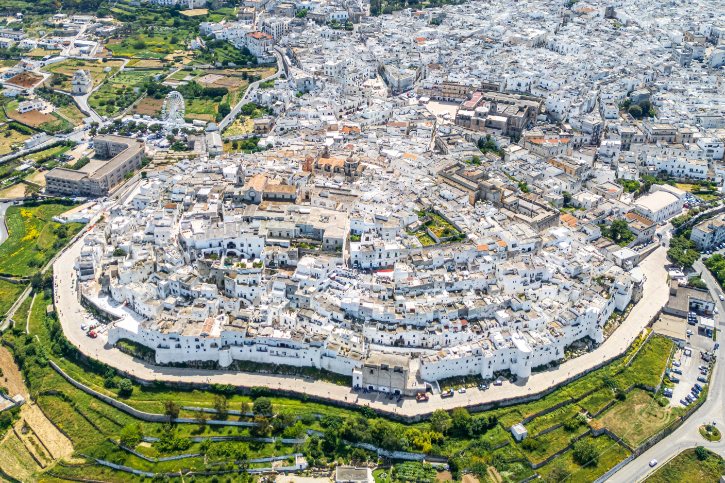
a. Why you should stop
Ostuni, “the White City”, has one of the most dramatic silhouettes in southern Italy. It crowns three hills as a bright white citadel above an endless plain of ancient olive trees running down to the Adriatic.
b. The lower squares
- Piazza della Libertà is the threshold between the modern and medieval town.
- The tall Baroque Guglia di Sant’Oronzo spire rises here, free of scaffolding.
- The citizens raised it in thanks for surviving the plagues.
c. The climb up
You reach the top along Via Cattedrale, a winding stone spine past palazzi and whitewashed arches. Watch for dead-end alleys that once trapped invaders. Near the summit you pass under the Arco Scoppa, a bridge-like loggia inspired by the Bridge of Sighs in Venice.
d. The cathedral
- Its most famous feature is a huge 24-ray rose window, one of the largest in Europe.
- The facade blends late Gothic and Romanesque, with a rare wavy roofline.
e. The olive plain
From the eastern bastions, look out over a protected landscape of monumental olive trees, many over a thousand years old, reaching all the way to the sea.
10. Ceglie Messapica
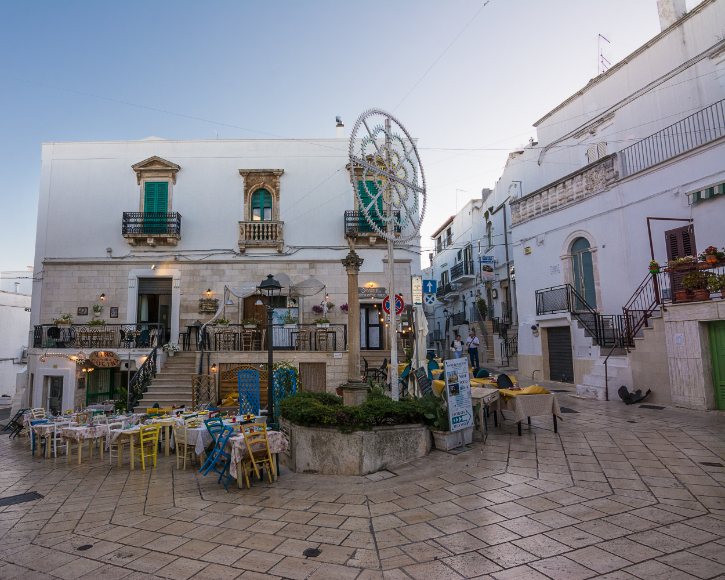
a. Why you should stop
Ceglie Messapica is a calm inland town whose value lies in its age. Settled more than two and a half thousand years ago, it is the archaeological threshold between the valley and the Salento plain.
b. Ancient roots
- Known in antiquity as Kailìa, it was a stronghold of the Messapians.
- It once allied with Oria and Brindisi against Spartan Taranto.
- Several streets still follow the alignment of the ancient defensive ditches.
c. Castello Ducale
- Its oldest part is a 34-meter square Norman tower.
- Later circular bastions were added for gunpowder warfare.
d. The main church
The Collegiata di Santa Maria Assunta was rebuilt in the late 18th century. Its Baroque interior includes ceiling frescoes, one of which shows an early painted view of Ceglie’s own skyline and castle towers.
e. The old centre
- Enter through medieval gateway arches into quiet stone lanes.
- The look is different from Ostuni, mixing grey limestone with honey-toned stone.
- Try the local Biscotto di Ceglie, an almond-and-honey pastry with Slow Food status.
11. Oria
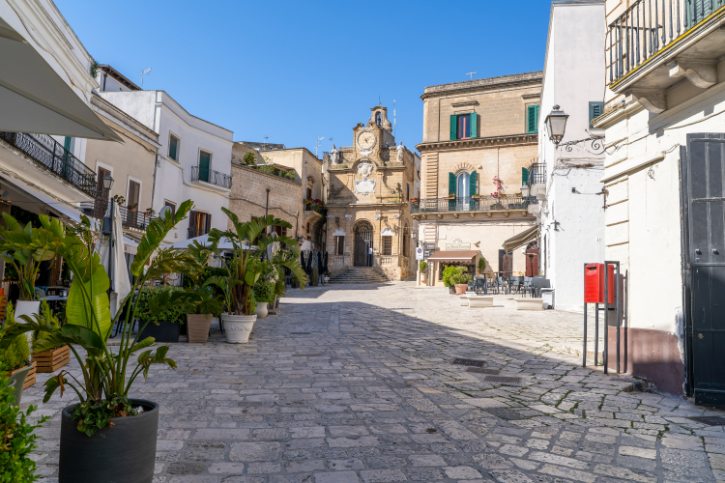
a. Why you should stop
Oria is a hilltop fortress town, and its identity is written in its skyline. A triangular castle rises above the plain, joined by a colourful cathedral and a former Jewish quarter.
b. Castello di Oria
- Its ground plan is a distinctive triangle, shaped like the bow of a ship.
- Three towers define it, one square, one round, and one sharp wedge.
c. The cathedral and crypt
The cathedral anchors the town with a colourful majolica-tiled dome in yellow, blue, and green, visible for miles. Beneath it lies the Crypt of the Mummies, where niches hold the preserved bodies of confraternity members in historic dress. Both are open on regular schedules.
d. The Jewish quarter
- Oria was a major centre of Jewish scholarship for centuries.
- You enter the old quarter through the stone Porta degli Ebrei.
- Its medieval layout of narrow lanes and courtyards survives.
e. The best viewpoint
- The Parco Montalbano sits directly beneath the castle ramparts.
- It gives clear, dramatic views straight up at the fortress towers.
- It is the perfect spot before wandering down into the old alleys.
12. Mesagne
a. Why you should stop
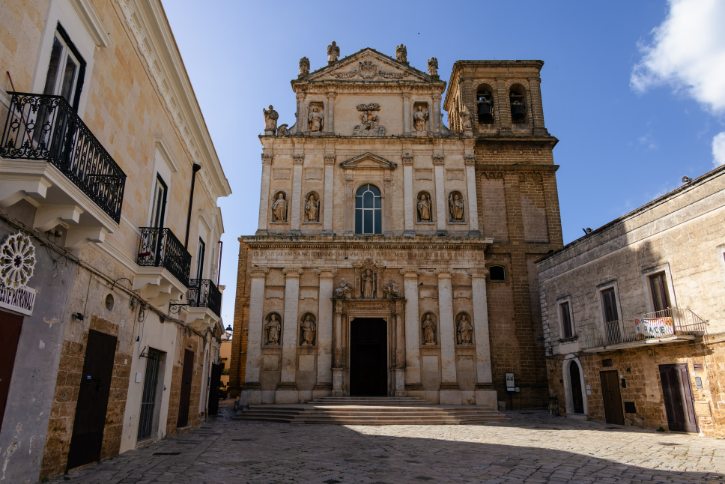
Mesagne offers one of the fullest encounters with Messapian civilization in southern Italy. Its historic centre is shaped, from above, like a heart, and it pairs a castle with an excellent museum, far from the crowds.
b. The castle and museum
- The Castello Normanno-Svevo is built around an 11th-century Norman keep.
- Inside is the MATER museum, holding Messapian and Roman finds.
- Both the castle and museum are fully open.
c. Treasures to look for
A few objects help you picture ancient Messapian society:
- An elite painted tomb from over two thousand years ago.
- The trozzella, a vase found only in women’s tombs as a status symbol.
- Carved stelae written in the Messapian language using a Greek-style alphabet.
d. Gates and squares
The grand Porta Grande is the ceremonial entrance to the centre, a soaring arch crowned by the town’s crest. The paved Piazza Orsini del Balzo is the civic core, framed by old churches and the ducal palace walls.
e. History underfoot
- In several squares, glass panels let you look down into excavated tombs.
- They show how the modern town sits directly over its ancient one.
- Street paving is clear and open throughout.
13. Lecce
a. Why you should stop
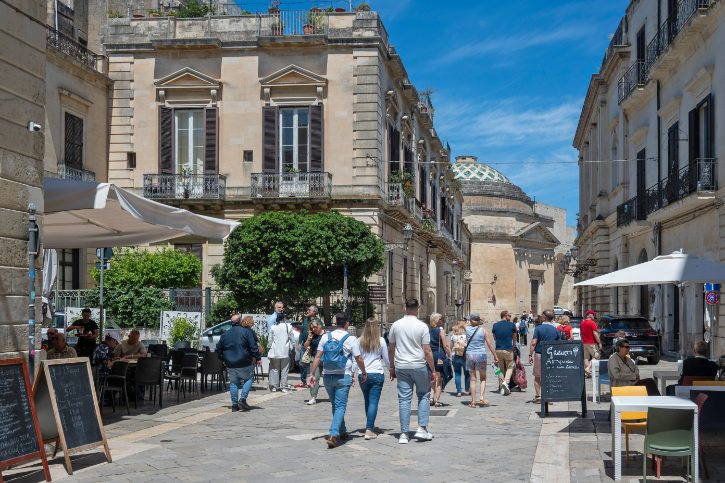
Lecce is the cultural capital of Salento, famous for its exuberant carved Baroque architecture. The secret is its stone, and once you understand the material, the whole city makes sense.
b. The magic stone
- Pietra leccese is soft when quarried, easy to carve like wood.
- In air and sunlight, it hardens and turns a warm, golden-honey colour.
- This is why carvers could cover facades in such dense detail.
c. Basilica di Santa Croce
- The masterpiece of Lecce Baroque, built over more than a century.
- Its facade rises in three tiers of beasts, figures, and a great rose window.
- Good news: its restoration is complete, and the cleaned carvings are fully unveiled.
d. The two great squares
Piazza del Duomo is a rare enclosed square that works like an open-air stage, holding the cathedral, bell tower, and palaces. Because you enter facing the cathedral’s side, the architect added a grand false facade so your first impression is still dramatic. Nearby, Piazza Sant’Oronzo centres on the Roman past.
e. Roman Lecce and crafts
- The partly excavated Roman amphitheatre once seated over 14,000 people.
- You take it in from the balustrades around the square, where new excavation and walkway works are ongoing.
- Look out for cartapesta, the local papier-mâché sculpture still made in workshops.
14. Nardò
a. Why you should stop
Nardò shows the concentrated side of Salento Baroque. Instead of spreading its treasures across a large city, it gathers them around one remarkable central square.
b. Piazza Salandra
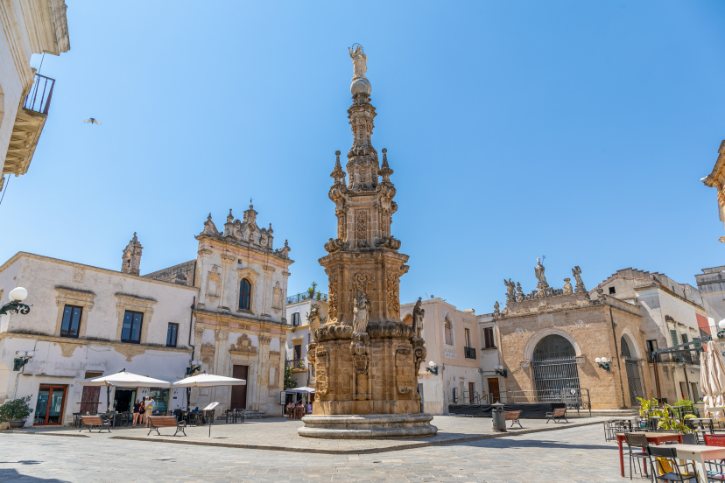
- One of the most harmonious public squares in southern Italy.
- Palaces, a spire, a loggia, and church facades form a single elegant scene.
- The square is fully open and still hosts community events.
c. The central spire
The Guglia dell’Immacolata rises at the centre, a slender Baroque spire raised in thanks for surviving a great earthquake.
d. Around the square
- Il Sedile, an open stone loggia, was once the town hall.
- The Fontana del Toro shows the bull that legend says founded the town.
- The Church of San Domenico dazzles with a facade of carved masks and figures.
e. The cathedral
Step into the cathedral for a complete change of mood. In place of Baroque drama, you find heavy Norman-Romanesque arches, medieval wall paintings, and a venerated old wooden Black Christ.
15. Gallipoli
a. Why you should stop
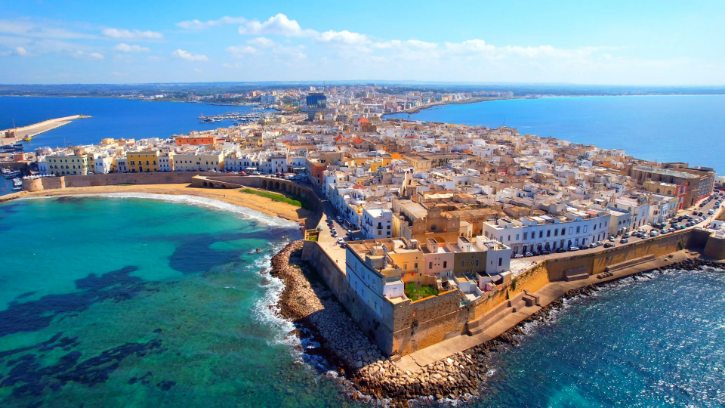
Gallipoli, whose name means “Beautiful City”, is a fortified old town almost surrounded by the Ionian Sea. Think of it as a historic island fortress first and a beach resort second.
b. The island old town
- The historic centre sits on a limestone island, joined by a 16th-century bridge.
- Whitewashed alleys twist through it and meet the sea on every side.
- The sea walls form an unbroken walking circuit around the island.
c. Castle and cathedral
- The Castello Angioino-Aragonese is a sea fortress ringed by water, fully open.
- At the highest point stands the Cathedral of Sant’Agata, carved in golden stone.
- A plain-looking church nearby, Santa Maria della Purità, hides a lavish tiled interior.
d. The underground mills
One of Gallipoli’s most fascinating layers lies below the streets. The city grew rich shipping lamp oil across Europe, and it pressed that oil in mills carved into the bedrock. The restored mill at Palazzo Granafei keeps its old presses and stables and runs guided visits.
e. Sand and sea
- A small beach, Spiaggia della Purità, tucks right beneath the bastion walls.
- The ramparts look out toward a lighthouse on a protected offshore island.
- Everything wraps tightly together in bright coastal light.
16. Galatina
a. Why you should stop
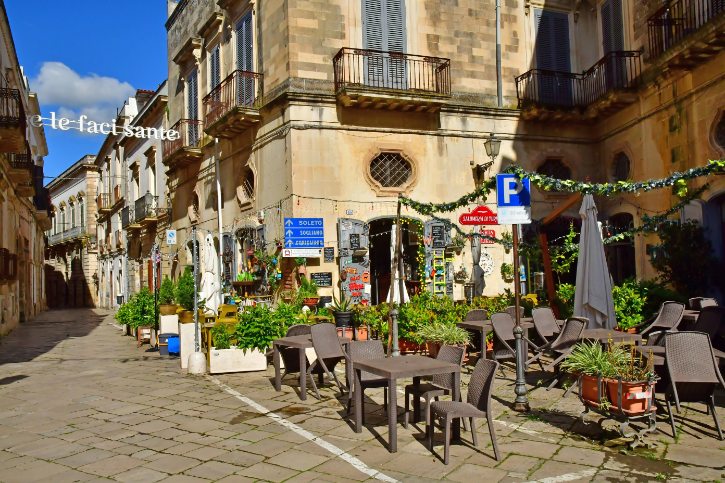
Galatina is a place of interiors and deep roots. It holds one of Europe’s finest medieval fresco cycles, and it is the historic home of an old healing ritual.
b. Basilica di Santa Caterina
- Founded by a powerful noble family and completed by a queen of Naples.
- Its plain exterior gives no hint of the colour inside.
- The frescoes and vaults are fully open, with no scaffolding.
c. The frescoes
Inside, three great vaulted bays form a visual encyclopedia of medieval art. You will find the drama of the Apocalypse, scenes from Genesis and the life of Christ, and the tombs and portraits of the founding family. Stepping from a sunlit street into this glowing interior is one of the most memorable moments on the whole route.
d. The tarantism tradition
- Galatina is the historic centre of tarantism, an old folk belief.
- Sufferers, mostly women, were thought to have been bitten by a spider.
- The cure was rapid, hypnotic music that let them dance to exhaustion.
- It is best understood as a cultural practice, not a medical fact.
e. A sweet stop
- Galatina is the birthplace of the pasticciotto, a warm cream-filled pastry.
- Around the summer patron feast, the town hosts folk music in the centre.
- Both the basilica and the chapel of Saint Paul are open.
17. Otranto
a. Why you should stop
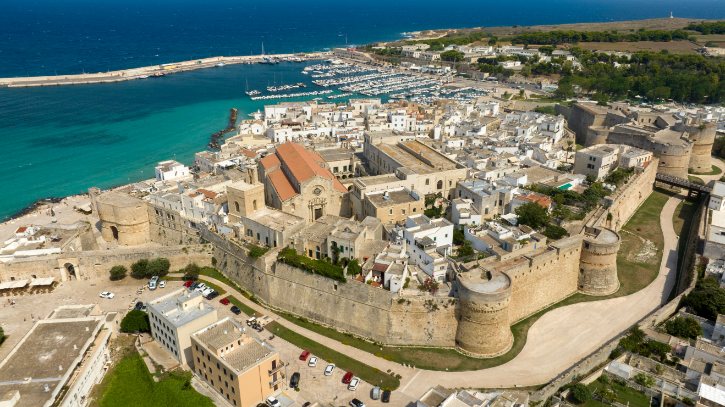
Otranto is the natural finale. Sitting where the Adriatic and Ionian meet, this easternmost Italian city ties together everything the journey has shown you: fortifications, medieval art, and a proud frontier identity.
b. Walls and castle
- You enter the old town through the fortified Porta Alfonsina.
- The pentagonal Castello Aragonese is ringed by a deep dry moat.
- Look for real Ottoman cannonballs embedded in its outer walls.
c. The cathedral mosaic
The cathedral holds the artistic climax of the whole route, a vast floor mosaic made by a monk named Pantaleone. It is far more than a “Tree of Life”. Across it you will find:
- Biblical scenes, from the Creation to the Tower of Babel.
- Classical figures, including Hercules and Alexander the Great.
- King Arthur, one of the earliest depictions of the legend in European art.
- A wild bestiary of unicorns, sirens, and griffins.
d. Crypt and martyrs
Below the cathedral is a forest-like crypt of 42 columns salvaged from ancient buildings. Nearby, the cathedral holds the relics of the Martyrs of Otranto, citizens killed after the Ottoman siege and later made saints. This is a solemn part of the town’s story, best approached quietly.
e. Good to know
- The cathedral and mosaic are fully open. A small fee applies to guided visits, while individual entry stays free.
- A waterfront regeneration is happening on the modern outer promenade only.
- It does not disrupt the historic centre or the cathedral.
Standing before the mosaic, you find the whole character of Puglia in stone: Eastern and Western, sacred and secular, ancient and medieval.
Looking back across the route, from Trani rising out of the sea to the trulli of the valley and the golden Baroque of Lecce, one thing becomes clear. Puglia is not a far-flung province but a compact, richly connected crossroads, where every short drive carries you into a completely different world.