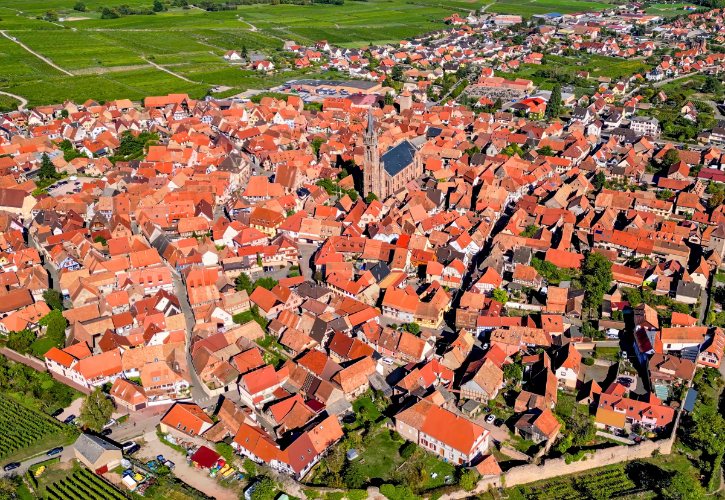
Heading south from Strasbourg toward Colmar is easier than you expect. Short, relaxed drives link every stop, so you glide from grand city stone into wine country, fortified villages, vineyard foothills, a mountain castle, quiet rivers, and finally the historic streets of the south.
The road keeps changing character, and each place opens a different side of Alsace. The drive itself becomes part of the pleasure. 😊
1. Strasbourg
a. Why it opens the trip
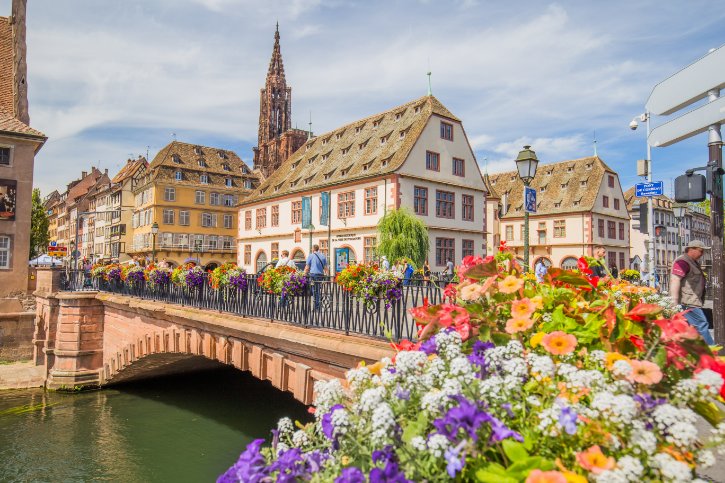
Strasbourg is the grand introduction to Alsace. Before the smaller wine towns, this is where the region shows its full, city-scale architecture. It sets the tone for everything that follows, from Gothic stone to canals and old fortifications.
b. Notre-Dame Cathedral
Start in front of the cathedral, one of Strasbourg’s defining landmarks. It rewards a slow look rather than a quick photo.
- Built between 1176 and 1439 from pink Vosges sandstone.
- You can read its history in the stone, from the older Romanesque choir to the soaring High Gothic western front.
- Its single north spire reaches 142 meters, once the tallest structure in the Christian world.
- On the western façade, study the triple portal, the carved Wise and Foolish Virgins, and the Tempter with toads and serpents crawling up his back.
- Notice the delicate outer screen of stone shafts pulled forward from the wall, which throws shifting shadows across the sandstone.
c. The Grande Île and Petite France
The cathedral sits at the heart of the Grande Île, the historic island wrapped by the River Ill and listed by UNESCO. Wander the narrow streets outward toward the water.
Petite France grew up around trade, and its buildings still show it.
- This was the working quarter for tanners, millers, and fishermen in the 16th and 17th centuries.
- Look for stone ground floors built to resist channel damp.
- Above them sit jettied timber-framed floors and steep roofs with open drying lofts for curing hides.
- The Maison des Tanneurs of 1572 is a classic example.
d. Ponts Couverts and Barrage Vauban
Follow Petite France west and you reach Strasbourg’s old defensive edge, a strong finish to an old-town walk.
- The Ponts Couverts are anchored by four square sandstone towers from the 1250s, once part of the city walls.
- The Barrage Vauban is a massive weir fortress built between 1686 and 1700, designed to flood the southern approaches during a siege.
- Climb its roof terrace for the best view. Looking east, the four towers frame the distant cathedral spire above the tiled roofs. Trust me, this is the shot worth waiting for.
e. Neustadt, if you have time
If you want to see how much variety Strasbourg holds, cross the Ill into the Neustadt, the planned German district. Its grand civic palaces around Place de la République feel large and formal. Set against the tight timber lanes of the island, they prove Alsace is far more than rustic half-timbering.
From this monumental cityscape, the road heads southwest toward the Vosges foothills, where the scale shrinks but the history stays rich.
Read More: Strasbourg Travel Guide: Best Things to Do, See, and Know Before You Visit
2. Molsheim
a. The surprise stop
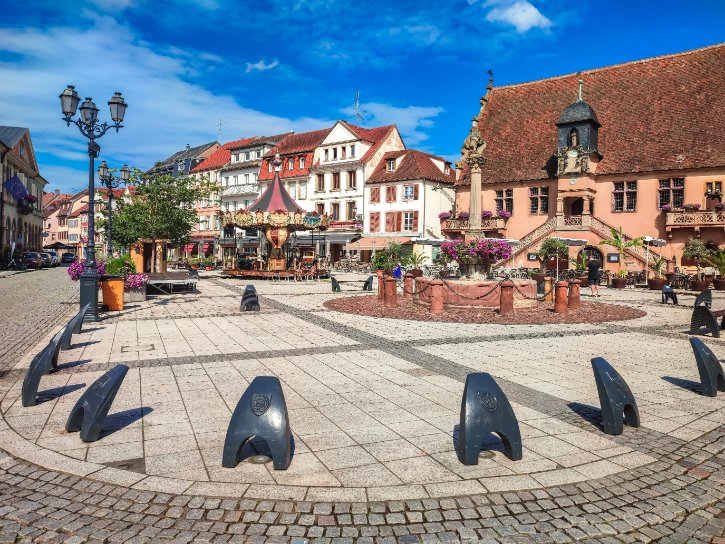
Molsheim is the surprise of the trip. It is not a smaller Strasbourg or a warm-up for Obernai. Its character comes from an unusual mix of religious heritage, civic pride, and the birthplace of Bugatti, all in one small town.
b. The Metzig and old center
Begin around Place de l’Hôtel de Ville and the Metzig, a Renaissance guildhall built in 1583 by the butchers’ corporation.
- A vaulted, open ground-floor arcade.
- An ornate double-flight stone staircase.
- An onion-domed turret over the main façade, holding the Jaquemart clock of 1607, where two carved angels strike the hours and quarter-hours.
c. The Jesuit Church and the Chartreuse
The Église des Jésuites shows how much religious power once gathered here.
- Built between 1615 and 1617 in the German Nachgotik, a deliberate late-Gothic revival.
- At 61 meters long, it is the largest religious building in Alsace after Strasbourg Cathedral.
- Look for the Saint Ignatius chapel, where early Baroque stucco hints at changing tastes.
The Chartreuse de Molsheim, a former Carthusian monastery, is a quieter experience.
- It sits unusually inside the town walls, an enclosed retreat within a busy center.
- You can see the cloister, prior’s lodging, and individual hermitage cells.
- Look for the guichet passe-plat, an angled opening through which solitary monks received food without seeing anyone.
d. The Bugatti connection
Molsheim’s second story is pure speed. In 1909, engineer Ettore Bugatti set up his workshops here, home to racing machines like the Type 35.
- An official 12-stage Bugatti discovery circuit runs through the town.
- You can visit the Hostellerie du Pur Sang, once used to host racing drivers.
- Parc des Jésuites holds a life-size bronze of Ettore Bugatti and a bronze Type 35.
- The Musée de la Chartreuse keeps automotive artifacts and original drawings.
- The modern Bugatti factory and headquarters are private and closed to the public.
e. Planning the Chartreuse
The Chartreuse museum and cloister are seasonal, open afternoons in the warmer months. Long-running masonry conservation can shift the internal visitor route, so it is worth checking current arrangements before you arrive.
Leaving Molsheim’s cloisters and racing history, the road runs south along the base of Mount Sainte-Odile toward broad squares and defensive walls.
3. Obernai
a. The civic heart
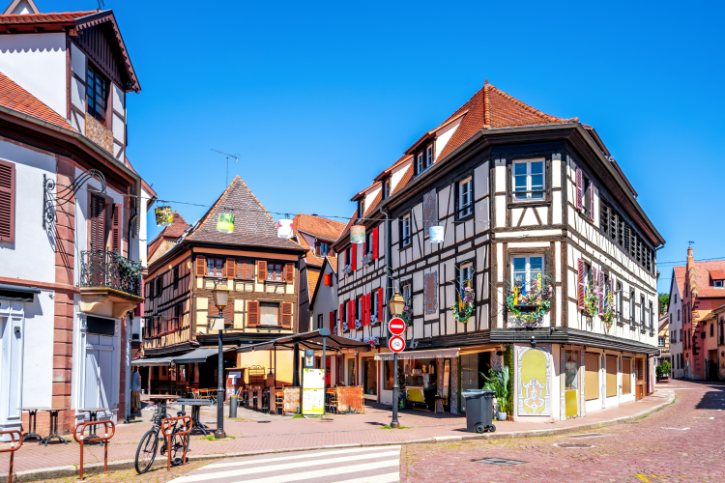
Obernai is the civic heart of the route. It is easy to admire the colorful façades, but the real story is in its public spaces. The market square, the belfry, the well, the church, and the old ramparts show how a prosperous market town was run.
b. Place du Marché and the Kappelturm
Start at Place du Marché, once the political and financial hub of the community. It still feels like the natural gathering point.
The Kappelturm, or Chapel Tower, anchors the square.
- It rises about 60 meters above the rooftops.
- It began in the late 13th century as a fortified chapel belfry.
- The chapel nave was demolished in 1573 to expand the market.
- In 1596 the tower was raised and topped with a Renaissance lantern and openwork spire, becoming the town watchtower.
c. The Six-Bucket Well
A few steps away stands the Puits à Six Seaux, far more than a simple well.
- Carved in 1579 by a guild of Strasbourg stonemasons.
- An octagonal sandstone tank supports three Corinthian columns and a carved canopy.
- Beneath hang three double pulleys holding six iron-strapped oak buckets.
- The stonework carries Renaissance detail and Latin verses.
Many visitors walk straight past it, so slow down and look closely.
d. Church and ramparts
To the west, the Church of Saints-Pierre-et-Paul dominates the skyline. Built in Vosges sandstone in the Neo-Gothic style, it keeps a late-Gothic Holy Sepulchre from 1504 and a symphonic organ by Joseph Merklin from 1882.
Obernai also wears a double ring of medieval walls, running for roughly 1.4 kilometers.
- Well-preserved stretches survive along Rempart Monseigneur Freppel and Rempart Maréchal Foch.
- These keep corbels, gun loops, and round defensive towers.
- The tree-lined outer promenade is an easy, pleasant walk.
e. What to notice
Look for the layered structure of a real medieval town.
- The Kappelturm rising over the center.
- Renaissance carving at the Six-Bucket Well.
- The shift from tight central streets to the open defensive edge.
Note that town-center upgrade works may cause occasional short detours, but the ramparts and promenade stay open and walkable.
From Obernai’s polished squares, the road drops into quieter country, where the line between town and vineyard nearly disappears.
4. Dambach-la-Ville
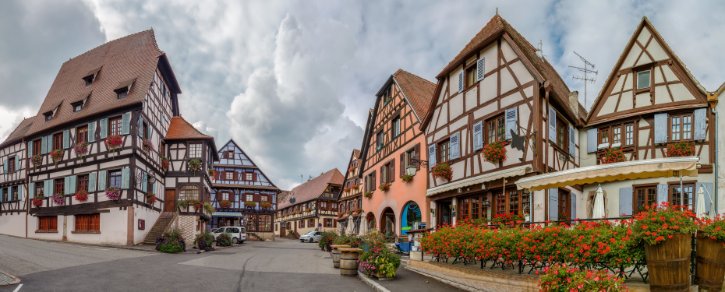
a. Where wine meets walls
Dambach-la-Ville is the first stop where a fortified town and its vineyards feel completely braided together. It has a different rhythm from Obernai, more agricultural and more open at the edges.
b. The old town
Dambach grew as a fortified wine town under the Prince-Bishops of Strasbourg, who fortified it in the early 14th century to protect their vineyard income.
- Three surviving 14th-century gate towers: the Porte de Blienschwiller, the Porte de Dieffenthal, and the Porte d’Ebersheim.
- The Porte de Blienschwiller is a textbook of local design, with a pointed sandstone arch in thick granite, a timber guardhouse, and storks nesting on top.
- The narrow, tall half-timbered Maison Sermonnet, also called the Clog Maker’s House, dates from 1686.
- Carved lintels above courtyard gates show guild emblems like coopers’ adzes and pruning billhooks.
c. Chapelle Saint-Sébastien
Above the vineyards sits the Chapelle Saint-Sébastien, at about 257 meters.
- It once served a vanished medieval village called Oberkirch.
- It blends a 12th-century Romanesque choir tower with a 15th-century Gothic
- Inside is a carved linden-wood Baroque high altar from 1690.
- An arched ossuary in the eastern wall holds remains from the old village cemetery.
Approach interior visits with realistic expectations, since the inside is usually locked and access is limited. The outdoor terrace, though, stays open, with a wide view over the roofs toward the Black Forest.
d. Grand Cru Frankstein
Rising right behind the western wall are the granite slopes of the Grand Cru Frankstein.
- Steep, south-facing slopes between about 220 and 330 meters.
- Fast-draining, mineral-rich granite soils force vine roots deep into the rock.
- This gives the Riesling and Gewurztraminer their tension and flinty character.
e. What makes it different
You do not need to be a wine expert to enjoy this. Just notice how the vineyards climb straight up from the town walls, part of the same living landscape. Walls give way to vines, and gateways open onto open country.
Now the road changes gear completely, climbing into the Vosges toward a fortress on a mountain.
5. Château du Haut-Kœnigsbourg
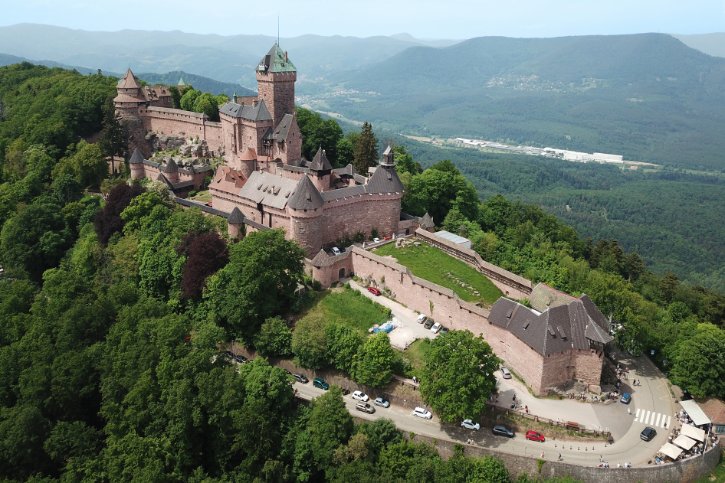
a. The high point of the trip
This is the crescendo of the drive, in every sense. After all the town gates and ramparts, you reach a full mountain fortress commanding the plain. The setting, the defenses, and the sweeping views make this the dramatic centerpiece.
b. The approach and exterior
The château sits 757 meters up on a rocky pink sandstone spur.
- Founded in the 12th century by the Hohenstaufen dynasty to guard a key Vosges pass.
- Later refortified in the 15th century for heavy artillery.
- Swedish forces besieged and burned it in 1633, and it stood as a ruin for over 250 years.
- As you climb, notice how the walls and towers follow the natural rock.
c. Moving through the fortress
The visit unfolds as a sequence of defensive spaces rather than a list of rooms.
- The Lower Courtyard, once full of stables, a smithy, and the mill.
- The Lions’ Gate barbican, with a rock-cut ditch and drawbridge to trap attackers.
- The Inner Courtyard, built over the rock, with an open hexagonal spiral staircase.
- The residential apartments, including the weapons hall and the frescoed Imperial Hall.
- The Grand Bastion, a huge horseshoe-shaped artillery platform at the western tip.
d. The restoration story
Here is something important to understand before you go. What you see is not an untouched medieval castle.
- In 1899 the ruin was given to German Emperor Wilhelm II.
- Between 1900 and 1908, architect Bodo Ebhardt led a full restoration.
- Where evidence survived, he rebuilt with archaeological precision. Where it did not, he designed careful reconstructions.
- The result is both a real late-medieval fortress and a monument of early 20th-century restoration.
Knowing this makes the visit richer, not less impressive.
e. The views
From the Grand Bastion, the panorama is the reward. On a clear day you can see across the Upper Rhine Plain to the Kaiserstuhl and the distant Black Forest, with the Vosges ridges running south. Views depend on the weather, so a hazy day may hide the far horizon.
After the vast fortress, the road winds back down toward defense at a human, village scale.
6. Bergheim
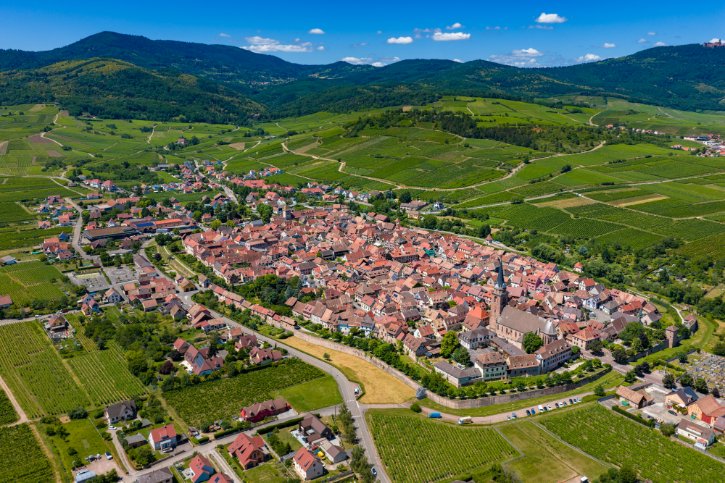
a. A quieter, thoughtful stop
Bergheim is calm and reflective, and it does not blend into its wine-village neighbors. Its two strong themes are an almost complete ring of walls and a sobering chapter of local history.
b. The ramparts
Bergheim’s great feature is that it kept its walls when most towns tore theirs down.
- The circuit was built between 1311 and 1312 and reinforced later.
- A signed path, the Promenade des Remparts, follows the outer perimeter.
- Because both walls survive, you can trace the ditch, the lower outer wall, and the tall inner wall together.
- The belt keeps nine towers, including the Powder Tower and the Witches’ Tower.
- The main entry is the 14th-century Porte Haute, with a pointed arch, portcullis channels, and a painted sundial.
c. The Maison des Sorcières
Bergheim holds a serious museum, the Maison des Sorcières, set in a 16th-century timber house.
- It examines the witch trials held in the area between 1582 and 1683.
- Around 40 people, nearly all local women, were tried and burned at the stake here.
- The trials peaked in 1630 during the hardship of the Thirty Years’ War.
- The exhibition lays out the legal machinery behind the persecution without sensationalism.
This is real human tragedy, not a gimmick, and the museum treats it with the seriousness it deserves.
d. What to notice
As you walk, the contrast is immediate. Inside the walls sit timber houses and gardens. Outside, the vineyards of the Grand Cru Altenberg climb the sunny slopes. Gates, towers, and houses all sit within the old defensive footprint.
e. A practical note
The ramparts, gate towers, and vineyard paths are open every day. The museum runs on a limited seasonal schedule, so treat it as an optional deeper experience. Even if it is closed, the walls and views make the stop worthwhile on their own.
Leaving Bergheim’s quiet enclosure, a short drive brings you to a livelier town framed by three ruined castles.
7. Ribeauvillé
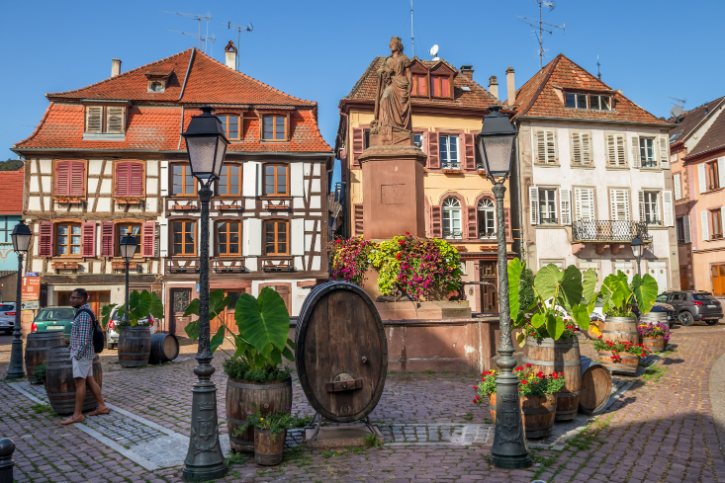
a. The castle-backdrop town
Ribeauvillé’s charm comes from the relationship between a long, animated main street and three ruined fortresses on the heights above. Look up often here, because the skyline is part of the experience.
b. The Grand’Rue
The spine of the town is the Grand’Rue, stretching more than a kilometer along the valley.
- Place de la Sinne, anchored by a fountain from 1536, once the focus of trading and fairs.
- The Hôtel de Ville, which keeps silver goblets gifted by the Ribeaupierre lords.
- The Pfifferhüs at No. 14, dated 1663, once the guildhall of the region’s minstrels.
c. The Tour des Bouchers
Midway along the street stands the Tour des Bouchers, the Butchers’ Tower.
- Built around 1290 and raised higher in 1536.
- This 29-meter gate tower once divided the middle town from the older upper town.
- It served as a fortified barrier and bell tower, with a portcullis and arched passage.
- It took its name from the nearby butchers’ stalls.
Do not plan to climb it on a normal day, since the interior is closed except for special heritage occasions.
d. The three castles
From almost any open spot along the street, look northwest to the ridge.
- Saint-Ulrich, the main baronial residence, with Romanesque apartments and a Knight’s Hall.
- Girsberg, clinging to a sheer granite needle, with a pentagonal keep.
- Haut-Ribeaupierre, on the highest summit at 642 meters, with a cylindrical keep in beech forest.
e. Walk or admire from below
Here is a useful distinction for a road trip. Reaching all three on foot is a strenuous walk of about 2.5 to 3 hours over roughly 6 kilometers. For most travelers, the castles are best enjoyed as a dramatic backdrop from the streets. Save the full climb only if you have set aside a half day for hiking.
From Ribeauvillé’s open valley, the road winds into a tighter town where you can read the defenses right in the streets.
8. Riquewihr
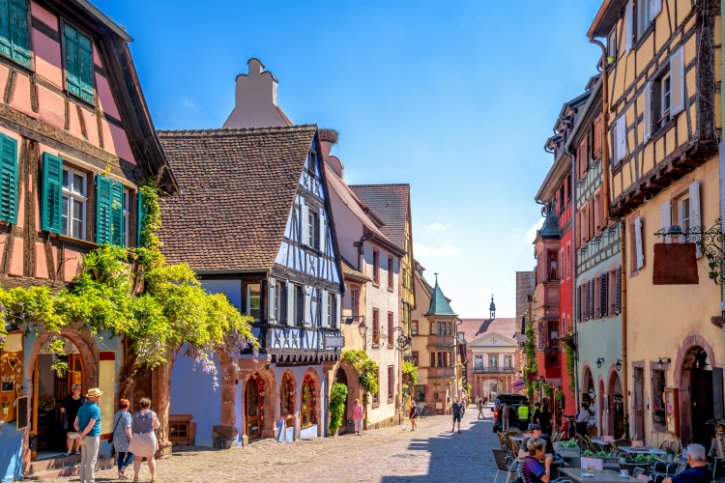
a. More than a pretty village
Riquewihr is more than one of Alsace’s prettiest villages. See it as a lesson in how a walled wine town actually worked, from its towers and gates to its merchant houses.
b. The main street
The village is built around a single climbing street. Look past the bright façades to the signs of wine wealth.
- Wide carved carriage entrances built to admit heavy grape carts.
- Vaulted cellars beneath the houses, kept cool for fermentation.
- Stone oriel windows jutting from upper floors, where merchant families watched the street.
c. The Dolder
At the top of the street stands Le Dolder, the signature fortified belfry gate, built in 1291 and rising 25 meters. It has two very different faces.
- The outer western face is plain and heavy, pierced only by narrow arrow slits.
- The inner eastern face opens into a charming five-tiered half-timbered front with a gallery, clock, and alarm bell.
- Inside, the upper floors hold a small museum of civic defense.
d. The Tour des Voleurs
A short walk along the inner ramparts leads to the Tour des Voleurs, the Thieves’ Tower, built in 1550 on a pentagonal plan.
- It was the seigniorial prison and the seat of justice.
- Inside is a preserved 16th-century interrogation chamber.
- The oubliette is a deep pit into which prisoners were lowered by rope.
- An adjoining winemaker’s house shows the gap between daily work and harsh justice.
e. Reading the streets
Even without going inside, the streets tell the story. Notice the line of the walls and gates, the narrow building plots squeezed inside, and the timber-framed upper stories stacked for space. The outdoor streets are open all year, while the two tower museums run seasonally, so do not count on entering them in the colder months.
From Riquewihr’s enclosed streets, the landscape opens again toward a town built around a river.
9. Kaysersberg
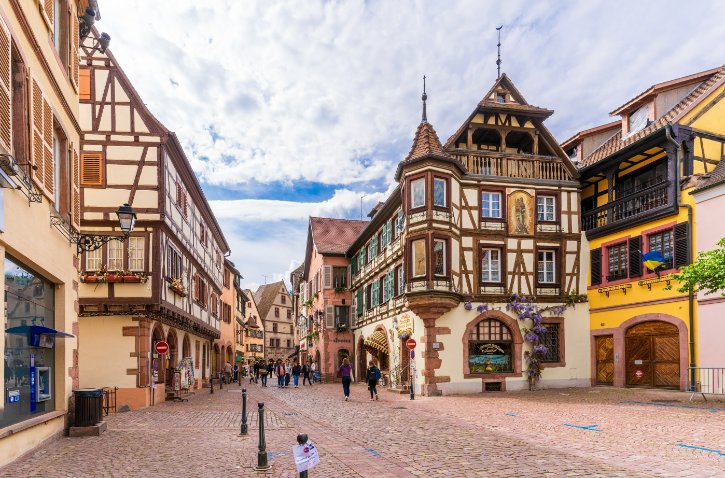
a. The river and castle town
Kaysersberg brings moving water into the journey. Set where the Weiss River leaves the mountains, it grew as an imperial town guarding a trade route. Its bridge, houses, church, and hilltop castle stack into one of the most layered views on the drive.
b. The fortified bridge
The heart of town is the Pont Fortifié, thrown across the Weiss in 1514.
- Built of pink Vosges sandstone, with wide arches for spring snowmelt.
- Its parapets carry gun-ports for defense.
- At its center sits a covered chapel with an 18th-century statue of the Virgin Mary.
- Solid half-timbered merchant houses, like the Maison Badhus of 1600, line the banks.
Pause on the bridge and look both ways along the river. It is one of the best spots in town.
c. The historic center and church
Just east of the bridge, the old center clusters along the main street, dominated by the Église Sainte-Croix.
- Construction began around 1230, with a Romanesque western portal.
- Inside the Gothic nave is a carved wooden altarpiece from 1518 by Hans Bongart of Colmar.
- Facing the church is the Renaissance Hôtel de Ville of 1604.
d. The imperial castle
Rising 50 meters above the roofs is the Château de Kaysersberg, established around 1220 to control the trade route.
- The main survivor is a cylindrical keep, 11.4 meters across with walls over 4 meters thick.
- It is one of the oldest round keeps in Alsace.
- A triangular wedge wall was added on its exposed side to deflect siege fire.
e. The optional climb
The climb is an optional but rewarding extension.
- A stairway and vineyard trail leave from behind the Hôtel de Ville, climbing in 15 to 20 minutes.
- The ruins and the internal staircase are freely open all year.
- From the top you get a full view of the river cutting through the roofs, framed by the church spire and vineyards.
From Kaysersberg’s riverside, the road follows the valley to a town where old defenses stay part of a living tradition.
10. Turckheim
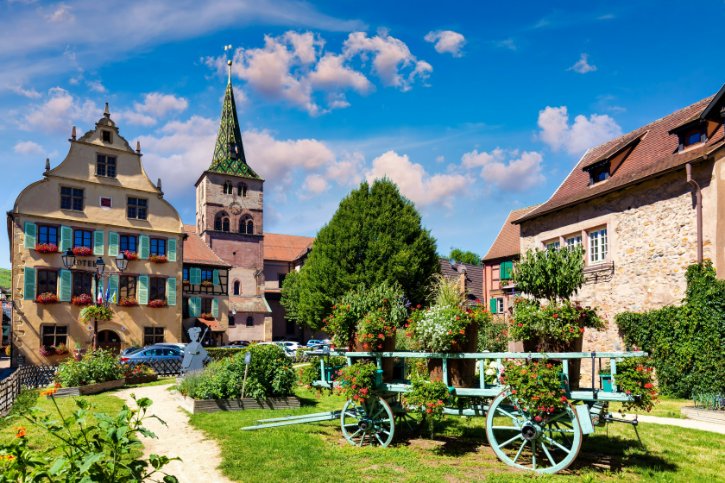
a. The living-tradition stop
Turckheim’s medieval gates and streets set the stage, but the real experience is its night watchman, a custom kept alive for real. It is a place that comes into its own after dark.
b. The Porte de France
Enter through the Porte de France, the lower gate dating to 1330, which faced the plain and once carried the town’s main trade route.
- Built of pink sandstone with a hipped roof and storks’ nests.
- It still keeps its portcullis grooves and massive oak hinges.
Standing under it, it is easy to imagine arriving at a fortified town centuries ago.
c. The other gates
Turckheim keeps three main gate towers, each marking a stage of its defenses.
- Porte de France, the lower gate toward the plain, the town’s main entrance.
- Porte de Munster, toward the Munster valley, through which condemned prisoners were once led out to execution.
- Porte du Brand, named for the Brand vineyard it faced, the most heavily built gate, with a well-preserved moat.
d. The historic center
Inside the Porte de France lies Place Turenne, centered on the 16th-century Corps de Garde, the guardhouse. It once served the town watch and the winegrowers’ guild. The small squares and streets between the gates are worth a relaxed wander, but the gates and the watchman remain the main draw.
e. The night watchman
Turckheim’s signature experience is its Veilleur de Nuit, revived continuously since 1953 and still active.
- Night watchmen once checked for fires and enforced the evening curfew.
- Turckheim is one of very few towns in Western Europe to keep this as a genuine ritual.
- Dressed in a black cloak and tricorn hat, and carrying a halberd, lantern, and horn, he leads visitors through the unlit lanes.
- At key corners he stops to sing the old rhyming verse in the Alsatian dialect.
- The round runs nightly in the warmer months, is free, and needs no booking.
For history lovers, Turckheim also has a small memorial museum about the fierce winter fighting to clear the Colmar Pocket in the mid-1940s.
From Turckheim’s straight old streets, the next village turns everything in circles.
11. Eguisheim
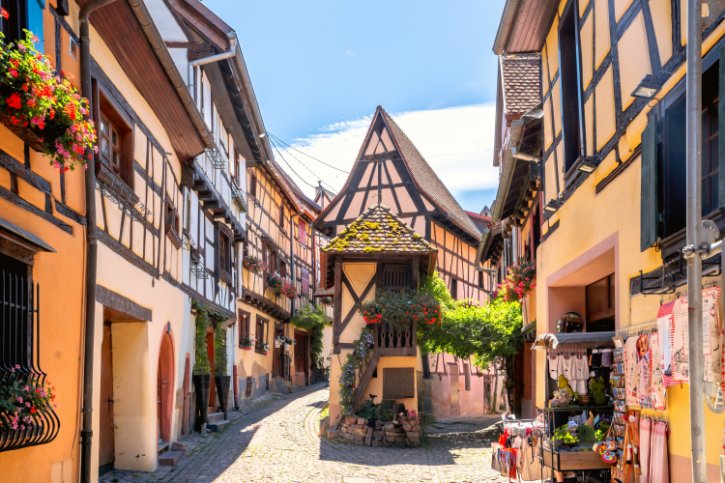
a. A village built in rings
Eguisheim is best understood through its shape. Forget the flowers and fairytale labels for a moment. The magic is the concentric street plan that grew around a central castle, one of the most unusual layouts in Alsace.
b. The castle core
Start at Place Saint-Léon, built on the site of an 8th-century castle. From this family came Bruno of Eguisheim, born here in 1002, who became Pope Leo IX.
- The Saint-Léon Fountain of 1834 is crowned by a statue of the pope.
- The Chapelle Saint-Léon stands over the foundations of the old castle keep.
- Inside are vivid frescoes showing scenes from the life of Leo IX.
c. The circular streets
From this core, the village spreads outward in rings. Because space was tight, ordinary artisans built their homes directly against the inner face of the outer wall.
Walk the outer ring and the street curves constantly, hiding what comes next and revealing fresh views at every step.
d. Details to watch
Slow down and look closely as you walk.
- Jettied upper stories leaning out over the narrow lanes to gain space.
- Carved sandstone door lintels recording dates, couples’ initials, and trade emblems.
- Le Pigeonnier, a slim half-timbered house on a tapering plot, an icon of local carpentry.
e. What the layout tells you
The curving zones map the town’s growth, from the open castle core to the tight outer ring built into the wall line. Following the curves is the whole point, so let yourself get pleasantly turned around. The historic core is fully pedestrianized and free to explore.
From Eguisheim’s tight circles, the road runs the short distance into Colmar, where the whole journey comes together.
12. Colmar
a. The grand finale
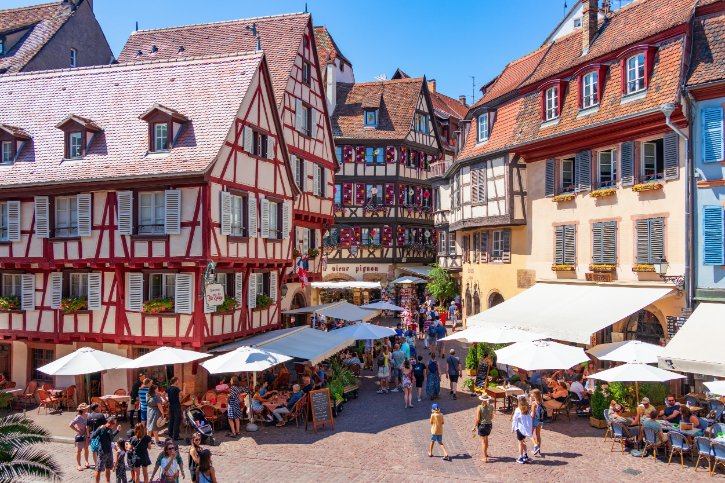
Colmar deserves more than a quick look at Little Venice. This is where the themes of the whole drive reunite: canals, timber framing, medieval streets, Renaissance merchant houses, and Gothic stone. It feels like a summary of everything you have seen.
b. Little Venice and the Tanners’ district
Begin at Little Venice, where the Lauch River enters the southern quarters.
- Once a market-gardening and boatmen’s quarter, where farmers brought vegetables by flat-bottomed boat.
- The neighboring Quai de la Poissonnerie housed fishermen in tall painted riverside houses.
- North along the canal, the Quartier des Tanneurs holds some of the tallest timber buildings in Alsace.
- Their wide open drying lofts under steep roofs once caught the wind for drying leather.
The canals are lovely, but they were working waterways first, and that history gives them depth.
c. The Koïfhus and merchant houses
The civic heart is Place de l’Ancienne Douane, dominated by the Koïfhus, the Old Customs House, completed in 1480.
- Its ground floor was a vast warehouse where officials taxed and inspected goods.
- Its upper floor held the meeting chamber of the Décapole, the league of ten free cities.
- Along the Rue des Marchands, the Maison Pfister of 1537 marks the shift to German Renaissance homes, with a corner oriel and painted murals.
- On the Rue des Têtes, the Maison des Têtes of 1609 carries 106 sculpted stone masks and grotesque heads.
d. Saint-Martin Church
The spiritual center is the Collégiale Saint-Martin, built between 1235 and 1365 in warm sandstone.
- Its scale leads locals to call it the Cathedral.
- Look for the Saint-Nicolas Portal, the high Gothic choir, and the old stained glass.
- A fire in 1572 destroyed the original spire, and since then the tower has carried a distinctive Renaissance crown above its roof of colored glazed tiles.
Standing here, remember Strasbourg’s cathedral at the very start. Saint-Martin echoes it and closes the journey with a real sense of continuity.
e. An optional cultural end
If you have extra time, the Musée Unterlinden is a fine way to finish. It sits in a 13th-century Dominican cloister and holds the Isenheim Altarpiece, a masterpiece of Northern Renaissance art. The permanent collection is open through the year.