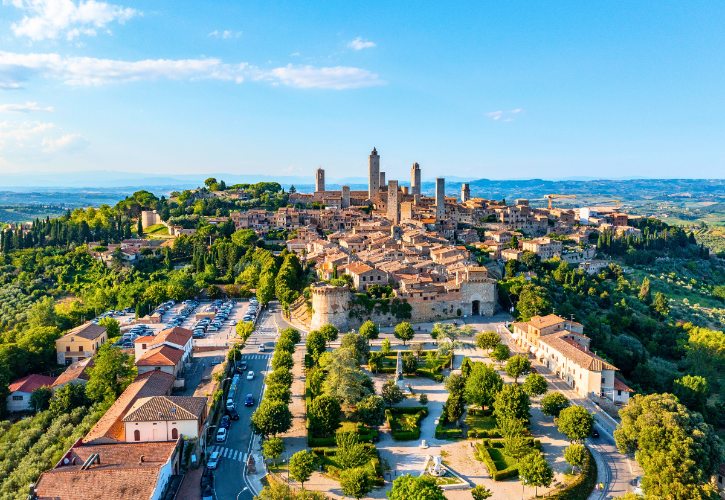
You do not need a complicated plan to fall in love with central Tuscany. The distances are short, the roads are easy, and the scenery keeps shifting just when you want it to.
One stretch gives you Renaissance domes and grand squares, the next gives you vineyards, medieval towns, fortified villages, and the golden hills of the Val d’Orcia.
The real joy is how naturally one experience leads into the next, so you are never chasing sights. You are simply following the rhythm of the road. 😊
1. Florence
a. Why you start here
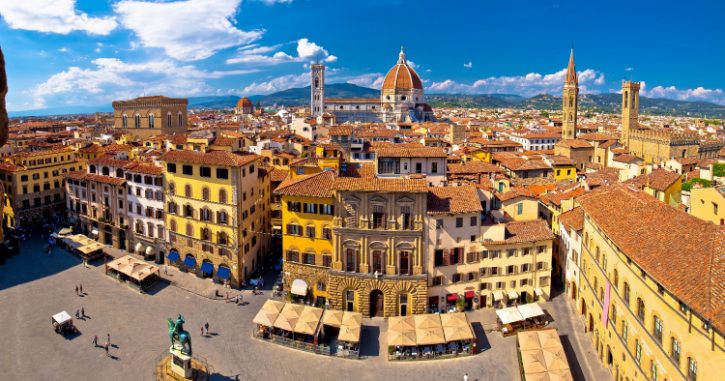
Florence sets the tone for everything that follows, with monumental architecture, deep civic history, and world-class art all curved around the Arno. Begin here, and the journey only grows smaller, quieter, and more rural from this point on.
b. The Piazza del Duomo complex
This square rewards slow looking. Focus on four things:
- Cathedral of Santa Maria del Fiore, begun in 1296, the anchor of the group.
- Brunelleschi’s dome, raised between 1420 and 1436 with no wooden supports, using self-carrying herringbone brickwork.
- Giotto’s Campanile, about 84.7 meters tall, banded in white, green, and pink marble.
- Baptistery of San Giovanni, famous for Ghiberti’s gilded bronze doors, the Gates of Paradise.
c. Squares, bridges, and the Arno
A short walk brings you to the civic heart of the old republic:
- Piazza della Signoria, dominated by the fortified Palazzo Vecchio and its tall tower.
- The Ponte Vecchio, the city’s oldest bridge, rebuilt in 1345.
- Its shops once held butchers, until Grand Duke Ferdinando I banned them in 1593 and brought in the goldsmiths still there today.
d. Choosing your museum and neighborhood
You do not need to see everything. Pick what fits you:
- Uffizi Gallery for the sweep of Italian painting.
- Accademia for Michelangelo’s David.
- Bargello for quieter sculpture by Donatello and Verrocchio.
- Palazzo Pitti for grand living and the Boboli Gardens.
- The Oltrarno, across the river, where artisans still fill the lanes of San Frediano, Santo Spirito, and San Niccolò.
e. The view that ties it together
- Climb to Piazzale Michelangelo, laid out in 1869 by Giuseppe Poggi.
- From here you see the whole city at once: the terracotta dome, the tower of Palazzo Vecchio, and the ribbon of the Arno.
- Those red roof tiles were not made in Florence. They came from the kilns to the south, which leads you straight to Impruneta.
Read More: The Perfect Florence Walking Route to Explore the City’s Best Sights in One Day
2. Impruneta
a. The home of Tuscan clay
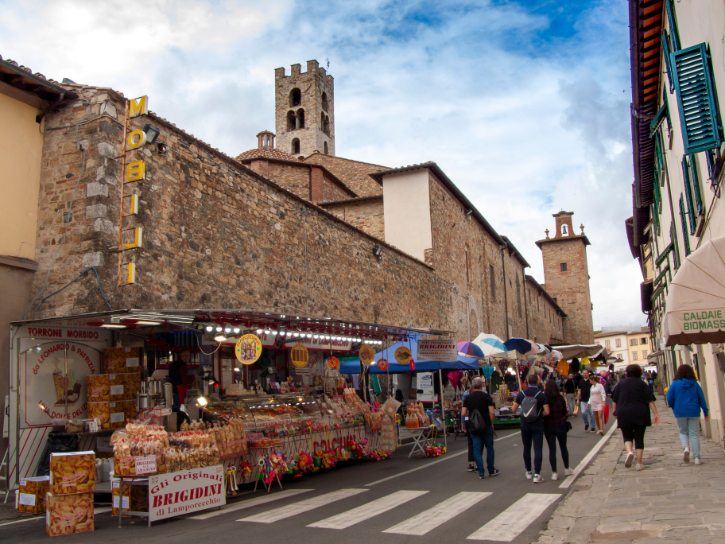
Impruneta is where you meet the raw material behind Tuscany’s look. It sits on rich galestro clay, which fires into a tough, frost-resistant terracotta called cotto imprunetino that has shaped roof tiles, planters, and oil jars for over seven centuries. This is the source, not just another pretty town.
b. The square and the basilica
Start in the center and look for these:
- Piazza Buondelmonti, a long market square with a 15th-century pilgrim portico.
- Basilica di Santa Maria all’Impruneta, founded in 1060 and restored after 1944 bomb damage.
- Two Renaissance marble shrines by Michelozzo, with glazed terracotta reliefs by Luca and Andrea della Robbia.
- The Museo del Tesoro, holding manuscripts, gold reliquaries, and liturgical silver.
c. Seeing how terracotta was made
Head to the Antica Fornace Agresti on Via delle Fornaci to understand the craft:
- Built in the early 19th century into the hillside.
- It still holds its clay basins, wooden molds, drying galleries, and two large underground kilns.
- It no longer produces terracotta, but works today as a civic exhibition space that walks you through the old hands-on process.
d. Peposo, the kiln workers’ dish
Keep the history of this peppery beef stew in three clear layers:
- The legend. A popular story credits the architect Brunelleschi with cooking it in the kilns for his dome workers, though there is no solid proof he did.
- The verified tradition. Kiln workers really did braise tough beef in red wine, garlic, and black pepper overnight in the residual kiln heat.
- The modern rule. An official local standard now requires Tuscan beef, red wine, and peppercorns, and bans tomato.
e. What comes next
As the kiln smoke fades, the road drops into the green valley of Chianti Classico, and vineyards take over as you reach Greve.
3. Greve in Chianti
a. The market town of Chianti
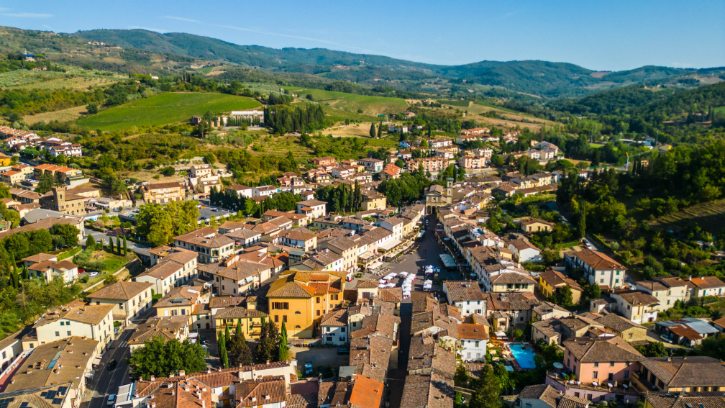
Greve is the everyday, commercial side of Chianti. It grew on the valley floor as an open market town serving the castles in the hills, so shops, food, and wine are woven into daily life here, not just a tasting stop.
b. Piazza Matteotti at a glance
The town’s signature is its unusual funnel-shaped triangular square:
- Deep, uneven porticoes run along the edges on thick stone pillars.
- Farmers and winemakers once traded here in any weather.
- Today the walkways hold butchers, wine merchants, basket makers, and copper workers.
- A 19th-century statue honors Giovanni da Verrazzano, the navigator born nearby who charted New York Harbor in 1524.
c. Churches and sacred art
Two stops reward a look beyond food and wine:
- The Church of Santa Croce, at the wide end of the square, rebuilt in neoclassical style, holding a late-14th-century polyptych attributed to Bicci di Lorenzo.
- The former Convent of San Francesco, uphill, now a sacred art museum, recently reopened after structural work and holding a striking glazed terracotta Lamentation group.
d. Tasting Chianti in town
Here is the friendliest gateway to Chianti Classico wine culture:
- The wines are based on at least 80% Sangiovese and marked by the black rooster symbol.
- Take a slow loop around the square and let the wine shops guide you.
- Compare a fresh young Chianti with a deeper, oak-aged Riserva in one afternoon.
- You can do all of this without ever moving your car.
e. Climbing toward Panzano
Leaving the market streets, the road climbs the spine of the Chianti hills. The views open up and the settlement shrinks as landscape and food begin to blend at Panzano.
4. Panzano
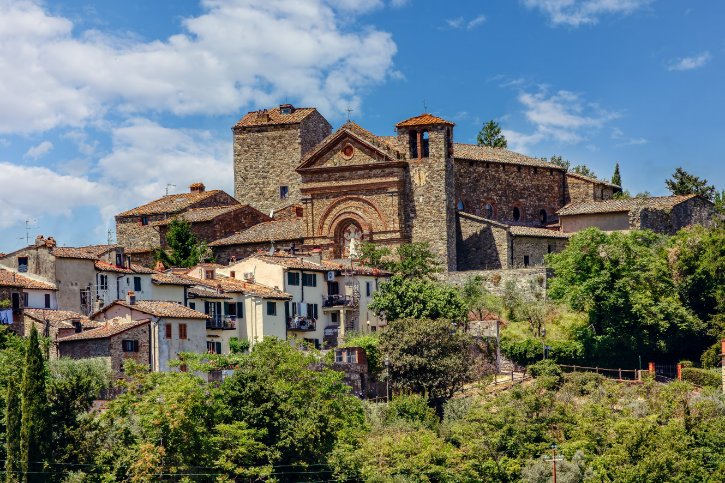
a. Ridge, vineyards, and food
Panzano is about two things: the vineyard landscape and a serious food culture. It sits high on the ridge between two river valleys, so the countryside becomes part of the visit. The star view is the Conca d’Oro, a wide south-facing bowl of vines that locals name for the way it catches the sun.
b. The historic core
Walk uphill to the older village and look for these:
- Remains of the 12th-century Panzano Castle, including a square watchtower and old walls.
- The Church of Santa Maria, built on fortress foundations.
- The Pieve di San Leolino just outside town, one of the most complete Romanesque churches in Chianti.
- Inside it, early panels by Meliore di Jacopo and Mariotto di Nardo, plus Della Robbia tabernacles.
c. The meat tradition
Panzano’s modern fame comes from butchery, led by Dario Cecchini and his family’s long-running shop:
- It reflects a genuine Tuscan idea of using the whole animal and wasting nothing.
- That habit was born from old peasant economies, not modern fashion.
- It is why the food here feels cultural rather than a celebrity draw.
d. Panzano versus Greve
Keep the two towns clear in your mind:
- Greve is the horizontal market town, defined by its arcaded square and trade.
- Panzano is the ridge town, defined by elevation, deep limestone vineyards, and food.
e. Toward Radda
From Panzano’s world of landscape and food, the road turns into deeper history. Radda takes you into the medieval politics that shaped this region.
5. Radda in Chianti
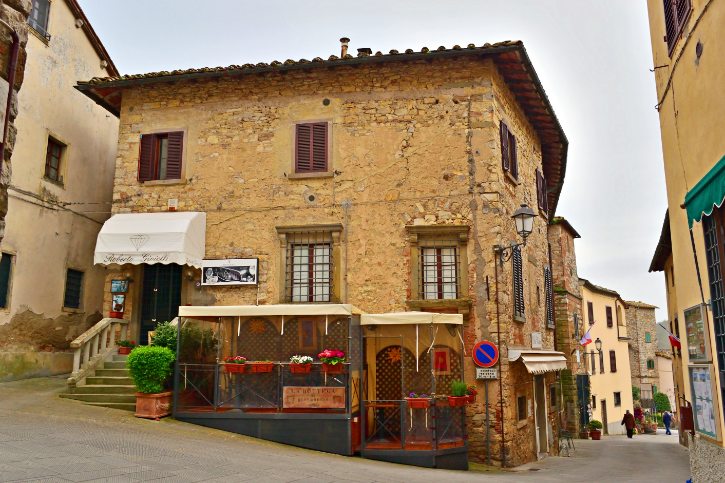
a. The heart of the Chianti League
Radda trades open views for a fortified stone town with real history. It served as the historic capital of the Chianti League, an alliance Florence set up in 1384 to defend the borderlands facing Siena, and its central, defensible position made it the seat of the League’s chief magistrate.
b. Piazza Ferrucci and its buildings
The town keeps its compact medieval shape inside oval walls. In the center you will find:
- Piazza Ferrucci, the main square.
- The Palazzo del Podestà, its facade set with dozens of carved heraldic shields.
- The Church of San Niccolò, with a neo-Gothic front and a 15th-century wooden crucifix.
c. Wandering the lanes
The best of Radda is a slow walk through shaded stone passages, where you will find:
- Covered vaulted tunnels.
- Old cistern openings.
- Small walled kitchen gardens that once helped feed the town during sieges.
d. Understanding the wine
For context, visit the Casa del Chianti Classico in a former monastery just outside the walls:
- It is run with the local consortium.
- Exhibitions, tastings, and archives explain the DOCG and its soils.
- The convent church holds a 15th-century Madonna by Neri di Bicci.
e. What makes Radda memorable
The pretty landscape you see today was once a hard-fought frontier between Florence and Siena. Radda’s high position was exactly why it mattered, and in its quiet streets it is easy to forget you are walking through contested ground.
6. Castellina in Chianti
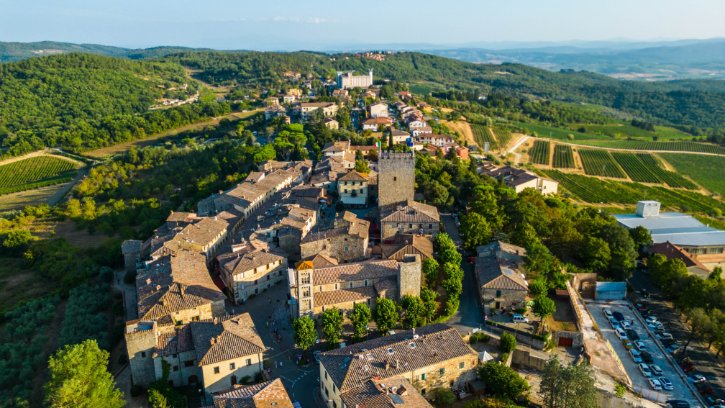
a. The archaeological stop
Perched at 580 meters, Castellina is the deep-history anchor of Chianti. Its streets look medieval, but underneath lies something far older: this was an important Etruscan trade and burial center between the 7th and 5th centuries BCE.
b. The Rocca and Via delle Volte
The medieval core is ruled by La Rocca, a 15th-century fortress with a tall keep:
- After heavy damage in 1478, Florence rebuilt the defenses, with records pointing to Giuliano da Sangallo.
- The fortress now serves as the town hall, and you can climb the keep for long views.
- The Via delle Volte is a covered patrol tunnel built into the walls, still lined with arrow slits.
- Above it runs Via Ferruccio, the main street.
c. Etruscan treasures
Castellina’s highlight is the Archaeological Museum of the Sienese Chianti, inside the Rocca:
- It displays grave goods and ceramics from nearby Etruscan sites.
- The prized piece is an archaic bronze chariot found in a burial vault.
- The collection connects directly to sites in the surrounding land.
d. The Montecalvario Tumulus
Just outside town, this burial mound ties the museum to the landscape:
- It is 53 meters across and was sketched long ago by Leonardo da Vinci.
- Inside are four Etruscan tombs from the late 7th to 6th century BCE.
- You can walk the corridors into the chambers and see the massive stone lintels that once sheltered Etruscan rulers.
e. Keeping wine in its place
Castellina sits in Chianti, so wine belongs here too. But let the archaeology, the fortress, and the historic center be your real reasons to stop. This is not just another tasting town.
7. San Gimignano
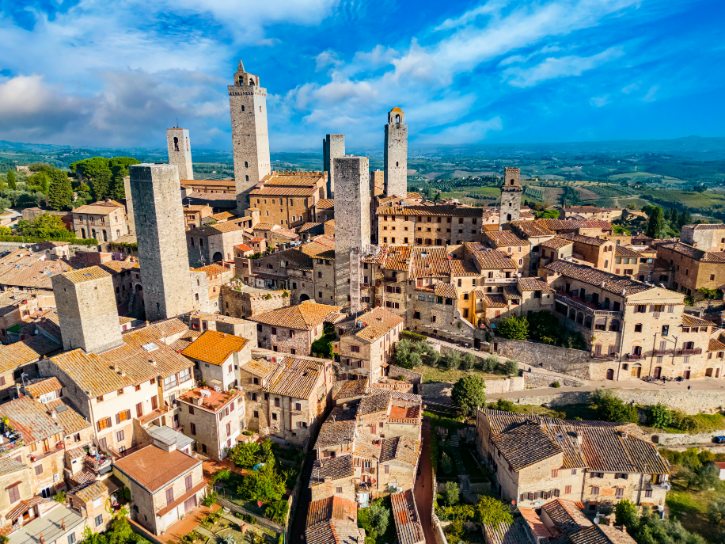
a. More than a skyline
The towers are the hook, and they are unforgettable. But this walled town, a merchant commune on the Via Francigena and a UNESCO World Heritage Site since 1990, offers far more than a silhouette. One fact to get right: careful surveys confirm 14 medieval towers survive today, not the dozens older guides claim.
b. Through the historic center
Walk a natural route between the two linked squares:
- Piazza della Cisterna, paved in herringbone brick around a 1287 wellhead.
- Piazza del Duomo, the religious and civic heart.
- The Collegiata di Santa Maria Assunta, whose plain facade hides rich fresco cycles.
- Inside, work by Bartolo di Fredi, the Memmi brothers, and Ghirlandaio in the Chapel of Santa Fina.
c. The view from above
For the high experience, head to the Palazzo Comunale and Civic Museum:
- The Sala di Dante recalls Dante’s visit in 1300.
- From the museum you can climb the Torre Grossa, built between 1300 and 1311.
- At the top you look down onto the roofs and neighboring towers, with fields rolling out beyond.
d. A different glass of wine
San Gimignano breaks from the region’s reds:
- Its sandy hills produce Vernaccia di San Gimignano, a crisp white with citrus notes and an almond finish, praised by Dante.
- At the hilltop ruins of La Rocca, the Vernaccia Wine Experience pairs tastings with cultural exhibits.
- You get the story alongside the glass.
e. What most visitors miss
Try to notice the contrast between:
- the tall vertical skyline
- the richly painted church interiors
- the calm civic squares
- the open countryside beyond the walls
Travelers who only photograph the towers walk away with a fraction of what this town holds.
8. Monteriggioni
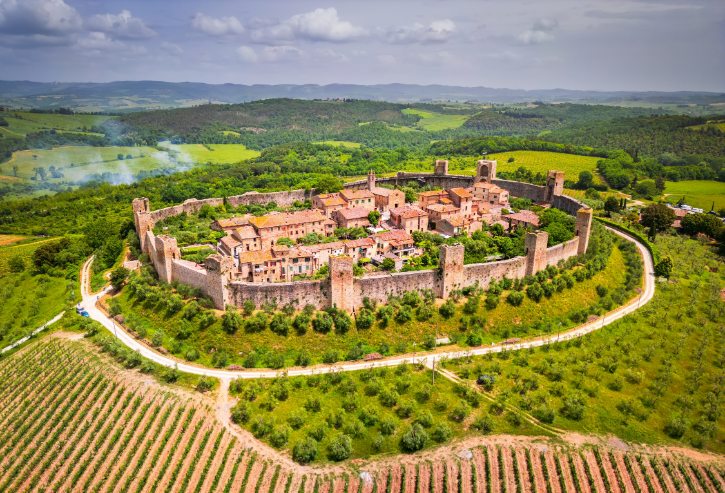
a. A fortress you can read at a glance
Monteriggioni is one of the clearest places to understand medieval defense. It was built from scratch as a military garrison, not grown around a market:
- Founded by Siena between 1213 and 1219.
- Placed along the Via Francigena to guard against Florence.
- Its stone wall runs about 570 meters around the hilltop.
- The wall carries 14 square towers, striking enough that Dante named them in the Inferno.
b. Inside the walls
You enter through one of two gates into Piazza Roma, ringed by low stone houses:
- Facing the square stands the Church of Santa Maria Assunta, a simple Romanesque-Gothic building with sacred panel paintings inside.
- The village is so compact that you grasp its defensive logic almost immediately.
c. The armory experience
On the square you can visit Monteriggioni in Arme:
- It displays careful reproductions of medieval and early Renaissance weapons and armor.
- You can handle some pieces and feel the real weight of medieval gear.
- It makes the town’s military purpose far easier to picture.
d. Current access to the walls
Here is the practical update you need:
- The southern walkway near Porta Romea has been partially reopened.
- The northern section remains closed for maintenance.
- From the open stretch, you look inward over the roofs and outward toward the Chianti hills.
- Plan around the open section rather than counting on a full circuit.
e. On to Siena
Monteriggioni was Siena’s forward shield. Follow the road south and you arrive at the powerful city that built it.
9. Siena
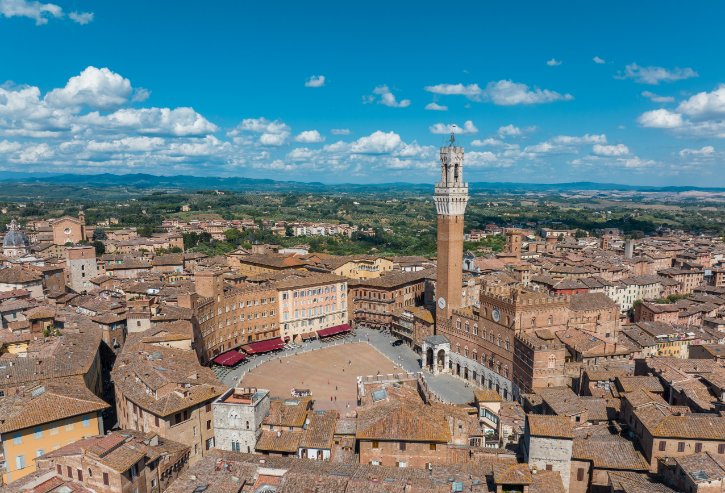
a. The medieval climax
Siena is the great civic high point of the trip, and it deserves to be seen on its own terms, not just as a rival to Florence. Where Florence tells a story of merchant capitalism, Siena stands for medieval collective government and a Gothic city that has kept its identity intact, with a historic center named a UNESCO site in 1995.
b. Piazza del Campo
The center of gravity is this famous shell-shaped square:
- Pale travertine lines divide it into nine sectors, honoring the Government of the Nine.
- At the top sits the Fonte Gaia
- Anchoring the low edge is the Palazzo Pubblico, with the Torre del Mangia rising about 87 meters.
- Twice each summer it hosts the Palio, a fierce civic ritual run between the city’s 17 historic contrade, not a tourist show.
c. The Duomo and the Facciatone
Climb Via di Città to reach Siena Cathedral, banded in dark and white marble:
- Its lower facade was carved by Giovanni Pisano between 1284 and 1296.
- Inside are Pisano’s pulpit, Donatello’s bronze St. John, and a floor of 56 inlaid marble panels.
- The Duomo Nuovo was a planned huge expansion, halted by structural faults and the Black Death of 1348.
- What survives is the Facciatone, an unfinished wall you can climb for a rooftop view.
d. Siena at street level
Do not spend all your time inside monuments:
- Siena’s steep brick lanes and small neighborhood churches are part of the reward.
- Walking between the Campo and the Duomo, watch for the plaques marking each contrada’s territory.
- The old fabric of the city is an attraction in itself.
e. If you have extra time
Two options stand out for a deeper visit:
- Santa Maria della Scala, one of Europe’s oldest hospitals, with early-15th-century frescoes.
- The Civic Museum in Palazzo Pubblico, home to Lorenzetti’s frescoes on good and bad government.
10. Buonconvento
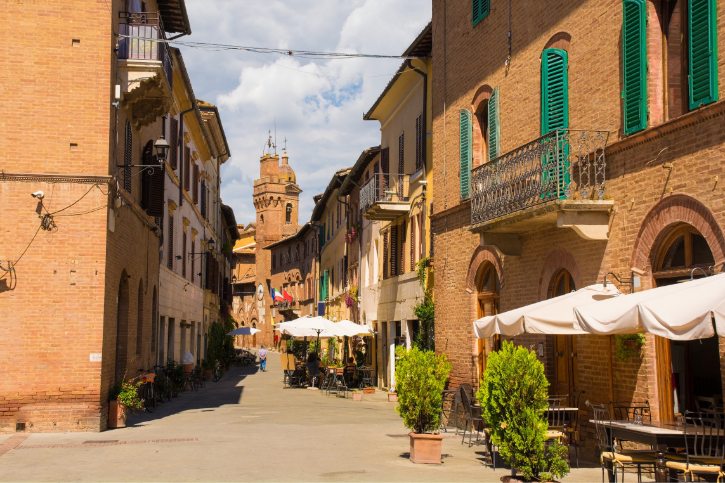
a. The intimate medieval town
After Siena’s grandeur, Buonconvento feels grounding. It is a small, honest medieval town built entirely in warm red brick, set where two rivers meet along the old Via Cassia. Do not expect it to compete on monuments. Its charm is the whole, not any single sight.
b. Walls, gates, and the main street
The town keeps its neat rectangular plan inside 14th-century walls:
- You enter through the sturdy Porta Senese, a crenellated brick gatehouse.
- The southern Porta Romana was destroyed in 1944, leaving Porta Senese as the only surviving medieval gate.
- Via Soccini runs down the center as a corridor of brick facades and a few Art Nouveau touches.
c. The sharecropping museum
Buonconvento’s standout stop is the Museo della Mezzadria Senese:
- It tells the story of mezzadria, the sharecropping system that shaped rural life until the 1960s.
- Tenant families lived on isolated farms and split their harvest with landlords.
- Recordings, photographs, tools, and reconstructed rooms show the labor that shaped the landscapes you have been driving through.
d. For lovers of sacred art
If religious art appeals to you more than farming history, visit the Museo d’Arte Sacra della Val d’Arbia:
- It gathers works saved from rural churches nearby.
- The anchor is the exquisite late-13th-century Madonna di Buonconvento by Duccio di Buoninsegna.
- There are also panels by Pietro Lorenzetti and Sano di Pietro.
e. Climbing to Montalcino
From these humble clay plains, the road climbs sharply south toward Montalcino, a wine town whose fortress carries you back into the military history of Siena.
11. Montalcino
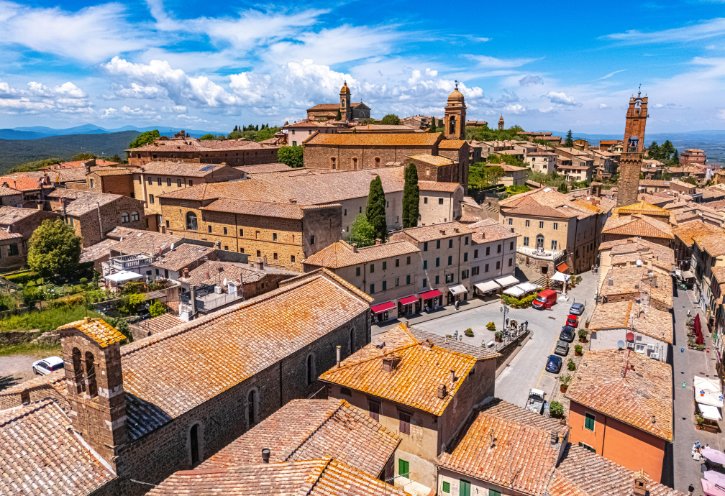
a. Fortress, wine, and views together
Montalcino works because three things come together: Brunello wine, a fortified hill town, and huge open views. Sitting at 567 meters, it looks over the Val d’Orcia and toward Mount Amiata. This is not only a wine stop. The town, fortress, and landscape all belong to the same story.
b. The fortress and the center
Start high and work your way down:
- La Fortezza, the pentagonal fortress built in 1361.
- After Siena fell in 1555, noble families held out here until 1559 as the last “Republic of Siena in Montalcino”.
- Climb the ramparts for a full circle of views over the vineyards.
- Down in Piazza del Popolo, see the Palazzo dei Priori with its tall clock tower and Gothic loggia.
c. Understanding Brunello
Keep the wine story simple:
- It is made from 100% Sangiovese, the local clone called Brunello.
- The dry climate, warm slopes, and rocky soils suit the grape well.
- The wine ages for years before release, which builds its depth.
- Taste it in the historic cellars beneath the fortress or along Via Mazzini.
d. Art and architecture, kept in balance
If you want more, the former Sant’Agostino complex houses a civic and diocesan art museum with medieval manuscripts, wooden sculpture, and painted panels. Enjoy these, but let the fortress, the atmosphere, the views, and the wine stay at the center of your visit.
e. Down to Bagno Vignoni
Leave the dry ramparts behind, and the road winds into a quiet valley where the whole character shifts. At Bagno Vignoni, water becomes the main event.
12. Bagno Vignoni
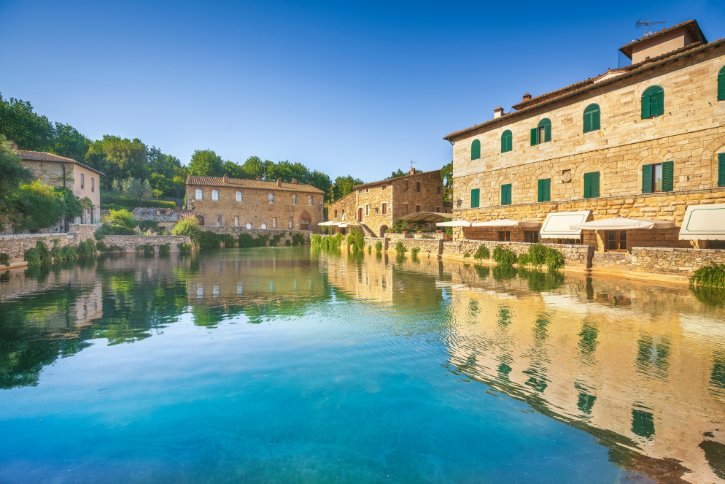
a. A square made of water
Bagno Vignoni is unlike anywhere else on this route. In place of a stone market square, its center is a giant thermal pool:
- The Piazza delle Sorgenti is a 16th-century basin, 49 by 29 meters.
- Hot mineral water rises from deep underground at around 49 to 52 degrees Celsius.
- The steam hangs over the pool, especially at dawn and on cool evenings.
- Renaissance stone buildings and old loggias frame the basin.
b. Pilgrims, saints, and the Via Francigena
The springs have drawn people since Etruscan and Roman times:
- Sitting on the Via Francigena, the village became an important stop for pilgrims and rulers.
- Documented visitors include Saint Catherine of Siena, Pope Pius II, and Lorenzo the Magnificent.
- That history gives it real depth, far beyond a pretty spa village.
c. The Parco dei Mulini
Below the square lies a piece of clever old engineering:
- Because the hot spring flowed steadily all year, medieval builders used it to power four flour mills.
- The mills were carved into the travertine cliff.
- Following the footpaths, you can still see the chambers, grinding wells, and calcified stone channels.
- It shows the water was put to work, not just used for healing.
d. One important rule
Please note this clearly:
- You cannot bathe in the monumental pool in the village. It is protected by law.
- Full-immersion bathing in the lower pools of the Parco dei Mulini below the village is also banned under a local ordinance, so do not plan on soaking there. You may still dip your feet in the warm channels along the path down.
- To actually soak, use the dedicated spa hotels in and around the village.
- For genuinely free, open-air thermal bathing, drive to Bagni San Filippo, about 30 minutes south.
e. On to San Quirico
The Via Francigena ties these stops together. From a thermal village long linked to travelers, the road climbs back onto the ridge toward another Val d’Orcia town shaped by that same route.
13. San Quirico d’Orcia
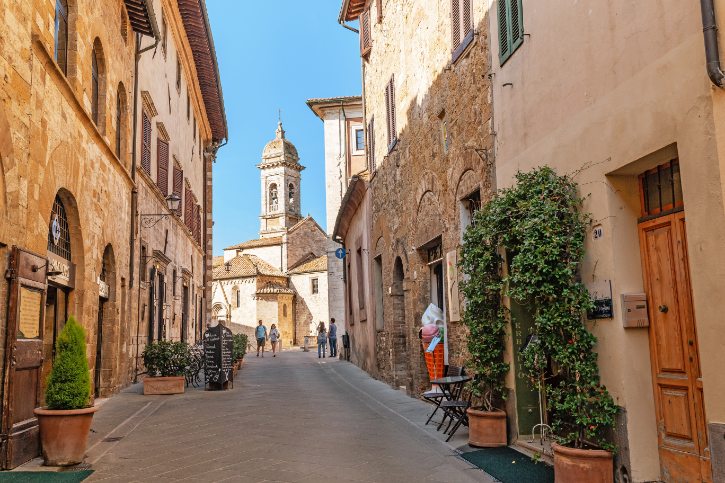
a. A pilgrim town with quiet depth
San Quirico is the crossroads of the Val d’Orcia, and it offers the unhurried feel of a real medieval resting stop on the Via Francigena. It even appears in a 990 travel itinerary written by an archbishop bound for Rome. Come here to slow down, not to tick off big sights.
b. The Collegiata
The artistic centerpiece is the Collegiata dei Santi Quirico e Giulitta, a Romanesque church in golden sandstone. Its three carved portals are the thing to study:
- The western portal, from the late 12th century, rests on stone lions.
- The southern portal, from 1298, is linked to the workshop of Giovanni Pisano.
- Inside is a 15th-century triptych by Sano di Pietro, soft and gilded.
c. Walking the center
Treat the historic center as one connected stroll along Via Dante Alighieri:
- Pass through Piazza della Libertà.
- See the Baroque Palazzo Chigi.
- Visit the Church of San Francesco, with a glazed terracotta Madonna attributed to Andrea della Robbia.
d. The Horti Leonini
San Quirico’s surprise is this formal Renaissance garden built inside the town walls:
- It was created around 1581 by Diomede Leoni, a friend of Michelangelo.
- It was designed as a public park for pilgrims, not a private garden.
- Its clipped boxwood hedges and stone staircase make a lovely change of pace after vineyards and fortresses.
e. A living cultural layer
The town is not frozen in time. Forme nel Verde, running since 1971, is one of Italy’s longest open-air sculpture shows, placing modern works among the hedges and in Palazzo Chigi each year and creating a gentle tension between old order and new art.
14. Pienza
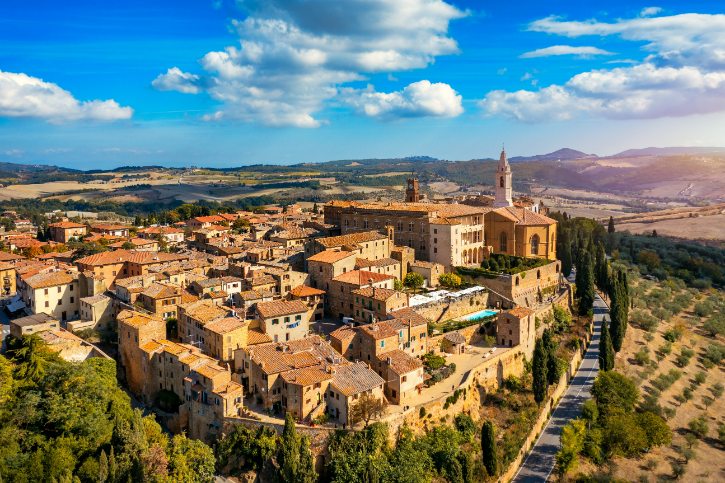
a. The ideal Renaissance city
Pienza is not just beautiful. It is historically extraordinary, built almost from scratch between 1459 and 1462 as a real attempt at the “ideal city”, and named a UNESCO site in 1996. The town began as a village called Corsignano, until Pope Pius II hired the architect Bernardo Rossellino, guided by the theories of Alberti, to rebuild it as Pienza.
b. Piazza Pio II
The heart of the plan is this trapezoidal square, designed as one composition:
- It narrows toward the entrance and widens toward the cathedral, tricking the eye into feeling larger.
- The Cathedral of Santa Maria Assunta has a bright hall-church interior full of light.
- Palazzo Piccolomini, the pope’s family palace, stands to one side.
- Palazzo Comunale and Palazzo Borgia complete the group.
c. The best view
Inside Palazzo Piccolomini, walk through the courtyard to the rear loggia and its hanging garden, one of the earliest of its kind:
- Three arched openings frame sweeping views across the Val d’Orcia to Mount Amiata.
- Do check current access when you arrive.
- This is where Renaissance design and wild landscape meet.
d. Back lanes and local cheese
Step off the square and Pienza gets playful:
- Along the ramparts you will find lanes with romantic names like Via dell’Amore and Via del Bacio.
- The contrast is the point: formal order in the square, tiny side streets, huge open hills below.
- The town’s food star is Pecorino di Pienza, a herbaceous sheep’s cheese you can taste at different ages.
e. A deeper stop
If you have extra time, walk a kilometer downhill to the Pieve di Corsignano, an 11th-century Romanesque church that predates the papal town. With its unusual round bell tower, it holds the font where both Pope Pius II and his nephew were baptized, and it adds real historical depth.
15. Monticchiello
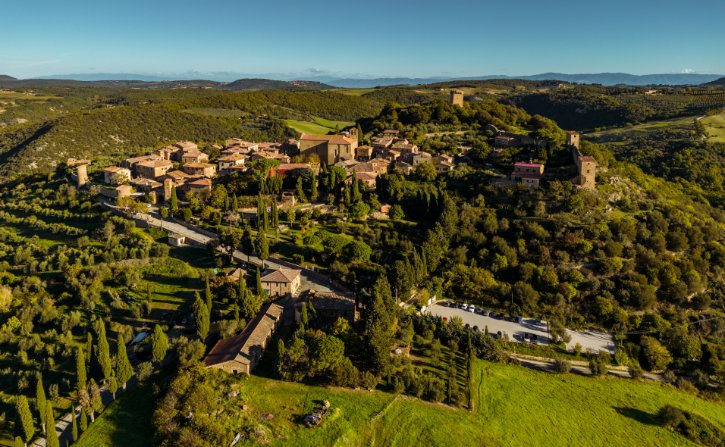
a. Small scale, big heart
Monticchiello brings the journey back to a human size. Tucked into the hills facing Pienza, this tiny fortified village keeps its dense medieval feel and stays refreshingly free of heavy tourism. It grew as a Sienese frontier outpost, and its intimacy is exactly what makes it special.
b. Walls and defenses
The village wears its history openly:
- You enter through the arched Porta Sant’Agata, which still shows the grooves for its old portcullis.
- Sections of crenellated wall survive, punctuated by original watchtowers.
- At the top stands the ruined Cassero Senese, a 13th-century keep with valley views.
c. The church
At the upper level sits the Church of Santi Leonardo e Cristoforo, a plain 13th-century Gothic church with a simple rose window:
- Inside are Sienese-school frescoes from the 1300s.
- The largest shows Saint Christopher, patron of travelers.
- It was painted to watch over pilgrims in the valleys below.
d. The Teatro Povero
What makes Monticchiello unmissable is its living Teatro Povero, or Poor Theater:
- In the late 1960s, the collapse of sharecropping threatened to empty the village.
- In response, the villagers created a theater where residents write, direct, and act.
- Each summer they stage an original autodramma drawn from their own lives.
- The cooperative also runs the local cultural center, dining hall, and archives.
e. The slow experience
The best way to enjoy Monticchiello is unhurried:
- Walk the edges of the walls for views west toward Pienza on its distant ridge.
- Wander the atmospheric lanes and linger at the defensive features.
- Below the village runs the famous zigzag cypress-lined road, one of Tuscany’s most photographed sights.
16. Montepulciano
a. An uphill journey
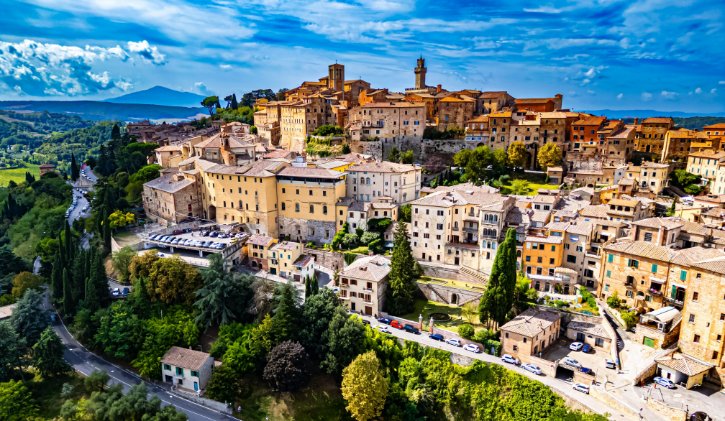
Montepulciano is best understood as a climb. Set on a narrow ridge at 605 meters, between the Val d’Orcia and the Valdichiana, the town unfolds as a steady uphill walk along its main street, ending at the summit square. Follow the climb the way you actually experience it, rather than reading a random list of sights.
b. The climb up Il Corso
Begin at the lower gate, Porta al Prato, and head up Il Corso:
- Early Renaissance facades line the lower street, including the Church of Sant’Agostino by Michelozzo.
- The Torre di Pulcinella clock tower is topped by a wooden figure that strikes the hours.
- Higher up, grand noble palaces take over.
- Pause at Palazzo Bucelli, whose base is studded with ancient Etruscan urns and inscriptions.
c. Piazza Grande
The climb ends at the town’s monumental heart, framed by four standout works:
- Palazzo Comunale, echoing Florence’s Palazzo Vecchio, with a tower you can climb for the highest view in town.
- The Cathedral of Santa Maria Assunta, with a raw brick front hiding a refined interior and a 1401 triptych by Taddeo di Bartolo.
- Noble palaces including Palazzo Contucci.
- The finely carved 1520 Pozzo dei Grifi e dei Leoni, a marble well.
d. San Biagio and the cellars
Two experiences set Montepulciano apart:
- Just below town, the Tempio di San Biagio stands alone among cypress trees, a Renaissance masterpiece by Antonio da Sangallo the Elder, built between 1518 and 1545 on a centered plan under a large dome.
- In town, the great cellars are buried right beneath the palaces.
- You walk down into vast vaulted chambers to see huge oak casks aging Vino Nobile di Montepulciano.
e. Montalcino versus Montepulciano
Hold the two wine towns clearly apart:
- Montalcino: fortress, hilltop landscape, and Brunello.
- Montepulciano: Renaissance streets, palaces, underground cellars, Piazza Grande, and Vino Nobile.
17. Cortona
a. The grand finale
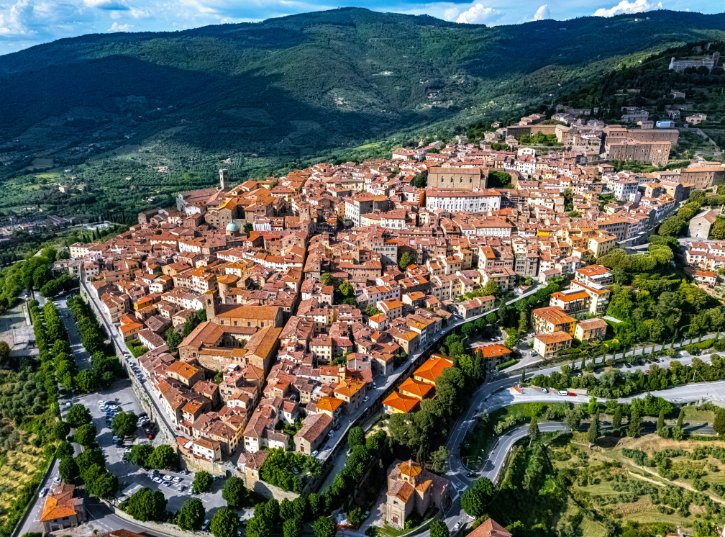
Cortona is the perfect last stop, because it holds one of the deepest histories on the route. Rising at 600 meters on Mount Sant’Egidio, it was one of the twelve major cities of the Etruscan League, with roots stretching back nearly three thousand years. Here the layers stack up: Etruscan foundations, ancient walls, medieval streets, Renaissance art, and sweeping views.
b. Climbing through the center
Cortona is another energetic climb up steep stepped streets:
- The civic heart joins Piazza della Repubblica and Piazza Luca Signorelli.
- Piazza della Repubblica sits over the old Roman forum, ruled by the 13th-century Palazzo Comunale.
- Nearby stands Palazzo Casali, the medieval lords’ residence.
- The Cathedral of Santa Maria Assunta and viewpoints over the Valdichiana reward the effort.
c. The MAEC museum
Cortona’s top cultural priority is the MAEC, inside Palazzo Casali:
- The Etruscan bronze chandelier, a 5th-century BCE lamp nearly a meter across.
- The Tabula Cortonensis, a bronze tablet with one of the longest surviving Etruscan texts.
- Rich collections of Greek pottery, Etruscan gold, and Roman bronzes.
d. Art and archaeology nearby
Two more stops carry the story further:
- The Diocesan Museum, across from the cathedral, closes the art thread from Florence, Siena, and Pienza, with Fra Angelico’s luminous Annunciation and works by Cortona’s own Luca Signorelli.
- The Archaeological Park at Il Sodo, on the plain below, holds monumental Etruscan tumuli from the 6th century BCE, including the striking Sodo Tumulus II with its sculpted stone altar terrace.
e. The final viewpoint
To finish, climb to the highest point in town:
- The Fortezza del Girifalco, built in 1556 and restored into a cultural center.
- From its bastions you look over Cortona’s roofs, across the Valdichiana, and toward Lake Trasimeno.
- For a quiet extra, add the Eremo delle Celle, a 13th-century Franciscan hermitage founded by Saint Francis in 1211.
This high, wide view is a fitting way to end the journey.