Day trips from Paris tend to follow the same short list: Versailles, Giverny, maybe Reims.
Go further and it starts to sound like work. Connections, a rental car, an early alarm.
It doesn’t have to be. Several French cities sit at the end of a single direct train from a central Paris station, most of them under two hours away.
Medieval streets. Big cathedrals. Canals, markets, museums, quiet corners. And far fewer international visitors than the usual names.
Here are five worth the ticket.
1. Provins
a. Why Visit
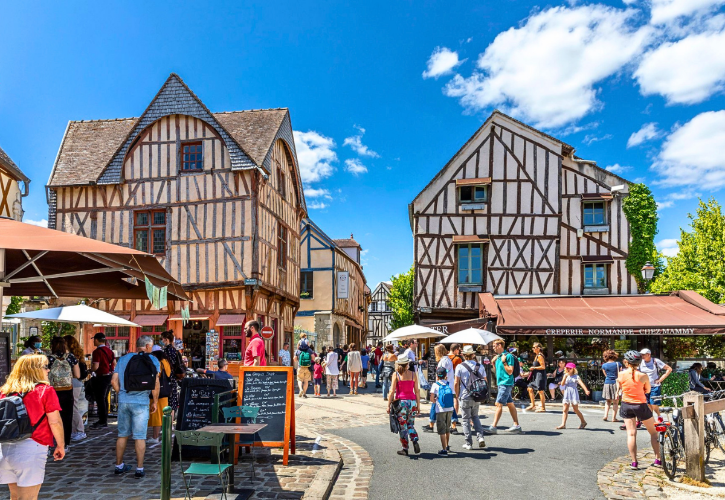
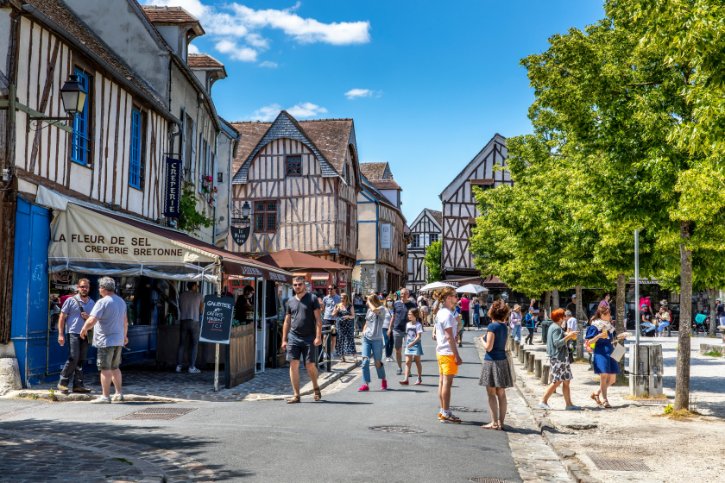
Provins is one of the most complete medieval towns in northern France, and the change of pace from Paris is immediate.
It was the capital of the Counts of Champagne and host of the famous Champagne Fairs. That preserved architecture earned it UNESCO World Heritage status in 2001.
The town splits in two: the Ville Basse below, where the station sits, and the fortified Ville Haute on the hill, ringed by walls, gates, and towers.
It draws far fewer international visitors than Versailles or Giverny, though it’s well known to French families and gets busy during medieval festivals and summer weekends.
b. Best Places and Experiences
The Fortified Upper Town
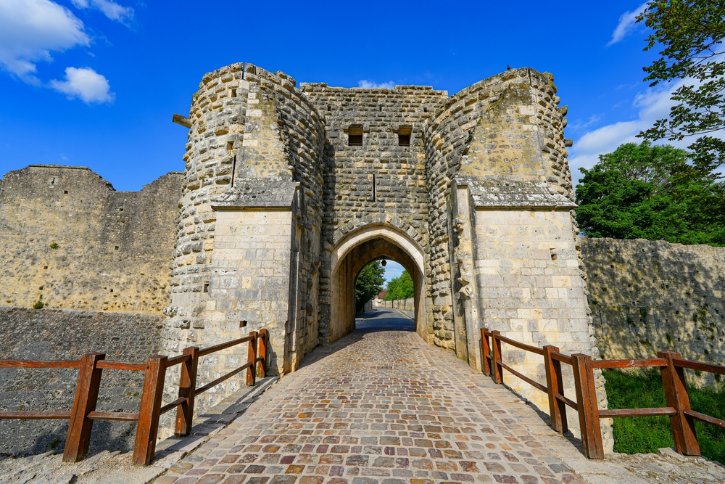
- Porte Saint-Jean: a thirteenth-century twin-towered gateway on the old trading road to Paris.
- The ramparts: 2 kilometers survive, with square, round, and polygonal towers side by side. Climb designated sections for countryside views. One of the best areas for photos in town.
- Place du Châtel: a gravel square of medieval houses with an old stone well at its center.
- Tour César: a twelfth-century octagonal keep, once watchtower, prison, and bell tower. Narrow spiral stairs.
- Collégiale Saint-Quiriace: a Gothic church never finished because money ran out. Its dome stands out on the skyline.
Trade, Tunnels, and Museums
- Grange aux Dîmes: a merchant house turned tithe barn, with life-sized figures showing the old trades.
- Souterrains de Provins: limestone tunnels dug for the fuller’s earth used to clean wool. Old graffiti still marks the walls.
- Tunnel visits are guided only. It stays cool and damp underground all year, so bring a layer.
- The damp, uneven steps rule the tunnels out for some visitors.
- Musée de Provins: Merovingian sarcophagi and Greco-Roman statues. Allow one hour.
Roses and Medieval Shows
- The Rose Garden: over 450 varieties, honoring the rose brought back from the crusades in 1240. Blooms peak late May to early June, so it’s optional otherwise.
- The Eagles of the Ramparts: free-flying birds of prey with equestrian handlers.
- The Legend of the Knights: an equestrian combat show in the dry moat.
- Shows run late March to early November on set times and add about two hours.
c. Efficient Route After Arriving
- Provins station, in the lower town
- Rue Saint-Thibault, climbing to the Ville Haute
- Porte Saint-Jean
- The ramparts
- Place du Châtel
- Grange aux Dîmes
- Tour César
- Collégiale Saint-Quiriace
- The tunnels or the museum
- The rose garden, in season
- Back to Provins station
- The climb takes 15 to 20 minutes up a steep cobbled slope. A local bus or the seasonal tourist train is a fair alternative.
- Going up first and looping back down avoids repeating the climb.
- The tunnels and the shows run on set times, so check those before you plan the rest.
d. Food and Local Specialties
- Rose products, year-round around Place du Châtel: jam, honey, syrup, candies, and tea.
- Niflette, a cream-filled puff pastry. Once an All Saints’ Day treat, now common at festivals and busy weekends.
- Brie de Provins, a rich raw milk cheese from the surrounding region.
e. Day Trip or Overnight Stay?
Full-day trip. Six to eight hours covers the ramparts, Tour César, one show, and the Grange aux Dîmes.
A half-day is tight, and you’ll lose either the tunnels or the garden.
Stay overnight if you want the streets after the day visitors leave. The hill and cobbles slow the pace, so wear proper shoes.
f. How to Get There
- Departing from: Paris Gare de l’Est
- Arriving at: Provins
- Train service: Transilien Line P
- Journey time: 1 hour 23 minutes at best, usually 1 hour 25 to 1 hour 40 minutes
2. Laon
a. Why Visit
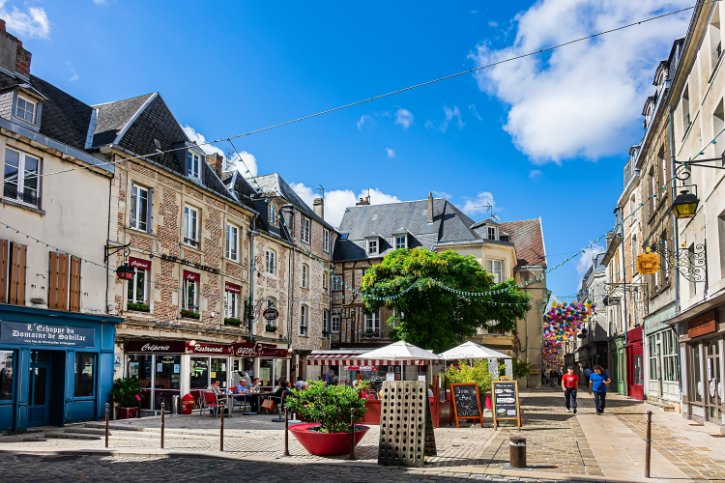
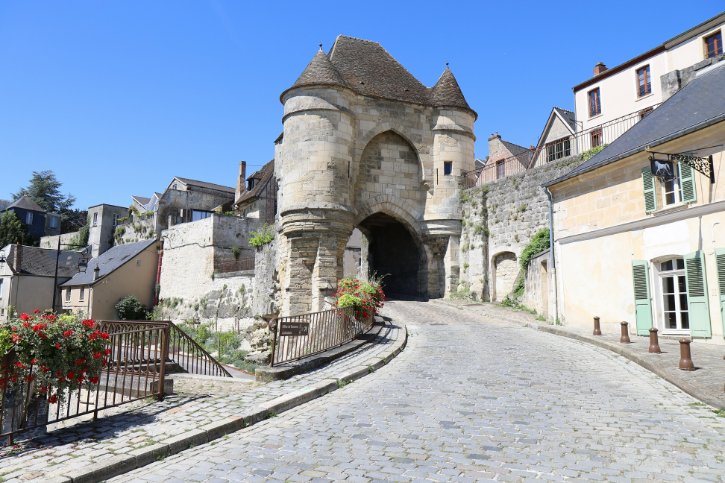
Laon sits on a solitary 100-meter limestone hill, rising out of the flat farmland of Picardy. Locals call it the “Crowned Mountain”.
That geography made it a royal seat for the Carolingian and early Capetian kings, before Hugh Capet chose Paris.
The skyline belongs to Laon Cathedral, visible from a long way across the plains. Below it run medieval streets, gateways, and walls.
It’s quieter and less commercial than Chartres or Reims, with over 80 listed monuments inside its walls, and it sees relatively few international visitors.
b. Best Places and Experiences
The Cathedral Quarter
- Cathédrale Notre-Dame de Laon, built 1160 to 1230, is one of the earliest Gothic churches in France and served as the blueprint for Chartres.
- Deep, cavern-like portals and openwork towers define the west façade.
- Look up for 16 stone oxen. Local legend says a white ox appeared to haul limestone up the hill after the original team collapsed.
- Inside it’s bright, with a rare flat choir end shaped to fit the narrow plateau. 210 steps lead up the tower.
- The former Hôtel-Dieu, the oldest preserved hospital building in France, now holds the Tourist Office. Start here.
Walls, Gates, and Streets
- The ramparts run about 6 kilometers around the plateau, passing the leaning Tour Penchée. Full circuit: 2 to 2.5 hours.
- Porte d’Ardon: a thirteenth-century gateway with two massive towers. A photogenic way in.
- Porte de Soissons: a twelfth-century gate on the quieter western side, with ditches and open views.
- Rue Châtelaine: the main pedestrian street, with old façades, bakeries, and bookshops.
Chapel, Museum, and Tunnels
- Chapelle des Templiers: a rare octagonal chapel built around 1140 by the Knights Templar, modeled on the Holy Sepulchre.
- Musée d’Art et d’Archéologie: Gallo-Roman jewelry, plus a transi tomb carved as a decaying corpse. Allow one to two hours with the chapel.
- Abbatiale Saint-Martin: a twelfth-century monastic church, plain and calm. Optional on a short day.
- “Secrets beneath the City”: a one-hour guided tunnel tour under the citadel. Cool year-round, so bring a layer. Booking advised, with stairs and tight spaces throughout.
c. Efficient Route After Arriving
- Gare de Laon, in the lower town
- The climb to the upper city, on foot or by bus
- Porte d’Ardon
- The cathedral quarter
- Cathédrale Notre-Dame de Laon
- Rue Châtelaine
- Chapelle des Templiers and the museum
- Porte de Soissons
- Abbatiale Saint-Martin
- Selected rampart viewpoints
- Back to Laon station
- Walking up takes 20 to 30 minutes and is steep. TUL bus Line 4 or a taxi does the job instead.
- Skip the full rampart circuit on a day trip, and allow 30 to 40 minutes to get back down.
- If time runs short, cut Saint-Martin first, then the museum.
d. Food and Local Specialties
- Ficelle picarde: the local star. A baked crêpe with ham and mushrooms, covered in cream and gratinéed.
- Maroilles, a pungent cheese, often baked into a Tarte au Maroilles.
- Regional terrines, duck pâtés, and craft beers.
- Pavé de Laon, a sweet pastille tied to the city itself.
Lunch options sit in the upper town, not near the station, and service can be limited mid-week.
e. Day Trip or Overnight Stay?
Full-day trip, if your legs are willing. Seven to nine hours covers the cathedral, some ramparts, the tunnels, and the museum.
Laon asks more of you than Amiens, Dijon, or Lille. Those are flat. This is a hill with stairs and cobbles on top.
Stay overnight to walk the full rampart circuit slowly. If you have significant mobility limits, this is the hardest stop here.
f. How to Get There
- Departing from: Paris Gare du Nord
- Arriving at: Laon
- Train service: TER Picardie and TER Hauts-de-France
- Journey time: 1 hour 32 minutes at best, usually 1 hour 35 to 1 hour 50 minutes
3. Dijon
a. Why Visit
Dijon puts history, art, and very good food within one flat walk of each other.
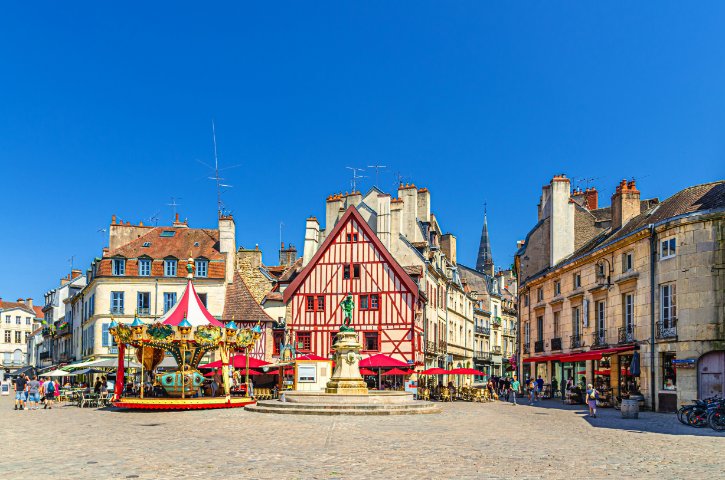
This was the capital of the Dukes of Burgundy, whose duchy rivaled the French crown in wealth. The old town joined the UNESCO World Heritage List in 2015.
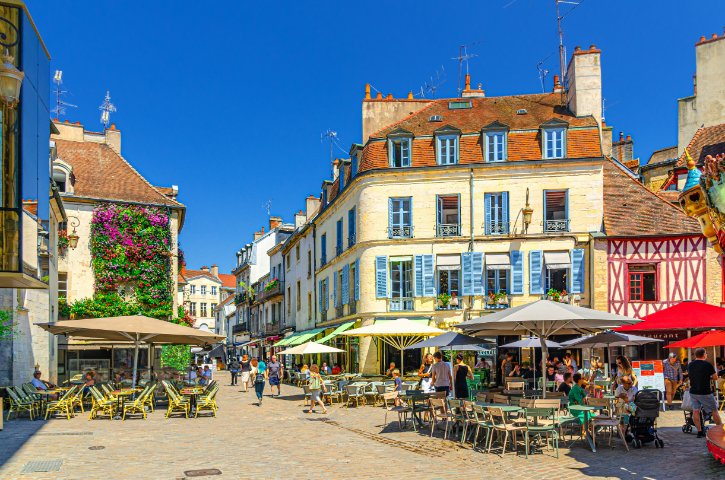
You’ll see grand stone mansions, elegant squares, timber-framed houses, and the famous Burgundy glazed roof tiles in green, yellow, black, and red.
Most travelers know one word about Dijon: mustard. Fair, and the mustard is excellent. But the city also has major museums, Gothic churches, and one of the best food halls in France.
b. Best Places and Experiences
From the Station to the Old Town
- Jardin Darcy: a calm nineteenth-century park built over the city’s water reservoir, linking station to old town.
- Porte Guillaume: an eighteenth-century arch on the site of a medieval gate.
- Rue de la Liberté: the main pedestrian avenue to the ducal palace, with the classic mustard and gingerbread shops.
- The Owl Trail: 1,600 brass owl plaques guide you through 22 stops over 3 kilometers. 1 to 1.5 hours walking, 4 to 5 hours with stops. Brochures and an app come from the tourist office.
The Historic Core
- Rue des Forges: grand noble mansions. Peek through the gates at the courtyards, which are easy to miss from the street.
- Église Notre-Dame: thirteenth-century Burgundian Gothic, with a flat façade carrying three tiers of gargoyles.
- The owl carving on Rue de la Chouette is worn smooth. Touch it with your left hand, right hand on your heart, and make a wish.
- Maison Millière: a timber-framed house from 1483, seen in the 1990 film Cyrano de Bergerac. An exterior stop.
- Palace of the Dukes: a fourteenth-century fortress core with a classical façade added later.
- Place de la Libération: the semicircular square designed by Jules Hardouin-Mansart, architect of Versailles.
Art, Views, and Food Halls
- Musée des Beaux-Arts: inside the palace. The Salle des Gardes holds the tombs of the Dukes, with individually carved alabaster mourners. Allow two hours.
- Tour Philippe le Bon: 316 steps to a 46-meter terrace. Guided, limited capacity, booking required. Adds about one hour.
- Les Halles: an iron and glass market hall by the company of Gustave Eiffel, a Dijon native. Active only Tuesday, Thursday, Friday, and Saturday.
- Cité Internationale de la Gastronomie et du Vin: exhibitions, shops, and a wine-tasting hall near the station. Best at the end of the day. 2 to 3 hours.
- Cathédrale Saint-Bénigne: its crypt dates to the year 1000. Near the station, so make it first or last.
c. Efficient Route After Arriving
- Dijon Ville
- Jardin Darcy
- Porte Guillaume
- Rue de la Liberté
- Rue des Forges
- Église Notre-Dame and the owl carving
- Maison Millière
- Palace of the Dukes and Place de la Libération
- Musée des Beaux-Arts
- Les Halles, on a market day
- Cathédrale Saint-Bénigne
- Cité Internationale de la Gastronomie et du Vin
- Back to Dijon Ville
- Let the Owl Trail It links most of these stops.
- Put lunch at Les Halles on a market day, or near Notre-Dame otherwise.
- The Musée des Beaux-Arts needs the most time, and Tour Philippe le Bon must be booked, so slot it in first.
- The loop ends near the station, so you won’t backtrack. You won’t need the trams.
- If the day fills up, drop the gastronomy complex.
d. Food and Local Specialties
Dijon mustard uses verjus, the juice of unripe grapes, instead of vinegar. Production moved to the outskirts, but Maille and Edmond Fallot still sell it fresh from pumps.
- Pain d’épices, honey-and-spice gingerbread
- Crème de cassis, and the Kir it makes with Aligoté
- Burgundy wines, gougères, and Époisses cheese
- Oeufs en meurette and boeuf bourguignon, both worth a proper sit-down meal
Quick lunch means cheese and prepared food at Les Halles. Dijon’s wine-based cooking is a clear contrast with Lille’s beer and cheese.
e. Day Trip or Overnight Stay?
A long day trip works. Seven to nine hours covers the Owl Trail, the museum, the tower, and a traditional lunch.
One night is better, because a multi-course dinner with wine pairings is what a day trip can’t give you. Two nights turn Dijon into a base for the Côte de Nuits vineyards.
Don’t try central Dijon and a full vineyard trip in one short day. Dijon is flat and easier going than Provins or Laon.
f. How to Get There
- Departing from: Paris Gare de Lyon
- Arriving at: Gare de Dijon-Ville
- Train service: TGV INOUI. TGV Lyria also runs the route. Both direct
- Journey time: 1 hour 32 minutes at best, usually 1 hour 35 minutes to 2 hours
4. Amiens
a. Why Visit
Amiens gives you two very different things in one day: monumental stone, and quiet water.
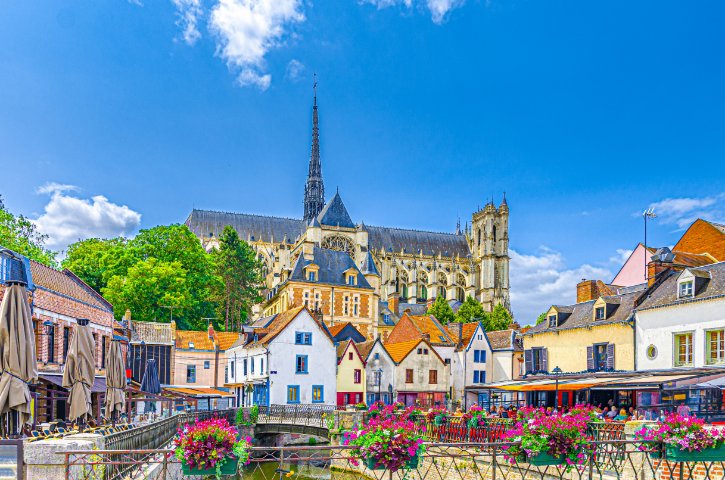
The Cathédrale Notre-Dame d’Amiens is a UNESCO World Heritage Site and the largest Gothic cathedral in France by internal volume.
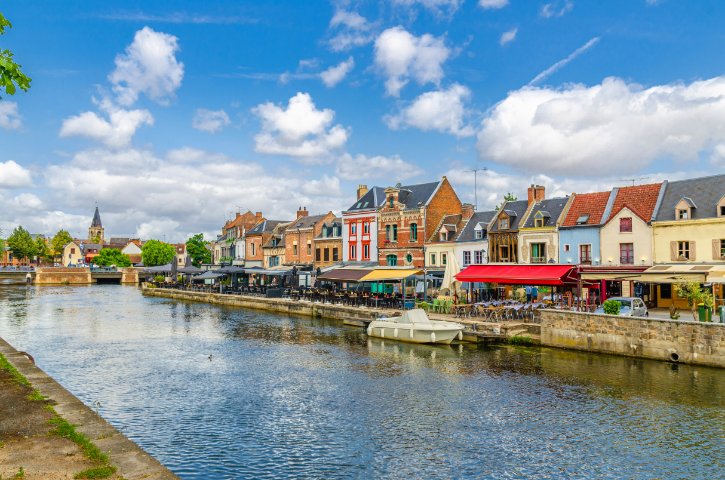
Walk five minutes north and the mood changes. The Saint-Leu district is a web of canals and colorful houses, nicknamed the “Little Venice of the North”.
Just east lie the Hortillonnages, floating market gardens worked since the Middle Ages. Amiens was also the long-term home of Jules Verne.
b. Best Places and Experiences
The Cathedral and Its Quarter
- Tour Perret, opposite the station, is a 104-meter concrete tower and France’s first skyscraper. The interior is private, so it’s a quick exterior stop.
- The cathedral, built 1220 to 1270, holds about twice the volume of Notre-Dame de Paris, with a nave 42 meters
- The west façade carries over 700 statues, a “Stone Bible” for worshipers who couldn’t read.
- Inside: the 234-meter labyrinth in the nave floor, the skull of Saint John the Baptist, and the Weeping Angel, which became a well-known image during the First World War.
- 307 steps lead up the towers. Allow 1 to 1.5 hours.
- Walk a few streets back and turn around. That’s where you get the scale.
Water, Gardens, and Museums
- Saint-Leu: a former quarter of weavers and dyers, with canals, small bridges, and half-timbered houses. Quai Bélu is the heart of it. Calm by day, busier in the evening.
- The Hortillonnages: a 300-hectare network of islands and canals worked since Roman times. Traditional barques leave from 54 Boulevard de Beauvillé, about 25 to 30 minutes on foot from the center.
- Boats run April to October, booking is essential, and the trip takes about one hour. Boarding needs a short step down.
- Parc Saint-Pierre: a flat park linking Saint-Leu to the gardens. 20 to 30 minutes to cross.
- Maison de Jules Verne: his home from 1882 to 1900, with his circular study, manuscripts, and a Nautilus Allow one hour.
- Musée de Picardie: the first purpose-built fine arts museum in France. Allow 1.5 to 2 hours. Useful in poor weather.
- The belfry: fifteenth-century and UNESCO-listed. Interior access is limited and usually pre-booked, so treat it as optional.
- Chroma: a free 50-minute light show projecting color onto the façade sculptures, recreating their original medieval paint. Evenings, July to mid-September and December.
c. Efficient Route After Arriving
- Gare d’Amiens
- Tour Perret, a quick exterior stop
- Maison de Jules Verne
- Cathédrale Notre-Dame d’Amiens
- The cathedral quarter
- Saint-Leu, with lunch on or near Quai Bélu
- Parc Saint-Pierre
- The Hortillonnages, on your booked boat
- Musée de Picardie
- The belfry and central streets
- Back to Gare d’Amiens
- Everything central sits within a 10 to 15 minute flat walk of the station.
- The Hortillonnages add roughly 25 to 30 minutes of walking each way, or a short taxi.
- Your boat time is the fixed point, so build the day around it.
- Doing Jules Verne early, near the station, saves crossing the city twice.
- Pick one museum, not both.
d. Food and Local Specialties
- Macaron d’Amiens: strongly local. A dense, chewy almond disc, not the Parisian kind. The best souvenir here.
- Pâté de canard d’Amiens: duck pâté in a pastry crust, about as local as it gets.
- Ficelle picarde and gâteau battu, a tall egg-rich brioche. Both Picardy classics, best eaten fresh.
- Maroilles, carbonnade, and regional beers, tied more broadly to Hauts-de-France.
Saint-Leu is the practical lunch area, right on your route.
e. Day Trip or Overnight Stay?
The easiest full-day trip here. Flat, compact, and a fast train.
Seven to nine hours covers the cathedral, a boat trip, Saint-Leu, and one museum. Both museums plus the gardens looks fine on paper and feels rushed in practice.
Stay overnight in summer or December for Chroma without watching the clock. Level streets suit reduced mobility well. The one obstacle is the step into the boats.
f. How to Get There
- Departing from: Paris Gare du Nord
- Arriving at: Gare d’Amiens
- Train service: TER
- Journey time: 1 hour 08 minutes at best, usually 1 hour 10 to 1 hour 30 minutes
5. Lille
a. Why Visit
Lille is the busiest and most urban stop here, and that’s the appeal.
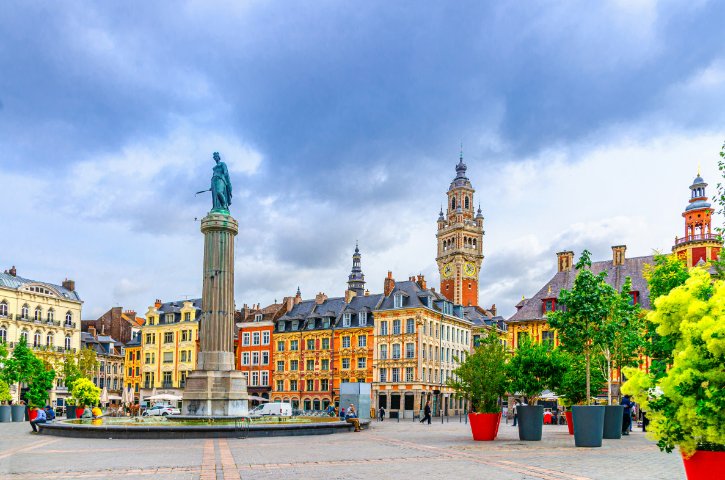
Near the Belgian border, it blends French elegance with a strong Flemish identity: red brick, ornate gables, grand squares, cobbled alleys.
Plenty of travelers only know it as the place where the train stops between Paris, London, and Brussels, and never leave the station.
Vieux-Lille is worth more than that. It’s a well-preserved old town, backed by one of France’s largest art museums, a serious beer and food scene, and a busy café culture.
Lille isn’t hidden. It’s underrated, which is different.
b. Best Places and Experiences
The Grand Squares
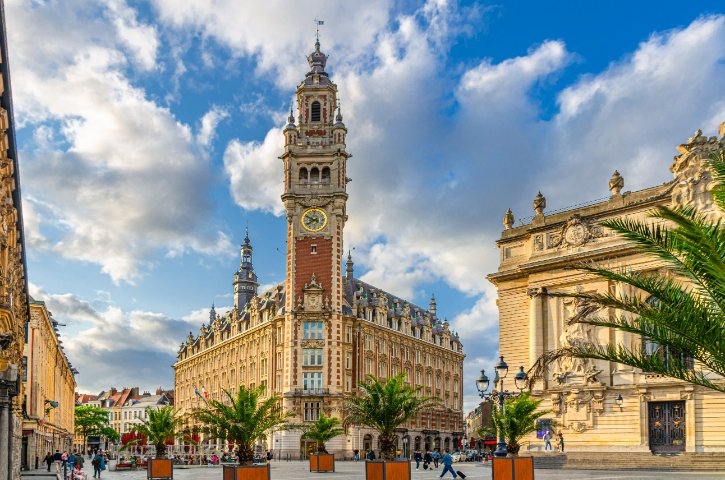
- Place du Théâtre: the Lille Opera in neoclassical stone faces the Chamber of Commerce in neo-Flemish brick, with its 76-meter belfry. Two styles in one square.
- Grand’Place, officially Place du Général de Gaulle, is the social center, with the Goddess Column marking resistance during the 1792 siege.
- Look for stepped gables and gold detail on red brick, sitting beside French classical façades.
- Vieille Bourse: built in 1652, it’s not one building but 24 Flemish Renaissance houses around an arcaded courtyard, where booksellers and chess players
Vieux-Lille
- Rue Esquermoise: historic façades and food shops, including Méert, the ornate pastry house known for filled waffles.
- Rue de la Monnaie: the spine of the old town. Watch the façades shift from seventeenth-century brick to French stone.
- Place aux Oignons: a small cobbled square ringed by restored houses and traditional estaminets. Quiet, photogenic, and a good place to eat.
- Musée de l’Hospice Comtesse: a hospital founded in 1237, with a barrel-vaulted ward, Delft tiles, and Flemish furniture. The one that explains the city. Allow 1 to 1.5 hours.
- Cathédrale Notre-Dame-de-la-Treille: its façade was only finished in 1999. The translucent marble veil looks dark outside and glows warm amber within.
Museums, Views, and Beyond the Center
- Palais des Beaux-Arts: second only to the Louvre for European painting, with Rubens, Goya, Delacroix, and Picasso, plus rare plans-reliefs of fortified cities. Allow at least two hours.
- Town Hall Belfry: a 104-meter Art Deco tower and UNESCO World Heritage Site. 100 steps, then a lift to a 360-degree view. Mornings need booking, afternoons usually allow walk-ins. Adds about one hour.
- Wazemmes Market: one of the largest open-air markets in northern France. Tuesday, Thursday, and Sunday mornings only. Probably too much for a first day trip.
- The Citadel: Vauban’s star fort from 1667, still an active base, so the interior is closed. The moats and woods are a 20-minute walk from Vieux-Lille, and fit an overnight stay better.
c. Efficient Route After Arriving
- Lille Flandres or Lille Europe
- Place du Théâtre
- Grand’Place
- Vieille Bourse
- Rue Esquermoise
- Rue de la Monnaie
- Musée de l’Hospice Comtesse
- Cathédrale Notre-Dame-de-la-Treille
- Place aux Oignons, for an estaminet lunch
- Palais des Beaux-Arts or the Town Hall Belfry
- Back to the station
- Lille Flandres is the more convenient station, a flat 5-minute walk from Place du Théâtre. Lille Europe is about 10 minutes out, and the two sit 10 minutes apart.
- The center is flat and you won’t need the metro, though the cobbles in Vieux-Lille need care.
- Both the Palais des Beaux-Arts and the belfry in one day only works if you keep Vieux-Lille brisk.
- If time is short, drop the belfry first, then the Citadel.
d. Food and Local Specialties
An estaminet is a traditional Flemish tavern: cozy, rustic, wood-heavy. Half the experience is the room.
- Carbonnade flamande: beef slow-cooked in brown beer with gingerbread and mustard. The most representative dish here.
- Le Welsh: bread and ham under melted cheddar and beer, baked in a ramekin. Very filling.
- Potjevleesch, a chilled terrine of four white meats, and waterzooi, a creamy stew.
- Tarte au Maroilles, French fries, and regional beers.
- Gaufre Fourrée Méert and tarte au sucre. Both travel well as souvenirs.
Heavy dishes need a proper meal, so don’t book a museum right after. Vieux-Lille is the best area for estaminets.
e. Day Trip or Overnight Stay?
A long day trip works, thanks to a train under an hour. Eight to ten hours covers the historic core, the Palais des Beaux-Arts, the belfry, and a proper lunch.
One night is better. The evening dining and pub culture is a real part of the city. Two nights let you add Wazemmes and the Citadel.
Either way, it’s worth more than a platform change between trains.
f. How to Get There
- Departing from: Paris Gare du Nord, a central Paris station, not the Charles de Gaulle Airport stop that also appears in searches
- Arriving at: Lille Flandres or Lille Europe. Direct trains serve both, so check which one yours uses.
- Train service: TGV INOUI and OUIGO
- Journey time: 52 minutes at best, usually 1 hour to 1 hour 10 minutes
- Heads up: Lille Flandres is closer to the historic center. Lille Europe mainly serves cross-border trains like Eurostar.