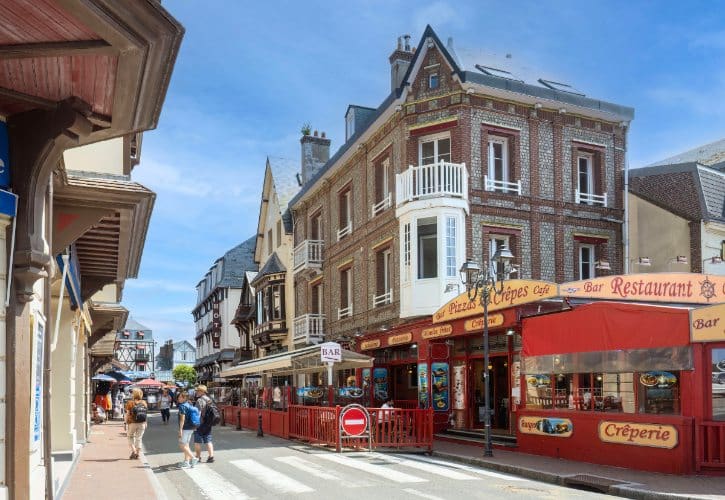
Every year, millions of travelers cross the causeway to Mont Saint Michel, snap their photos, and move on. Many leave without discovering the rest of Normandy and the breathtaking places waiting beyond it.
Just beyond that famous tidal bay, you will find dramatic chalk cliffs, historic fishing harbors, flower-filled villages, elegant seaside towns, and quiet countryside.
There are working waterfronts, distinct regional architecture, and cobbled streets full of small details most visitors never slow down to notice.
Let’s start with a coastline that looks almost too dramatic to be real. 😊
1. Étretat
a. The Famous Cliffs
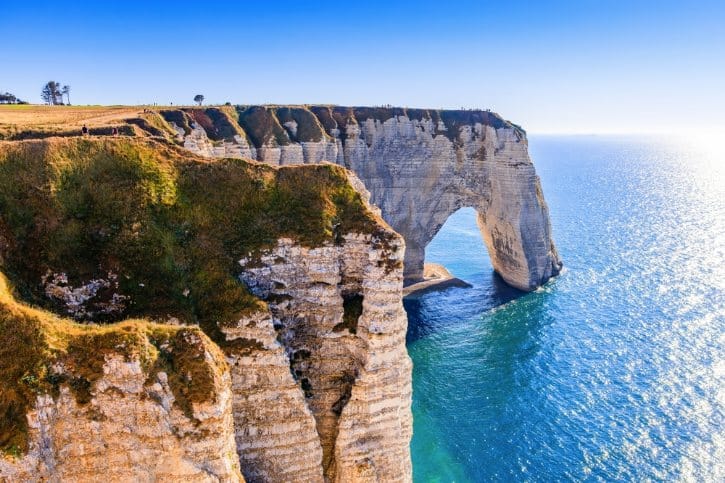
Étretat is all about its white chalk cliffs on the Alabaster Coast. Four formations shape the view:
- Porte d’Aval: a huge natural arch reaching into the sea on the western side.
- L’Aiguille: a 51-meter chalk needle rising just beyond it.
- La Manneporte: an even bigger arch farther west.
- Falaise d’Amont: the eastern cliff, topped by a small chapel.
b. The Best Viewpoints
Do not settle for one photo. From the center of the pebble beach, the bay is framed by Falaise d’Amont and Porte d’Aval. Climb the eastern cliff for views over the town’s slate roofs, or follow the GR21 path west for dramatic angles down onto L’Aiguille and La Manneporte.
c. The Seafront and Streets
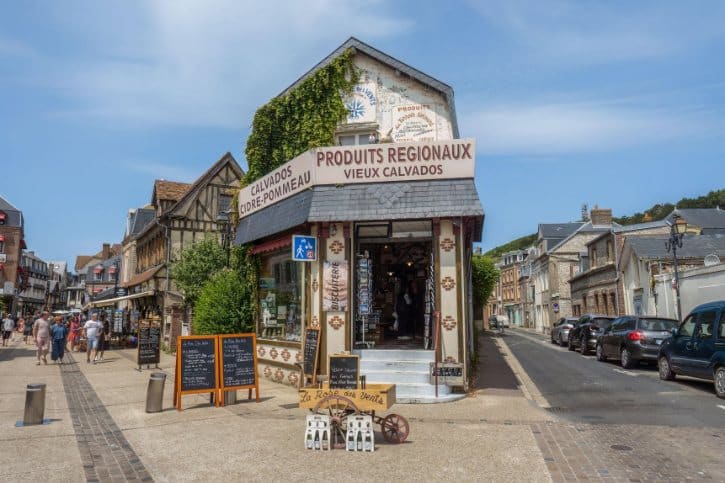
The seafront promenade, Le Perrey, runs between town and beach, with old thatched fishing shelters called caloges along it. Behind it, wander Rue Alphonse Karr toward the market, quieter Rue Monge for local houses, and Place Foch, home to the timber-framed covered market Les Halles, built in 1926.
d. Beyond the Cliffs
For something different, visit Les Jardins d’Étretat, avant-garde gardens on the eastern heights that frame the sea through sculpted topiary. Fans of a good mystery will enjoy Le Clos Lupin, the former home of Maurice Leblanc, creator of Arsène Lupin. Look too for the villa La Guillette and the Neo-Gothic Château des Aygues.
2. Honfleur
a. The Vieux Bassin
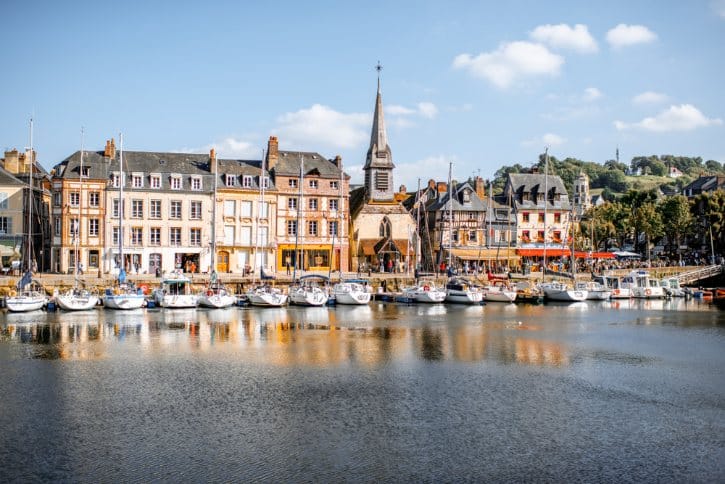
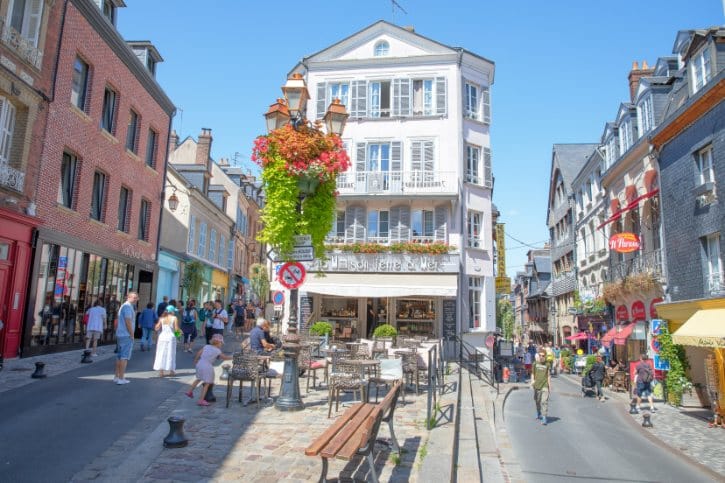
The heart of Honfleur is the Vieux Bassin, an old harbor dug in 1681. Tall, narrow slate-clad houses line the water, built upward because waterfront land was taxed by width.
Walk the full loop, because the façades and reflections change from each quay. In early morning, the calm water turns into a mirror.
b. The Quays
Each quay has its own character:
- Quai Sainte-Catherine: the busiest, lined with galleries and cafés.
- Quai Saint-Étienne: historic stone buildings and the Maritime Museum.
- Quai de la Quarantaine: wider views toward the estuary.
Nearby, La Lieutenance, the last piece of the old fortifications, still guards the harbor entrance.
c. The Wooden Church
Just inland is Place Sainte-Catherine and its remarkable Church of Sainte-Catherine, built almost entirely of wood in the late 1400s by local shipwrights. Look for the twin ceilings shaped like upside-down ship hulls, the heavy oak columns, and the separate chestnut-shingle bell tower, built apart to reduce fire risk.
d. Old Streets and High Ground
Behind the water, explore lanes like Rue de la Prison, Rue des Lingots, and Rue Haute, full of half-timbered houses and galleries. Then climb to Mont Joli for views over the rooftops, estuary, and the Pont de Normandie, and visit the sailors’ chapel Notre-Dame de Grâce, hung with model ships.
e. Jardin des Personnalités
End at the Jardin des Personnalités near the estuary, a peaceful park of boat-shaped garden bowers. Each holds a bronze bust of someone tied to Honfleur, including painter Eugène Boudin, composer Erik Satie, and explorer Samuel de Champlain.
3. Veules-les-Roses
a. Follow the River
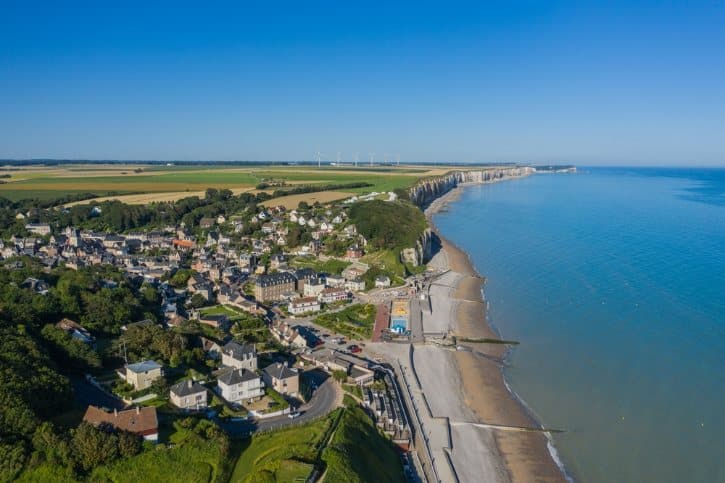
This village is built around the River Veules, France’s shortest sea-bound river at just 1,149 meters.
A public path follows it from its springs to the sea, and walking the whole route is the best thing to do here. It carries you past watercress beds, mills, cottages, and gardens before reaching the beach.
b. Mills and Watercress
Along the way, look for:
- Les Cressonnières, spring-fed watercress beds worked since the 14th century.
- Moulin du Gu, with its large wooden wheel against flint-and-brick walls.
- Old stone sluices and channels that once powered up to eleven mills.
View the watercress only from the public railings.
c. Cottages and Streets
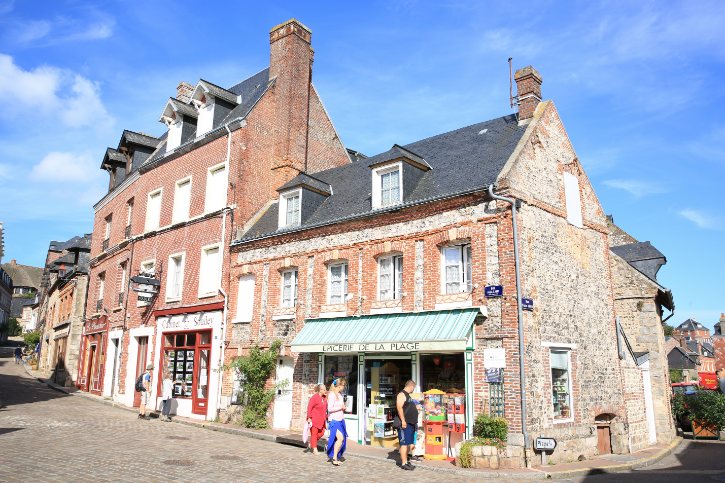
The village shows classic Caux-region styles: low thatched cottages with irises along their roof ridges, and houses banded in black flint and red brick. Narrow lanes cross the river on small stone bridges framed by climbing roses and hydrangeas. Watch for lovely small scenes, a bridge and flowers, or a water wheel beside a cottage.
d. The Seafront
Where the river reaches the sea, it slips through a gap in the cliffs onto the shore. At high tide, waves hit a steep pebble bank below white chalk cliffs. At low tide, the sea pulls back to reveal wide wet sand and rock pools. Early 1900s villas line the cliffs, and offshore oyster beds appear beyond the low-tide mark.
4. Beuvron-en-Auge
a. The Central Square
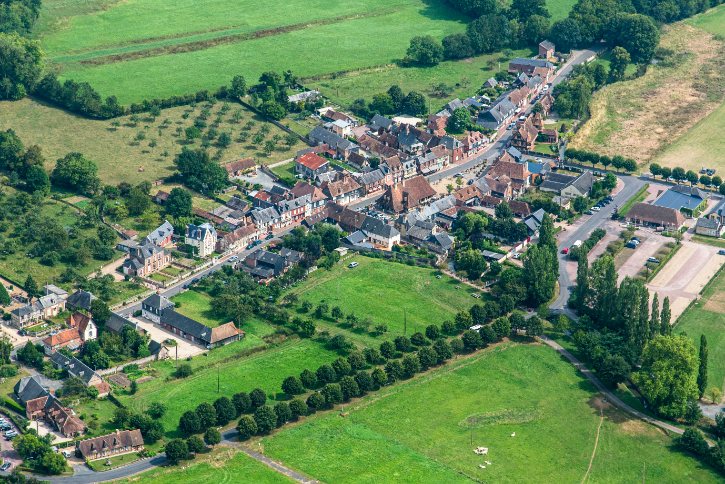
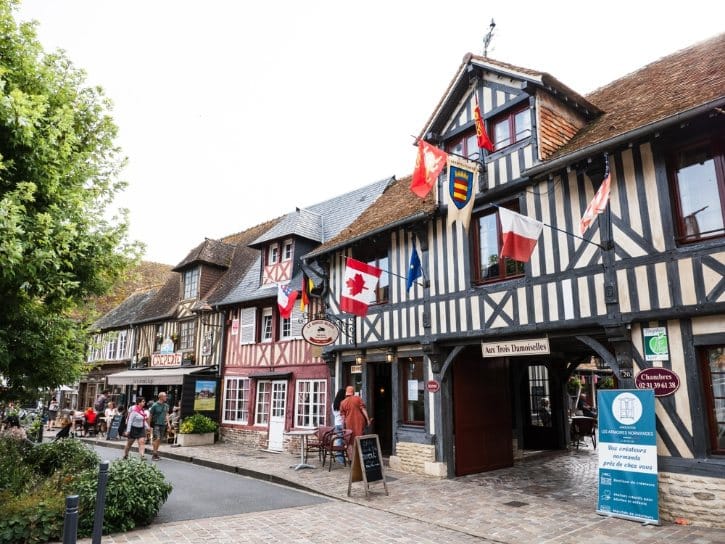
Beuvron-en-Auge, one of the Most Beautiful Villages of France, centers on Place Michel Vermughen. A rebuilt wooden covered market hall anchors the square, framed by half-timbered buildings beautifully restored from the 1970s onward.
Look up at the rooflines, dormers, and beams, and notice the patterned brick and clay-cob infill between the oak frames.
b. Historic Buildings
A few standouts to find:
- Le Vieux Manoir, a 15th-century manor with carved oak corner posts and overhanging upper floors.
- L’Auberge de la Boule d’Or, an 18th-century coaching inn with red-brick infill.
- Saint-Martin Church, a 17th-century parish church with an ornate interior altarpiece.
c. Streets and Artisans
Wander beyond the square down lanes like Rue de l’Enfer and Rue de la Catouillette, where timber houses give way to orchards and pastures. Around the village, active artisan studios fill old civic buildings, with cabinetmakers, potters, and leatherworkers you can often watch at work.
d. Orchards and a Wider View
The surrounding Pays d’Auge is apple country, the source of protected Cidre Pays d’Auge, Calvados, and Pommeau. For a wider view, take a short public footpath up the hills near the Chapelle Saint-Michel de Clermont, where the village appears as a tight cluster of tiled and slate roofs among green hedgerow pastures.
5. Barfleur
a. The Tidal Harbor
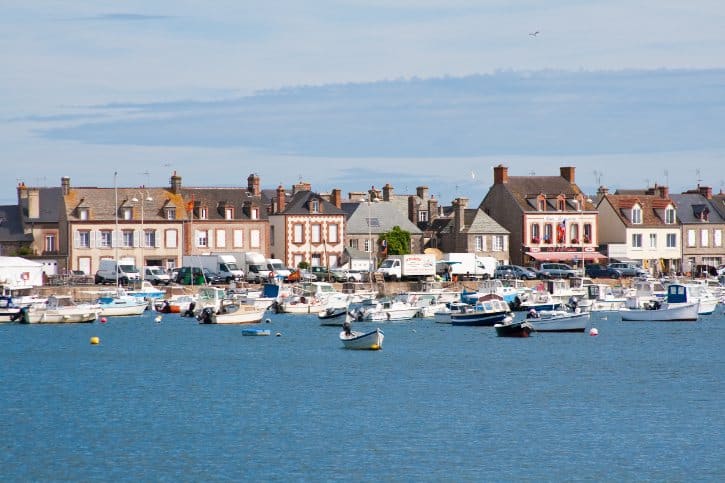
Barfleur, another Most Beautiful Village, is a granite fishing port ruled by big tides. Its harbor is a tidal grounding harbor, so the water drains twice a day.
At high tide, boats float and mirror the stone houses. At low tide, they rest on their keels on the exposed harbor bed. The view changes every hour.
b. The Quays
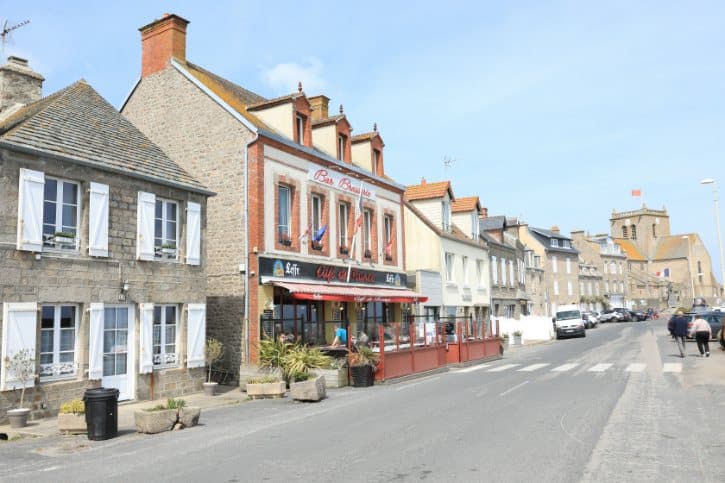
Walk Quai Henri Chardon and Quai Henri II for front-row views of working fishing life:
- Lobster traps, mussel crates, coiled ropes, and drying nets.
- Small trawlers built for the tough Cotentin currents.
- Heavy granite quay blocks and old fishermen’s houses.
c. The Church and Coast
At the seaward point stands the granite Church of Saint-Nicolas, with a fortress-like square base, an octagonal upper tower, and a marine cemetery whose gravestones face the sea. A narrow public lane beside it opens onto ocean views, with the distant Gatteville Lighthouse on the horizon and mussel-covered reefs at low tide.
d. Granite Streets and Seafood
Explore lanes like Rue Saint-Thomas and Cour du Vieux Château for carved granite door lintels dated to the 1700s and bright painted shutters. Barfleur is famous for wild mussels called La Blonde de Barfleur, grown on natural offshore beds. A monument near the harbor marks where William the Conqueror sailed for England in 1066.
6. Le Tréport
a. The Cliff-Top Panorama
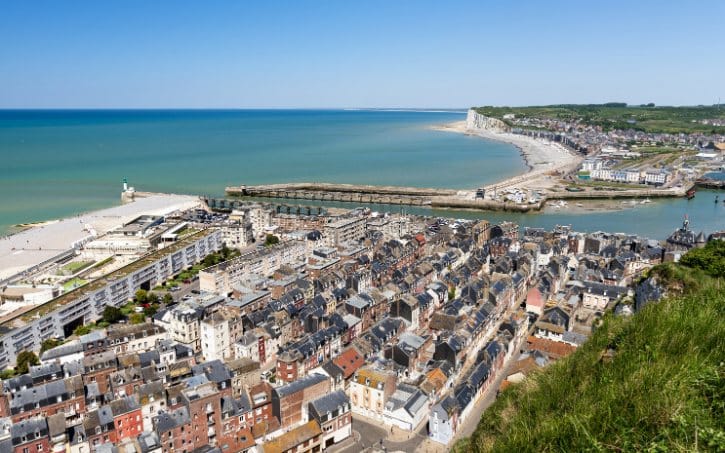
Le Tréport is squeezed between tall chalk cliffs, a harbor, and the sea. From the cliff-top plateau, reached by trail, stairway, or funicular, you look down on packed slate roofs against the chalk, across the harbor, and over to the colorful villas of Mers-les-Bains on the far bank.
b. The Funicular and Cordiers District
Ride the funicular, first built in 1908, which runs through tunnels cut straight into the cliff. At the base sits the Quartier des Cordiers, the old fishermen’s quarter.
Walk Rue de la Tour or Rue de la Commune de Paris to see tall, narrow houses with colorful brick, floral ceramic tiles, and iron balconies, framed by the cliff behind.
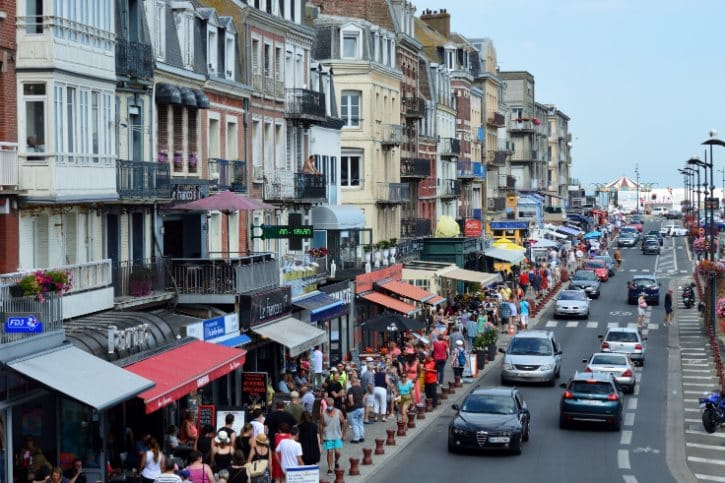
c. The Port and Beach
Le Tréport has a busy working port. Along Quai François 1er, watch trawlers unload and fishmongers sell the fresh catch at the Halle aux Poissons. The wide pebble beach has a boardwalk, and a long stone pier reaches out to a green-and-white harbor light, with fine views back toward the cliffs.
d. History to Add In
Two extra stops enrich a visit: the flamboyant Gothic Church of Saint-Jacques, and the Kahl-Bürg, a World War II bunker system of 270 meters of tunnels dug into the cliffs, open by guided tour.
7. Deauville
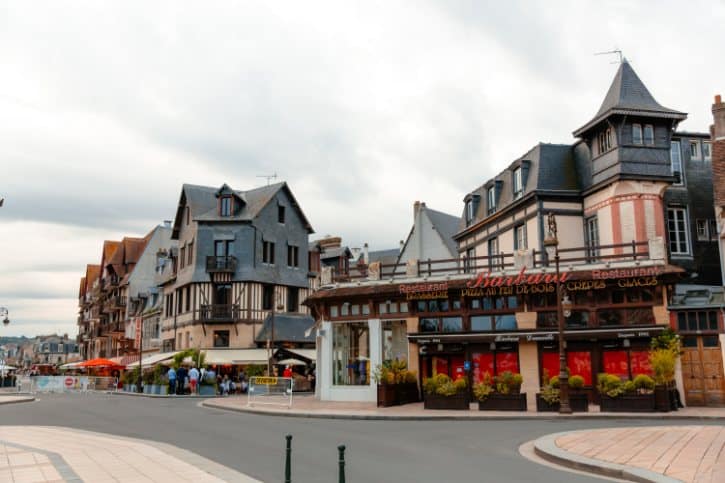
a. Les Planches and the Beach
Deauville is Normandy’s elegant planned resort. Its icon is Les Planches, a wooden beach boardwalk from 1923. Alongside it, Art Deco beach cabins carry the names of film stars, painted on since the Deauville American Film Festival began in 1975. Walk its length for changing views of wood, sand, and sea.
b. Art Deco and Villas
Behind the boardwalk sits the Établissement des Bains de Mer, an Art Deco bathing complex with mosaics, concrete screens, and stylish lettering. Around town, admire grand villas from the public street:
- Villa Strassburger (1907), with turrets and steep slate roofs.
- Hôtel Normandy (1912) and the Casino de Deauville (1912).
- Villa Le Cercle (1873), in Second Empire style.
c. Town Center and Marina
Place Morny is the octagonal town-center square, with eight radiating avenues, a fountain, and café terraces. Nearby, the ornate half-timbered Marché Couvert shows a more everyday side, with Norman cheeses and cider. Walk the quays of the Bassin Morny marina for calm reflections and views toward Trouville.
d. Horses and Cinema
Horses are part of Deauville’s soul. Time an early low tide to catch racehorses training on the wet sand, a truly iconic sight. The town also starred in the 1966 film A Man and a Woman, and cinema turns up everywhere, from the festival to the names on the cabins.
8. Caen
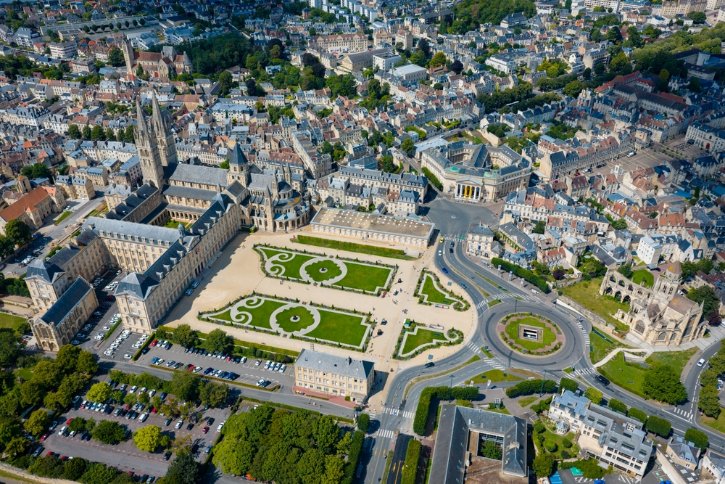
a. The Castle at the Heart of the City
Caen is the historic city of William the Conqueror, and its centerpiece is the Château de Caen, one of the largest medieval fortresses in Europe.
William began building it around 1060 and made it his main residence. Walk the ramparts for wide views over the city rooftops, the spire of Église Saint-Pierre, and the Abbaye aux Hommes in the distance.
b. Museums Inside the Walls
The castle grounds hold two excellent museums:
- Musée des Beaux-Arts: a fine arts museum with works by Monet, Boudin, and Courbet, and a sculpture garden out front featuring Rodin and Bourdelle.
- Musée de Normandie: the region’s story, from prehistory to rural traditions.
Also within the walls are the small Église Saint-Georges and the Échiquier (Exchequer), a rare stone hall from the late 11th century.
c. William and Matilda’s Two Abbeys
Caen has two great abbeys, founded by William the Conqueror and his wife Matilda in the 11th century and set at opposite ends of the old town.
- Abbaye aux Hommes (Abbey of Saint-Étienne): a Romanesque masterpiece that holds William’s tomb and now serves as Caen’s town hall.
- Abbaye aux Dames (La Trinité): founded by Queen Matilda, with her tomb, a remarkable crypt, and a peaceful French-style garden.
d. The Old Streets and Vaugueux Quarter
Wander the historic center for the ornate Gothic Église Saint-Pierre, the Renaissance Hôtel d’Escoville (now the tourist office), and the Maison des Quatrans on Rue de Geôle, one of Caen’s oldest houses.
The lively Vaugueux quarter, along Rue du Vaugueux, keeps its medieval Caen-stone houses and fills with restaurants and bars in the evening. Edith Piaf’s grandparents once ran a café here, and the nearby city-center marina makes for a relaxed waterside stroll.
e. The Mémorial de Caen
The Mémorial de Caen is one of Europe’s most powerful history museums. Opened in 1988, it traces the 20th century with a focus on the Second World War and the Battle of Normandy, using films, a 360-degree cinema, and memorial gardens dedicated to the Allied troops. It also makes a natural starting point for the nearby D-Day landing beaches.
9. Lyons-la-Forêt
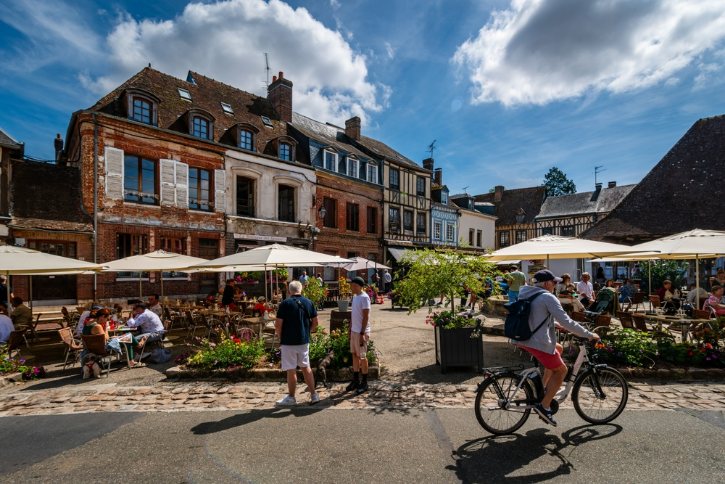
a. The Market Square
Lyons-la-Forêt is a timber-framed village wrapped in a great beech forest. Its heart is Place Isaac Benserade, anchored by an 18th-century covered market of heavy oak beams. Sit at a café terrace and take in the warm pink-and-red brick, half-timbering, and climbing flowers on the houses around you.
b. The Historic Village
The streets curl around the mound where a castle once stood. Notable buildings to find:
- The Ancien Bailliage, the former court with old jail cells on the ground floor.
- Hôtel de la Maréchaussée, a grand 18th-century residence.
- Rue du Rempart, which follows the line of the old medieval defenses.
c. River and Literary Corners
Along the Lieure river sit old watermills and the 15th-century Saint-Denis Church, with its checkerboard flint-and-stone walls. The pretty lane Rue du Bout du Bas is lined with half-timbered cottages and flower boxes, and holds La Huchette, where composer Maurice Ravel lived and worked. The village also played the town in two film versions of Madame Bovary.
d. The Forest of Lyons
All around lies the Forêt de Lyons, one of Europe’s finest beech forests at over 10,700 hectares. Walk the marked trails or visit the Arboretum des Bordins to feel the tall, straight beech trunks rising like cathedral columns, with light filtering through golden leaves.
10. Trouville-sur-Mer
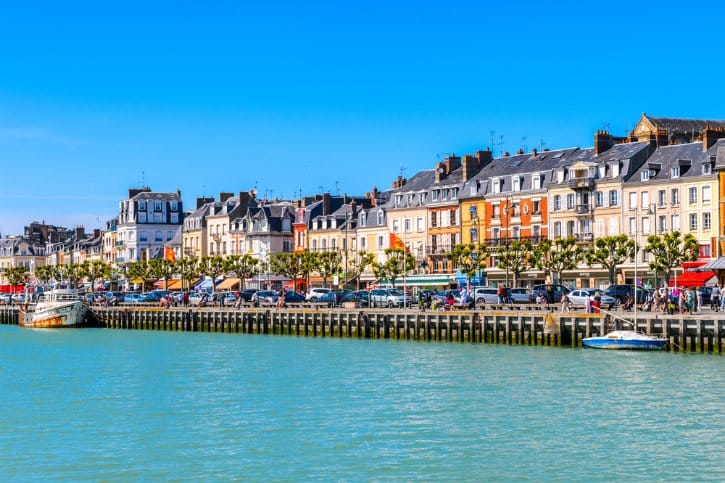
a. The Fishing Port
Across the estuary from Deauville, Trouville has an older, lived-in feel. Start at its working fishing port along Boulevard Fernand Moureaux, where real trawlers dock and unload.
Watch the boats move through the channel, the gulls circling, and the crews at work, with Deauville’s piers just across the water.
b. The Fish Market and Rue des Bains
On the same boulevard stands the Halle aux Poissons, a 1936 Neo-Norman fish market with half-timbered gables and a corner turret, rebuilt after a 2006 fire. Inside, fishmongers sell oysters, scallops, and crab.
Nearby, pedestrian Rue des Bains is the town’s lively spine of bakeries, cheese shops, and cafés. Look above the shopfronts for 19th-century details.
c. Beach and Belle Époque Villas
Trouville’s wide sandy beach runs beside Promenade Savignac, a boardwalk from 1867. Grand villas rise along the front and hills, including the 1866 Hôtel des Roches Noires, painted by Monet, and the 1865 Villa Montebello, now the town museum. Climb the sloped streets up to Villa Montebello for elevated estuary views.
d. Savignac and Street Art
Trouville has a playful, artistic side thanks to poster artist Raymond Savignac, who lived here for decades. Large murals of his famous posters appear on walls around town and along the promenade, alongside contemporary street art.