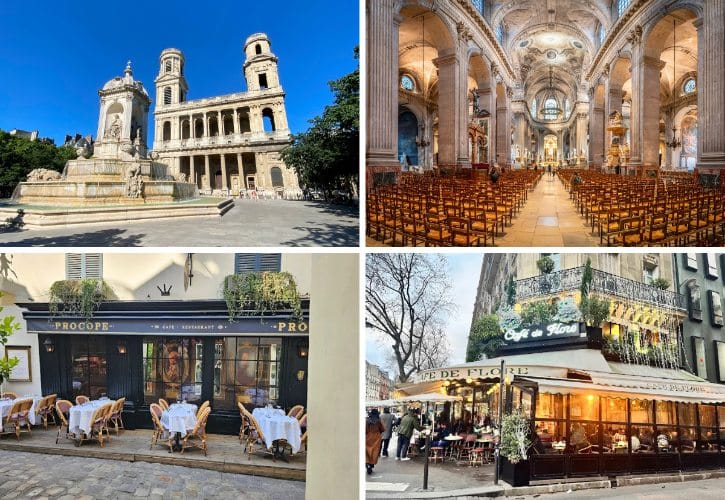
Saint-Germain-des-Prés is one of the best neighborhoods in Paris for a slow, unhurried walk. It is not just about one famous church or one legendary café.
The area is layered with gardens, bookish side streets, pastry shops, old theaters, grand boulevards, and quiet corners that reward you for slowing down.
If you are the kind of traveler who would rather pause at a fountain, linger over a pastry, or notice an old doorway than rush through a checklist, this walk is for you.
Here are 12 stops worth savoring. 😊
1. Jardin du Luxembourg
Why Visit
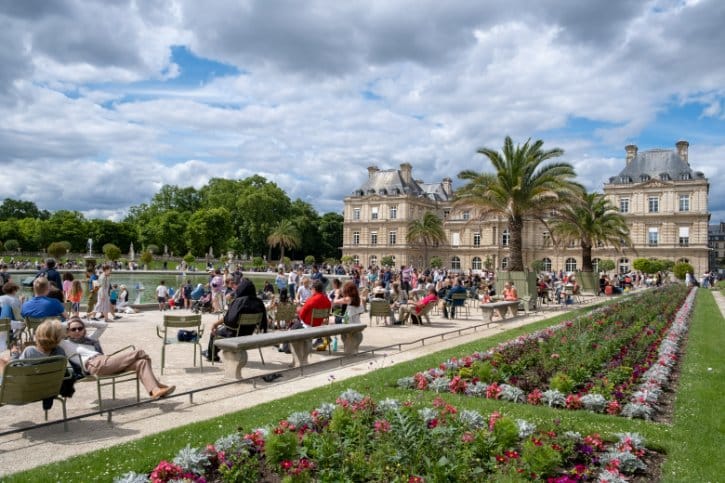
This 25-hectare garden is the perfect place to ease into the neighborhood.
Created in 1612 by Queen Marie de Médicis, it blends formal French landscaping with a more relaxed English garden section.
The Luxembourg Palace at its edge now houses the French Senate, while the grounds remain open to the public.
What to Notice
- Over 100 statues, including a series of 20 marble queens and notable women of France
- The Medici Fountain, tucked beneath ancient plane trees
- The famous green metal chairs, free to use since 1974, scattered around the central basin
Tips
- Arrive early in the morning for a quiet start. The garden opens between 7:30 and 8:15 AM depending on the season.
- Do not rush this stop. Sit, wander, and watch the model sailboats on the water before heading into busier streets.
From the northern gates, you will step directly into Place de l’Odéon.
2. Odéon Théâtre de l’Europe
Why Visit
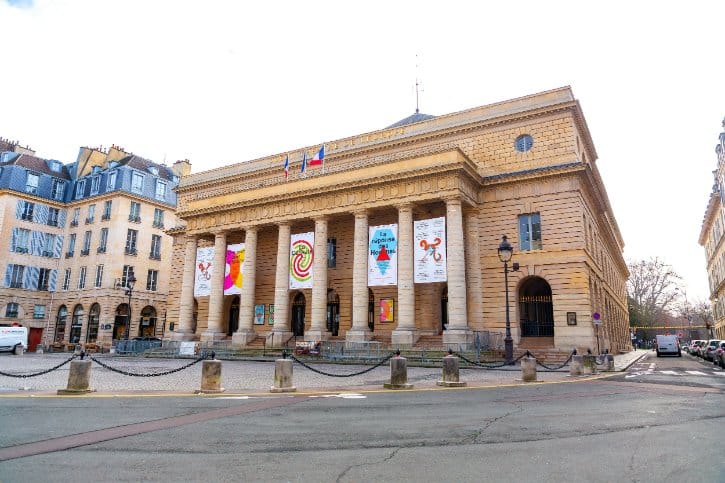
This neoclassical theater was the first building in Paris designed specifically as a theater.
Inaugurated by Marie-Antoinette in 1782, its Doric columns and arched façade still anchor the elegant semicircular plaza around it.
What to Notice
- The radiating street pattern, designed to emphasize the theater’s civic importance
- The refined, literary atmosphere of the surrounding streets
Tips
- This works best as a quick visual stop. Admire the exterior from the square.
- If you are interested in performances, the theater now focuses on contemporary and international works.
A five-minute walk west brings you to Église Saint-Sulpice.
3. Eglise Saint-Sulpice
Why Visit
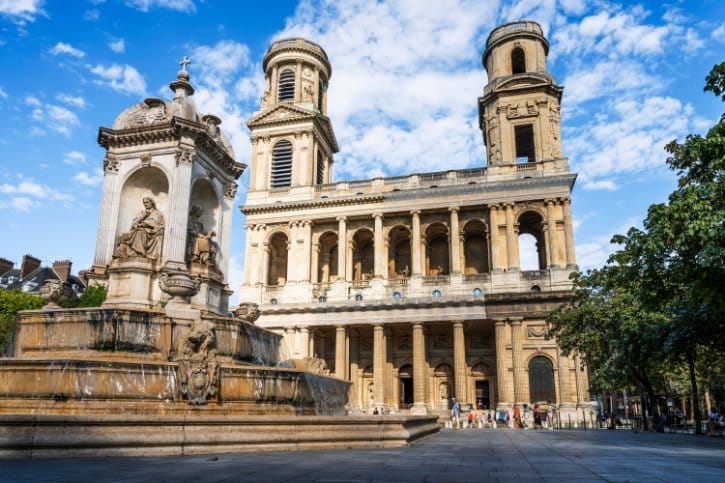
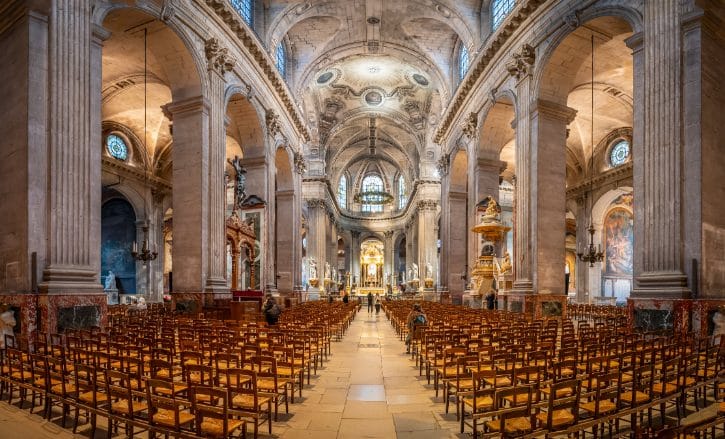
The second-largest church in Paris after Notre-Dame, Saint-Sulpice took 224 years to build.
That long history left it with a fascinatingly imperfect character, including two mismatched towers.
The northern one is taller and more ornate, while the southern tower was never finished.
What to Notice
- Delacroix’s murals in the Chapel of the Holy Angels, including Jacob Wrestling with the Angel
- Two enormous holy water fonts made from halves of a giant clam shell, gifted to King Francis I by the Venetian Republic
- The Gnomon, an 18th-century astronomical instrument that uses sunlight to mark the solstices and equinoxes
- The grand organ by Aristide Cavaillé-Coll, one of the most significant in the world
Tips
- Far less crowded than the most famous Paris churches, making it ideal for a quiet, reflective break.
- Take time inside rather than treating it only as a photo stop. The square outside is also worth a pause.
From Place Saint-Sulpice, walk a few steps to Rue Bonaparte.
4. Pierre Hermé
Why Visit
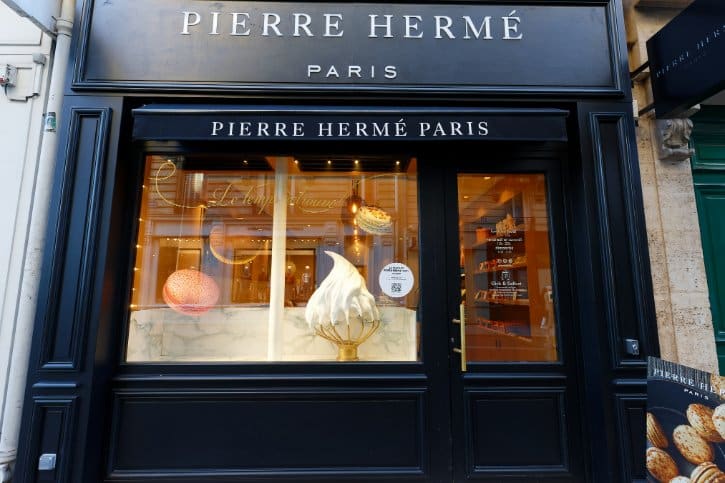
At 72 Rue Bonaparte sits Pierre Hermé’s first Parisian boutique, opened in 2001.
Often called the “Picasso of Pastry”, Hermé is known for pushing French pâtisserie into new territory with bold, seasonal flavor combinations.
What to Try
- The Ispahan, his signature blend of rose, lychee, and raspbserry
- The Mogador, made with milk chocolate and passion fruit
Tips
- This location can be busy. Treat it as a takeaway stop if there is a crowd, and enjoy your pastry later on the walk.
- Check opening hours before planning around it. A small food moment like this makes a slow walk much more memorable.
Rue Bonaparte leads naturally toward Boulevard Saint-Germain and the famous cafés.
5. Café de Flore
Why Visit
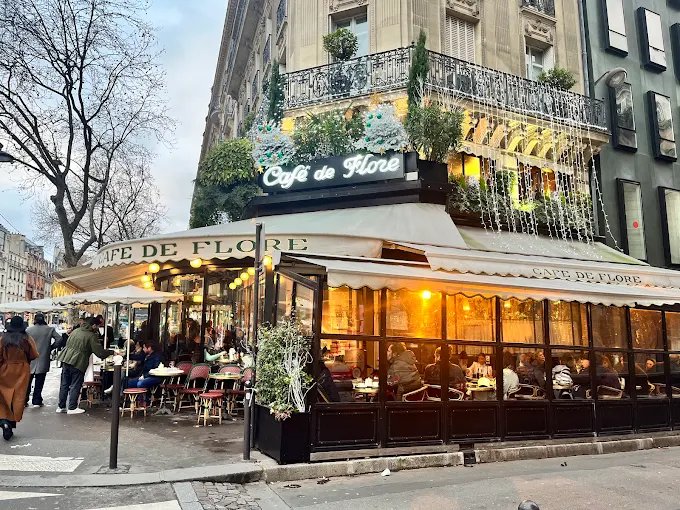
Café de Flore is one of the most iconic café stops in Saint-Germain-des-Prés.
Opened in the late 19th century, it became the working headquarters of Jean-Paul Sartre and Simone de Beauvoir during the 1940s and 1950s.
The Art Deco interior, with its red mahogany seating and large mirrors, has been carefully preserved.
What to Notice
- The famous terrace along Boulevard Saint-Germain
- The Chocolat Spécial Flore, a thick, rich hot chocolate served in a porcelain pot
Tips
- Prices are higher than ordinary cafés, but you are paying for the atmosphere.
- You do not need a full meal. A single coffee or hot chocolate is enough to enjoy the experience.
- This is less about discovering something hidden and more about experiencing the classic “see and be seen” Paris café scene.
Its eternal rival is just 30 meters away.
6. Les Deux Magots
Why Visit
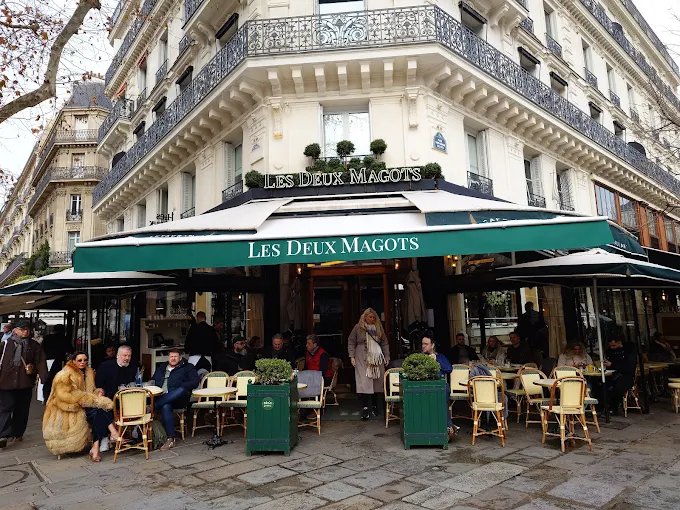
Sitting at Place Saint-Germain-des-Prés, Les Deux Magots is deeply tied to the identity of this neighborhood.
Named after two Chinese merchant statues still perched on a central pillar, it started as a silk shop in 1812 before becoming a literary café in 1885.
Where Café de Flore attracted the existentialists, Les Deux Magots was the territory of the Surrealists and the Lost Generation, including Ernest Hemingway and André Breton.
What to Notice
- The 1930s interior with brass fittings, chandeliers, and wall-length mirrors
- The terrace view looking directly across the square toward the ancient abbey church
Tips
- Good for a drink, dessert, or a short terrace stop. Expect crowds because of its fame.
- The café is known for its collaboration with Pierre Hermé for pastries and its Poilâne bread sandwiches.
- Les Deux Magots feels more anchored to the oldest part of the neighborhood than Café de Flore, thanks to its position near the church and square.
From the terrace, you are already looking at your next stop.
7. Eglise Saint-Germain-des-Prés
Why Visit
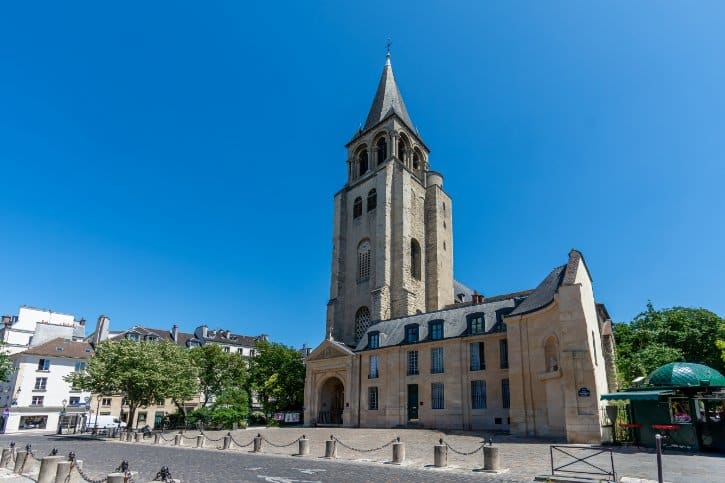
This is the oldest church in Paris, founded in 543 AD. It gave the neighborhood its name.
Originally part of a Benedictine monastery that sat “in the fields” (des prés) outside the medieval city walls, it survived Viking raids, a Revolutionary-era gunpowder explosion, and centuries of change.
Its 11th-century bell tower is one of the oldest in France.
What to Notice
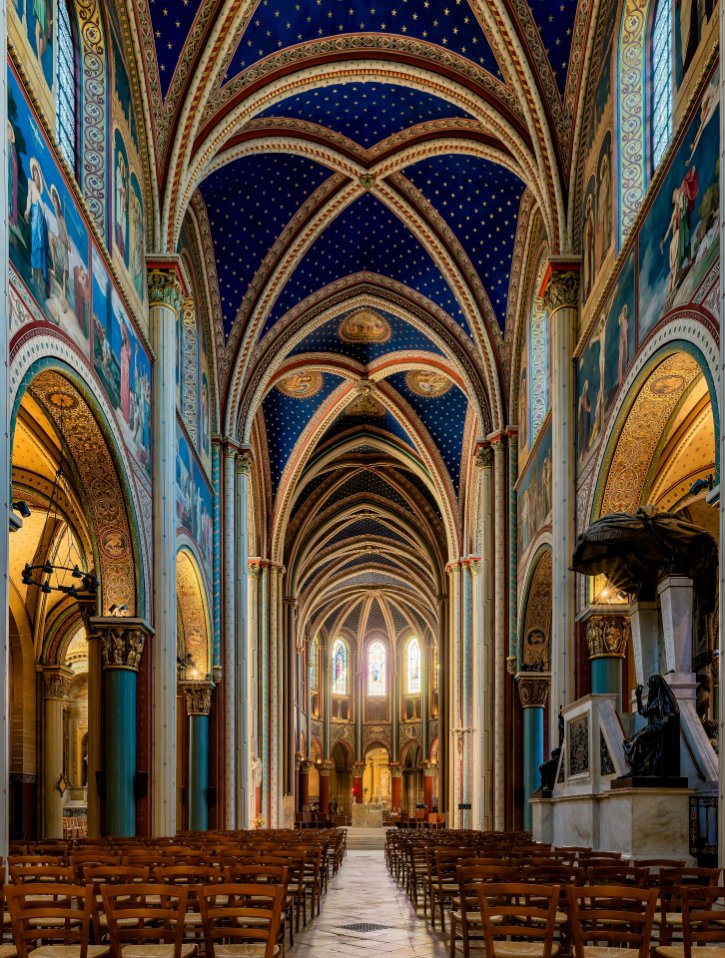
- The restored 19th-century frescoes by Hippolyte Flandrin, revealed during a major restoration completed in 2020
- Deep cobalt blue ceilings sprinkled with gold stars
- The Chapel of Saint Symphorien near the entrance, the oldest surviving part of the building
Tips
- After the energy of the cafés, this is a good place to slow down.
- Step inside if it is open. The restored interior is unexpectedly warm and colorful.
- This stop helps you understand why Saint-Germain-des-Prés feels so layered. It has roots going back nearly 1,500 years.
From the church, slip onto one of the quieter streets behind the square.
8. Rue Jacob
Why Visit
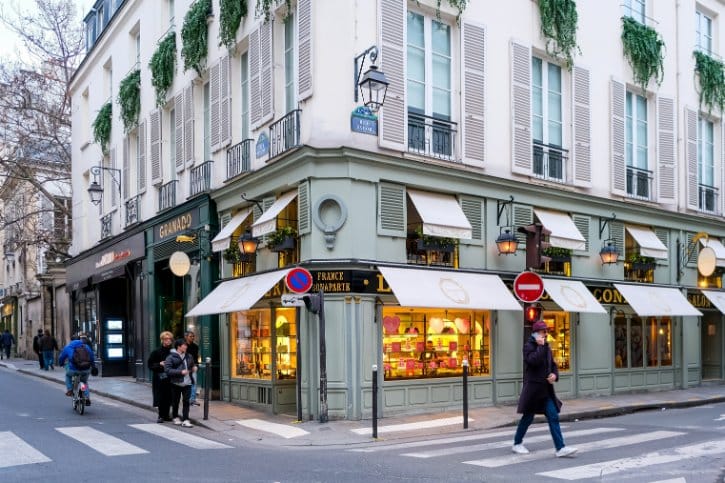
Rue Jacob captures the village-like side of Saint-Germain-des-Prés.
Lined with independent bookshops, antique galleries, and preserved townhouses with cobblestone courtyards hidden behind heavy wooden doors, it is a welcome shift after the bustle of the famous cafés.
What to Notice
- Place de Furstenberg, often called one of the most charming small squares in Paris, which leads to the Musée national Eugène Delacroix
- Number 56, where the Treaty of Paris was signed in 1783, ending the American Revolutionary War
Tips
- Walk slowly. Notice doorways, window details, and shopfronts.
- Not every stop on a walk needs to be a monument. Some streets are beautiful because of their mood and rhythm.
Rue Jacob intersects with a more artistic street just ahead.
9. Rue de Seine
Why Visit
This narrow street acts as the neighborhood’s gallery row, packed with art galleries specializing in modern masters, tribal art, and avant-garde furniture.
Walking toward the river gives you a view of the Institut de France and its famous dome.
What to Notice
- The traditional street market at the intersection with Rue de Buci, selling fresh produce, cheeses, and flowers
- La Palette, a historic café at the corner of Rue de Seine and Rue de Callot, a gathering spot for art students and painters for over a century
Tips
- Browse the galleries even if you do not plan to buy anything.
- Rue de Seine has a more social, artistic energy compared to the quieter elegance of Rue Jacob. Look down the side streets as you walk.
Continue along and you will arrive at one of the liveliest spots on this route.
10. Rue de Buci
Why Visit
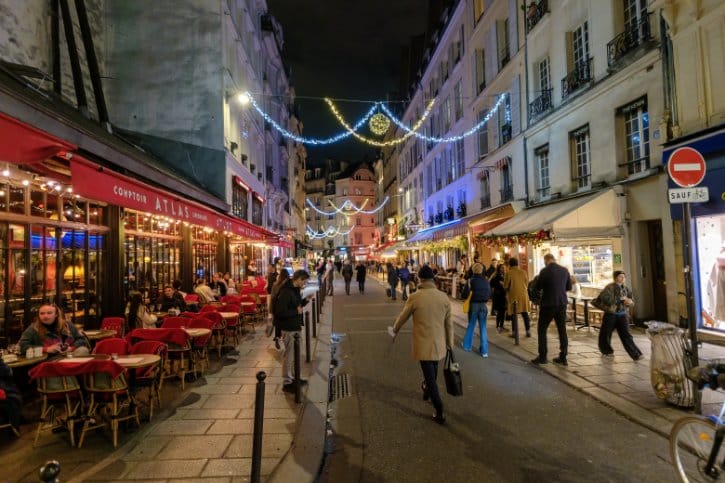
Rue de Buci brings a burst of energy to the walk. Documented as far back as 1352, this mostly pedestrian-friendly street is now a bustling stretch of café terraces, food shops, bakeries, and street musicians.
What to Notice
- Bar du Marché on the corner, a neighborhood favorite known for its red-and-white checkered awning and classic Parisian service
Tips
- Good for coffee, snacks, casual meals, or people-watching. It works well around late morning or early evening.
- It can feel busy, so enjoy the energy rather than looking for a quiet spot.
- This street adds balance to the route. A slow walk should not be only churches and famous cafés.
From Rue de Buci, take a short detour into a cobblestone passage nearby.
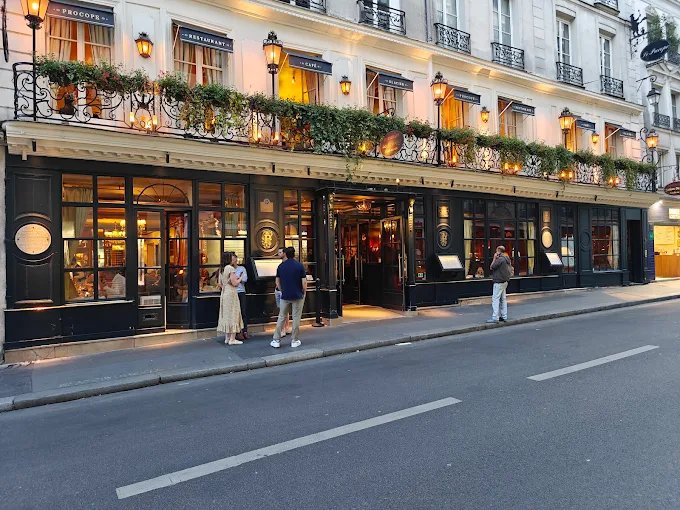
11. Le Procope
Why Visit
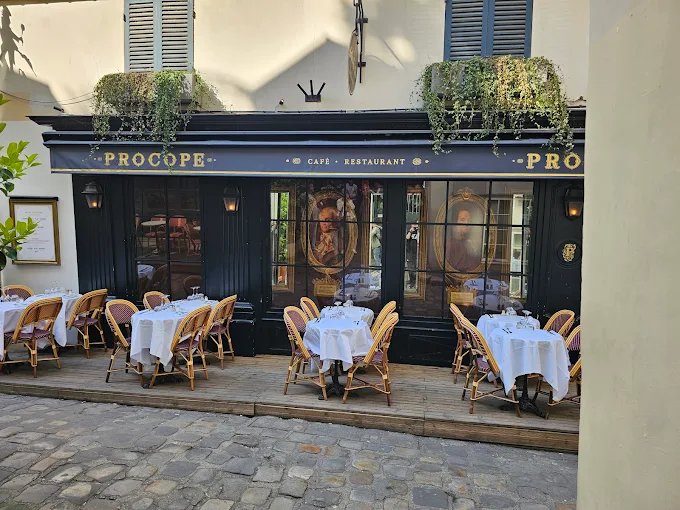
Hidden inside the Cour du Commerce Saint-André, Le Procope is the oldest restaurant in Paris, founded in 1686.
It introduced the concept of the literary café to the city, with early regulars including Voltaire, Rousseau, and Diderot.
During the French Revolution, it was a meeting ground for figures like Marat and Danton.
What to Notice
- Historical artifacts on display, including what is said to be Napoleon’s bicorne hat and Voltaire’s marble-topped writing table
- Original 1830s wallpaper and a copy of the 1789 Declaration of the Rights of Man
Tips
- Best for travelers who want a sit-down historic meal. Check menus, hours, and consider a reservation.
- Even walking past and looking into the passage adds depth to the route.
- Choose Le Procope for a historic restaurant experience. Choose Café de Flore or Les Deux Magots for a classic terrace café atmosphere.
From here, finish the walk on the grand boulevard that ties the neighborhood together.
12. Boulevard Saint-Germain
Why Visit
The walk ends on Boulevard Saint-Germain, the wide, elegant artery that Baron Haussmann carved through the Left Bank in the 1850s.
It reveals the polished, 19th-century side of the neighborhood, with high-end boutiques, grand buildings, and constant movement.
What to Notice
- Brasserie Lipp, a listed historical monument across from Café de Flore, known for its Art Nouveau ceramics
Tips
- The boulevard is busier than the side streets, so treat this as a lively finish rather than a quiet finale.
- Transport links are convenient. Saint-Germain-des-Prés (Line 4), Odéon (Lines 4 and 10), and Mabillon (Line 10) metro stations are all nearby.
- You can continue walking, stop for one more coffee, browse the shops, or head to the Seine, about 10 to 15 minutes away on foot.
Boulevard Saint-Germain ties the neighborhood together. But it is the smaller streets, the quiet courtyards, and the pastry counters that reveal the slower, more intimate side of Saint-Germain-des-Prés.