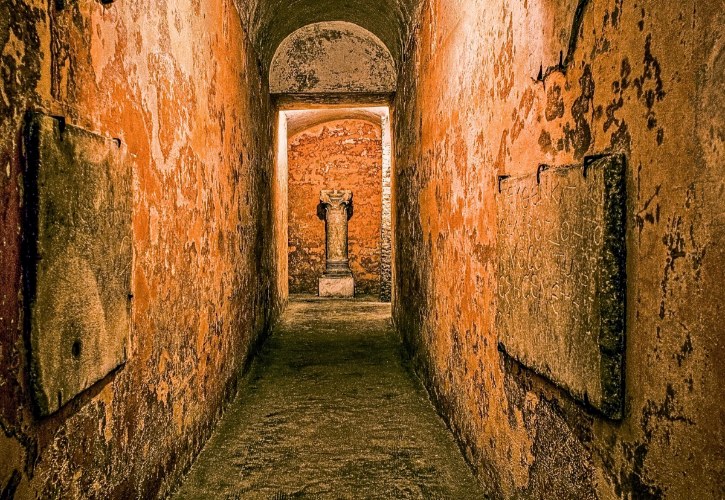
Under Rome’s busy streets and grand churches lies a hidden city. Fires, floods, and endless rebuilding buried whole neighborhoods, rich homes, secret temples, and ancient cemeteries deep in the dark.
A plain doorway or a worn church staircase is often all that stands between you and two thousand years of history waiting quietly below.
Best of all, you can walk through many of these places yourself, far from the surface crowds and the summer heat. 😊
1. Case Romane del Celio
a. A Quiet Hill With a Secret Below
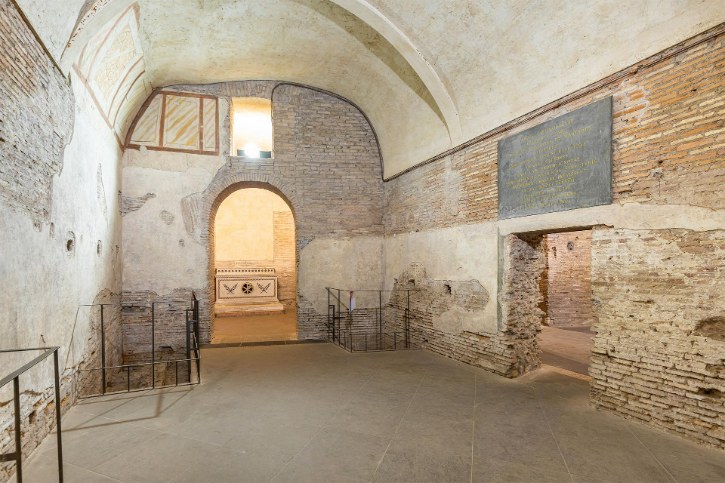
You will find this one on the calm Caelian Hill, southeast of the Colosseum, reached along the ancient Clivus Scauri road that is still crossed by medieval brick arches. Beneath the Basilica of Santi Giovanni e Paolo wait more than twenty rooms across several levels, rediscovered in 1887. Think of it as the clearest window in Rome into how ordinary people, and later wealthy ones, actually lived.
b. One Plot, Four Centuries of Change
- Started as street-level shops along a Roman road.
- Became a two-level private house with its own bath in the second century.
- Grew a tall apartment block, an insula, with flats for rent.
- Joined into one grand mansion by a wealthy owner in the third and fourth centuries.
- Sealed and saved when Senator Pammachius built the basilica on top around AD 400.
c. Frescoes You Should Not Rush Past
- Sala dei Geni: winged guardian spirits, flower garlands, and a cheerful grape harvest with cupids.
- Sala dei Finti Marmi: walls that fake costly marble, done purely with a brush.
- Sala dell’Orante: a near-perfect woman standing arms wide in prayer, framed by masks and sea creatures.
- The Nymphaeum: a wide marine scene of tiny cupids sailing and fishing around an island.
d. Good to Know Before You Go
- The frescoed halls, nymphaeum, medieval oratory, and museum are all on the standard route.
- The Confessio shrine is not part of the standard visitor route.
- You can explore alone with an audio guide, or join a guided visit.
2. Vicus Caprarius: The Water City
a. Ancient Rome, Steps From the Trevi
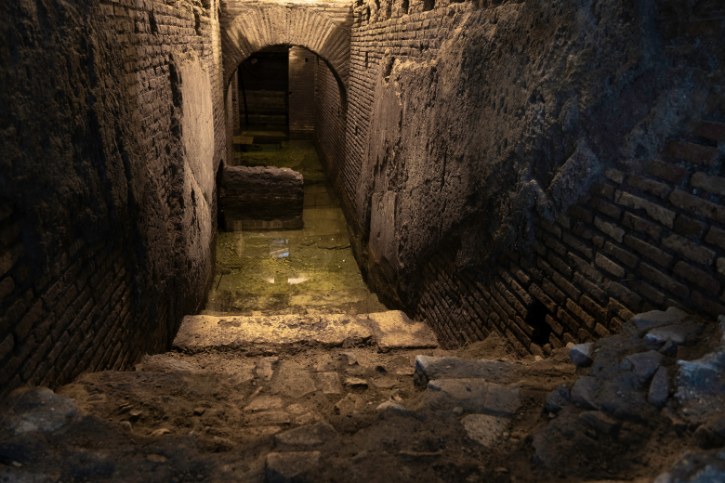
Just beside the Trevi Fountain, a plain door drops you nine meters into a preserved slice of Roman city life. Despite the catchy nickname, the site sits next to the fountain, not under its basin. After the crush of the piazza above, the cool, quiet ruins feel like a secret only you are in on.
b. Water That Never Stopped Flowing
- Fed by the Aqua Virgo, built in 19 BC and still running today.
- Engineers under Emperor Hadrian built a castellum aquae, a water tank, right here.
- Clear water still trickles audibly through the ancient channels and basins.
- You cross the ruins on raised metal walkways, so look for the old lead pipes below.
c. From Rental Flats to a Rich Home
- Began as an ordinary apartment block after the Great Fire of AD 64.
- Turned into a luxury domus in the fourth century, with private piped water.
- Fragments of mosaic, fresco, and colored marble survive from its grand days.
d. Treasures in the Little Museum
- A carved marble head often called Alexander Helios, a scholarly guess, not proven.
- Slim North African oil jars called spatheia.
- A hoard of more than 800 bronze coins, everyday small change saved one by one.
3. Basilica of San Clemente
a. Three Cities Stacked in One Spot
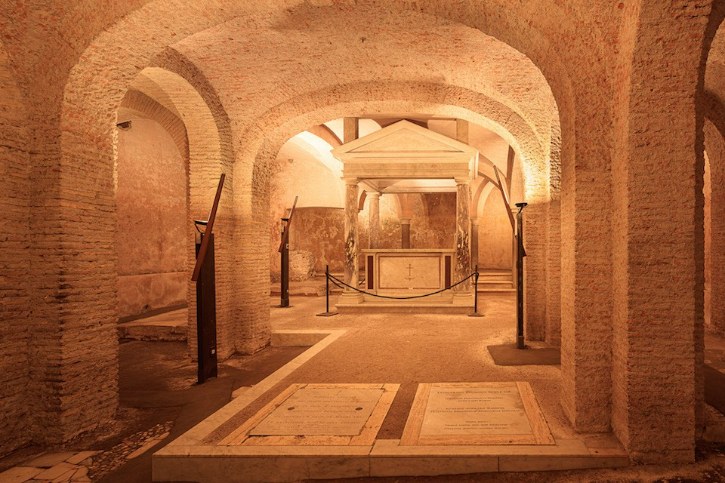
East of the Colosseum, San Clemente lets you climb down through three layers of history, from a medieval church into early Christian and then pagan Rome. A Dominican priest first dug beneath the floor in 1857, and the order still cares for the site today. Few places let you feel the passage of time so physically, one staircase at a time.
b. The Churches on the Way Down
- Top level: a twelfth-century basilica with a glowing golden apse mosaic and a marble floor.
- Middle level: a vast fourth-century church, about 45 by 25 meters, full of early frescoes.
- The Legend of Sisinnius, where an official’s street curse is one of the earliest written lines of Italian.
- A quiet chapel holding the memorial of Saint Cyril, creator of the alphabet behind Cyrillic.
c. A Hidden Temple in the Dark
- The lowest level holds a Mithraeum, a secret cave-like temple from around AD 200.
- Its marble altar shows Mithras killing a sacred bull, a symbol of renewal.
- Stone benches line the hall, where members reclined for ritual meals.
- Across a narrow alley stands a huge building, read as either an Imperial Mint or a warehouse.
d. The Sound You Will Remember
Deep below, underground water rushes beneath the oldest foundations, the same water that once flooded the dig and stopped it for years. Stand still for a moment and you can hear it moving in the dark. The upper church is free to enter, and a flight of steep stairs leads down to the two lower levels.
4. Le Domus Romane di Palazzo Valentini
a. Ancient Ruins Brought Back to Life
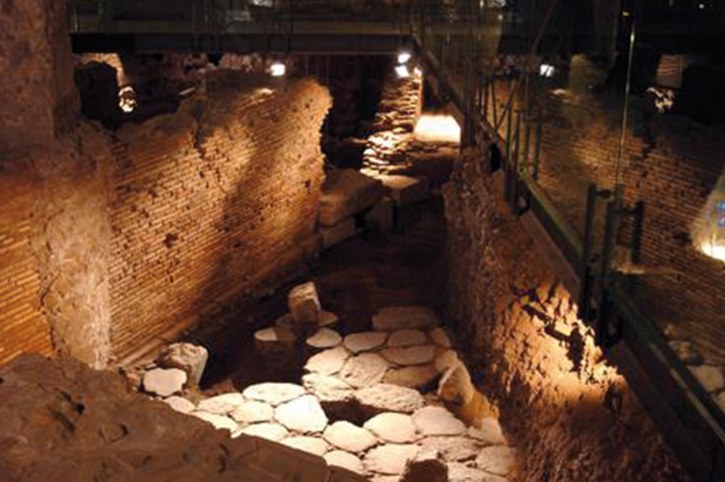
Seven meters under a grand palace beside Trajan’s Column lie two luxury Roman mansions. Instead of leaving you to puzzle over bare walls, lights, sound, and projections rebuild the vanished rooms right over the real stones as you cross glass walkways. It is the most cinematic of Rome’s underground sites, and a great choice if you are visiting with teenagers.
b. Homes Fit for Senators
- Two neighboring mansions, known simply as Domus A and Domus B.
- Peak luxury in the early fourth century, with grand halls and marble corridors.
- A famous carpet mosaic of about half a million tiny tiles, now the museum’s emblem.
- Black-and-white mosaics and walls once covered in colored marble.
c. A Private Bath and Clever Heating
- A rare private bath suite, a real status symbol in ancient Rome.
- A large cold room, the frigidarium, paved in marble.
- An exposed hypocaust, the under-floor heating system, visible below your feet.
- Projections that show hot air moving and steam rising through the rooms.
d. A Debate and a Wartime Surprise
- Massive foundations linked to a temple of Trajan and Plotina, though scholars still argue the spot.
- A real 1939 air-raid shelter beneath the courtyard, where the tour ends.
- Visits that run as timed multimedia sessions for small groups.
5. Basilica di San Crisogono
a. A Church Drowned by the River
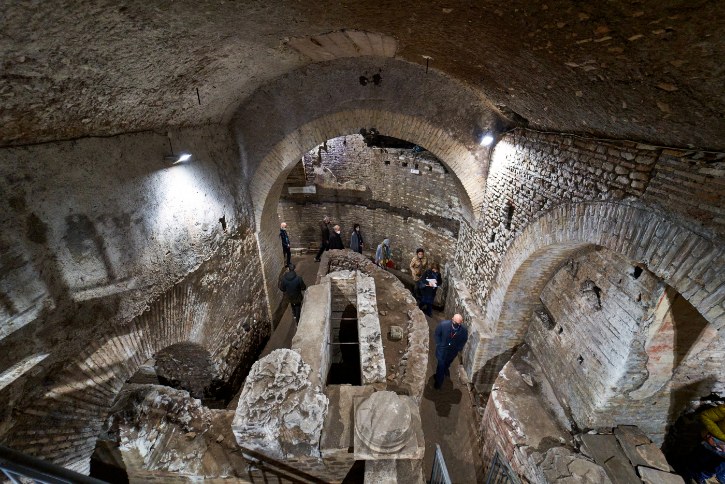
In Trastevere, below a later basilica, hides a fourth-century church worn down by Tiber floods. Builders filled it in during the 1120s and raised a new church on top. It was rediscovered in 1907, around six meters down. This is one of Rome’s quietest underground stops, so you often have the old nave almost to yourself.
b. Walking the Early Christian Plan
- Step into the broad single nave of fourth-century Rome.
- Trace the entrance porch, the curved apse, and two side rooms.
- One side room was a baptistery, with an old font cleanly sliced in half by a later wall.
- Rumors that the font reused a Roman laundry stay unproven.
c. Rare Frescoes and Ancient Tombs
- Wall paintings that survive from the eighth through eleventh centuries.
- Saint Benedict Healing a Leper, with the Latin word “Leprosus” still readable.
- Scenes of Pope Sylvester and other saints along the walls.
- Several carved marble sarcophagi, both pagan and Christian, still on view.
d. Timing Your Visit Right
Because this is still an active parish, the excavations keep limited hours that shift around church services, so it is worth checking before you go. You reach them from inside the church, where the custodian near the sacristy can let you down for a small fee, or you join a Trastevere underground tour.
6. Catacombs of Priscilla
a. The Queen of the Catacombs
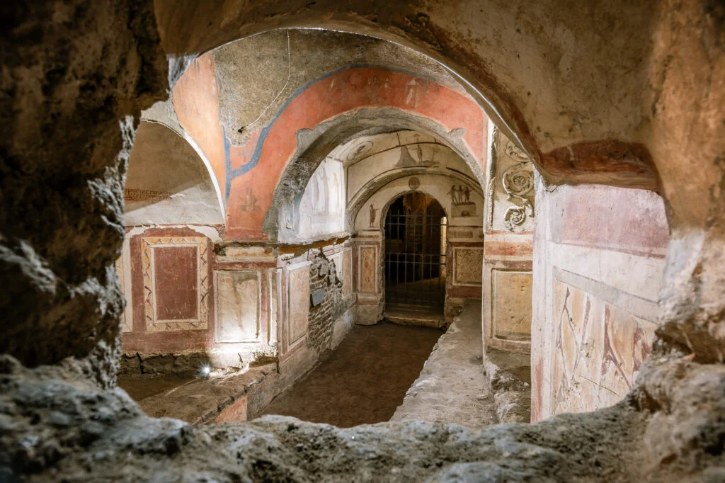
Along the ancient Via Salaria, just outside the old city walls, lies one of Rome’s greatest Christian cemeteries, carved from soft tufa rock. Over time it grew to more than 13 kilometers of tunnels holding an estimated 40,000 burials, which earned its royal nickname. You enter today through the cloister of a working Benedictine convent, which only adds to the hush.
b. How Early Christians Were Buried
- Loculi: simple wall slots for ordinary believers.
- Arcosolia: carved arched niches for wealthier families.
- Cubicula: private painted burial rooms.
- Seven popes and several early martyrs were laid to rest here.
c. Early Christian Art You Can Still See
- A tender third-century fresco, around AD 230, widely called one of the earliest images of Mary and Jesus.
- The Cubicle of the Veiled Woman, showing a woman in prayer with raised arms.
- The Greek Chapel, with its famous Fractio Panis, the Breaking of the Bread.
d. Rules to Remember
- Visits are guided only, lasting about 45 minutes along a set route.
- Photography and filming are not allowed inside.
7. Santa Cecilia in Trastevere
a. A Saint’s Story Beneath a Quiet Church
Behind a calm courtyard in Trastevere, go about five meters down and you meet a rough, everyday corner of ancient Rome. Tradition ties the church to Saint Cecilia, martyred here, though no inscription proves these exact rooms were her home. Part of the charm is exactly that tension, where devotion and plain city history sit side by side.
b. The Roman Rooms Below
- A mix of a noble house (domus) and an apartment block (insula).
- Herringbone brick floors and intact third-century mosaics.
- A small figure of the goddess Minerva from a household shrine.
c. The Mystery of the Eight Vats
- A large hall holds eight round brick vats sunk into the floor.
- Some scholars read them as grain silos or food stores.
- Others suggest an industrial tannery.
- After a century of study, no one is sure, so enjoy the puzzle.
d. The Jewel at the End
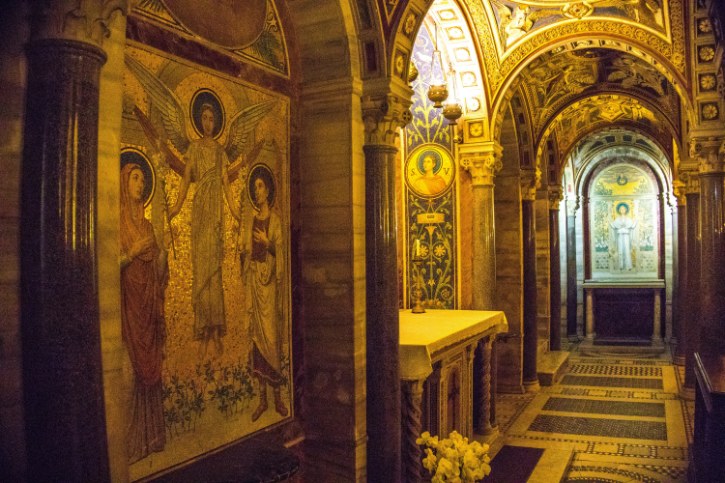
- A glittering Crypt of Saint Cecilia finishes the route, rich with mosaic columns and gilded vaults.
- It holds the relics of Cecilia and her husband Valerian.
- You request entry at the nuns’ porter’s lodge, or join a guided walk.
8. Santa Maria Maggiore Archaeological Area
a. Gold Above, Silence Below
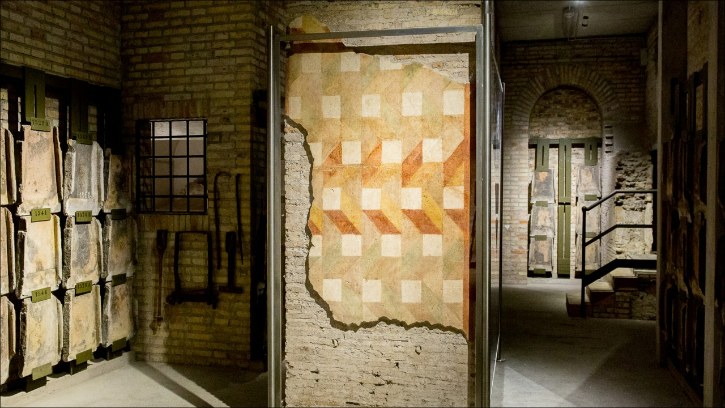
On the Esquiline Hill, below one of Rome’s grandest basilicas, lies a quiet Roman world from the first to fifth centuries. It was carefully excavated in the 1960s by archaeologist Filippo Magi, and the Vatican opened it to visitors only fairly recently. It makes a fitting final stop, with one of the most memorable climbs in the city.
b. A Roman Courtyard and Its Baths
- A wide first-century porticoed courtyard, ringed by brick rooms.
- Well-kept thermal baths, with mosaic floors and wall heating.
- Frescoes with crisp geometric patterns.
- Around 14,000 stamped terracotta roof tiles, documented and cataloged, some datable from the first to the fifth century AD, which helped archaeologists date the site.
c. Rome’s Only Painted Farming Calendar
- A rare agricultural calendar fresco, widely described as the only surviving Roman wall painting of its kind.
- A cycle that once ran about 35 meters along the courtyard walls.
- The best-preserved scenes show July and August, still visible on the path.
d. Sorting Legend From Fact
- A famous legend of a summer snowfall marking the church’s outline on August 5, AD 358.
- No fourth-century church has ever been found below, so the snowfall stays tradition rather than fact.
- The earliest building confirmed by both foundations and the golden mosaics above is the fifth-century basilica of Pope Sixtus III, which sealed the Roman courtyard below.
e. Planning Your Visit
- Entry is by guided tour only, lasting about 50 minutes.
- Children under seven are not admitted, and photo ID plus covered shoulders and knees are required.
Climbing back up from those cool, silent rooms into the blazing gold of the basilica above gives you, in a single staircase, the full vertical story of underground Rome.