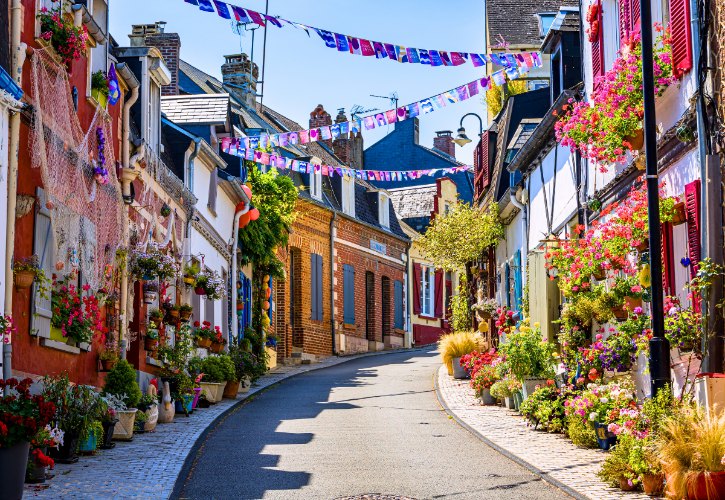
France rewards travelers who slow down and look closer. Away from the big cities, its small towns and villages each tell a different story, and no two feel quite the same.
Some grew around pottery, ochre, or wine, while others guarded a lake or a tidal coast.
What ties them together is how closely each place reflects the land around it. Here are twelve worth planning a trip around. 😊
1. Saint-Cirq-Lapopie, Occitanie
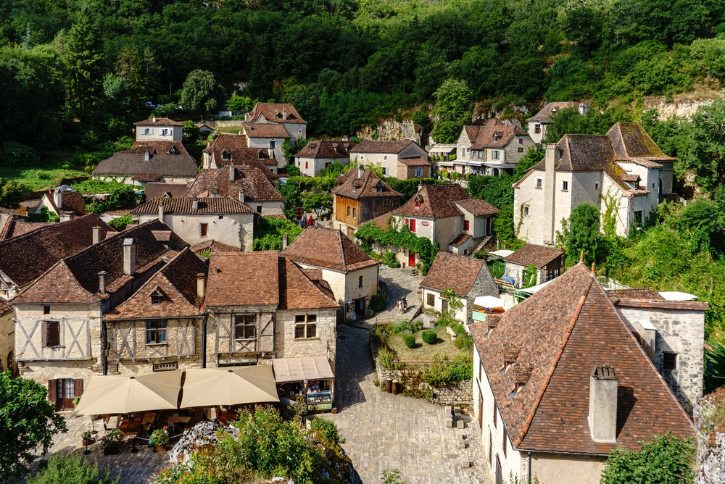
Perched on a sheer limestone cliff about 100 meters above the Lot River, this village feels carved from the rock itself. Come here for one of France’s most dramatic cliff settings, where a whole medieval town seems to grow straight out of the stone.
a. A village built by shared power
In medieval times this was a fortified stronghold split between several co-lords, which is why you see multiple fortified enclosures and towers packed into one small site. From the 13th to 16th centuries, it thrived on Lot river trade and skilled artisans, especially woodturners and leather tanners.
b. What makes the architecture special
- Ground floors in local Quercy limestone, often with pointed-arch arcades that once held workshops.
- Upper floors in timber framing that juts out over the narrow lanes.
- Steep roofs covered in flat terracotta tiles or stone slabs called lauzes.
With 13 protected historical monuments and a place among Les Plus Beaux Villages de France, the preserved heritage here is remarkable.
c. The riverside walk you should take
Just outside the village runs the Ganil Towpath, once used so tow-horses could haul barges upstream. One stretch is carved directly into the base of the cliff, and a sculptor later added a long relief into the rock face showing river creatures, fossils, and stone layers. Pairing the village with time along the river gives you the full picture.
2. Moustiers-Sainte-Marie, Provence-Alpes-Côte d’Azur
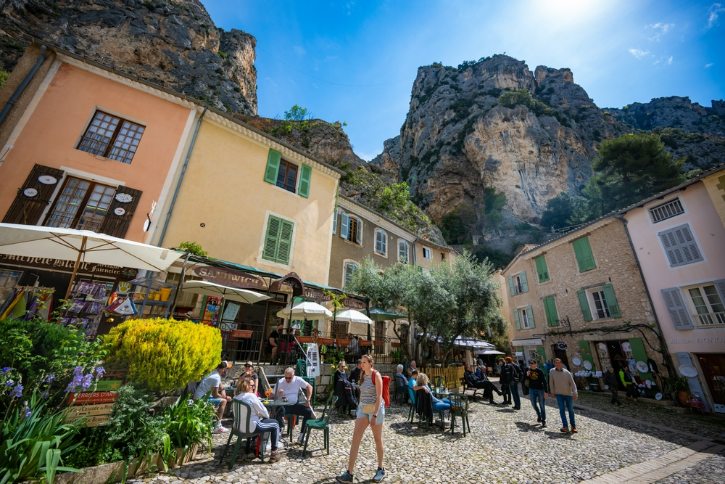
At the western gate of the Gorges du Verdon, Moustiers fills a natural amphitheater of tall limestone cliffs, split down the middle by a mountain torrent. Come for a rare combination in one small village: a spectacular gorge setting, a golden star hung high between the cliffs, and centuries of fine pottery you can still buy from working studios.
a. The golden star overhead
Strung across the 227-meter gap between the two cliffs hangs the Étoile de Moustiers, a gilded five-pointed star on an iron chain. Local legend credits a Crusader knight who vowed to hang it for the Virgin Mary if he returned home safely.
In truth its origin is undocumented, and several stars have fallen and been replaced over the centuries, so enjoy the story as legend rather than fact.
b. Churches worth the climb
- Église Notre-Dame-de-l’Assomption, with a 22-meter Romanesque bell tower and a Gothic choir.
- Chapelle Notre-Dame de Beauvoir, perched 80 meters above the village on a much older foundation.
Reaching the chapel means a steep climb of 262 cobbled steps lined by the Stations of the Cross, but the view over the rooftops and the gorge is your reward.
c. A town shaped by pottery
Moustiers is famous for its fine tin-glazed earthenware, or faïence, a craft established here in 1679. The signature look is white enamel painted in cobalt blue, ochre, and green. Working studios still produce it today, and the Musée de la Faïence holds more than 300 pieces spanning four centuries.
3. Yvoire, Auvergne-Rhône-Alpes
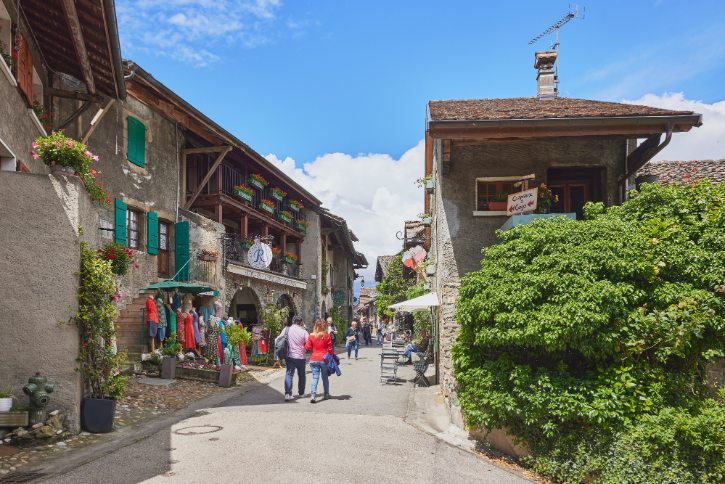
On the French shore of Lake Geneva, Yvoire is a fortified medieval port where the water is part of the experience, not just the view. It is worth the trip to wander a genuine lakeside stronghold, arrive dramatically by boat across the water, and slow down in one of France’s loveliest gardens.
a. A stronghold built to control the lake
In 1306, the House of Savoy turned a fishing village into a military post to command lake trade. You can still see that defensive past in the surviving 14th-century gates, curtain walls, and the massive square castle keep that anchors the waterfront.
The Église Saint-Pancrace adds a lighter touch with its shining onion dome, covered in stainless steel and gold leaf.
b. The Garden of the Five Senses
Set within the castle’s old kitchen gardens, the Jardin des Cinq Sens is laid out like a medieval cloister and built around each human sense:
- Touch: soft and bristly leaves.
- Smell: aromatic herbs and roses.
- Sight: structured borders of color.
- Taste: edible flowers and heritage fruits.
- Hearing: trickling fountains and birdsong.
It holds an official Jardin Remarquable label, a calm counterpoint to the fortified streets.
c. Arrive by water for the best view
Arriving by boat shows you how the village was set to guard the water, and watching its stone walls rise from the shore is the moment Yvoire’s whole identity clicks into place.
4. Rochefort-en-Terre, Brittany
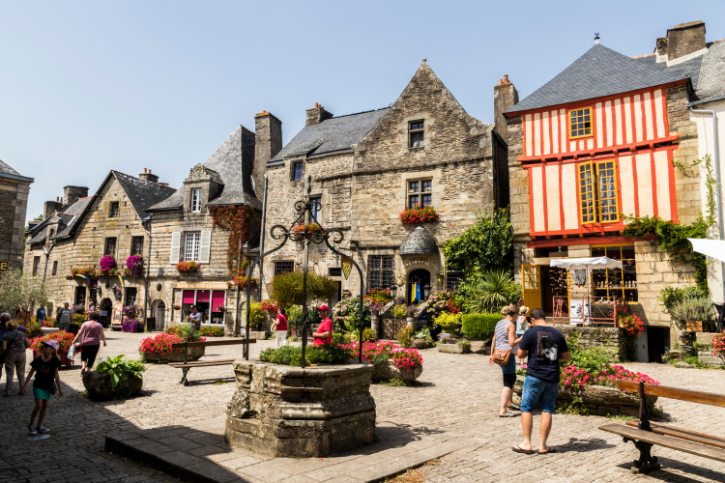
Set on a rocky rise above a Breton valley, Rochefort-en-Terre is built from dressed blue-grey granite and schist, topped with slate roofs. Come for the striking contrast of sober Breton stone softened by cascading blooms, backed by a lively community of artists and craftspeople.
a. More than a preserved village
The town began as an 11th-century feudal site, but its modern look owes a lot to one man. In 1907, American painter Alfred Klots bought the ruined castle, rebuilt part of it into an eclectic manor, and started an annual flower competition among the villagers. That contest is why the streets still overflow with geraniums and hydrangeas today.
b. What to see on foot
- Place du Puits and Place des Halles, lined with 16th- and 17th-century granite houses and an old communal well.
- Collégiale Notre-Dame-de-la-Tronchaye, with a fine Flamboyant Gothic stone calvary carved from local granite.
- Panorama des Grées, a trail over exposed bedrock with wide views of the Breton heathland.
c. Castle grounds and contemporary art
The manor interior is closed to casual visits, but you can walk the landscaped park, the medieval walls, and the vaulted cellars. Those same cellars house the Naïa Museum, dedicated to fantastic, kinetic, and digital sculpture, a very different experience from the historic stone around it. The village’s working craft studios add to the creative feel.
5. Roussillon, Provence-Alpes-Côte d’Azur
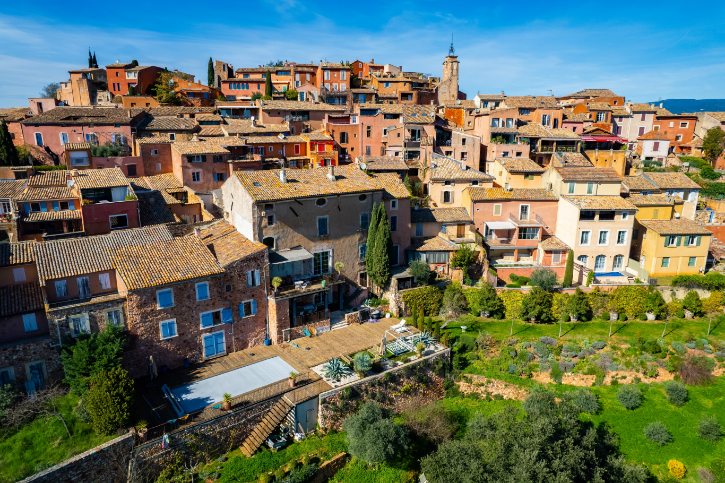
In the heart of the Luberon, Roussillon glows in more than twenty shades of natural ochre, from golden yellow through burnt orange to deep crimson. Visit to see a whole village colored by the earth beneath it, then walk right into the ochre cliffs that gave it those tones.
a. Color that comes from the ground
The whole village sits on ochre-rich earth formed around 110 million years ago. Commercial mining began in the late 18th century and peaked around 1900, exporting pigment worldwide until synthetic dyes ended most production.
Today, local rules require every facade in the historic core to use natural ochre-based washes, so the buildings blend seamlessly with the cliffs.
b. The ochre trail
The Sentier des Ocres leads out of the village into old quarries, past eroded formations known as the Fairy Chimneys and the Giants’ Causeway. Walking it is the best way to understand how one landscape gave the village both its cliffs and its colors. A word of warning: the ochre permanently stains clothing and shoes, so dress accordingly.
c. A viewpoint and an industrial story
- Place du Castrum, the highest point, with views over the ochre cliffs, the Luberon to the south, and Mont Ventoux to the north.
- Ôkhra, the ochre eco-museum, set in a former factory just outside the village, where old basins and kilns show how pigment was made.
6. Aigues-Mortes, Occitanie
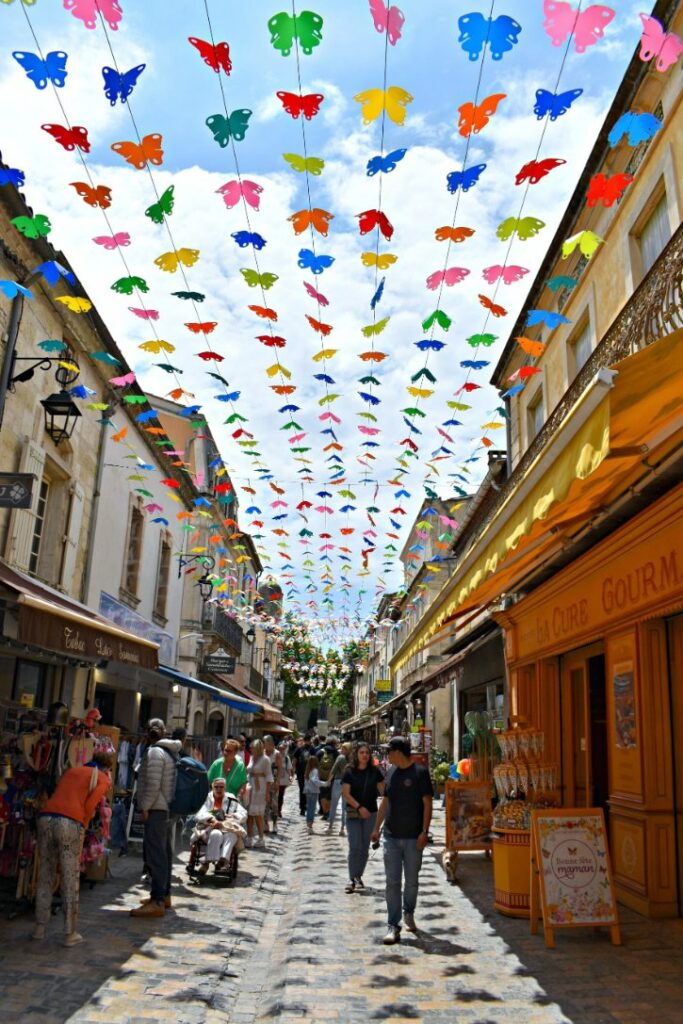
Most beautiful French villages climb hills. Aigues-Mortes does the opposite, rising as a complete walled town straight out of the flat marshes and salt pans of the Camargue. Come to walk a fully intact ring of medieval ramparts and pair it with the wide, otherworldly salt landscape just outside the gates.
a. A royal town with a purpose
The town owes its existence to King Louis IX, who in the 1240s wanted a Mediterranean port under direct French control. He gathered two crusades here, and his successors completed the full ring of walls between 1272 and 1300.
b. The walls and towers
- A continuous rampart circuit stretching 1,634 meters, with 20 towers and 10 fortified gates.
- The Tour de Constance, a 30-meter cylindrical keep with walls up to 6 meters thick, later used as a prison. One prisoner, Marie Durand, was held here for 38 years, and the word meaning “resist” is still carved into the stone.
- The Église Notre-Dame-des-Sablons, where Louis IX prayed before sailing on crusade.
c. Salt, wetlands, and local flavors
Along the southern walls lie the vast salt pans of the Salins d’Aigues-Mortes, active since ancient times and producing prized fleur de sel. The land also shapes the local table, from Camargue red rice and bull-meat stew to the orange-scented Fougasse d’Aigues-Mortes traditionally baked at Christmas.
7. Eguisheim, Grand Est
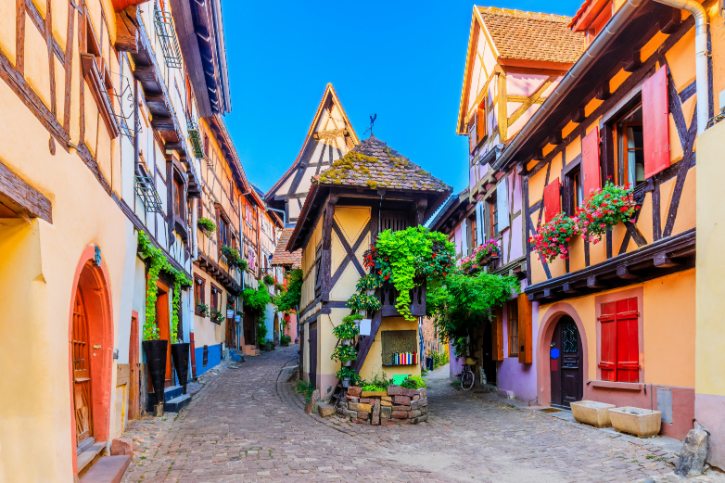
Just outside Colmar on the Alsace Wine Route, Eguisheim is built in rings. Come for its unusual circular street plan, unlike the typical village grid, wrapped in colorful timber-framed houses and edged by some of Alsace’s finest vineyards.
a. Why the streets curve
The village grew around a medieval castle wrapped in two rings of walls. When those defenses were no longer needed, winemakers and artisans built timber-framed homes along the old moats, creating the circular street plan you walk today.
b. The heart of the village
At the center sits the Place du Château Saint-Léon, home to the castle ruins, a fountain topped by a statue of Pope Leo IX, who was born here, and the neo-Romanesque Chapelle Saint-Léon.
Nearby, the church of Saints Peter and Paul keeps a rare 14th-century “Opening Virgin”, a wooden statue that opens to reveal the Holy Trinity.
c. Wine at the doorstep
- Eguisheim sits within two celebrated Alsace Grand Cru areas, Eichberg and Pfersigberg.
- A gentle vineyard discovery trail loops above the village, explaining the grapes and soils.
- From the higher slopes, you get the classic view back over the ring of rooftops.
- On the ridge above town, three ruined castles offer wide views toward Germany’s Black Forest.
8. La Roque-Gageac, Nouvelle-Aquitaine
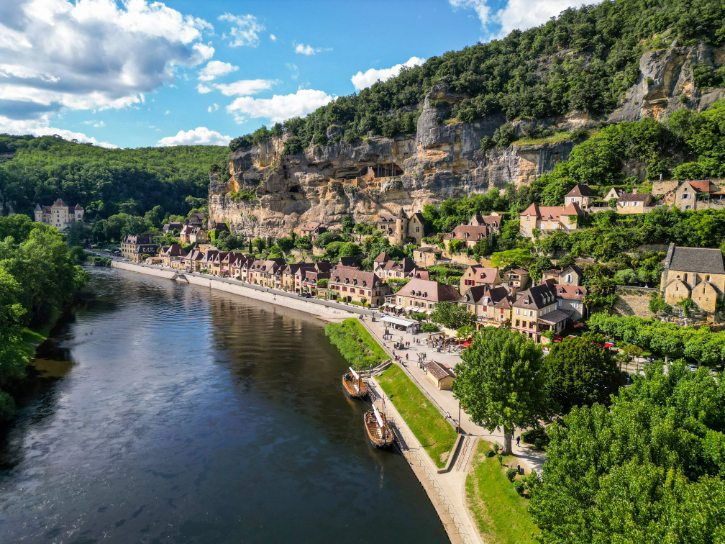
Squeezed into a thin strip between a tall limestone cliff and the Dordogne River, La Roque-Gageac is a village where the setting decided everything. It is worth visiting for one of the Dordogne’s most memorable river scenes, best appreciated from the water looking back at the houses pressed against the cliff.
a. Architecture shaped by the cliff
With so little room, buildings had to work with the rock. High above the rooftops sits a 12th-century troglodyte fort, tucked into a natural cave and once used to defend the river. Down below, the Renaissance Manoir de Tarde recalls a local canon who knew Galileo and kept an early telescope.
b. An unexpected splash of the tropics
Around the church grows the Jardin Exotique, planted in 1970. Because the cliff soaks up the sun and blocks cold northern winds, subtropical plants thrive outdoors here, including:
- Windmill palms and banana plants.
- Oleanders and bougainvillea.
- Cacti tucked among the terraces.
It is a surprising sight in the middle of the Dordogne.
c. The view is from the river
The best perspective on La Roque-Gageac comes from the water, aboard a traditional flat-bottomed boat called a gabarre, once used to carry wood and wine down toward Bordeaux. From the river you see the whole village stacked against the cliff, and it finally becomes clear how settlement and rock fit together.
9. Saint-Rémy-de-Provence, Provence-Alpes-Côte d’Azur
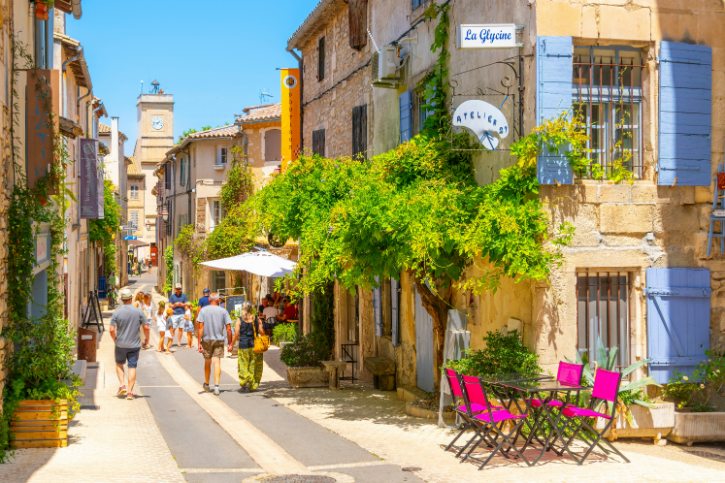
Unlike the smaller preserved villages elsewhere on this list, Saint-Rémy is a living Provençal town where ancient ruins, art history, and market life all meet. Come for the rare chance to browse a Provençal market, explore a layered Roman site, and stand where Van Gogh painted, all in a single day.
a. A town centered on its market
The historic core is ringed by shaded boulevards that follow the line of long-gone walls. Inside, you will find Renaissance mansions, a fountain honoring Nostradamus, who was born here, and a famous Wednesday Provençal market that spreads through the streets with olive oil, tapenades, cheeses, and fabrics.
b. Step back 2,000 years at Glanum
Just south of town lies Glanum, an archaeological site with three layers of history rather than one. It is not simply Roman:
- A Celto-Ligurian phase built around a sacred healing spring.
- A Hellenistic phase with clear Greek influence.
- A Roman city developed under Augustus, with a forum and baths.
Beside it stand Les Antiques, two beautifully preserved Roman monuments that marked the old entrance to the town.
c. Van Gogh in the real landscape
Next to Glanum is the monastery of Saint-Paul-de-Mausole, where Vincent van Gogh stayed voluntarily for a year and produced more than 150 paintings, including The Starry Night. You can see a reconstruction of his room and follow a trail of his works placed where he painted them.
10. Lourmarin, Provence-Alpes-Côte d’Azur
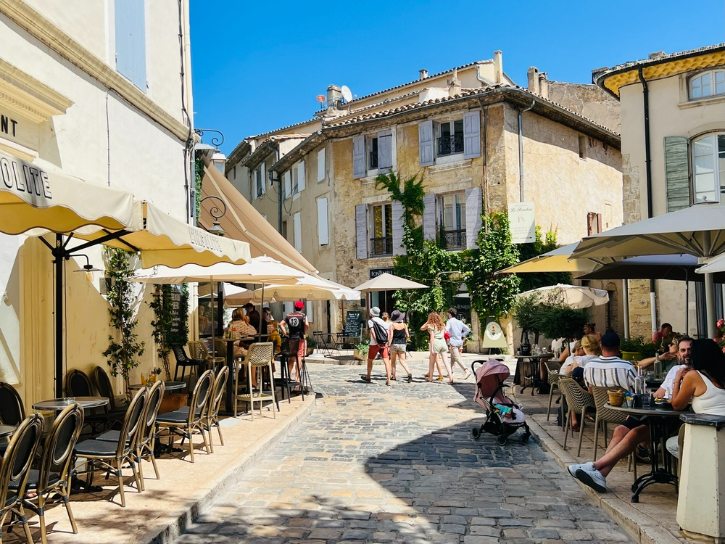
Lourmarin is the refined, literary one. Set among olive groves and vineyards in the Luberon, it is the place to come when you want a slower, more cultured stop: a landmark Renaissance château, a rich literary past, and easygoing café and market life rather than dramatic scenery.
a. A château that changed Provence
The Château de Lourmarin is recognized as the first Renaissance château in Provence, the earliest in the region to bring Italian Renaissance style into a home rather than a fortress. It has two clear parts:
- A medieval wing from the 15th century, with defensive towers and Gothic rooms.
- A Renaissance wing, added in the 16th century, with an open loggia staircase and grand carved fireplaces.
Restored in the 1920s, it now hosts historic collections and a summer concert program.
b. A quietly literary village
Lourmarin holds a notable 20th-century literary legacy. Nobel Prize-winning author Albert Camus used his prize money to buy a house here and lived in the village until his death in 1960. He is buried in the local cemetery, alongside his friend, the Provençal novelist Henri Bosco.
c. Village life and market day
The center is a gentle mix of cobbled alleys, shaded squares, and a clock tower crowning the summit. Its celebrated Friday morning market fills the streets with regional produce, truffles in season, lavender, and crafts, giving the whole village a sociable buzz.
11. Saint-Valery-sur-Somme, Hauts-de-France
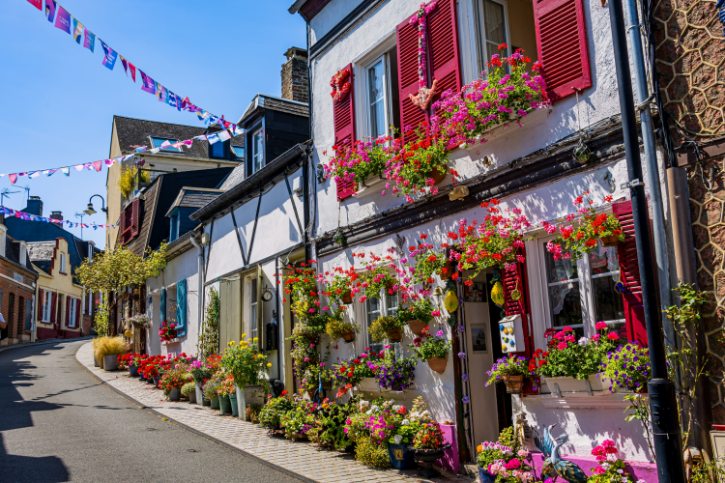
On the edge of the Baie de Somme, this is a town where the scenery changes with the tide. Twice a day the water pulls back to reveal wide mudflats, then floods in again. Come for a coastline that reinvents itself daily, paired with a medieval upper town, France’s largest seal colonies, and a heritage steam railway around the bay.
a. Three towns in one
- The medieval upper town, on a chalk cliff, with 13th-century gate towers that sheltered William the Conqueror’s fleet in 1066 and a striking church of banded chalk and flint.
- Le Courgain, a fishermen’s quarter of brightly painted brick cottages.
- The waterfront, a tree-lined promenade looking across the estuary toward Le Crotoy.
b. The best panorama
At the tip of the cliff stands the Sailors’ Chapel, rebuilt in 1854 with a distinctive checkerboard exterior of white chalk and dark flint. From the chapel grounds and the nearby Sailors’ Calvary, you get sweeping views over the whole bay, its channels, and its sandbanks.
c. Nature at the town’s edge
The Baie de Somme is a protected nature reserve and home to France’s largest seal colonies, which haul out on the sandbanks at low tide. The tidal flats are dangerous because of fast tides and deep mud, so only cross the bay on foot with a certified guide.
A historic steam railway, running since 1887, also links the towns around the bay and is an experience in itself.
12. Uzès, Occitanie
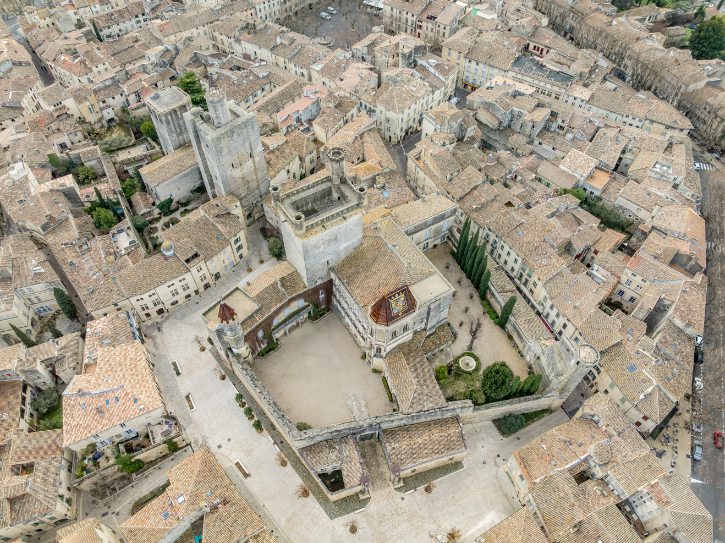
We finish with the elegant one. Uzès is a ducal town where the beauty comes from arcaded squares, aristocratic stone architecture, a skyline of towers, and one of southern France’s finest markets rather than dramatic scenery. Come for the feel of a polished small city that has kept every bit of its grace.
a. The social heart of town
Place aux Herbes is the center of life here, framed by vaulted stone arcades and shaded by plane trees. It hosts two weekly markets: a smaller Wednesday food market and a large, lively Saturday market that draws hundreds of producers with food, wine, textiles, and ceramics.
b. A skyline of towers
Uzès is defined by its towers, which double as landmarks as you explore:
- Le Duché, the fortified home of the Dukes of Uzès, spanning eight centuries of building and still partly lived in by the ducal family.
- Tour Bermonde, a 42-meter Romanesque keep with views over the plateau.
- Tour Fenestrelle, the only surviving round Romanesque bell tower in France, with six stepped tiers of paired windows.
c. A garden for a slower visit
For a quieter moment, the Jardin Médiéval sits beneath two old towers and grows more than 450 species of medicinal plants, dye herbs, and ancient crops, arranged in the medieval monastic tradition, a peaceful pause among the town’s elegant streets.
Twelve towns, and not one of them is trying to be another. That is the real pleasure of France’s smaller places: each one is completely, specifically itself. Pick the landscapes that pull at you most, and start there.