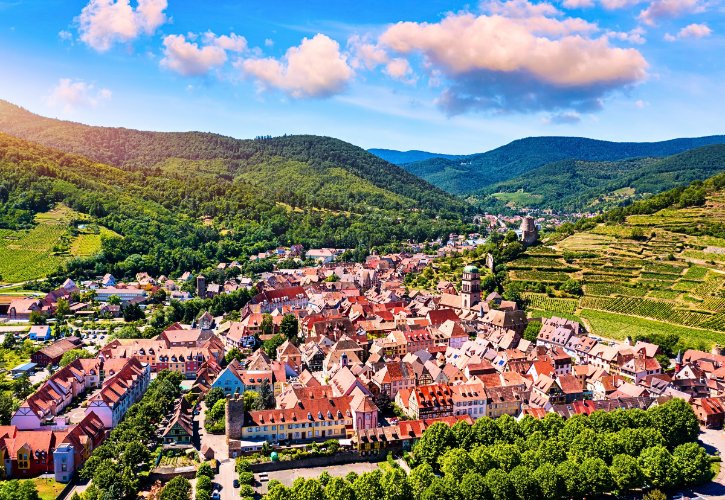
Strasbourg and Colmar draw most visitors to Alsace, and they earn it. But the smaller villages along the Wine Route each have a distinct character.
Some are tight fortified wine towns. Others curl in rings around a castle, sit beside a river below a ruin, or hide inside near-complete medieval walls.
You will find old gateways, vineyard paths, market squares, and living traditions. A few are polished and popular, and others reward a longer walk. Here are seven worth your time. 😊
1. Riquewihr
a. What Makes Riquewihr Different
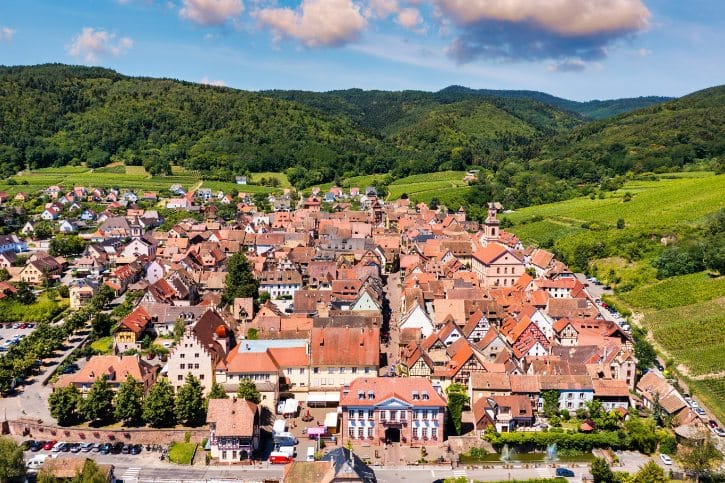
Riquewihr is the most tightly enclosed village here. Its old center still sits almost entirely inside its historic defensive walls, so it feels like a compact, fortified wine town rather than a village that spread outward.
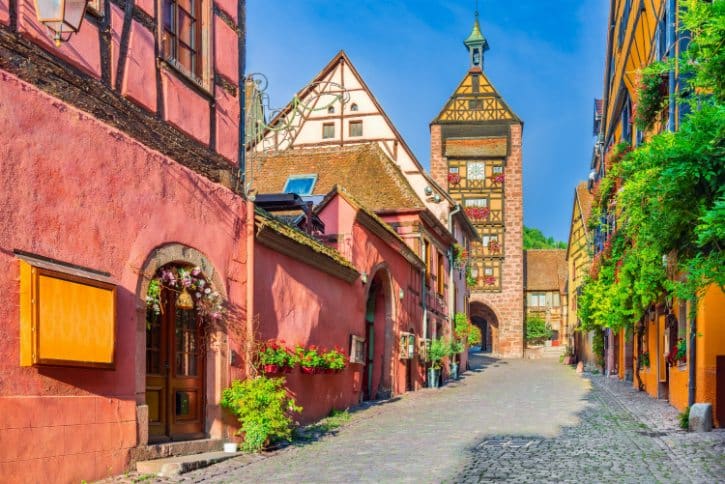
One climbing street, Rue du Général de Gaulle, rises from the lower gate to the Dolder tower at the top. That single rising axis sets it apart from Eguisheim’s rings and Kaysersberg’s riverside.
Most buildings date from the 15th to 18th centuries, with carved corner posts, oriel windows, and hidden courtyards once built wide for wine wagons.
b. Main Sights and Historic Features
- The Dolder: The tower that defines the skyline, built in 1291 and later altered. It served as watchtower, bell tower, and gate, with a plain defensive outer face and a decorated village-facing side.
- Thieves’ Tower: A 14th-century tower that held the town prison, with its old judicial rooms still intact.
- The Winemaker’s House: A 16th-century house showing how people once lived and worked, right next to the Thieves’ Tower.
- The upper defenses: Gateways, the Porte Haute, and wall remains near the Dolder.
- Quiet side lanes like Rue des Remparts, where old stonework is exposed away from the crowds.
c. Best Walking Route
- Enter at the lower eastern end near the Hôtel de Ville and walk up Rue du Général de Gaulle, pausing for courtyards and carved details.
- Turn onto Rue des Juifs for the Thieves’ Tower and Winemaker’s House.
- Continue up to the Dolder and the upper gate.
- Loop back along Rue des Remparts and Rue des Trois Églises to avoid retracing your steps.
- Finish on the footpath just outside the western walls, which leads to the vineyard edge for elevated views over the rooftops.
d. Getting There by Public Transport
- Riquewihr has no railway station.
- Take Fluo Grand Est Line 68R016 from Colmar station, about 30 minutes to the Riquewihr-Poste stop.
- From Strasbourg, ride a TER train to Colmar first, then the same coach.
- In season, the Kut’zig sightseeing shuttle also stops here.
e. How Long to Spend
Give it at least half a day. That covers the main street, the side lanes, the upper defenses, the vineyard viewpoint, and the small museums inside the towers.
Staying into the evening or overnight is even better, since the village calms right down once the day visitors and coaches leave.
2. Eguisheim
a. What Makes Eguisheim Different
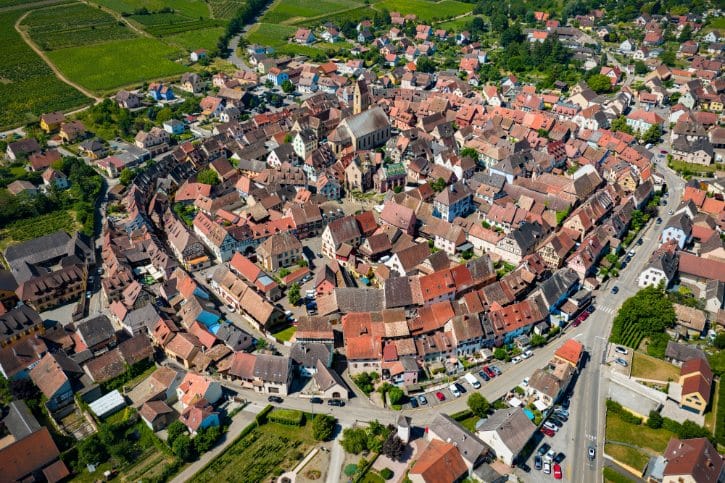
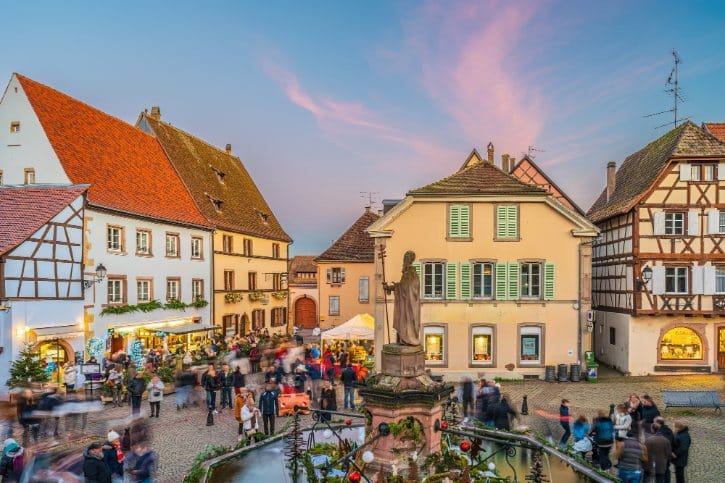
Eguisheim has the most unusual plan of the group. Instead of one main street, its lanes curve around the center in rings that follow the old fortifications.
The village grew from an 8th-century settlement around the castle of the Counts of Eguisheim, and as it expanded, walls were added in rings. Later, winegrowers built their houses right into those walls.
Two curving lanes, Rue des Remparts Nord and Sud, now form a continuous loop. Because they curve, the view changes at every step, which keeps the walk feeling fresh.
b. Main Sights and Historic Features
- Place du Château Saint-Léon: The historic heart, with the Octagonal Castle, the Saint-Léon Fountain, and the chapel.
- Chapel of Saint Leo IX: Eguisheim is the birthplace of the man who became Pope Leo IX, and the chapel holds frescoes of his life.
- Church of Saints Peter and Paul: A late 13th-century Gothic tower on a Romanesque base, with a rare medieval wooden sculpture inside.
- The ring streets themselves, lined with winegrowers’ courtyards and their wide wagon gates.
- Carved beams, dates, and trade marks on the houses, plus an official heritage route with nine interpretation panels.
c. Best Walking Route
- Start at Place du Château Saint-Léon and take in the chapel, fountain, and church.
- Step into the outer ring at Rue des Remparts Sud.
- Follow the curve gently all the way around rather than cutting through the middle.
- Stop at the interpretation panels and courtyard doors as you go, then return to the square by a different lane.
- If time and weather allow, continue to the flat vineyard path at the western edge, which runs into the Grand Cru slopes with almost no effort.
d. Getting There by Public Transport
- Eguisheim has no railway station.
- Take Fluo Grand Est Line 68R030 from Colmar, about 15 to 20 minutes.
- Service is regular on weekdays but very limited on Sundays and holidays, so a short road distance does not always mean frequent buses.
- From Strasbourg, take a TER to Colmar and transfer. The Kut’zig also serves the village in season.
e. How Long to Spend
Plan for at least half a day. Two hours covers the square and the full ring, but a half day lets you add the architectural details, the interpretation panels, a tasting, and the easy vineyard walk.
If you want the longer forest hike to the Three Castles above the village, keep that as a separate half-day outing, since it is a real climb of around 5 kilometers.
3. Kaysersberg
a. What Makes Kaysersberg Different
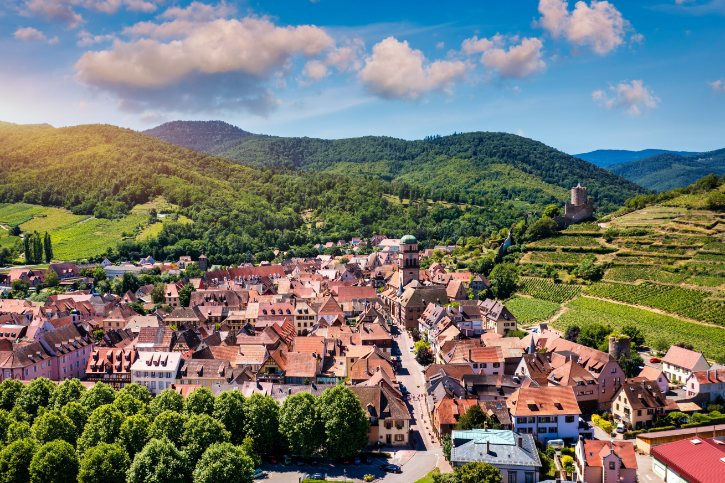
Kaysersberg is where water, stone, and height all come together. The Weiss River runs straight through the center, a fortified bridge crosses it, and Schlossberg Castle watches from the hill above.
This layered landscape is its real appeal, and it feels closer to the Vosges foothills than the flatter wine villages.
You get an easy riverside town at the bottom and an optional climb to a castle viewpoint at the top, with vineyards and wooded slopes wrapping around everything.
b. Main Sights and Historic Features
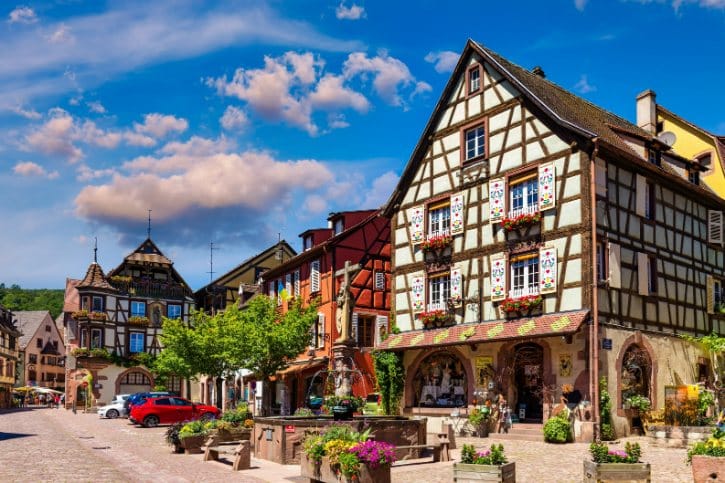
- The Fortified Bridge: Built in 1511 from pink sandstone, with loopholes and a small niche holding a statue of the Virgin Mary. It is also the best photo spot in town.
- Sainte-Croix Church: Home to a 12th-century Romanesque portal and a carved wooden altarpiece from 1518.
- Schlossberg Castle: An imperial fortress above the town. You can enter the courtyard and climb the round keep for wide valley views.
- Centre Schweitzer: A museum for Nobel Peace Prize winner Albert Schweitzer, born here in 1875.
- Renaissance Town Hall and old fountains along the main street.
c. Best Walking Route
- Start near Porte Basse and walk through the historic street to the Weiss River.
- Explore both banks and the fortified bridge, then visit Sainte-Croix Church.
- Just after the bridge, pick up the signposted trail that climbs steeply to Schlossberg Castle, with over 100 stone steps and about 80 meters of gain.
- Take the climb only if the trail is open and dry, and wear shoes with good grip.
- If stairs are difficult, skip the climb entirely and still enjoy the center, river, and bridge.
d. Getting There by Public Transport
- Kaysersberg has no railway station.
- Take Fluo Grand Est Line 68R013 from Colmar, about 25 to 30 minutes, to the Porte Basse or Rocade stop.
- Daily service runs year-round but thins out on weekends, so check return times before a castle hike.
- From Strasbourg, ride a TER to Colmar and transfer. The Kut’zig also stops at Porte Basse in season.
e. How Long to Spend
Give Kaysersberg at least half a day. That covers the historic center, the river, the bridge, and the climb to the castle, plus the Schweitzer Centre or a tasting.
A full day suits anyone who wants to add the 5-kilometer Weiss Valley vineyard loop or a longer walk into the hills, with time to enjoy a riverside lunch without rushing.
4. Ribeauvillé
a. What Makes Ribeauvillé Different
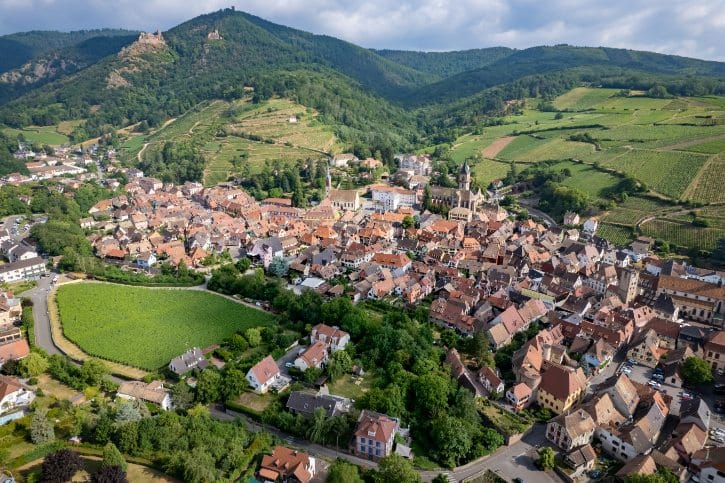
Ribeauvillé feels like the biggest and busiest place on this list. It is a proper little town with a long historic main street, plenty of shops and restaurants, and three ruined castles on the hills above.
Grand’Rue runs for about 1.5 kilometers, linking a series of squares, fountains, and towers. It is fairer to call it a small town than a tiny village, and it stays active with everyday life.
Your main choice here is whether to explore the lower town, do a short hillside walk, or commit to a serious castle hike.
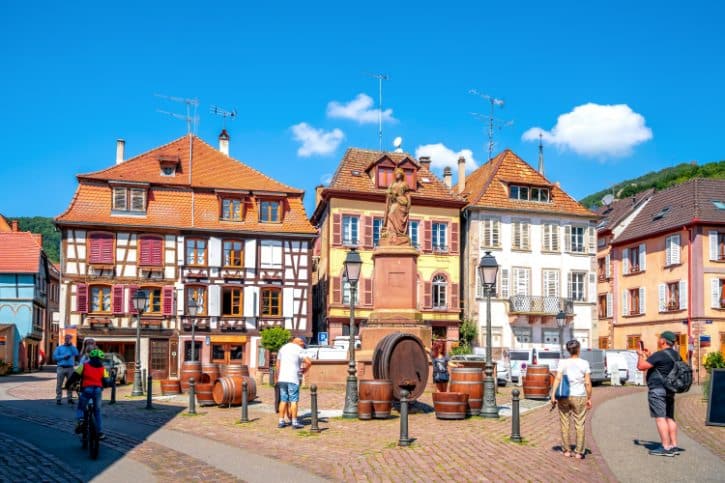
b. Main Sights in the Lower Town
- Grand’Rue: The spine of the town, connecting its main squares and monuments.
- Butchers’ Tower: A 29-meter defensive gate tower, first built in the 13th century and rebuilt in 1536.
- Maison des Ménétriers: A decorated 1683 house that was the headquarters of the regional guild of traveling musicians.
- Town Hall: Built in 1773, holding a historic collection of silver goblets.
- Renaissance fountains, including the 1536 fountain on Place de la République.
c. The Three Castles
This is a genuine hillside hike, not a quick staircase behind the town. Three ruins stand at different heights. Saint-Ulrich, at 530 meters, is the largest and most complete, with a hall, chapel, and keep you can explore.
Girsberg sits on a granite ridge opposite, and Haut-Ribeaupierre is the highest and oldest, though its keep interior is often closed for safety.
- The full loop runs about 6.7 to 7.3 kilometers with 370 to 380 meters of climb, taking 2.5 to 3.5 hours of walking.
- The trail is steep and rocky, so wear proper boots and carry water, since there is nothing along the way.
- If you cannot finish the whole loop, Saint-Ulrich on its own is the most rewarding.
d. Best Walking Options
Option One: Historic Town Only
- Start at the lower end of Grand’Rue near the Jardin de Ville stop.
- Walk west past the Town Hall, the Place de la République fountain, and the House of the Minstrels.
- Pass under the Butchers’ Tower.
- Continue to the upper end near the Church of Saint-Grégoire.
- Return by the quieter parallel streets to see wall towers and courtyards.
Option Two: Town and Castles
- Begin early in the historic center.
- Follow the marked castle path from the upper town.
- Allow enough time for the ruins based on current trail conditions.
- Return to town for food, rest, or a reserved tasting.
- Do not add another village on the same day if you attempt the full castle loop.
e. Getting There by Public Transport
- No active railway station in the center.
- Take Fluo Grand Est Line 68R016/68R017 from Colmar, about 35 minutes, the same line that serves Riquewihr.
- From Strasbourg, the smoothest route is often a TER train to Sélestat, then switching right outside the station to a TER coach for the final 20-minute ride into Ribeauvillé.
- The Kut’zig shuttle also stops here. Always check the last return before starting the castle hike.
f. How Long to Spend
Give the lower town at least half a day so you can enjoy Grand’Rue, the fountains, and the monuments at a relaxed pace.
If you want the full three-castle hike, set aside a whole day. You will need five to seven hours for the town, the climb, time at the ruins, and a return for evening refreshments, and you should not try to add another village on the same day.
5. Bergheim
a. What Makes Bergheim Different
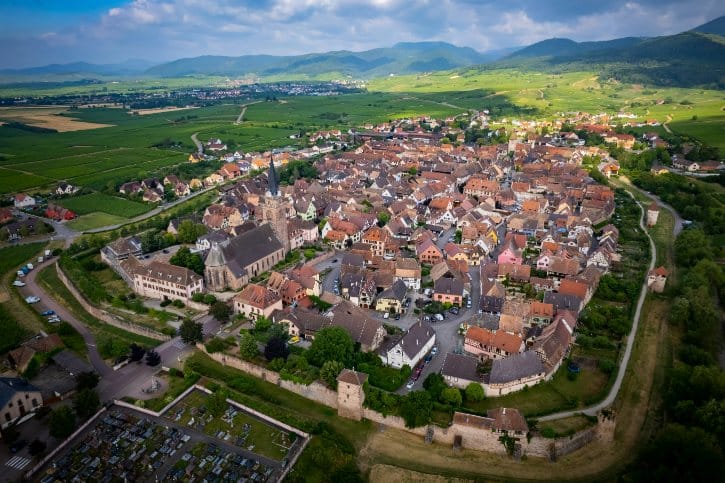
Bergheim is the village for a proper walk along the walls. It keeps one of the most complete medieval rampart circuits in Alsace, built as a double wall system in the 14th and 15th centuries, with a dry moat, corner towers, and gates.
A quiet path runs along the top of the ramparts, with views over gardens and vineyards.
It feels noticeably less commercial and more residential than Riquewihr or Ribeauvillé, and its history runs deep, taking in Roman, medieval, Jewish, and early modern chapters.
b. Main Sights and Historic Features
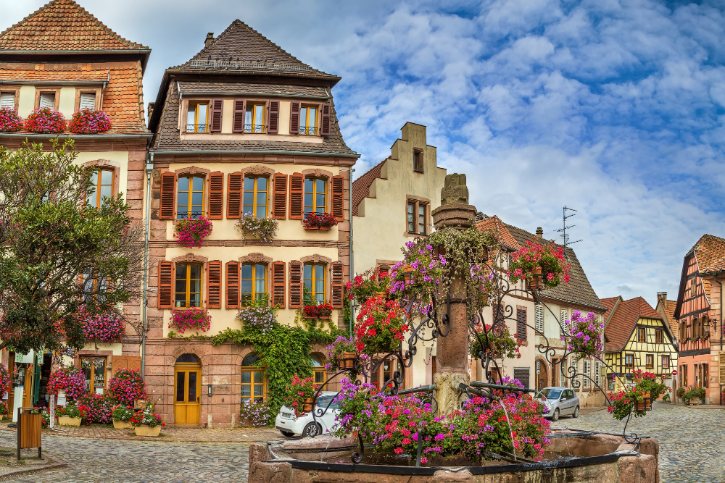
- Porte Haute: An imposing 14th-century gate tower in red sandstone and timber, the natural place to start.
- The Rampart Walk: A circular path of about 1.8 kilometers following the outer walls past towers and the old moat.
- Jardin d’Annette: A recreated medieval herb garden set into the wall circuit.
- The Old Synagogue: A reminder of the town’s historic Jewish community.
- The parish church, town fountain, and winegrowers’ houses inside the walls.
c. Best Walking Route
- Start at Porte Haute.
- Join the rampart path and follow it along the best-preserved wall sections.
- Visit Annette’s Garden if it is open.
- Re-enter the village and walk Grand’Rue to see the church, fountain, and winemakers’ houses.
- Visit the Old Synagogue and, if open, the Maison des Sorcières.
- Finish with the southern rampart section back to Porte Haute, or a short vineyard-edge walk.
d. Getting There by Public Transport
- Bergheim has no railway station.
- Take Fluo Grand Est Line 68R017 from Colmar, about 45 minutes, to the Porte Haute stop.
- Service runs on weekdays and Saturdays, but Sunday service is very limited.
- From Strasbourg, take a TER train to Sélestat, then TER coach. Note that Bergheim is not on the Kut’zig route.
e. How Long to Spend
Plan for at least half a day. Two hours covers the ramparts and central streets, but a half day lets you add the herb garden, the Maison des Sorcières, the Jewish heritage sites, and a tasting at a village cellar.
Bergheim suits a slower, more thoughtful visit, especially if you have a real interest in fortifications or social history, so there is no need to rush through it.
6. Turckheim
a. What Makes Turckheim Different
If you are traveling without a car, Turckheim is a gift. It is the easiest traditional wine town to reach directly by train from Colmar, which makes it far more flexible than the coach-dependent villages.
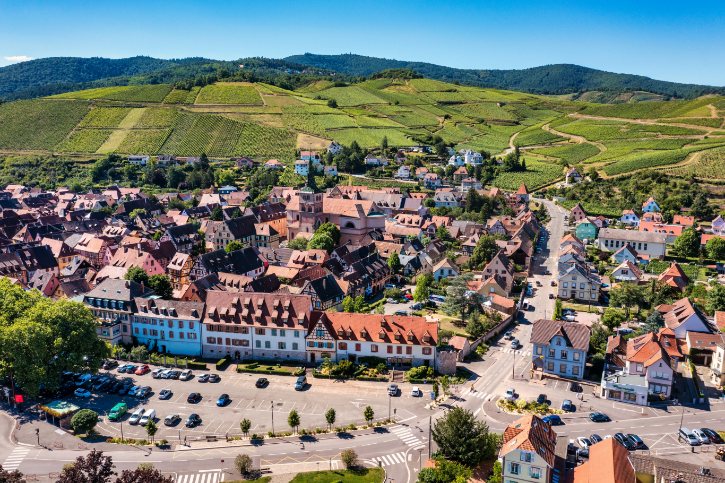
Three surviving 14th-century gateways, Porte de France, Porte de Munster, and Porte du Brand, mark the old defensive perimeter, and entering through them is part of the experience.
The town keeps a real residential and wine-producing character, with local shops and family wineries beside the Grand Cru Brand vineyards on the slopes above.
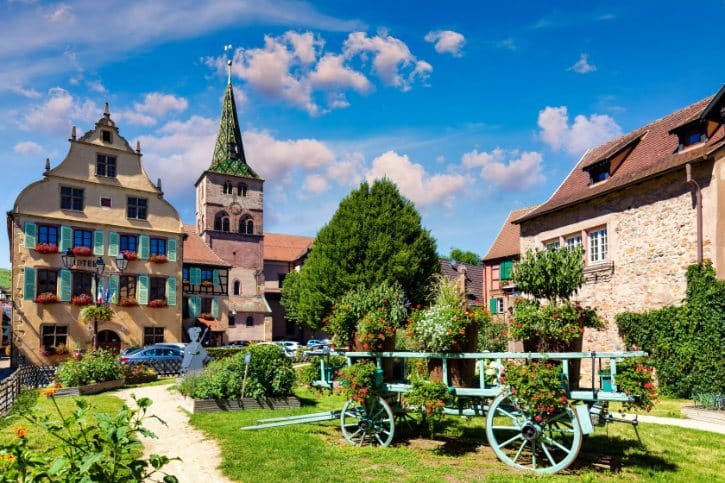
b. Main Sights and Historic Features
- Porte de France: Built in 1320, with a heavy archway and a stork nest platform on the roof.
- Porte de Munster and Porte du Brand: The other two gates, one facing the mountain valley, the other guarding the vineyard road.
- Corps de Garde: A 1595 guard house on the central square, with a fountain and a carved statue.
- Church of Saint-Anne: A 12th-century Romanesque tower paired with a later nave.
- Old winemakers’ houses along Grand’Rue and Rue Wickram, with deep cellars and courtyard gates.
c. Best Walking Route
- Start outside the railway station and cross the bridge over the Fecht River.
- Enter through Porte de France.
- Walk along Grand’Rue to the central Place de l’Église, past the Corps de Garde and Saint-Anne Church.
- Continue to Porte de Munster.
- Follow the interior wall path to Porte du Brand.
- Step out to the base of the vineyard slopes if conditions allow.
- Return via Rue Wickram to see the winemakers’ courtyards.
- Come back in the evening for the night watchman round when it is running.
d. Getting There by Public Transport
- Direct TER trains connect Colmar and Turckheim in just 9 to 10 minutes, running through the day on weekdays and weekends.
- From Strasbourg, take a TER to Colmar, then change to the Turckheim train.
- The Kut’zig shuttle stops at Turckheim République, linking it with Eguisheim and Kaysersberg.
e. How Long to Spend
Give Turckheim at least half a day, and ideally an evening too. A half day covers the three gates, the historic center, and the Sentier du Dragon vineyard trail that climbs into the Grand Cru Brand, a 3.5-kilometer loop with fine views.
Stay on for dinner and the night watchman round to round out the day. Just be sure you have confirmed the last train back to Colmar before you settle in.
7. Obernai
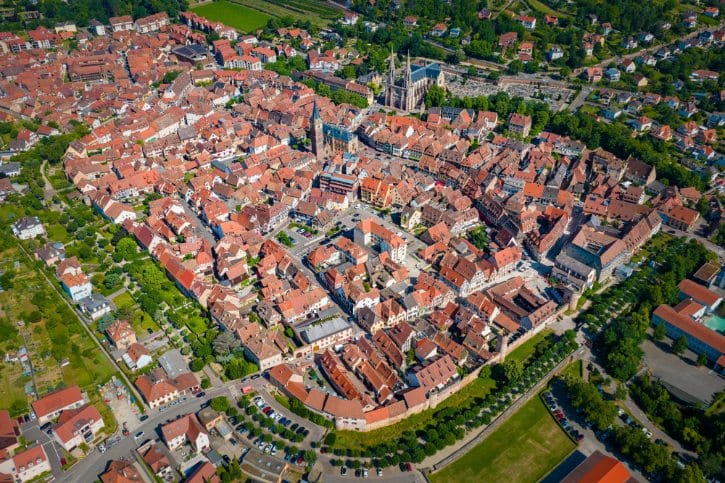
a. What Makes Obernai Different
Obernai is less a tiny Wine Route village and more a lively market town. It sits at the foot of Mont Sainte-Odile, with wide squares, grand civic buildings, complete wall walks, and a real weekly market.
It is bigger than the compact villages near Colmar, with broader streets and a larger historic core, and it keeps an active commercial life.
Its biggest advantage for planning is the direct, frequent train from Strasbourg, which makes it the easiest Wine Route destination if the regional capital is your base.
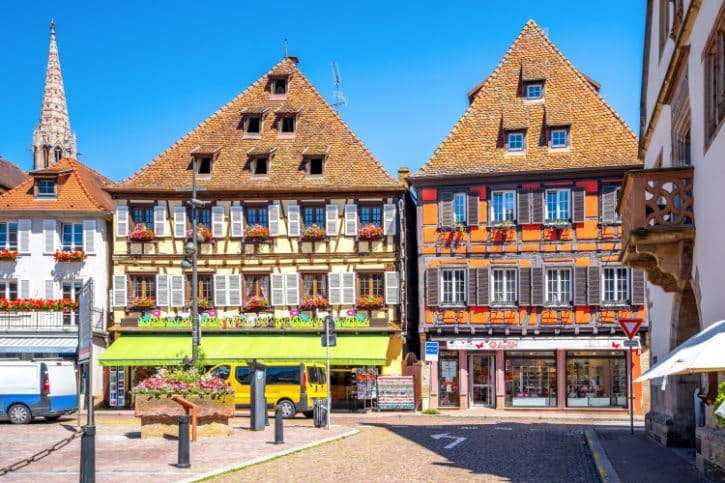
b. Main Sights and Historic Features
- Place du Marché: The wide civic and social heart of the town.
- Kapellturm: A 62-meter sandstone belfry from the 13th and 16th centuries.
- Town Hall: Rebuilt in 1848, keeping a 1610 Renaissance balcony façade.
- Halle aux Blés: A 1554 Renaissance grain hall with carved cattle heads on its gables.
- The Six-Bucket Well of 1579 and the ramparts, a 1.4-kilometer wall circuit with towers and shaded paths.
c. Best Walking Route
- Walk from Obernai station into the center, about 5 minutes along Avenue de la Gare.
- Start at Place du Marché.
- See the Belfry, Town Hall, Wheat Hall, and Sainte-Odile Fountain.
- Walk north to the church and the Six-Bucket Well.
- Follow the signposted old town discovery route.
- Join the Fortress Path (Marche des Remparts) around the walls.
- Return to the market square for food, shopping, or an event.
d. Getting There by Public Transport
- Direct TER trains connect Strasbourg and Obernai in about 28 to 33 minutes, with frequent service through the day.
- From Colmar, take a TER north to Sélestat, then transfer, for a total of about 45 to 50 minutes.
- Obernai fits far more naturally into a Strasbourg-based day than a Colmar village circuit.
- The station is a short 5-minute walk from the center.
e. How Long to Spend
Plan for at least half a day here, since Obernai is larger than the other places. A half day covers the main monuments, the old town route, the rampart walk, a relaxed lunch, and the weekly market if your timing lines up.
With a full day you can add a cellar tasting or a trip up to the Mont Sainte-Odile sanctuary overlooking the plain, which pairs beautifully with the town below.