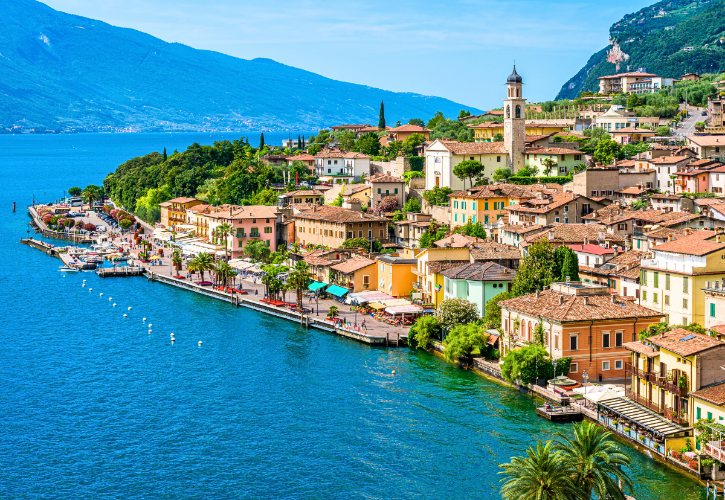
You do not need weeks to see the best of Lake Garda. In a single relaxed drive you can move between medieval towns, old harbors, vineyards, citrus terraces, grand villas, gardens, and Roman ruins.
The scenery keeps changing as you go, from the wide sunny south, up into a dramatic north walled in by mountains, then back down a softer western shore.
Each stop sits just 10 to 30 minutes from the next, so the whole loop feels easy, and the surprises keep coming. 😊
1. Sirmione
a. A Dramatic Start
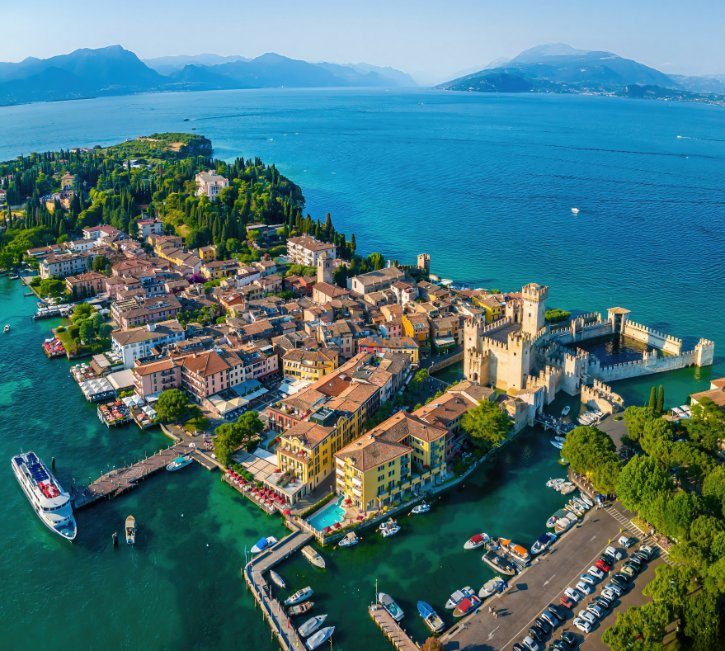
Sirmione greets you at the tip of a narrow peninsula that reaches about 4 kilometers into the lake. It packs a fortress, Roman ruins, old lanes, and thermal waters into one place surrounded by water.
b. Castello Scaligero
- Built around 1277 by Mastino I della Scala to guard the southern lake.
- Cut off from the mainland by a wide moat fed by the lake, reached by drawbridges.
- Topped with swallowtail merlons and three corner towers, with a keep you climb by 146 steps.
- Its walled dock, the darsena, is the only intact 14th-century fortified naval harbor left in Europe.
c. Grotte di Catullo
- The grandest Roman home ever found in Northern Italy, built between the late 1st century BC and early 1st century AD.
- The name does not mean caves. Renaissance travelers found the buried vaults and thought they looked like grottos.
- Look for the huge vaulted supports and the covered gallery once used for shaded walks.
- It sits inside an olive grove of more than 1,500 trees, with the lake on every side.
d. Jamaica Beach and Thermal Waters
Below the ruins, Jamaica Beach trades sand for flat limestone shelves. When the water is low, you can walk across pale turquoise shallows near the tip. Sirmione is also a spa town, fed by warm mineral springs that rise from the lakebed and gave the town its bathing tradition.
Leaving Sirmione, you cross back to the mainland and follow a gentler shore toward Lazise, a town still wrapped in its walls and gates.
2. Lazise
a. A Walled Old Town
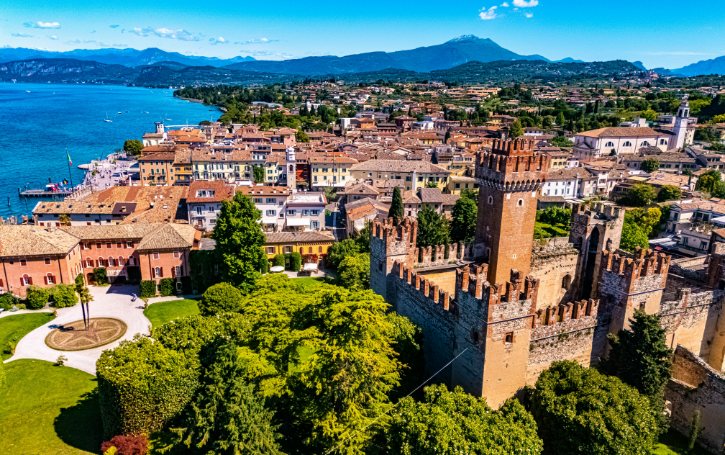
Lazise is the finest example on this route of a fortified lakeside town, where walls, gates, streets, and harbor still feel like one connected place.
b. Walls and Gates
- The defenses date mostly to around 1375, built from river pebbles and brick bands.
- Three medieval gates still guard the town.
- Porta San Zeno carries the Scaliger ladder emblem in a marble niche.
- Porta Lion shows a carved Lion of Saint Mark, added after Lazise joined Venice.
- Roads stop at the ramparts, so you enter the old town on foot.
c. The Square and Old Harbor
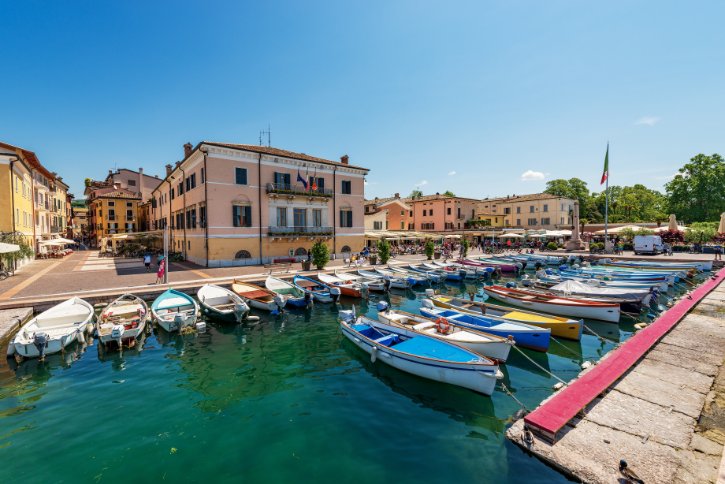
- Piazza Vittorio Emanuele II runs straight down to the historic harbor.
- Its paving mixes pink Verona marble, white limestone, and dark stone in wave-like patterns.
- Wooden fishing boats moor right beside the outdoor tables.
- Pastel merchant houses with stone arcades line the water.
d. Dogana Veneta
At the harbor mouth stands the old Venetian customs house. It began as a shipyard, then managed and taxed goods moving between Venice, Milan, and Mantua. In its early days the lake flowed straight inside, so boats could sail in and unload under cover. Today it is a restored exhibition space with open vaulted halls.
e. Waterfront Walk
The lakeside promenade takes you from the enclosed lanes into open views. From here you can look back at the fortified walls from the water side, which is the best way to appreciate the whole town.
North of Lazise the shore turns greener, the hills fill with vineyards, and the mood shifts from defensive to relaxed as you reach Bardolino.
3. Bardolino
a. Wine Country
Bardolino is the wine heart of the route. The vineyards on the hills and the easygoing waterfront belong to the same story.
b. The Wines
- The town gives its name to Bardolino wine, granted DOC status in 1968.
- Reds are light to medium bodied, ruby colored, and made to enjoy young.
- Native grapes lead the blend: Corvina for body, Rondinella for aroma, Molinara for lightness.
- Chiaretto is the pale, salmon-pink dry rosé, with notes of wild strawberry and citrus blossom.
c. Tasting Without the Tour
Here is the easy part. You do not need a full winery tour to enjoy it. Wine bars, tasting rooms, and family cellars line the streets, where you can sample the local wine alongside Garda olive oil and lake fish.
d. Church of San Severo
- A fine example of Veronese Romanesque architecture, rebuilt in the late 11th to early 12th century.
- A slender bell tower, paired windows, and three rounded apses mark the outside.
- Inside are rich 12th-century frescoes, including Apocalypse scenes and armored knights.
- Below lies an 8th-century crypt with reused Roman and medieval capitals.
e. Open Waterfront
Unlike walled Lazise, Bardolino spreads out with green lawns, tall pines, and a wide walking path. Two long jetties reach into the lake, sheltering boats and ferries. The whole front feels bright and unhurried.
Heading north, the hills close in, olive terraces replace vineyards, and the road narrows toward the working port of Torri del Benaco.
4. Torri del Benaco
a. The Working Lake
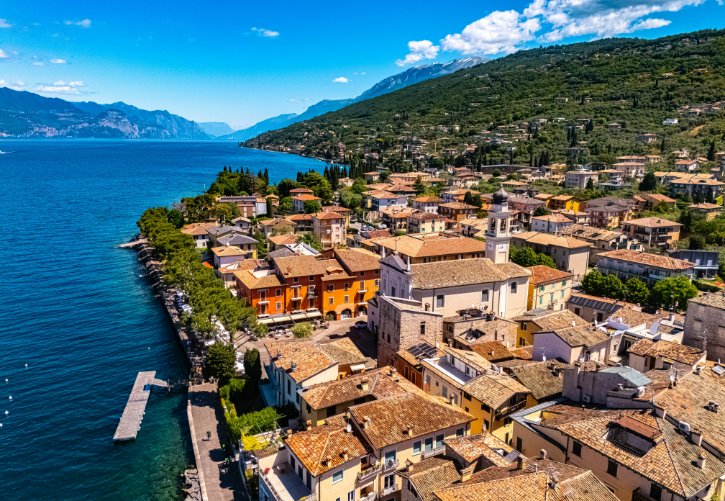
Torri del Benaco shows you how people actually lived and worked on Lake Garda. Fishing, boatbuilding, olives, and citrus all come together here.
b. Castello Scaligero
- Built in 1383 over an older 10th-century stronghold, whose West Tower still stands.
- Part of its outer wall was taken down in 1760 to build a lemon house.
- It reopened as a museum in 1983.
- Climb the wall walkway for views over the round harbor and north toward Monte Baldo.
c. Museum of Traditional Life
- One hall honors the calafati, the old boatbuilders, with their caulking irons and adzes.
- The fishing room shows hand-knotted nets, willow eel traps, and flat-bottomed punts.
- A prehistoric collection displays Bronze and Iron Age rock carvings from the hills above.
d. The Lemon House and Olive Press
Along the castle wall sits an authentic lemon house from 1760, with tall stone pillars and chestnut beams that were closed in with wood and glass each autumn. The grounds also keep an original olive press, with its oak lever beam and granite wheels. Both give you a first taste of the citrus and olive story that grows bigger further along.
e. A Change in Scenery
Look north from the castle and you notice the shift. The southern plains have vanished, and the rocky heights of Monte Baldo begin to crowd the horizon. This is where the trip starts to feel more dramatic.
North of here the land tilts sharply upward, the lake turns a deeper blue, and Malcesine appears where mountain and water meet.
5. Malcesine
a. A Vertical Town
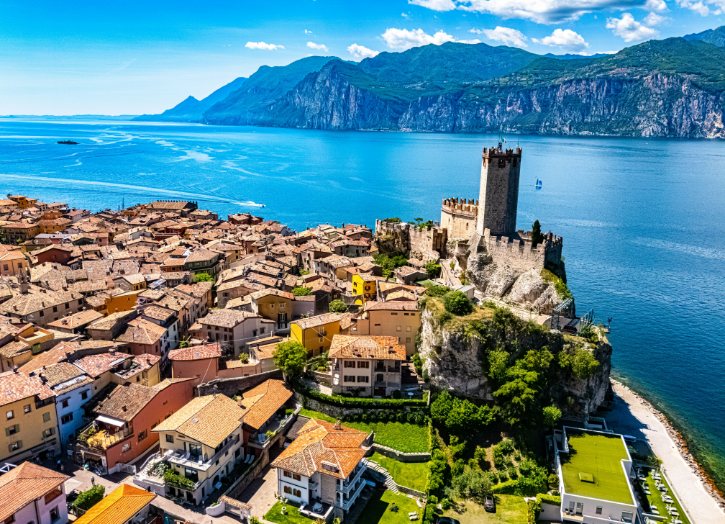
Malcesine is defined by height. The town is squeezed between deep water and the towering mass of Monte Baldo, so a medieval village and high crags sit almost on top of each other.
b. Castello Scaligero
- Perched on a white limestone spur that drops straight into the lake.
- Shaped into its current form under Alberto della Scala in the late 1200s.
- Its five-sided keep rises 31 meters above the rock.
- From the top you look down on rooftops, across to far cliffs, and up into the mountains.
c. Old Streets and Palazzo dei Capitani
Wander the cobbled alleys, stone archways, and steep stairways of the old center, and you reach a quiet inner harbor. Just south stands the Palazzo dei Capitani, once the seat of the Captain of the Lake. Look for its Gothic windows facing the water, painted ceilings, and lakeside palm garden.
d. Monte Baldo
- Rising to 2,218 meters, it is one of Europe’s great botanical reserves.
- The scenery shifts from olives and cypress at the shore to alpine meadows near the top.
- Up high you can hike or bike among wildflowers, with long views over the lake.
- Pack windproof layers, since the summit can be 10 to 15 degrees Celsius cooler than the shore.
e. A Quieter Bay
Just south lies Val di Sogno, a calm bay fringed with olive trees. In dry spells a gravel bar appears and you can walk out to a small island. It is a gentle counterpoint to the busy center.
Continuing north, you cross into Trentino, the lake narrows, whitecaps appear, and the mood turns to wind and sails at Torbole.
6. Torbole sul Garda
a. The Wind Capital
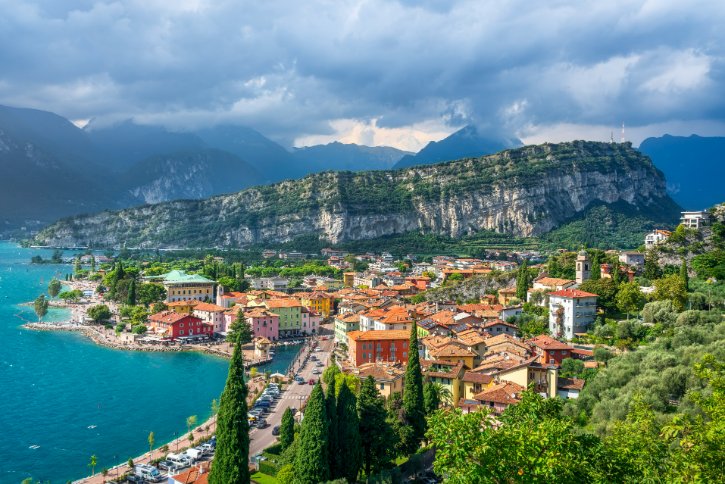
Torbole is where the lake feels most active. An old fishing village meets sailing, windsurfing, and a lively outdoor crowd.
b. Why the Wind Matters
- Steep walls funnel two reliable daily winds.
- The Pelèr blows north to south in the morning, strong and steady.
- The Ora blows south to north in the afternoon, smoother and gentler.
- Each afternoon the water fills with windsurfers and racing boats against the mountains.
c. The Old Harbor
Behind the modern scene sits a genuine old center. The semicircular harbor is framed by pastel cottages. On the pier stands a 15th-century customs house from the days when this was the border between Austrian Tyrol and Venice, where every boat stopped to declare goods.
d. Nago and Castel Penede
- Above town, the ruins of Castel Penede sit on a rocky spur.
- Built in the early 1200s, it guarded an old trade route and later fell to French troops.
- The masonry is fenced off for safety, but the park, trails, and picnic meadow stay open.
- The viewpoint helps you read the whole layout of the northern lake.
e. Marmitte dei Giganti
Off the road between Nago and Torbole lie the Giants’ Pots, huge round shafts drilled into limestone by meltwater during the ice ages. An easy footpath leads right into them, giving you a direct look at the forces that shaped the lake.
A short drive west, the compact sports village opens into the broad streets of Riva del Garda, the capital of the north.
7. Riva del Garda
a. The Grand Northern Capital
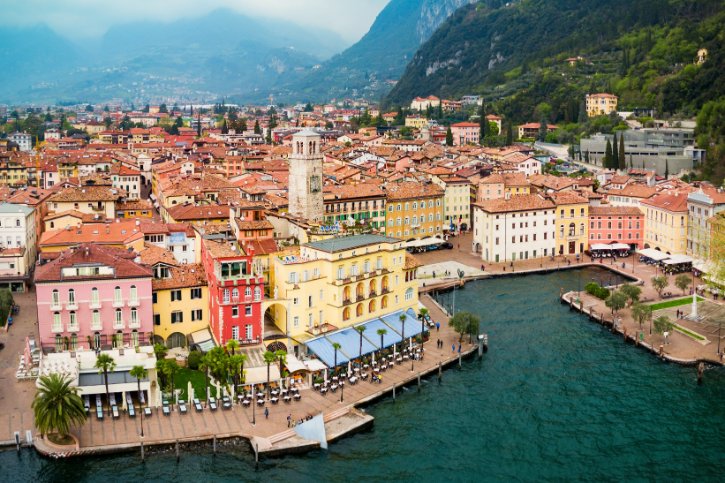
Riva del Garda is the big historic and cultural center of the north, where dramatic mountains meet grand squares, palaces, and museums.
b. Piazza III Novembre and Torre Apponale
- The main square faces straight onto the harbor, framed by medieval and Renaissance palaces.
- The 34-meter watchtower dates to around 1220.
- A bronze weather-vane angel on top is the town’s symbol.
- Climb 165 steps for views over the square and the fjord-like waters.
c. La Rocca and the MAG Museum
The square water-fortress, La Rocca, is ringed by a moat and reached by a stone bridge. Inside, the MAG museum is a great place to understand the region, with Copper Age standing stones, Roman bronzes, old lake paintings, and displays on the region’s frontier history.
d. Waterfront and the Bastione
- Riva has the most generous, landscaped waterfront on the lake.
- Broad promenades pass gravel beaches and sailing clubs.
- High above town stand the ruins of the Bastione, a Venetian artillery tower.
- Reach it on a shaded footpath or a panoramic glass elevator that climbs the cliff in about three minutes.
e. The View That Explains the North
From the Bastione terraces you finally grasp the setting. A sheet of blue water sits locked between vertical mountain walls, with a valley leading off toward the Dolomites. It is the clearest view of how the northern lake is shaped.
South of Riva you move onto the western shore, along a road blasted through the rock, until the cliff terraces of Limone appear.
8. Limone sul Garda
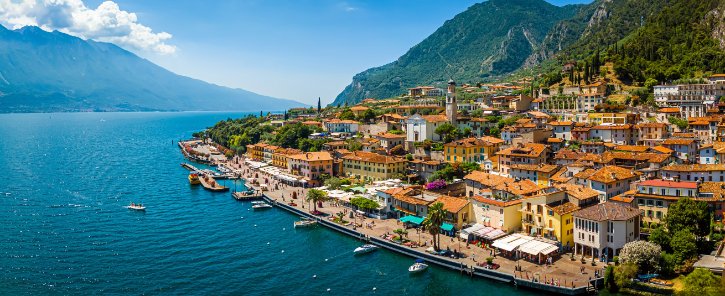
a. Gardens on a Cliff
Limone is the story of people turning a steep slope into flourishing citrus gardens. Its lemon houses, cliffside setting, and old harbor all grow from that one idea.
b. The Citrus Story
- Franciscan friars brought citrus here in the 13th and 14th centuries.
- At 45 degrees north, Limone became the northernmost place on earth to grow citrus commercially.
- The lake softens winter cold, and the cliffs block frost while radiating warmth at night.
- Fun fact: the name comes from an old word for boundary, not the lemon.
c. Limonaia del Castèl
- A restored early 18th-century citrus garden high in the upper town.
- Tall stone pillars, spaced about four meters apart, are linked by chestnut beams.
- Each November the frame was closed in with planks and glass to keep out frost.
- You walk beneath lemon, citron, and mandarin trees with the blue lake showing between the pillars.
d. Old Harbor and Cliff Path
Until the shore road was finished in 1931, Limone was reached only by boat or mule track, which is why its fishing-village shape survives. Steep lanes wind between whitewashed houses draped in bougainvillea. North of the village, a suspended path juts out from the cliff about 50 meters above the water, and walking it feels like floating over the lake.
e. Local Flavors
You will find lemon liqueur, citrus honey, and lemon-infused olive oil made locally, often paired with grilled lake fish. The whole town is really a lesson in adapting rock for farming, which goes well beyond simply being pretty.
South of Limone the cliffs draw back, gentle hillsides appear, the crowds fade, and you reach the calm elegance of Gargnano.
9. Gargnano
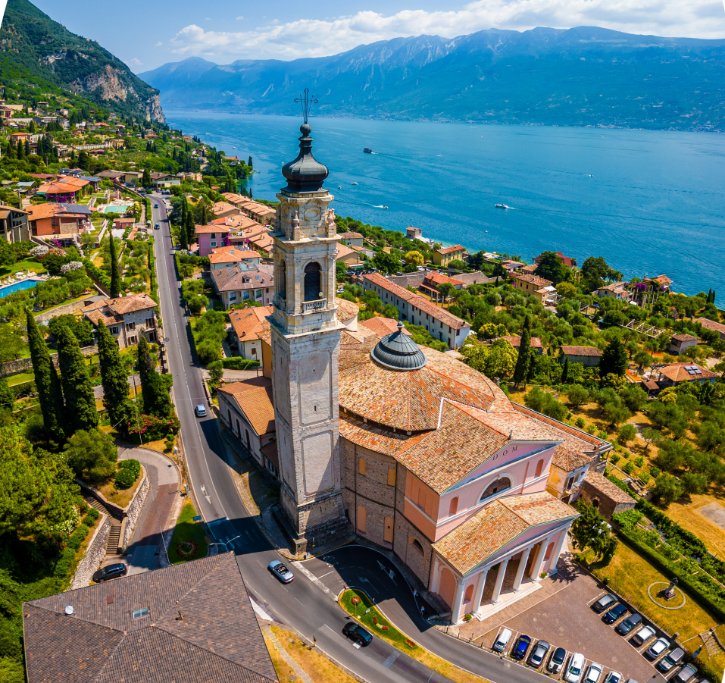
a. Quiet and Refined
Gargnano is one of the quietest and most refined stops on the route, with old harbors, cultivated slopes, and grand villas setting a slow pace.
b. The Harbor
- The main village gathers around a small protected basin.
- Pastel houses, little osterie, and quiet café tables line the water.
- Private sailing boats outnumber the ferries.
- Look at the 16th-century town hall wall for cannonballs from an 1866 naval bombardment.
c. Franciscan Roots and Citrus
The Church of San Francesco, founded in 1289, has a cloister whose carved capitals show the earliest known citrus fruits in European stone carving. This marks Gargnano as the birthplace of the lake’s citrus culture. Around town, old lemon-garden pillars still stand within family estates.
d. Villa Bettoni at Bogliaco
- Two kilometers south, at Bogliaco, stands the grand Villa Bettoni.
- Built for a wealthy family from around 1756, it wears a late-Baroque face with marble statues.
- Inside are frescoed salons and a gallery with works by Canaletto.
- A formal garden climbs the hillside toward a temple to Apollo.
e. Visiting the Villa
The villa is still a private family home, so it is not open for casual daily visits. You can see the interior and gardens on guided tours booked ahead in the warmer months, often led by members of the family. It stands at Bogliaco, not in Gargnano’s central harbor, so keep that in mind when you plan.
The villas around Gargnano set the tone for something grander, as private elegance turns theatrical at Gardone Riviera.
10. Gardone Riviera
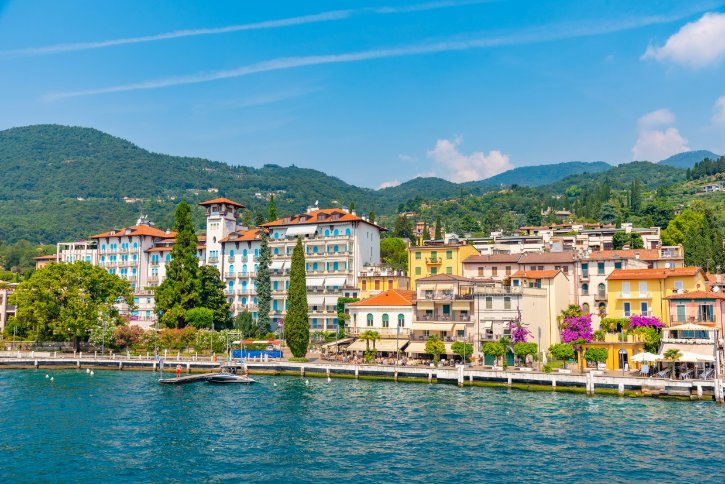
a. The Most Theatrical Stop
Gardone Riviera is the most theatrical stop on the route, built around a famous estate, lush gardens, and elegant resort history.
b. Il Vittoriale degli Italiani
- A nine-hectare estate created by the poet Gabriele d’Annunzio, staged as a monument to his own life.
- His residence is kept in permanent semi-darkness, filled with thousands of books and art objects.
- The prow of a real warship is built into the hillside forest, its guns pointing over the trees.
- A hilltop mausoleum and an open-air amphitheater complete the estate.
c. Heller Garden
Down the slope, the Heller Garden blends botany and art. More than 3,000 plant species grow here, from alpine flora to subtropical palms and bamboo, woven through with sculptures by artists including Keith Haring and Auguste Rodin.
d. Resort-Era Elegance
- Gardone made its name as an elegant winter health resort.
- Grand mansions and hotels line the water, including a hotel that once hosted Winston Churchill.
- The lakeside walk runs beneath oleanders, magnolias, and palms.
- After the intensity of the estate, the calm waterfront is a welcome change.
e. What to Notice
Rather than rushing through a checklist, slow down and take in the unusual details, the warship among the trees, the framed lake views, and the sculptures hidden in the greenery. This is the curated, eccentric, garden-focused corner of the trip.
South of Gardone the mood shifts again, from a very personal estate to a broad public bay, as you arrive in Salò.
11. Salò
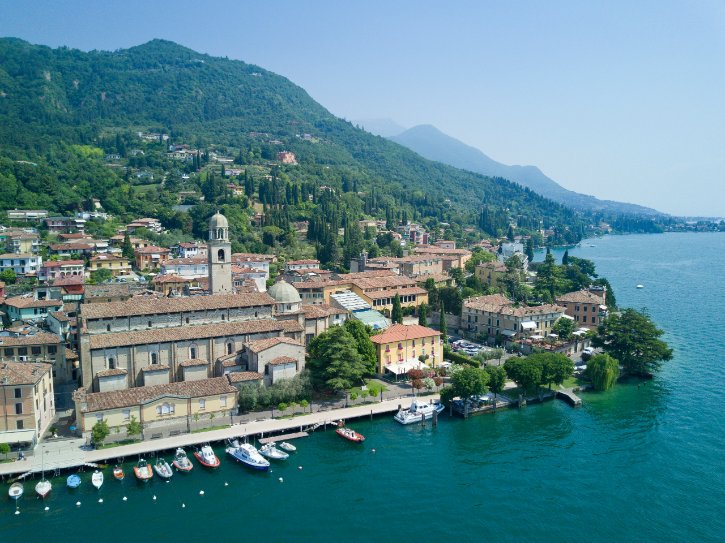
a. The Grand Waterfront
Salò is the grand civic waterfront of the western shore, with a long promenade, handsome buildings, a major cathedral, and a layered history.
b. Lungolago Zanardelli
- The longest lakefront promenade on the lake, following the sweep of the bay.
- Grand palaces, arcades, and old cafés line one side.
- Balustrades, flowerbeds, and mooring posts edge the water.
- In the evening it becomes the stage for the traditional Italian stroll.
c. The Cathedral
Set slightly inland, the Duomo is the largest church on the lake. Its brick exterior looks plain, but the inside is the surprise, with tall airy naves and a life-sized wooden crucifix once admired by the painter Andrea Mantegna as one of the most beautiful in Italy.
d. MuSa Museum
- Housed in a restored 16th-century monastery.
- One section honors Gasparo da Salò, a pioneer of the modern four-string violin.
- Another handles the town’s role as headquarters of a wartime republic between 1943 and 1945.
- That difficult period is set carefully in context, as one layer within a much longer history.
e. Behind the Promenade
Just behind the water, the old town keeps Renaissance doorways, vaulted alleys, and quiet courtyards. Covered passages lead you back to the lake, so it is easy to move between the open promenade and the denser streets. This is the route’s strongest civic waterfront, about public squares and daily life around a broad bay.
Leaving Salò, the tall cliffs fall away, the lake widens into an open expanse, and you reach the lively finale at Desenzano.
12. Desenzano del Garda
a. A Lively Finale
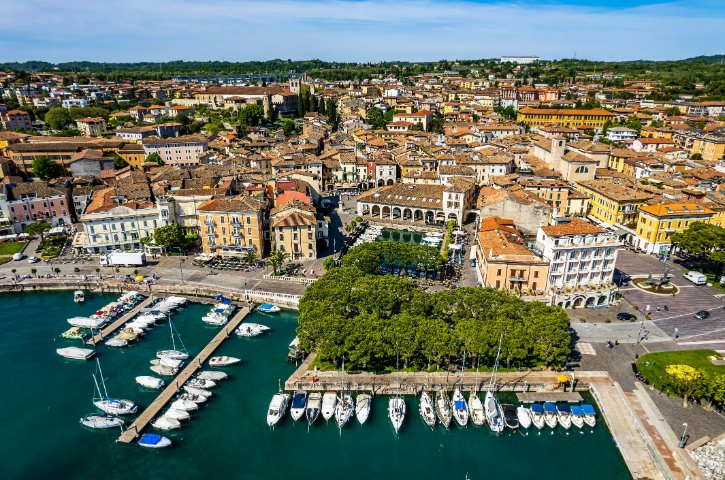
Desenzano is the energetic southern finale, a busy lakeside town with a historic harbor, waterfront squares, a castle viewpoint, and important Roman ruins.
b. Villa Romana
- The most important late Roman residence in Northern Italy, found by accident in 1921.
- Its grand layout dates to an early 4th-century rebuild.
- More than 240 square meters of colorful mosaic floors survive intact.
- Look for Orpheus playing his lyre, cupids harvesting grapes, and figures of the Four Seasons.
c. A Link Back to Sirmione
The villa pairs beautifully with Sirmione, showing two sides of Roman life on the southern lake. The Grotte di Catullo is earlier and monumental, with huge vaults but only mosaic fragments. Desenzano’s villa is later and decorative, built for comfort, with its rich floors still intact. Seeing both connects the start and end of your loop.
d. Porto Vecchio and Piazza Malvezzi
- The old harbor gives you one of the finest urban scenes on the lake.
- Colorful houses and former grain stores ring the basin, crossed by a stone bridge.
- Beside it, Piazza Malvezzi buzzes with cafés under Renaissance arcades.
- Unlike the smaller resorts, Desenzano works all year round.
e. Castello di Desenzano
On a low hill above the rooftops stands the old castle, always a community refuge rather than a princely home. Climb to the battlements for the trip’s final reward, a wide view over the roofs, across the southern basin, and directly toward the long peninsula of Sirmione. That view brings the whole journey full circle, back to where you began.