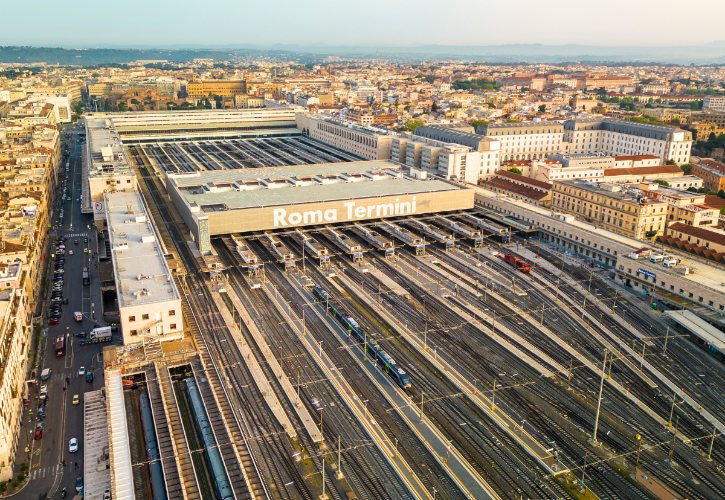
Countless travelers pour off the high-speed train in Rome and reach Venice in under four hours, watching Italy blur past the window.
Between the capital and the lagoon lies some of the country’s most rewarding ground: fortified hill towns, Renaissance art cities, food capitals, lake shores, and classical architecture at its purest.
Slow the journey down and you turn a simple transfer into a full cross-section of Italy. It all begins where the story does, in Rome. 😊
1. Rome
a. Why Visit Here
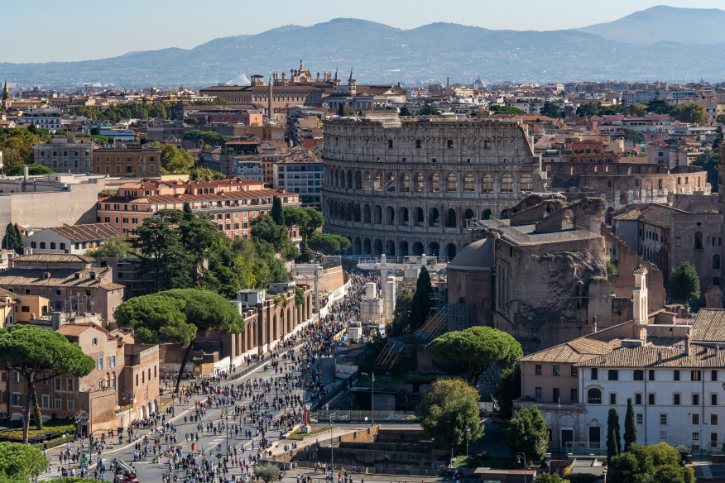
Rome is the foundation you measure everything else against, not just the station where you catch your first train. No other stop compresses thousands of years into one city, where classical engineering, early Christian shrines, papal palaces, and Baroque squares all overlap. Give it real time and you gain the historical context for every town that follows.
b. What to See and Do
- Ancient core: See the Colosseum, Roman Forum, and Palatine Hill as one connected site, the old seat of civic ritual, commerce, and imperial power.
- Historic center: The Pantheon and its open oculus, Piazza Navona over the footprint of Domitian’s stadium, and Caravaggio’s Saint Matthew cycle inside San Luigi dei Francesi.
- Vatican: For the Vatican Museums and Sistine Chapel, booking a timed entry online ahead is strongly recommended to skip the long ticket lines, though same-day tickets are sold at the door. Peter’s Basilica holds Michelangelo’s Pietà, and a 551-step climb takes you up the dome.
- Neighborhoods: Wander Trastevere for its cobbled alleys and medieval mosaics, and the Jewish Ghetto for its cuisine and Roman ruins.
Read More:
- The Best Walk From Vatican City to Trevi Fountain
- The Best Walking Route That Starts Around the Colosseum and Ends at Trevi Fountain
c. Nearby Places and Day Trips
Two excursions keep the ancient theme going. Ostia Antica is a remarkably intact Roman seaport, with apartment blocks, taverns, and mosaic-floored guild offices, ideal if you want more of the ancient world. Tivoli trades that for two hillside estates: the fountains and gardens of Villa d’Este and the sprawling ruins of Hadrian’s Villa.
d. How Long to Stay
- Two days: Too little, and it forces a tiring checklist.
- Three full days: The practical minimum for the ancient park, the center, and the Vatican.
- Four nights: The ideal, with room for Ostia Antica and unhurried evenings.
e. Getting to the Next Stop by Train
- Departure: Roma Termini (some departures also serve Roma Tiburtina)
- Arrival: Orvieto
- Operator: Trenitalia
- Service types: Regionale Veloce (RV), Regionale (R), and occasional Intercity (IC)
- Pattern and timing: Direct Regionale Veloce trains run along the historic Florence-Rome conventional line (Linea Lenta), with no change needed. Direct regional services usually take between 1 hour 5 minutes and 1 hour 25 minutes, depending on stops.
One practical point matters at the far end. The railway station sits on the valley floor in the modern district of Orvieto Scalo (Piazza Matteotti), while the historic center stands high on an isolated volcanic tufa bluff.
- Do not try to walk up the cliffs with luggage.
- Directly opposite the station, board the historic funicular (Funicolare di Orvieto), which climbs to Piazza Cahen in about two minutes.
- From Piazza Cahen, local electric minibuses run through the pedestrian streets to Piazza del Duomo, covered by the same funicular ticket.
2. Orvieto
a. Why Visit Here
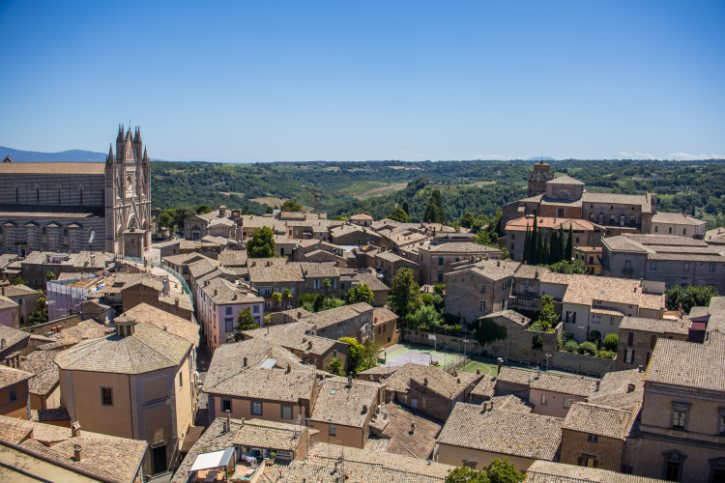
Orvieto is your first real pause, and the shift is immediate. After Rome’s sprawl, this compact town on a plate of tufa rock feels contained and walkable, ringed by sheer cliffs. It shows off Umbria in golden stone, cave networks underfoot, and long views across the valley, and it quiets down beautifully once the day visitors leave.
b. What to See and Do
- Duomo di Orvieto: A Gothic facade of golden mosaics, marble statuary, and bas-reliefs by Lorenzo Maitani, with black basalt and white travertine striping running along the side walls. Inside, Luca Signorelli’s apocalyptic frescoes later influenced Michelangelo.
- Pozzo di San Patrizio: A well dropping 53 meters into the rock on a double-helix staircase, built so pack animals could descend and climb without meeting.
- Orvieto Underground: More than 1,200 hand-cut caves, Etruscan cisterns, and old olive presses beneath the streets.
- On the table: Handmade umbrichelli pasta with wild boar ragù, paired with a glass of dry Orvieto Classico DOC.
c. Nearby Places and Day Trips
Two nearby spots add something the town itself cannot. Civita di Bagnoregio is the “dying town”, clinging to an eroding plateau and reached only by a footbridge. Lake Bolsena, Europe’s largest volcanic crater lake, offers lakeside paths and a medieval castle.
d. How Long to Stay
- Half day: Enough for the cathedral and a short walk.
- Full day plus one night: The better choice, when the streets empty and the lit facade glows after dark.
e. Getting to the Next Stop by Train
- Departure: Orvieto
- Arrival: Arezzo
- Operator: Trenitalia
- Service types: Regionale Veloce (RV) and occasional Intercity (IC)
- Pattern and timing: Direct Regionale Veloce trains head north on the conventional line through Umbria and eastern Tuscany, taking roughly 1 hour 5 minutes to 1 hour 15 minutes.
Not every departure is direct. Some itineraries require a change at Chiusi-Chianciano Terme or Terontola-Cortona, which pushes the total to around 1 hour 30 minutes or even 2 hours. Aim for a direct Regionale Veloce when you can.
3. Arezzo
a. Why Visit Here
Arezzo is your artistic warm-up before Florence, set on a hillside in eastern Tuscany. Because it sits off the main high-speed line, far fewer visitors come through, and the Tuscan rhythm stays unhurried. You can stand close to Early Renaissance frescoes in their original setting here, without the museum queues you’ll meet in Florence.
b. What to See and Do
- Basilica di San Francesco: Piero della Francesca’s fresco cycle The Legend of the True Cross, a cornerstone of Renaissance painting. Entry is limited, so reserve ahead.
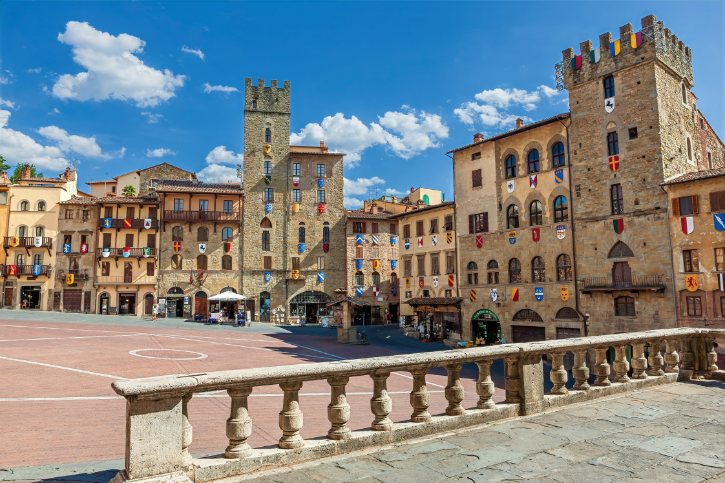
- Piazza Grande: A sloping square framed by Vasari’s Logge and the Romanesque apse of Santa Maria della Pieve.
- Antiques fair: On the first Sunday of each month and the Saturday before, dealers fill the square. Worth timing for if your dates line up.
- More art: The Gothic Duomo holds Piero’s Mary Magdalene, and Casa Vasari preserves the artist’s frescoed home.
c. Nearby Places and Day Trips
Three towns sit within easy reach. Cortona crowns a hilltop over the Val di Chiana, with a strong Etruscan and medieval core. Sansepolcro, the birthplace of Piero della Francesca, holds more of his work, including The Resurrection. Anghiari is a stone hill town tied to the 1440 battle later drawn by Leonardo.
d. How Long to Stay
- Half day: The frescoes and Piazza Grande.
- Full day plus a night: Adds Casa Vasari, the cathedral, and a slow dinner.
- Two nights: Useful mainly as a base for the nearby towns.
e. Getting to the Next Stop by Train
- Departure: Arezzo
- Arrival: Firenze Santa Maria Novella (Firenze SMN)
- Operator: Trenitalia
- Service types: Regionale Veloce (RV) and Regionale (R)
- Pattern and timing: Direct Regionale Veloce trains reach central Florence in 50 to 65 minutes. Slower Regionale trains stop everywhere and take 1 hour 25 minutes to 1 hour 40 minutes.
Choose your Florence station with care. Aim for a train that terminates at or calls at Firenze Santa Maria Novella (Firenze SMN), the terminal in the historic center. Some regional departures end at peripheral stations such as Firenze Campo di Marte or Firenze Rifredi, which then need a local connection to reach the core.
4. Florence
a. Why Visit Here
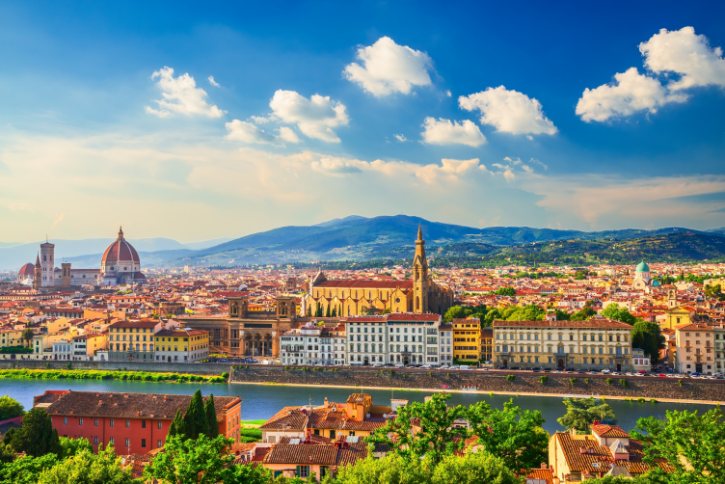
Florence is the full scale of the Renaissance. Where Arezzo gives you single masterworks in a quiet town, Florence shows how merchant wealth, civic rivalry, and Medici patronage remade an entire city. The classical ideas you saw revived begin here, in Brunelleschi’s engineering and the sculpture and painting that followed.
b. What to See and Do
- Duomo complex: Brunelleschi’s dome, Giotto’s Campanile, the Baptistery, and the Museo dell’Opera. The 463-step dome climb needs a timed Brunelleschi Pass and is not for anyone uneasy with heights or tight spaces.
- Civic core: Piazza della Signoria, Palazzo Vecchio, and the Uffizi, whose collection runs from Giotto and Botticelli to Leonardo and Caravaggio. Book the Uffizi ahead.
- Oltrarno: Cross the Ponte Vecchio into the artisan quarter around Santo Spirito, calmer than the center.
- A choice: The Accademia for Michelangelo’s David and sculpture, or the Uffizi for the broad sweep, if time is short.
- On the table: Bistecca alla fiorentina, ribollita, and lampredotto from a street stall.
Read More: The Perfect Florence Walking Route to Explore the City’s Best Sights in One Day
c. Nearby Places and Day Trips
The options range widely. Fiesole is a hillside village with Roman ruins and views back over Florence. Siena rewards a full day with its shell-shaped Piazza del Campo and striped marble cathedral.
Pisa and Lucca make easy add-ons, one for the leaning tower, one for its intact walls. Chianti, the vineyard country, is best reached by car, driver, or tour rather than public transit.
d. How Long to Stay
- Two full days: The minimum for the Duomo, the Uffizi, and the core.
- Three nights: The balanced pace, with a day for the Accademia or Fiesole.
e. Getting to the Next Stop by Train
- Departure: Firenze Santa Maria Novella (Firenze SMN)
- Arrival: Bologna Centrale
- Operators: Trenitalia (Frecciarossa) and Italo
- Service type: High-Speed (Alta Velocità / AV)
- Pattern and timing: Direct high-speed trains take just 37 to 40 minutes, running through the Apennine base tunnels (including the 18.5-kilometer Vaglia Tunnel).
Slowing a trip down does not mean refusing fast trains. Using high-speed rail to punch through a natural mountain barrier saves time and energy you can then spend on the towns in between. Conventional regional trains over the old mountain lines take about two hours with transfers and offer little scenery.
5. Bologna
a. Why Visit Here
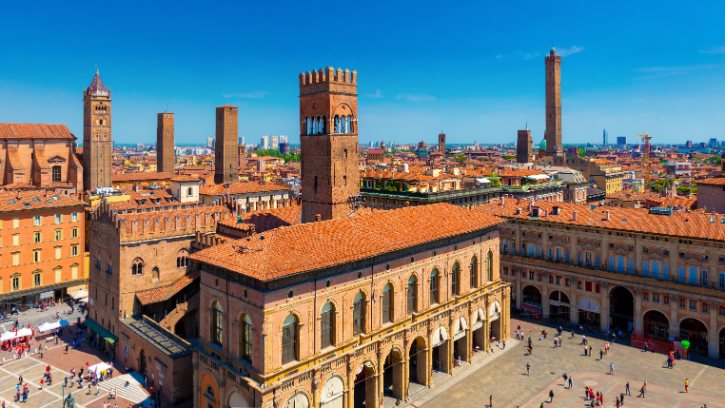
Cross the Apennines and the whole look changes. Bologna trades Tuscan stone for warm brick, wide squares, and kilometers of covered porticoes. It is home to the Western world’s oldest university, and it rewards food lovers, walkers, and anyone who likes a lived-in city center.
b. What to See and Do
- Piazza Maggiore: The civic heart, with the vast brick Gothic Basilica di San Petronio and its 17th-century meridian line set in the floor.
- Quadrilatero: A tight grid of market streets full of butchers, fishmongers, and delis.
- Archiginnasio: The old university seat, with a spruce-carved anatomical theatre.
- Porticoes: A UNESCO-listed feature of the city, led by the 3.8-kilometer Portico di San Luca up to a hilltop sanctuary.
- Towers: Torre degli Asinelli is currently closed for a multi-year stabilization project. For the rooftop view, climb the Torre dell’Orologio on Piazza Maggiore instead.
- On the table: Mortadella, tortellini in brodo, and tagliatelle al ragù, which is nothing like “spaghetti bolognese”.
c. Nearby Places and Day Trips
Three cities each add something Bologna lacks. Modena brings a UNESCO cathedral, the Ferrari museum, and traditional balsamic vinegar. Ferrara is a planned Renaissance city around the moated Castello Estense. Ravenna holds some of the finest early Christian and Byzantine mosaics in Italy.
d. How Long to Stay
- One day: The main squares and a taste of the food.
- One or two nights: Better, for evening aperitivo under the porticoes and morning markets before the crowds.
e. Getting to the Next Stop by Train
- Departure: Bologna Centrale
- Arrival: Parma
- Operators: Trenitalia Tper and Trenitalia
- Service types: Regionale Veloce (RV), Regionale (R), and Intercity (IC)
- Pattern and timing: Trains follow the historic conventional Milan-Bologna corridor, which runs parallel to the Roman Via Emilia. Direct Regionale Veloce trains take 50 to 55 minutes, Intercity services about 45 to 50 minutes, and slower stopping trains up to 1 hour 15 minutes.
For this stretch, the direct Regionale Veloce is the practical backbone, and it needs no advance seat reservation. The arrival station is simply Parma.
6. Parma
a. Why Visit Here
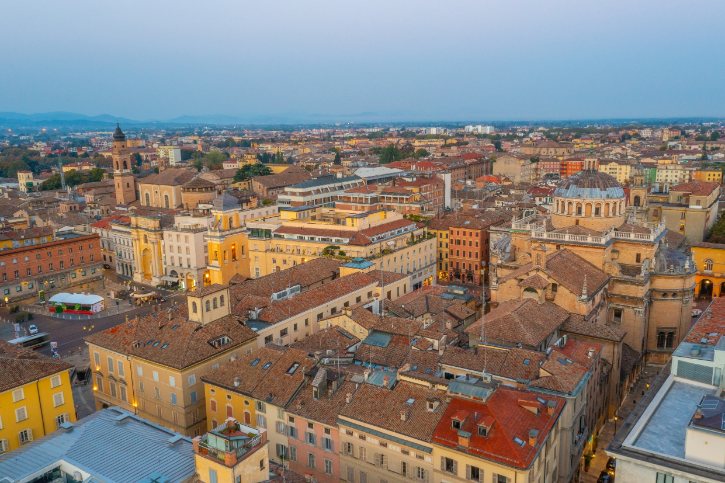
Parma swaps Bologna’s bustle for a quieter, ducal calm. Both are food cities, but they are not the same: Bologna runs on fresh egg pasta and markets, while Parma rests on world-class cured meats and cheese, plus deep ties to Verdi and Renaissance painting. The pace is gentle and the center is easy to cover on foot.
b. What to See and Do
- Piazza Duomo: The cathedral’s illusionistic dome fresco by Correggio, beside a pink-marble Baptistery by Antelami.
- Complesso della Pilotta: The Galleria Nazionale, holding Leonardo’s La Scapigliata, and the Teatro Farnese, an all-wood theatre coated in plaster to look like marble.
- Teatro Regio: A neoclassical opera house with famously exacting audiences.
- Food, two ways: Taste Parmigiano Reggiano DOP and Prosciutto di Parma DOP in town, or book a morning tour to a working dairy or curing house in the countryside to see them made.
c. Nearby Places and Day Trips
The countryside is the real draw here. Torrechiara is a fortified Renaissance castle with the frescoed Camera d’Oro. Langhirano is the production hub for Parma ham, with a dedicated museum. Busseto sits in Verdi’s home country, with the composer’s estate nearby.
d. How Long to Stay
- A two-hour stop: Too little, given the food and the Pilotta.
- One full day plus a night: The main sights and an evening meal.
- Two nights: Room for a countryside food tour.
e. Getting to the Next Stop by Train
- Departure: Parma
- Arrival: Milano Centrale
- Operators: Trenitalia and Trenord
- Service types: Regionale Veloce (RV), Intercity (IC), and occasional Frecciarossa
- Pattern and timing: Direct Regionale Veloce trains run through Piacenza and Lodi in about 1 hour 25 minutes to 1 hour 35 minutes. Intercity services take 1 hour 10 minutes to 1 hour 20 minutes, and Frecciarossa services, where scheduled via the high-speed link, take 50 to 55 minutes.
- Milano Centrale is the destination station.
It is worth being honest about the geography. Routing through Parma and Milan is a deliberate detour to the northwest, not the direct path. The straight railway from Bologna to Venice branches northeast across the Po Valley via Ferrara and Padua. The detour still makes sense: it buys you the ducal art of Parma, the energy of Milan, and the Lake Garda shore before the route turns east toward Venice.
7. Milan
a. Why Visit Here
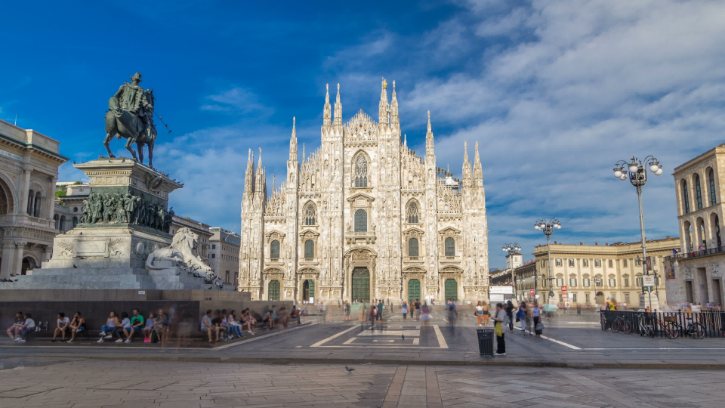
Milan is the sharpest change on the route. As Italy’s fashion, design, and finance center, it runs fast and modern, yet it holds the country’s greatest Gothic cathedral and Leonardo’s High Renaissance work. Come here for major art, contemporary architecture, and a lively city after dark.
b. What to See and Do
- Duomo di Milano: A vast marble Gothic cathedral. Go up to the rooftop terraces to walk among the spires, with the Alps in view on a clear day.
- Galleria Vittorio Emanuele II: A grand 19th-century glass arcade next to La Scala.
- The Last Supper: Leonardo’s fresco allows only short viewings and sells out fast, so reserve as far ahead as you can. Same-day entry is not something to count on.
- Brera: Cobbled streets and the Pinacoteca di Brera, with works by Mantegna, Raphael, and Caravaggio.
- Castello Sforzesco: Museums including Michelangelo’s unfinished Rondanini Pietà.
- Navigli: Canalside bars for an evening aperitivo.
Read More: The Best Milan Route to See the City’s Top Sights in One Day
c. Nearby Places and Day Trips
Two options sit close, but they are not equally useful here. Bergamo, a walled hilltop old town, is the better pick because it adds variety rather than another lake. Lake Como is striking, but it can feel redundant if you’re already heading to Lake Garda next.
d. How Long to Stay
- One day: The Duomo and Galleria, but thin on museums.
- Two nights: The standard, covering the rooftops, the Last Supper, and Brera.
- Three nights: Adds a day trip to Bergamo.
Your Last Supper time slot will often shape one full day, so plan around it.
e. Getting to the Next Stop by Train
- Departure: Milano Centrale
- Arrival: Desenzano del Garda-Sirmione (the departure board may show the shortened name Desenzano)
- Operators: Trenord and Trenitalia (Frecciarossa)
- Service types: Regionale / RegioExpress (RE) and Frecciarossa
- Pattern and timing: Both run direct along the Milan-Venice line. Trenord RegioExpress trains take about 1 hour 20 minutes to 1 hour 25 minutes, while Frecciarossa services run in roughly 51 to 53 minutes.
The fast train saves around half an hour, but the Trenord regional express is reliable and needs no seat reservation. Pick whichever direct service best matches your departure time rather than defaulting to the fastest.
8. Desenzano del Garda
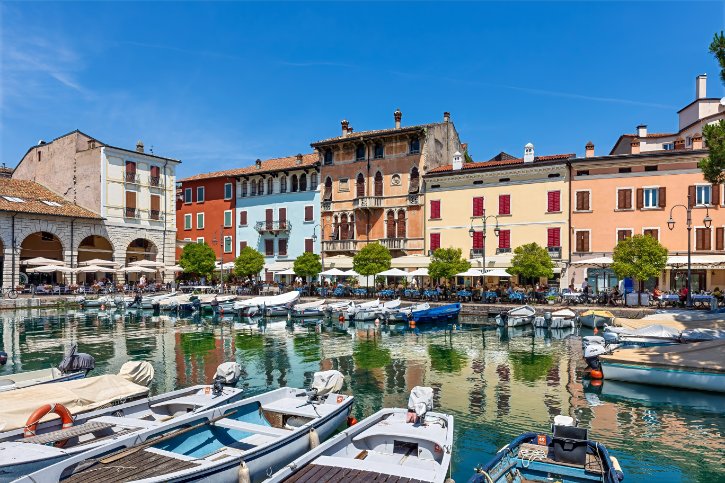
a. Why Visit Here
This is your breather. After a run of art cities, Desenzano gives you open water and a lakeside stroll on the southwestern shore of Lake Garda. Just as important, it sits on the main railway line, which makes it a far more practical base than Sirmione, which has no train station.
b. What to See and Do
- Porto Vecchio: The old harbor from Venetian times, ringed with pastel facades and cafes.
- Villa Romana: A Roman residence with more than 240 square meters of mosaic floors.
- Castello di Desenzano: Ramparts looking out over the lower lake.
- Lakefront: Walk the promenade, and leave time unscheduled to sit by the water with a glass of local Lugana DOC
c. Nearby Places and Day Trips
The lake opens up several trips, with Sirmione the standout. Sirmione runs along a long peninsula holding a water fortress and the Roman ruins of the Grotte di Catullo. Peschiera del Garda is a canal-ringed Venetian fortress town on the lake. Salò and Gardone Riviera are lakeside towns with the eccentric Vittoriale estate.
d. How Long to Stay
- A few hours: The harbor and Roman villa.
- One night: Adds an afternoon over to Sirmione and a lakeside dinner.
- Two nights: Room for the wider lake.
e. Getting to the Next Stop by Train
- Departure: Desenzano del Garda-Sirmione
- Arrival: Verona Porta Nuova
- Operators: Trenord, Trenitalia, and Italo
- Service types: Regionale Veloce (RV), Regionale (R), Frecciarossa, and Italo
- Pattern and timing: All services run direct eastward into the Veneto. High-speed Frecciarossa and Italo trains take about 20 minutes, regional trains about 25 to 30 minutes.
Because the distance is only about 35 kilometers, the high-speed train saves only a handful of minutes over the regional. Just take whichever direct service fits your schedule. That short link is part of what makes Desenzano such a practical base.
Read More: 12 Beautiful Lake Garda Spots With Only a Short Drive Between Them
9. Verona
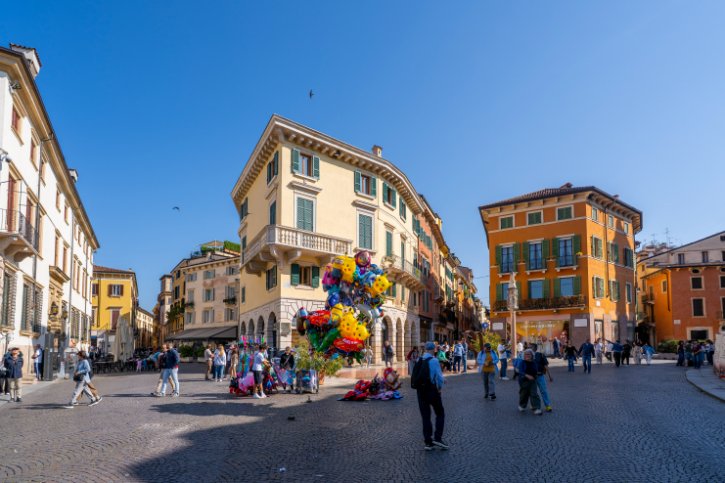
a. Why Visit Here
Verona brings you back into a historic city while keeping some scenery, wrapped in a bend of the green Adige River. Popular culture ties it to Romeo and Juliet, but its real weight is Roman engineering, medieval Scaliger power, and Venetian Renaissance architecture, all in a compact, walkable center.
b. What to See and Do
- Verona Arena: A Roman amphitheater that predates the Colosseum and still hosts summer opera.
- The squares: Piazza delle Erbe, the old forum turned market, and Piazza dei Signori with the Gothic Scaliger tombs nearby.
- Castelvecchio: A red-brick fortress and bridge, with a museum famously reworked by architect Carlo Scarpa.
- River views: Cross the Roman Ponte Pietra and ride up to the Castel San Pietro
- Churches: Prioritize San Zeno Maggiore and Sant’Anastasia over the crowds.
- Juliet’s House: Culturally famous but a modern literary tribute, so weigh it against the city’s real history.
c. Nearby Places and Day Trips
The area splits between towns and wine country. Mantua is a Renaissance Gonzaga city, with Palazzo Te and its Hall of the Giants. Valpolicella, the hills that make Amarone, is best explored with a driver or tasting tour. Soave is a walled village under a castle, ringed by white-wine vineyards.
d. How Long to Stay
- One day: The Arena, the squares, and the river viewpoint.
- One night: Adds the quiet, illuminated evening along the Adige.
- Two nights: Room for Mantua or a wine afternoon.
e. Getting to the Next Stop by Train
- Departure: Verona Porta Nuova
- Arrival: Vicenza
- Operators: Trenitalia and Italo
- Service types: Regionale Veloce (RV), Regionale (R), Frecciarossa, and Italo
- Pattern and timing: Regionale Veloce trains take about 27 to 30 minutes, high-speed Frecciarossa and Italo services about 24 to 25 minutes.
On this short 45-kilometer corridor, the Regionale Veloce is almost as fast as the high-speed trains, which makes it the most flexible choice.
10. Vicenza
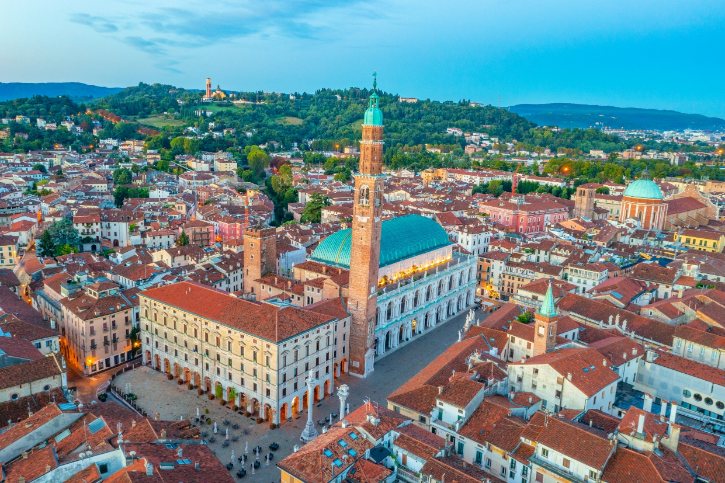
a. Why Visit Here
Vicenza adds a distinct note: the calm symmetry of the High Renaissance. Known as the City of Palladio, it and its country villas form a UNESCO site built around the architect’s work. Where Verona is Roman and medieval, Vicenza is all classical proportion and temple-inspired facades, and it stays clean and uncrowded.
b. What to See and Do
- Basilica Palladiana: A medieval hall that Palladio wrapped in an elegant marble loggia built around the serliana, the arch-and-lintel motif his work here made famous as the Palladian window.
- Teatro Olimpico: The oldest surviving enclosed Renaissance theatre, with a trompe-l’œil stage set of receding streets.
- Palladian palazzi: Grand facades throughout the center, plus the Palladio Museum.
- Villa La Rotonda: Palladio’s most famous house. Interior access is limited to certain days, so check before going.
- Villa Valmarana ai Nani: Nearby, with vivid frescoes by Tiepolo.
c. Nearby Places and Day Trips
The countryside supports a themed day for architecture lovers. Bassano del Grappa is a river town with a Palladio-designed covered bridge and historic grappa distilleries. Marostica has medieval walls and a square laid out as a giant chessboard. Further out, estates like Villa Barbaro and Villa Emo carry Palladio’s work across the Veneto plain.
d. How Long to Stay
- Half day: The Basilica Palladiana and the Teatro Olimpico.
- Full day plus a night: The right pace if you want to reach the villas outside the center.
e. Getting to the Next Stop by Train
- Departure: Vicenza
- Arrival: Padova (Padua)
- Operators: Trenitalia and Italo
- Service types: Regionale Veloce (RV), Regionale (R), Frecciarossa, and Italo
- Pattern and timing: Regionale Veloce trains take about 17 to 20 minutes, Frecciarossa about 14 to 16 minutes.
A note on the name: Italian timetables, boards, and ticket machines all show the station as Padova, while English guidebooks usually say Padua. They are the same city, so look for Padova when booking. The Regionale Veloce takes only about three minutes longer than the fast trains, so it is the practical pick for this 30-kilometer hop.
11. Padua
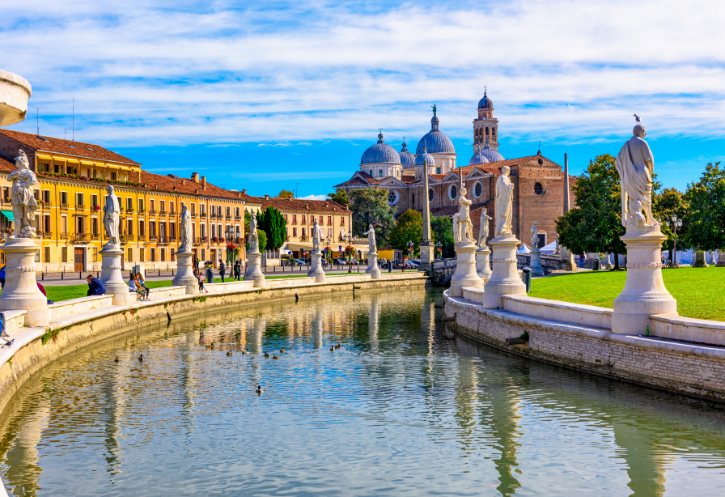
a. Why Visit Here
Padua is a serious stop for art, learning, and science, not just a pause before Venice. Home to one of the oldest universities in the world, it holds Giotto’s Scrovegni Chapel, whose early sense of space paved the way for the Renaissance you’ve already seen. Two separate UNESCO listings underline how much sits here.
b. What to See and Do
- Scrovegni Chapel: Giotto’s fresco cycle, often called the dawn of Western painting. Entry is timed and must be booked ahead, with a short acclimatization stop before a strict viewing window.
- Palazzo della Ragione: A giant medieval hall above centuries-old market squares.
- Basilica di Sant’Antonio: A major pilgrimage shrine with bronze altar works by Donatello.
- Prato della Valle and the Orto Botanico: One of Europe’s largest squares beside the world’s oldest academic botanical garden.
- Palazzo Bo: The university seat, with Galileo’s lectern and a historic anatomical theatre.
c. Nearby Places and Day Trips
The trips here shift toward water and hills. The Brenta Riviera is a canal lined with Venetian villas, led by the palatial Villa Pisani, which makes a natural bridge toward Venice. The Euganean Hills offer spa towns and the stone village of Arquà Petrarca, where the poet Petrarch spent his final years.
d. How Long to Stay
- A day trip: Possible, but tight once you factor in the timed chapel booking.
- One full day plus a night: The comfortable choice, with an evening in the lit squares.
e. Getting to the Next Stop by Train
- Departure: Padova
- Arrival: Venezia Santa Lucia
- Operators: Trenitalia and Italo
- Service types: Regionale Veloce (RV), Regionale (R), Frecciarossa, and Italo
- Pattern and timing: Regionale Veloce trains take about 26 to 28 minutes, Frecciarossa and Italo about 25 minutes.
The station choice here is the one first-timers get wrong, so it is worth being very clear:
- Venezia Mestre is on the industrial mainland. It is a major rail junction, but it is not the historic island city.
- Venezia Santa Lucia is the final terminus, sitting directly on the Grand Canal inside historic Venice.
If you are staying in central Venice, stay on the train past Mestre as it crosses the four-kilometer railway causeway (Ponte della Libertà) over the open lagoon. Stepping out of the Santa Lucia concourse puts you straight at the edge of the Grand Canal and the vaporetto docks.
12. Venice
a. Why Visit Here
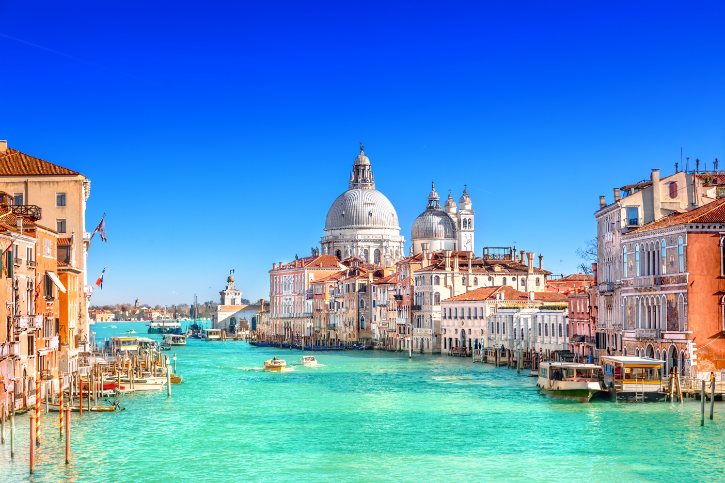
Venice is the payoff, and it stands apart from everything before it. Earlier stops rose on Roman grids, tufa bluffs, Tuscan hills, and river plains. This one exists entirely in a saltwater lagoon, built on millions of wooden pilings driven into the mud. As the old maritime republic, it fused Gothic, Byzantine, and Islamic styles along canals where boats replace cars. It is the fitting finale to the whole journey.
b. Current Visitor Rules
- Access fee: A daily entry fee applies to day-trippers entering historic Venice between 8:30 AM and 4:30 PM on designated peak dates in spring and summer.
- Overnight exemption: If you stay within the municipality and pay the lodging tax, you’re exempt, but you must register online in advance to receive a valid QR code.
- Groups: Guided tour groups are capped at 25 people, and outdoor loudspeakers are banned in the historic center.
c. What to See and Do
- San Marco: Treat it as one experience: the mosaic-filled Basilica di San Marco, the Gothic Doge’s Palace, and the Bridge of Sighs behind it.
- Grand Canal: Ride Vaporetto Line 1 or 2 from the station to San Marco. The water route is the sightseeing.
- Rialto: The historic bridge and market district, best in the early morning.
- Dorsoduro: The cultural quarter, with the Gallerie dell’Accademia and the Peggy Guggenheim Collection.
- Cannaregio: A calmer residential area holding the historic Jewish Ghetto.
- For art lovers: The Frari, with Titian’s Assumption, and the Tintoretto cycle at the Scuola Grande di San Rocco.
- On the table: Cicchetti and an ombra of wine at a traditional bacaro.
Read More: The Perfect Venice Walking Route for Seeing the Best Sights in One Day
d. Lagoon Islands
- Murano: The center of Venetian glassmaking, with working studios you can tour.
- Burano: Brightly painted fishermen’s houses and a lace-making tradition.
- Torcello: The quiet, ancient cradle of the lagoon, with early Byzantine mosaics.
- Lido: A barrier island with beaches and the Film Festival venues.
Linking Murano, Burano, and Torcello in one day is realistic. Adding the Lido on top of that makes the day feel rushed, so choose by interest.
e. How Long to Stay
- One day: Rushed, and spent mostly in the busiest corridors.
- Two full days: Covers the core with a little room.
- Three nights: The recommendation, and the right way to end a slow trip.
Staying over is the whole difference. In the early morning and late evening, once the day-trippers leave, the canals fall silent and the alleys open up. That quiet is the reward for taking the long way here.