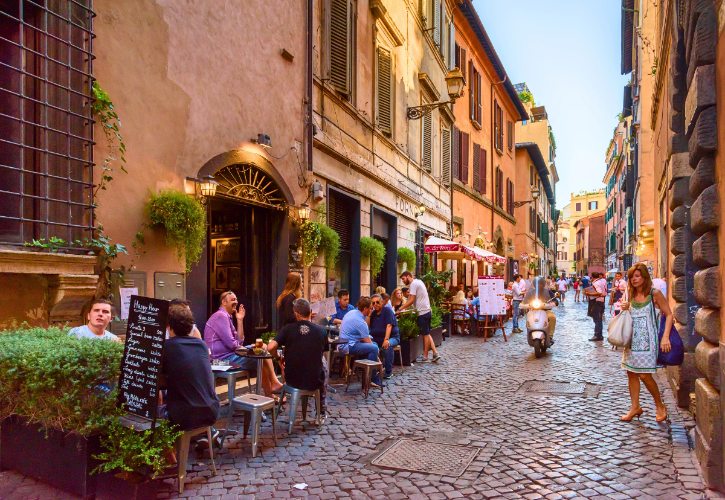
Trastevere is one of those rare corners of Rome where the whole city seems to fold into a few short streets.
You start high above the rooftops with wide views and grand monuments, then drop into a world of medieval churches, sunlit piazzas, tiny cafés, and narrow lanes dotted with quiet shrines.
The scale keeps shifting as you walk. Here, monumental history and everyday neighborhood life sit right next to each other, all the way down to the Tiber. 😊
1. Janiculum Hill
a. Start with the view
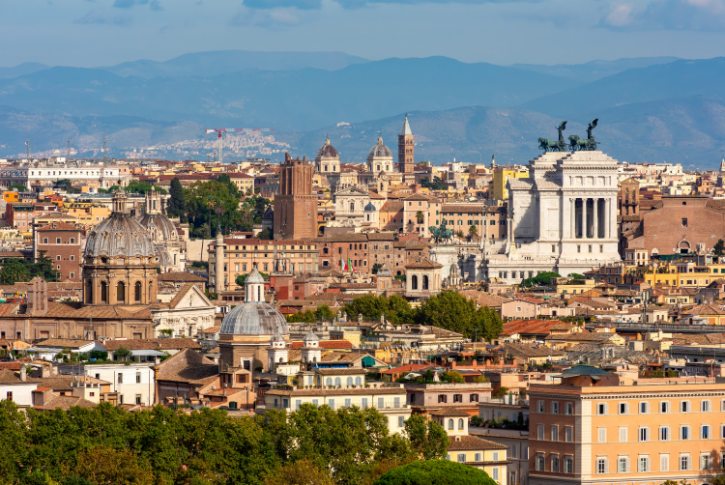
The Janiculum, or Gianicolo, rises on the western bank of the Tiber, just outside Rome’s ancient Seven Hills. Because it sits on a high ridge, it hands you the most complete panorama of the historic center. Starting up here gives you a sense of the city’s scale before you disappear into the tight streets below.
b. What you can see from up top
From the balustrades of Piazzale Giuseppe Garibaldi, look for:
- The sweeping curve of the Tiber
- The domes of Sant’Andrea della Valle and the Pantheon
- The huge white bulk of the Monument to Victor Emmanuel II (Il Vittoriano)
- The distant Sabine and Alban Hills on a clear day
c. The character of the hill
- Wide gravel piazzas and open avenues
- Tall maritime stone pines and leafy plane trees
- A calm, spacious mood, the opposite of the crowded lanes ahead
d. A memorial to modern Italy
This ridge is one of the founding landscapes of modern Italy. In the spring of 1849, it became the main battleground of the short-lived Roman Republic, defended under the command of Giuseppe Garibaldi against French forces. The republic fell on July 3, 1849, and after Italy was unified the hill became a park of national memory.
e. Monuments to look for
- Garibaldi’s equestrian statue, cast by Emilio Gallori, unveiled in 1895, gazing toward the Vatican
- The monument to Anita Garibaldi (1932), riding at full gallop with a pistol in hand and her infant son in her arm; her remains rest in the base
- The busts of the patriots, 84 marble herms lining the promenades
- The Janiculum Lighthouse (1911), a gift from Italian emigrants in Argentina, whose lantern once shone green, white, and red
f. What to photograph
- The tall pine trunks framing the skyline
- The heraldic carvings on the monument pedestals
- Morning and late-afternoon light on the busts tucked in the greenery
Slow down here. This is a memorial, not just a photo stop.
2. Fontana dell’Acqua Paola
a. The “Big Fountain”
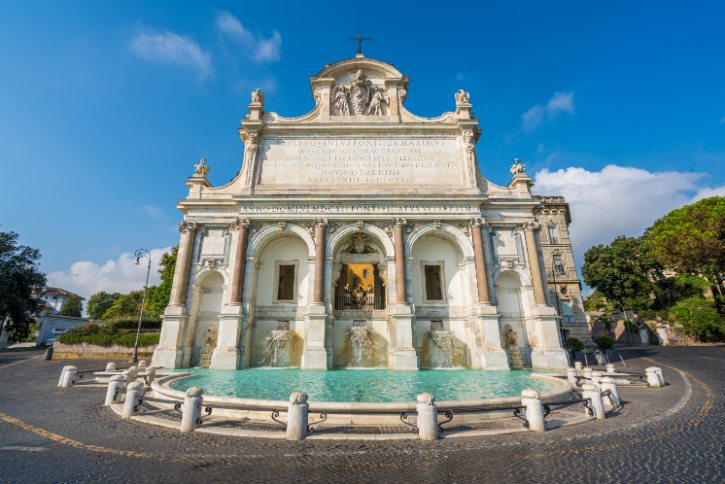
Romans call it Il Fontanone, and one look tells you why. It is the grand display point of the Acqua Paola aqueduct, built to bring clean water back to Trastevere, Borgo, and the Vatican.
b. Who built it and when
- Commissioned by Pope Paul V (Camillo Borghese)
- Built between 1610 and 1612
- Designed by Flaminio Ponzio and Giovanni Fontana
- Shaped like a triumphal arch of five bays with colossal granite columns
c. The Borghese details
- The papal tiara and crossed keys of Saint Peter at the summit
- The Borghese eagle and dragon as heraldic symbols
- Sculpted dragons acting as water spouts
d. Recycled from ancient Rome
The fountain is a clear example of spolia, the reuse of older monuments:
- The six granite columns were salvaged from the old Constantinian Basilica of Saint Peter’s
- The white marble of the attic came from the Temple of Minerva in the Forum of Nerva
e. Why it looks the way it does
Originally, water spilled into five small basins. In 1690, Carlo Fontana removed them and built the single sweeping semicircular basin you see today, plus the viewing terrace. That is why it now works like a giant reflecting sheet of water.
f. A bit of Roman wit
The long Latin inscription actually contains a famous historical error about which aqueduct the water came from. Because the supply was heavily mineral and sometimes brackish, Romans coined a saying comparing anything worthless to the Acqua Paola. A papal triumph, gently mocked.
3. Church of San Pietro in Montorio and Bramante’s Tempietto
a. Two treasures in one spot
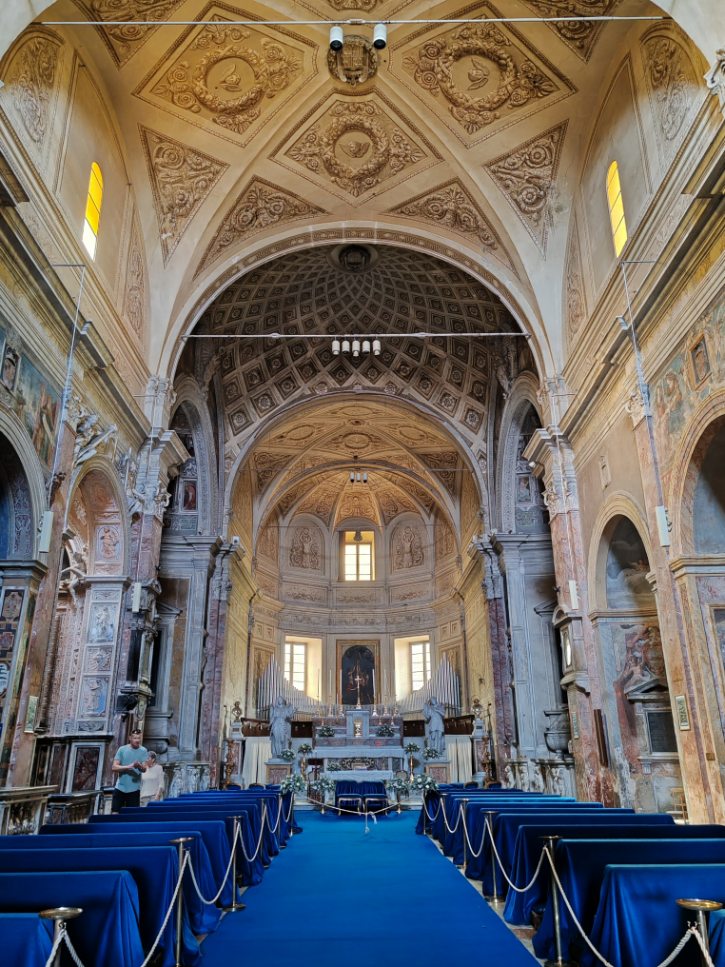
You get a historic church and, beside it, one of the most important small buildings in the world. The name Montorio comes from Mons Aureus, “Golden Mount”, for the golden sand of this part of the hill.
b. The church’s story
- Rebuilt between 1481 and 1500 by the Catholic Monarchs of Spain, Ferdinand and Isabella
- Consecrated by Pope Alexander VI in 1500
- Long tied by legend to Saint Peter’s crucifixion, though scholars place that at the Vatican
c. The art not to miss
- The Borgherini Chapel (first on the right), decorated by Sebastiano del Piombo
- Its Flagellation of Christ was painted in oils on dry plaster for a rich, deep glow
- It was done in close collaboration with Michelangelo, who supplied drawings for the figure of Christ
- The Raimondi Chapel by Bernini, an early example of his hidden-light effects
d. A dramatic 1849 chapter
During the French siege of June 1849, the church sat on the front line and was badly damaged. The monastery became a military field hospital for wounded fighters. Since 1881 the surrounding buildings have housed the Royal Academy of Spain in Rome.
e. The Tempietto, the real climax
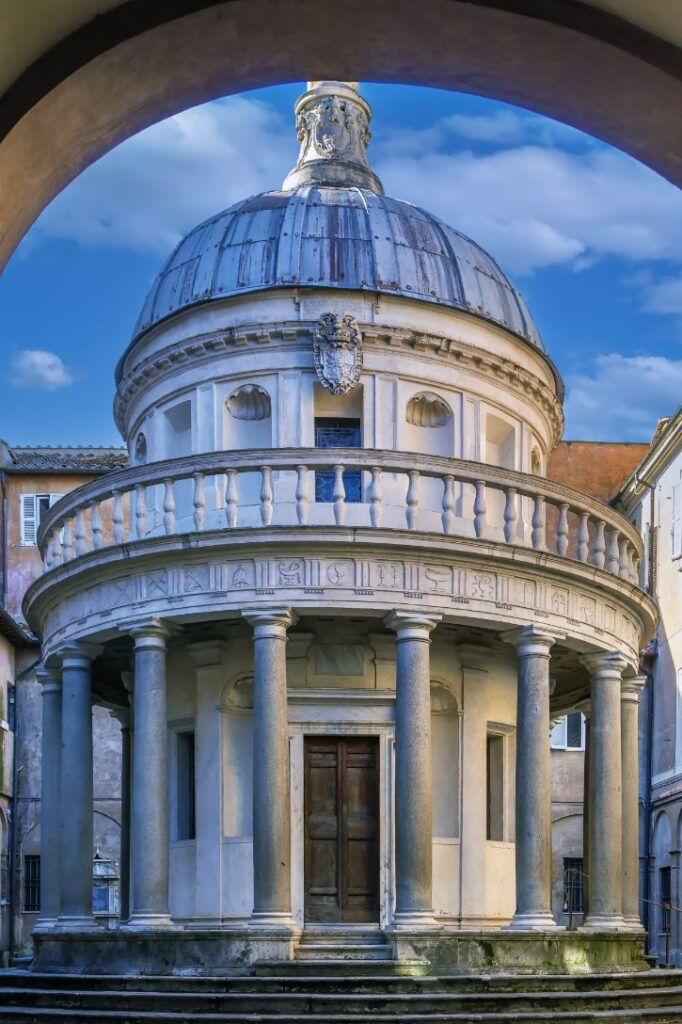
Designed by Donato Bramante and begun around 1502, this tiny round temple is seen as the purest example of the High Renaissance style. Look for:
- A circular platform reached by concentric steps
- A ring of 16 antique granite columns with white marble capitals
- A dome topped by a lantern and cross
f. Why such a small building matters
- It follows perfect harmonic proportions, its height matching its width
- Inside, alternating niches and a Cosmatesque marble floor make it feel far grander than its 4.5-meter width
- A small crypt below marks the spot tied to Saint Peter
- For photos, use the courtyard corners to frame the dome against straight walls
4. Via della Paglia
a. The doorway into real Trastevere
This is the exact spot where the grand world of the Janiculum dissolves into the flat, tightly packed heart of Trastevere. Step onto the cobblestones and the wide horizon simply vanishes.
b. What surrounds you
- Four-story houses in warm colors of ochre and faded sienna
- Shuttered windows and little iron balconies spilling with jasmine
- Streetlamps strung across the narrow gap overhead
c. A shift in the senses
- The clatter of cutlery from trattorie
- The hum of café chatter
- The smell of roasting coffee and fresh bread
d. Where the name comes from
The name means “Straw Street”, and it has practical roots:
- The upper part was once “Cemetery Alley”, running along the basilica’s old burial ground
- The lower part held large hay and straw storehouses and stables for the animals that hauled goods from the river docks
e. The best view here
- The lane works like a funnel, drawing your eye east
- Tall façades, laundry lines, and dining umbrellas frame a bright opening at the far end
- That opening is the next stop, and it is a showstopper
f. How to enjoy it
This stop is about soaking in a real neighborhood, not hunting for a monument. Let the outdoor tables, open doorways, and cool vaulted hallways pull you in slowly.
5. Basilica of Santa Maria in Trastevere and Piazza di Santa Maria
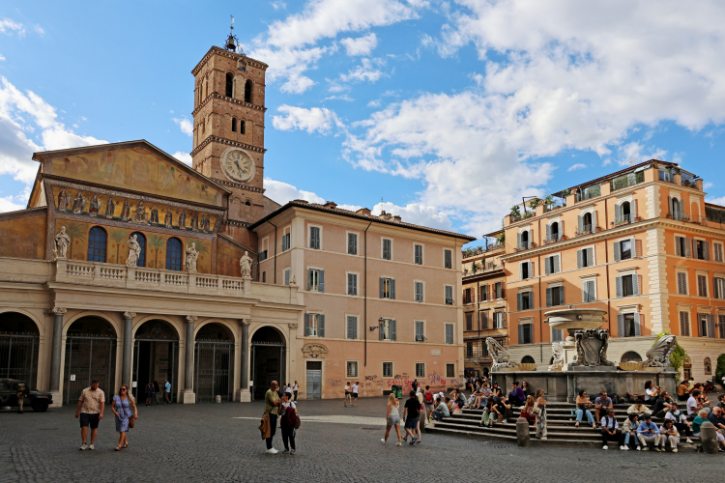
a. Layers of history in one place
This is one of the richest stops on the walk. Santa Maria in Trastevere is widely regarded as one of the oldest Christian churches in Rome, and you are looking at nearly two thousand years piled into a single building.
b. Legend versus fact
- The legend: a spring of pure oil is said to have burst here in 38 BC, later read as a sign of Christ; the spot is marked inside as Fons Olei
- The early church: traditionally founded by Pope Callixtus I around 220 AD
- The building today: mainly rebuilt by Pope Innocent II between 1138 and 1148
c. Study the outside first
- The Romanesque bell tower from the mid-12th century, with an antique mosaic near the top
- The glowing 13th-century golden mosaic across the façade, showing the Virgin nursing Christ, flanked by ten women with lamps (eight lit, two dark)
- The portico added in 1702 by Carlo Fontana, its walls lined with ancient inscriptions and carved fragments
d. Inside, in a clear order
- The nave: 22 huge antique columns of Egyptian granite, salvaged from the Baths of Caracalla; several capitals once carried carved Egyptian gods, chiseled off in 1870
- The ceiling: a gilded coffered ceiling designed in 1617 by Domenichino, with a central Assumption
- The apse mosaics: the artistic climax
e. The mosaics worth the trip
- In the upper curve (around 1140), Christ and the Virgin sit side by side on one throne
- Along the lower band, six glowing scenes of the Life of the Virgin by Pietro Cavallini (around 1291)
- Cavallini added natural light, real weight to the fabrics, and believable space, looking ahead to Giotto
f. The piazza and its fountain
The square is the social heart of the district, and its fountain is often called the oldest working public fountain in Rome:
- Bernini moved it to the center in 1659 and added four carved shells
- Carlo Fontana reworked it in 1692
- The city rebuilt it in gray marble in 1873, adding the P.Q.R. monogram
6. Bar San Calisto
a. A true Roman institution
Bar San Calisto, on the edge of Piazza San Calisto, is not a fancy destination bar, and that is exactly the point. It began as a humble milk bar and café and grew into a beloved symbol of working-class Rome.
b. The people make it
- Run by the Forti family since 1969, when Marcello “Marcellino” Forti took over
- A shared gathering ground for locals, students, workers, and travelers
- The square becomes its open-air living room, full of debates and card games
- Featured in Paolo Sorrentino’s Oscar-winning film La Grande Bellezza (2013)
c. What to order
Keep it simple and do as the locals do:
- A caffè at the standing counter
- A granita di caffè con panna, shaved coffee ice with cream
- A cold Peroni in the afternoon
d. The real experience
This stop is about people, not architecture. Sit for a while and watch the neighborhood go about its day. That is the whole point.
7. Via della Lungaretta
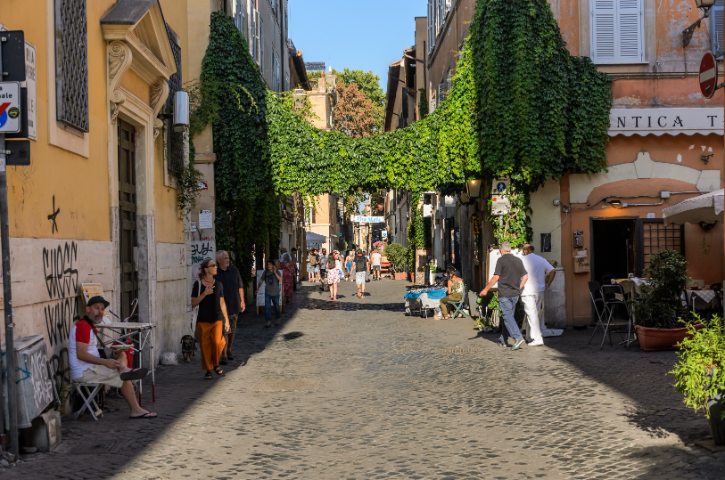
a. A street that has carried people for 2,000 years
Via della Lungaretta is the central spine of Trastevere, and what sets it apart is how straight it runs through an otherwise tangled maze. That straight line is ancient.
b. Its deep roots
- It closely follows the route of the Roman Via Aurelia Nova, built in the 2nd century BC
- That old road crossed the whole Trastevere plain and climbed the Janiculum toward the coast
- In the medieval period it was the Via Transtiberina, later renamed the “little long street”
c. A main road, not an alley
- Unlike the winding vicoli, it was always a primary connector
- It linked the river crossing near Tiber Island to the great square at Santa Maria in Trastevere
- Being wider, it gives you longer views and a real sequence of architecture
d. What you will see along it
- Romanesque brickwork and embedded antique columns
- Medieval porticoes and Renaissance doorways
- Workshops, boutiques, bakeries, and osterie at street level
e. A big cut through history
Between 1888 and 1890, the city drove a wide new boulevard, now Viale di Trastevere, straight through the district to reach the new railway station. It sliced Via della Lungaretta clean in two, a clear example of modern Rome cutting through its own medieval plan.
f. Best photo approach
- Shoot straight down the cobblestone corridor
- Let the repeating façades and overhead lanterns frame the flow of people
- Notice the shady side alleys plunging off into the quieter heart of the neighborhood
8. Via del Moro
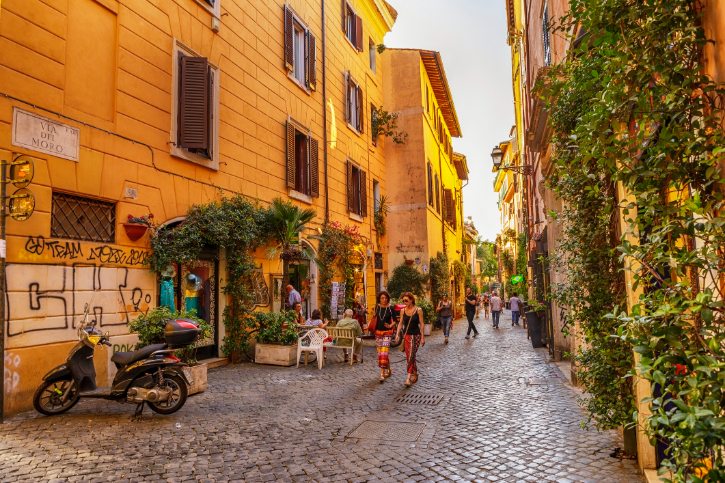
a. History written on the walls
Via del Moro is all about how old business history survives right on the streetscape. Its name comes from the historic Caffè del Moro, working here as a coffeehouse and tavern by at least 1873.
b. The detail most people walk past
Look up at the corner of Via del Moro 38 for one of the rarest surviving commercial signs in Rome:
- A hand-wrought iron frame holding an enameled painted panel
- Donated around 1900 by the Fratelli Branca distillery, makers of Fernet-Branca
- Widely documented as the second-oldest surviving tavern sign on public display in Rome
c. A sign with a complicated past
- Its imagery is tied to Italy’s colonial history and the Italo-Ethiopian War of the 1890s
- It shows Italian soldiers offering liqueur to East African women
- Worth pausing on honestly, as a survivor of both old advertising and a troubling imperial mindset
d. Architecture beyond the sign
Keep your eyes up for two good examples:
- At civico 48, a 16th-century townhouse with a bold rusticated portal carved from grey peperino stone
- At civico 50, the base of a truncated medieval tower-house, still visible in the massive tufa blocks
e. Why it earns its own stop
- This street rewards slow looking, not just eating and drinking
- The survival of old signs and portals sets it apart from the busier main streets
f. Best photo approach
- One wide shot of the busy dining street
- One tight shot of a single detail, like the weathered Branca sign against old plaster
9. Vicolo del Cinque
a. A street you can read like an archive
Vicolo del Cinque is a perfect example of the “street as archive”, where history is written directly onto the walls of ordinary homes. It takes its name from the noble Del Cinque family, recorded here since the early 15th century.
b. The family palazzo
- At civico 5 stands the late Renaissance Palazzo Del Cinque
- A grand round-arched travertine portal with heavy barred windows
- An aristocratic house on a mostly working-class lane, showing how classes once lived side by side
c. A small shrine with a big backstory
At civico 2 is an 18th-century Marian shrine, or Madonnella, showing the sorrowful Virgin in an ornate Baroque frame. These shrines were more than decoration:
- Funded by local families and confraternities
- Before street lamps arrived, they were often the only light in the dark alleys at night
- They served as both spiritual protection and navigation beacons
d. The most memorable curiosity
High on the wall at civico 58 is a genuine piece of everyday Roman law, a marble rubbish plaque:
- Issued by the papal Magistrate of Streets and dated June 15, 1764
- It banned dumping rubbish, manure, or rubble in the alley
- Penalties included heavy fines, confiscation of your cart and horse, and even corporal punishment
e. Details for façade fans
- Baroque houses with carved shell motifs and scrolls above the windows
- A stone coat of arms showing a tower, a lion, and small hills
f. How to look and photograph
- This is a “look up, look down, look at corners” kind of place
- Frame the Baroque shrine against weathered plaster
- Capture the worn 1764 plaque, often sitting right beside modern street art
10. Vicolo del Bologna
a. A lane named for a working man
Most Roman streets honor saints or noble families. This one is named for a craftsman, which makes it feel wonderfully human. The man was Mastro Girolamo, a 16th-century master carpenter known across Rome as “Il Bologna” for his home city.
b. His trade
- A skilled woodworker employed on major civic and church projects
- Known for making trusses and carved coffered ceilings
- His name honors the ordinary workers who built Renaissance Rome
c. Handle the tower story with care
- At civici 24 to 25 stands a truncated medieval tower-house
- Tradition calls it his home and workshop, but there is no firm proof he lived there
- An 18th-century marble plaque shows that later owners wanted to mark the link
d. Ancient Rome in the walls
At civico 36, embedded right at eye level, is one of the city’s clearest examples of “micro-archaeology”:
- Two 1st-century Roman marble funerary plaques from nearby underground tombs
- One carries a touching dedication from a husband, Hermes, to his wife
- A carved marble satyr mask, a broken column shaft, and a fragment of an imperial frieze
e. A striking juxtaposition
- At civico 37, an 18th-century shrine of the Madonna and Child sits just meters away
- Pagan Roman tomb markers and Christian devotion share one small wall
- A vivid picture of how builders treated ancient ruins as a quarry
11. Via della Scala and Piazza di San Egidio
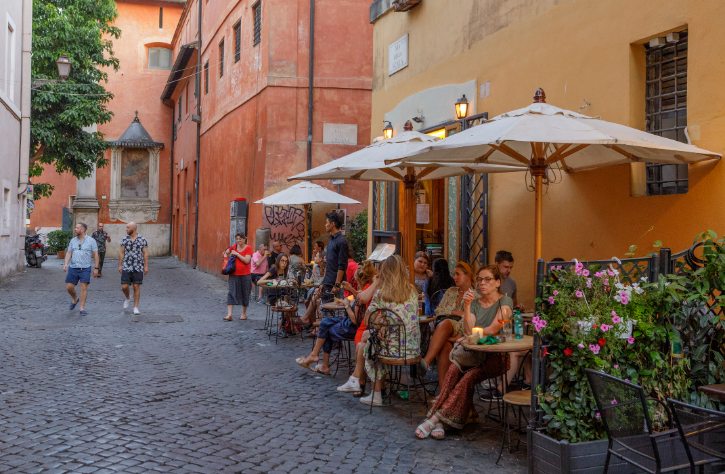
a. A calmer cultural crossroads
After the tight vicoli, Piazza di San Egidio feels like a breath of open air. It is an intimate, slightly irregular square that works as a genuine cultural and devotional crossroads, framed by a former 17th-century Carmelite convent.
b. The Church of Sant’Egidio
- Rebuilt between 1628 and 1630 under Prince Filippo Colonna
- Dedicated to Saint Aegidius, patron of hermits and outcasts
- A deliberately plain façade of pale stucco and travertine, reflecting Carmelite poverty
c. The standout detail is on the side
Don’t judge the church by its front. Its best feature is high on the side wall: the monumental shrine of the Madonna del Carmelo, ranked among the largest and most complex street shrines in all of Rome.
- A high-relief oval of the Virgin offering the Carmelite scapular
- A swirling Baroque stucco cloudburst of cherubs and angels
- The grand payoff to all the smaller shrines you passed earlier
d. Why the surrounding buildings matter
The convent was secularized after 1870, and today it holds two very different institutions:
- The Community of Sant’Egidio, a lay Catholic association founded in 1968 that made this former convent its headquarters in 1973, now known worldwide for humanitarian work and peace mediation
- The Museo di Roma in Trastevere, devoted to the popular life of Rome
e. Inside the museum
- The Scene Romane, lifelike dioramas with wax figures recreating old trades and taverns
- The famous Roma Sparita watercolors by Ettore Roesler Franz, recording streets later demolished
f. One more thing along Via della Scala
Glance up toward the Church of Santa Maria della Scala, built to shelter a miraculous image of the Madonna:
- A travertine façade with a marble Madonna and Child carved in 1633
- An attached monastery that once housed the oldest working pharmacy in Rome
g. How to enjoy this stop
Find a seat and read the space in layers: the plain church, the theatrical shrine overhead, and the old religious buildings now buzzing with new life. This stop is about continuity and reinvention.
12. Piazza Trilussa
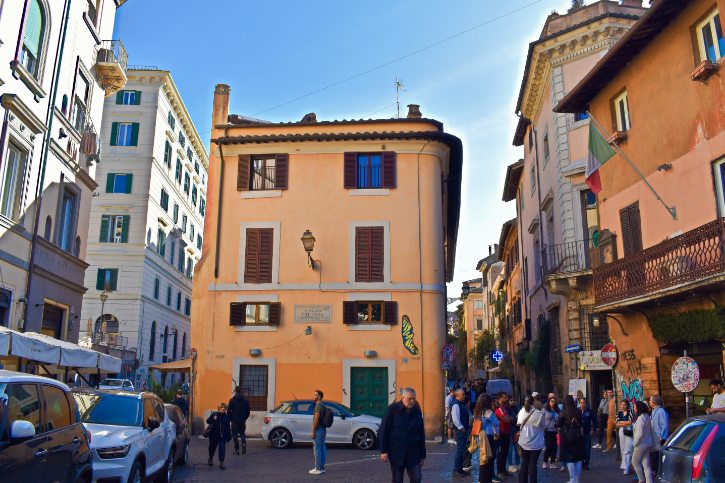
a. The finale, where Trastevere meets the river
Piazza Trilussa is the perfect ending. It sits right on the riverfront, across from the ancient Ponte Sisto, forming a grand doorway between Trastevere and the historic center. After all those enclosed lanes, the openness feels wonderful.
b. Not just “the square with the steps”
The centerpiece is a real monument, the Fontanone di Ponte Sisto:
- Commissioned in 1613 by Pope Paul V
- Designed by Flaminio Ponzio and Giovanni Fontana, part of the same Acqua Paola network from the start of your walk
- A rusticated triumphal niche with the Borghese dragons and eagles
c. The fountain’s remarkable move
Here is why it sits where it does. It was not built here at all:
- It originally stood on the opposite bank of the Tiber, at the head of Via Giulia
- After the catastrophic flood of 1870, it was dismantled in 1879
- In 1898, architect Angelo Vescovali rebuilt it here, recarving the missing stones and adding the broad steps
d. The route’s satisfying loop
This fountain and the Fontana dell’Acqua Paola on the Janiculum are close cousins:
- The same patron, Pope Paul V
- The same architects, Ponzio and Giovanni Fontana
- The same water source, the Acqua Paola
Stand on the middle of Ponte Sisto and look west. The Piazza Trilussa fountain sits in the foreground while the Fontana dell’Acqua Paola rises on the ridge directly above it. Your walk has traced the water from the hilltop all the way down to the river.
e. The poet behind the name
The square was renamed in 1952 for Carlo Alberto Salustri (1871 to 1950), better known as Trilussa, an anagram of his surname:
- The great Roman dialect poet of the 20th century
- Loved for his sharp fables and his defense of ordinary people
- A bronze monument to him was unveiled in 1954, showing him leaning against a wall mid-verse
f. Best things to see and photograph
Take in the finale in three layers:
- The fountain and its steps, catching the warm evening light
- The Trilussa monument off to the side, with his 1946 poem All’ombra carved beneath
- The open view toward Ponte Sisto and the Tiber, leading back into old Rome
A Final Word
The real magic of Trastevere is not any single monument. It is how quickly everything changes as you walk. In just a handful of short streets, you move from hilltop views and grand fountains to lived-in lanes, humble coffee bars, tiny shrines, and finally the open river. Walk it slowly, look up, look down, and check the corners. Every wall here has a story to tell.