You already know Rome, Florence, and Venice. But some of Italy’s most memorable places sit far from those crowds.
In the smaller towns, you’ll find villages that seem to grow from cliffs, colorful houses above harbors and rivers, and stone lanes tucked beneath castles. Their beauty isn’t only about monuments. It comes from the setting, the old stone, the viewpoints, and the everyday atmosphere.
Here are twelve small towns worth the trip. Each one gives you its own version of Italy, so let’s take them one at a time.
1. Pitigliano, Tuscany
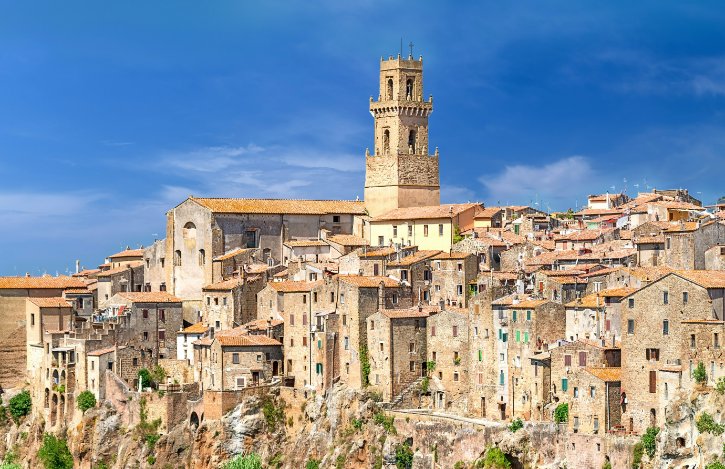
A town that seems to rise straight out of the volcanic rock beneath it.
a. The first view
Pitigliano stands on a narrow spur of volcanic tuff, about 313 meters up, ringed by cliffs where three rivers carved deep gorges. The houses were built from the same tuff dug out of the plateau, so the rock face seems to continue straight up into the walls. From a distance, you can barely tell where cliff ends and town begins. For the classic view, stop at the Belvedere of the Sanctuary of Madonna delle Grazie.
b. Through the old center
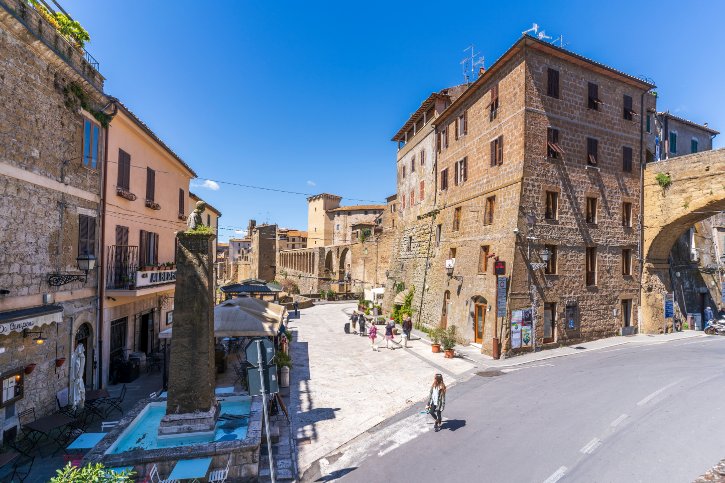
You enter from the east at Piazza della Repubblica. As you walk, look for:
- The Medici Aqueduct, with fifteen rounded 16th and 17th century arches
- Palazzo Orsini, a fortified residence with a Renaissance loggia and carved travertine wellhead
- Three parallel streets linked by narrow alleys
- External stone staircases (profferli) and passages that end at open cliff edges
c. Little Jerusalem
Pitigliano is known as “Little Jerusalem”. From the mid-16th century, Jewish families found refuge here, outside both Papal and Medici control. You can still see:
- The Synagogue (1598), with its Torah ark and restored Baroque frescoes
- The ritual bath, matzoh bakery, kosher cellar, and dye-works, all carved into the tuff below street level
- The nearby museum of Jewish culture
- The Sfratto, a local walnut-and-honey pastry tied to this history
d. Walk the Vie Cave
Around the plateau run the Vie Cave, sunken roads cut into the tuff by the Etruscans over two thousand years ago. Walking them, you’ll notice:
- Corridors up to twenty meters deep but only two or three meters wide
- Cool, shaded air and light filtering through the trees
- Moss-covered walls marked with ancient chisel grooves and small votive niches
Above, you look down on the town. Here, you walk inside the rock that holds it up.
e. Small details to notice
- Tuff door frames with weathered coats of arms and 16th-century dates
- Lower house walls that flare out and blend into the cliff cracks
- Little niches near old gates, once holding religious images to keep evil away
f. Why it’s worth the trip
Pitigliano is a rare case where the buildings and the rock beneath them are truly one. Add the Etruscan roads, the Renaissance engineering, and the underground Jewish quarter, and no other Tuscan hill town can take its place.
2. Vernazza, Liguria
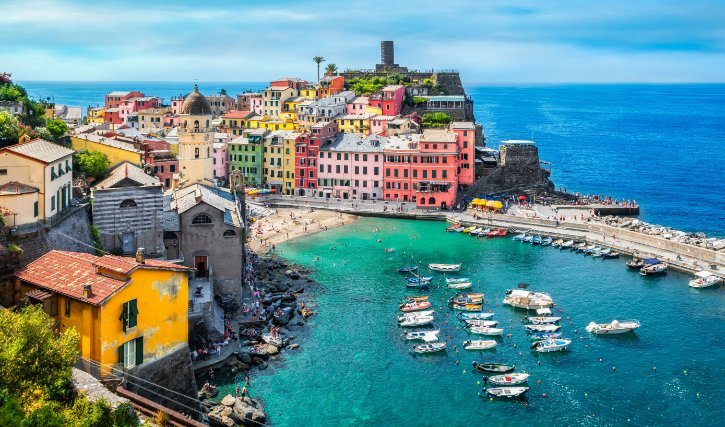
A tiny maritime village gathered around one of Italy’s loveliest natural harbors.
a. The classic scene
Vernazza sits at the mouth of a single narrow valley, carved by the Vernazzola stream, its colorful houses rising in a natural amphitheater above the water. Tall Ligurian tower-houses in ochre, terracotta, and pale yellow crowd around a small harbor, backed by steep terraced hills. It’s the most protected village in the Cinque Terre.
b. Around the harbor
Piazza Marconi is the heart, and Vernazza has the only natural harbor in the Cinque Terre. Its sheltered inlet protects small and medium boats, though it isn’t built for the heaviest winter storms. The view shifts as you turn:
- Look out to sea for the open Mediterranean framed by rocky headlands
- Look back at the town rising as a dense pyramid under the terraces
- Look up to the ramparts of Doria Castle and the Belforte tower
- Watch for wooden fishing boats moored in the water or hauled onto the pavement
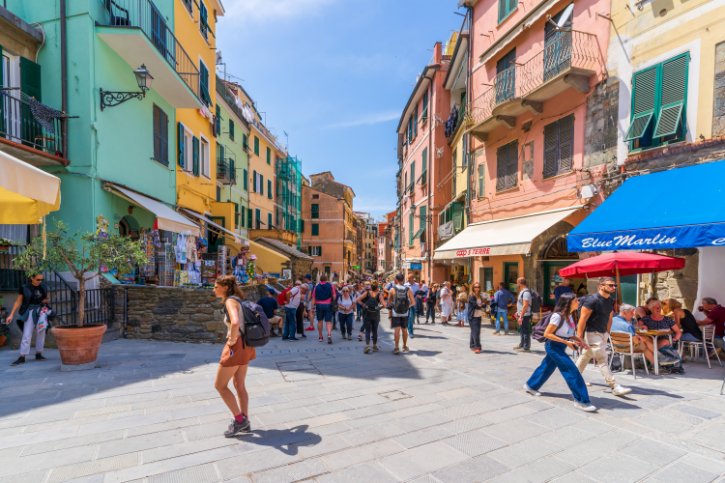
c. Into the carruggi
Step away from the water and the village breaks into narrow alleys called carruggi, often under two meters wide. Here you’ll find:
- Steep stone stairways and dark vaulted underpasses
- Tower-houses four to six stories tall with narrow fronts
- A tight layout built to slow raiders and channel cool sea breezes
d. The church and the castle
- The Gothic Church of Santa Margherita di Antiochia sits on a rock shelf at the water, its 40-meter bell tower doubling as a landmark for sailors
- Doria Castle crowns the headland about seventy meters up, once a lookout against pirates
- The Belforte tower platform is the best high viewpoint, over the harbor, the church dome, and the coast toward Monterosso and Corniglia
e. Small details to notice
- Ligurian shutters with adjustable lower louvers
- Salt-faded lime wash on the facades
- Iron rings set in the harbor flagstones for hauling boats
- Dry-stone terraces on the hills, still growing vines for Cinque Terre wines
f. Why it’s worth the trip
Vernazza brings together the only natural harbor in the Cinque Terre, an ocean-facing Gothic church, a medieval tower, and hand-built vineyard terraces, all in one small place. That harbor is what sets it apart from the other Cinque Terre villages.
3. Castelmezzano and Pietrapertosa, Basilicata
Two villages built among the rock pinnacles of the Lucanian Dolomites.
a. A dramatic mountain setting
These two villages face each other across a forested gorge in the interior of Basilicata, set among sharp sandstone spires called the Lucanian Dolomites. Despite the name, the rock isn’t Alpine dolomite but hardened sandstone shaped by millions of years of erosion. The towers aren’t just scenery. They form the foundations of houses, stairs, and squares.
b. Castelmezzano
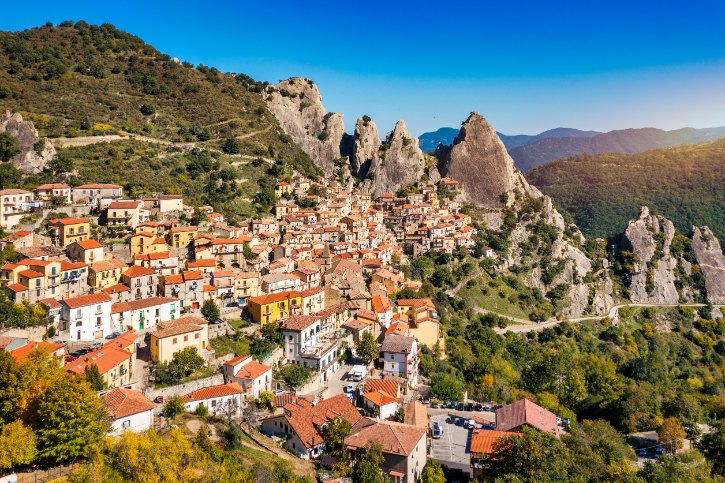
Built into a natural sandstone amphitheater, its houses climb in tiers against the rock. Look for:
- Roofs of local sandstone slabs that match the spires above
- The Mother Church of Santa Maria dell’Olmo on Piazza Caiazzo
- Steep stairways and passages, with bare rock as an interior wall in some homes
- The Gradinata Normanna, 54 steps cut into a pinnacle to an old Norman lookout (guided, with harnesses)
c. Pietrapertosa
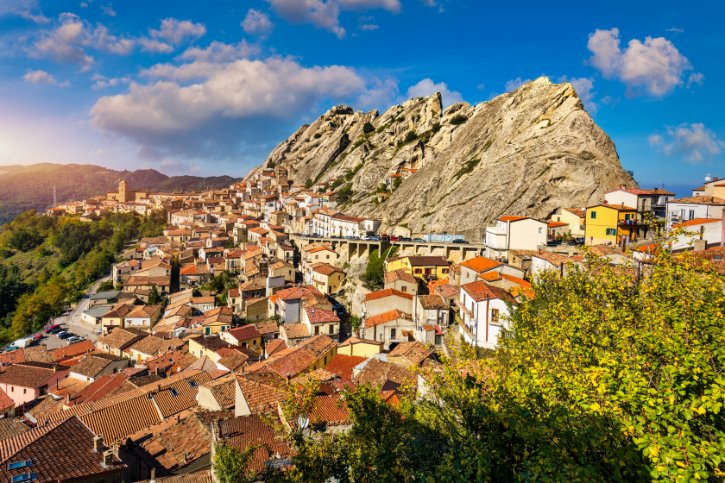
The highest town in Basilicata at 1,088 meters, and the wilder of the two. Seek out:
- The Arabata, its oldest quarter, a maze of stone homes founded by Saracen settlers in the 9th century
- Steep stepped paths and dead-end lanes
- Norman-Swabian castle ruins built into the crag, with wide valley views
d. Between the two villages
- The Volo dell’Angelo, a tandem zipline strung hundreds of meters above the valley (seasonal, roughly May to early November, so check the current schedule before you go)
- The Path of the Seven Stones, a two-kilometer shepherds’ trail with seven themed stone installations tied to local folklore
e. Small details to notice
- In Pietrapertosa, living rock used as interior walls and steps worn smooth by centuries of feet
- In Castelmezzano, roof slabs weighed down with river stones and iron crosses set into the pinnacles
- Air scented with wild thyme and woodsmoke, and no cars in either core
f. Why it’s worth the trip
Together they show you two ways of living inside the same dramatic geology, linked by an ancient trail and a modern cable. See one and you get half the story. See both and it all makes sense.
4. Civita di Bagnoregio, Lazio
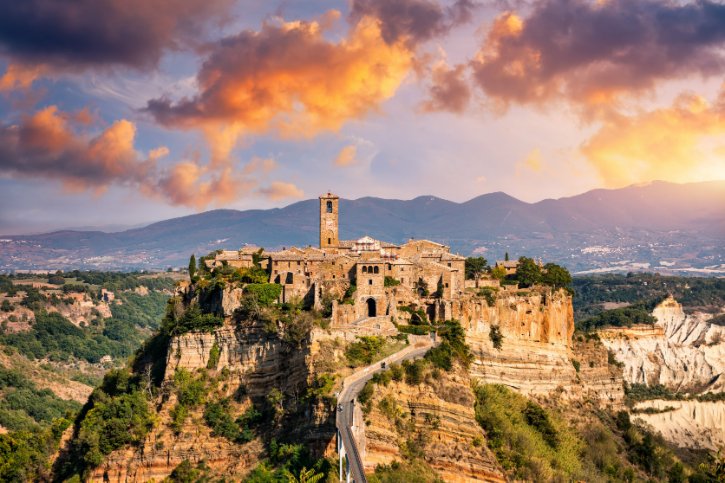
A stone village stranded on an eroding plateau above a landscape of badlands.
a. The distant view
Civita sits on an isolated plateau about 443 meters up, surrounded by the eroded clay ridges of the Valle dei Calanchi. A hard volcanic cap rests on soft clay, and centuries of erosion stripped away the base, cutting the village off from the land around it. The best full view is from the Belvedere of Bagnoregio, where it seems to float above the basin.
b. Crossing the bridge
Civita is car-free and reached only by a 300-meter footbridge. Walking it is part of the visit:
- The valley drops into clay canyons on both sides
- The last fifty meters steepen sharply
- You end up looking up at the volcanic base and the old stone gate
- All traffic stays behind, setting a slow pace
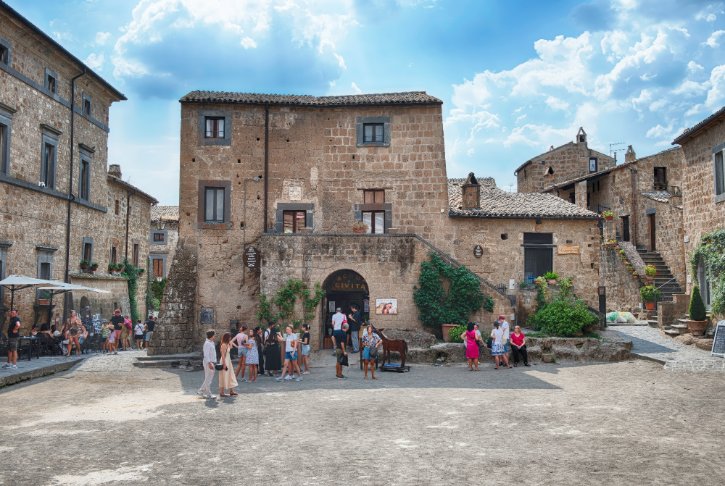
c. The gate and the square
- Porta Santa Maria, the only surviving entrance, cut through the rock
- Two worn reliefs of a lion, marking a 1457 revolt against feudal rule
- Piazza San Donato, with its rare packed-earth surface
- The Church of San Donato, built over a Roman temple, holding old frescoes and a Flemish crucifix
d. Why the ground matters
Civita is nicknamed “The Dying City”. Erosion and landslides are recorded over centuries, and a 1695 earthquake even forced the town government to move away. Still, it isn’t about to vanish. The small geology and landslides museum on the square shows how the plateau is monitored and reinforced today.
e. Small details to notice
- Porous tuff blocks flecked with dark volcanic stone
- Worn basalt pavers polished smooth over centuries
- Doorways and walls opening into thin air where rooms once broke away
- Lanes that end at low railings above the grey badlands
f. Why it’s worth the trip
Civita is an extraordinary meeting of solid old stone and constant erosion. You can’t separate the village from its bridge and its badlands. Here, the setting is the beauty.
5. Pienza, Tuscany
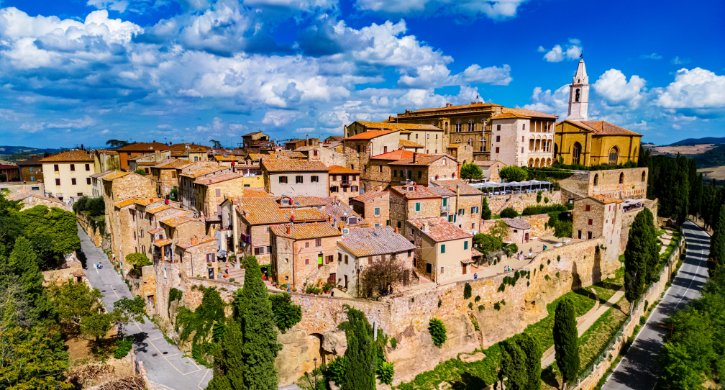
A Renaissance vision of the perfect town above the Val d’Orcia.
a. A town built by design
Pienza wasn’t left to grow slowly like most medieval towns. In 1459, Pope Pius II set out to rebuild his birthplace as an “ideal city”, hiring the architect Bernardo Rossellino, who finished the center in just three years. It became the earliest example of Renaissance town planning and is now a UNESCO site.
b. Piazza Pio II
The square is a small masterpiece of design. Notice:
- Its trapezoidal shape, which makes it feel larger than it is
- Red herringbone brick set in a grid of pale travertine
- The Cathedral of Santa Maria Assunta, bright with travertine and tall windows
- Palazzo Piccolomini, with a loggia over a hanging garden framing the valley
- The bishop’s palace and town hall completing the ensemble
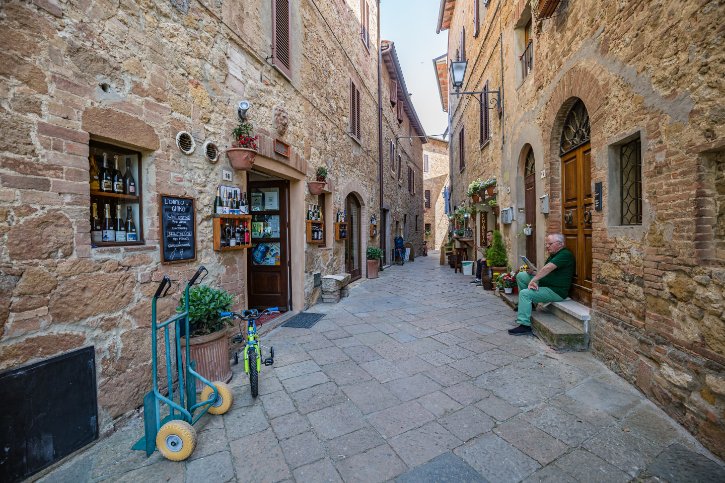
c. Walking the town
- Corso Rossellino, the main street, curves gently so the views open gradually
- Shops selling the local Pecorino di Pienza cheese
- Poetic lanes like Via dell’Amore and Via del Bacio, whose romantic names are modern, not medieval
- Via del Casello, a promenade along the southern walls
d. The view over the Val d’Orcia
From the wall-top promenade, the Val d’Orcia opens up, itself a UNESCO landscape. Depending on the season, you may see clay hills, farmhouses with cypresses, Monte Amiata, and the distant fortress of Radicofani. The whole town was designed to frame this countryside, not wall it off.
e. Small details to notice
- Rossellino’s carved travertine wellhead on the piazza
- Monitoring plates on the cathedral, where one side slowly settled on soft clay
- The Piccolomini family crest across the facades
- Stone benches built into the palace bases for people to gather
f. Why it’s worth the trip
In Pienza you experience Renaissance proportion and planning across a whole town center, not just one building. Where Pitigliano grew from its rock, Pienza was designed on purpose as a single work of art.
6. Bosa, Sardinia
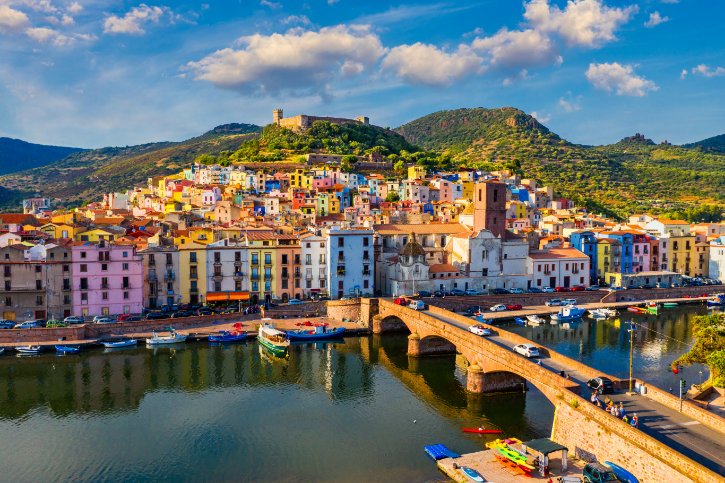
A colorful Sardinian river town climbing toward a medieval castle.
a. The overall picture
Bosa sits along the Temo, the only navigable river in Sardinia, about two kilometers from the sea. It reads as three tiers: the river with its quays and boats, the pastel hillside houses of Sa Costa, and the medieval castle at the top. The classic view, catching all three at once, is from the far riverbank or the old bridge.
b. Along the river
- The Lungotemo promenade, the center of low-town life
- The Ponte Vecchio, a red trachyte bridge from the 1870s
- Wooden fishing skiffs with blue and red hulls
- Sas Conzas, the old leather-tanning warehouses, now a national monument with a small museum
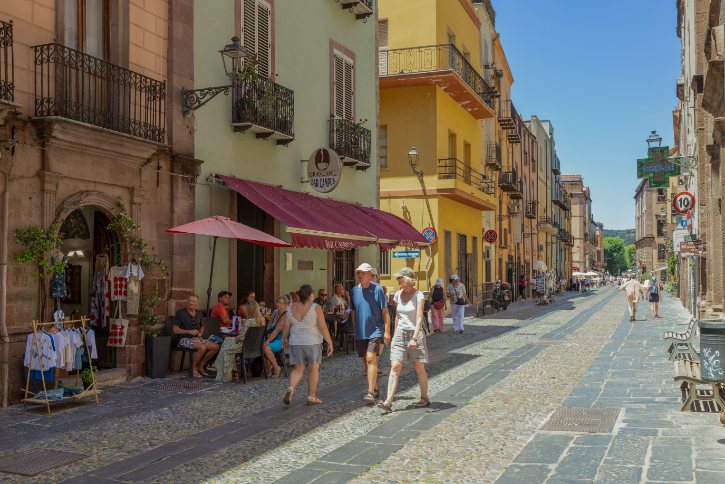
c. Climbing Sa Costa
The historic core spreads up the slope beneath the castle. Watch for:
- Bright facades once painted so families could spot their homes from boats
- Door and window frames carved from red trachyte
- Wrought-iron balconies and dark green shutters
- Narrow stairways with new views opening between the houses
d. The castle
The Castello di Serravalle, also called Malaspina, crowns the hill. Begun around 1112 and expanded over the following centuries, it keeps its walls, towers, and a small chapel with rare 14th-century frescoes found under whitewash in 1972. From the ramparts, you see the whole town laid out: the roofs, the river, the tanneries, and the sea.
e. Small details to notice
- Deep red trachyte stonework in lintels and portals
- Traditional Filet di Bosa lacework, sometimes made in doorways
- Worn granite mooring posts along the river
- Curved “goose-breast” iron balconies in the alleys
f. Why it’s worth the trip
Bosa’s mix is unique in Italy: a navigable river lined with stone tanneries, a bright cascade of pastel houses, and a hilltop fortress. Those three parts make it instantly recognizable.
7. Badolato, Calabria
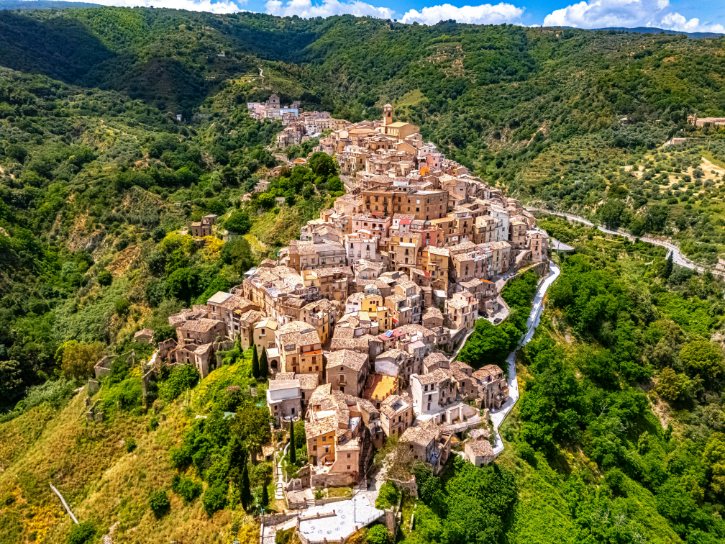
A quiet medieval hill village where lanes and church towers look toward the Ionian Sea.
a. The hilltop setting
Badolato sits on a hilltop spur about 240 meters up, five kilometers inland from its coastal twin. It was built high to guard against sea raids while keeping watch over the Gulf of Squillace. From the coast roads, you’ll see a dense cluster of stone houses and church towers rising out of olive groves.
b. The joy of wandering
There’s no single grand monument here. The appeal is the intact medieval fabric:
- Narrow cobbled lanes, granite staircases, and vaulted underpasses
- Small stone piazzas and quiet corners
- Old cellars (catoja) carved partly into the rock
- Two famously narrow lanes, Via Portella and Vico Scesa Rossini
c. The viewpoints
- Belvedere Carmelina Amato, over olive hills down to the sea
- Piazza Castello, on the old castle site, looking down over the roofs
- Piazza Bastione, framing the village against the coastal plain
d. The churches
Badolato is known as “The Village of the 14 Churches”. The ones to seek out:
- The Immacolata (1686), dramatically set on a promontory outside the walls, over the sea
- The Mother Church of Santissimo Salvatore, with a bell tower anchoring the skyline
- Santa Caterina, an intimate medieval church with old frescoes
e. A detail to hunt for
Set into the house walls throughout the village are the “Talking Stones”, carved tablets by local artist Gianni Verdiglione that mix bas-reliefs with poems, proverbs, and local history. They’re easy to miss, which is exactly why you should look for them.
f. Why it’s worth the trip
Badolato is an authentic southern hill town that kept both its architecture and its warmth without turning into a tourist stop. Its quiet mix of lanes, churches, views, and small art is what sets it apart.
8. Spello, Umbria
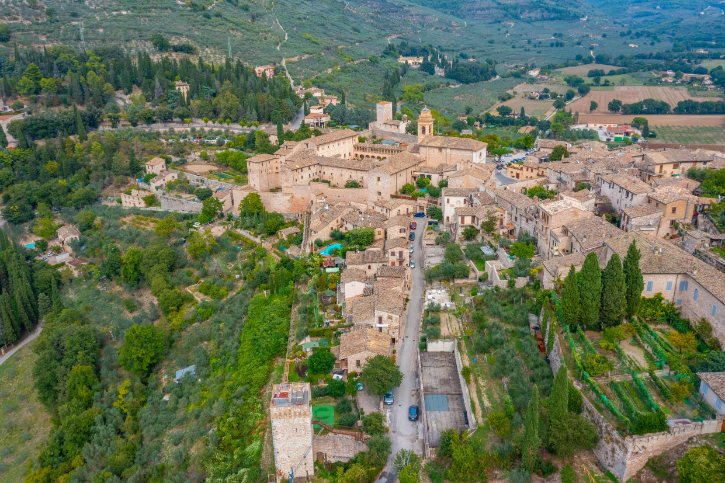
Roman gateways, medieval stone lanes, and extraordinary flowers.
a. A town of layers
Spello rises on the slopes of Mount Subasio, built from pink Subasio limestone that glows cream to rose through the day. Roman walls form the frame for a dense medieval town, and residents fill the streets with flowers. It rewards slow wandering far more than a quick landmark tour.
b. The Roman layer
Spello has the most complete Roman gates in Umbria. Trace these:
- Porta Consolare, the main gate, with three Roman statues set above it
- Porta Urbica, built into the old Augustan wall
- Porta Venere, flanked by two twelve-sided towers named for the poet Propertius
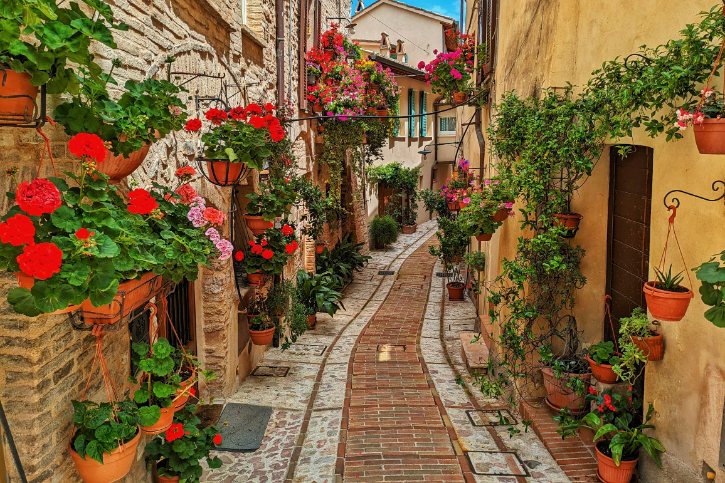
c. The flowers
Spello is famous for its floral displays, at their best in late spring and summer. Look for:
- Balconies, stairways, and doorways crowded with pots and climbing plants
- Lanes turned into vertical gardens for the annual flower competition
- The Infiorate, when locals build long floral carpets on the pavement overnight for Corpus Domini, using only petals, seeds, and leaves
d. The art
- The Cappella Baglioni in Santa Maria Maggiore, painted by Pinturicchio in 1501, with a hidden self-portrait
- The chapel’s original 1566 Deruta majolica floor
- The Villa dei Mosaici, a Roman villa found in 2005, with ten rooms of colorful floor mosaics
e. Small details to notice
- Fragments of Roman inscriptions reused in medieval walls
- Pink and white veins running through the limestone
- Reinforcing arches spanning high between the houses
f. Why it’s worth the trip
Spello is far more than a “pretty flower town”. It layers Roman gates, a pink-stone medieval core, one of Pinturicchio’s finest fresco cycles, and a living floral tradition into a single place.
9. Rocca Imperiale, Calabria
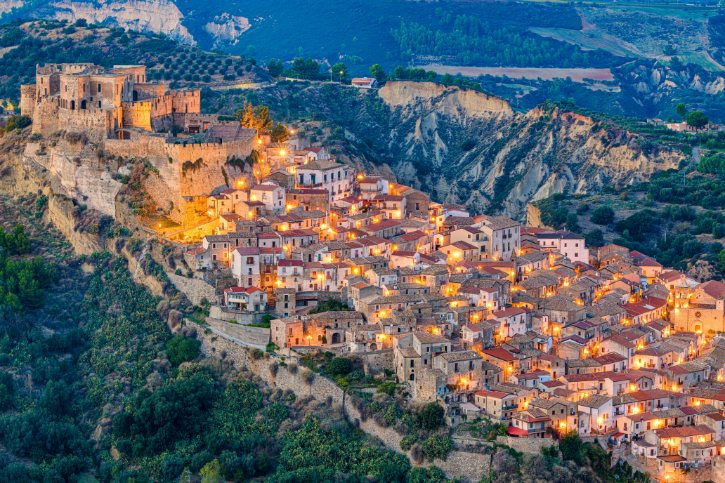
A medieval village cascading beneath the fortress of Frederick II, in lemon country by the Ionian.
a. The castle-crowned silhouette
Rocca Imperiale sits on a cone-shaped hill about 200 meters up, near the Basilicata border and four kilometers from the sea. From the plain, it forms a striking pyramid: pastel-and-stone houses wrapped around the hill, terracotta roofs spilling down toward lemon groves, and Frederick II’s fortress crowning the top.
b. The Swabian castle
- Commissioned in 1225 by Frederick II, who gave the town its name
- A limestone keep and curtain walls, later upgraded with round towers for gunpowder warfare
- Views from the battlements over the village, the groves, and the Gulf of Taranto
c. Beneath the fortress
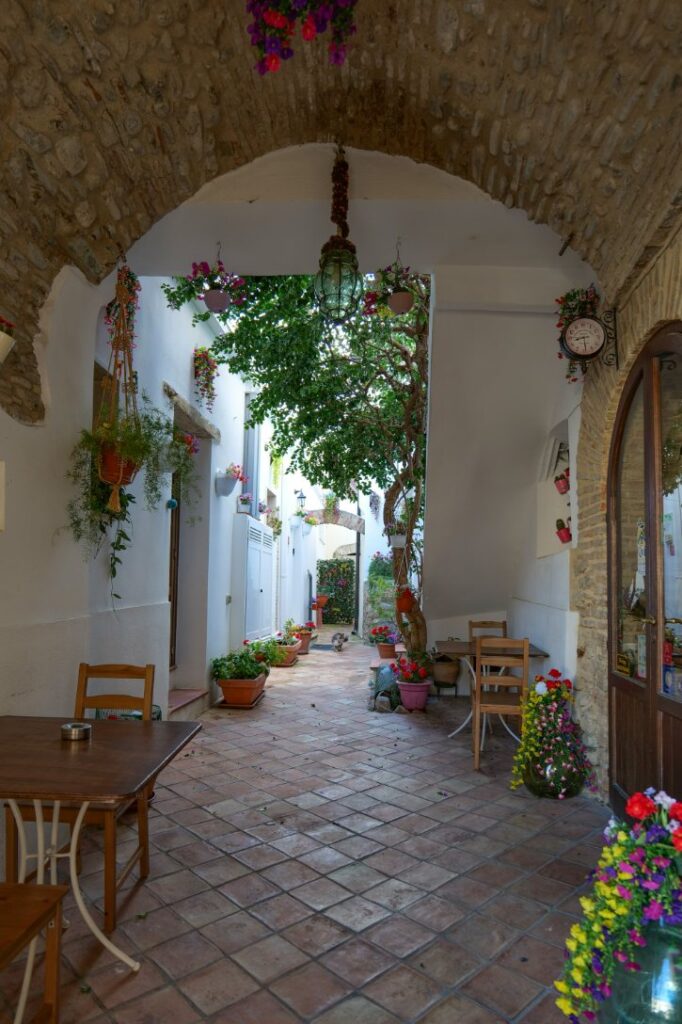
The medieval center runs down steep terraces:
- Narrow cobbled paths following the cone of the hill
- Vaulted underpasses, arches, and heavy limestone doorways
- The fortress walls visible from nearly every corner
d. The lemon landscape
Rocca Imperiale is known across Europe for its IGP lemons, grown in terraced orchards around the village. The trees bloom several times a year, and in spring and late summer the alleys fill with a sweet citrus scent. In other seasons, don’t expect the same fragrance, so time your visit if that’s part of the draw.
e. Small details to notice
- Rusticated cornerstones and loopholes on the old fortress
- Painted ceramic tiles of lemons and heraldry beside doorways
- Ramps banded with pebbles and stone, once giving donkeys traction
- Cylindrical terracotta chimneys standing against the sea
f. Why it’s worth the trip
Few places in the south combine an imperial fortress, a steep medieval village, and famous lemon groves running to the sea. Where Morano is a mountain town, Rocca Imperiale is coastal and agricultural.
10. Morano Calabro, Calabria
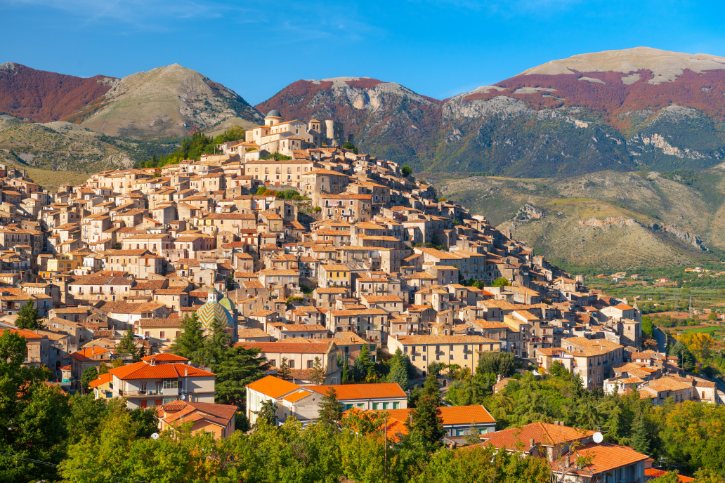
A dense, crib-like mountain town beneath a ruined castle at the foot of the Pollino.
a. The townscape
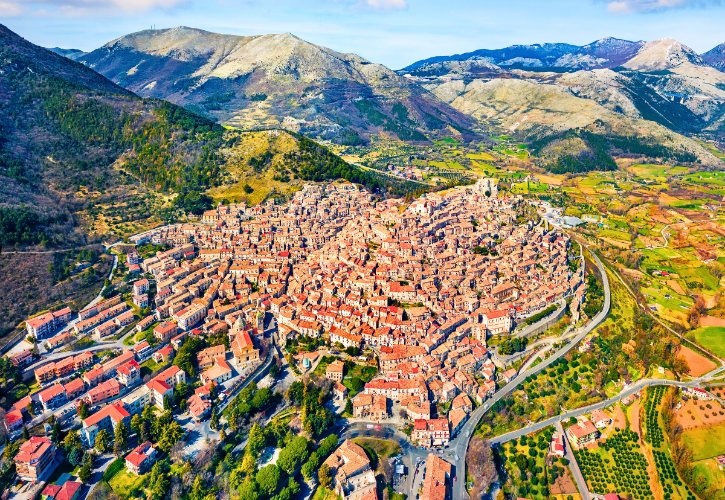
Morano clings to a cone-shaped hill about 694 meters up, inside Pollino National Park. Its houses stack in tight concentric bands up to castle ruins at the summit, framed by limestone peaks. Locals and tourism boards call it the “Nativity Scene of the Pollino”, since the stacked roofs really do look like a Christmas crib. The best distant view is from the southern approach road.
b. Climbing to the castle
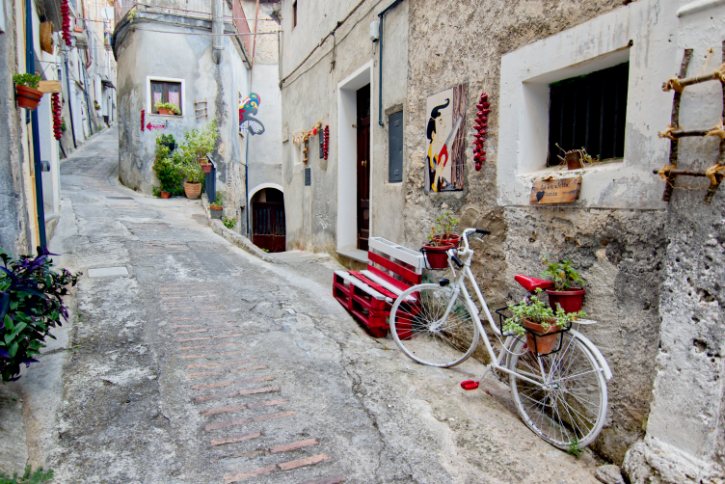
- A car-free maze of ramps, vaulted passages, and staircases
- Three old quarters to pass through on the way up
- The Pollino peaks appearing and vanishing between the houses
- Norman-Swabian castle ruins at the top, with a full 360-degree view
c. The churches and their art
For a remote town, Morano hides remarkable art:
- Santa Maria Maddalena, with a majolica-tiled dome and a lavish Baroque interior
- Its greatest treasure, a 1477 polyptych by the Venetian master Bartolomeo Vivarini
- San Bernardino, a Franciscan church with a carved ship’s-keel wooden ceiling
d. A curiosity: San Nicola
If you have time, the Church of San Nicola is built on two levels, with a mid-15th-century upper church and a 12th-century crypt below. It’s a memorable, well-documented detail for anyone who wants to look a little deeper.
e. Small details to notice
- The bright yellow, green, and blue tiled dome shining against grey stone
- Terracotta roofs held down with river cobbles against the winter snow
- Worn granite doorways carved with inscriptions and family crests
f. Why it’s worth the trip
Morano is one of the most unified mountain townscapes in the Mediterranean, a stone pyramid beneath castle ruins that hides world-class Renaissance art inside its quiet churches.
11. Rotondella, Basilicata
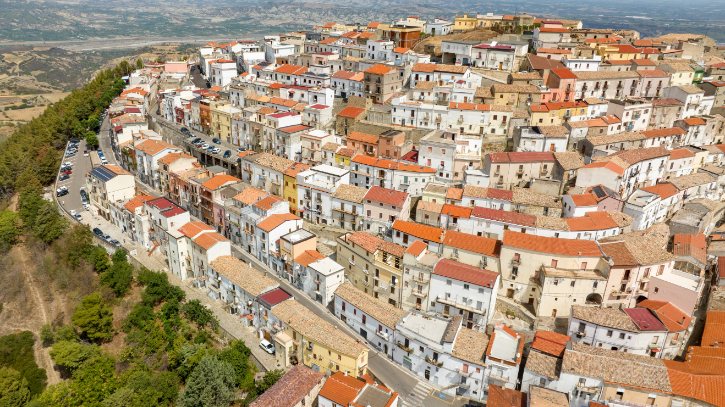
A spiral hilltop “Balcony of the Ionian” full of unusual details.
a. The Balcony of the Ionian
Rotondella crowns an isolated hilltop about 576 meters up, with the official nickname “Balcony of the Ionian”. From the main terrace on a clear day, you can take in the sea, the Sinni river plain, and the Pollino mountains all at once. Seeing three different landscapes from one spot is the real draw.
b. The spiral layout
Its rarest feature is the town plan itself:
- Streets wrapping the summit in concentric rings, forming a slow spiral
- The sea view vanishing behind houses, then opening again at each corner
- Steep straight stairways linking the rings between levels
c. The houses
Look closely at the old noble homes:
- Curved “goose-breast” iron balconies, shaped to fit wide 18th-century dresses
- Stone masks (mascheroni) carved into doorways to ward off the evil eye
- Portals framed with diamond-point stone and heraldic crests
d. The Lamie di Bitonte
The most unusual landmark is the Lamie di Bitonte, a set of monumental 17th-century stone vaults built beneath a noble palace. They form a covered stone tunnel across the road, framing views of the hills and coast through their arches. The contrast of cool shadow and bright landscape makes it the most photographed spot in the area.
e. Small details to notice
- A local pastry topped with a spiral swirl that mimics the town plan
- Red peppers hung to dry under the stone vaults in autumn
- The old Sanseverino tower, now home to the town archives
f. Why it’s worth the trip
Rotondella pulls together a rare spiral plan, a sweeping coastal panorama, and a set of unusual details you won’t find elsewhere. No other town on this list combines them quite the same way.
12. Gagliano Castelferrato, Sicily
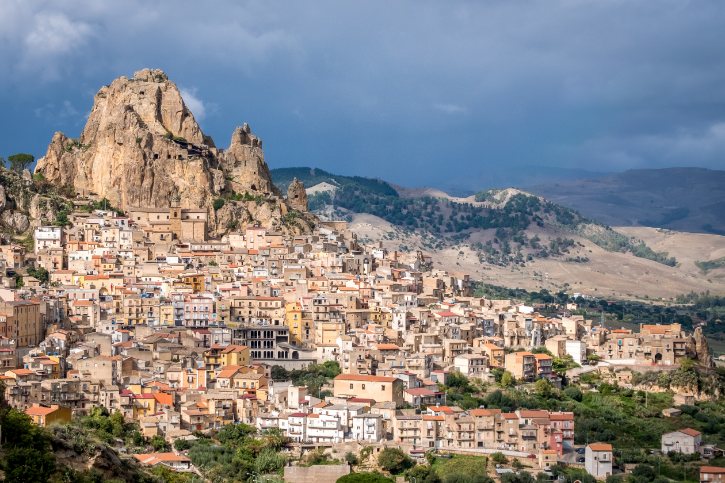
A little-known Sicilian town beneath an enormous rock fortress carved into living stone.
a. The Rocca
Gagliano sits in the mountainous interior of central Sicily, dominated by a huge sandstone monolith, the Rocca di Gagliano, rising to about 850 meters. The town’s houses don’t sit beside the rock. They spill directly beneath its sheer cliff, small against the bare wall. Around it lie clay hills and wheat fields, with Mount Etna on the horizon.
b. The “Iron Castle”
The name Castelferrato means “Iron Castle”, earned because the fortress was seen as impregnable, defended by sheer cliffs on three sides. The rock was fortified across many eras, and in 1300 it even hosted the Sicilian parliament in its rock-cut halls. Its exact ancient origins aren’t precisely dated, so the earliest history is best treated with care.
c. Carved into the rock
The fortress wasn’t just built from blocks. It was cut into the living sandstone. As you look up, you can pick out:
- Caves, rock-cut chambers, and a large underground hall
- Deep cisterns that collected rainwater for long sieges
- The Porta Falsa, a secret trapdoor gate that dropped attackers into a precipice
d. The church beneath the cliff
At the foot of the rock stands the Mother Church of San Cataldo, with a stone bell tower topped by a tiled spire. The best view is from the lower square looking north, where the elegant tower stands silhouetted against the raw sandstone behind it. That single scene captures the whole town.
e. Why it’s worth the trip
Gagliano isn’t just another castle village. Here, natural geology and human fortification are almost impossible to tell apart, which makes it a fitting and unforgettable final stop.