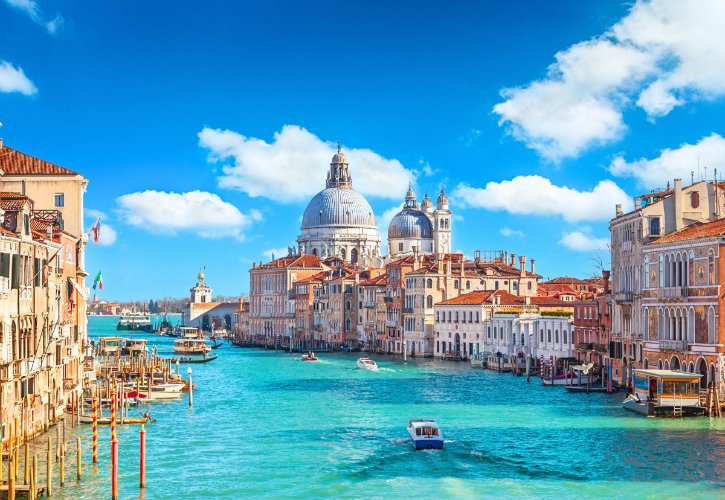
Venice looks confusing at first. Canals, bridges, blind alleys, and streets that twist without warning make the historic center feel like a maze.
But that is exactly why it rewards walkers: the mood shifts completely from one corner to the next.
One honest note before you start. You cannot do all 17 of these spots well in a single day. If you only have one, focus on the first 13 and save the last four for another visit. 😊
1. Basilica Santa Maria della Salute
a. Why it’s here
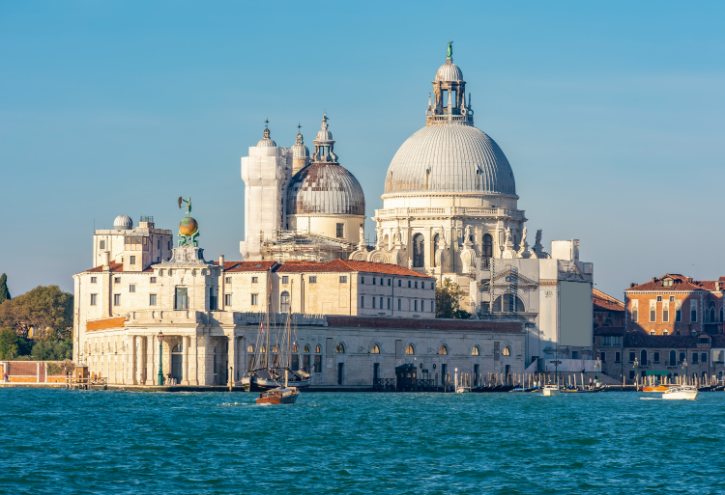
Start where Venice is at its most theatrical. The Basilica di Santa Maria della Salute sits on the narrow tip of Punta della Dogana, where the Grand Canal meets the San Marco basin. Its huge white domes anchor the skyline, but the real story is grief. This is a monument to survival, not just a pretty Baroque building.
b. The plague and the vow
- In autumn 1630, bubonic plague killed roughly a third of the city, over 46,000 people.
- On October 22, 1630, the Doge and Senate vowed to build a church to the Virgin Mary as Salute, a word meaning both health and salvation.
- Architect Baldassare Longhena won the design at just 33 and worked on it for over five decades.
- The foundation stone was laid on March 25, 1631, and the church was consecrated on November 9, 1687.
c. What to notice outside
- A 15-step Istrian stone staircase rises straight out of the canal, built for dignitaries arriving by boat.
- The plan is a centralized octagonal rotunda, not a standard cross.
- A large dome over the rotunda is braced by sixteen spiral buttresses; a smaller dome crowns the sanctuary behind.
- At the summit stands a statue of the Virgin shown as a naval commander, holding a maritime baton.
d. What to notice inside
- Light pours into a bright rotunda through windows set in the octagonal drum.
- The high altar holds a marble group by Josse de Corte: the Virgin protects a kneeling Venice while an angel drives away a gaunt hag representing the Plague.
- At its center is the Mesopanditissa, a Byzantine icon brought from Crete in 1669, tying the church to Venice’s eastern trade.
e. How to experience it
Study it from the stone quay first, up close, then again from across the water. The church still lives in the city’s calendar: every November 21, the Festa della Madonna della Salute brings a temporary pontoon bridge across the canal so locals can walk over to light candles. From this public monument, the walk now shrinks to one collector’s private world.
2. Peggy Guggenheim Collection
a. The unfinished palace
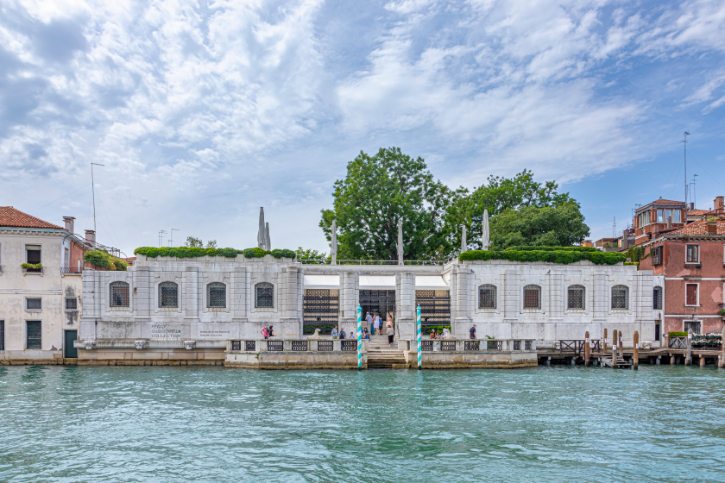
This modern art museum lives inside one of the Grand Canal’s oddest buildings, Palazzo Venier dei Leoni. It was meant to be a grand mansion but was never finished, and that is exactly why it stands out.
- Commissioned in 1748 to 1749 by the noble Venier family, designed by Lorenzo Boschetti.
- Old engravings show a planned palazzo of three to five storeys; only the ground floor and basement were ever built.
- Locals nicknamed it Il Palazzo Non Finito, the Unfinished Palace.
- Its low, single-storey stone front creates a long horizontal pause among the tall canal mansions.
b. Peggy Guggenheim’s home
- American collector Peggy Guggenheim bought it in July 1949 and lived here for thirty years, until her death in December 1979.
- From 1951 she opened her rooms and garden to the public a few afternoons a week.
- The Solomon R. Guggenheim Foundation opened the museum in its current form in 1980.
- You are walking through a former home, where major canvases hang in rooms that were once a dining room and bedroom.
c. A detail and a legend
- Along the water-level base are eighteen carved stone lion heads, the documented source of the name dei Leoni.
- A popular story says the family once kept a live lion in the garden. Treat that as folklore, not fact.
d. The art, and the setting
The collection is strong in Cubism, Futurism, Metaphysical art, Surrealism, and American Abstract Expressionism, with works often on show by Magritte, Pollock, Picasso, de Chirico, Ernst, Brancusi, and Kandinsky. One caveat: the museum rotates and lends works, so no single piece is guaranteed on the wall.
- Step onto the low terrace and you are right at the water’s edge, sky open above you.
- The rear Nasher Sculpture Garden, where Peggy is buried beside her dogs, shades bronzes by Giacometti and Marini.
- The intimate scale is the real draw. Next, the walk winds back in time to historic Venetian painting.
3. Gallerie dell’Accademia
a. The visual language of Venice
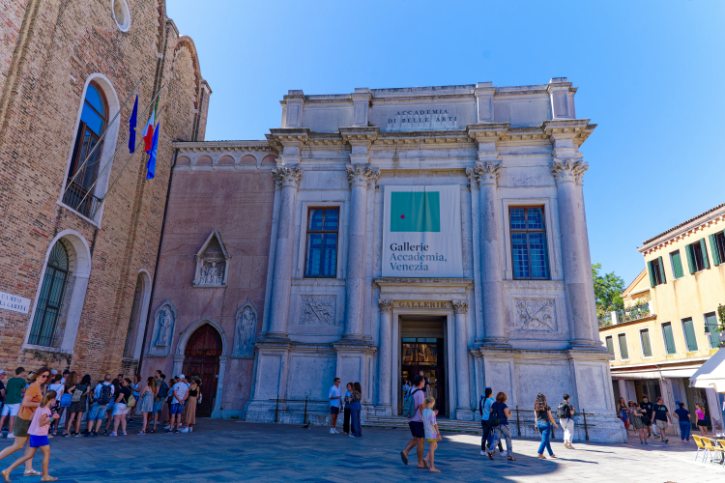
The Gallerie dell’Accademia holds the defining collection of Venetian and Veneto painting from the fourteenth to the eighteenth centuries. Established under Napoleon in 1807, it fills a former church and convent complex. Seeing these works in Venice connects the art directly to the city outside, because Venetian painters chased color and light, called colorito, over the sharp lines favored in Florence and Rome.
b. Read the collection like a guide to the city
- Light and skies: Giovanni Bellini’s golden glazes and Titian’s fluid brushwork capture a humid lagoon sky.
- Ceremony and identity: processional scenes by Gentile Bellini and Vittore Carpaccio record rituals, architecture, and historical clothing.
- Textile wealth: Veronese’s paintings show off damasks, velvets, and gold-brocaded silks from eastern trade.
c. One painting to slow down for
Let Giorgione’s The Tempest (about 1506 to 1508) anchor your visit. It shows a soldier, a nursing woman, broken columns, and a town under a stormy sky. Scholars have never agreed on its meaning, and the official reading is that the true subject is the landscape and mood itself. Do not try to solve it. Just take in the atmosphere.
d. A painting that turns the city into a gallery
- Find Carpaccio’s Miracle of the Relic of the True Cross at the Rialto Bridge (about 1496).
- It shows the old wooden Rialto Bridge with a raised drawbridge and timber shops.
- Study it now, and you will picture that lost city when you stand on today’s stone bridge later.
e. How to visit without burning out
- Pick a small handful of works and look at them slowly.
- Compare precise early paintings with the loose, dramatic light of Tintoretto.
- Treat the galleries as training for your eyes before you meet the living city.
4. Ponte dell’Accademia
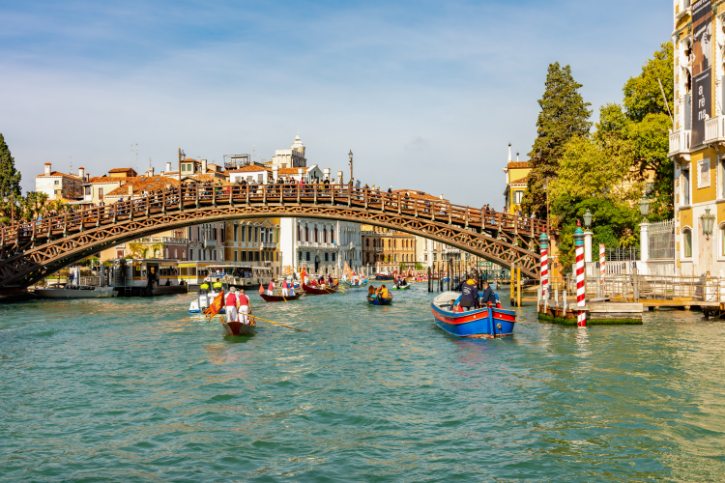
a. A twentieth-century surprise
Everyone comes for the view, but almost no one expects the bridge itself. Unlike Venice’s famous stone crossings, the Ponte dell’Accademia is an arched timber bridge, and a modern one at that.
- An iron bridge stood here from 1854 until it decayed and drew criticism.
- Engineer Eugenio Miozzi built the wooden replacement in just 37 days; it opened on January 15, 1933.
- It was meant to be temporary. People liked it so much it stayed, later reinforced with steel.
b. The view you came for
- Look east toward the mouth of the Grand Canal.
- The canal curves past grand palaces and ends at the great white dome of Santa Maria della Salute.
- Seeing the Salute again from up here is a lovely callback to where your walk began.
c. What to actually look at
- The water street: vaporetti, taxis, and gondolas keep the surface in constant motion.
- The facades: trace Venetian architecture evolving from pointed arches to Renaissance and Baroque.
- The contrast: plain timber and steel sitting beside carved stone and marble.
Inside the Accademia you did quiet, concentrated looking. Out here it is moving water and a live skyline. Come down the steps and a slim lane opens into a broad, sociable square.
5. Campo Santo Stefano
a. Room to breathe
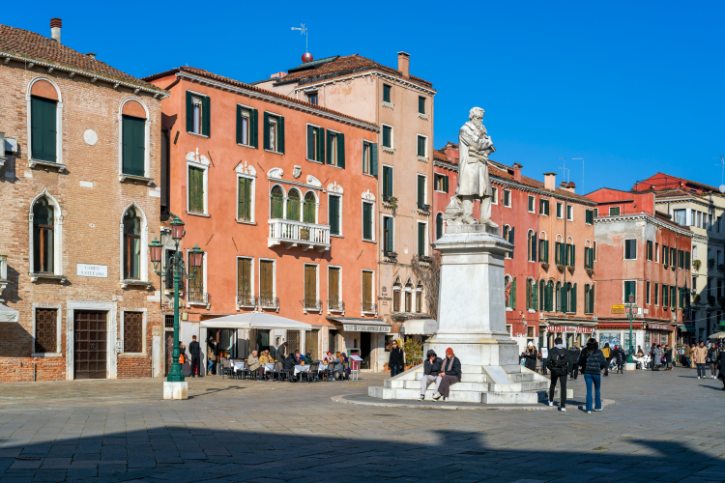
After the Grand Canal crossing, this is your first real breathing space. Campo Santo Stefano is one of the largest and most sociable squares in Venice. Grand facades frame it, but it works as a neighborhood living room, not a ceremonial stage. Do not just cross it. Pause and watch it work.
b. The church at the north end
- The Church of Santo Stefano was founded in 1294 by Augustinian friars and rebuilt in the following centuries.
- It is the third largest monastic church in Venice and a fine example of late Venetian Gothic.
- Inside, a fifteenth-century timber ship-keel ceiling, shaped like an upturned hull, was built by Arsenale shipwrights.
- Its detached campanile leans about two meters out of true at the top.
c. A small civic detail
Near the center stands an 1882 statue of Niccolò Tommaseo, a writer and patriot who helped lead the 1848 uprising against Austrian rule. He is shown backed by a tall stack of his own books, which earned the monument an affectionate local nickname. It is a quick, human window into nineteenth-century Venice.
d. What to do here
- Slow down and watch everyday pedestrian life.
- Take in the mix of medieval brickwork and classical window surrounds.
- Skip the urge to make the cafes the point. The point is the square itself.
From this open, civic space, the route now turns toward one of the city’s most polished shopping streets.
6. Calle Larga XXII Marzo
a. Not every Venetian street is a dark alley
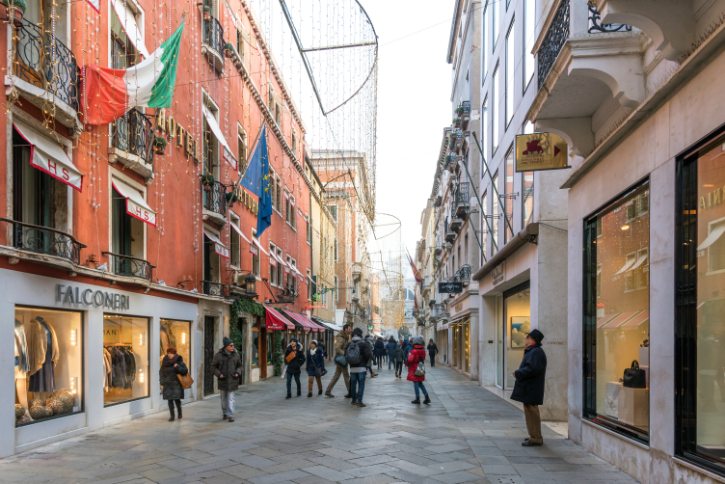
This street quietly kills the idea that every Venetian lane is narrow and medieval. Calle Larga XXII Marzo is unusually wide, a straight paved avenue that serves as Venice’s main luxury shopping corridor, with clear sightlines and big display windows.
b. Worth a look even if you buy nothing
- Sleek storefronts of glass and bronze sit beneath historic stone arches.
- Look up for Gothic windows, eighteenth-century cornices, and marble roundels from the street’s older life.
- The generous width lets daylight reach the ground and light up details.
c. Old buildings, new uses
- Former banks, offices, and palazzi have been turned into modern shops.
- Original stone doorframes, vaulted porticos, and ironwork have been kept inside.
- It is a quiet lesson in how modern commerce settles into protected old masonry.
d. Where the name comes from
The name honors March 22, 1848, when Venetians rose against Austrian rule, freed the patriots Daniele Manin and Niccolò Tommaseo from prison, and proclaimed a short-lived republic. In 1881 the city widened the old narrow street and renamed it to mark that day. From this curated commercial strip, the lanes tighten again around a world-famous opera house.
7. Teatro La Fenice
a. The theater that keeps rising
Teatro La Fenice is built on survival. Designed by Giannantonio Selva and opened in 1792, it was named “The Phoenix” because its founders meant to rise again after losing their previous theater to fire. They have had to, more than once.
- 1836: fire gutted the auditorium; it was rebuilt and reopened by 1837.
- January 29, 1996: arson destroyed the interior; an inquiry blamed two contractors dodging penalties.
- Rebuilt on the principle “com’era, dov’era” (as it was, where it was), it reopened in 2003, with fully staged opera back in 2004.
b. Why it matters in opera history
- It hosted premieres by Rossini, Bellini, and Donizetti.
- Its deepest bond was with Giuseppe Verdi, who premiered five operas here.
- La traviata debuted on March 6, 1853, was jeered that night, then became a favorite, and was chosen to reopen the rebuilt theater.
c. Inside the auditorium
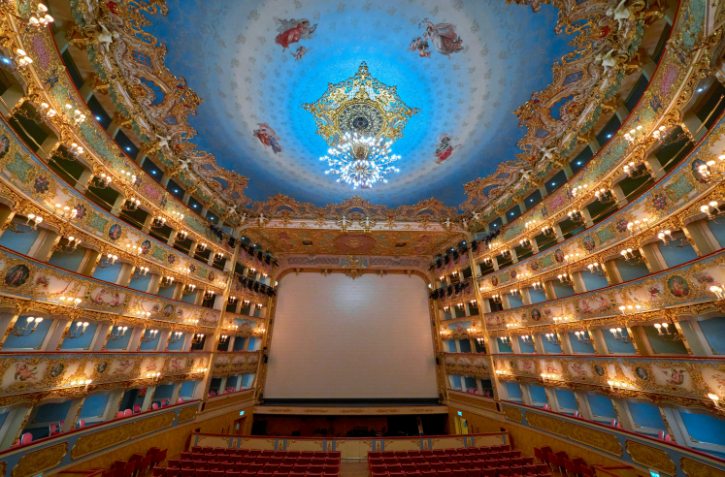
- A classic Italian horseshoe plan with five tiers of gilded boxes and a central Royal Box.
- After 1996, craftsmen remade the decoration from old photos in carved wood, papier-mâché, and gold leaf.
- The building keeps its historic water entrance, once used by aristocrats arriving by boat.
d. The best moment
The restrained facade in Campo San Fantin gives away nothing. Step inside and the room erupts into pastel color, gilding, and crystal light. Then look up: the ceiling holds a chandelier ringed by painted allegories, in soft blues, greens, and pinks chosen to spread light evenly. You do not need a performance. The room performs on its own. Next, the route turns secretive.
8. Palazzo Contarini del Bovolo
a. The joy of finding it
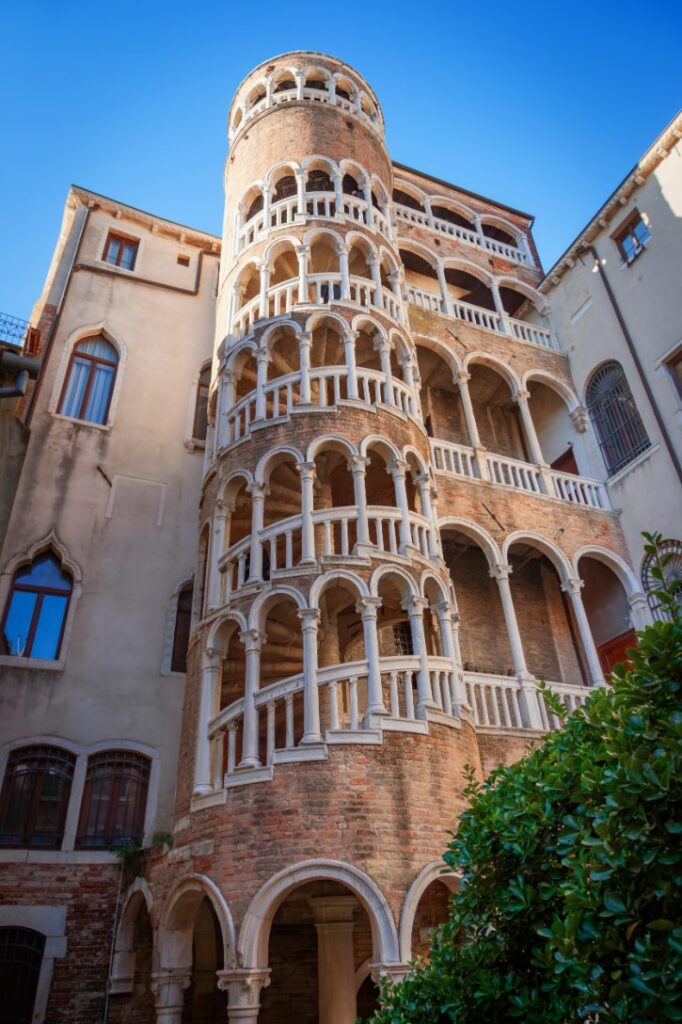
Half the fun is the discovery. Tucked inside a quiet courtyard, the Palazzo Contarini del Bovolo hides a spiral staircase that is the real star. The palace began in the fourteenth century, but around 1499 the family added a freestanding staircase tower so striking that Venetians named it bovolo, dialect for “snail shell”.
b. The staircase itself
- It rises about 26 meters, with eighty Istrian stone steps winding inside an open brick tower.
- Its exterior has five tiers of open loggias with rhythmic round arches.
- It blends styles: Renaissance arches, Gothic verticality, and Byzantine-style loggia rings.
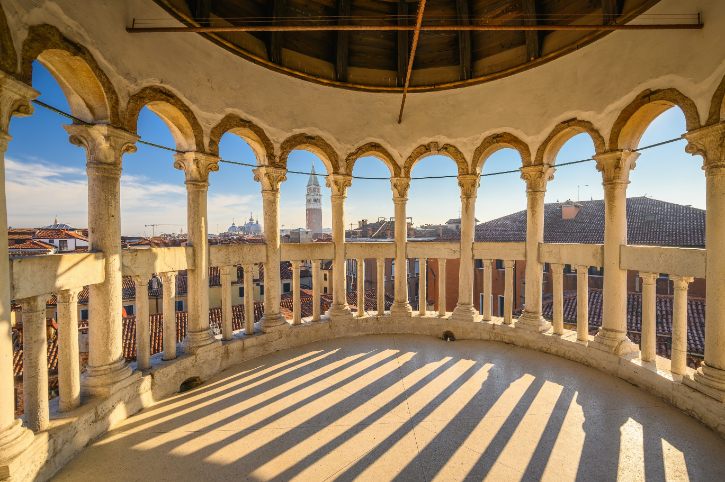
- The top opens onto a domed belvedere with rooftop views.
c. Who designed it? Nobody is sure
- Older accounts credit Giovanni Candi.
- Recent scholarship points to Giorgio Spavento, chief architect of Saint Mark’s.
- Official records are inconclusive and treat the design as disputed, so take any single name with a grain of salt.
d. See it from below and above
- From below: stand in the courtyard and watch the arches spiral upward.
- From above: climb to the belvedere for a 360-degree view over terracotta roofs and chimney pots, with the domes of Saint Mark’s in the distance.
From this intimate courtyard, the walls suddenly fall away into Venice’s grandest space.
9. Piazza San Marco + St Mark’s Campanile + Saint Mark’s Basilica
a. One grand composition
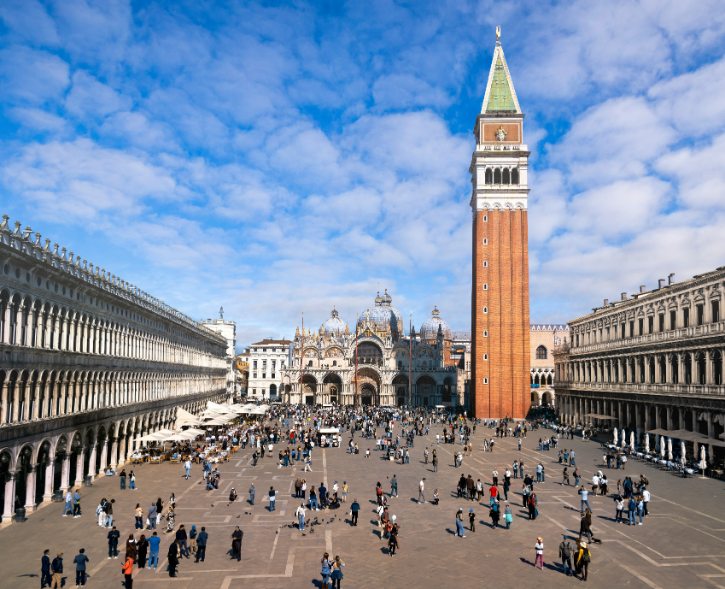
Treat these three as a single ensemble, the ceremonial and sacred heart of the old Republic. A Venetian quirk: San Marco is the only square in the city called a piazza. Every other one is a campo. Stepping out of the tight alleys into this vast space is a genuine jolt of scale.
b. Saint Mark’s Basilica: Venice facing east
- Founded in 828 to house the relics of Saint Mark, smuggled out of Alexandria by Venetian merchants.
- The current church, the third here, was consecrated in 1094, modeled on a Byzantine plan with five domes.
- Returning fleets were required to bring home marble and carvings, creating a mix of Byzantine, Gothic, and Islamic styles.
- The four bronze horses outside are replicas; the originals are inside the Basilica Museum.
c. Inside the Basilica
- Over 8,000 square meters of golden mosaics, made from the eleventh to seventeenth centuries.
- The Pala d’Oro, a gold altarpiece with cloisonné enamel and around 1,927 gemstones.
- The Loggia dei Cavalli, a balcony with an open view over the square.
d. The Campanile
- At 6 meters, it is the tallest structure in Venice, topped by a gilded Archangel Gabriel that turns with the wind.
- On August 21, 1609, Galileo demonstrated his telescope from here to the Doge and senators.
- On July 14, 1902, the tower collapsed into rubble. No one died; the only casualty was the custodian’s cat.
- It was rebuilt exactly as before and reopened in 1912, the same philosophy later used for La Fenice.
e. How to take it all in
Walk the perimeter to see how the arcades frame the Basilica, climb to the loggia for a raised view, and take the lift up the Campanile for a panorama over the lagoon. From this outward face of Venice, the walk turns to the machinery of the state next door.
10. Doge’s Palace
a. From spectacle to government
Think of the Doge’s Palace less as a pretty building and more as the control room of a republic. It was the residence of the Doge and the seat of the councils, law courts, and prison system all at once, an expression of Venice’s carefully balanced government designed to stop any one family from seizing power.
b. Architecture that looks lighter than it is
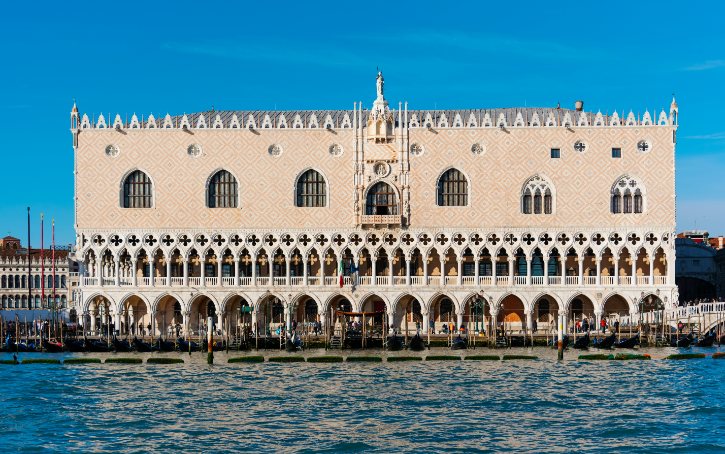
- A ground arcade of 36 sturdy stone columns.
- A middle loggia of delicate pointed tracery.
- A solid upper wall clad in pink Verona marble and white Istrian stone.
The heavy part sits on top, above the airy openwork. That open front toward the lagoon signaled a city that trusted its navy, not stone walls, for defense.
c. The room that explains the Republic
- The Chamber of the Great Council is one of the largest column-free halls in Europe.
- It was built to seat the entire adult male patrician class, whose names were kept in the Libro d’Oro after the reforms of 1297.
- At its peak it held 1,200 to 2,000 voting members at once, who elected the Doge and debated laws.
d. Art in the service of power
- Behind the throne hangs Tintoretto’s Paradise (1588 to 1592), about 22 by 7 meters, often called one of the largest oil paintings ever made.
- Its message was blunt: Venice governed under divine approval.
- The Sala delle Quattro Porte, where ambassadors waited for an audience, shows how art, architecture, and diplomacy met in one room.
e. Follow the route through power
The visit itself teaches the hierarchy, moving from the courtyard and its ceremonial staircases, through richly decorated council chambers, and down toward the judicial rooms. That path ends at a small enclosed bridge.
11. Bridge of Sighs
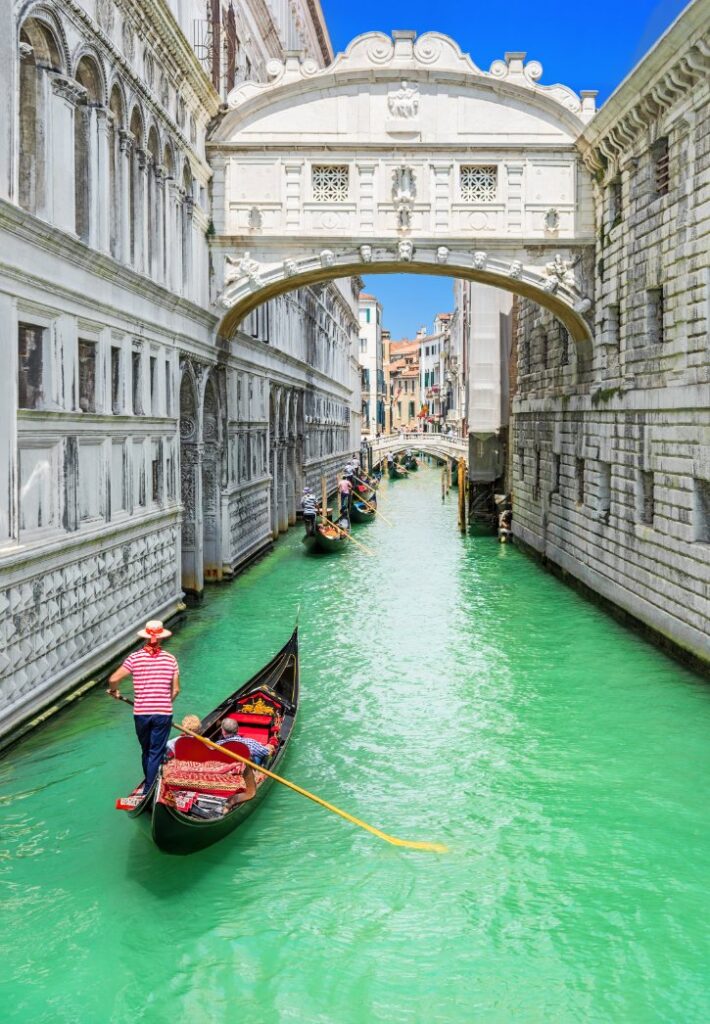
a. The real story, not the romance
The Bridge of Sighs is sold as a romantic sight, but its origins are strictly practical. Built between 1600 and 1602 by Antonio Contino, it connected the courts inside the Doge’s Palace with the New Prisons across the canal. Inside, it splits into two parallel passages so prisoners and guards would never meet or be seen.
b. Where the name really comes from
- The bridge was not called this during the Republic.
- The name appeared in the early nineteenth century and was popularized by Lord Byron in an 1818 poem.
- The legend of prisoners sighing at a last view of freedom is a later invention, not documented history.
c. The New Prisons
- Finished between 1560 and 1614, they were an early step in humane prison design.
- Earlier cells were damp basements or stifling rooms under the lead roof.
- The new cells were dry, ventilated, and lit by barred windows, a real improvement for the time.
d. Two ways to see it
- From outside: a small, elegant thing in pale stone, a single graceful arch over the canal.
- From inside: a narrow corridor where you glimpse only a sliver of water through pierced stone grilles.
The real feeling here is the gap between graceful architecture and grim purpose. From confinement, the route now spills back into the busy shopping streets.
12. Merceria Orologio
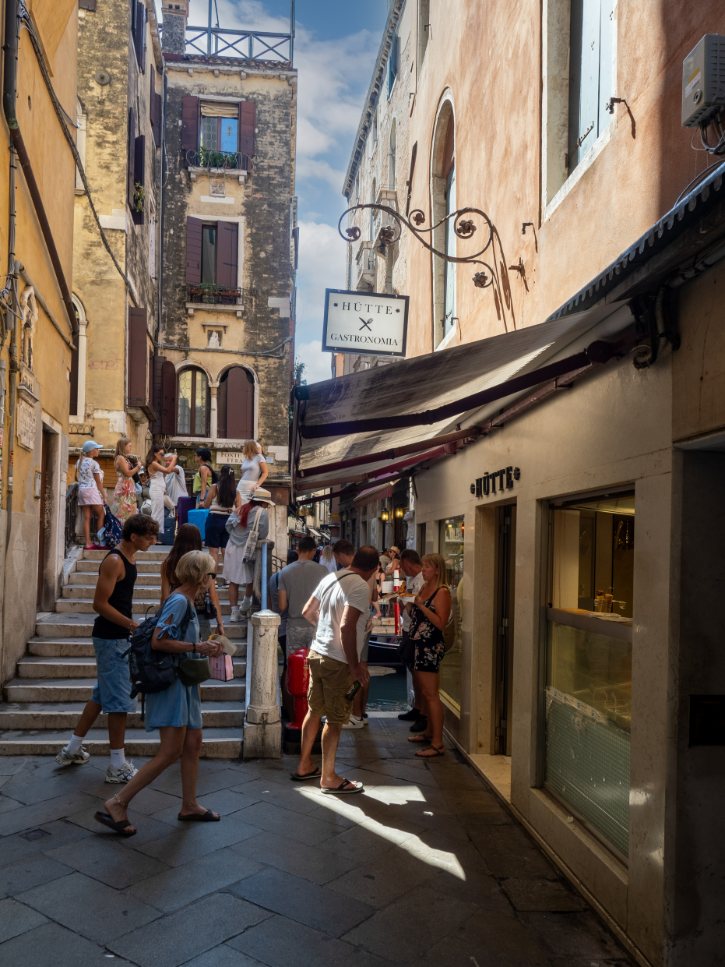
a. The doorway between two Venices
Merceria Orologio is the threshold where ceremonial Venice hands over to commercial Venice. It is the first link in the Mercerie, the chain of shopping streets that for centuries has connected San Marco with the markets of Rialto. Passing under the Clock Tower arch is an abrupt swap: monuments behind you, an intimate retail corridor ahead.
b. The Clock Tower
- The Torre dell’Orologio was designed by Mauro Codussi and built between 1496 and 1499.
- Its astronomical dial shows the hours, the moon phases, and the sun through the zodiac.
- The Winged Lion of Saint Mark sits on a star-studded blue background.
- Two bronze figures, the Moors, strike the bell on the hour; one old and one young, marking time.
c. What the street feels like
- The open sky of the piazza vanishes, replaced by tall four-storey walls.
- Sound changes, with footsteps and voices echoing between close facades.
- Your attention drops from grand monuments to shopfronts and the flow of people.
d. Look back
A few steps in, turn around. The Clock Tower, a flat facade from the open piazza, now works as a gateway framing a narrow slice of Saint Mark’s sky. Same monument, different from this angle. The street leads on toward the Grand Canal.
13. Rialto Bridge
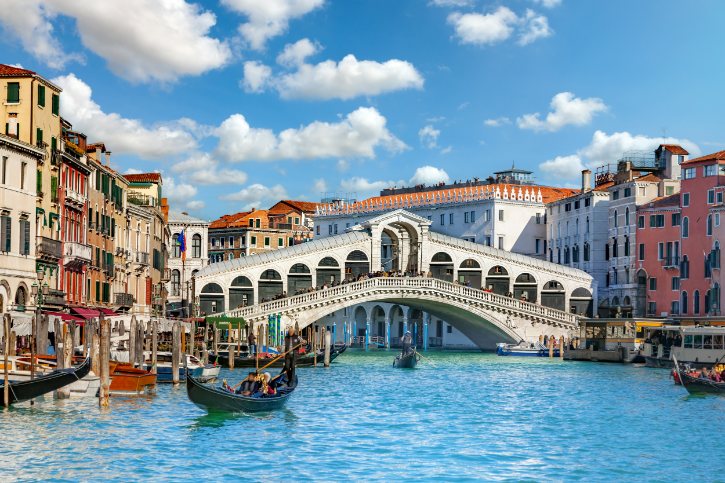
a. Architecture and commerce in one
The Rialto Bridge is both an engineering landmark and evidence of how Venice made its money. Designed by Antonio da Ponte and built between 1588 and 1591, his plan beat proposals by Palladio and Sansovino. From 1591 until 1854, it was the only permanent crossing over the Grand Canal.
b. A bridge built for trade
- The area was the trading exchange of the Mediterranean.
- Nearby, an open-air financial exchange saw bankers and insurers close deals in gold ducats.
- The docks held the Erberia (vegetable market) and Pescaria (fish market).
- The bridge was designed as a marketplace, with two rows of shops built into it.
c. What to notice
- A single stone arch spanning over 28 meters, rising high enough for laden boats to pass.
- Three lanes: two outer walkways with canal views and a central avenue lined with 24 shops.
- Carved reliefs of the Annunciation on the arch, meant to bless vessels entering the harbor.
d. How it differs from Ponte dell’Accademia
- Accademia: quiet timber arch, a calm spot for the Salute view.
- Rialto: dense stone masonry, packed with shops, commerce, and energy over the working market docks.
From this famous crossing, the route slips into a hidden pocket just off the main flow.
14. Campiello Remer
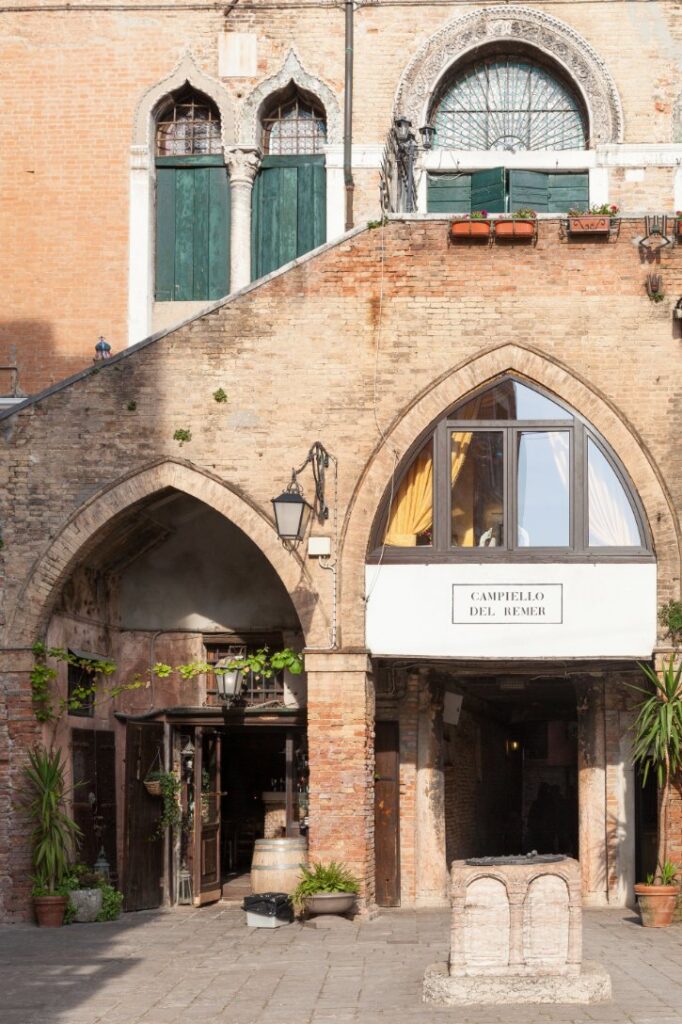
a. A hidden reveal
This is the walk’s best small surprise, and it does not pretend to be a monument. Campiello Remer is a secluded dead-end square that ends right at the Grand Canal. You wind through narrow, shadowy alleys, and then the space opens onto a stone terrace with nothing between you and the water.
b. Why it is worth stopping
- An external Gothic open-air staircase climbs the brick face of a fourteenth-century palazzo.
- An authentic stone wellhead sits in the middle of the pavement.
- The name Remer recalls the craftsmen who once made wooden oars for gondolas here.
c. What to look for across the canal
- Palazzo dei Camerlenghi, at the foot of the Rialto Bridge.
- The Rialto markets with their open-air loggias.
- The Rialto Bridge itself, seen in profile from this quiet, low angle.
d. A quick honesty note
- Some blogs repeat ghost stories about this square.
- They have no historical basis and are modern tourist inventions.
- The real value is the medieval architecture, the boat-building heritage, and the calm view.
This is a place to sit on the water steps, not to rush. Then the route rejoins the main flow of Cannaregio.
15. Strada Nova
a. The everyday circulation of Cannaregio
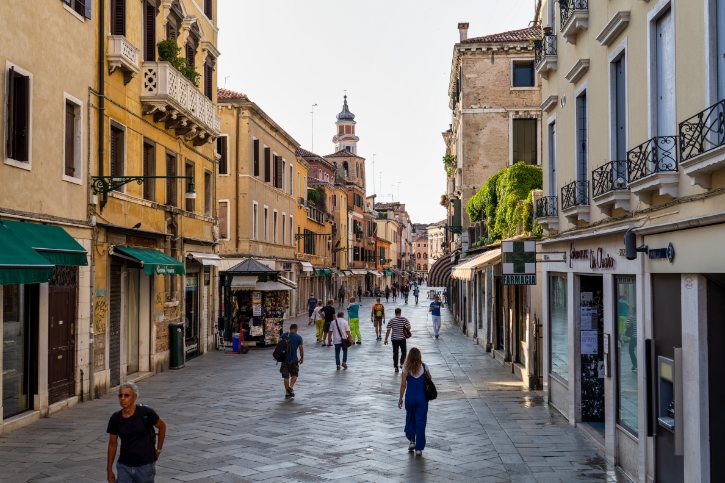
Strada Nova is where you meet the ordinary, working pulse of the city. Built between 1871 and 1872 by paving over old waterways, it was created as a direct walking link between Rialto and the railway station. Today it is a busy pedestrian corridor full of commuters, students, and travelers.
b. What to look for
- Bridges crossing historic canals, opening views toward the lagoon.
- Open squares of historic churches like San Felice and Santa Fosca.
- Side alleys where the noise drops away into quiet lanes just steps off the main street.
c. Why it belongs in a “beautiful spots” list
- It shows how Venice adapted to modern movement without losing its pedestrian feel.
- Above the shop signs you will find Gothic tracery and classical stonework.
- It is lived-in Venice, with bakeries, bookstalls, and mask-makers beside modern shops.
d. How to walk it well
This is not an undiscovered secret, and that is fine. The trick is to slow down, look at the upper floors, peer into the side calli, and use the street as a window into everyday Venetian life. Its lesson is that the city’s character can change within a few turns. Beyond it, the water returns to your side.
16. Fondamenta de la Misericordia
a. Where Venice turns residential
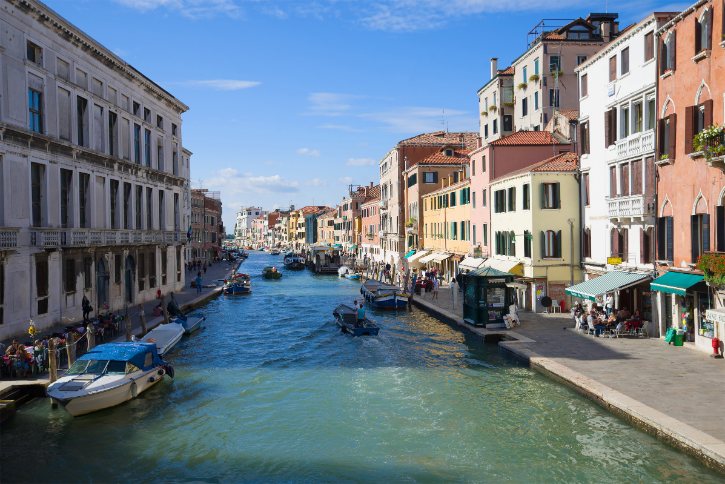
This is where the walk starts to feel unmistakably like a neighborhood. Fondamenta de la Misericordia runs into the residential heart of northern Cannaregio, shaped by local life, old rowing traditions, and food and drink. It is a real, lived-in area rather than a tourist-free secret, and that is its charm.
b. What a fondamenta actually is
- A fondamenta is a paved walkway running directly alongside a canal.
- Unlike a typical calle boxed in by walls, it keeps the water at your side the whole way.
- That gives you long, straight views down the canal, with the sounds of boats and lapping water.
c. What to do here
- Try cicchetti, small Venetian plates like creamed cod on polenta or sweet-and-sour sardines.
- Pair them with an ombra, a small glass of local wine, or a Venetian spritz.
- In the evening, locals gather along the stone edge to socialize in the open air.
d. Ordinary architecture worth seeing
- Three- and four-storey homes in weathered ochre, rose, and terracotta plaster.
- Timber shutters, iron window boxes, and stone mooring steps into the canal.
- Down the canal, the brick shell of Sansovino’s Scuola Grande della Misericordia adds historic scale.
This is a canal-side promenade for slow walking. Keep going west and the walkway carries on into the final stop.
17. Fondamenta dei Ormesini
a. An ordinary street with a global secret
The last stop is the charm of residential Venice with a hidden twist. The name Ormesini was documented by the nineteenth-century archivist Giuseppe Tassini, so it rests on a respected source.
- Ormesini was a fine, lightweight silk once made in workshops along this canal.
- The fabric took its name from Ormuz (Hormuz), a trading port at the mouth of the Persian Gulf.
- Venetian merchants imported these silks, then wove the fabric locally into the eighteenth century.
b. Why it works as a final stop
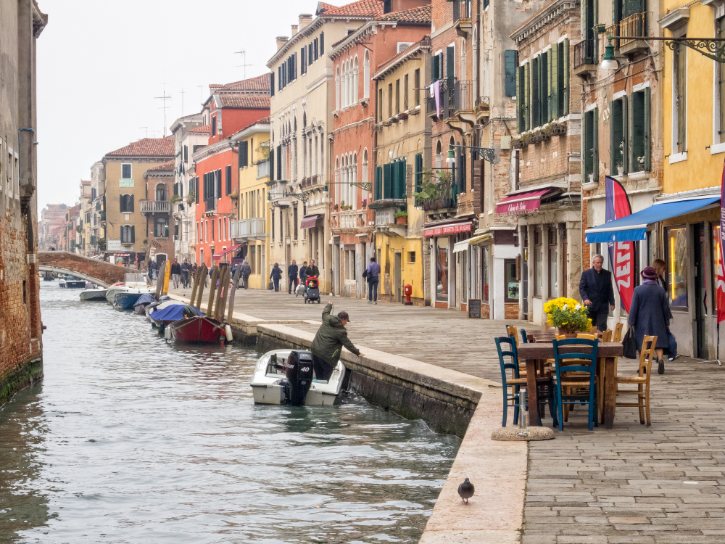
- A long stone quay lined with modest houses, small workshops, and casual osterie.
- Low stone and brick bridges crossing the green canal water.
- Wooden boats tied to weathered poles, their reflections rippling on the surface.
c. How to spend your time
- Watch delivery boats thread through the low bridges.
- Stop at a canal-side osteria for a glass of wine and a plate of cicchetti.
- Take a seat on the stone edge as the workday winds down.
d. A note on the light
- The canal runs roughly east to west, so late-afternoon light can travel straight down it.
- It catches the weathered brick and ochre plaster and throws warm reflections on the water.
- The sun shifts with the seasons, so treat this as a pleasant possibility, not a guaranteed sunset.
e. The idea that ties it all together
Venice’s identity as a trading power was never limited to grand monuments. The materials and luxury goods of Mediterranean and Asian trade reached deep into ordinary neighborhoods too. That is what this street name shows: international history survives here not only in palaces, but in trades, words, and everyday canal-side space. It is a fitting place to stop walking, order an ombra, and let the city settle in.