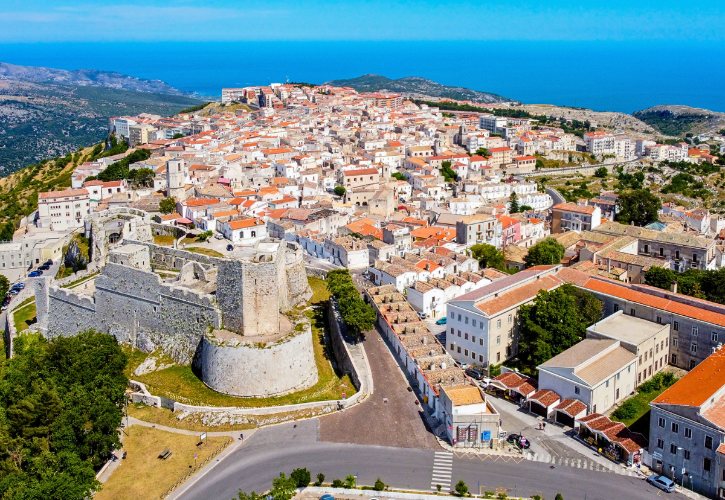
Somewhere in southern Italy, whole towns glow white in the sun. Pale stone lanes twist up hillsides, sunlit façades stack one above the other, and flowers spill from wrought-iron balconies.
Some perch on cliffs above impossibly blue water. Others rise from silver seas of ancient olive trees.
Walk their narrow passageways and centuries-old streets, and you could easily believe you had wandered onto a Greek island. Here are ten of the most beautiful. 😊
1. Ceglie Messapica: A Quiet Maze of White Lanes Around a Ducal Stronghold
a. Why go
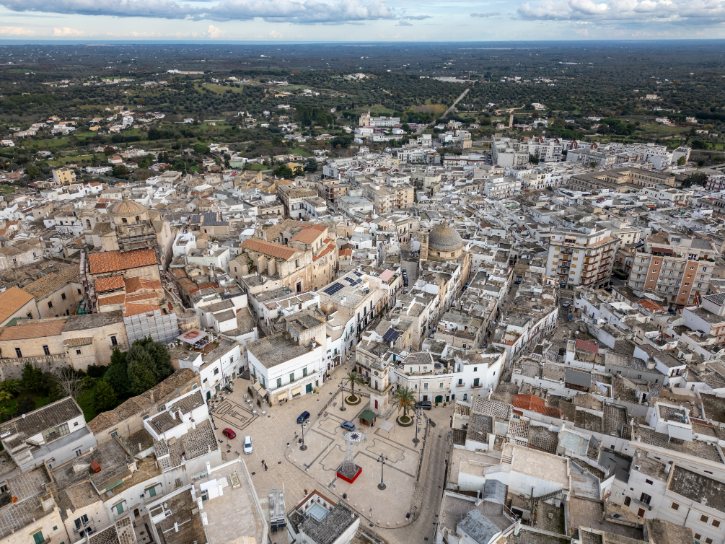
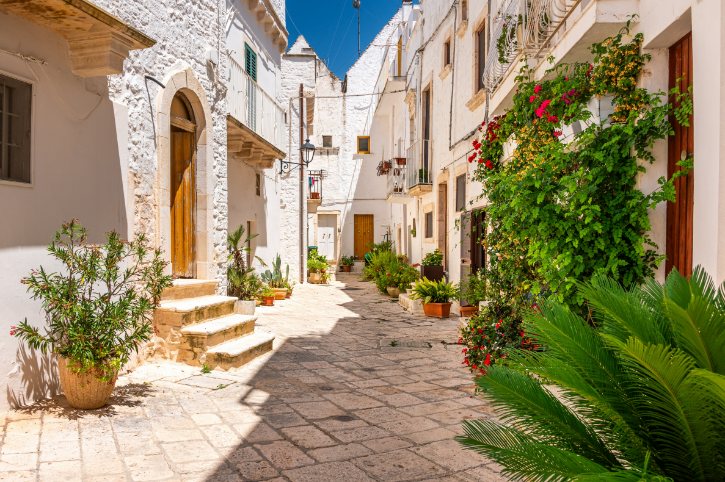
Ceglie Messapica sits where the Valle d’Itria eases into the plains of northern Salento. It is still a working farming and food town rather than a polished tourist stop, so it keeps a real, lived-in feel. The beauty is quiet and everyday: white lime-washed houses pressed right up against the warm golden stone of the town’s grand old landmarks.
b. What makes it beautiful
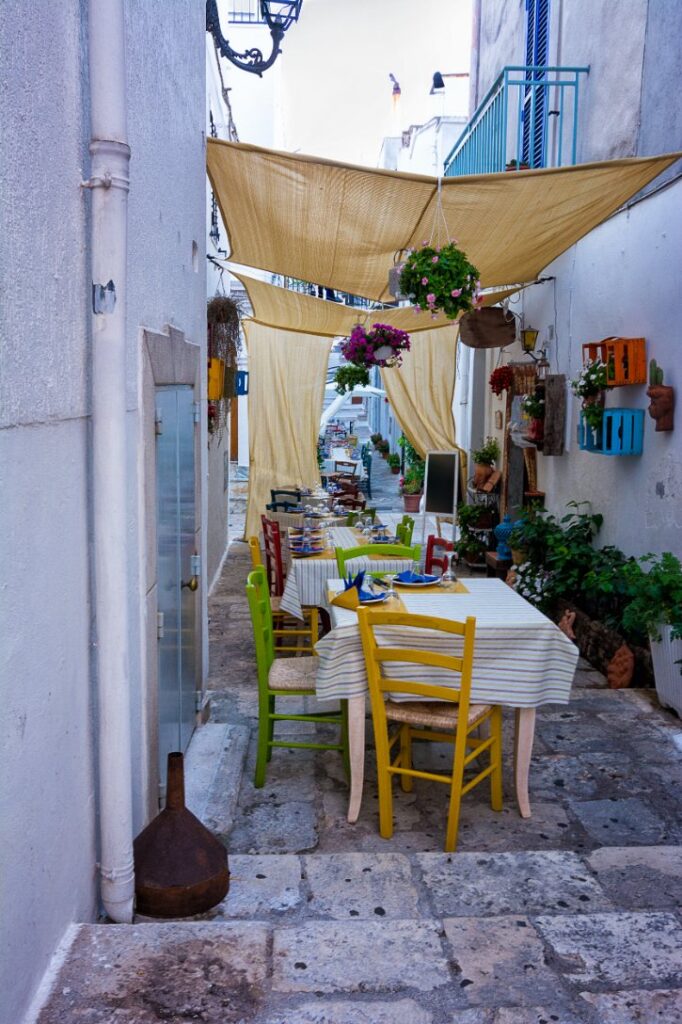
- Narrow lanes paved in smooth limestone
- Steep outdoor stone staircases between the houses
- Covered archways that tunnel under buildings
- Wrought-iron balconies with terracotta planters, and dark green and blue wooden doors
- Small courtyards tucked off the main lanes
c. What to see
- Piazza Plebiscito, the social heart of town
- The Torre dell’Orologio, an 1890 clock tower with four clock faces and two bronze bells
- The Castello Ducale, on the highest point, with a Norman watchtower rising around 34 meters and three round Aragonese towers
- The Mother Church, crowned by a squat dome of colorful majolica tiles
d. How to wander it
Begin on Piazza Plebiscito, then step through the arched Porta di Giuso into the medieval core. The moment you pass through, the lanes tighten and the smell of fresh baking drifts from open windows.
Wander up past Largo Ognissanti, the town’s ancient meeting square and once the agora of the Messapian settlement, where the grand Palazzo Vitale still stands.
Finish just outside the old walls at Belvedere Monterrone, a natural balcony over the Valle d’Itria that looks across olive orchards to the distant hilltop shape of Cisternino on the horizon.
e. A local flavor
- Try the biscotto cegliese, the town’s famous ancient almond pastry
- Come here first for authentic white lanes without the crowds
2. Pisticci: White Lammie Cascading Above Basilicata’s Lunar Calanchi
a. Why go
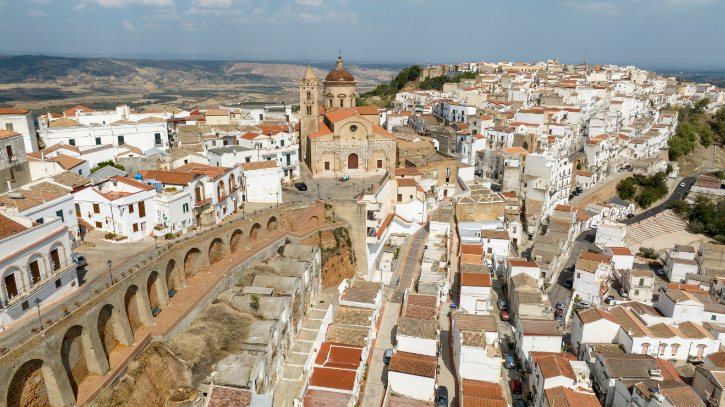
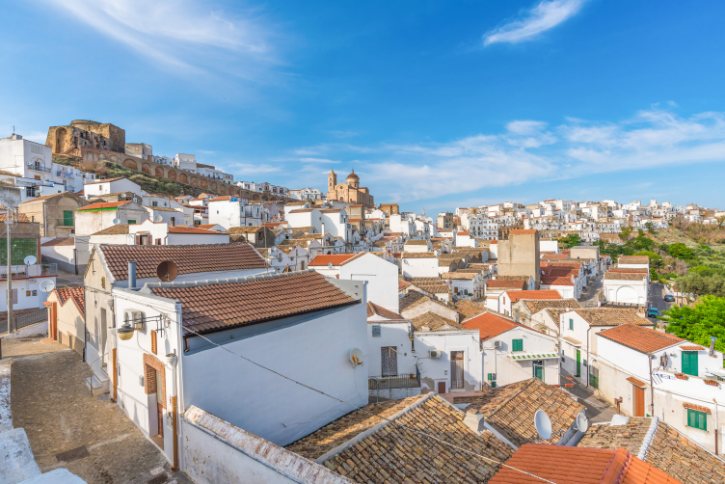
Pisticci is the most unusual-looking town on this list. It sits on a clay ridge in Basilicata, its white houses spilling down the slopes directly above the calanchi, a vast landscape of eroded clay gullies and knife-edge ridges. Nothing else here mixes bright white geometry with such a strange, almost lunar countryside.
b. The look
- The Rione Dirupo, white houses arranged in tidy stepped rows like an amphitheater
- Houses called lammie: small single-room homes with barrel-vaulted roofs and red terracotta tiles
- Rows standing shoulder to shoulder, following the curve of the hill
- Pale grey and ochre clay ravines framing the white walls
c. A little history
On the night of 9 February 1688, remembered as the Night of Sant’Apollonia, days of heavy snowfall soaked and weighed down the hillside until it suddenly gave way.
The landslide tore through the old town, destroying hundreds of homes and killing an estimated 300 people, though some accounts put the toll as high as 400.
Rather than leave, the survivors rebuilt with the lightweight lammie you see today, designed to sit gently on the unstable slope. The white lime wash kept the homes clean and reflected the harsh summer sun.
d. What to see
- Rione Terravecchia, the older, higher quarter with a Norman castle keep and a stone-built Mother Church
- The lower Chiesa dell’Immacolata Concezione, with a wooden ceiling shaped like an upturned ship’s hull
- The stone balustrades near the Mother Church, looking down over thousands of red-tiled roofs
e. How to wander it
- Start high in Terravecchia for the best overview
- Descend into Dirupo between the tight rows of lammie
- Look for arched doorways, flowerpots, and stone steps to upper terraces
- Be ready for steep lanes and uneven stairs, and take it slowly
3. Monte Sant’Angelo: White Terraces, Pilgrimage Lanes, and Gargano Panoramas
a. Why go
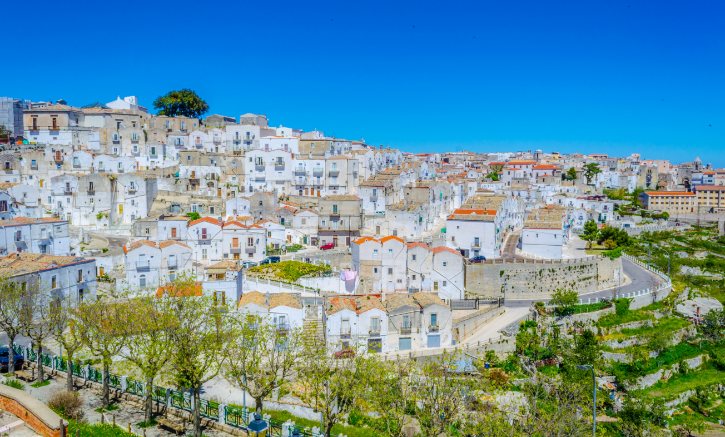
Monte Sant’Angelo sits high on the Gargano promontory, above 800 meters, with clean mountain light and sweeping views over the Gulf of Manfredonia. It brings together white terraced houses, deep spiritual history, and dramatic elevation. Many visitors come only for the sanctuary and miss the white quarter, which would be a mistake.
b. The sanctuary
- The Sanctuary of San Michele Arcangelo, a UNESCO World Heritage site
- Built around a natural cave where, by tradition, the Archangel Michael appeared in the late 400s
- A descent of 86 stone steps into the mountain, past inscriptions carved by centuries of pilgrims
- A candlelit Sacred Grotto with a baroque marble altar and a white marble statue of Saint Michael
c. Rione Junno
- Long stepped terraces of small white single-story homes
- Steeply pitched gable roofs in terracotta, with tall stone chimneys
- Rounded stone door frames opening into vaulted rooms
- Rows terraced so tightly that one roofline meets the base of the terrace above
The poet Giuseppe Ungaretti once described it as a flock of white houses climbing the mountain, and the image sticks.
d. How to wander it
Begin at the castle on the high western edge, then drop down past the sanctuary’s bell tower into Rione Junno. Inside, wide streets give way to narrow stepped passages and small stone landings, with low arches linking the houses across the lanes. Follow the streets south to the open belvederes, where the white gable roofs frame the hills sliding down to the shining Gulf of Manfredonia.
e. Don’t miss
- The walk from the bright lanes above down into the cool, dim grotto
- Hand-painted ceramics and flowers brightening the whitewashed walls of Junno
- The castle’s pentagonal watchtower, known as the Torre dei Giganti
4. Cisternino: The Intimate White Maze of Arches, Stairs, and Flowerpots
a. Why go
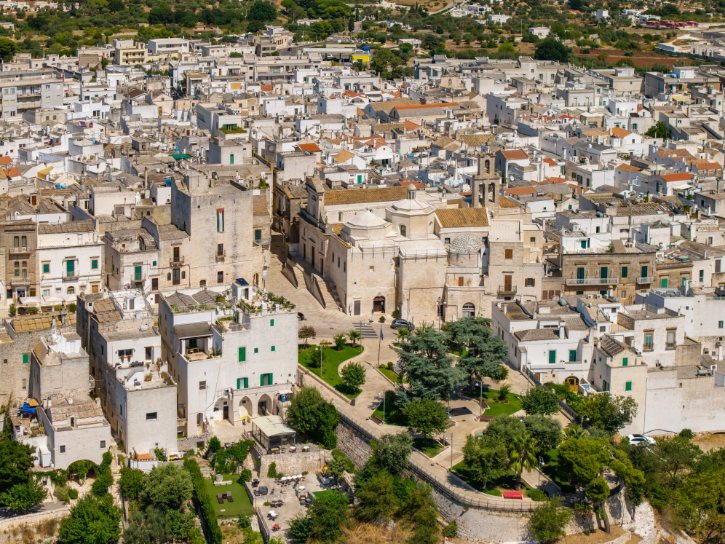
Cisternino is for wandering, not for ticking off monuments. Sitting on a gentle hill in the Valle d’Itria, it is one of the finest examples of everyday white architecture in the region. There is no traffic, so it stays quiet and calm, and its charm hides in small details that are easy to miss if you rush.
b. What makes it beautiful
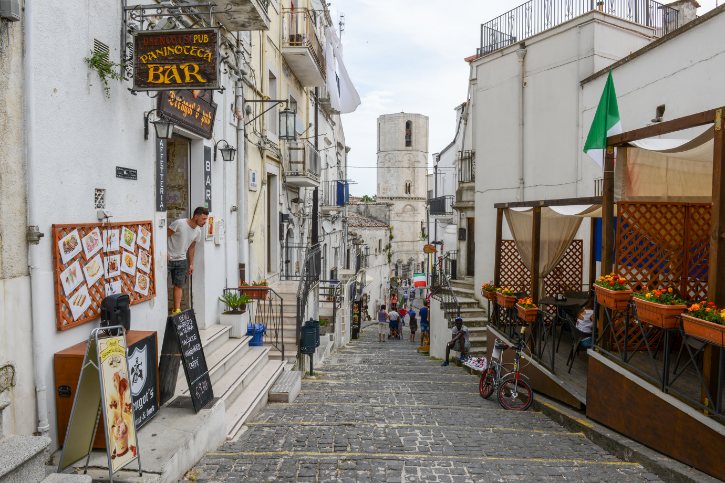
- Exterior staircases running up the fronts of houses, with storage tucked underneath
- Connecting arches stretching overhead between opposite buildings
- Soft lime wash that rounds off the corners of windows and doorways
- Terracotta pots of geraniums and bougainvillea against green or blue shutters
- Carved stone corbels, wall niches with small statues, and iron lanterns
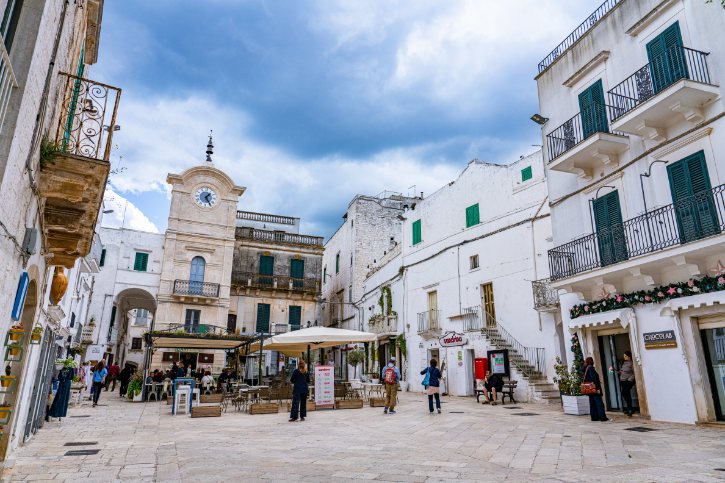
c. What to see
- The Rione Bère Vecchie, the most intact and photogenic old quarter
- The Torre Normanno-Sveva, a 17-meter medieval tower topped by a small statue of San Nicola
- The pale-stone Chiesa Madre di San Nicola, built in the 1300s over a much older crypt
- Piazza Garibaldi, the civic square that doubles as a viewing terrace
d. The view
From the belvedere at Piazza Garibaldi, you look out over the Valle d’Itria: a patchwork of dry-stone walls, old olive groves, and the cone-shaped roofs of trulli. That open view is the perfect contrast to the enclosed lanes waiting just behind you.
e. How to wander it
- Start at the belvedere, then pass beneath the tower into the old center
- Do not follow a set route; simply drift through the alleys of Bère Vecchie
- Let the arches and staircases frame little slices of sky and stone as you go
5. Martina Franca: Where Whitewashed Puglia Turns Flamboyantly Baroque
a. Why go
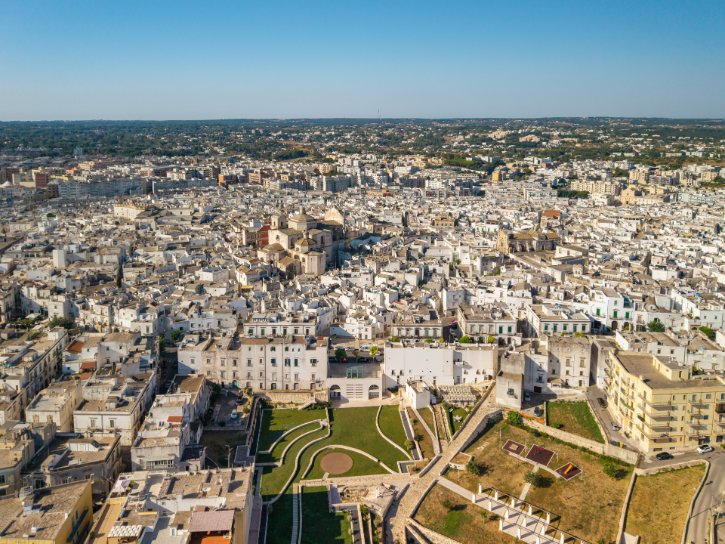
Martina Franca stands out from its simpler white neighbors. Here, whitewashed streets meet grand, theatrical Baroque and Rococo architecture. The beauty comes from that tension: elegant golden-stone palaces rising straight out of a dense weave of quiet white lanes. If you are already touring several white towns, this one adds a dose of aristocratic grandeur.
b. The grand landmarks
- Porta Santo Stefano, the main gateway, rebuilt in 1764 with graceful Baroque moldings
- Piazza Roma and the huge Palazzo Ducale, with fine iron balconies and frescoed state rooms
- The Basilica di San Martino, its two-tiered façade full of relief carving, with a high-relief of Saint Martin sharing his cloak with a beggar as the centerpiece above the main doorway
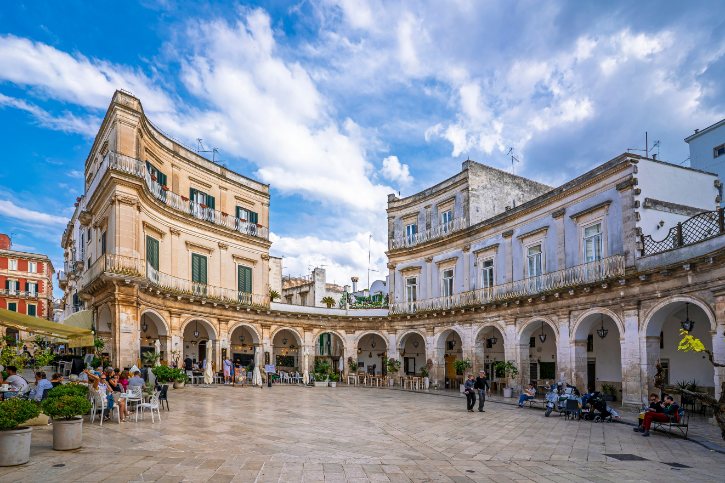
- Piazza Maria Immacolata, a graceful half-circle of pale stone arcades
c. The quiet quarter
- The Rione Lama, once home to vineyard workers and artisans
- Small houses called casedde, with sharply pitched roofs covered in thin limestone slabs
- Narrow, hushed streets with simple iron hooks and flower-lined doorsteps
d. What to look for
Slow down at each landmark and study the carving rather than just noting the name. The relief work on the Basilica, the iron balconies of the Palazzo Ducale, and the sweep of the arcades all reward a closer look. The real pleasure is watching grand architecture and humble white lanes sit side by side.
e. How to wander it
- Enter at Porta Santo Stefano and step into Piazza Roma
- Follow the main axis to Piazza Plebiscito and the Basilica
- Pass through the arcades of Piazza Maria Immacolata
- Descend into the maze of Rione Lama, where the mood turns quiet and white
6. Locorotondo: A Circular White Hill Town Crowned by the Cummerse
a. Why go
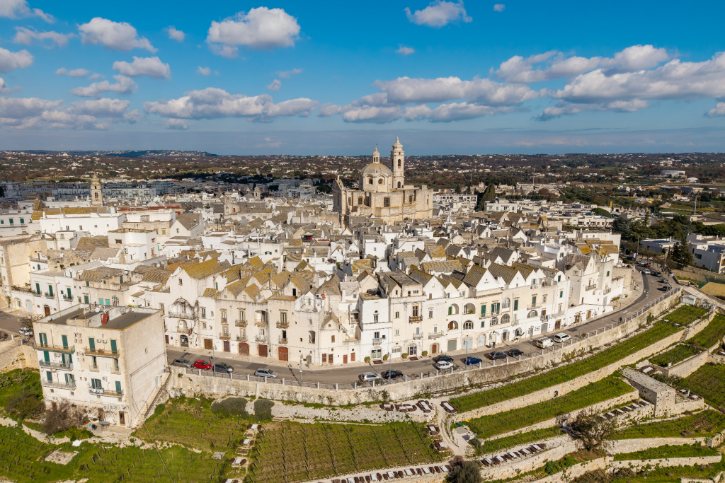
You will recognize Locorotondo before you arrive. Perched on an isolated hilltop, its old center forms a near-perfect circle, which is where its name comes from. The circular plan makes wandering feel gently continuous, curving you around the hill as you go.
b. Look up
- The cummerse, tall narrow houses topped with steep pointed roofs
- Roofs clad in thin grey limestone slabs, the same stone used for trulli cones
- A skyline of repeated pointed gables unlike anywhere else in Puglia
- Balconies overflowing with geraniums and detailed wrought-iron work
c. What to see
- Palazzo Morelli, an 18th-century noble house with a carved Baroque doorway
- The Chiesa della Madonna della Greca, the oldest church, with a rose window and carved stone animals
- The neoclassical Mother Church of San Giorgio, lifting a 35-meter dome above the pointed roofs
d. The inland “lungomare”
Trace the southern edge along Via Nardelli, which locals fondly call the town’s “lungomare”, or seafront promenade. Do not expect the sea, though. There is none in sight. The name is affectionate, because the street rings the hilltop like a coastal railing, looking out over a wide basin of vineyards, olive trees, and trulli.
e. When to visit
- Early morning: wander the cool, quiet inner streets as the sun picks out clean white walls
- Late afternoon to golden hour: walk the perimeter of Via Nardelli, when low light warms the buildings and throws long shadows across the valley
7. Monopoli: White Alleys Flowing into an Old Fishing Harbour
a. Why go
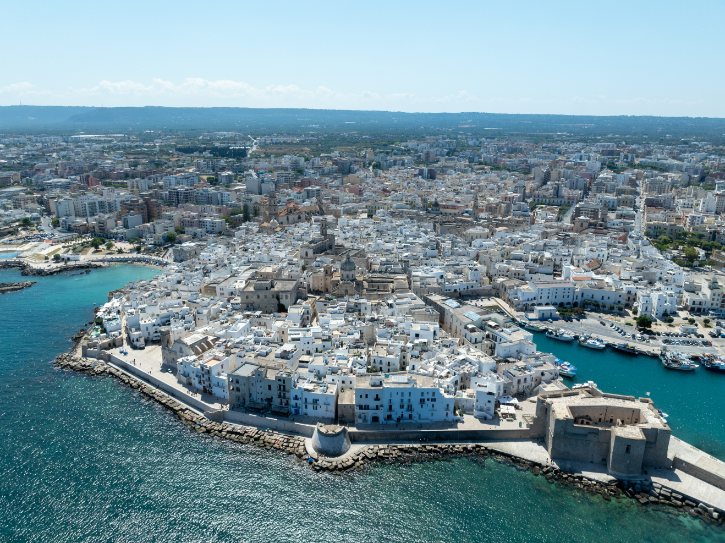
Monopoli gives you something the inland towns cannot: the sea. A dense web of whitewashed lanes runs right down to a working fishing harbor. The fun is in the surprise. You thread through narrow shaded streets, then suddenly emerge among boats, old defensive walls, and blue Adriatic water.
b. The old harbor
- The Porto Vecchio, a sheltered old harbor ringed by walls and palazzi
- Traditional fishing boats called gozzi, painted bright cobalt blue and red
- The Palazzo Martinelli, built on the sea walls, with a neo-Gothic loggia of eight pointed arches
- Fishermen mending nets beside their moored boats
c. What to see
- Castello Carlo V, a 1552 fortress on the promontory at the harbor entrance
- Sweeping Adriatic views from its heavy walls
- The Baroque Cathedral of the Madonna della Madia, with a rich marble interior
- A treasured Byzantine-style icon that legend says washed ashore in the harbor
d. Streets and squares
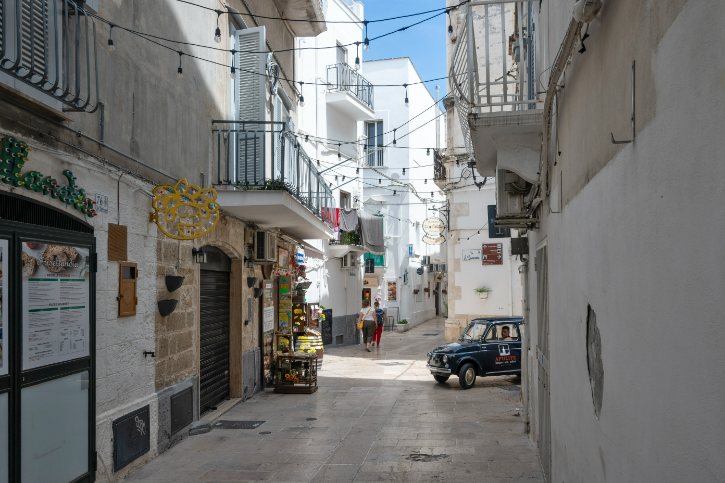
Inside the old town, whitewashed alleys are strung with potted plants and hanging laundry, and small churches appear between the lanes. The pleasure here is the constant shift between enclosed shade and sudden open sea, between salt air and cool stone.
e. How to wander it
- Start on the waterfront above the Bastione Santa Maria, over the open Adriatic
- Follow the seawall north toward Castello Carlo V
- Round the fortress into the calm Porto Vecchio
- Pass beneath the frescoed Arco del Porto into the white streets, climbing to the cathedral square
8. Otranto: Pale Fortified Lanes Above Impossibly Blue Salento Water
a. Why go
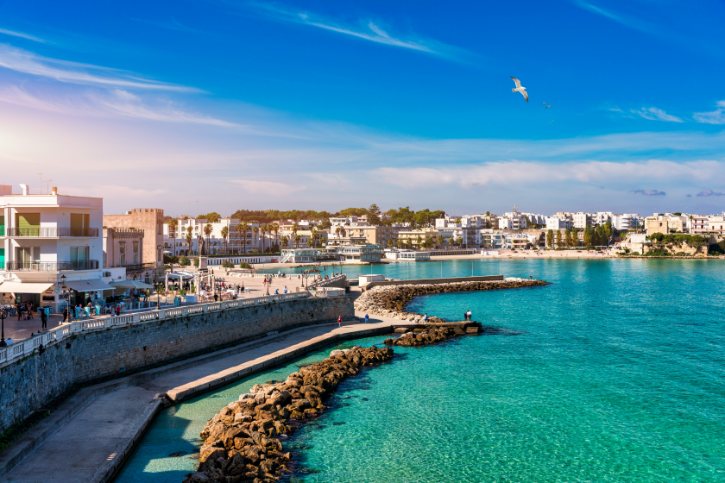
Otranto sits on the easternmost tip of Italy, looking across the sea toward the Balkans. A quick note of honesty: it is not uniformly whitewashed like Ostuni or Cisternino. Its glow comes from golden-cream and luminous pale local stone. What makes it belong here is the mix of bright fortified streets and some of the bluest water in all of Salento.
b. The look
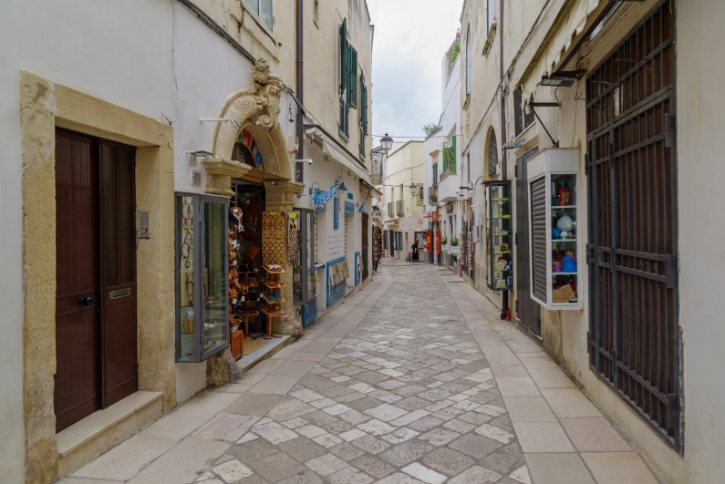
- Narrow streets paved in smooth, pale limestone
- Low stone façades, iron wall sconces, and climbing bougainvillea
- Thick Aragonese walls enclosing the whole old town
- Small squares and streets that suddenly open toward the sea
c. What to see
- Otranto Cathedral, with a vast 12th-century mosaic floor
- The sprawling “Tree of Life” carried by two elephants, weaving together bible stories, myth, and the zodiac
- A sobering chapel displaying the remains of 800 townspeople killed in the 1480 Ottoman siege
- The Castello Aragonese, with a deep dry moat, thick ramparts, and three great corner towers
d. The best view
Head out onto the Bastione dei Pelasgi, one of the finest lookouts on the Salento coast. From the ramparts you gaze down at clear turquoise water and the little beach below, with warm stone battlements framing the scene. It is the moment where pale stone and vivid blue meet most beautifully.
e. How to wander it
- Enter through the Porta Alfonsina, set into the thick walls
- Get lost in the pale stone lanes of Corso Garibaldi, past workshops selling leather and ceramics
- Visit the cathedral and the castle courtyards
- Finish on the bastion for the coastal panorama
9. Polignano a Mare: White Medieval Houses Balanced on Limestone Cliffs
a. Why go
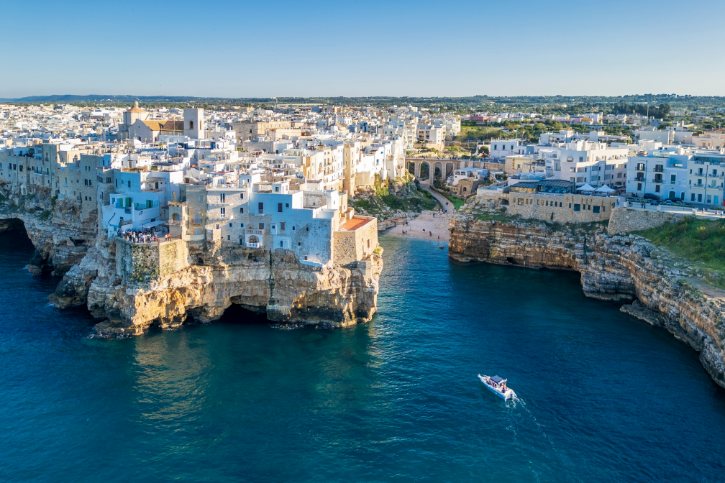
Polignano a Mare is spectacular in the truest sense. The old town sits on a limestone cliff that drops straight into the Adriatic, its base hollowed into caves by the waves. White medieval houses cling to the very edge, so their walls look like a continuation of the pale rock beneath.
b. In the old town
- The Arco Marchesale, the 16th-century gate once the only way in by land
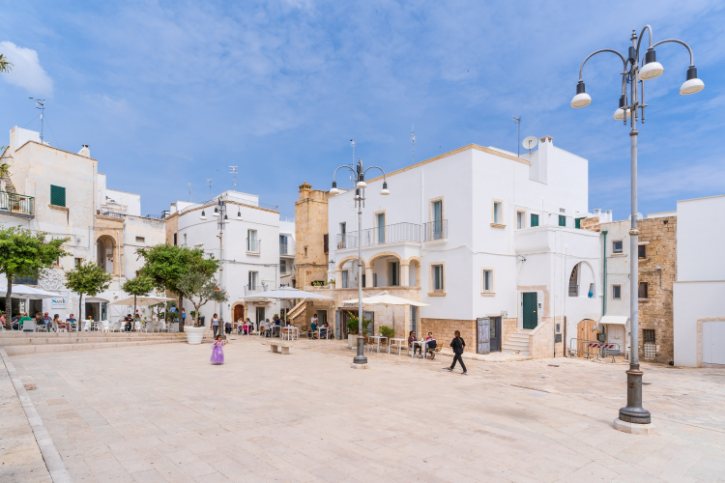
- Narrow limestone alleys, including Via Giudea, the former Jewish quarter
- Lines of poetry hand-painted across walls and steps by a local artist known as “Guido il Flâneur”
- Sea-facing terraces like the Terrazza di Santo Stefano, looking straight down into the water
c. The classic view
The essential viewpoint is the Ponte Borbonico, a 19th-century bridge over the Lama Monachile ravine. Standing on it gives you the postcard view: a turquoise inlet framed by vertical cliffs, topped by clusters of white houses. Nearby, tucked into the inland side of the same ravine, hides an even older single-arch Roman bridge that once carried the Via Traiana.
d. Beach and caves
- Lama Monachile, the white-pebble beach in the gorge, stunning from above and below
- Arrive around sunrise for quiet water and soft morning light, before the afternoon crowds
- Sea caves honeycombing the cliffs beneath the town
- A boat, kayak, or paddleboard trip for a ground-up view of the cliffs and caverns
e. See it from every level
- Wander the cliff-edge lanes
- Look down from the open terraces
- Stand on the pebble beach below
- Admire the cliffs from the water
10. Ostuni: The Definitive White City Rising Above Olive Country
a. Why go
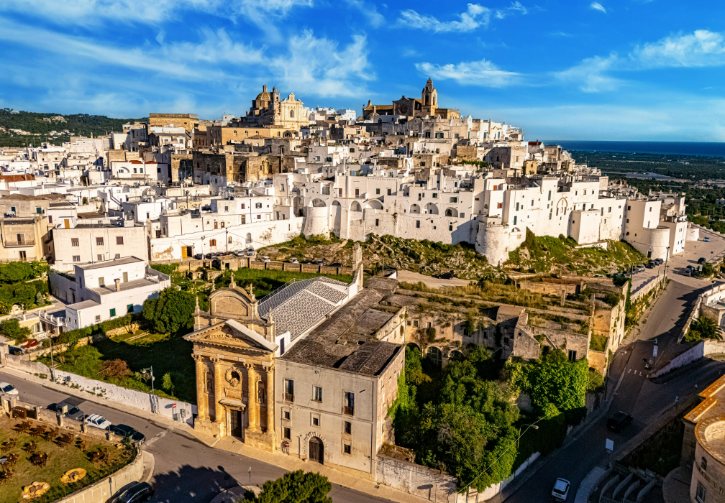
Ostuni is the finale, and the fullest expression of everything this list is about. Known across Italy as La Città Bianca, the White City, its old center covers three limestone hilltops. From miles away, it appears as a dense white pyramid crowning the hill, with the warm stone of its cathedral at the very top. Seeing that silhouette from a distance matters as much as walking the streets.
b. What makes it beautiful
- Whitewashed houses, winding lanes, and steep flights of stairs
- Arches, hidden courtyards, and small squares
- The historic heart, La Terra, a maze of concentric streets and covered passages
- Sudden terraces that open over the olive groves below
c. A tradition of white
The town has coated its buildings in white lime since the Middle Ages, partly as a natural disinfectant. During the plague of 1656, whitewashing the streets and homes helped Ostuni limit the outbreak, and the tradition has held ever since. The blinding white you see today comes straight from that history.
d. What to see
- Piazza della Libertà, with a 20-meter Baroque spire and the former monastery that now serves as town hall
- The Cathedral at the summit, with a golden-amber front and a rose window carved with 24 rays, among the largest in Europe
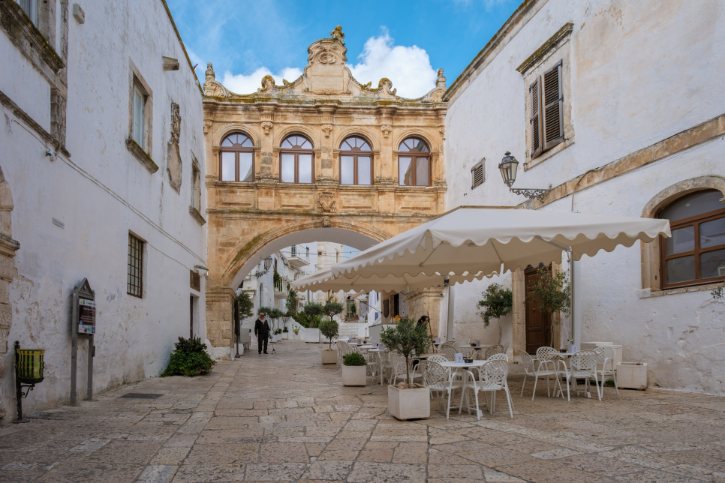
- The ornate Arco di Scoppa bridge, framing the sky above the narrow summit street
- The Piana degli Olivi Secolari, a plain of hundreds of thousands of ancient olive trees below
e. Experience it at three levels
- From outside: take in the whole white hill from the approach road
- From within: climb from Piazza della Libertà up Via Cattedrale into the alleys of La Terra
- From above: reach the cathedral summit and the walls to look across the olive plain toward the distant Adriatic
One thing to remember: the white city itself is inland, so the sea is a blue line on the horizon rather than at your feet.