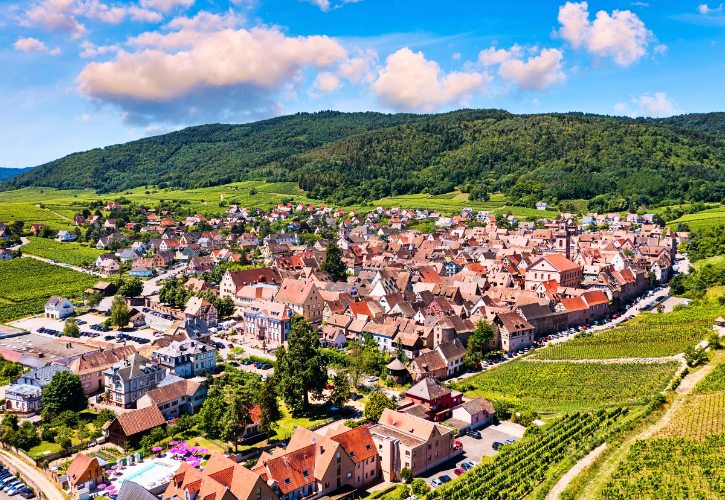
Paris is wonderful, but France’s real magic often hides in its small villages.
Picture cobbled lanes, flower-filled windows, golden castles on cliffs, vineyards rolling into the distance, and quiet squares where time slows down.
These ten villages show you the country at its most charming, from Alsace to Brittany, Provence to the Dordogne.
Each one has its own story and mood, and any of them can easily become the highlight of your trip. Let’s start with the first. 😊
1. Riquewihr, Alsace
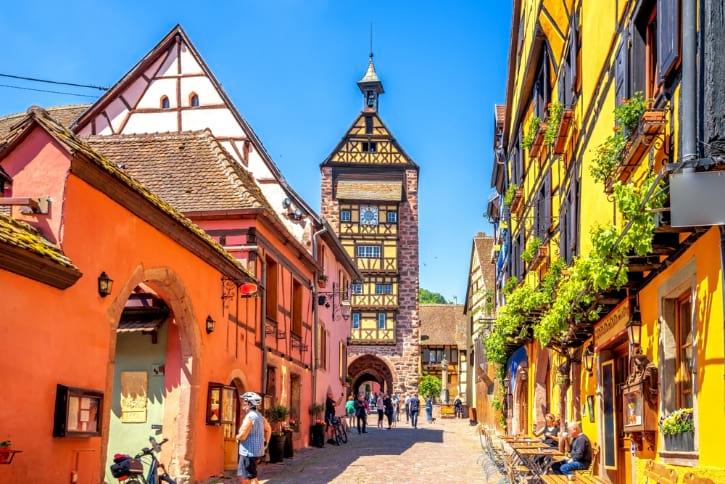
Tucked between vineyards in Alsace, Riquewihr feels like stepping into a storybook.
You’ll wander past painted half-timbered houses, cobbled lanes, and old defensive walls.
The village is officially listed among Les Plus Beaux Villages de France, a national label that recognizes France’s most charming and best-preserved small villages.
You’ll love Riquewihr if you want classic Alsace charm with fairytale houses and rich history.
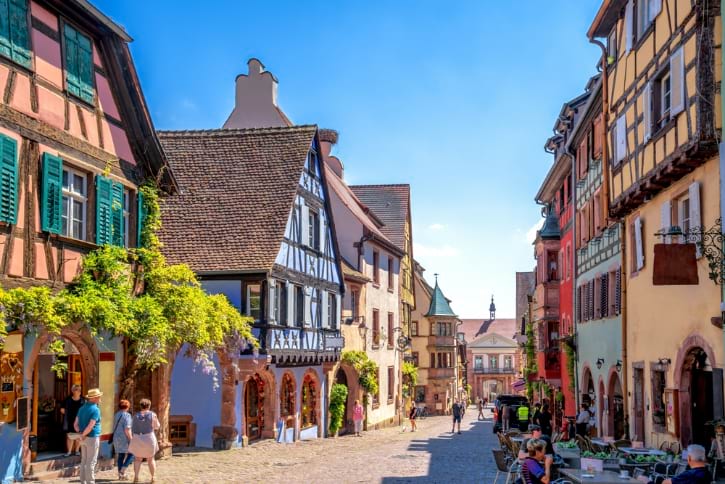
Main Things to See
- Dolder Tower, a 13th-century gate and watchtower
- Thieves’ Tower, the old village prison with preserved dungeons
- Württemberg Castle and the old Town Hall
- Painted houses along Rue du Général-de-Gaulle
Best Time to Visit
- Spring and summer: flowers everywhere, long sunny evenings
- Autumn: golden vineyards and the harvest atmosphere
- December: one of the most famous Christmas markets in Alsace, with lights, mulled wine, and decorated houses
How Much Time You Need
A short visit of two to three hours covers the main streets. A half-day is better if you want to eat, taste wine, and wander slowly. Staying overnight is a real treat, because the village empties out and feels almost private after sunset.
How to Get There
Riquewihr is about 15 km north of Colmar, and several options work well:
- By car: the easiest option, with vehicle access ending at the historic gates
- By bus: Fluo Grand Est regional bus line 68R016 from Colmar
- By seasonal tour bus: in warmer months, hop-on hop-off services connect the wine villages
- By guided tour: plenty of half-day tours run from Colmar and Strasbourg
Nearby Places to Pair With It
For a relaxed day along the Wine Route, pair Riquewihr with:
- Hunawihr, just a short drive away
- Ribeauvillé, slightly larger and great for lunch
- Kaysersberg, another classic Alsace village
- Eguisheim, doable but better as a separate day
- Colmar, perfect as a base
2. Eguisheim, Alsace
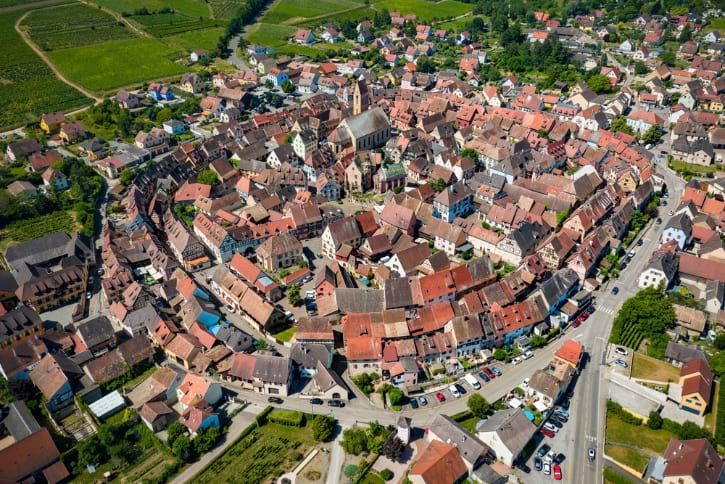
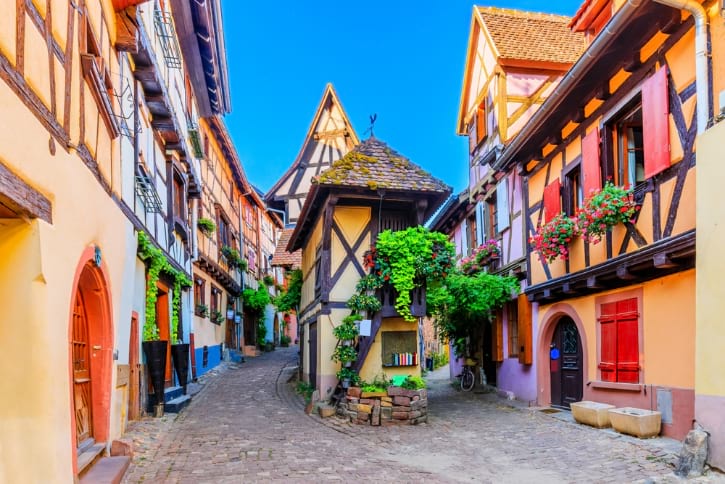
Just south of Colmar, Eguisheim has one feature you’ll fall for quickly. It’s built in circles. Pastel half-timbered houses follow concentric ring streets around an old castle, making it one of the most romantic small villages in Alsace.
You’ll love Eguisheim if you want a compact, photogenic Alsace village you can enjoy slowly.
Main Things to See
- Place Saint-Léon, the central square
- The Saint-Léon Fountain with its statue of Pope Leo IX
- Saint-Léon-Pfalz castle and the municipal chapel beside it
- The full outer ring walk along Rue du Rempart
Best Time to Visit
- Spring to early autumn: flower season is at its peak
- Autumn: the surrounding vineyards turn gold and the wine harvest energy is wonderful
- December: the small Christmas market is one of the most charming in the area
How Much Time You Need
Plan for about two to three hours if you just want to walk and take photos. A half-day is better if you want to taste wine, have lunch, and slow down. Eguisheim pairs well with another village or two in the same day.
How to Get There
Eguisheim sits just over 4 km south of Colmar, so it’s very easy to reach:
- By car: quick drive from Colmar, with parking outside the village
- By bus: Fluo bus line 68R030 from Colmar (weekdays only)
- By bike: a flat, scenic ride along dedicated vineyard paths from Colmar
- By guided tour: plenty of half-day options combine it with Riquewihr
Nearby Places to Pair With It
Realistic combinations for one relaxed day:
- Colmar in the morning, Eguisheim in the afternoon
- Eguisheim + Turckheim, both close and small
- Eguisheim + Kaysersberg, slightly longer but doable
- Riquewihr + Eguisheim if you want two contrasting layouts
3. Yvoire, Haute-Savoie
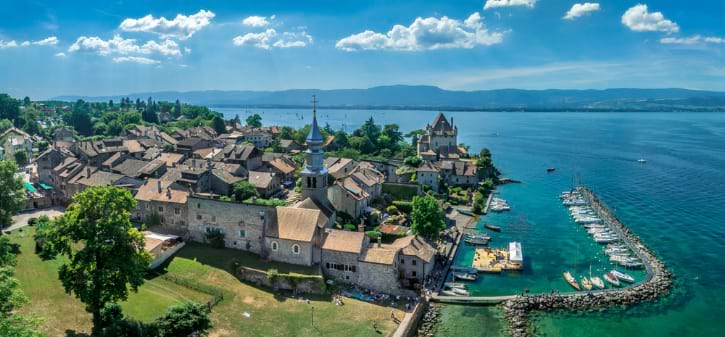
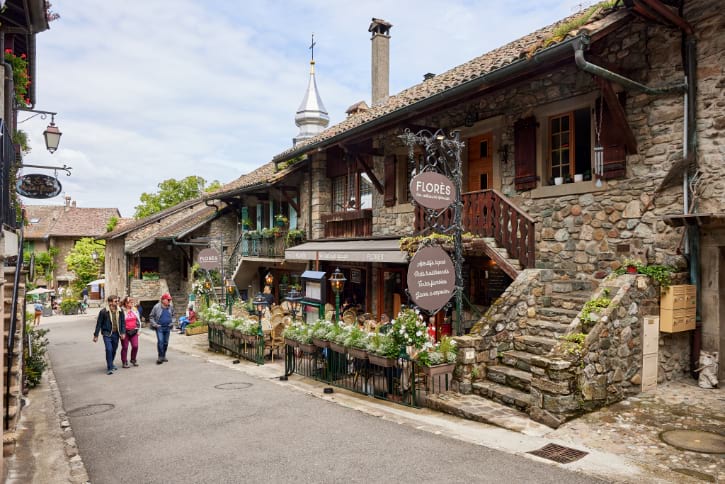
Yvoire sits on a peninsula along the French shore of Lake Geneva. This 14th-century stone fortress is nicknamed the Pearl of Lake Geneva, with medieval walls, small harbors, and award-winning flower displays.
You’ll love Yvoire if you want a romantic medieval village with lake views and easy Geneva access.
Main Things to See
- The medieval stone ramparts and old gates
- Château d’Yvoire at the water’s edge (private, but stunning from outside)
- Saint-Pancrace Church with its onion-dome bell tower
- The peaceful Garden of the Five Senses
- The harbor area for slow walks and lake views
Best Time to Visit
- Late spring to summer: the gardens are in full bloom and boat services run often
- Early autumn: quieter, with soft light and fewer crowds
- Winter: much quieter, with limited boat and garden access
How Much Time You Need
A half-day is enough for the main village and harbor. A full day is better if you want to include the garden, a long lunch, and a boat trip. If you arrive by ferry, plan around the schedule.
How to Get There
Yvoire is easy to reach from several directions:
- By car from Geneva, Thonon-les-Bains, or Évian-les-Bains
- By ferry with CGN from Nyon, Switzerland (about a 20-minute crossing)
- By bus from Thonon-les-Bains on regional line 152
- By boat from other Lake Geneva towns in season
Nearby Places to Pair With It
For a wider Lake Geneva day:
- Thonon-les-Bains and Évian-les-Bains on the French side
- Geneva for a city contrast
- Nyon, Switzerland, for a cross-lake combo (best if you take the ferry)
4. Moustiers-Sainte-Marie, Provence-Alpes-Côte d’Azur
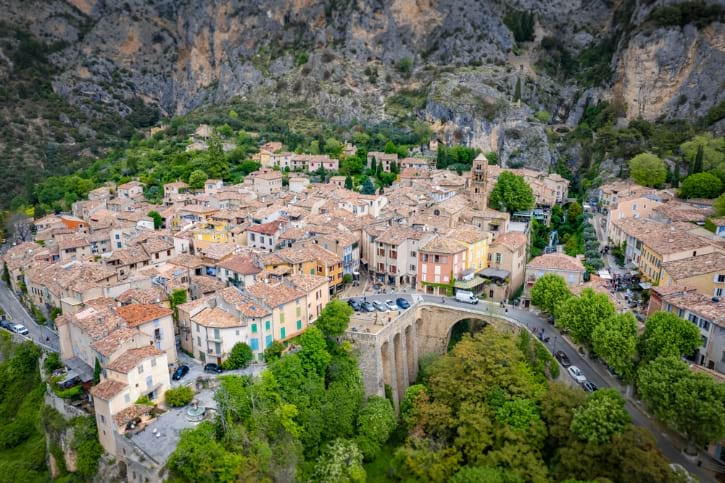
Wedged between two huge limestone cliffs, Moustiers-Sainte-Marie is one of the most dramatic Provençal villages you’ll ever see. A mountain stream flows through the middle, and a legendary gold star hangs from a chain high above the rooftops.
You’ll love Moustiers-Sainte-Marie if you want Provence beauty, dramatic cliffs, and nearby nature in one trip.
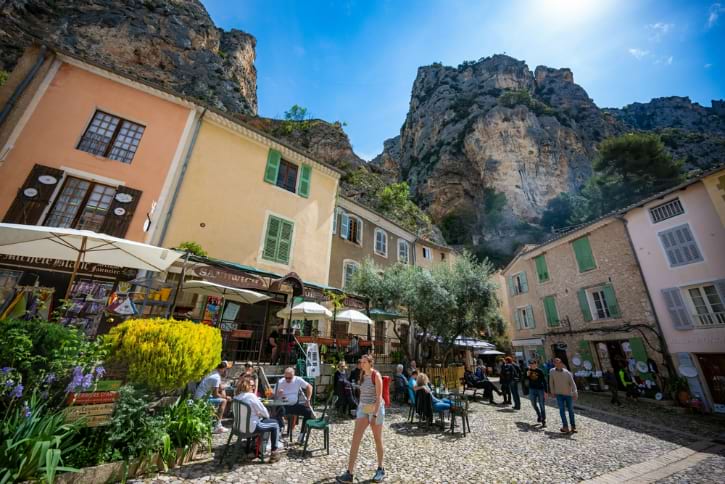
Main Things to See
- The old village center with its stone bridges and fountains
- Chapelle Notre-Dame de Beauvoir, reached by a steep 262-step climb
- The Romanesque parish church with its 22-meter bell tower
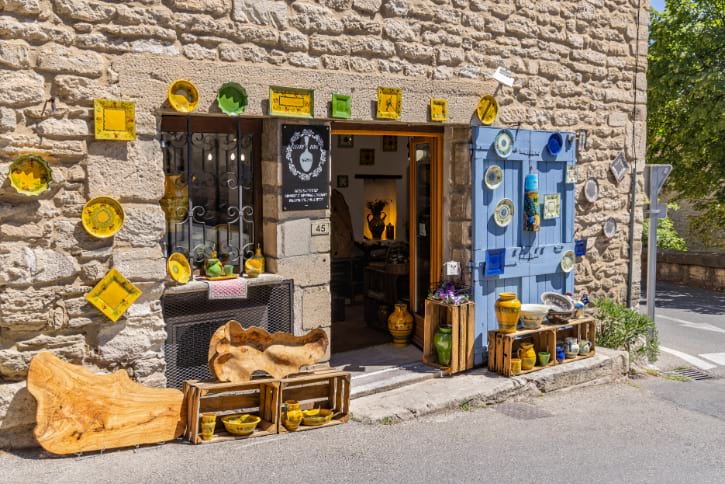
- Traditional ceramic and faïence workshops along the lanes
- The famous suspended gold star above the village
Best Time to Visit
- Late spring to early summer: mild weather and lavender beginning to bloom on the nearby Valensole Plateau
- Early autumn: softer light and smaller crowds
- High summer: beautiful, but very busy due to the lake and gorge
How Much Time You Need
- Half a day is enough for the village itself
- One to two days is better if you want to combine it with Lake Sainte-Croix and the Verdon
- A full canyon trip can easily fill a third day
How to Get There
- By car: the easiest option, via the A51 highway and the D952
- By regional bus: ZOU! lines 450 from Riez
- Seasonal bus links sometimes connect Castellane in summer
- Roads can be narrow and winding, so allow extra time
Nearby Places to Pair With It
Great combinations for a Verdon trip:
- Gorges du Verdon scenic drive
- Lake Sainte-Croix for swimming or kayaking
- Valensole Plateau in lavender season
- Castellane for a longer canyon loop
- Riez for a quieter village stop
5. Gordes, Provence
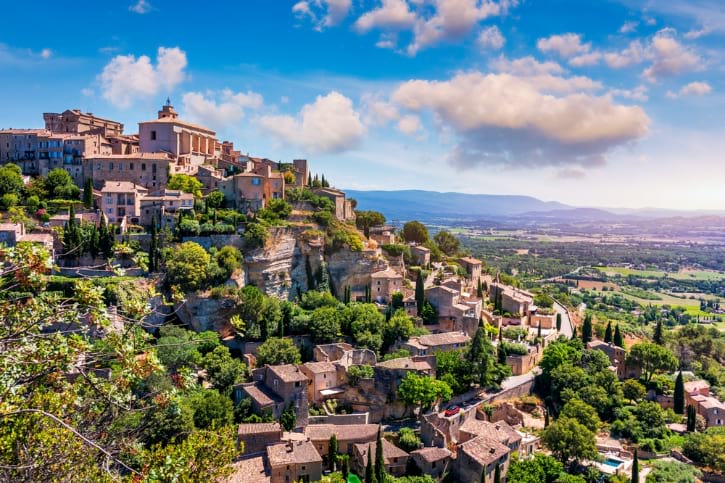
If you’ve ever seen a postcard of Provence with a hilltop village glowing in gold, there’s a good chance it was Gordes. Pale limestone houses climb the cliff in a terraced shape, and the famous approach view is one of the most photographed scenes in France.
You’ll love Gordes if you want the classic postcard Provence experience with golden stone and Luberon views.
Main Things to See
- The medieval Château de Gordes at the top of the village
- The Church of Saint Fermin and underground Caves of the Palais Saint Firmin
- Stone-paved calades winding through the upper lanes
- The classic approach view from the Route de Cavaillon
- The nearby Abbaye de Sénanque, set in a lavender-filled valley
Best Time to Visit
- Spring: mild weather, wildflowers, and quieter lanes
- Early summer: lavender beginning to bloom in the area
- Autumn: golden vineyards and a relaxed atmosphere
- High summer: very busy and hot, especially around the abbey
How Much Time You Need
- A half-day is enough for the village center and the famous viewpoint
- A full day is better if you want to add Sénanque Abbey, a long lunch, and a nearby village or two
How to Get There
- By car: easiest and most flexible option
- By train and bus: TGV to Avignon, regional train to Cavaillon, then bus line 917
- By guided tour: day tours from Avignon and Aix-en-Provence are common
- Public transport works, but a car gives you the freedom to chase viewpoints and abbey light
Nearby Places to Pair With It
Easy and rewarding pairings:
- Village des Bories, the dry-stone hut hamlet just outside Gordes
- Roussillon, famous for its red ochre cliffs
- Bonnieux and Ménerbes, both classic Luberon villages
- L’Isle-sur-la-Sorgue, especially on market days
- Sénanque Abbey, the obvious add-on
6. Conques, Aveyron
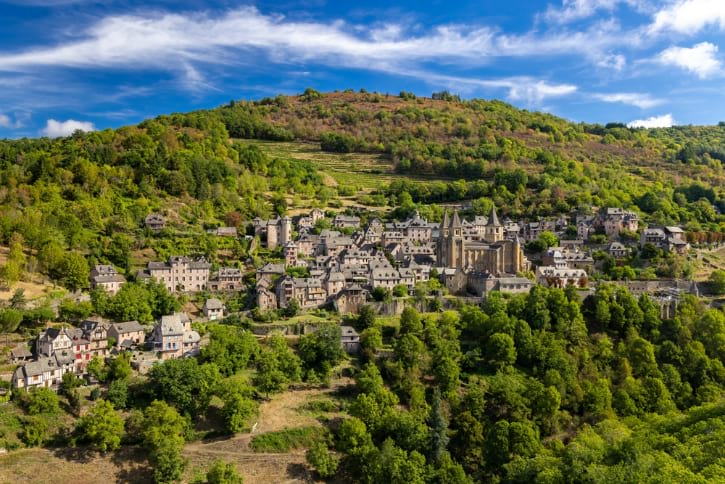
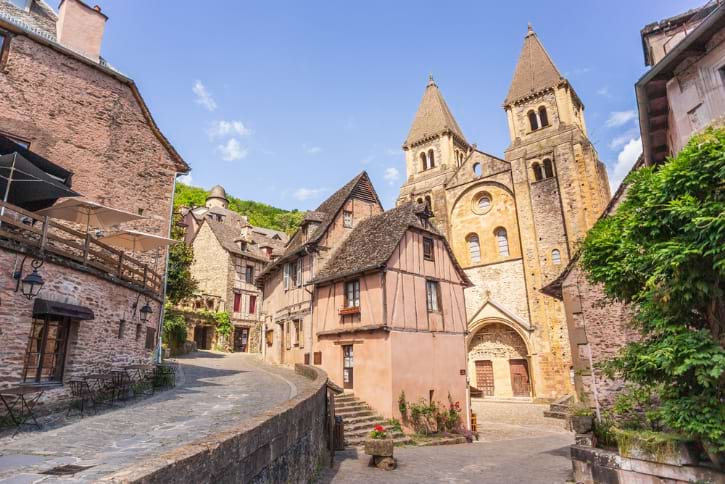
Hidden in a steep wooded valley, Conques is a deeply atmospheric medieval village on the historic Camino de Santiago route. The slate roofs, narrow stone lanes, and quiet spiritual mood give the place a depth that stays with you long after you leave.
You’ll love Conques if you want a medieval village with spiritual, artistic, and historical depth.
Main Things to See
- The 11th-century Abbey Church of Sainte-Foy with its carved Tympanum of the Last Judgment
- The 104 contemporary stained-glass windows by Pierre Soulages
- The treasury with its medieval reliquaries
- The old pilgrims’ bridge over the Dourdou River
- The walk up to the Chapel of Sainte-Foy for the classic panoramic view
The abbey church and pilgrims’ bridge are UNESCO listed as part of the Santiago routes in France, rather than the whole village itself.
Best Time to Visit
- Spring and early autumn: ideal weather for walking and quieter lanes
- Summer: busier with pilgrims and visitors, but warm evenings are lovely
- Quiet mornings and after sunset are the most atmospheric times in any season
How Much Time You Need
- A half-day covers the abbey and the main village walk
- An overnight stay is better if you can manage it, especially to see the abbey at night
How to Get There
- By car: the most practical option, with parking outside the village
- By bus: regional liO bus line 223 from Rodez, running daily between April and October
- Conques is more remote than other villages on this list, so allow extra travel time
Nearby Places to Pair With It
Good options for a wider Aveyron trip:
- Rodez, the regional hub with the Soulages Museum
- Estaing and Belcastel, two more beautiful villages
- Quiet Aveyron countryside drives
- Other heritage stops along the Camino route
7. Saint-Cirq-Lapopie, Occitanie
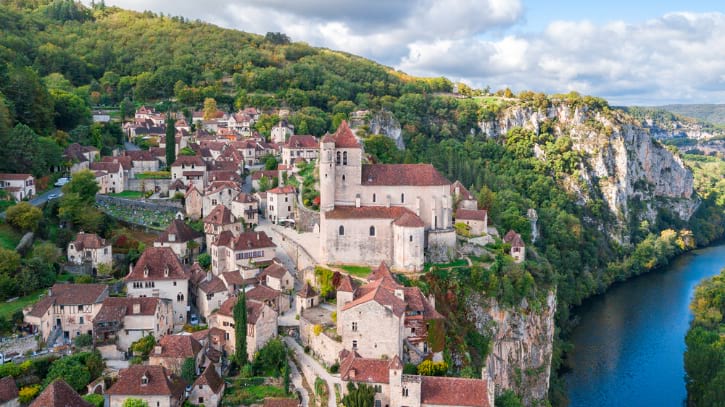
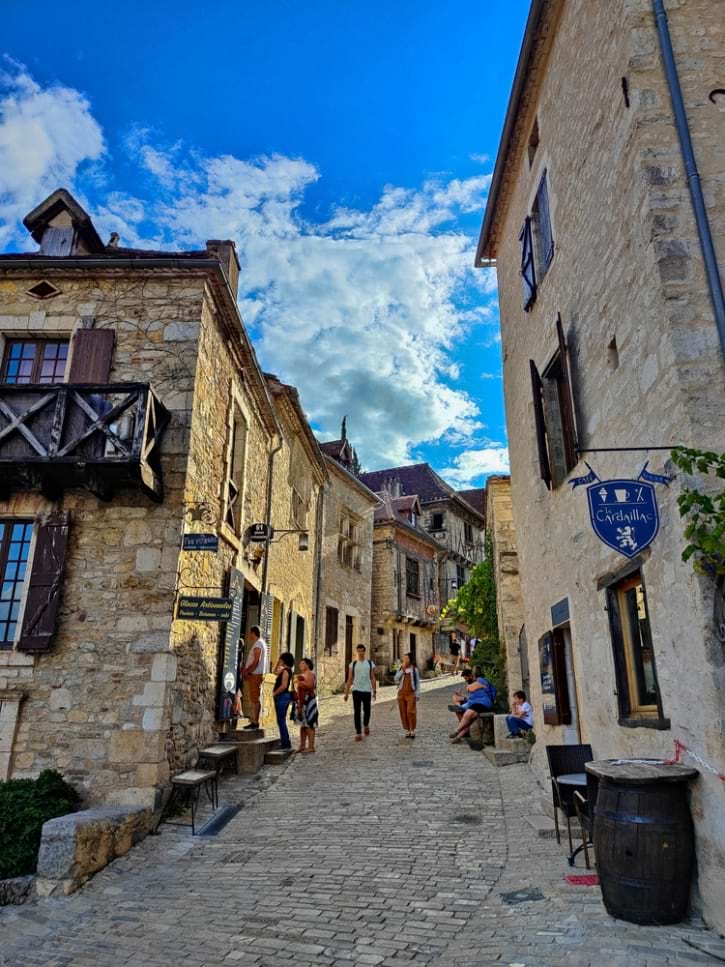
Perched on a sheer cliff about 100 meters above the Lot River, Saint-Cirq-Lapopie offers one of the most dramatic village views in France. Narrow lanes climb the slope, and every viewpoint opens up the valley below.
You’ll love Saint-Cirq-Lapopie if you want one of France’s strongest village-and-river landscapes with a creative soul.
Main Things to See
- The 16th-century Church of Saint-Cirq-et-Sainte-Juliette
- The ruined Lapopies family castle at the very top
- The old town gate, Porte de Rocamadour
- The flat Chemin de Halage towpath carved into the cliff (about 4 km to Bouziès)
- Galleries linked to the village’s surrealist past (André Breton summered here)
Best Time to Visit
- Spring and autumn: ideal for walking, with comfortable temperatures
- Summer: beautiful but hot, and the steep lanes can feel tiring at midday
- Early morning or late afternoon light is best for photos
How Much Time You Need
- A half-day covers the main village and viewpoints
- A full day is better if you want to add the Chemin de Halage walk, a river view, or a short boat ride
- Take time on the climbs, especially in summer heat
How to Get There
- By car: about 35 minutes east of Cahors, the most flexible option
- By boat trip or canoe, paired with the towpath walk, for a really memorable day
- Parking is outside the village, with a walk up into the historic center
Nearby Places to Pair With It
Realistic combinations:
- Bouziès, at the other end of the towpath
- Cahors, for the medieval bridge and city break
- Pech Merle Cave in Cabrerets, with prehistoric paintings
- Figeac, a historic town with a strong character
- Rocamadour, doable as part of a wider Lot itinerary
8. Rocamadour, Lot
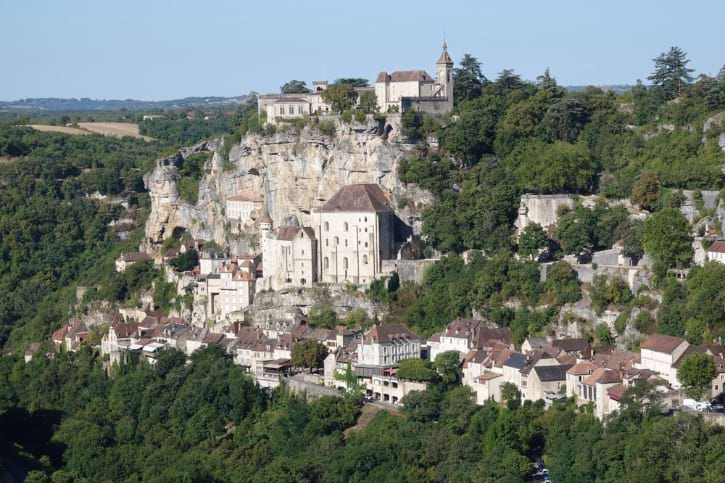
Clinging vertically to a sheer limestone cliff about 150 meters above the Alzou canyon, Rocamadour stops you in your tracks. It’s built in three dramatic levels, with a sacred history that has drawn pilgrims for centuries.
You’ll love Rocamadour if you want a dramatic, spiritual, cliffside village unlike anywhere else in France.
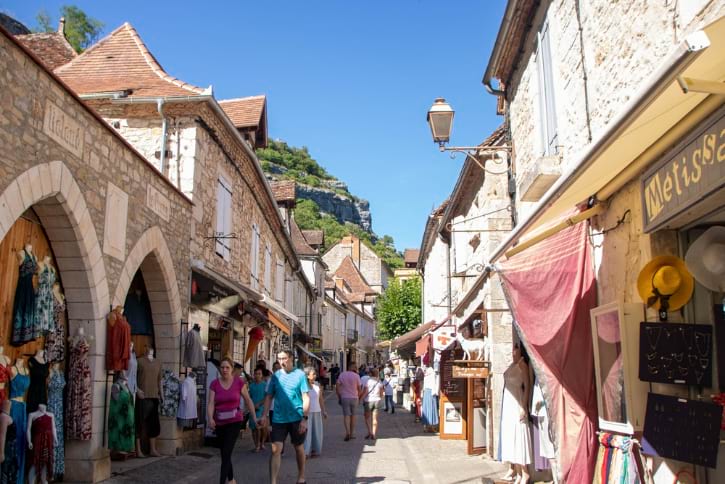
Main Things to See
- The lower village street and historic gates
- The Grand Escalier des Pèlerins, 216 stone steps up to the sanctuaries
- The cluster of chapels and basilicas at the sanctuary level
- The Chapelle Notre-Dame, home of the famous Black Madonna
- The Château de Rocamadour and ramparts at the very top
Best Viewpoints
For the most iconic photos of Rocamadour:
- The hamlet of L’Hospitalet, on the opposite cliff plateau, offers the classic full-village view
- The upper ramparts look out over the canyon
- The approach roads from L’Hospitalet have several pull-offs with great angles
Best Time to Visit
- Spring and early autumn: comfortable weather and easier crowd levels
- Early mornings: the most peaceful time to visit the sanctuaries
- Summer: very busy and often hot, so an early start helps
- Evenings: beautiful soft light on the cliff
How Much Time You Need
- A half-day is enough for the sacred loop and main viewpoints
- A full day is better if you want to add a nearby attraction or longer canyon walks
How to Get There
- By car: the most practical way, with multiple arrival points at different levels
- By regional transport: limited, so a car or guided tour is usually easier
- By guided tour: day tours often combine Rocamadour with nearby sights
- Think carefully about which level you arrive at, because that decides how much climbing you’ll do
Nearby Places to Pair With It
Practical combinations:
- Gouffre de Padirac, a huge underground chasm about 30 minutes away
- Saint-Cirq-Lapopie for a strong village-cliff double day
- Figeac, a historic medieval town
- Souillac, on the way to or from the Dordogne
- Nearby Dordogne Valley villages
9. Beynac-et-Cazenac, Dordogne
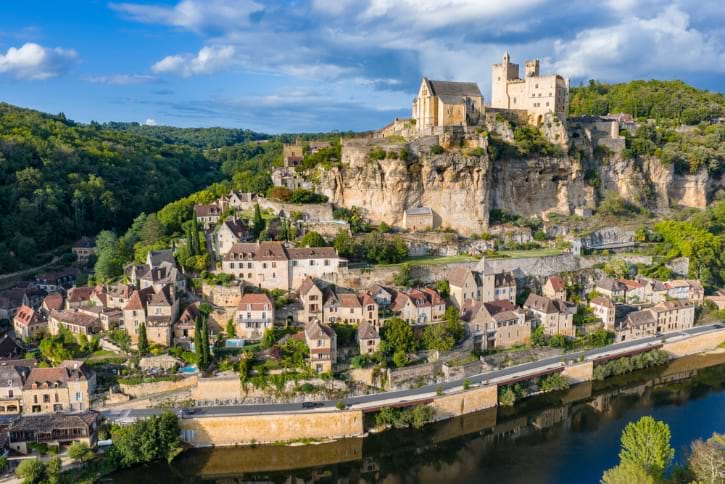
If you’ve ever imagined the perfect Dordogne scene, with a golden castle on a cliff and a quiet river curving below, you’ve basically imagined Beynac.
This classic Périgord village has warm limestone houses, traditional stone roofs, and a powerful medieval castle towering above.
You’ll love Beynac-et-Cazenac if you want a medieval village with a castle, river, and classic Dordogne scenery.
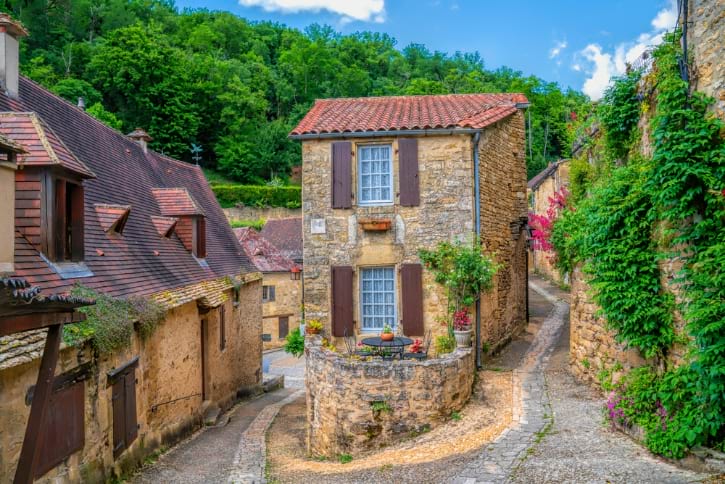
The Castle Above the Village
The 12th-century Château de Beynac is the main heritage anchor of the village.
- Built directly on the cliff edge, with sheer drops on multiple sides
- A key stronghold during the Hundred Years’ War, facing the English-held Château de Castelnaud across the river
- Beautifully preserved, with thick walls, towers, and old halls
- Spectacular views from the ramparts, especially down the river valley
Main Things to See
- The 12th-century Château de Beynac on the clifftop
- The steep main lane climbing from the river to the castle
- The village church with its traditional lauze stone tile roof
- Viewpoints along the path up to the castle
- A relaxing gabarre boat cruise along the Dordogne
Best Time to Visit
- Spring to early autumn: the most enjoyable months for the river and the castle
- Summer: beautiful but very busy
- Late afternoon: the soft, low light on the golden stone is unforgettable
- Autumn: quieter, with golden trees along the riverbanks
How Much Time You Need
- A half-day covers the village and castle
- A full day is better if you want to add a gabarre cruise, a canoe trip, or a nearby village or two
How to Get There
- By car: the most practical option, with parking near the river
- About a 15-minute drive from Sarlat-la-Canéda, the main base for the region
- Public transport is limited in the area, so a rental car is strongly recommended
- Boat trips from Beynac are a fun add-on rather than transport in themselves
Nearby Places to Pair With It
Beynac sits in one of the most village-rich corners of France:
- Sarlat-la-Canéda, an exceptional historic town
- La Roque-Gageac, another cliffside village along the river
- Castelnaud-la-Chapelle, with its own castle facing Beynac
- Domme, a bastide town with sweeping valley views
- Marqueyssac Gardens, famous for their sculpted boxwoods
- Dordogne canoe trips, easy to arrange in season
10. Locronan, Brittany
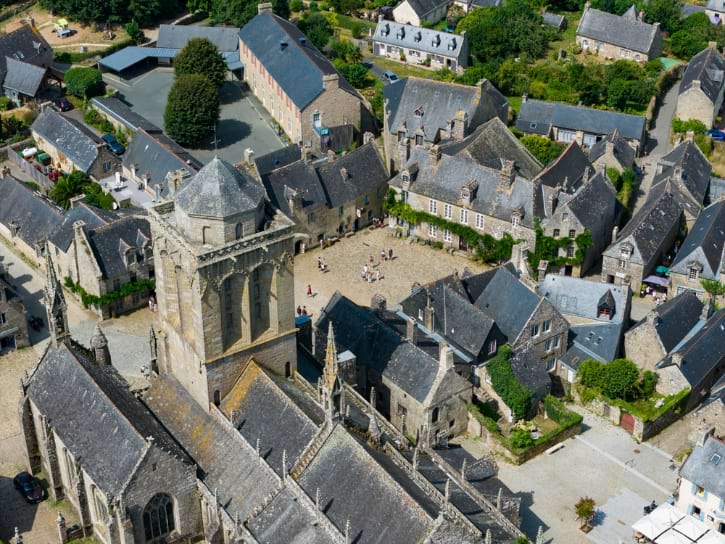
After cliffs, vineyards, and lakeside views, Locronan offers a complete change of mood. This Breton village is built almost entirely of grey-blue granite, with no overhead cables, no antennas, and no traffic lights to break the atmosphere.
You’ll love Locronan if you want a preserved Breton village with granite beauty and a different mood from southern France.
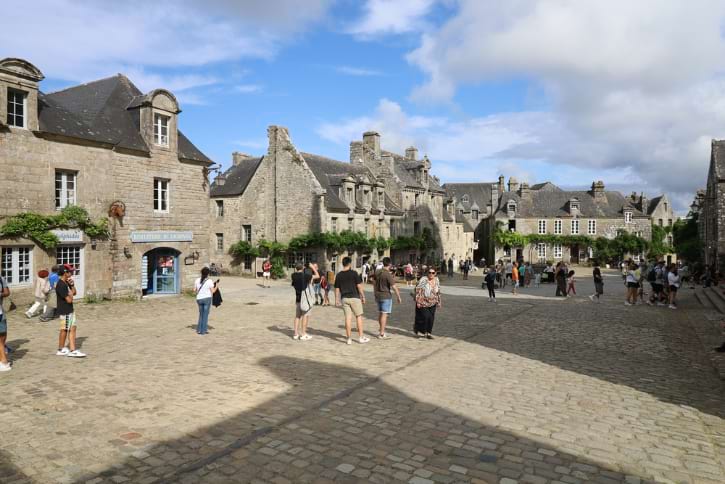
Main Things to See
- The cobbled Place de l’Église with its central stone well
- The 15th-century Flamboyant Gothic Church of Saint-Ronan
- The Penity Chapel holding Saint Ronan’s tomb
- Grand 17th and 18th-century granite manor houses around the square
- Traditional craft shops and galleries linked to the old sailcloth trade
Best Time to Visit
- Spring: mild weather and blooming hydrangeas
- Summer: lively, with longer evenings
- Early autumn: quieter, with soft Breton light
- Quiet evenings: especially magical, when the streets empty and the granite takes on a timeless feel
- Misty, cloudy weather: classic Brittany mood, and arguably the most atmospheric
How Much Time You Need
- Two to four hours is enough for the main village and square
- Half a day is better if you want to enjoy lunch, browse shops, and take time with photography
- A longer visit makes sense if you want to combine with the nearby coast
How to Get There
- By car: about 14 km north of Quimper and 9 km from Douarnenez
- By bus: local QUB bus line 10 from Quimper, around a 30-minute ride
- By tour: plenty of half-day options from Quimper
- Parking is outside the historic center, with a short walk into the village
Nearby Places to Pair With It
For a fuller Brittany day:
- Quimper, with its cathedral and old town
- Douarnenez, a working fishing port
- Pointe du Raz, dramatic Atlantic cliffs and ocean views
- Crozon Peninsula, for wild beaches and coastal hikes
- Other coastal Brittany stops, depending on time
Some of these combinations are realistic for one day, while the Crozon Peninsula deserves its own trip.