Paris does not keep its history in one place. It hides it in plain sight, beneath your feet and inside stone you pass every day.
A single island can hold a medieval church, a royal palace turned prison, and a quiet memorial to the deported.
Each place has been built, damaged, and rebuilt many times over. Knowing those stories changes how you see them, and how you see Paris itself. 😊
1. Notre-Dame Cathedral: Nearly Nine Centuries of Paris History
a. A Cathedral That Keeps Changing
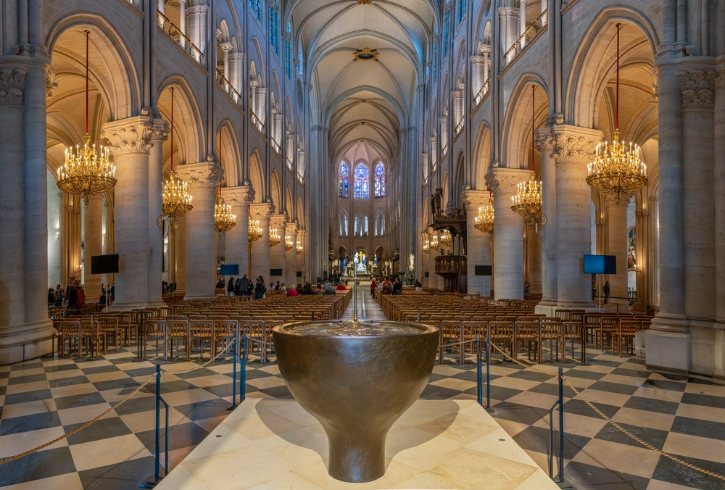
Notre-Dame is best seen as a living building, changed and restored many times rather than frozen in the Middle Ages.
Work began around 1163 under Bishop Maurice de Sully and took nearly two hundred years. During the 1789 Revolution, statues were torn down, roof lead was melted for weapons, and the church was given to revolutionary cults.
Interest revived after Victor Hugo’s 1831 novel, leading to a restoration from 1844 to 1864 under Eugène Viollet-le-Duc. The 2019 fire later destroyed the spire and roof, a heavy loss that fits the same long story of damage and repair. The cathedral has since reopened.
b. Gothic Architecture Worth Noticing
Notre-Dame is a landmark of French Gothic design. A few features reward a slower look:
- The west front, with three deep portals and twin towers about 69 meters
- The tall nave with ribbed vaults
- The flying buttresses outside, which brace the walls so light can pour in.
The spire has changed more than once. The medieval one came down in the late 1700s, Viollet-le-Duc added a new one in the 1800s, and after the fire it was rebuilt with hand-cut oak using traditional tools.
c. Key Figures and the Crown of Thorns
Two men shaped what you see: Maurice de Sully, who began the medieval cathedral, and Eugène Viollet-le-Duc, who led the great restoration.
The cathedral also guards the Crown of Thorns, one of Christianity’s most famous relics, bought by King Louis IX in 1239. Saved from the fire, it now rests in the Treasury.
d. Three Different Visits
The cathedral is really three visits, each with its own rules:
- The main cathedral (nave, choir, restored chapels): free, with an optional free online reservation that helps you skip long queues.
- The Treasury, home to the Crown of Thorns: a separate paid ticket.
- The Towers: you must book a timed ticket online in advance, with no entry without one, and be ready for a hard climb of 424 steps and no elevator.
Read More: 10 Breathtaking Churches in Paris You Can’t Miss
2. Sainte-Chapelle: A Royal Chapel Built for Sacred Relics
a. Why It Was Built
Sainte-Chapelle was built between 1242 and 1248 by King Louis IX, later Saint Louis, inside the royal Palais de la Cité (Palace of the City), as part of his own palace rather than a separate church.
Its purpose was to hold the Passion Relics, above all the Crown of Thorns, bought in 1239 at huge cost. Owning them made Paris look like a sacred center of Christendom and boosted the king’s power.
b. A Chapel on Two Levels
- The lower chapel served the palace staff, guards, and servants.
- The upper chapel was reserved for the king and court, who viewed the relics on a raised shrine.
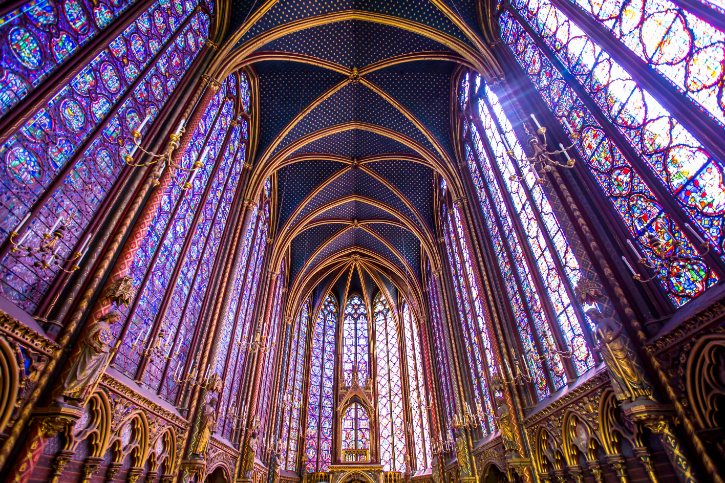
The whole building was designed to look like a giant reliquary, a precious jeweled case turned into architecture.
c. Reading the Stained Glass
The glass is not just beautiful, it tells a story you can follow. The upper chapel has fifteen tall windows with more than a thousand panels, read like a book: Old Testament scenes on one side, the life and Passion of Christ at the far end, and how Louis IX brought the relics to Paris on the other.
This style, Rayonnant Gothic, moves the weight onto slim outer supports so the walls almost dissolve into colored light. A later rose window shows scenes from the Book of Revelation.
d. Where the Relics Are Now
One surprise for visitors: the relics have moved. The Crown of Thorns now rests in the Treasury of Notre-Dame, so you will not see it inside Sainte-Chapelle.
e. Special Attention for Entry
- Book a timed ticket in advance, since inside space is limited and fills up fast.
- Security runs through the neighboring Palais de Justice (Palace of Justice), so allow extra time.
- A combined ticket with the Conciergerie next door pairs two sites from the same royal complex.
- Download the official stained-glass app to name each scene as you look.
Read More: Sainte-Chapelle in Paris: What Most Tourists Miss Inside This Famous Chapel
3. The Conciergerie: From Royal Palace to Revolutionary Prison
a. One Building, Many Lives
The Conciergerie shares its roots with Sainte-Chapelle, both part of the medieval Palais de la Cité. It was the main home of French kings until 1358, when the court moved to the Louvre, then became a place of justice and, in time, a prison.
Its story is about these changing roles, royal hall, courthouse, and jail, not just one famous prisoner.
b. Medieval Halls to Admire
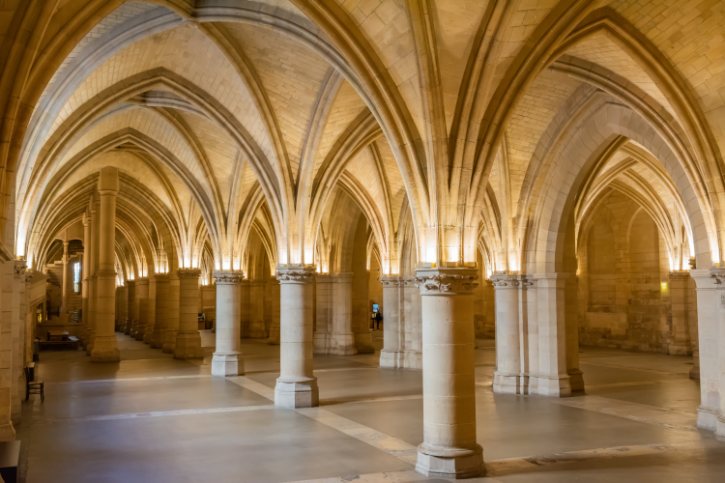
- The Salle des Gens d’Armes (Hall of the Men-at-Arms), a huge vaulted hall built in the early 1300s for the royal guard.
- The Salle des Gardes (Guards’ Room), with carved stone details worth a close look.
- The Cuisines de Saint Louis (Kitchens of Saint Louis), built around 1353, with four giant fireplaces that once fed hundreds.
These rooms best show the royal palace that came before the prison.
c. The Revolution and Marie-Antoinette
The prison’s darkest years came with the Revolution. In 1793 the Revolutionary Tribunal sent thousands to the guillotine, among them Danton, Robespierre, and Queen Marie-Antoinette.
Her original cell is gone. In 1816 a later king turned it into a memorial chapel on the same spot, so what you see is the chapel, not the cell as she knew it.
d. Seeing the Past With HistoPad
Much of the old palace and prison has vanished, so the site lends out HistoPad tablets. Hold one up and it rebuilds the lost royal halls and prison cells over the real stone in front of you, a great way to picture what time has erased.
e. Special Attention for Entry
- Booking ahead is wise, and a combined ticket with Sainte-Chapelle helps if you plan both.
- HistoPad is included with entry.
- The ground-floor halls suit visitors with reduced mobility, but the upper rooms need stairs.
4. The Panthéon: From Church to France’s Temple of Great Figures
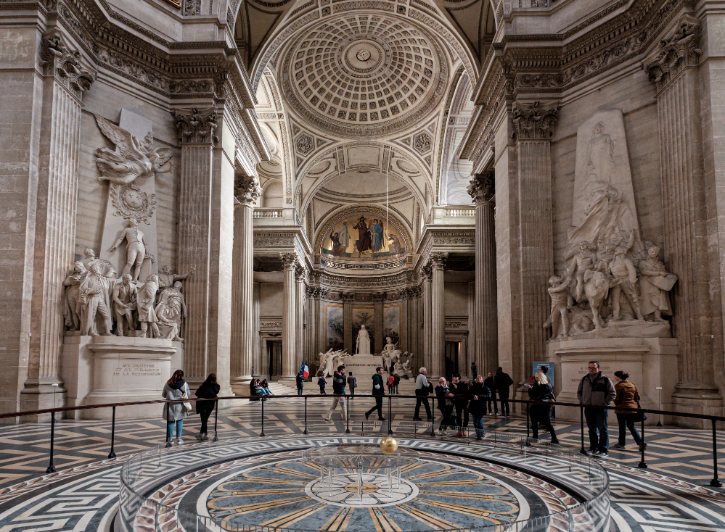
a. A Monument That Changed With France
Few buildings have switched meaning as often as the Panthéon. It began as a church and became a resting place for the nation’s heroes, flipping between the two several times as France argued over religion and the republic.
b. Soufflot’s Grand Design
It started as a royal promise in 1744 to rebuild the church of Sainte-Geneviève, patron saint of Paris. The architect Jacques-Germain Soufflot began work in 1764, blending classical grandeur with Gothic lightness.
He used a columned porch modeled on the ancient Pantheon in Rome and an ambitious triple dome that gives the building its commanding shape. It feels very different from the Gothic churches nearby, all columns and Roman calm.
c. Who Rests in the Crypt
- Victor Hugo and Émile Zola, giants of French literature.
- Marie Curie, the pioneering scientist, buried beside Pierre Curie.
- Jean Jaurès, a leading voice for workers.
- Simone Veil, Holocaust survivor and stateswoman.
- Joséphine Baker, performer and Resistance agent.
Resistance memory is strong here, including a national tribute to the historian and Resistance leader Marc Bloch, honored alongside his wife Simonne Bloch.
d. Foucault’s Pendulum
One of the quietest thrills in Paris hangs under the dome. In 1851 the physicist Léon Foucault swung a long pendulum here, and as it moved, the floor seemed to turn beneath it. That turning was really the Earth itself, the first clear proof of our planet’s rotation. A working pendulum still swings here today.
e. Special Attention for Entry
- The panoramic dome walk and colonnade are closed for restoration, so check first if the rooftop view is your main reason to visit.
- The nave, the pendulum, the sculptures, and the crypt stay open and are the heart of the visit.
5. Les Invalides: Much More Than Napoleon’s Tomb
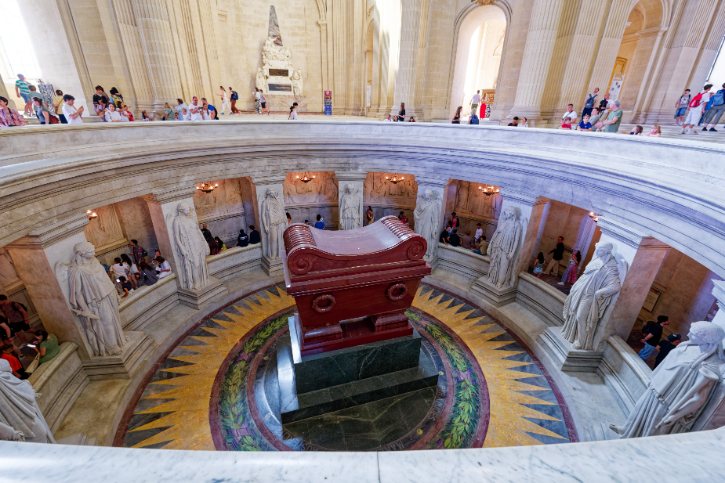
a. Built for Wounded Soldiers
Before it held Napoleon, Les Invalides was built for ordinary soldiers. King Louis XIV founded it in 1670 as a hospital and home for veterans who were wounded, sick, or old.
It ran like a small town, with housing, care, workshops, and worship for thousands. Napoleon’s tomb came much later and is just one layer on top.
b. Two Churches and a Golden Dome
Two architects shaped the complex, set around a vast courtyard.
- The Église des Soldats (Soldiers’ Church) was the plain church for daily worship.
- The Dôme des Invalides, its gilded dome rising about 107 meters and built between 1677 and 1706, was the grand royal chapel.
The huge courtyards and golden dome showed both a duty to the army and the king’s own ambition.
c. Revolution and Napoleon’s Return
Les Invalides helped spark the Revolution. On July 14, 1789, a crowd stormed its cellars and seized tens of thousands of muskets, then used them to attack the Bastille.
Napoleon arrived only in death. In 1840 his remains returned from the island of Saint Helena, and in 1861 they were placed in a crypt built right beneath the dome.
d. The Tomb and the Military Necropolis
The tomb is deliberately grand. Napoleon lies inside a series of nested coffins, in a massive red stone sarcophagus ringed by statues for his campaigns.
He is not alone. The Dôme also holds commanders such as Turenne, Vauban, Foch, and Leclerc, so it honors French military history broadly, not just one emperor.
e. What Else to See and Entry Notes
- The Cour d’Honneur (Court of Honor) and its artillery.
- The world-class Musée de l’Armée (Army Museum).
- The Musée de l’Ordre de la Libération and the Musée des Plans-Reliefs, with historic models of fortified cities.
A short visit can center on the Dôme and Napoleon, while a half day covers the museums too. In the evening, AURA Invalides lights up the dome with sound and light. It needs a separate ticket and enters only through the Place Vauban gate.
Read More: The Best One-Day Walking Route Around Les Invalides and Saint-Germain in Paris
6. Catacombs of Paris: The Dark History Beneath the Streets
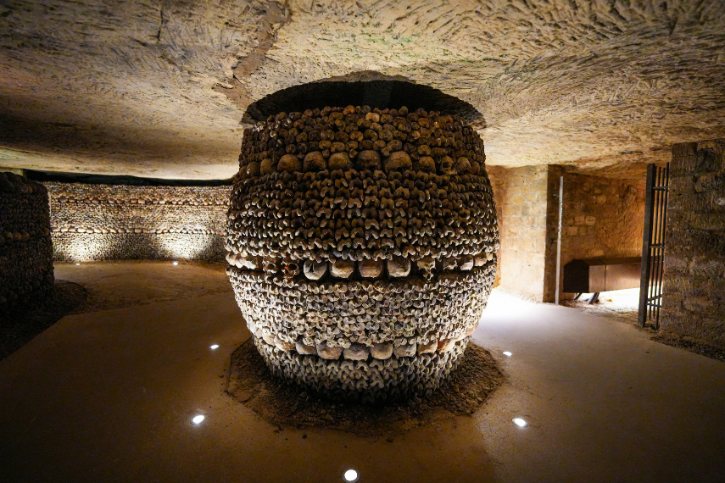
a. Why the Catacombs Exist
The Catacombs are not an ancient city of bones. They are a municipal ossuary, a store of human remains, set inside old limestone quarries.
By the late 1700s the city’s graveyards were dangerously full, so authorities began moving remains into the empty tunnels below.
b. From Graveyard Crisis to Ossuary
The worst case was the old Saints-Innocents cemetery, so packed it was fouling the water and collapsing nearby cellars.
Between 1785 and 1814, the remains of an estimated six to seven million Parisians were moved underground, often at night. Around 1809 to 1810, an official named Héricart de Thury turned the grim store into a place of memory, stacking the bones into neat walls and adding pillars, altars, and carved lines about death.
c. The Quarries Beneath Paris
The tunnels exist because Paris was, in a way, dug out of itself. The ground holds good limestone, quarried since Roman times to build the city above. As the stone came out it left miles of empty galleries, which later held the bones.
d. What You Actually Visit
Know what you are entering. The public Catacombs are a small, legal, controlled route holding the ossuary.
The wider quarry network runs for hundreds of kilometers and stays off-limits, and a normal ticket does not open it. The site has been modernized, with better air flow, lighting, fire safety, and an audio guide, so ignore older sources that still call it closed.
e. Special Attention for Entry
- You must book a timed ticket online in advance. Walk-up entry is not available, so do not just turn up.
- Large bags and suitcases are not allowed, and there is nowhere to store them, so never arrive from the airport or station with luggage.
- The route is one-way, so you do not exit where you entered.
- Expect about 131 steps down and 112 steps up, no elevator, and a cool 14°C below ground.
- The stairs and setting make it a poor fit for limited mobility.
These are the remains of real people, so treat the place with respect rather than as a spooky photo stop.
7. Père Lachaise Cemetery: Where Paris Remembers Its Artists and Rebels
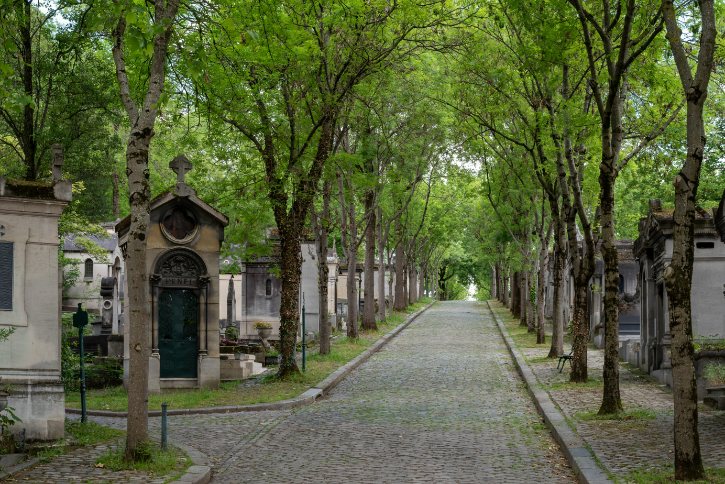
a. More Than a Cemetery
Père Lachaise is a working cemetery, a landscaped park, and an open-air museum of tombs all at once. It opened in 1804 under Napoleon I to replace the crowded, unhealthy churchyards of central Paris, and its garden design felt new for a burial ground.
b. Origins and Landscape
The hill once belonged to François de La Chaise, a Jesuit confessor to Louis XIV, whose name lives on here.
The architect Alexandre-Théodore Brongniart laid out the grounds like a park, using slopes, winding paths, trees, and long views to soften the presence of death.
c. Famous Graves Worth Finding
- Molière and Jean de La Fontaine, moved here early to raise the cemetery’s fame.
- The medieval lovers Héloïse and Abélard, whose sad story drew pilgrims.
- The singer Édith Piaf and the musician Jim Morrison.
- Artists and writers such as Chopin, Balzac, Proust, and Oscar Wilde, whose tomb has a striking winged sphinx.
d. Memory and the Paris Commune
The cemetery also holds one of the rawest sites in Parisian political memory. On May 28, 1871, in the last days of the Paris Commune, defeated fighters were shot against a wall here, remembered today as the Mur des Fédérés (Wall of the Federated). Treat it as a real memorial.
Along the Avenue Circulaire, other monuments remember victims of the Nazi camps and the Resistance.
e. Special Attention for Entry
- Entry is free and no booking is needed.
- The grounds are large, so pick up a free map near the main entrance instead of wandering.
- This is still an active burial ground, so respect funerals and families, and note that not every chapel can be entered.
8. Arc de Triomphe: From Victory Monument to National Memorial
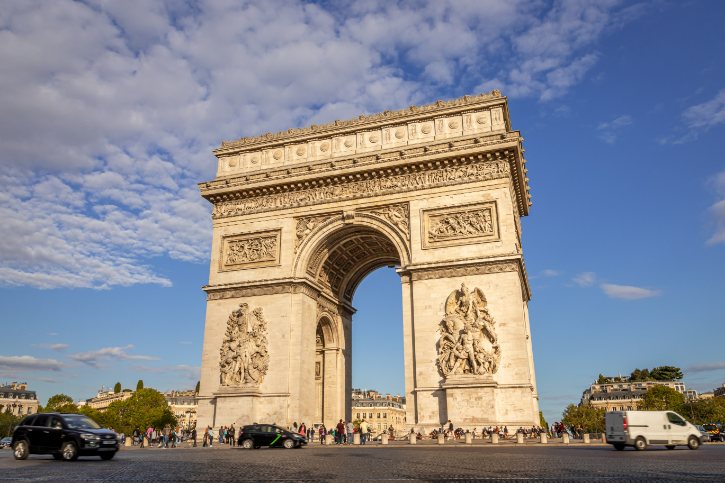
a. From Triumph to Mourning
Napoleon I commissioned the Arc de Triomphe in 1806 to celebrate his army after the victory at Austerlitz. Wars and politics slowed the work, and it was finished only in 1836, long after his fall.
Its meaning changed most when the Tomb of the Unknown Soldier was placed beneath it, turning a victory monument into a place of national mourning.
b. Architecture and Sculpture
The Arc copies the triumphal arches of ancient Rome, scaled up to stand at the head of the Champs-Élysées.
Its most famous carving is La Marseillaise by François Rude, showing Liberty urging French volunteers into battle. Look at the pillars and vaults too, which list hundreds of names and battles from the Revolutionary and Napoleonic wars.
c. The Unknown Soldier and the Flame
After the First World War, France honored its many unidentified dead through one unknown soldier, chosen at Verdun in 1920 and buried under the arch in 1921.
A Flame of Remembrance burns over the tomb and has never gone out. It is rekindled every evening in a public ceremony that anyone can watch.
d. What You Can See From the Top
The upper visit passes the sculptures and exhibition rooms and comes out on the terrace. From there you get one of the best views in the city: straight down the Champs-Élysées, across the twelve avenues that fan out below, and west toward the towers of La Défense.
e. Special Attention for Entry
- The ground plaza, the tomb, and the evening flame ceremony are free, reached by an underpass. Never try to cross the roundabout on foot.
- The terrace needs a paid ticket and a climb of 284 steps.
- The elevator is limited and generally kept for visitors with proven mobility needs, so plan on the stairs.
- National ceremonies can close the monument for a day, so check before a special trip.
Read More: The Perfect Right Bank Walking Route in Paris for One Unforgettable Day
9. Palais Garnier: The Opulent Theater of Second Empire Paris
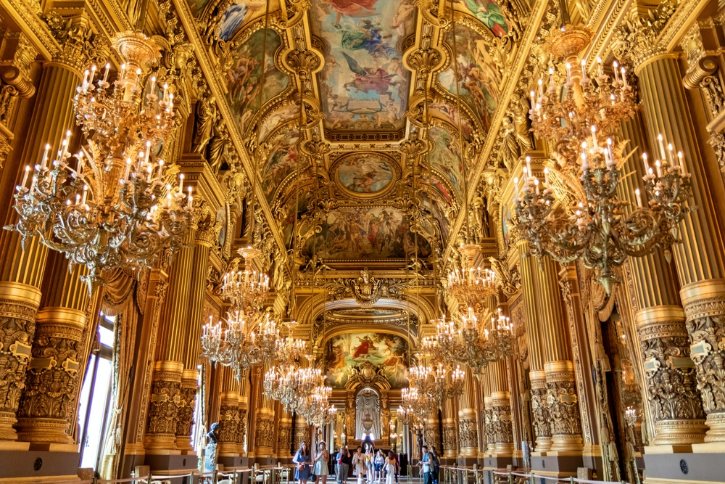
a. A Theater Built for Spectacle
The Palais Garnier was built to dazzle, on stage and off. Emperor Napoleon III launched it, and a public contest was won by a young, little-known architect, Charles Garnier.
The audience was part of the show. The grand staircases and foyers were designed so opera-goers could see one another and be seen.
b. A Long, Interrupted Build
The push for a new opera house came after an attack on Napoleon III outside the old theater in 1858. Building began in 1861 and dragged on through war and upheaval, opening only in 1875.
By then the empire that started it was gone, so a Second Empire project ended up opening under the Third Republic.
c. Rooms Worth Slowing Down For
- The façade, with marble columns, composer busts, and Carpeaux’s sculpture group La Danse (The Dance).
- The Grand Escalier (Grand Staircase), built in marble and onyx as a stage for arriving guests.
- The Grand Foyer, a gilded gallery of mirrors and painted ceilings inspired by Versailles.
- The auditorium, in red velvet and gold under a huge chandelier.
Look up in the auditorium to see a modern ceiling painted by Marc Chagall in 1964, set inside the older gilded room.
d. The Underground Lake Myth
You may have heard of a hidden lake beneath the opera. The truth is plainer. Digging the foundations, Garnier hit a high water table, so he built a concrete water tank under the stage to steady the building.
That tank is still there, anchoring the foundations and feeding water for emergencies. The romantic lake comes from Gaston Leroux’s 1910 novel The Phantom of the Opera, which used the real building but is fiction.
e. Special Attention for Entry
The building is open for self-guided and guided visits, usually covering the façade, the Grand Staircase, the Grand Foyer, and the auditorium.
One honest note: this is a working opera and ballet house. Access to the auditorium and the Chagall ceiling can be blocked by rehearsals or shows, so a ticket lets you tour the building but cannot promise every room on a given day. Booking ahead is still wise.
10. Deportation Martyrs Memorial: A Powerful Place of Memory Behind Notre-Dame
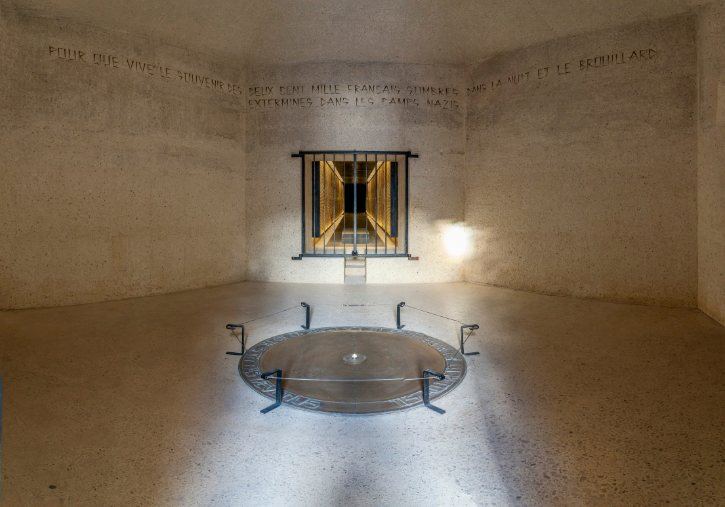
a. A Very Different Kind of Site
After the palaces and grand tombs, this last site feels deliberately different. The Mémorial des Martyrs de la Déportation (Memorial to the Martyrs of the Deportation) works through restraint, not grandeur.
Its underground rooms, narrow passages, and bare concrete are meant to make you feel confinement and loss. It sits just behind Notre-Dame, at the eastern tip of the same island where this guide began.
b. Why It Was Created
The memorial remembers those deported from France during the Second World War. It was designed by the modernist architect Georges-Henri Pingusson and opened in 1962, with President Charles de Gaulle present.
It honors the more than 200,000 people deported from France to Nazi camps, speaking to that whole history rather than one group.
c. A Journey Through Architecture
- You go down a narrow staircase into a sunken courtyard whose high walls cut off the city.
- A narrow gap behind an iron grate gives only a barred glimpse of the Seine and of freedom.
- The crypt holds the Tomb of the Unknown Deportee under an eternal light.
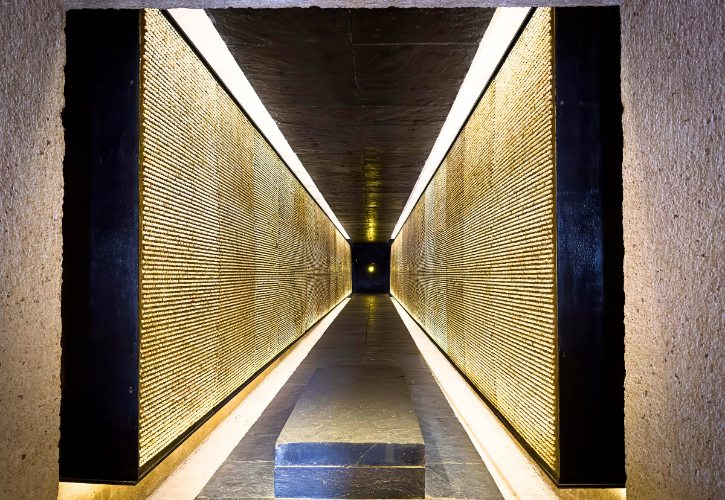
- A dim gallery is lined with 200,000 glass crystals, one for each person deported.
- Wall niches hold urns of soil and ashes brought from the camps.
Instead of towering over you, the space presses in, using light and movement to create remembrance.
d. A Fuller Story Over Time
The memorial has grown in how it explains this history. In 2016 its exhibition rooms were updated with displays on collaboration, persecution, and the wider story of deportation from France, so visitors grasp who was deported and why.
e. Special Attention for Entry
- Entry is free and no booking is needed.
- This is a place to slow down and reflect, not a quick stop.
- Keep a quiet, respectful manner.
- The entrance uses narrow staircases, which limit access for visitors with reduced mobility.