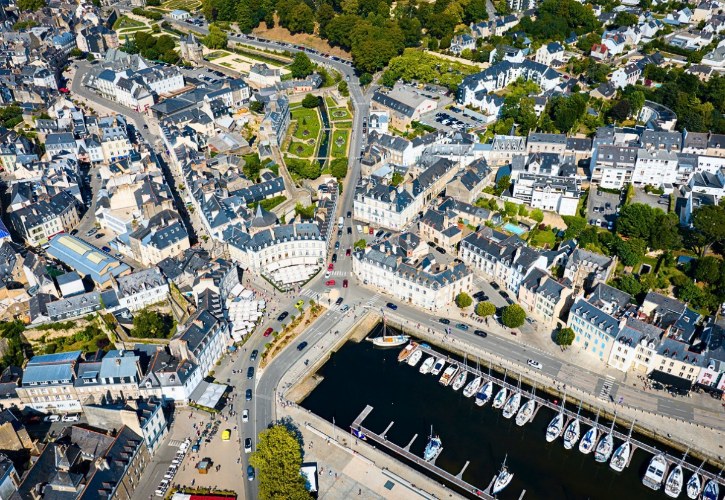
You can cover a lot of Southern Brittany without long hours behind the wheel. In one trip you move from flower-filled medieval villages and ducal castles to wild Atlantic cliffs, ancient stone fields, and lively fishing harbors.
Many of the best stops sit close together, often just 20 to 30 minutes apart. If you love mixing history, coastline, and quiet countryside, this corner of France gives you far more variety than you might expect. 😊
1. Rochefort-en-Terre
a. A Hilltop Village That Feels Like a Postcard
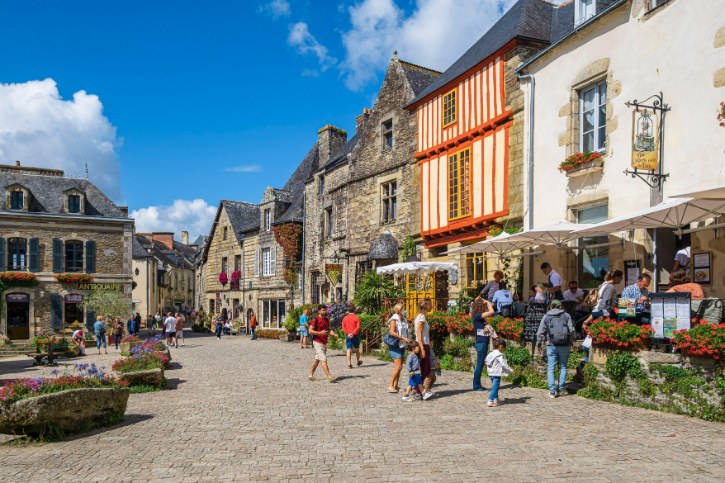
Rochefort-en-Terre makes a wonderful place to begin. It sits high on a schist ridge above the Gueuzon valley, and its look comes from a simple mix:
- Dark local schist stone paired with fine granite.
- Timber framing on the older houses.
- A long tradition of seasonal flowers spilling from windows and walls.
- Cobbled lanes that stay beautifully kept all year.
b. The Honors That Put It on the Map
- One of Les Plus Beaux Villages de France, the country’s most beautiful villages.
- A Petite Cité de Caractère, a label for its heritage and character.
- Voted the Village Préféré des Français, France’s favorite village, in a national vote.
- These honors reward a village core that stays remarkably intact.
c. Streets, Mansions, and the Market Hall
The main pedestrian lane climbs gently between Place Saint-Michel and the château gate, a lovely stretch to wander slowly.
- Grand mansions from the 16th to 18th centuries, with carved corner turrets and dormer windows.
- Les Halles, an open-sided market hall with a distinctive U shape, timber beams, and a slate roof.
- A reminder of the days when the village was a busy inland trading town.
d. The Château and Its Dramatic Past
- The Château de Rochefort-en-Terre was built in the 12th century by the lords of Rochefort.
- It was destroyed three times over the centuries, leaving the curtain walls, ramparts, and a gatehouse.
- In 1907, American painter Alfred Klots bought the ruins and rebuilt a manor using salvaged stone.
- The grounds now belong to the village and open to the public, with terrace walks over the wooded slate hills of Les Grées.
e. Churches, Gates, and Local Crafts
- Collegiate Church of Notre-Dame-de-la-Tronchaye: A blend of Romanesque and Flamboyant Gothic, home to a treasured wooden Virgin Mary said to have been hidden in a tree during Norman raids.
- The calvary: A carved stone calvary in the churchyard shows scenes of the Passion.
- The fortified gates: The Porte Cadre and Porte de l’Étang survive from the old town defenses.
- Artisan shops: Craft workshops, ceramic studios, and galleries fill the streets around the church.
- For families: The nearby Parc de la Préhistoire in Malansac offers an open-air exhibition on prehistoric life.
From this inland hilltop, the route heads southwest toward the coast and the ducal fortress of the Rhuys Peninsula.
2. Domaine de Suscinio (Sarzeau)
a. A Great Castle Between Gulf and Ocean
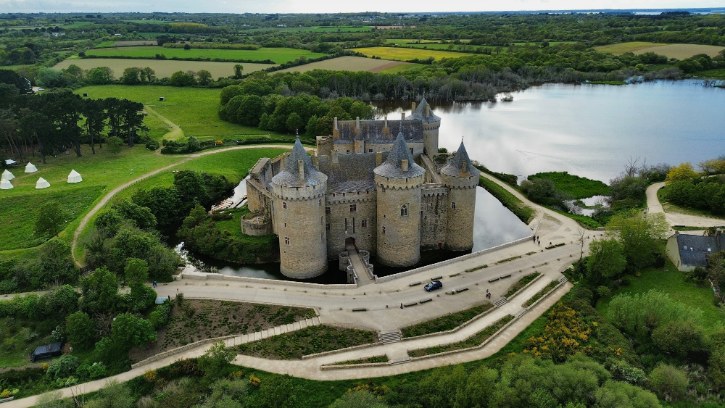
The Domaine de Suscinio is one of the most striking historic sites in Southern Brittany. Its setting is what makes it special:
- In the commune of Sarzeau, on the Rhuys Peninsula.
- Right between the sheltered Gulf of Morbihan and the open Atlantic.
- Once a hunting estate, pleasure retreat, and seat of power for the Dukes of Brittany.
- Never just a fortress, but a true ducal residence.
b. Why Its Profile Stops You in Your Tracks
- Six towers, curtain walls, and a drawbridge give it a bold shape.
- A wide moat wraps around the stone.
- It rises straight from flat marshland, which makes it look all the more dramatic.
- It is one of the clearest examples of 13th- to 15th-century ducal architecture you can visit.
c. Inside the Walls
Step inside and you discover how the Breton dukes once lived. The restored lodgings show off:
- Oak roof framing, large hooded fireplaces, and vaulted guard rooms.
- Private ducal chambers set out as they once were.
- A remarkable 14th-century tile floor, found near the collapsed chapel and pieced back together.
- Heraldic crests and mythical creatures on the tiles, one of Europe’s most important medieval ceramic finds.
d. Views and Wild Marshland
- Climb to the 20-meter tower platform for a wide view across the wetlands to the Atlantic.
- The castle sits inside a protected natural area of reed beds, brackish marshes, and salt ponds.
- These wetlands are nesting grounds for grey herons, little egrets, and migratory birds.
- A footpath winds through the marshes straight to the ocean beach.
e. History You Can Watch Come Alive
Through the seasons, the estate brings its past to life, and it is easy to pair the history with time outdoors:
- Historical demonstrations and living-history displays.
- Summer evening light projections on the castle walls.
- Quiet walks through the surrounding peninsula at your own pace.
From these marshes, the road follows the peninsula westward to Arzon, where the calm gulf meets the restless open sea.
3. Arzon
a. Where Two Seas Come Together
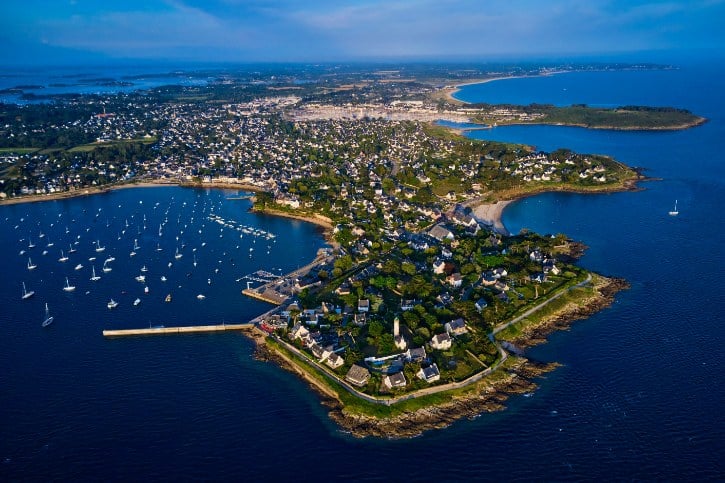
Arzon stands at the far western tip of the Rhuys Peninsula, and its location is the real draw.
- It sits at the narrow mouth of the gulf, between the open Atlantic and the sheltered Gulf of Morbihan.
- At this tight strait, tides rush through at great speed.
- The result is one of the most powerful marine currents in Europe.
b. Port du Crouesty, the Big Marina
- On the Atlantic side, one of the largest marinas on France’s Atlantic coast.
- More than 1,400 berths, busy with yachting, sailing, and major regattas.
- Wide boardwalks lined with ship chandlers, seafood brasseries, and terraces.
- Each autumn it hosts Le Mille Sabords, Europe’s largest trade fair for pre-owned boats.
c. Port-Navalo, the Quieter Harbor
At the northern tip, Port-Navalo keeps the gentler feel of a traditional Breton pilot station, where pilots once set out to guide ships through the gulf.
- Granite cottages and seafood taverns around the water.
- A coastal path up to the green-domed lighthouse on the cliffs.
- Fine views toward the inner islands and the distant shapes of Belle-Île-en-Mer and Houat.
d. Beaches and a Clever Tide Mill
- Plage du Fogeo: A broad crescent of fine sand backed by maritime pines, dunes, and walking paths.
- Moulin de Pen-Castel: A tide mill on the calm gulf side, dating to the late 12th century.
- It once used the rising tide to turn its wheels and grind grain, a lordly mill later held by the Dukes of Brittany.
- The town now runs it as a cultural space, with temporary art exhibitions inside.
e. Oysters, Crêperies, and Island Hops
Oyster farming is central to Arzon’s identity, and it is easy to taste the local life:
- Wooden tasting cabins serving fresh gulf oysters with local cider.
- Crêperies and small waterfront spots to match.
- Passenger ferries from Port-Navalo into the heart of the Morbihan islands.
Leaving the sea air behind, the route curves around the inner gulf toward Vannes.
4. Vannes
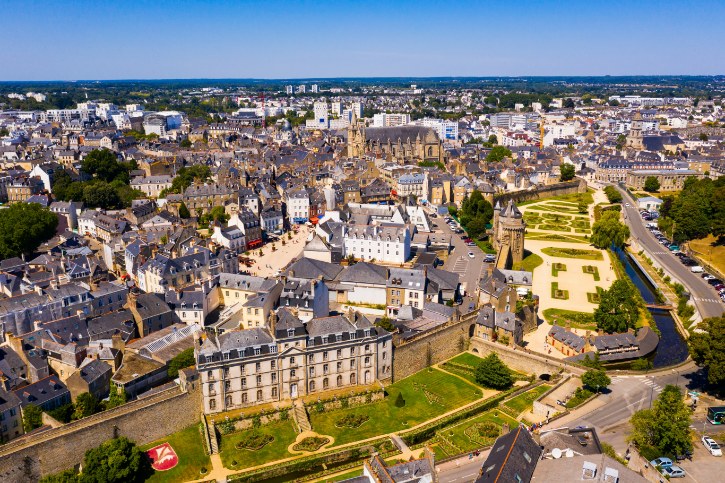
a. A Walled City With a Living Marina
Vannes is one of the most appealing historic cities in Southern Brittany. It brings together strong medieval walls, colorful old streets, and a marina that reaches right into the center. With Roman roots and a later role as a home of the Dukes of Brittany, it keeps about three-quarters of its old wall circuit intact.
b. Ramparts and Garden Views
- The most photographed stretch runs along the eastern ramparts.
- The stone Tour du Connétable looks down over the old moat.
- The former moat now holds the Jardins des Remparts, where neat flower beds meet weathered granite.
- The tree-lined Promenade de la Garenne gives you an elevated view over the towers and slate roofs.
c. Wandering the Old Town
Enter through historic gateways like the Porte Saint-Vincent, and you find a maze of cobbled lanes lined with more than 170 timber-framed houses.
- Place Henri IV: An enclosed square framed by leaning, multi-story half-timbered buildings.
- Vannes et sa femme: A carved relief of a smiling merchant couple set into a corner beam near Rue Noé.
- Saint-Patern district: A quarter just beyond the walls that keeps a village-like feel, with artisan workshops and bistros.
d. The Cathedral and Its Treasures
- Cathédrale Saint-Pierre mixes Romanesque foundations with a Flamboyant Gothic nave.
- Its most unusual feature is a round Renaissance rotunda.
- The rotunda holds the tomb of Saint Vincent Ferrer.
- The Saint-Patern church was a historic stop on the medieval Tro Breiz pilgrimage.
e. Markets, Marina, and Extra Stops
Down by the water, the marina brings pleasure boats and tree-shaded quays right into town, with cafés along the edge and food shops nearby.
- Château Gaillard: An early 15th-century granite mansion that once housed the Parlement of Brittany and later regional history collections.
- Conleau Peninsula: A short extension south, with a pine-fringed headland and a sea-fed swimming pool over the gulf.
From here, the road heads west to the intimate riverside port of Saint-Goustan.
5. Saint-Goustan (Auray)
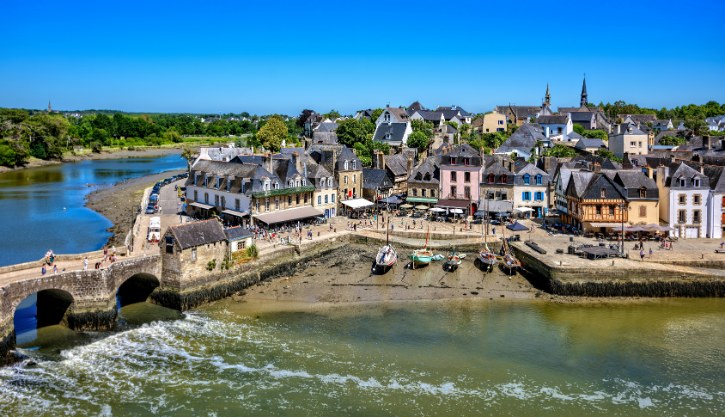
a. The Old Port of Auray
A quick point to clear up: Saint-Goustan is the historic port district of the town of Auray, not a separate town. It sits in a sheltered tidal valley where the River Loch meets the Auray River, which kept it safe from ocean storms and well preserved.
b. A Harbor Built on Trade
- In its heyday, boats brought wine from Bordeaux, salt from Guérande, timber, and grain to its slipways.
- The four-arch Pont de Saint-Goustan has crossed the River Loch since the 13th century, rebuilt in the 15th.
- Its pointed cutwaters split the current, and crossing it once meant paying a toll to the dukes.
- At low tide, wooden boats rest on the mud, then float upright again as the sea returns.
c. Place Saint-Sauveur and the Climbing Lanes
- Place Saint-Sauveur: A cobbled square that slopes gently to the water.
- Timber-framed merchant houses with jettied upper floors and slate-hung façades.
- Crêperies and bistros spilling onto the cobblestones.
- Steep lanes like Rue du Château climbing to the upper town, with views back over the bridge.
d. A Surprising Slice of History
- On December 3, 1776, an American ship carried Benjamin Franklin up the Auray River.
- He was on a secret mission to seek French support for the American Revolution.
- Blown off course from Nantes, he stepped ashore at the quay now named Quai Benjamin Franklin.
- It is a small harbor with an outsized place in international history.
e. A Calmer Kind of Port
Compared with the larger marinas of Vannes or Port du Crouesty, Saint-Goustan feels small, quiet, and beautifully preserved. It is a lovely place to linger over a coffee by the water. If you are drawn to religious heritage, the pilgrimage sanctuary of Sainte-Anne-d’Auray sits just a short drive inland.
From here, the journey steps far back in time, toward the prehistoric stones of Carnac.
6. Carnac
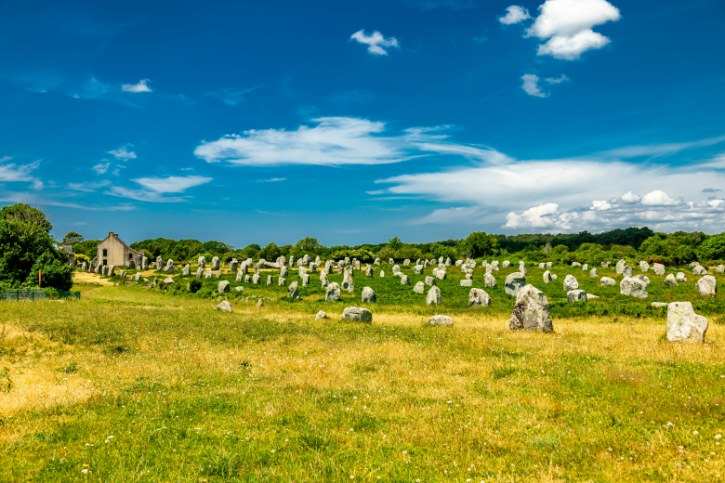
a. Standing Stones Older Than the Pyramids
Carnac is one of the most fascinating stops on the whole trip. It is famous worldwide for its Neolithic alignments, rows of standing stones older than both Stonehenge and the Egyptian pyramids. In total there are more than 3,000 menhirs, raised by early farming communities between 4500 and 3300 BCE.
b. The Three Great Stone Fields
- Le Ménec: Around 1,050 stones in eleven rows, ending in a curved stone enclosure.
- Kermario: The most monumental group, with 982 stones in ten rows, crossing an ancient dolmen tomb.
- Kerlescan: 555 stones in thirteen rows, with a well-preserved rectangular enclosure.
- Nearby stand the six-meter Giant of Manio and the Tumulus Saint-Michel, a huge burial mound.
c. Myth, Evidence, and the Museum
- Old folklore claimed the stones were a Roman army turned to stone by a local saint.
- Archaeologists see them as monumental architecture, ceremonial paths, and ritual spaces.
- It helps to keep that line between legend and evidence in mind.
- The Musée de Préhistoire in town holds jadeite axe heads, ancient pottery, and other finds that make the stones make sense.
d. How You Visit the Alignments
- To protect the fragile ground, the main stone fields are fenced off.
- In the busy season you can go inside only on a guided visit; in the quieter months access inside is free.
- An open perimeter path lets you view the alignments year-round.
- The outer paths still give you a strong sense of their scale and setting.
e. The Seaside Side of Carnac
By contrast, Carnac-Plage grew into a classic seaside resort and feels worlds away from the ancient stones.
- Grande Plage: A two-kilometer sweep of pale sand, backed by pines and elegant villas.
- Church of Saint-Cornély: An ornate granite porch and painted wooden vaulting in the old village center.
- Anse du Pô: Tidal mudflats west of the center that support a traditional oyster trade.
From here, the route heads south to the wilder shores of the Quiberon Peninsula.
7. Quiberon Peninsula
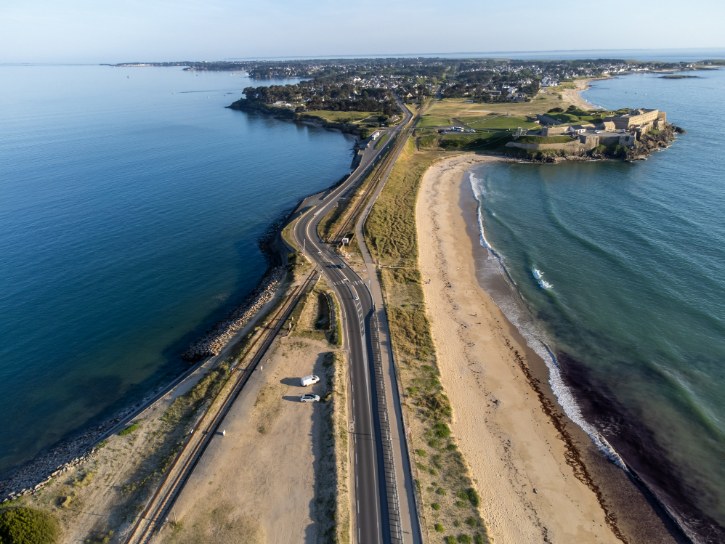
a. A Thin Finger of Land in the Sea
The Quiberon Peninsula serves up some of the most dramatic coastal scenery in Southern Brittany. It reaches about fourteen kilometers into the Atlantic and joins the mainland by a slim strip of land, barely twenty-two meters across at its narrowest point. Picture it in two halves: the exposed western shore, and the calmer eastern coast facing the bay.
b. The Wild Coast
- The Côte Sauvage runs for eight to ten kilometers of granite cliffs shaped by Atlantic storms.
- It is full of sea arches, crevices, and wave-cut chasms.
- The Arche de Port-Blanc is a natural sea arch you can reach at low tide.
- Important safety note: Swimming is strictly forbidden here because of powerful undertows and rogue waves, so stay on the marked paths.
c. A Castle on the Cliffs
- Château Turpault stands at the southern end of the cliffs, built in 1904.
- This Anglo-medieval granite manor has turrets, battlements, and steep slate roofs built for ocean gales.
- It is privately owned and not open to visitors, but you can admire it from the coastal paths.
- Further along, Pointe de Beg-er-Goalennec opens wide views toward Belle-Île-en-Mer.
d. The Town of Quiberon
- Grande Plage: A broad, south-facing beach with a lively promenade of cafés and sweet shops.
- Local treats include fruit lollipops called niniches and salted butter caramels.
- Port-Maria was once a major sardine landing center and still works as an active fishing harbor.
- Historic canneries such as La Belle-Iloise, founded in 1932, keep the tradition alive.
e. Islands and Quiet Corners
- Quiberon’s port is the main gateway to the nearby islands.
- Ferries run to Belle-Île-en-Mer, Houat, and Hoëdic.
- Small hamlets with traditional Breton houses sit beyond the resort.
- These quieter landscapes add to the peninsula’s charm.
From the open ocean, the route crosses back inland to the calm waters of the Ria d’Étel.
8. Saint-Cado Island
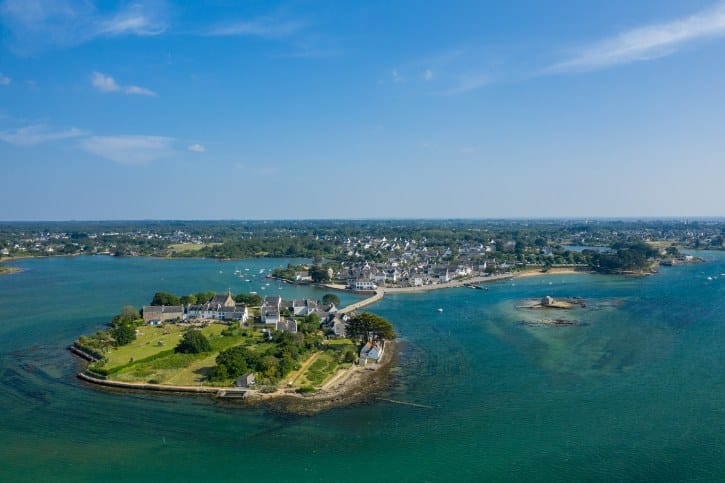
a. A Calm Islet After the Wild Coast
Saint-Cado is one of the most peaceful and photographed spots in Southern Brittany. Picture a tiny island village of stone cottages, an old chapel, and still water all around. It sits in the commune of Belz, within the tidal estuary called the Ria d’Étel, a world of quiet channels, salt marshes, and wide tidal flats.
b. Crossing to the Village
- A short stone causeway connects the island to the mainland.
- To keep the village calm, cars stay on the mainland and you cross on foot.
- The islet is small enough to walk around in under an hour.
- The loop gives you ever-changing views over the shifting waters.
c. The Chapel and the Cottages
- Chapel of Saint-Cado: Founded in the 12th century by Benedictine monks, with a simple Romanesque nave and carved portal.
- Inside is the “bed of Saint Cado”, an ancient stone slab pilgrims once visited hoping to cure hearing problems.
- A granite calvary rises above the village roofs.
- Traditional fishermen’s cottages cluster around the chapel, with whitewashed walls and blue shutters.
d. The Famous Little House
- Across the water to the east sits a small stone house with blue shutters.
- It stands not on Saint-Cado itself but on the tiny neighboring islet of Nichtarguer.
- It was built in 1894 for an oyster farm guard.
- At high tide it seems to float, and at low tide it perches above the sand, one of the most recognizable scenes in Morbihan.
e. Tides, Oysters, and a Good Legend
Daily life here is tied to oyster farming, and the quiet mudflats attract egrets, curlews, and grey herons. There is a fine story too. Local legend says Saint Cado made a deal with the Devil to build the causeway overnight, then outwitted him at dawn by sending a black cat across first. Just folklore, of course, but it suits the place.
From here, the route crosses into Finistère and the river town of Quimperlé.
9. Quimperlé
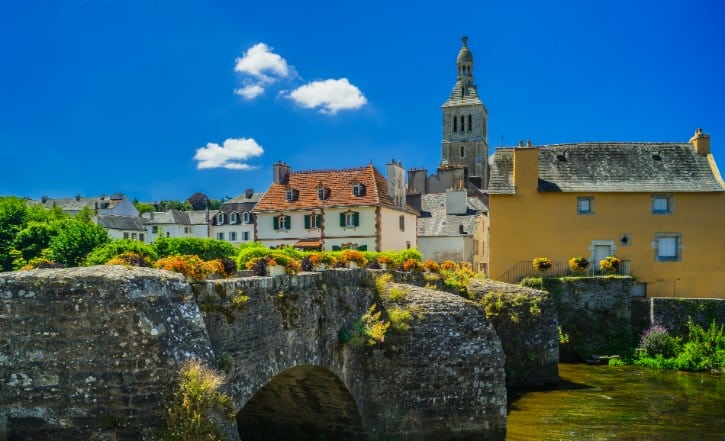
a. A Town Shaped by Its Rivers
Quimperlé is an underrated gem in southern Finistère. Its name means “confluence of the Ellé” in Breton, and water runs through its whole character. The Ellé and Isole rivers join here to form the tidal Laïta, splitting the town into a riverside lower town and an elevated upper town.
b. A Rare Round Church
- The lower town grew around the Abbaye Sainte-Croix, founded in the 11th century.
- Its abbey church is special for its circular, rotunda-shaped plan.
- The design is modeled on the Church of the Holy Sepulchre in Jerusalem.
- A round nave ringed by carved columns leads down to an 11th-century crypt.
c. Lanes, Bridges, and Market Life
- Pont Fleuri: A medieval stone bridge over the Isole, decorated with flower boxes.
- It frames pretty views of timber-framed houses and the abbey tower.
- Maison des Archers: A four-story half-timbered townhouse with a spiral stone staircase.
- The covered market hall hosts weekly markets with regional treats like flat oysters and local cider.
d. Climbing to the Upper Town
- Steep stone alleys and stairways lead up the hillside to the Haute-Ville.
- This was the town’s old administrative and military heart.
- The Church of Notre-Dame-de-l’Assomption is a Gothic building with a square battlemented tower.
- The former Ursuline Convent keeps a 17th-century chapel and cloister, now used for contemporary art.
With its quiet squares and valley viewpoints, Quimperlé offers a calm change from the busy coastal resorts. From here, the road heads west to Pont-Aven.
10. Pont-Aven
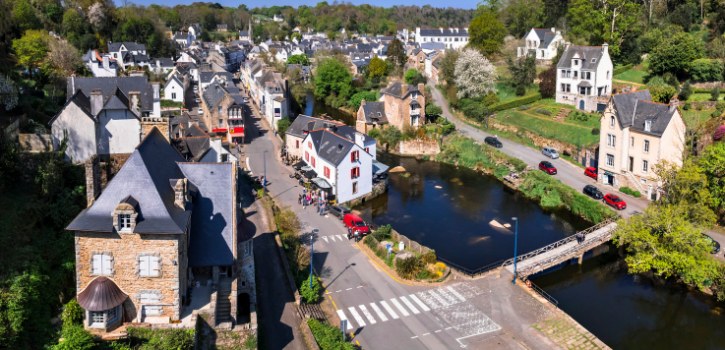
a. The River Town That Inspired Painters
Pont-Aven is a true charmer. Set where the freshwater Aven meets the tidal estuary, this small town grew from a busy milling center into an international artists’ colony. An old Breton saying summed it up as a town of renown, with fourteen mills and fifteen houses.
b. The River and the Old Mills
- The River Aven shapes the town’s whole character.
- Upstream, the water rushes through a “granite chaos” of large, rounded boulders.
- That flowing energy once powered watermills grinding wheat and rye.
- Several mills survive today as restaurants and galleries, with turning waterwheels and stone channels.
c. The Birth of a Painting Movement
- In the 1880s, the town drew artists led by Paul Gauguin and Émile Bernard.
- They worked alongside Paul Sérusier and Maxime Maufra.
- Together they moved beyond Impressionism, using bold outlines, flat color, and Breton subjects.
- Many gathered at the humble Pension Gloanec, where the owner accepted paintings in place of rent.
d. Museums, Chapels, and Shady Walks
- Musée de Pont-Aven: Tells the story of the Pont-Aven School and the movements it sparked.
- Bois d’Amour: A shaded forest path along the Aven, tied to Gauguin’s famous advice to paint with pure color.
- Chapelle de Trémalo: Holds the rustic wooden crucifix that inspired Gauguin’s The Yellow Christ.
- Promenade Xavier Grall: A riverside path with footbridges, old washhouses, and flowering water gardens.
e. Galleries and a Famous Biscuit
Beyond the art history, Pont-Aven is simply a lovely place to stroll, and its creative spirit lives on in more than sixty galleries and studios. Be sure to try the town’s specialty, the galette de Pont-Aven, a crisp pure-butter biscuit made by local bakeries since the late 19th century.
From these riverside paths, the journey returns to the coast and the fortified town of Concarneau.
11. Concarneau
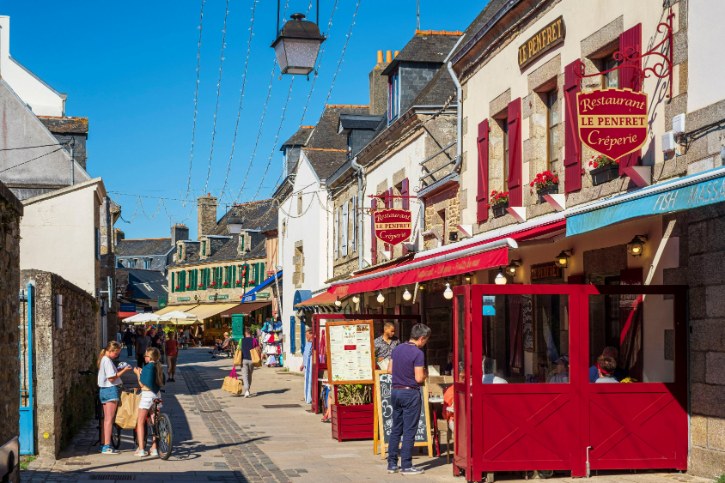
a. A Walled Island Inside a Harbor
Concarneau is one of the most memorable coastal stops of the trip. Its star attraction is the Ville-Close, a fortified island citadel enclosed by stone ramparts, sitting right inside the natural harbor. The island measures about 350 meters by 100 meters and was chosen in the Middle Ages for its natural defenses.
b. Walls Shaped by Vauban
- Building of the walls began during the 14th-century War of the Breton Succession.
- Between 1680 and 1694, the royal architect Vauban modernized the defenses for artillery, adding a half-moon fort and a drawbridge over the moat.
- The clock tower over the main gate, known as Le Beffroi, came much later, in the early 20th century.
- You reach the walled island on foot, crossing a bridge to the main gate.
c. Life Within the Ramparts
- Rue Vauban: The cobbled main street, lined with granite and half-timbered houses.
- Artisan shops and seafood restaurants fill the storefronts.
- Narrow side lanes lead to quiet courtyards and staircases up to the walls.
- Walking the ramparts gives you fine views over the harbor and the trawler moorings.
d. A Living Fishing Town
- Musée de la Pêche: France’s first fishing museum, set in an old chapel and arsenal.
- It covers the history of ocean fishing, boatbuilding, and fish preservation.
- The Hémérica, a steel side-trawler from 1957, is moored at the quay and open to board.
- The port still lands tuna and whitefish, sold at lively morning auctions.
e. Beaches, a Château, and a Festival
- Plage des Sables Blancs: A sheltered beach of fine white sand north of the center.
- Château de Kériolet: A Neo-Gothic palace built for a Russian princess, blending French, Breton, and Russian styles.
- Festival des Filets Bleus: A maritime festival each August, with Celtic music, bagpipe bands, and costumes.
From the ramparts and harbor, the road leads northwest to Quimper, where the journey comes to a fitting close.
12. Quimper
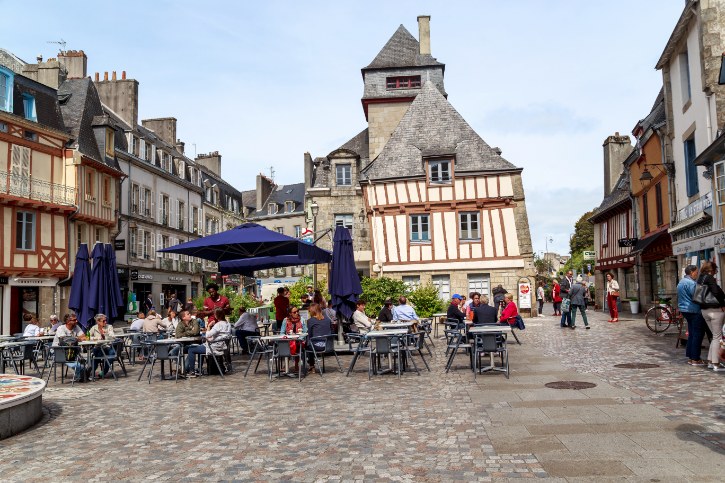
a. The Cultural Capital of Cornouaille
Quimper makes an ideal final stop. As the historic capital of Cornouaille, it brings together a grand cathedral, beautiful medieval streets, and proud Breton traditions. Set in a valley framed by wooded hills, it takes its name from the meeting of the Steïr and Odet rivers, with flower-decorated bridges linking the shopping streets and the old town.
b. A Cathedral With a Famous Bend
- The Cathédrale Saint-Corentin is a masterpiece of Breton Gothic, begun in 1239.
- Its twin stone spires rise more than 75 meters above the city.
- The choir leans about ten degrees from the nave, a quirk explained by unstable ground and older foundations.
- Inside you find centuries-old stained glass, restored stone vaulting, and painted chapel frescoes.
c. Wandering Vieux Quimper
- Vieux Quimper: A pedestrian-friendly maze of cobbled streets around the cathedral.
- Half-timbered houses from the 14th to 17th centuries line streets like Rue Kéréon.
- Place au Beurre, or Butter Square, is the food heart of the district.
- Traditional crêperies there serve buckwheat galettes with local cider.
d. Museums Worth Your Time
- Musée Départemental Breton: Set in the former Bishop’s Palace, with regional archaeology, carved furniture, and traditional costumes.
- Musée des Beaux-Arts: Home to European master paintings and a gallery devoted to the Pont-Aven School.
- Together they connect the threads of history and art you have seen along the way.
e. The Craft of Quimper Faïence
- Downstream along the Odet lies Locmaria, the city’s original settlement.
- It is the birthplace of Quimper’s famous faïence pottery, a craft that began here in 1690.
- You can visit the Musée de la Faïence and tour the working HB-Henriot workshops.
- Locmaria also keeps the 11th-century Church of Notre-Dame de Locmaria, an early Romanesque monument.
Quimper is a fitting finale. It pulls together everything you have seen: the stone craft of Rochefort-en-Terre, the coastal fortresses of Suscinio and Concarneau, the tidal scenes of Arzon and Saint-Cado, and the artistic spirit of Pont-Aven.
By car, Southern Brittany gives you flower-filled villages, ducal castles, wild Atlantic coasts, prehistoric monuments, pretty harbors, and beautiful cities, all within easy reach of one another. Few road trips offer this much variety in so little driving, and that is exactly why this region is so easy to love.