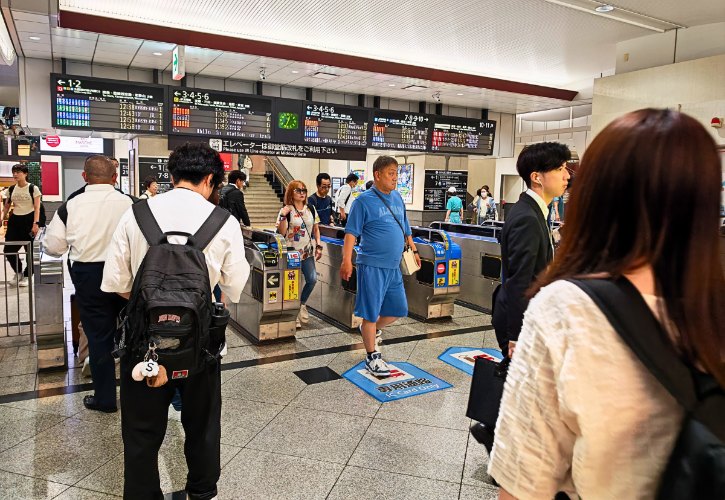
Osaka and Kyoto are two of the easiest and most rewarding places you can travel. The trains run on time, people are kind, and the food is worth the flight on its own.
Still, a few things catch visitors off guard. Busy transport, crowded streets, local rules, and seasonal weather can turn a smooth day into a stressful one.
A little preparation saves you missed trains, surprise costs, and wasted hours. Here is what to watch for. 😊
1. Shin-Osaka vs. Osaka Station: Do Not Confuse Them
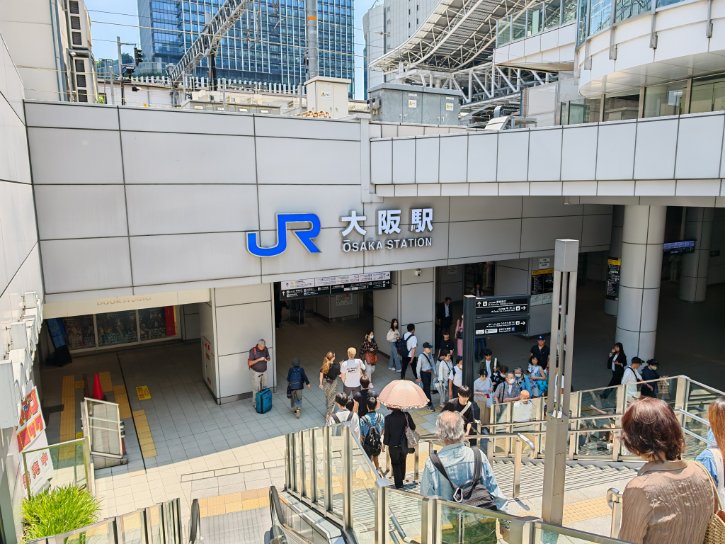
a. Two Different Stations
They sound the same. They sit 3 to 4 kilometres apart.
Shin-Osaka Station is the bullet train gateway, handling the Tokaido Shinkansen toward Kyoto and Tokyo, and the Sanyo Shinkansen toward Kobe and Fukuoka.
JR Osaka Station is the conventional rail heart of the city, in Umeda. It serves the JR Kyoto Line, JR Kobe Line, and Osaka Loop Line.
No Shinkansen stops at Osaka Station. None.
b. The Umeda Puzzle
Around JR Osaka Station, several companies run separate stations with similar names.
- Osaka-Umeda (Hankyu): trains to Kyoto, Kobe, Takarazuka
- Osaka-Umeda (Hanshin): a different station, different company
- Umeda (Osaka Metro): Midosuji Line
- Nishi-Umeda (Osaka Metro): Yotsubashi Line
- Higashi-Umeda (Osaka Metro): Tanimachi Line
They are linked underground but physically separate. Moving between them means leaving one company’s gates and entering another’s. That means a separate fare.
c. Mistakes and Prevention
- Check the departure station on your booking, whether it is a mobile app, a QR code, or a confirmation email. Look for the full name, not just the word “Osaka”
- Identify the operator before approaching any gate, since JR, Hankyu, Hanshin, and Osaka Metro all have their own gates
- Search the Japanese station name in navigation apps, because “Osaka” and “Umeda” return several results: 新大阪 for Shin-Osaka, 大阪 for Osaka
- Show taxi drivers the station name on your screen, rather than saying it aloud
- Never assume a rail pass or Shinkansen booking covers a local subway transfer
- Allow 15 to 20 minutes for transfers through the Umeda network
d. If You Are at the Wrong Station
From Osaka Station, take the JR Kyoto Line from platforms 7, 8, or 9. Any train reaches Shin-Osaka in 3 to 4 minutes. The Midosuji Line takes about 6 minutes. IC cards work on both. Skip taxis, which sit in traffic.
If you miss a reserved Shinkansen, that seat ticket is void. Under standard JR rules you may generally board the non-reserved cars of a later train that day. This depends on your ticket type, so do not assume a free rebooking. Ask at a staffed JR ticket office (Midori-no-madoguchi).
Read More: Osaka Itinerary: Best 3 Day Trip Guide You’ll Ever Find
2. Train Platform Symbols: What the Circles, Triangles, and Squares Mean
a. What the Markings Do
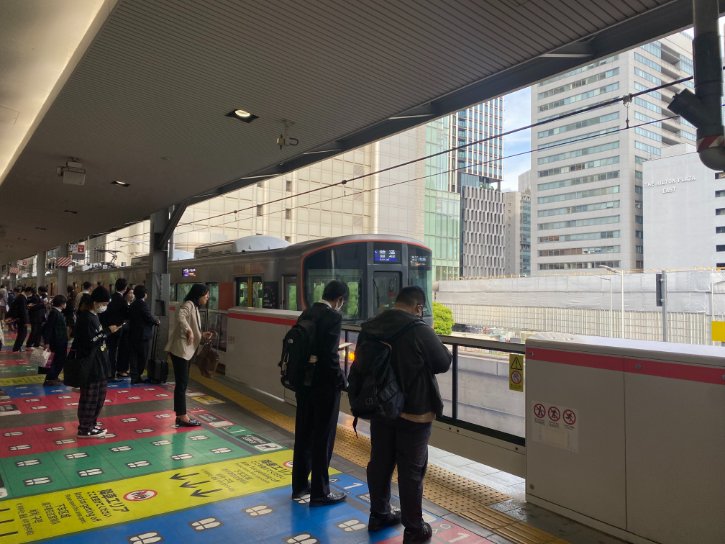
Look down on any platform and you will see painted circles, triangles, and numbers. They show exactly where the train doors will open.
On JR West lines, triangles generally mark 3-door trains (Special Rapid and Rapid) and circles mark 4-door trains (Local services). Private operators use their own colour-coded shapes.
A shape does not mean the same thing on every railway.
b. Platform Symbols vs. Booking Symbols
On booking screens and ticket machines, the same shapes mean something entirely different:
- Circle (○): seats widely available
- Triangle (△): limited availability
- Cross (×): fully booked
These have nothing to do with the shapes painted on the floor.
c. How to Use Them
- Confirm you are at the correct station and platform.
- Match the departure time on the overhead LED board.
- Confirm the destination.
- Confirm the train or service name.
- Confirm the category: Local, Rapid, Special Rapid, Limited Express, airport express, or Shinkansen.
- Note the shape, colour, letter, or boarding marker shown on the board.
- Find the matching painted shape on the platform floor.
- Confirm the carriage number or door position.
- Check whether that carriage is reserved or non-reserved.
- Queue behind the line at the correct position.
- Let everyone off before you step forward.
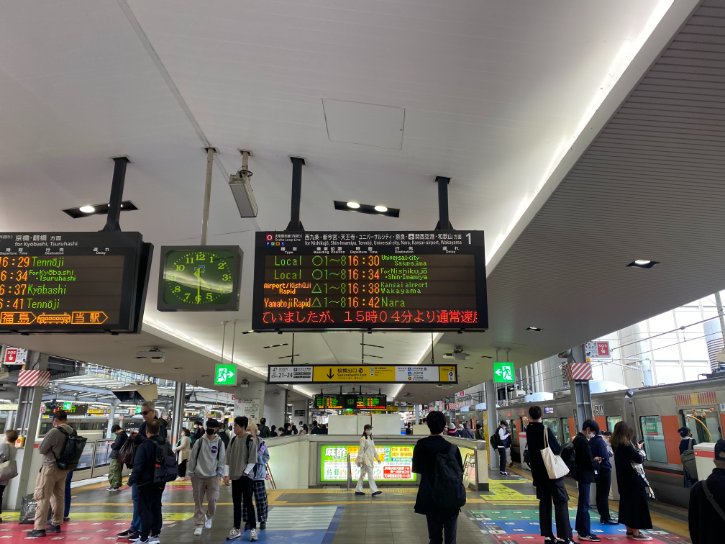
Electronic departure boards at major stations do display the shape and carriage numbers for upcoming trains. Once you know to look, the whole system clicks into place.
Pay extra attention on the Shinkansen platforms at Shin-Osaka, at Osaka Station, at Kyoto Station, and at any large JR or private-railway interchange, where several train types share one track.
d. Safety and Recovery
- Never stand on the raised yellow tactile paving. It guides visually impaired passengers.
- Do not run along the platform, and never hold closing doors.
- Keep strollers and suitcases behind the safety line.
Wrong queue? Let the others board and step aside. Wrong carriage? Walk through the gangways once the train is moving. Wrong train? Get off at the next station.
3. Rush Hour Crowds on Trains, Platforms, and Stations
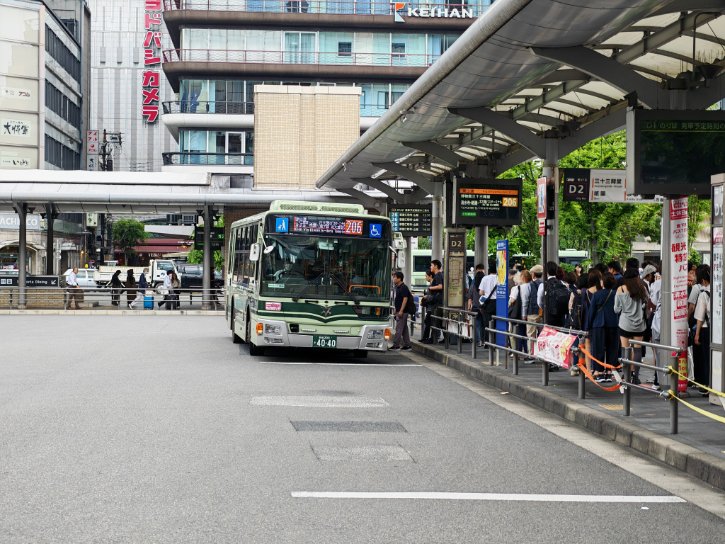
a. When It Gets Busy
- Weekday morning: roughly 07:30 to 09:00
- Weekday evening: roughly 17:30 to 19:30
- Cherry blossom season and autumn foliage bring all-day crowding
- Golden Week, Obon, and New Year are heavier still
b. The Lines to Watch
- Osaka Metro Midosuji Line: the busiest corridor, linking Shin-Osaka, Umeda, Namba, Tennoji
- JR Kyoto and Kobe Lines: Special Rapid services fill fast
- Hankyu Kyoto Line and Keihan Main Line: tourist-heavy toward Gion-Shijo
- Kyoto city buses (100 and 200 series): the most congested transport in the city
c. Local Expectations
Boarding with a suitcase is difficult at peak times, and transfers take longer than your app predicted. That is how airport connections get missed.
Queue at the marked positions, let passengers off first, and hold your backpack in front. To exit a packed train, say “Sumimasen, orimasu” (“Excuse me, I am getting off”).
Escalators deserve a note. Osaka traditionally stands on the right, Kyoto on the left. But authorities in both now ask passengers to stand still in two lines and not walk. Follow the current signs, not the old habit.
d. Practical Strategies
- Travel between 09:30 and 16:30 where you can.
- Use the Yotsubashi Line instead of the Midosuji Line between Umeda and Namba. It is far quieter.
- In Kyoto, use the subway rather than city buses. Buses sit in the same traffic you are escaping.
- Send luggage ahead with a delivery service.
- Walk further along the platform. Carriages near the stairs are always fullest.
e. When It Goes Wrong
If you cannot reach the door in time, ride to the next station and take the train back. If your group is separated, whoever boarded waits on the next platform. If you feel unwell, find station staff.
Never force your way in. Never hold the doors. The next train is minutes away.
Read More: Kyoto Itinerary: Your Best 3 Days Travel Guide
4. Luggage Size, Station Navigation, and Restrictions on Crowded City Buses
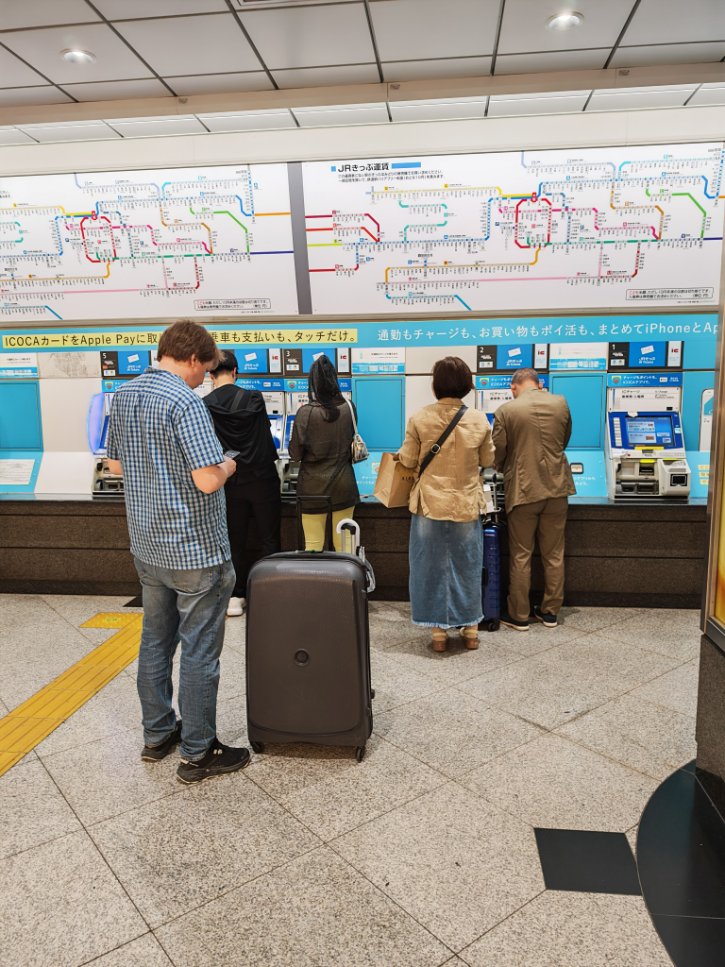
a. Oversized Luggage on the Shinkansen
On the Tokaido, Sanyo, and Kyushu Shinkansen, luggage is measured by adding length + width + height together. Not one side. All three.
- 160 cm or less: No reservation. Use the overhead rack.
- 161 cm to 250 cm: A reservation is mandatory.
- Over 250 cm: not allowed on board.
The reservation is free when paired with a reserved-seat ticket, booked through Smart EX or at a JR ticket office. Non-reserved tickets cannot be paired with one. Board without it and you pay a 1,000 JPY handling fee on the spot.
b. Navigating the Big Stations
Osaka Station has the deep Umekita underground platforms, serving the Haruka airport express. That walk takes 10 to 15 minutes, so build it into your timing.
Kyoto Station is split between the Central side and the Hachijo side. If your hotel is on the far side, that is a long walk with bags.
c. Lockers, Storage, and Delivery
- Coin lockers: around 400 JPY for small, 800 to 1,000 JPY for extra-large. Most accept IC cards. Large lockers are often full by mid-morning.
- Staffed storage: typically 800 to 1,000 JPY per bag per day, with no size limit.
- Luggage forwarding (takkyubin): same-day delivery between Kyoto and Osaka hotels if you drop off before the 09:00 to 10:00 cut-off. Typical cost is 1,500 to 3,500 JPY per bag.
Never ship passports, rail passes, medication, or electronics.
d. Large Luggage on Kyoto City Buses
The Kyoto Municipal Transportation Bureau officially requests that visitors avoid bringing large suitcases onto city buses. These are narrow single-deck vehicles, and a big bag blocks exit doors and the fare box.
Drivers may refuse boarding to passengers with bulky or multiple large bags during crowded periods. This is a policy, not a blanket ban, and no size limit is published.
The worst routes run from Kyoto Station toward Kiyomizu-dera, Gion, and Arashiyama. Use the subway, a taxi, or a delivery service instead. If a driver refuses your bag, step off politely rather than arguing.
5. Severe Crowding at Kyoto’s Most Popular Attractions
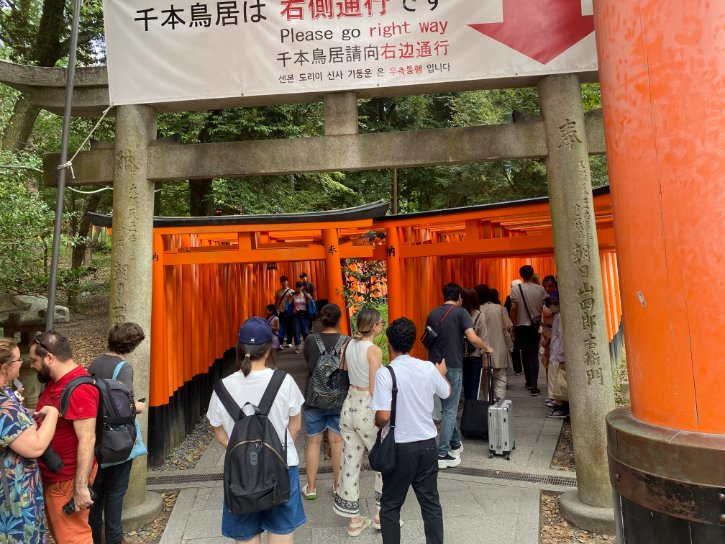
a. Crowding Is Concentrated, Not Everywhere
Kyoto is not uniformly packed. Walk ten minutes from a famous site and the city goes quiet.
The pressure points are Fushimi Inari Taisha, Kiyomizu-dera, Gion, Arashiyama, and Kinkaku-ji. Crowds are thickest between 10:00 and 17:00.
Early morning helps at open-air sites, but do not assume sunrise means solitude. In peak season, crowds are already dense by 08:30.
The Kyoto City Tourism Association publishes a multilingual five-level congestion forecast for major sites.
b. Gion’s Private Streets
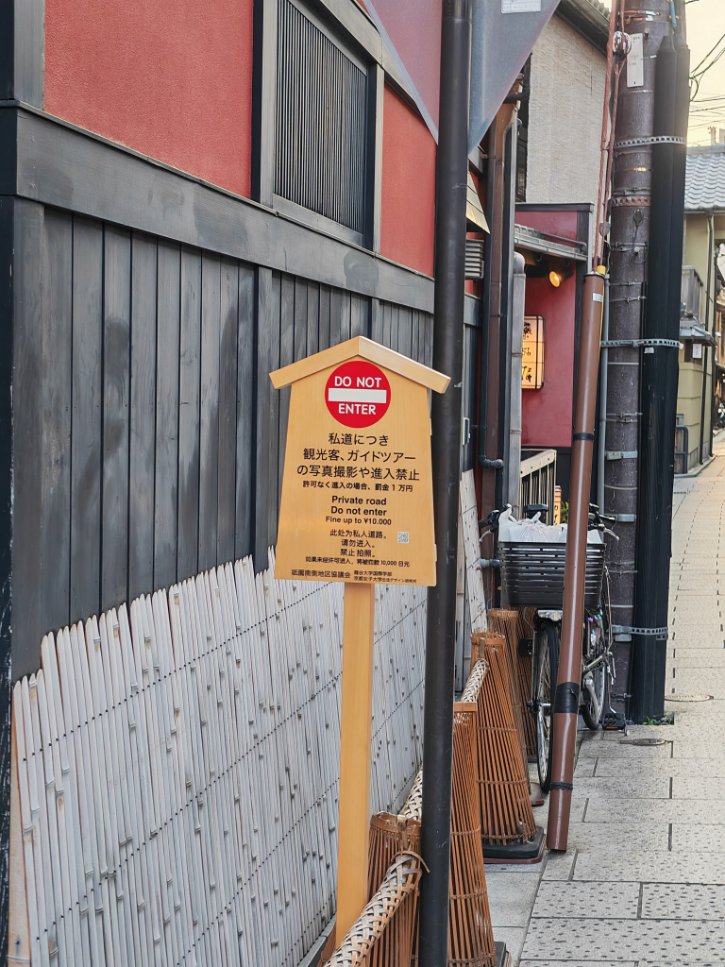
Gion has both public roads and private alleys, treated very differently.
Hanamikoji Street is a public road and remains open to everyone.
The private side alleys branching off it are closed to tourists. Bilingual signs read: “Private road. Do not enter. Fine up to 10,000 yen”. Photography on them is restricted.
Separately, following, harassing, or touching geiko and maiko can bring police involvement. They are working professionals on their way to an appointment, not a photo opportunity.
c. Kyoto’s 2026 Accommodation Tax
From 1 March 2026, the tax moves to five bands, charged per person, per night, based on the room rate:
- Under 6,000 JPY: 200 JPY
- 6,000 to 19,999 JPY: 400 JPY
- 20,000 to 49,999 JPY: 1,000 JPY
- 50,000 to 99,999 JPY: 4,000 JPY
- 100,000 JPY and above: 10,000 JPY
The property collects it at check-in or check-out. You pay it even if you pre-paid online, because most booking platforms do not include it.
d. Quieter Alternatives
- Instead of the Arashiyama Bamboo Grove: the bamboo paths near Adashino Nenbutsu-ji.
- Instead of Kiyomizu-dera: Kodai-ji or Kennin-ji, both with superb Zen gardens and a fraction of the foot traffic.
- Instead of Fushimi Inari: Tofuku-ji, one rail stop away. Trust me, in November it is extraordinary.
e. If a Site Is Already Packed
Move aside before checking directions, follow one-way routes and staff instructions, and keep children close. Then go somewhere nearby and come back later.
Read More: The Perfect One-Day Walking Route for Higashiyama in Kyoto
6. Kyoto’s “No Eating While Walking” Etiquette
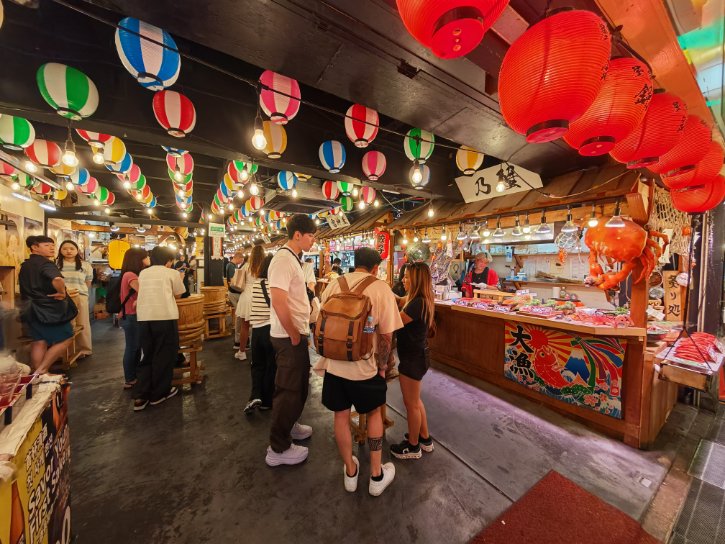
a. What Kind of Rule This Is
Eating while walking, aruki-tabe, is frowned upon in Kyoto. But be precise about what this is.
It is not a criminal law. It is a mix of market policy, posted requests, and cultural custom. Enforcement is social: signs, shopkeepers, polite reminders.
b. Nishiki Market and Other Areas
Nishiki Market is a narrow 400-year-old arcade, still a working market where locals shop. The market association asks visitors not to eat or drink while walking through it.
- Eat your food at or in front of the shop that sold it
- Many stalls provide small standing counters for exactly this
- Return rubbish to the shop that sold you the food. Stalls accept waste from their own products, not from competitors
Similar signs appear in Higashiyama, Gion, and near Kiyomizu-dera. Some temple grounds prohibit eating entirely. Read the signs where you are.
c. Why It Exists
The lanes in Nishiki and Higashiyama are often only 2 to 3 metres wide, so spills happen. Much Kyoto street food also comes on a sharp bamboo skewer, a genuine hazard at eye level in a tight crowd.
d. Practical Advice
- Ask the seller: “Koko de tabete mo ii desu ka?” (“Is it okay to eat here?”)
- Eat beside the shop when they say yes.
- Finish your food before you walk on.
- Carry a small plastic bag for your own rubbish, since public bins are rare.
If you get it wrong, stop walking and keep the packaging until you find a bin.
7. Osaka’s Strict Street Smoking Ban
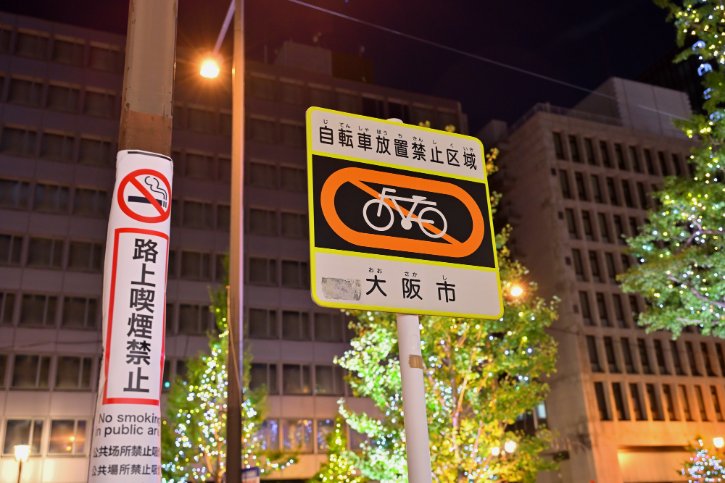
a. The Ordinance
If you smoke, read this carefully. Osaka is stricter than most visitors expect.
Under the Osaka City Ordinance on the Prevention of Smoking on the Streets, smoking is prohibited across all public areas within city limits. The citywide restriction took effect in January 2025.
- It covers all public roads, pavements, parks, plazas, and station approaches
- It applies throughout the city, not just tourist districts
- It includes heated tobacco (IQOS, glo) and vapes
- The penalty is an on-the-spot fine of 1,000 JPY
Patrols are heaviest in Dotonbori, Shinsaibashi, Namba, Umeda, and Tennoji. Do not read that as “the only places it applies”.
b. Designated Smoking Areas
Smoking is permitted only in designated indoor smoking rooms, or in officially marked outdoor smoking areas with green signs and partitions.
Your whole body must stay inside the marked boundary. Locations and hours change, so check the city’s current smoking-area map.
c. Common Misunderstandings
- “A quiet back street is fine”. No exempt public streets exist.
- “Heated tobacco is not smoking”. Officers treat it identically.
- “There is an ashtray here”. An ashtray outside a shop is not an approved smoking area.
- “I’ll just step outside the restaurant”. That pavement is a public street.
- “Tourists do not get fined”. Tourists get fined.
d. Street Rules vs. Indoor Rules
These are two different systems. Outdoors it is the city ordinance. Indoors it is Japan’s National Health Promotion Act, which bans smoking in restaurants, bars, and public buildings.
Venues may build dedicated smoking rooms where food cannot be served, and hotel rooms are non-smoking unless you book a smoking room.
e. If You Are Warned or Fined
Stop smoking immediately and stay cooperative, because arguing does not waive the penalty and claiming ignorance does not either. Officers carry official identification, may request your passport, and collect the 1,000 JPY on the spot.
8. Onsen, Ryokan, and Indoor Shoe Etiquette

Almost everything here is a facility rule, not a law. But these places take the rules seriously.
a. Shoes, Slippers, and Tatami
Enter a ryokan or traditional restaurant and you meet a genkan, a lowered entrance area.
- Remove outdoor shoes at the genkan. Never step onto the raised floor in them.
- Change into the provided indoor slippers for wooden hallways.
- Remove slippers before stepping on tatami. Bare feet or clean socks only.
- Restrooms have separate toilet slippers. Switch into them, and switch back on the way out.
- Never roll wheeled suitcases across tatami. Lift the bag.
b. Bathing at an Onsen or Sento
- Enter the correct changing room. Red curtain (女) for women, blue (男) for men.
- Remove all clothing. Swimwear is not permitted.
- Sit at a washing stall and wash completely before entering any bath.
- Keep soap and your small towel out of the water. Fold the towel on your head.
- Tie long hair up. No swimming, splashing, or loud talking.
- No phones, cameras, or recording. This one is absolute.
- Dry off before returning to the changing room.
Bathing after alcohol is discouraged. If you have a heart condition or are pregnant, speak to a doctor first.
c. Tattoo Policies
Tattoos are not illegal in Japan. But because of a historical association with organised crime, many onsen refuse tattooed guests. Policies differ by business, with no national rule.
- Some refuse tattooed guests entirely
- Some allow entry if tattoos are fully covered with waterproof patches
- Some offer private baths (kashikiri-buro) by the hour
- Some are openly tattoo-friendly. In Kyoto, Funaoka Onsen is a known example
Check the property’s website, then email ahead. A one-line question saves an awkward conversation at the front desk.
d. Ryokan Expectations
Check-in deadlines are strict, often 17:00 or 18:00. Kaiseki dinners are timed around arrivals, so arriving late can mean forfeiting the meal without a refund.
Yukata are provided. Fold the left side over the right. Right over left is used only when dressing the deceased.
Baths often switch gender at set times, and private baths need a reservation.
e. If You Make a Mistake
- Wore toilet slippers into the hallway: go back, swap them, carry on. Everyone has done it.
- Walked on tatami in shoes: step off and apologise.
- Entered the bath without washing: get out, wash properly, come back.
- A tattoo policy blocks you: accept it politely and ask about a private bath.
9. Nightlife Touts and Bar Scams in Dotonbori and Shinsaibashi
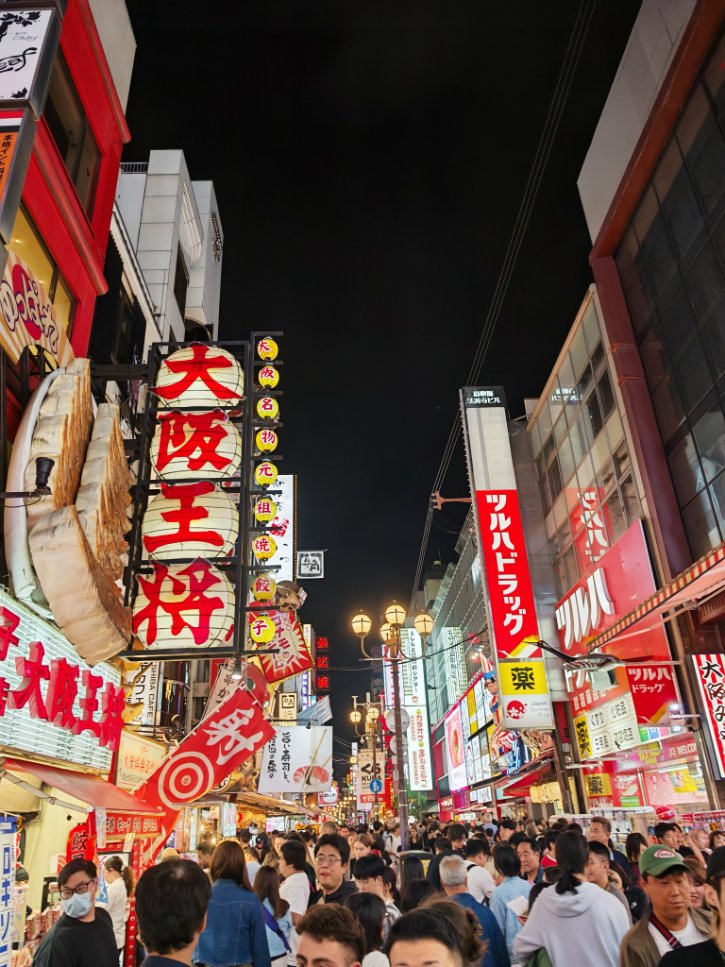
a. The Honest Context
Osaka is a safe city, and its nightlife is one of the great pleasures of Japan. The overwhelming majority of bars and izakaya operate transparently, and most visitors go home with nothing worse than a mild hangover.
The problem is a limited number of touts and unclear-pricing venues. The Osaka Prefectural Police enforce ordinances against illegal street touting (kyakuhiki), making it illegal to aggressively approach pedestrians or solicit them into bars.
b. How the Pattern Works
An English-speaking solicitor offers an all-you-can-drink deal at a low hourly price. The venue is upstairs or in a basement, unmarked, with no menu on display.
Then the bill arrives with charges nobody mentioned: seat charges (otōshi), late-night service fees, companion drinks ordered by staff at your table, and tax on top. Patrons who refuse to pay have been intimidated or pressured toward an ATM.
This is not something that happens to most visitors. It happens to people who follow a stranger into an unmarked building.
c. Red Flags
- A stranger insists on choosing the venue, especially one met on an app
- An unmarked entrance, reached only by lift or stairs
- No visible menu and no written prices
- An unusually cheap unlimited-drinking offer
- Your card is taken out of sight, or you are pressured toward an ATM
d. How to Prevent It
- Choose the venue yourself. This single habit prevents almost every version of this problem.
- Favour places with clear street frontage and visible windows.
- Confirm prices before you sit down. Ask: “Otōshi-dai wa ikura desu ka?” (“How much is the table charge?”)
- Keep your card in sight, and check the terminal amount before approving it.
- Ignore street touts. Keep walking. You owe them nothing.
e. During a Billing Dispute
- Stay calm. Ask for an itemised bill and compare it against the menu.
- Do not sign blank or unclear documents.
- Keep menus, receipts, and transaction details.
- If you are threatened or blocked from leaving, dial 110. That is the police emergency number.
- Otherwise walk to the nearest koban (police box), staffed around the clock.
- Contact your card issuer to dispute a charge.
- Prioritise safety over winning the argument.
Japan also runs a multilingual Consumer Hotline for Tourists. Confirm the current number through the Japan Tourism Agency or your hotel, since details change.
10. Typhoon Disruptions from August to October
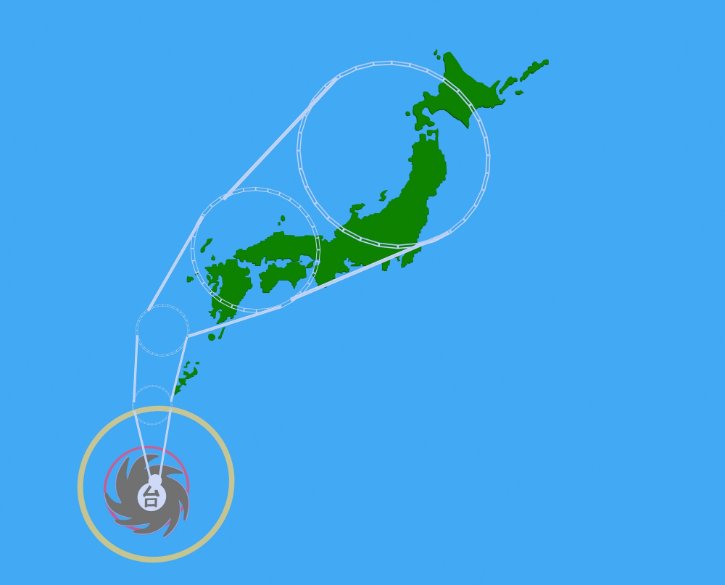
a. Getting the Facts Straight
- Typhoons can occur outside August to October. The season is broader than the peak.
- September historically shows the highest frequency of severe landfalls in western Japan.
- Not every typhoon affects Osaka or Kyoto, and one does not need to make landfall to disrupt transport.
- Forecast tracks change within 24 hours. Official warnings take priority over your itinerary.
b. What Gets Disrupted
Typhoons bring torrential rain, high winds, urban flooding, and landslides in mountainous areas such as Arashiyama.
Affected services can include JR lines, both Shinkansen routes, the Haruka airport express, the subways, city buses, and both airports.
Kansai International Airport deserves special attention. It sits on an artificial island, and high winds can close the bridge to the mainland, isolating the airport.
c. Planned Suspensions
When the Japan Meteorological Agency confirms a severe typhoon path, operators such as JR West and JR Central announce planned suspensions (keikaku unyu), often 24 to 48 hours ahead. Airlines pre-emptively cancel flights.
Services may stop before the weather looks bad, and may stay suspended afterwards while tracks are inspected.
A delay means trains are late. A suspension means they are not running. If the operator cancels, refunds and rebooking generally work in your favour. If you cancel voluntarily, they may not.
d. Common Mistakes
- Treating a forecast from five days out as final
- Checking only social media instead of official sources
- Assuming a reserved ticket guarantees the train will run
- Continuing outdoor sightseeing during active warnings
- Building an itinerary with zero flexibility
e. What to Monitor and How to Prepare
Watch the Japan Meteorological Agency English portal, the JR West and JR Central service status pages, and Kansai Airport’s official site. The Japan Tourism Agency’s “Safety Tips” app pushes multilingual weather and evacuation alerts.
Before the trip, book flexible accommodation and read the cancellation conditions. Buy travel insurance, and check what it actually covers, since weather cover is not automatic.
Avoid tightly connected itineraries in September. Pack rain gear that works in wind. Umbrellas do not.
f. If You Become Stranded
- Confirm official service status before doing anything else.
- Contact the railway or airline through official channels.
- Change or refund tickets. Digital tickets are handled online. Agency tickets go through the agent.
- Extend your current hotel stay rather than crossing a flooded city.
- Save every receipt, then file your insurance claim.
Never enter a flooded underpass, and never walk riverbanks or mountain paths during a warning. Strong wind is dangerous even without heavy rain.
Here is the reassuring part. Typhoons are time-limited events. They arrive, they pass, and Kansai gets back to work with impressive speed. Watch the official sources, keep a spare day in your plans, and your trip will almost certainly be everything you hoped for.